

Saved Bookmarks
This section includes 7 InterviewSolutions, each offering curated multiple-choice questions to sharpen your Current Affairs knowledge and support exam preparation. Choose a topic below to get started.
| 1. |
My friend hails from a country which does not share land boundary with India. Identify the country. |
|
Answer» Bhutan |
|
| 2. |
State Ampere's circuital law . Using it, derive the expression for magnetic field at a point due to a long current carrying conductor . |
|
Answer» Solution :Statement : The LINE integral of magnetic field around any closed path in FREE SPACE is equal to `mu_0` times the net current enclosed by that path. i.e., `ointvecB.dvecI=mu_0I`  CONSIDER a infinitelylong CONDUCTOR carrying a current .Let `I_e` be the current enclosed by the loop and L be the length of the loop for which .B. is tangential , then the amperes circuital law `oint vecB.dvecI=mu_0I` becomes `BL=mu_0I` If we assume a straight conductor and the boundary of the surface surrounding the conductor as a circle , then length of the boundary is the circumference , `2pir` , where .r. is the radius of the circle . Then B. `2pir=mu_0I` `therefore B=(mu_0I)/(2pir)` |
|
| 3. |
(a) Draw a labelleddiagram of AC generator. Derive the expressionfor the instantaneous value of the emf induced in the coil. |
|
Answer» Solution :(a) N//A (B) `A = 200 CM^(2)` `= 200 xx 10^(-4)m^(2) =2 xx 10^(-3) m^(2)` `n= 20` `omega = 50 "RAD" s^(-1)` `B = 3 xx 10^(-2)T` Max. emf `E_(o) = 3 xx 10^(-2) T` `= 20 xx 3 xx 10^(-2) xx 50 = 6000 xx 10^(-4) = 0.` Volt Max. Current `I_(0) = (E_(0))/(R ) = (0.6)/(R )A`. |
|
| 4. |
Match the paris in two column given below . |
|
Answer» 1-ii,2-v,3-iv 2 Photon is an elementary particle with untiy SPIN and zero mass 3 Photoconducting cell is photocell in which change in INTENSITY of light changes ,the CURRENT |
|
| 5. |
A moving coil voltmeter is generally used to measure the potential difference across a conductor of resistance 'r' carrying a current i. The resistance of voltmeter is R. For more correct measurement of potential difference |
| Answer» Answer :B | |
| 6. |
Find the capacitance of a capacitor, if it is made up of 120 sheets of paraffined paper 0.1 mm thick, interspaced with aluminium foil sheets of 5 cm xx 3 cm dimensions. In what range of voltages can such a capacitor work? |
|
Answer» Solution :The aluminium foil SHEETS are connected alternately to FORM a system of capacitors connected in parallel (FIG. 25.3). The number of capacitors is EQUAL to the number of DIELECTRIC layers. The breakdown voltage is `U_(bn)=E_(m)d`, so the working voltage is chosen to be 1/3 to 1/2 of this 
|
|
| 7. |
An observer looks at a distant tree of height 10 m with a telescope of magnifying power of 20. To the observer the tree appears.: |
|
Answer» 20 TIMES nearer |
|
| 8. |
An electron beam projected along +x axis, experience a force due to a magnetic field along the +y- axis. What is the direction of the magnetic field? |
| Answer» Solution :ALONG +ve z -axis in ACCORDANCE with Fleming.s LEFT HAND RULE. | |
| 9. |
Explain dispersion of white light. |
Answer» Solution :It has been known for a long time that when a narrow beam of sunlight, usually called white light is INCIDENT on a glass prism the emergent light is seen to be consisting of several colours. There is actually a continuous variation of COLOUR, but broadly, the different component colours that appear in sequence are : violet, indigo, blue, green, YELLOW, orange and RED (given by the ACRONYM VIBGYOR). The red light bends the least while the violet light bends the most. The phenomenon of splitting of light into its component colours is known as dispersion. The pattern of colour components of light is called the spectrum of light. |
|
| 10. |
A 0.2 kg object at rest is subjected to a force (0.3hati - 0.4 hatj) Newton. What is velocity of the object after 6 second |
|
Answer» `9hati - 12hatj` |
|
| 11. |
A reflecting type telescope has a concave reflector radius of curvature 120 cm. Calculate the focal length of eyepiece to secure a magnification of 20 . |
|
Answer» Solution :Data supplied , m = - 20 ,R = 120 cm,`f_(0) = (R)/(2) = (-120)/(2) = - 60 ` cm ,`"m" = (f_(0))/(f_(e))` `f_(e) = (f_(0))/(m) = (-60)/(-20)= 3 ` cm |
|
| 12. |
For a simple pendulum, a graph is plotted between its kinetic energy (K.E.) and potential energy (P.E.) against its displacement d. Which one of the following represents these correctly ? (graph are schematic and not drawn to scale) |
|
Answer»
`PE=(1)/(2)m omega^(2)y^(2)` At `""y=+-r` PE = MAXIMUM while KE = 0 So correct CHOICE is (a). |
|
| 13. |
A man standing at some distance from a cliff hears the echo of sound after 2s. He walks 495 m away from the cliff. He produces a sound there and recieves the echo after 5s. What is the speed of sound? |
|
Answer» 330 m/s |
|
| 14. |
If the length and breadth of a thin rectangular sheet are measured, usinga metre scale as 16.2 cm and 10.1 cm respectively. What is the area of the rectangular sheet. |
|
Answer» Solution :There are three significant figures in each measure ment. It means that the length I may be written as `l= 16.2 pm 0.1 CM = 16.2 cm pm 0.6 % ` Similarly, the BREADTH b may be written as `b=10.2pm 0.1 cm = 10.1 cmpm1% ` Then, the error of the PRODUCT of two (or more) ex- perimental values, using the combination of errors rule, will be `lb= 163.62 cm^(2)pm 1.6 %` `- 163.62 pm 2.6 cm^(2)` This leads use to quote the final result as `lb= 164 pm 3 cm^(2)` Here 3 `cm^(2)`is the UNCERTAINTY or error in the estima- tion of area of rectangular sheet. |
|
| 15. |
An electron microscope uses electrons accelerated by a voltage of 50 kV. Determine the de-Broglie wavelength associated with the electrons. If other factors (such as numerical aperture, etc.) are taken to be roughly the same, how does the resolving power of an electron microscope compare with that of an optical microscope which uses yellow light ? |
|
Answer» Solution :For an electron beam accelerated by a POTENTIAL V, the de-Broglie wavelength `lamda=(h)/(sqrt(2mVe))=(1.227)/(sqrt(V))=nm` In present case `V=50kV=50000V` `therefore lamda=(1.227)/(sqrt(50000))5.5xx10^(-3)nm` We know that resolving power of a microscope is GIVEN by `R.P.(2nsinalpha)/(1.22lamda)` [where `nsinalpha=`numeical APERTURE] As compared to yellow LIGHT `(lamda=550nm)`, the wavelength of electron wave `(lamda=5.5xx10^(-3)nm)` is `10^(-5)` times, hence resolving power of the electron microscope is about `10^(5)` times that of an optical microscope provided that numerical aperture is same. |
|
| 16. |
Polarisation can be produced by |
|
Answer» reflection |
|
| 17. |
Five identical conducting plates 1,2,3,4 and 5 are fixed parallel to and equidistant from each other as shown in figure. Plate 2 and 5 are connected by a conductor while 1 and 3 are joined by another conductor . The junction of 1 and 3 and the plate 4 are connected to a source of constant emf V_0. Match the following : |
|
Answer» <P> |
|
| 18. |
A parallel plate capacitor with air between the plates has a capacitance of 9 pF. The separation between its plates is ‘d'. The space between the plates is now filled with two dielectrics. One of the dielectrics has dielectric constant K_1 =3and thickness d/3 while the other one has dielectric constant K_2 = 6 and thickness2/3d. Capacitance of the capacitor is now |
|
Answer» `1.8 pF` When capacitor is filled with two DIELECTRICS, the NEW capacitance `C. = (epsi_0A)/((d_1/K_1 + d_1/k_2))=(epsi_0A)/(((d//3)/3+ (2D//3)/6))=(epsi_0A)/(((2d)/9)) = 9/2 (epsi_0A)/d = 9/2 xx 9 pF= 40.5 pF` |
|
| 19. |
In the following question a statement of assertion (A) is followed by a statement of reason (R ) A: the potential difference between two concentric sphereical shells depends only on the charge of inner shell R : the electric field in the region in between two shells depedns on the charge of inner shell and electric field is the negative of potential gradient. |
|
Answer» If both Assertion & Reason are true and the reason is the correct explanation of the assertion , then mark (1). |
|
| 20. |
Two bodies each of mass m, having specific heats s, are connected by ametal rod of negligible heat capacity of length l, area of cross section A and thermal conductivity k. Initially both bodies are at different temperatures, find the time taken for the temperature difference between the two bodies to become half of the. initial value. |
|
Answer» |
|
| 21. |
What are positive and negative charges ? Which type of charge does electron have ? |
|
Answer» Solution :The charges were named as positive and NEGATIVE by the American SCIENTIST Benjamin Franklin. When we add a positive number to a negative number of the same MAGNITUDE the sum is ZERO. This might have been the philosophy in naming the charges as positive and negative. By this LOGIC, charge of electron is considered as negative. |
|
| 22. |
How does the fringe width of interference fringes change, when the whole apparatus of Young's experiment is kept in a liquid of refractive index 1.3 ? |
| Answer» Solution :The fringe width decreases from `BETA` to `beta_(L)` where `beta_(l)=(beta)/(n_(l))=(beta)/(1.3)`. | |
| 23. |
A thin diamagnetic rod is placed vertically between the poles of an electromagnet. When the current in the electromagnet is switched on, then the diamagnetic rod is pushed up, out of the horizontal magnetic field. Hence the rod gains gravitational potential energy. The work required to do this comes from. |
|
Answer» The induced electric FIELD due to the changing magnetic field. The drawback of DIAMAGNETIC is that it is PUSHED from the dominant magnetic field to the weak magnetic field and hence the function happens. |
|
| 24. |
Calculate the maximum kinetic energy and maximum velocity of the photoelectrons emitted when the stopping potential is 81V for the photoelectric emission experiment. |
|
Answer» Solution :MAXIMUM KINETIC energy of electron, `{:(K_(max),= eV_(0)""V_(0) = 81 V),(,= 1.6 xx 10^(-19) xx 81""e = 1.6 xx 10^(-19) C),(,=129.6 xx 10^(-19)""m = 9.1 xx 10^(-31) kg),(,=1.29 xx 10^(-17)),(K_(max),= 1.3 xx 10^(-17) J):}` Maximum velocity of photoelectron, `v_(max) = sqrt((2eV_(0))/(m))` `= sqrt((2 xx 1.6 xx 10^(-19) xx 81)/(9.1 xx 10^(-31))) = sqrt((259.2 xx 10^(-19))/(9.1 xx 10^(-31))) = sqrt(28.48 xx 10^(12))` `v_(max) = 5.3 xx 10^(6) ms^(-1)` |
|
| 25. |
What will be maximum value of wavelength by which photo-electric emission can be obtained on metal surface with work function of 3.2 eV? (h=6.625xx10^(-34) Js) |
|
Answer» 1988Å `therefore lambda_(0)=(hc)/(phi_(0))=(6.625xx10^(-34)xx3xx10^(8))/(3.2xx1.6xx10^(-19))` `lambda_(0)=3.881835xx10^(-7)` `therefore lambda_(0)~~3882xx10^(-10)m` `therefore lambda_(0)=3882 Å` |
|
| 26. |
Minimum energy required to take out the only one electron from ground state of He^(+) is |
|
Answer» `13.6` EV Fe `he^(+), Z = 2` `therefore E = 13.6 XX (2)^(2) = 13.6 xx 4 = 54.4 eV` |
|
| 27. |
Two charges - q and +q are located at points (0, 0, - a) and (0,0, a), respectively. What is the electrostatic potential at the points (0, 0, z) and (x, y,0) ? |
|
Answer» Solution :The GIVEN charges behave as an electric dipole and the dipole length is 2a, hence dipole moment `p = q.2a`. For given dipole, point (0,0, z) lies at the axial line at a distance z from the mid-point of dipole. Hence `V = 1/(4PI epsi_0).p/((z^2-a^2))` However, the point (X, y,0) lies at the equatorial line of dipole and hence electric potential at this point is ZERO. 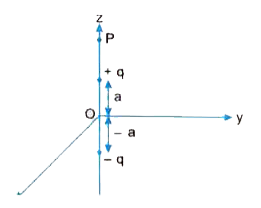
|
|
| 28. |
The wavelength of the matter wave is dependent od : |
|
Answer» mass |
|
| 29. |
The resistance of galvanometer is50Omega.To make full deflection 100mA current is needed. To convert it into an ammeter of 10 A, the required resistance is , |
|
Answer» `5XX10^(-3) OMEGA` in PARALLEL |
|
| 30. |
The threshold wavelength for a metal having work function W_0 is lambda_0. What is the threshold wavelength for a metal whose work function is W_0/2? |
|
Answer» `4lambda_0` |
|
| 31. |
Can resonance phenomenon be exhibited in a circuit containing L and R ? |
| Answer» SOLUTION :No, RESONACE can only be EXHIBITED in a circuitcontaining L and C both. | |
| 32. |
The height at which the acceleration due to gravity is 49% that of the earth is |
|
Answer» a)1 |
|
| 33. |
An object producing a pitch of 100 h=Hz approaches a stationary person in a straight line with avelocity of 200 m/s. Velocity of sound is 300 m/s. The person will note a change in frequency, as the object flies past him equal to |
| Answer» Answer :D | |
| 34. |
Find the equivalent cappacitance between A and B. (a) Three conducting concentic shells of radii r,2r and (b) An isoltated ball-shaped conductor of radius r surrounded by an adjuacent layer of dielectric (K) and outer radius 2r. Two conducting concentic spherical shells having radii r_(1) and r_(2)(r_(2)gtr_(1)), calculate capacity of the system if (i) The inner shell is given a charge and outer is connected to the earth. (ii) The outer shell is given a charge and inner is connected to the earth. (d) Find capacitance of the system (i) Two shells of radii r_(1) and r_(2) having charges are connected by a metallic wire, the separation between shells is large. (ii) Two shells of radii r_(1) and r_(2) carry equal and opposite charges and are separated by a distance d. |
|
Answer» SOLUTION :(a) Two capacitors, Capacitor `1,C_(1)=(4pi in_(0)r.2r)/((2r-r))=8piin_(0)r` Capacitor `2,C_(2)=(4pi in_(0)2r.3r)/((3r-2r))=24piin_(0)r` connected a battery between `A` and `B`, and check polarity, `+,-,+,-,`. `C=(C_(1)C_(2))/(C_(1)+C_(2))=+pi in_(0)r` (b) capacitor `1`: `C_(1)=(4pi in_(0)K.r.2r)/(2r-r)=8pi in_(0)Kr` Capacitor `2`: Isolated sphere of radius `2r` and outer radius infinite. `C_(2)=4pi in_(0)2r=8pi in_(0)r` `C_(1)` and `C_(2)` in series, as shown in `(a)` `C-(eq)=(C_(1)C_(2))/(C_(1)+C_(2))=(8pi in_(0)Kr)/(K+1)` (c) (i) Let total charge on outer shell is `Q`' `V_(p)=(1)/(4pi in_(0))((Q)/(r_(2))+(Q')/(r_(2)))=0impliesQ'=-Q` `C=(4pi in_(0)r_(1)r_(2))/(r_(20-r-(1))` (ii) Let charge on inner shell be `Q'`. `V_(p)=(1)/(4piin_(0))((Q')/(r_(1))+(Q)/(r_(2)))=0` `Q'=(-Qr_(1))/(r_(2))` This capacitor is combination of two capacitors (i) capacitor `1,C_(1)=(4piin_(0)r_(1)r_(2))/(r_(2)-r_(1))` (ii) Capacitor `2`, `C_(2)=4pi in_(0)r_(2)` (isolated spherical capacitor) These capacitor are in parallel. the POSITIVE plates of capacitors are at one place. the `-ve` plate of capacitor `1` is connected to ground i.e., its potential is zero. the `-ve` plate of capacitor `2`is at infine i.e., its potential is zero. hence, positive plates at one point and negative plates at another point and hence `C_(1)` and `C_(2)` are in parallel. `C_(eq)=C_(1)+C_(2)=4pi in_(0)r_(2)((r_(1))/(r_(2)-r_(1))+1)=(4piin_(0)r_(2)^(2))/((r_(2)-r_(1)))` (d) (i) `C_(1)=4pi in_(0)r_(1)` `C_(2)=4pi in_(0)r_(2)` `C_(1)` and `C_(2)` are in parallel. theirpositive platesare connected as shown and negative plates are at infine. `C_(eq)=C_(1)+C_(2)=4piin_(0)(r_(1)+r_(2))` (ii) Here, we will find capacitance with the HELP of energy. energy stored in a conductor, `U=(Q^(2))/(2C)` Energy of two point charges sepearated by `r`, `U'=(1)/(4piin_(0)) (Q_(1)Q_(2))/(r)` so potential energy of system `U=U_(1)+U_(2)+U_(12` `=(Q^(2))/(2C_(1))+(Q^(2))/(2C_(2))+(1)/(4piin_(0))((Q)(-Q))/(d)` `=(Q^(2))/(2xx4piin_(0)r_(1))+(Q^(2))/(2xx4piin_(0)r_(2))-(Q^(2))/((4piin_(0)d)` `=(Q^(2))/(8piin_(0))((1)/(r_(1))-(1)/(r_(2))-(2)/(d))` .....(i) For a system, `U=(Q^(2))/(2C_(eq))` Equating (i) and (ii), we get `(1)/(C_(eq))=(1)/(4piin_(0))((1)/(r_(1))+(1)/(r_(2))-(2)/(d))` `C_(eq)=(4piin_(0))/(((1)/(r_(1))+(1)/(r_(2))-(2)/(d)))` If `drarroo,C_(eq)=(4piin_(0))/((1)/(r_(1))+(1)/(r_(2)))` `(1)/(C_(eq))=(1)/(4piin_(0)r_(1))+(1)/(4piin_(0)r_(2))=(1)/(C_(1))+(1)/(C_(2))` i.e., the given system is equivalent to two capacitors `C_(1)=4pi in_(0)r_(1)` and `C_(2)=4piin_(0)r_(2)` in series. 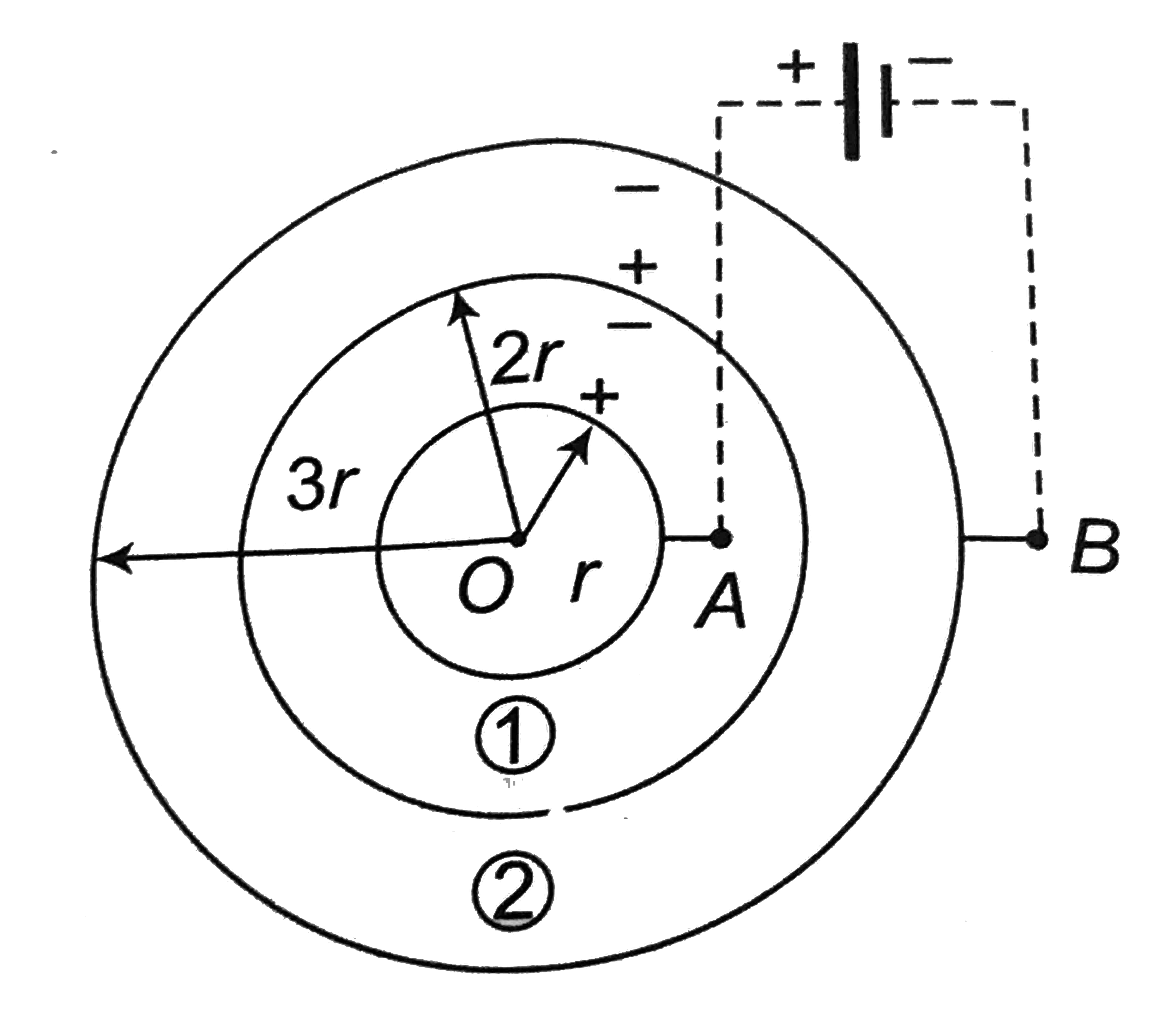 . . 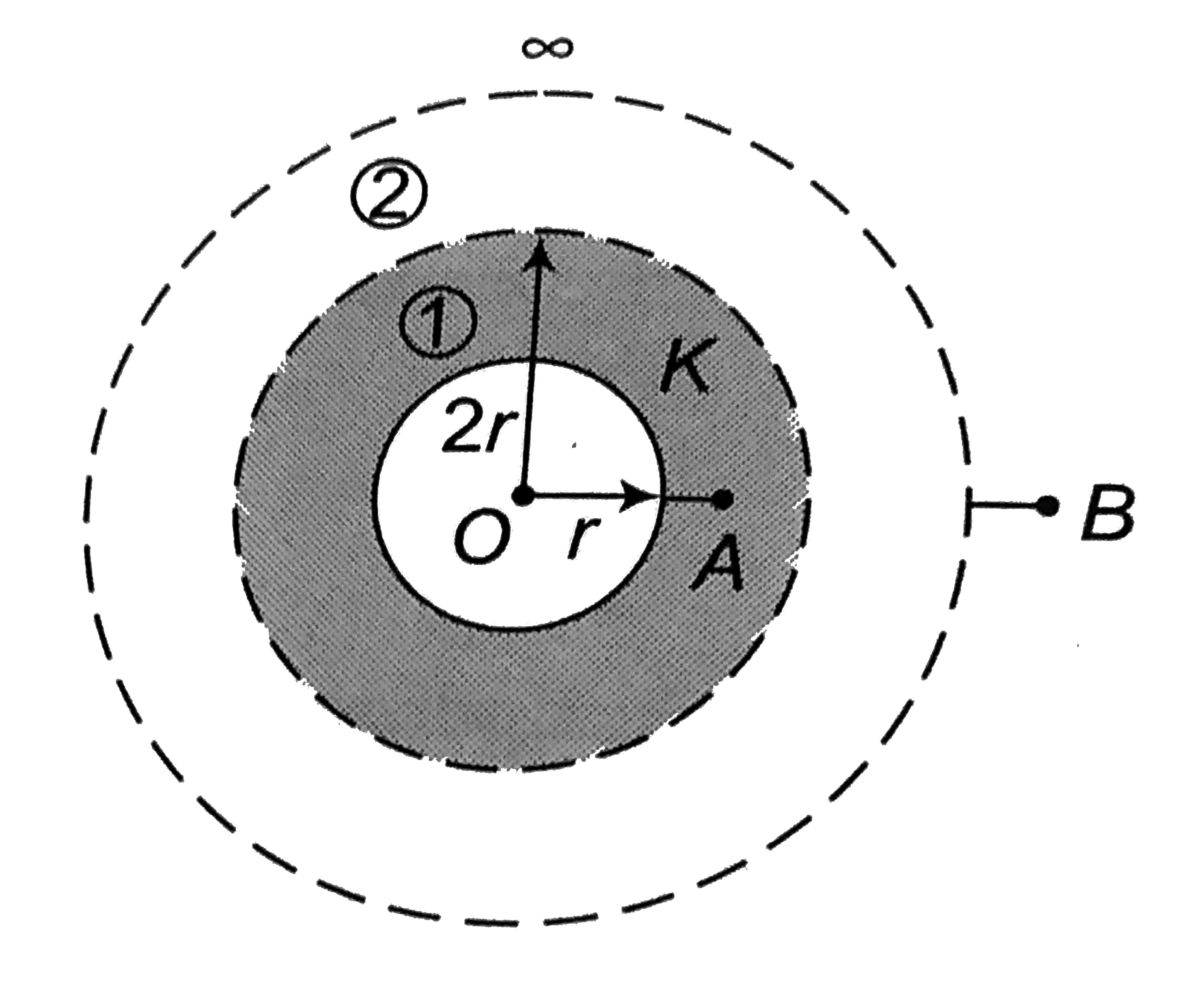 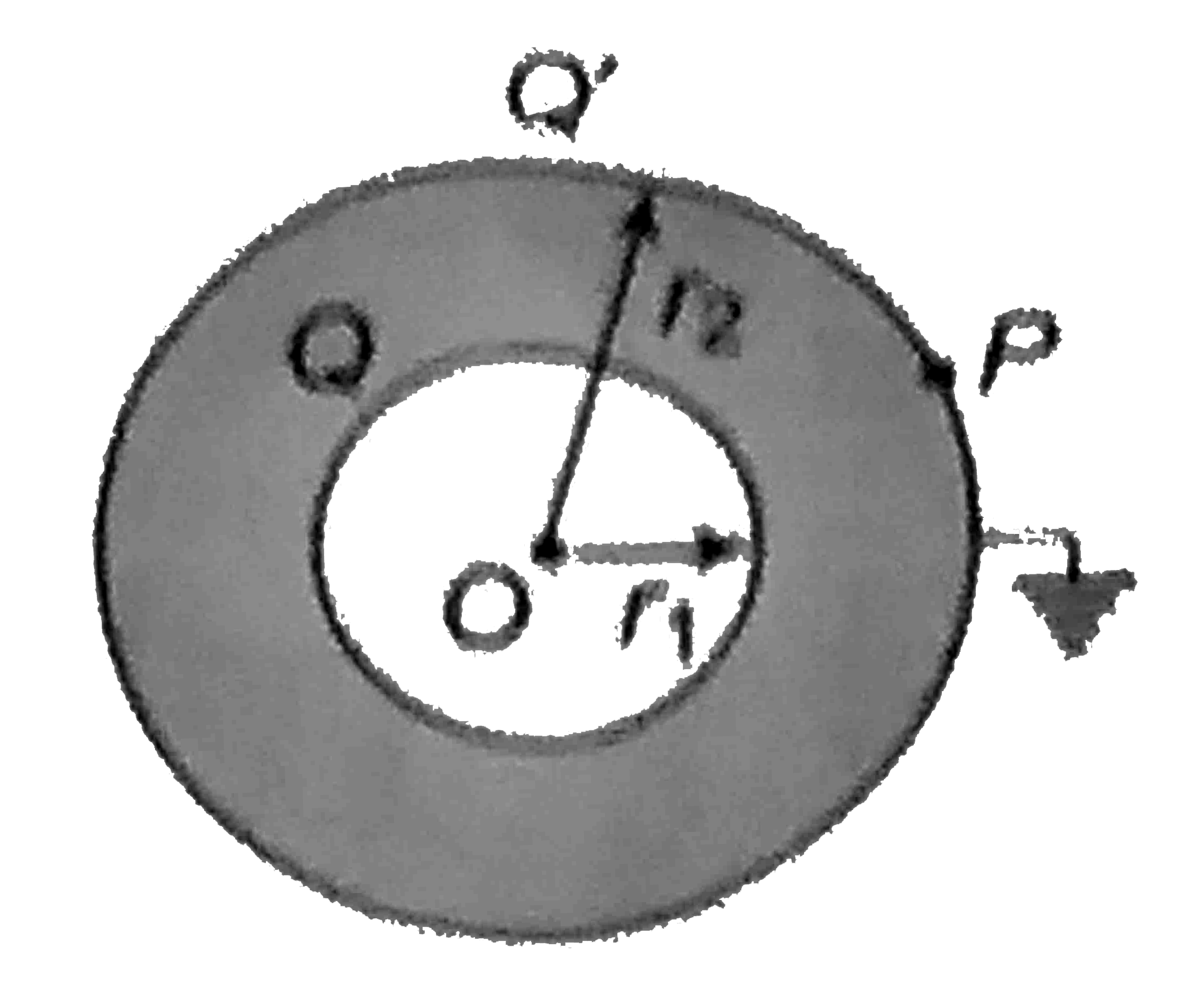 . . 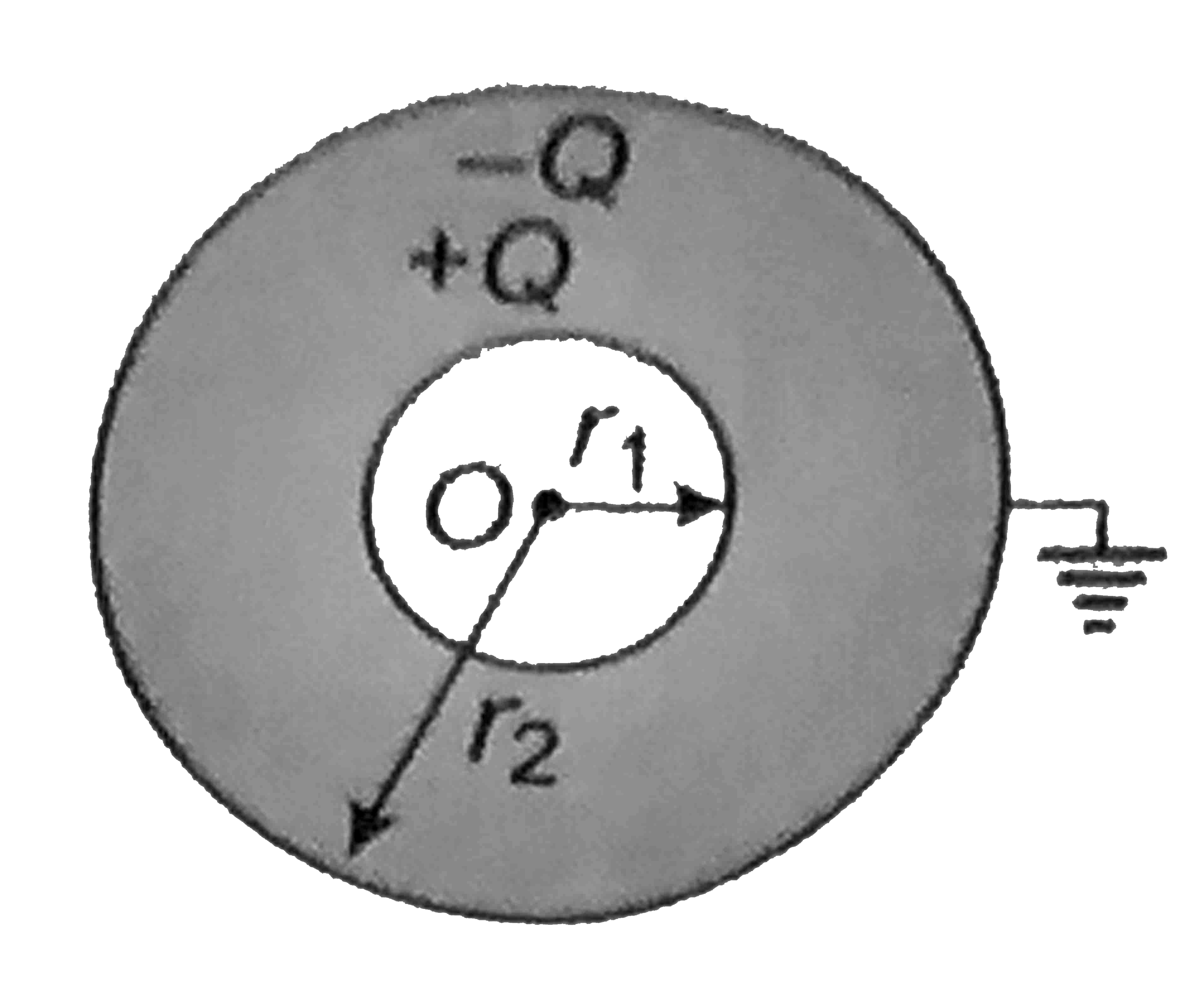 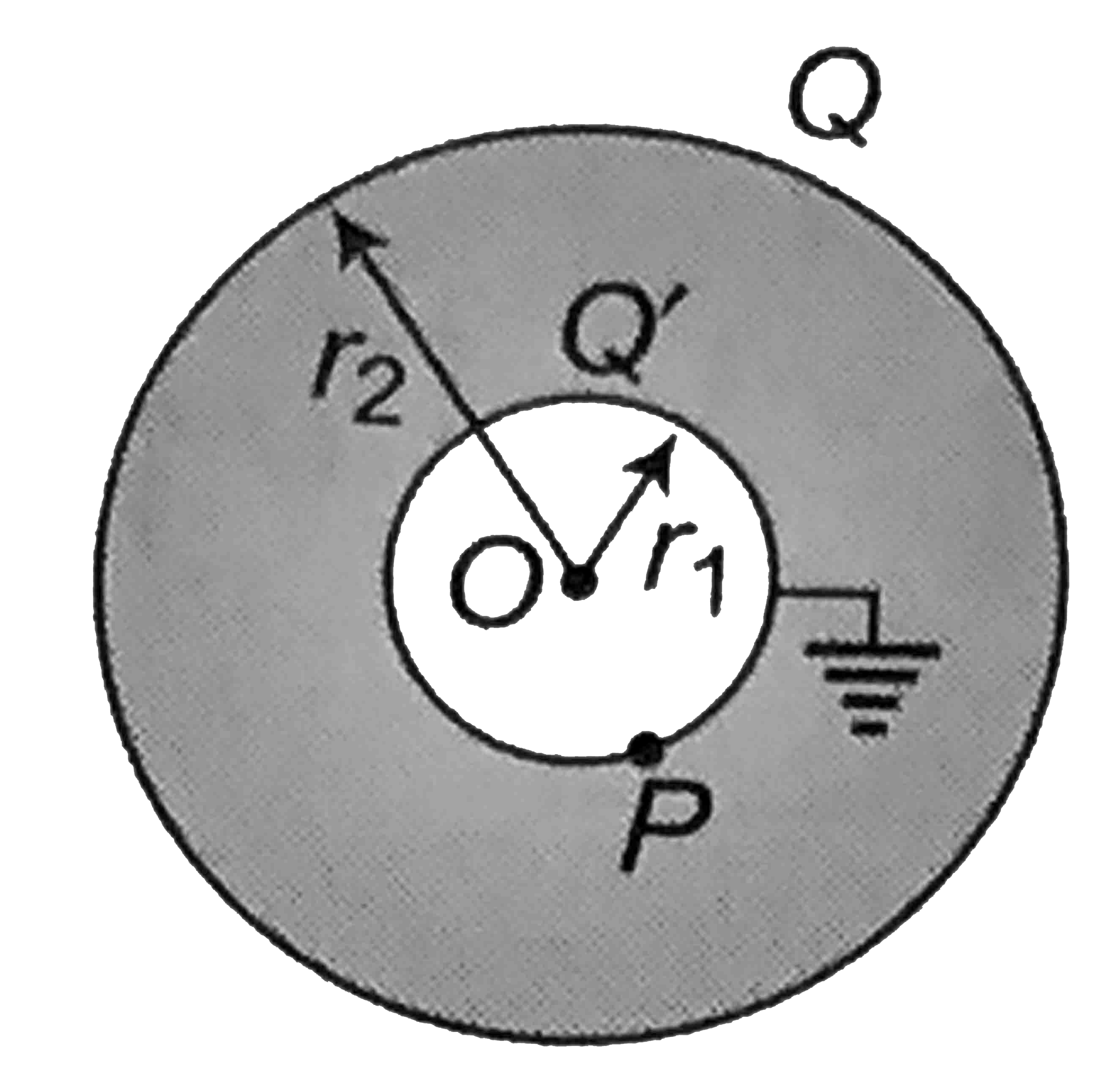 . . 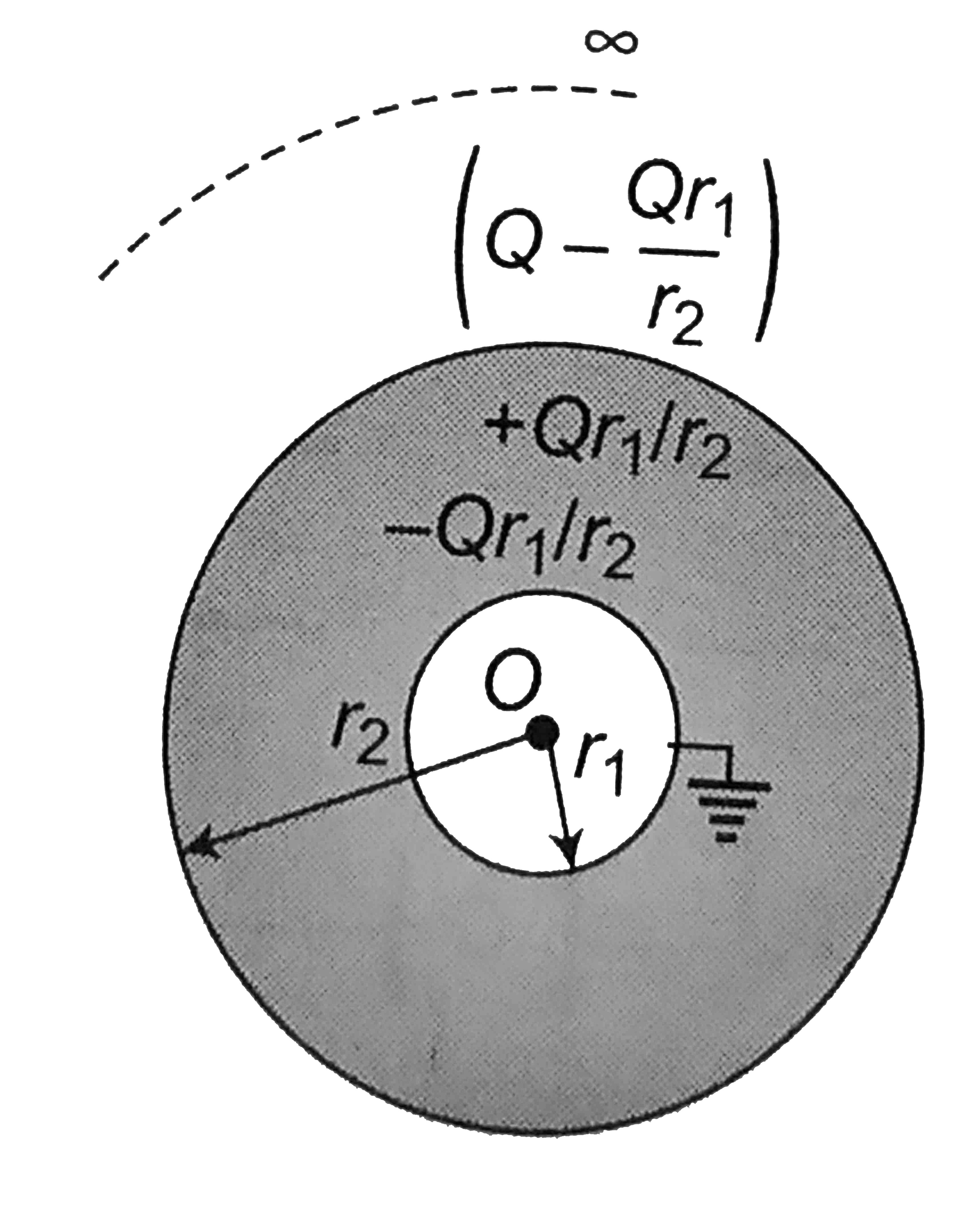 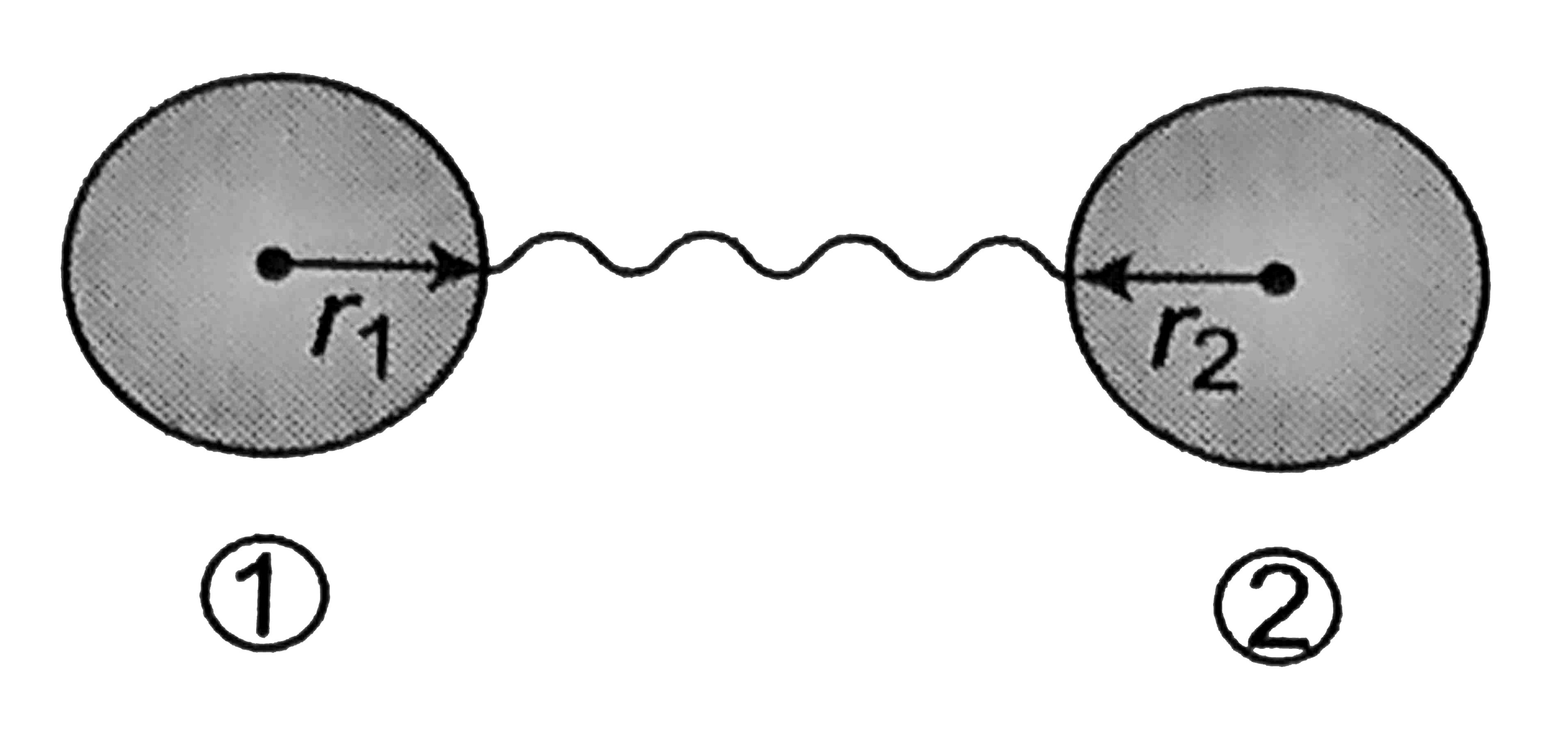 . . 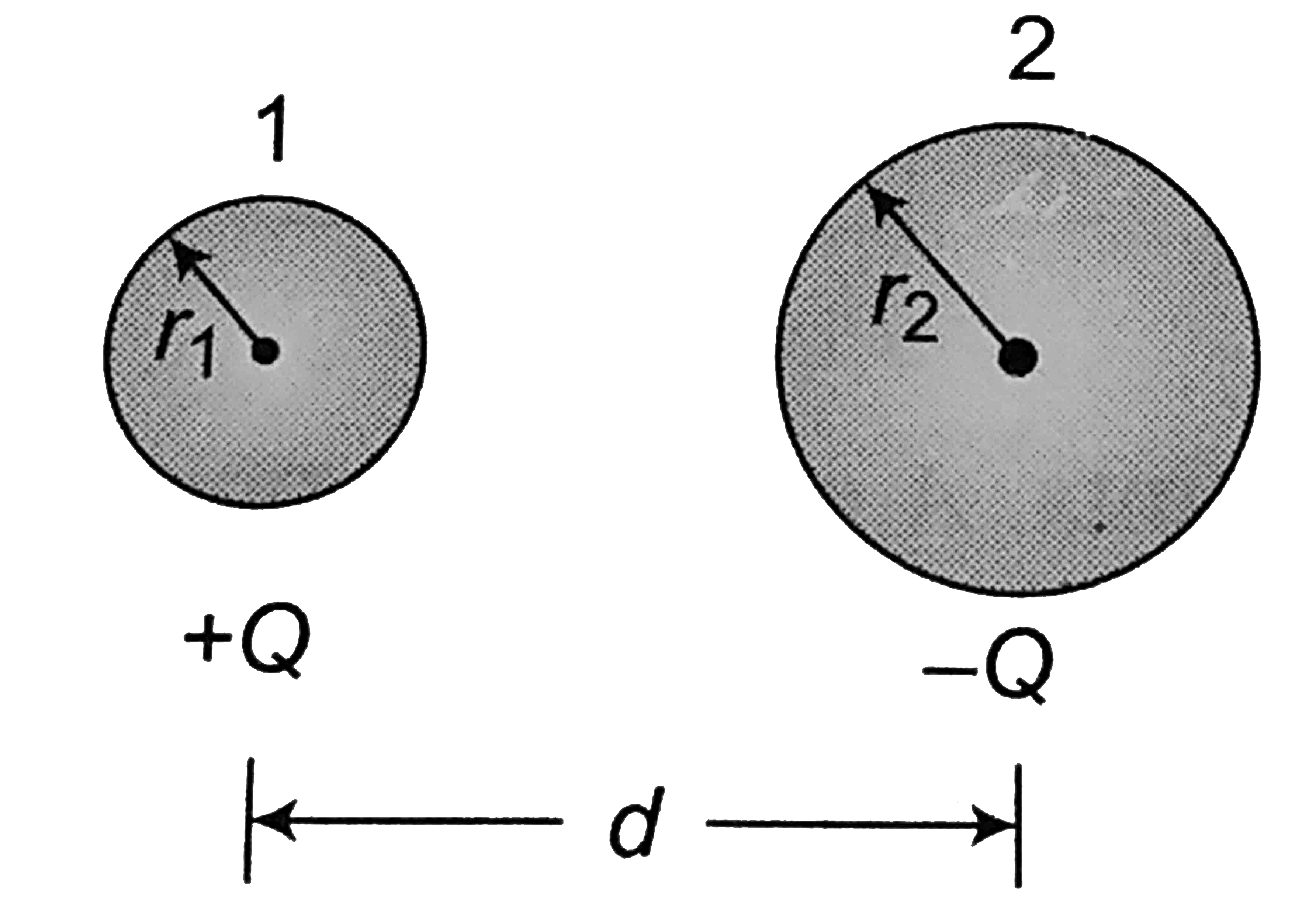
|
|
| 35. |
Calculate the current amplification factorbeta ( beta) when change in collector current is 1mA and change in base current is 20 Omega A . |
|
Answer» Solution :Change in COLLECTOR CURRENT `( Delta I_(C )) = 1m A = 10^(-3) A ` Change in base current `( Delta I_(B))= 20 mu A = 20 xx 10^(-6) A`. ` BETA= ( Delta I_(C ))/(Delta I_(B)) = ( 10^(-3))/( 20 xx 10^(-6))` `beta = ( 1000)/(20)` `beta = 50` |
|
| 36. |
During sunset , you might have noticed that the western horizon becomes reddish . Why is it so ? |
|
Answer» the SCATTERING of LIGHT |
|
| 37. |
For a normal eye , the far point is at infinity and the near point of vision is about 25 cm . The cornea of the eye provides a converging power of about 40 D and the least converging power of the eye lens behind the cornea is about 20 D . From this rough data estimate the range of accomodation (i.e the range of converging power of the eye lens ) of a normal eye . |
|
Answer» SOLUTION :The eye usesits least converging power for an object PLACED at infinity . Therefore, total converging power of the cornea =40 +20=60 D. Now, for object at infinity i.e ., at u=`oo` `v=f=1/P=1/(60)m=5/3cm ` For the IMAGE of an object placed at the near point, the focal length is `f=(1/v-1/u)^(-1)=(uv)/(u-v)=((-25)xx5/3)/((-25)-5/3)=(25)/(16)cm` `therefore` Converging power of the lens `=(100)/((25)/(16))=64 D` `therefore` Converging power of the eye lens =(64-40)=24 D Thus the range of accomodation of the eye lens is 20 D to 24 D. |
|
| 38. |
The x and y co-ordinates of a particle at any instant are x = 4t^2 + 7t and y = 5t where x, y are in metres and in seconds. The acceleration at t=5s is : |
|
Answer» Zero `( :.(d^2y)/(DT^(2))=0)` and `a=a_(x)=(d^(2)x)/(dt^(2))=8 m s^(-2)` For any value of .t. |
|
| 39. |
A compass needle which is allowed to move in a horizontal plane is taken to a geomagnetic pole it |
|
Answer» Will stay in north-south DIRECTION only |
|
| 40. |
What did Think- Tank say about the books: |
|
Answer» That the books are sandwiches and it is staple DIET of earthlings |
|
| 41. |
Find the number of molecules per unit volume of oxygen at NTP. [Mass of an oxygen molecule=5.313 xx 10^(-26) kg, rms speed of oxygen molecles at NTP = 461.2 m/s] |
|
Answer» Solution :` p = 1.013 xx 10^(5) N//m^(2)` `p = 1/3 (Nm_(0))/(V) c_(rms)^(2)` The number of molecules PER unit volume, ` N/V = (3P)/(m_(0) c_(rms)^(2))` ` (3xx 1.013 xx 10^(5))/(( 5.313 xx10^(-26)) (461.2)^(2))` ` 2.689 xx 10^(25) ` moleclules / `m^(3)` |
|
| 42. |
(A) : A current carrying wire loop of irregular shape placed in an external magnetic field attains a circular shape. (R) : For a given perimeter, a circle has maximum area. |
|
Answer» Both 'A' and 'R' are true and 'R' is the CORRECT explanation of 'A'. |
|
| 43. |
When the semiconductor is heated …….. |
|
Answer»
where`E_(g)=` energy gap `k_(B)=` Boltazmaan CONSTANT T = absolutetemperature |
|
| 44. |
A: Net magnetic force expericneed by a current carrying loop in a uniform magnetic field is always zero. R. A current loop placed in a uniform magnetic field never experiences a torque. |
|
Answer» If both ASSERTION & Reason are true and the reason is the CORRECT explanation of the assertion then mark (1) |
|
| 45. |
What is the force between two small charged soheres having charges of 2xx10^(-7)C and 3xx10^(-7) C placed 30 cm apart in air ? |
| Answer» SOLUTION :`6XX10^(-3)` N (REPULSIVE ) | |
| 46. |
When a light ray is incident on a medium of refractive index 4/3, reflected light is found to be 100% polarized. What is the angle of refraction in degrees? (tan 53^@ = 4/3). |
|
Answer» So ANGLE of refraction `r = 90^@ - i = 37^@` . |
|
| 47. |
A particle moves so that it acceleration is always twice its velocity. If its initial velocity is 0.1 ms^(-1) its velocity after it has gone 0.1 mis : |
|
Answer» `0.3 MS^(-1)` |
|
| 48. |
What is nuclear fusion ? Write its one example and one use of this reaction. |
|
Answer» e.g. two deuterons can fuse together to form a MEDIUM nucleus and release energy of about 24 MeV. i.e., `""_(1)H^(2)+""_(1)H^(2) rarr ""_(2)He^(4)+24` M eV. Some other examples of such reactions are `""_(1)H^(1)+""_(1)H^(1) rarr ""_(1)H^(2)+""_(+1)e^(0)+0.42` M eV `4""_(1)H^(1) rarr ""_(1)He^(4)+2""_(+1)e^(0)+26.7` M eV `""_(1)H^(3)+""_(1)H^(2) rarr ""_(2)He^(4)+""_(0)n^(1)+17.6` M eV `""_(4)Li^(7)+""_(1)H^(1) rarr ""_(2)He^(4)+""_(2)He^(4)+17.3` M eV. Nuclear fusion reaction takes place in the presence of very high temperature ( about `10^(7)` K), so they are called thermonuclear reactions. All these reactions are exoergic and release HUGE energies. The energy come from conversion of mass of final stage nucleus formed as a result of fusion is always less than that of the indiyidual light nuclei. The temperature of the order of `10^(7)` K is very difficult to obtain. The mechanism involved for producing high temperature is a self-sustained fission explosion. When an atom bomb containing `U^(235)` explodes, very high temperature `( ~= 10^(7)K)` is produced. Thus atomic explosion acts as trigger and release tremendousamount of energy. Conditions for Fusion (1) Either the reacting nuclei should be given large amount of kinetic energy to overcome the mutual repulsion between them. (2) Or a very HIGHER temperature should be produced. Such high temperature exists in the territoryof stars. Therefore, THERMAL fission is possible in stars. Example Nuclear fusion takes place in sun and stars. Hence they emit a Jarge amount of energy. USE Nuclear fusion is used in hydrogen bomb. |
|
| 49. |
The coefficient of friction between an insect and a hemispherical bowl of radius r is mu. The maximum height to which the insect can crawl in the bowl is |
|
Answer» `( R )/( sqrt( 1+ mu^(2)))` |
|
| 50. |
A galvanometer of resistance 50Omega is connecter to a battery of 8 V along with a resistance of 3950Omega in series. A full scale deflection on 30 div is obtained in the galvanometer. In order to reduce this deflection of 15 division, the resistance in series should be ______ Omega. |
|
Answer» 7900 `I=8/(3950+50)=8/4000=1/500A` Now, `I/2=V/(R^(1)+G)` `1/(2xx500)=8/(R^(1)+50)` `thereforeR^(1)+50=8xx1000` `thereforeR^(1)=8000-50` `thereforeR^(1)=7950Omega` |
|


