

Saved Bookmarks
This section includes 7 InterviewSolutions, each offering curated multiple-choice questions to sharpen your Current Affairs knowledge and support exam preparation. Choose a topic below to get started.
| 1. |
The power of a biconvex lens is 10 dioptre and the radius of corvature of each surface is 10 cm . Then the refractive index of the material of the lens is |
| Answer» Answer :A | |
| 2. |
A rifle bullet loses th of its velocity in passing through a plank. The least number of planks required just to stop the bullet is : |
|
Answer» 10 =`(20)/(2)1=11` |
|
| 3. |
Aparallel plate capacitor has two layers of dielectric as shown in figure. This capacitor is connected across a battery. The graph which shows the variation of electric field E on y axis and distance x on x-axis from left plate. |
|
Answer»
|
|
| 4. |
What is the displacement of the point of a wheel initially in contact with the ground when the wheel rolls forward half a revolution? Take the radius of the wheel as R and the r-axis as the forward direction? |
Answer» Solution :From figure, during half REVOLUTION of the wheel, the point A covers `AC = pi` horizontal distance, and BC = 2R vertical distance. 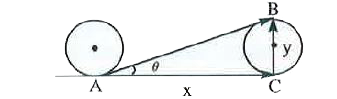 `x=pi R and y=2R`. Displacement, `s= sqrt(x^(2)+y^(2))= sqrt((piR)^(2)+(2R)^(2))=R sqrt(pi^(2)+4)` and `theta =Tan^(-1)((y)/(x))= Tan^(-1) ((2R)/(piR))= Tan^(-1)((2)/(pi))`with x-axis. i.e Displacement has magnitude `Rsqrt(pi^(2)+4)` and makes an angle `Tan^(-1)((2)/(i))` with x-axis. |
|
| 5. |
For an amplitude modulated wave , the maximum amplitude is found to be 10 V while has minimum amplitude is found to ve 2 V . Determine the modulation index , mu. What would be the value of m if the minimum amplitude is zero volt ? |
|
Answer» Solution :Given , maximum amplitude `A_("max") = 10V` Minimum amplitude `A_("min") = 2 V` Let `A_(c)` and `A_(m)` be amplitudes of carrier wave and signal wave `A_("max") = A_(c) + A_(m) = 10 ` _____ (1) and `A_("min") = A_(c) - A_(m) = 2 ` _______ (2) Adding the equation (1) & (2) we get `2 A_(c) = 6V , A_(m) = 10 - 6 = 4 V ` Modulation index `MU = (A_(m))/(A_(c)) = (4)/(6) = (2)/(3)` When the minimum amplitude is zero , then i.e., `A_("min") = 0` `A_(c) + A_(m) = 10 ""` _____(3) `A_(c) - A_m = 0 "" ` ______(4) By solving (3) & (4) we get `2 A_(m) = 10 , A_(m) = 5 , A_(c) = 5` Modulation index `mu = (A_(m))/(A_(c)) = (5)/(5) = 1` |
|
| 6. |
A string can withstand a tension of 25 N. What is the greatest speed at which a body of mass 0.5 kg can be whirled in a circle using 0.5m length of the string. Neglect the force of the gravity on the body |
|
Answer» 0.5 cm/s |
|
| 7. |
A beam of light consisting of two wavelength , 6500 A^(@) and 5200 A^(@) is used to obtain interference fringes in a Young's double slit experiment (1Å = 10^(-10)m). The distance between the slits 2.0 mm and the distance between the plane of the slits and the screen is 120 cm. Find the distance of the third bright fringe on the screen from the central maximum for the wavelength 6500 Å. |
|
Answer» 1.17 mm |
|
| 8. |
A parallel plate capacitor is half filled with a dielectric slab of dielectric constant (K) and mass M. Capacitor is connected to a cell of e.m.f. E. Plates are held fixed on horizontal surface. A bullet of mass M hits the dielectric elastically and it is found that the dielectric slab just leaves out the capacitor. Find the speed of the bullet? |
| Answer» Solution :`E[(epsilon_(0)AB(K-1))/(MD)]^(1//2)` | |
| 9. |
Adiabatic wind. The normal airflow over the Rocky Mountains is west to east. The air loses much of its moisture content and is chilled as it climbs the western side of the mountains. When it descends on the eastern side, the increase in pressure toward lower altitudes causes the temperature to increase. The flow, then called a chinook wind, can rapidly raise the air temperature at the base of the mountains. Assume that the air pressure p depends on altitude y according to p = P_0exp (-ay), where P_0= 1.00 atm and a = 1.16 xx10^(-4) m. Also assume that the ratio of the molar specific heats is gamma= 4/3. A parcel of air with an initial temperature of -13.0^@ C descends adiabatically from Y_1 = 4267 m to y = 1567 m. What is its temperature at the end of the descent? |
| Answer» SOLUTION :`17 ^@ C ` | |
| 10. |
In the above question, if the rays were to converge between F and C of mirror, then find the nature of final image formed |
|
Answer» real HENCE IMAGE is virtual `m=-(V)/(U)=-(y)/(x)rarr` negative, so image is inverted. Image will be ENLARGED. 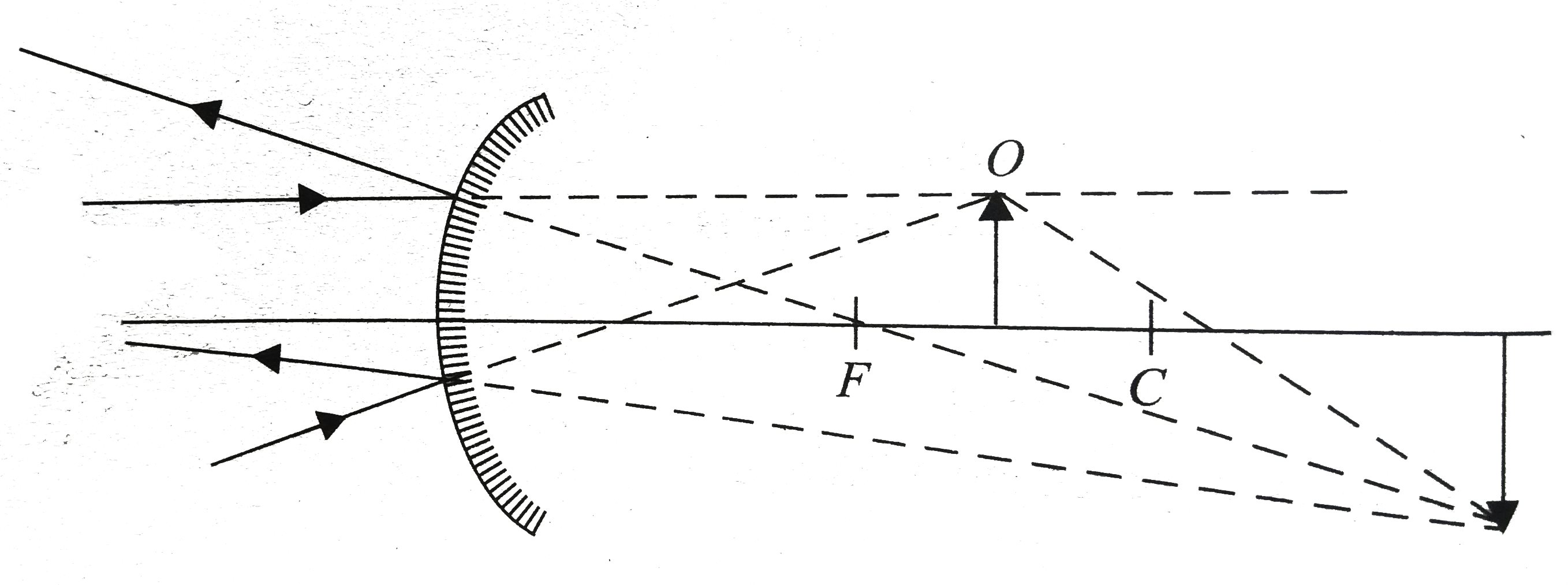
|
|
| 11. |
A bar magnet makes 40 oscillations per minute in a vibration magnetometer. An identical magnet is demagnetised completely and is placed over the magnet in the magnetometer. Calculate the time taken for 40 oscillations by this combination. Ignore induced magnetism. |
|
Answer» Solution :In the first case frequency of oscillaton , ` v =(1)/(2PI) SQRT((MB)/(I))` In the second case frequency of oscillation , `v^(1) = (1)/(2pi) sqrt((MB)/(2I) ) implies (v^(1))/(v) = (1)/(sqrt(2)) , (T^(1))/(T) = sqrt(2) (or) T^(1) = sqrt(2)T` `(or) 40T^(1) = sqrt(2) xx 40T` `(or) t^(1) = sqrt(2)t = sqrt(2)"MINUTE" = 1.414` minute |
|
| 12. |
Electromagneticwaveis passingthrougha smallvolume.Frequencyof thewaveis v.Energycontainedwithinvolumeisfound toosciallatewithfrequency nv. Whatis n? |
|
Answer» |
|
| 13. |
A current loop is placedin a uniform magnetic field in fourdifferenent orientation I,II,III andIV arrangethem in the decreasing order of potential energy |
|
Answer» `IgtIIIgtIIgtIV` |
|
| 14. |
Two cities are 150 km apart. Electric power is sent from one city to another city through copper wires. The fall of potential per km is 8 volt and the average resistance per km is 0.5Omega. The power loss in the wire is: |
|
Answer» 19.2 kw |
|
| 15. |
If n is the orbit number of the electron in a hydrogen atom, the correct statement among the following is |
|
Answer» electron energy increases as N increases. |
|
| 16. |
Find the quantum number n corresponding to nth excited state of He^(++) ion if on transition to the ground state the ion emits twophotons in succession with wavelength 108.5 nm and 30.4 nm. The ionization energy of the hydrogen atom is 13.6 eV. |
|
Answer» |
|
| 17. |
In order to prevent spoilage of potato chips, they are packed in plastic bags in an atmosphere of |
|
Answer» CHLORINE gas |
|
| 18. |
A closed vessel contains a mixture of two diatomic gases A and B. Molar mass of A is 16 times that of B and mass of gas A contained in the vessel is 2 times that of B. Which of the following statement is incorrect? |
|
Answer» Average KINETIC energy per MOLECULE of A is equal to that of B `(v_(rms))_(A)=sqrt((3RT)/(M_(A)))and(v_(rms))_(B)=sqrt((3RT)/(M_(B)))` No. of mole of `A=(m_(A))/(M_(A))` No. of mole of `B=(m_(B))/(M_(B))=(m_(A)//2)/(M_(A)//16)=8n_(A)` Pressure exerted by a gas in the vessel depends on the number of molecules presesnt inside. |
|
| 19. |
Out of many input signals of different frequencies,a series resonant circuit will accept one which has : |
|
Answer» the HIGHEST frequency |
|
| 20. |
Angle of deviation (delta) for a prism (refractive index mu and supposing prism angle A to be small) is given by: |
|
Answer» `(DELTA)=((mu-1)/(mu+1))A` |
|
| 21. |
A particle of charge 16 xx10^(-16) moving with velocity 10ms' along X-axis enters a region where magnetic field of induction vecB is along the y-axis and an electric field of magnitude 10^4 Vm^(-1)is along the negative Z-axis. If the charged particle continues moving along X-axis, the magnitude of vecB is: |
|
Answer» `16 xx 10^3 WBM^(-2)` |
|
| 22. |
A conservativeforce acts on a particleas the particle moves along the positive x-axis fromorigin origin to x=2m. The force is parallel to x-axis. Now, consider four different cases, as shown in the figures, 1, 2, 3, and 4, where the forces is shown as a function of x. Rank the situations according to the change in potentialenergy associated with the force, least ( or most negative) to greatest ( or most positive). |
|
Answer» 2, 1, 4, 3 |
|
| 23. |
A car battery of emf 12 V and intemal resistance 5x10^(-2)Ω, receives a current of 60 amp from extemal source, then potential difference of battery is. |
|
Answer» 12V |
|
| 24. |
Making use of the uncertainty relation, calculate the energy of the localization of a neutron in a nucleus, i.e. the kinetic energy that a neutron must possess to enter a nucleus. The dimensions of the nucleus are of the order of 10^(-14) m. Isn't there contradiction between this result and the experimental fact that even thermal neutrons with kinetic energies of the order of 10^(-2) eV are able to penetrate the nucleus? |
|
Answer» |
|
| 25. |
Inthe previous question, if dv//dt = 0,then the angular acceleration of the ladder when alpha = 45^(@)is |
|
Answer» `2 v^(2) //L^(2)` |
|
| 26. |
The threshold frequency for a metallic surface corresponds to an energy of 6.2eV and the stopping potential for a radiation incident on this surface is 5V. The incident radiation lies in |
|
Answer» ULTRAVIOLET REGION |
|
| 27. |
(A): All physically correct equations are dimensionally correct. (R): All dimensionally correct equations are physically correct. |
|
Answer» Both (A) and (R) are true and (R) is the CORRECT explanation of (A) |
|
| 28. |
At 25^(@)C, 1 mole of MgSO_(4(s)) was dissolved in sufficient water, the heat evolved was found to be 91.2 kJ. One mole of MgSO_(4).7H_(2)O_((s)) on dissolution gives a solution of the same composition, accompanied by an absorption of 13.8 kJ heat. Calculate the enthalpy of hydration of MgSO_(4(s)). MgSO_(4(s))+7H_(2)O_((l))to MgSO_(4).7H_(2)O_((s)) |
|
Answer» `-105` kJ/mole `-91.2=(Delta H_("hyd."))_("of anhydrous salt")+13.8` `(Delta H_("hyd."))_("of anhydrous salt")=-91.2-13.8` `=-105` kJ/mole |
|
| 29. |
Mention the important considerations required while fabricating a p-n junction diode to be used as a Light Emitting Diode (LED). What should be the order of band gap of an LED if it is required to emit light in the visible range ? |
|
Answer» Solution :The p-n junctiorn diode, which emits spontaneous radiation when forward biased, is known as the "LIGHT emitting diode" or LED. The semiconductorused in LED is chosen according to the required wavelength of emitted radiation. The visible light is from 0.45 um to 0.7 um and corresponding PHOTON energy is between 2.8 eV to 1.8 eV. Therefore, the least BAND gap of the semiconductor to be used in LED, in order to have the emitted radiation to be in the visible REGION, should be 1.8 eV. Phosphorous doped gallium ARSENIDE and gallium phosphide are two such suitable semiconductors. |
|
| 30. |
The speeds of red light and yelow light are exactly same |
|
Answer» in VACUUM but not in asir |
|
| 31. |
A rectangular wire frame of dimensions (0.25 xx 2.0 m) and mass 0.5 kg falls from a height 5m above a region occupied by uniform magnetic field of magnetic induction 1 T. The resistance of the wire frame is 1/8 (Omega). Find time taken by the wire frame when it just starts coming out of the magnetic field. |
|
Answer» 0.2s `V_(1) sqrt(2 gh) = sqrt(2(10)(5))= 10m//s` and the time taken is `t, = sqrt((2h)/(g) = sqrt((2(5))/(10))=1s` . (ii) When the frame has partially entered the field, the induced emf produced is `epsilon =BLV` `I=(epsilon)/(R) = (Blv)/(R)` (anticlockwise) Ampere's force, `F=(B^(2)l^(2)v)/(R)` (upward) Putting `m=0.5 kg, B=1 T, l=0.25m, `v=10m//s` R=1//8 Omega` We get, `F=((1)^(2)(0.25)^(2)(10))/(1//8) =5N` Since, `mg=(0.5)(10) = 5N` 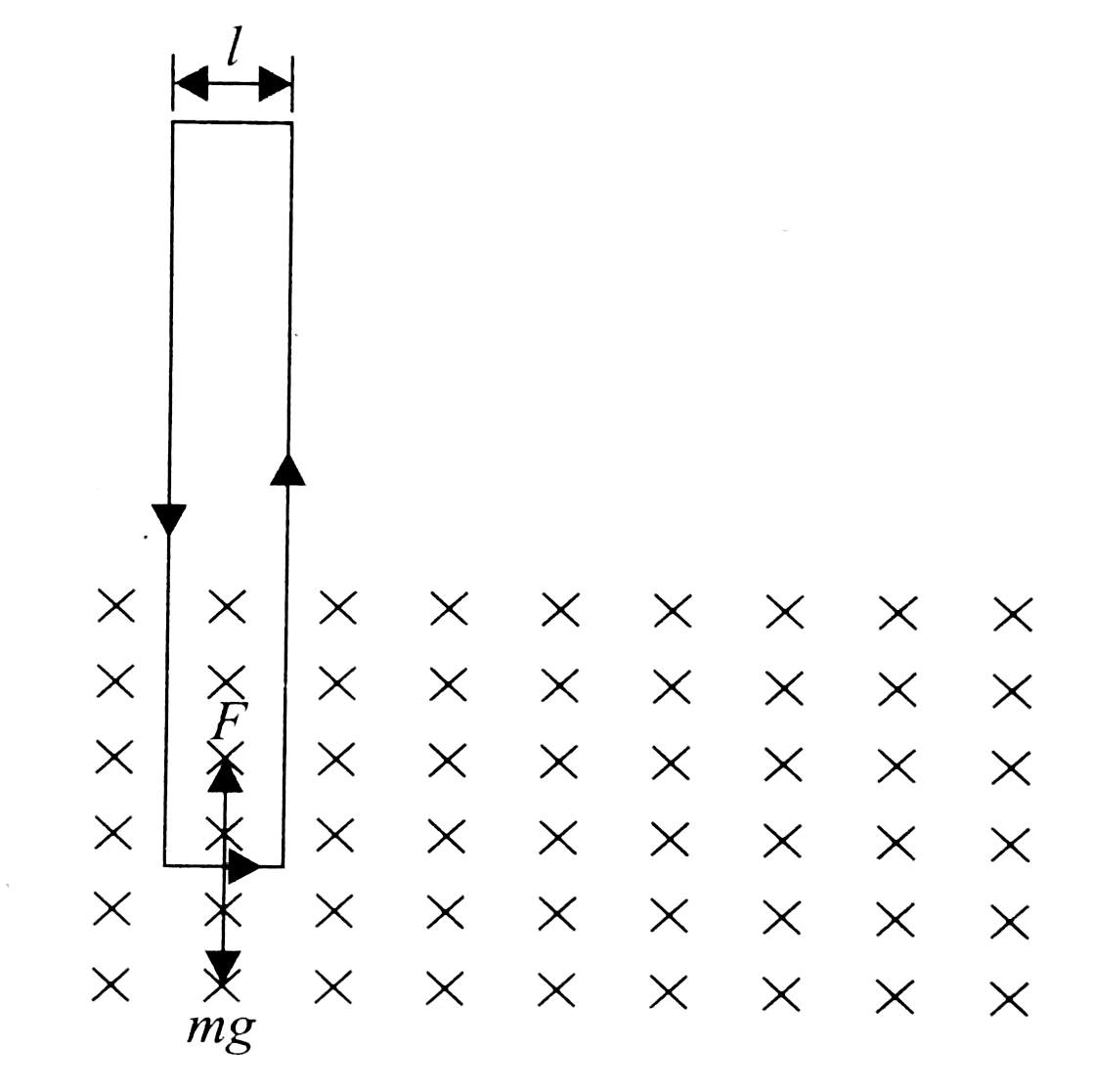 Since, `mg=(0.5)(10)=5N` Therefore, using Newton's second LAW, the acceleration of the wire frame while entering the magnetic field is zero, thus, time taken to completely entering into the field is `t_(2)=2/10 =0.2 s` (iii) When the frame has completely entered the field, current become zero and thus, the ampere's force ALSO become zero. The frame accelerates under gravity only. `:. 15 = 10t_(3)+5t_(3)2` or, `t_(3)^(2)+2t_(3)-3 =0` or `t_(3)=1s` The total time taken is `T=t_(1)+t_(2)+t_(3)=1 + 0.2 + 1 = 2.2 s`. |
|
| 32. |
A rectangular wire frame of dimensions (0.25 xx 2.0 m) and mass 0.5 kg falls from a height 5m above a region occupied by uniform magnetic field of magnetic induction 1 T. The resistance of the wire frame is 1/8 (Omega). Find time taken to completely enter into the field is |
| Answer» ANSWER :A | |
| 33. |
A ball of mass M//2 filled with a gas ( whose mass is M//2) is kept on a frictionless table . A bullet of mass m = M//4 and velocity v_(0)hat(i)penetrates the ball , and rests inside at t=0. Assume that the amount of gas emitted during the collision can be neglected. The compressed gas is emitted at a contant velocity v_(0)//2 relative to the ball and at an even rate k ( k is a positive constant ) . (a)What is the velocity of the ball after the collision with the bullet ?(b) Find the velocity of the ball v(t) as a function of time. Assume that the emission of gas starts at t=0. What is the final velocity of the ball ? |
|
Answer» |
|
| 34. |
The k line of singly ionised calcium has a wavelength of 393.3 nm as measured on earth. In the spectrum of one of the observed galaxies, this spectral line is located at 401.8 nm . The speed with which the galaxy is moving away from us, will be |
|
Answer» 6480 km/s |
|
| 35. |
To which part of the electromagnetic spectrum does a wave of frequency 5 xx 10^(19) Hz belong? |
| Answer» SOLUTION :X RAYS/Gamma rays. | |
| 37. |
Some metals get magnetised by orientation of atomic magnetic moments in external magnetic field. What are they called? |
|
Answer» |
|
| 38. |
A glass sphere of radius 2R, refractive index n has a spherical cavity of radius R, concentric with it. A black spot on the inner surface of the hollow sphere is viewed from the left as well as right. Obtain the shift in position of the object. |
|
Answer» Solution :a. Viewer on the left of hollow sphere: Single refraction takes place at surface S. From the single surface refraction equation, we have `mu_(2)=1, mu_(1)=n, u=-R, and R=-2R` `(1)/(V)-(n)/((-R))=((1-n))/((-2R))` which on solving for v yields, `v=-((2R)/(n+1))` Image is on the right of refracting surface S. Shift= Real depth-Apparent depth `R-((2R)/(n+1))=((n-1))/((n+1))R` b. When the viewer is on the right, two rerfractions take place at surfaces `S_(1)` and `S_(2)`. `mu_(2)=n, mu_(1)=1, u=-2R, and R=-R` For refraction at surface `S_(1): (n)/(v_(1))-(1)/((-2R))=((n-1))/((-R))` which on solving for `v_(1)=-(2nR)/(2n-1)` . The first lies to the left of `S_(1) ` and acts as OBJECT for refraction at the second surface. We have to shift the origin of CARTESIAN COORDINATE system to the vertex of `S_(2)`. The object distance for the second surface is `u_(2)=-[(2nr)/(2n-1)+R]=-((4n-1)/(2n-1))R` Here `mu_(2)=1, mu_(1)=n, R=-2R` `rArr (1)/(v_(2))-(n)/(-[(4n-1)/(2n-1)]R)=(1-n)/(-2R)` On solving for `v_(2)` , we get `v_(2)`=`-(2(4n-1))/((3n-1))R` The minus sign shows that image is virtual and lies to the leftof `S_(2)` . Shift= Real depth-Apparent depth `=3R-(2(4n-1)R)/((3n-1))` `=((n-1))/((3n-1))R` 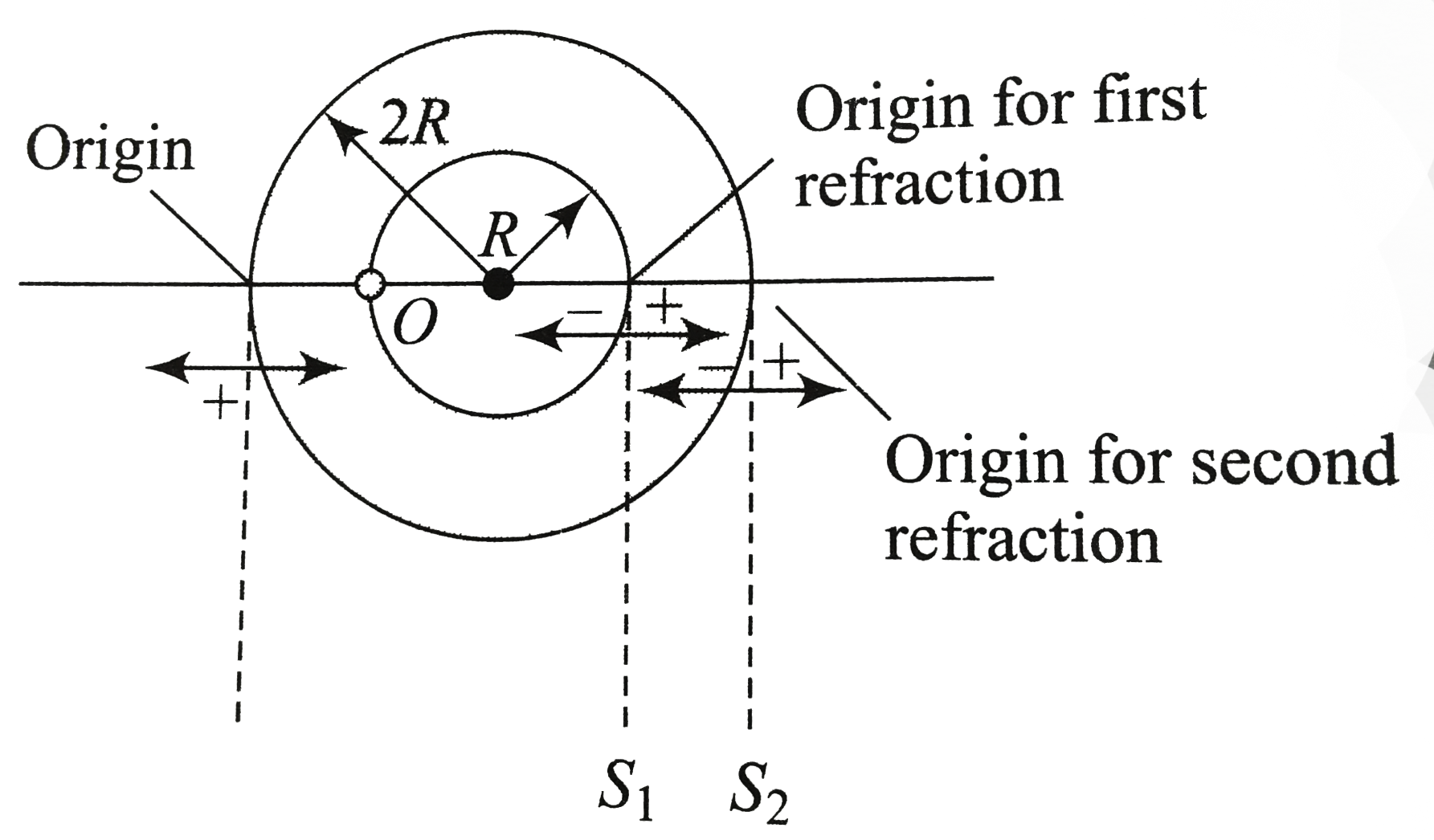
|
|
| 39. |
A thin glass plate is introduced in front of one of the double slits. What will happen to the fringe width? |
| Answer» Solution :FRINGE WIDTH will REMAIN the same will be shiftedby `(mu-I)` t where `'mu'` is R.I. of the MEDIUM and 't' is the thickness of the medium. | |
| 40. |
Consider the two idealized systems : (i) a parallel plate capacitor with large plates and small separation and (ii) a long solenoid of length L lt ltR, radius of cross-section. In (i) overset(to) is ideally treated as a constant between plates and zero outside. In (ii) magnetic field is constant inside the solenoid and zero outside. These idealised assumptions, however, contradict fundamental laws as below : |
|
Answer» case (i) contradicts Gauss's law for electrostatic fields. According to the Gauss.s law `oint overset(to) (E ) .overset(to)(d)a = (q)/( in_0)` for electrostatic field. Electric field lines does not form a continuous closed path. So the law for the electric field line is unabolished. For a magnetic field Gauss.s law is `oint overset(to)(B). overset(to)(d) s= 0` Hence the statement given is abolished. |
|
| 41. |
The correct match is |
|
Answer» a-g , b-f , C-h , d-h |
|
| 42. |
Graphite cannot be considered as |
|
Answer» CONDUCTING Solid |
|
| 43. |
In which of the following devices, the eddy current effect is not used ? |
|
Answer» ELECTRIC HEATER |
|
| 44. |
In distant communication, the data signal is not transmitted directly without the help of carrier wave. The reason is |
|
Answer» EXTREMELY LARGE transmitting antenna is necessary |
|
| 45. |
How can you charge a metal sphere positively without touching it? |
Answer» Solution :Shows an unchaged metallic spere on an inlsulating metal stand brign a negatively chaged rod close to themetallic spereas therodis BROUGHT closedistrubution sptopswhen the net force on the free electronsinside the metal is zero connect the spere to the ground by a conducting the negative chages one the rodheld at the near endremove the electrifield rod the POSTIVE charge will spread uniformly over the sphereas  in this experiment the metal sphere gets charged by the PROCESS of induction and the rod does not lose any of its chargeby induction by BRINGING a psotiviely charged rod near it in thisspereh is connected tothe ground with a wire can you EXPLAINWHY |
|
| 46. |
The momentum of a photo of energy of 1 Me V in kg m/s will be |
|
Answer» `5 xx 10^(-22)` |
|
| 47. |
The pressure that has to be applied to the ends of a steel wire of length 10 cm to keep its length constant when its temperature is raised by 100^(@)C is : (For steel Young's modulus is 2 xx 10^(11) N m^(2) and coefficient of themal expansion is 1.1 xx 10^(-5)K^(-1)) |
|
Answer» `2.2XX10^(6) PA`  `therefore (F)/(A)=" PRESSURE "=1.1xx10^(-5)xx100xx2xx10^(11)` `=2.2xx10^(8) pa` So correct CHOICE is (b). |
|
| 48. |
The de-Broglie wavelength 1 associated with an elementary particle of linear moemntum, p is best represented by the graph. |
|
Answer»
|
|
| 49. |
The photoelectric effect was first observed by H.Hertz. What is photoelectric effect? |
| Answer» Solution :The phenomenon of EMISSION of photoelectrons DUE to the interaction of matter with radiation is CALLED photo electric EFFECT | |
| 50. |
Frequency of the series limit of Balmer series of hydrogen atom interms of Rydlberg constant R and velocity of light c is |
|
Answer» RC |
|


