

Saved Bookmarks
This section includes 7 InterviewSolutions, each offering curated multiple-choice questions to sharpen your Current Affairs knowledge and support exam preparation. Choose a topic below to get started.
| 1. |
A 2 m string is fixed at one end and is vibrating in its third harmonic with amplitude 3 cm and frequency 100Hz (a) Write an expression for the kinetic energy of a segment of a segment of the string of length dx at a point x at some time l. At what time is its kinetic energy maximum? What is the shape of the string at this time? Find the maximum kinedic energy of the string by intergrating your expression for part (a) over the total length of the string. |
|
Answer» |
|
| 2. |
A conductor is moving with the velocity v in the magnetic field and induced current is I. If the velocity of conductor becomes double, the induced current will be |
|
Answer» 0.5 I |
|
| 3. |
The photoelectric cut-off voltage in a certain experiment is 1.5 V. what is the maximum kinetic energy of photoelectrons emitted ? |
|
Answer» SOLUTION :As `K_(max)=eV_(0) and` cut-off voltage `V_(0)=1.5V` `THEREFORE K_(max)=1.5xx1.6xx10^(-19)J=2.4xx10^(-19)J or 1.5eV`. |
|
| 4. |
Estimate the effect of the magnetic field in the conditions of the previous problem, if a 30% solution of sulphuric acid flows in the pipe. The conductivity of the solution is 74ohm^(-1).m^(-1). |
|
Answer» `N=(73.9xx0.36xx5xx10^(-2))/(1.02xx10^(3)xx0.2)=6.5xx10^(-3)LTLT1`. |
|
| 5. |
What is frequency modulation ? |
| Answer» Solution :When the modulation wave is SUPERIMPOSED on a high frequency carrier wave in a manner the amplitude of the MODULATED wave is the same as that of the carrier wave but its frequency is modified in accordance with that of MODULATING wave, the process is called FREQUENY modulation. | |
| 6. |
जब सिंगल पेरेंट द्वारा संतति का गठन किया जाता है तो इसे कहा जाता है ? |
|
Answer» लैंगिक जनन |
|
| 7. |
A light of wavelength 5800Å incident on a glass slab and undergoes refraction. Calculate the speed, wavelength and frequency of the refracted light (Refractive index of glass is 3//2) |
|
Answer» SOLUTION :Data SUPPLIED `lamda=5800Å=5800xx10^(-10)m, "" n_(ga)=3//2, n_(ga)=(c_(a))/(c_(g))` `:.c_(g)=(c_(a))/(n_(ga))=(3XX10^(8))/(3//2)=2xx10^(8)m//s` `lamda_(g)=(c_(g))/v=(c_(g))/(c_(a)//lamda_(a))=(lamda_(a).c_(g))/(c_(a)) [ :. c=vlamda]=(5800xx10^(-10)xx2xx10^(8))/(3xx10^(8))=3867xx10^(-10)=3867Å` `v=(c_(g))/(lamda_(g))=(c_(a))/(lamda_(a))=5.17xx10^(14)Hz` |
|
| 8. |
Statement-1: Stationary waves are so called because particles are at rest in stationary waves. Statement-2: When a wave travels from a denser medium to rater medium amplitude of oscillation increases. Statement-3: Two strings shown in figure have the same tension speed of transverse waves in string-1 will be more. |
|
Answer» FFF |
|
| 9. |
Half life T of a radioactiveelement is related to decay constantlambda accordingto the relation |
|
Answer» `T=(LAMBDA)/(0.693)` |
|
| 10. |
An object is placed at (i) 10cm (ii) 5 cm in front of a concave mirror of radius of curvature 15cm. Find the position, nature and magnification of the image in each case. |
|
Answer» SOLUTION :The focal length f = `(-15)/(2) ` cm = - 7.5 cm i. The object distance U = - 10cm . Then Eq. 6 GIVES `(1)/(v) + (1)/(-10) = (1)/(-7.5)or V = (10 xx 7.5)/(-2.5 ) = - 30 ` cm The image is 30 cm from the mirror on the same side as the object. ALSO, MAGNIFICATION m = `(-v)/(u) = ((-30))/((-10)) = - `3 The image is magnified. real and inverted . ii.The object distance u = -5 cm . Then from Eq. 6, `(1)/(v) + (1)/(-5) = (1)/(-7.5) or v = (5 x 7.5)/((7.5 - 5))`= 15 cm this image is formed at 15 cm behing the mirror. it is a virtual image. magnification m = `- (v)/(u) = (-15)/((-5)) = 3 ` The image is magnified, virtual and erect. |
|
| 11. |
Draw a plot of the binding energy per nucleon as a function of mass number for a large number of nuclei, 2le Ale 240. How do you explain the constancy of binding energy per nucleon in the range 30ltA lt170 using the property that nuclear force is short-ranged ? |
|
Answer» Solution :A PLOT of binding energy per nucleon as a FUNCTION of MASS number has been shown in Fig. 13.04. The constancy of the binding energy per nucleon in the range `30 lt A lt 170` is a consequence of the fact that the nuclear force is short ranged one. A particular nucleon will be under the influence of only some of the neighbouring nucleons which come within the range of the nuclear force. If a nucleon can have a maximum of p neighbours within the range of nuclear force, its binding energy would be proportional to p or is EQUAL to pk where k is a constant. If we increase mass number A, by adding more nucleons, they will not CHANGE the binding energy of a nucleon inside. Thus, binding energy per nucleon is a constant and is approximately equal to pk. |
|
| 12. |
In order to keep one magnetic needle, perpendicular to two magnetic fieldsB_1 and B_2, if the torques required are respectively tau_(1) and tau_(2) then (B_1)/( B_2)= …..... |
|
Answer» `tau_2/tau_1` `THEREFORE B= (tau)/(m)` `therefore B PROP tau""(because m= " constant for a given MAGNETIC needle" )` `therefore (B_1)/(B_2) = (tau_1)/( tau_2)` |
|
| 13. |
Two open organ pipes 80 and 81 cm long found to give 26 beats in 10 sec, when each is sounding its fundamental note. Find the velocity of sound in air. |
|
Answer» Solution :Fundamental frequency of the FIRST organpipe, `n_1 = v/(2l_1)` Fundamental frequncy of the second organ PIPE `n_2 =V/(2l_2)` Number of BEATS per socond=`n_1 ~ n_2 = V/(2l_2) ~ V/(2l_2)` `rArr 26/10 = V/160 - V/162 rArr 2.6 =(2V)/(160 xx162)` `rArr V = (2.6 xx 160 xx162)/2 = 33696 cms^(-1) ~= 337ms^(-1)` |
|
| 14. |
An object O is placed at 8cm in front of a glass slab, whose one face is silvered as shown in Figure. The thickness of the slab is 6cm. If the image formed 10 cm behind the silvered face,find the refractive index of glass. |
|
Answer» SOLUTION :At first SURFACE, `(mu_(1))/(d_(1))-(mu_(2))/(d_(2))rArr (1)/((-8))=(mu_(2))/(d_(2))rArrd_(2)=-8mu` Image `I_(1)` will serve as an object for the mirror and form an image `I_(2)`behind it at a distance of ` (8mu+6)` cm. `I_(2)` will serve as an object for the first surface. The rays will reflect from the mirror. Again using `(d_(1)^('))/(mu)=(d_(2)^('))/(1)` `d_(1)^(')=d_(2)+2T=(-8mu+12)` `d_(2)^(')=-(10+6)=-16CM ` After substituting the values, `mu=1.5.` 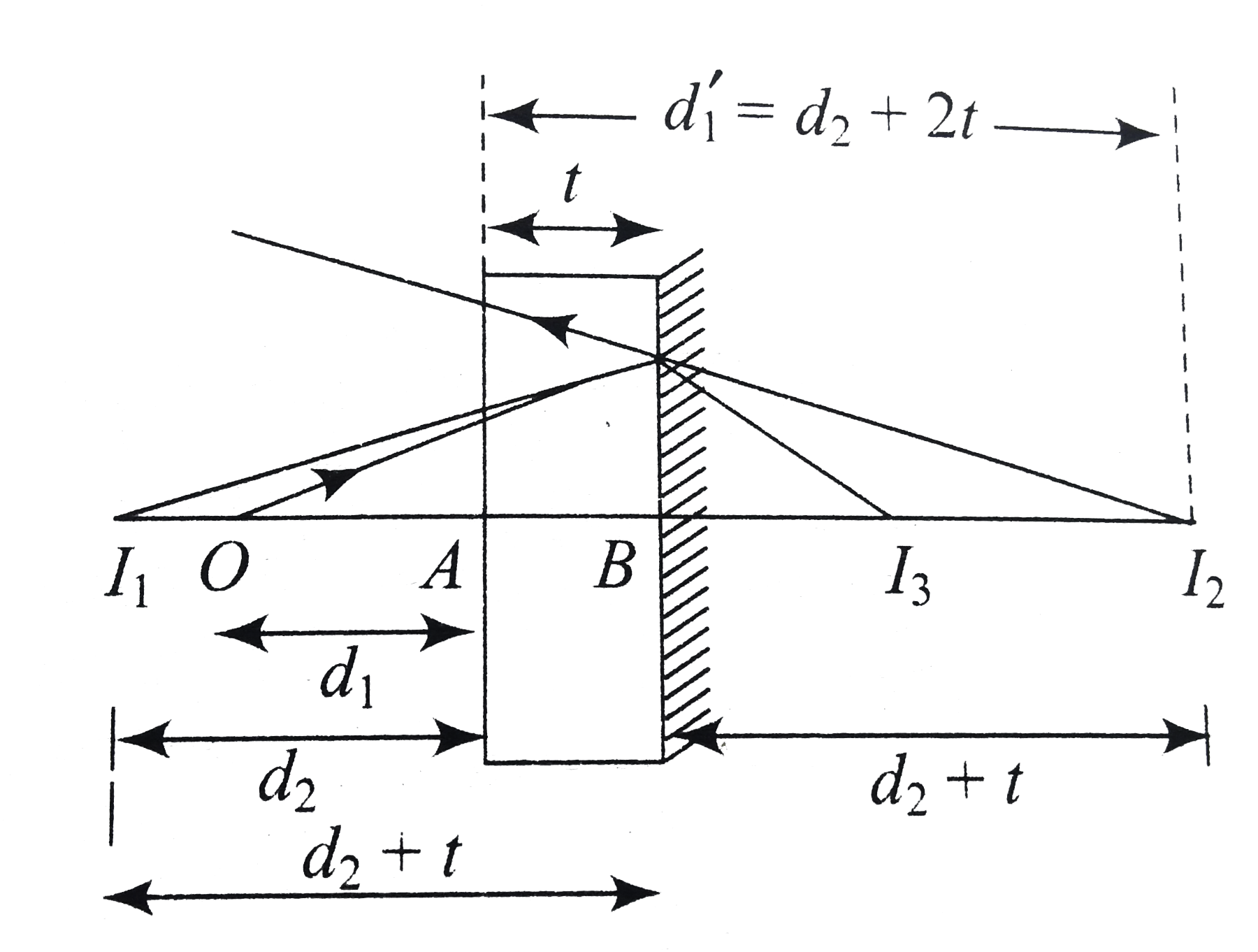
|
|
| 15. |
A conducting rod with resistance r per unit length is moving inside a vertical magnetic field B with spee v on two smooth horizontal parallel ideal conducting rails. The end of the rails are connected to a resistor R. the separation between the rails is d. The rod maintains a tilted angle theta to the rail. Find the external force F required to keep the rod moving |
|
Answer» `F=(B^(2)d^(2)v)/(R+dr)` |
|
| 16. |
Draw the energy bands of a N type semiconductor |
Answer» SOLUTION :
|
|
| 17. |
An electron emitted by a heated cathode and accelerated through a potential difference of 2.0 kV, enters a region with uniform magnetic field of 0.15 T. Determine the trajectory of the electron if the field (a) is transverse to its initial velocity, (b) makes an angle of 30º with the initial velocity. |
|
Answer» SOLUTION :According to work energy theorem, `W=DeltaK` `thereforeVe=1/2mv^(2)-0` `thereforev^(2)=(2Ve)/m` `thereforev=sqrt((2Ve)/m)""...(1)` `thereforev=sqrt((2xx2xx10^(3)xx1.6xx10^(-19))/(9.1xx10^(-31)))` `thereforev=2.652xx10^(7)m//s""...(2)` (i) Radius of circular path, by formula, `r_(1)=(mvsintheta_(1))/(Be)` `thereforer_(1)=(9.1xx10^(-31)xx2.652xx10^(7)xxsin90^(@))/((0.15)(1.6xx10^(-19)))` `thereforer_(1)=1.006xx10^(-3)m=1.006mm` (ii) Here, `r_(2)=(mvsintheta_(2))/(Be)=(mvsin30^(@))/(Be)` `thereforer_(2)=((9.1xx10^(-31))xx(2.652xx10^(7))(0.5))/((0.15)(1.6xx10^(-19)))` `thereforer_(2)=0.5028xx10^(-3)m=0.5028mm` |
|
| 19. |
Write the expression for electric field intensity at any point outside and inside due to a charged spherical shell. |
Answer» SOLUTION :Electric field due to a uniformly charged thin spherical shell : (i)When point P lies outside the spherical shell Suppose that we have to calculate electric field at the point P at a distance `r(rgtR)`from its centre. Draw the Gaussian surface through point P so as to ENCLOSE the charged spherical shell . The Gaussiansurface is spherical shell of radius r and centre O. Let `VECE`be the electric field at point P, then the electric flux through area element is `vecds`given by , `dphi=vecE*vecds` Since `vecds` is also along normal to the surface, `dphi=Eds` `THEREFORE` Total electric flux through the Gaussian surface isgiven by , `phi=oint_(s)Eds=Eoint_(s)ds` Now , `oint_(s)ds=4pir^(2)` `thereforephi=Exx4pir^(2)` ... (i) Since the charge enclosed by the Gaussian surface is q , according to Gauss theorem, `phi=(q)/(epsilon_(0))`...(ii) From equations (i) and (ii), we obtain `Exx4pir^(2)=(q)/(epsilon_(0))` `E=(1)/(4piepsilon_(0)).(q)/(r^(2))("for "rgtR)` (ii)When point P lies inside the spherical shell : In such a case , the Gaussian surface encloses no charge . According to Gauss law, `Exx4pir^(2)=0` i.e., E=0 `("for"r lt R)` Graph SHOWING the variation of electric field as a function of r : 
|
|
| 20. |
A NAND gate of two input has an output is taken as input of NOT gate. Show the circuit of it and give truth-table for final output of combination. |
Answer» Solution :Here two inputs of A and B NAND gate having OUTPUT is Y. which behaves as input of NOT gate. Due to thatcombination the final output is Y. Which has the TRUTH table is as FOLLOW. 
|
|
| 21. |
Four resistors, 100 Omega, 200 Omega, 300 Omega and 400 Omega are connected to form four sides of a square. The resistors can be connected in any order. What is the maximum possible equivalent resistance across the diagonal of the square? |
|
Answer» `210 Omega` ` therefore ` Equivalent resistance, `R_1 = 2R + 3R = 5R ` ALSO, R and 4R are in series their equivalent resistance will be, `R_2 = R +4 R= 5R `  Now` R_1 and R_2`are in parallelhencemaximumequivalentresistance ` R_(eq) = (R_1 + R_2)/( R_1 + R_2) = 5/2xx 100= 250Omega ` |
|
| 22. |
For most diatomic gases at room temperatures gamma = pm1.40 pm 0.01. Find the specific heat of nitrogen in these conditions. |
|
Answer» `R/(0.41) le C_(mv) le R/(0.39)` i.e., `2.02 xx 10^4 le C_(mv) le 2.13 xx 10^4` J/(kmole.K) `2.85 xx 10^4 le C_(MP) le 2.96 xx 10^4` J/(kmole .K)` . |
|
| 24. |
Dimensions of (1)/mu_0epsilon_0 where symbols have their usual meanings are: |
| Answer» Answer :C | |
| 25. |
Nucleus consists of neutrons and protons, neutrons and protons inside the nucleus interact with each other. They interchange into each other. The forces between them are charge independent. short range, mutual non conservative, strongly attractive. But many particles are emitted like alpha, beta, gamma rays and other high energy particles as mesons, leptons, baryons etc. Can you match the classification of particles in Column-1 with their characters in Coloumn-II. {:("Column-I","Column-II"),((A)"Chargeless integral spin particle",(p)"Pion"),((B)"Chargeless half spin particle",(q)"Photon"),((C)beta-"particle",(r)"Neutrino"),((D)"Exchange particle",(s)"Positron"):} |
|
Answer» |
|
| 26. |
Astronomical telescope is used to observe a planet and final image of the planet is found to be formed at infinity. Focal length of objective lens is 20 m and that for the eyepiece is 4 cm. |
|
Answer» Angular magnification achieved is 500 Length of the tube or distance between objective and eyepiece can be written as `L = f_(0) + f_(e)= 20 + 0.04 = 20.04 m` Hence, option (b) is also correct. FINALLY eyepiece forms virtual image of real image formed by objective lens and hence final image REMAINS inverted. Option (c) is also correct. In case of telescope it is required to make objective lens having larger aperture. We need sufficient amount of LIGHT from distant object to ENTER the telescope so that BRIGHTNESS of final image is OK. That is the reason we need larger aperture for objective lens. Hence option (d) is also correct. Hence all options are correct. |
|
| 27. |
The binding energies of two particles X and Y are 2.26 MeV/nucleon and 7.56 MeV/nucleon, respectively. Which of the following is more stable? |
| Answer» Solution :The particle Y with GREATER VALUE of binding ENERGY is more stable. SINCE the energy required to SEPARATE neutrons and protons of nucleus of Y is more, the particle is more stable. | |
| 28. |
Whichmetal does not form nitrate when heated with conc. HNO_(3) ? |
| Answer» Solution :Sn+conc. `HNO_(3)toH_(2)SnO_(3)UNDERSET("meta stannic ACID")` | |
| 29. |
Two prisms A and B are in contact with each other have angular dispersions of 2^@ and 4^@ respectively.The dispersive power of 'A' is 0.002. If the combination produces dispersion without deviation, the dispersive power of 'B' is |
|
Answer» 0.001 |
|
| 30. |
Find the energy liberated in the course of the thermonuclear reaction ""_(3)Li^(6)+""_(1)H^(2)to2""_(2)He^(4) Do the calculations for one nucleus and for one nucleon. Compare with the energy liberated in the process of fission of uranium. |
|
Answer» `Deltaepsi=(6.01513+2.01410-2xx4.00260)xx931.5=22.4MeV` The energy RELEASE PER nucleon is 22.4/8 = 2.8 MeV. This is three times as much as is released in FISSION of URANIUM : 200/235 = 0.85 MeV per nucleon. |
|
| 31. |
An electromagnetic wave going through vacuum is describedby E=E_(0) sin (kx-omega t) which of the following is/are independent of the wavelength? |
|
Answer» K |
|
| 32. |
Show that the mutual inductance between a pair of coils is same (M_(12) = M_(21)) |
Answer» Solution :i. When an electric current passing through a coil CHANGES with time, an emf is induced in the neighbouring coil. This phenomenon is called mutually induced emf.  ii. Consider two coils which are placed close to each other. If an electric current i 1 is sent through coil 1, the magnetic field produced by it is also linkedwith coil 2 as shown i Figure (a). iii. Let `Phi_(21)` be the magnetic flux linked with each turn of the coil 2 of `N_(2)` turns due to coil 1, then the total flux linked withcoil 2 `(N_(2)Phi_(21))` is proportional to the current `i_(1) in the coil 1. `N_(2)Phi_(21)propi_(1)` `N_(2)Phi_(21)=M_(21)i_(1)` `(or)M_(21)=(N_(2)Phi_(21))/(i_(1))` iv. The constant of proportionality `M_(21)` is the mutual inductance of the coil 2 with respect to coil 1. It is also called as coefficient of mutual induction. If `i_(1)=1A," then "M_(21)=N_(2)Phi_(21).` v. Therefore, the mutual inductiance `M_(21)` is defined as the flux linkage of the coil 2 when 1 A current flows through coil 1. vi When the current `i_(1)` changes with time, an emf `epsilon_(2)` is induced in coil 2. Form Faraday'slaw of electromagnetic induction induction, this mutually induced emf `epsilon_(2)` is given by `epsilon_(2)=(d(N_(2)Phi_(21)))/(DT)=(d(M_(2)i_(1)))/(dt)` `epsilon_(2)=-M_(21)(di_(1))/(dt)` `(or)M_(21)=(-epsilon_(2))/((di)/(dt))` vii. The negative sign in the above equation shows that the mutually induced emf always opposes the change in current `i_(1)` with respect to time. If `(di_(1))/(dt)=1As^(-1)," then "M_(21)=epsilon_(2).` VIII. Mutual inductance `M_(21)` is also defined as the opposing emf inducedin the coil 2 when the rate of change of current through the coil 1 is `1As^(-1).` ix. Similarly, if an electric current `i_(2)` through coil 2 changes with time, then emf `epsilon_(1)` is induced in coil 1. Therefore, `M_(12)=(N_(1)Phi_(12))/(i_(1))andM_(12)=(-epsilon_(1))/((di_(2))/(dt))` where `M_(12)` is the mutual inductance of the coil 1 with respect, to coil 2. It can be mutual inductance is same. `i.e.,M_(21)=M_(12)=M` x. In general, the mutual induction between two coils of turns of the coils, their relative orientation and permeability of the medium. |
|
| 33. |
The resultant of two forces at right engles is 5 N. When the angle between them is 120^@, then resultant is sqrt 13. Then the forces are |
|
Answer» `sqrt 12 N, sqrt 13 N` |
|
| 34. |
A string of length 'L' is stretched by L/20 and the speed of transverse waves along it is 'v'. The speed of wave when it is stretched by L/10 will be (Assume that Hooke's law is applicable) |
| Answer» ANSWER :C | |
| 35. |
A uniform chain of mass per unit length lambda is sliding down the hill with constant speed u. Dimension of the hill are h and d as shown. Find the momentum of the chain at the instant shown. (given lambda=1kg//m, d=3m, h=4m, and u=1m//s) |
|
Answer» |
|
| 36. |
A transmitting antenna is a height of 40 m and the receiving antenna is at a height of 60 m The maximum distance between them for satisfactory communication is nearly |
|
Answer» `22.5` KM |
|
| 37. |
A charge of Q coulomb is placed on a solid piece of metal of irregular sphase. The charge will distribute itself |
|
Answer» UNIFORMLY in the metal object |
|
| 38. |
Explain the limitations of Bohr atomic model. |
|
Answer» Solution :(1) Bohr model is applicable to hydrogenic atom. It cannot be extended even to atom like helium which contain two electrons. Also hydrogen spectra is made up of more than one lines. This cannot be explained by Bohr model. (2) While the Bohr.s model correctly predicts frequencies of light emitted by hydrogenic atoms. The model is unable to EXPLAIN relative intensities of the frequencies of spectrum. (3) Bohr model is unable to explain VARIATION in intensities. Thus, by Bohr model intensities of spectral lines can not be explained. (4) Bohr model cannot be applied to complex atom for complex atoms, we have to use new theory based on quantam mechanics. In calculation of Bohr model classical mechanics is used. This is an odd combination of classical PHYSICS and QUANTUM principles. (5) Orbit of electron NEED not be circular. It can be elliptical (oval) shape also. |
|
| 40. |
ab=a^3+b^3 प्रकार से परिभाषित N में एक द्विआधारी संक्रियापर विचार कीजिए अब निम्नलिखित में से सही उत्तर का चयन कीजिए |
|
Answer» * साहचर्य तथा क्रमविनिमेय दोनों है |
|
| 41. |
Unpolarised light is passed through a polaroid P_(1). When this polarised beam passes through another polaroid P_(2) and if the pass axis of P_(2) makes angle theta with the pass axis of P_(1), the write the expression for the polarised beam passing through P_(2). Draw a plot showing the variation of intensity when theta varies from 0 to 2pi. |
Answer» Solution : If the intensity of unpolarised light incident on POLAROID `P_(1)` be `I_(0)`, then intensity of light passing through the polaroid `P_(2)` is `I=(I_(0))/(2)cos^(2)theta`. A plot showing VARIATION of intensity I with `theta`, when `theta` VARIES from 0 to `2PI` is SHOWN in figure. |
|
| 42. |
In Melde's experiment , 4 loops were formed when the string was stretched by a weight of 8g. What weight should be used to double the no. of loops without disturbing the experimental setup? |
|
Answer» 4g |
|
| 43. |
A parallel plate capacitor of capacitance C_(0) is connected across a battery of voltage V. Calculate the change in energy stored in the capacitor if distance between both the plates is decreased to half of its original value. |
| Answer» SOLUTION :`(C_(0)V^(2))/(2)` | |
| 44. |
The SI unit of electric flux is |
|
Answer» volt `METRE^(2)` |
|
| 45. |
Assertion : When two light sources are placed near to each other, energy is distributed non-uniformly around them. Reason : Light waves from two sources interfere each other and redistribution of energy takes place due to phenomenon of interfernece. |
|
Answer» If both assertion and REASON are CORRECT and reason is a correct EXPLANATION of the assertion. |
|
| 46. |
In Fig. 4-30 a stone is projected at a cliff of height h with an initial speed of 42.0 m/s directed at angle theta_(0)=60.0^(@) above the horizontal. The stone strikes at A, 5.50 s after launching. Find (a) the height h of the cliff, (b) the speed of the stone just before impact at A, and ( c) the maximum height H reached above the ground. |
| Answer» SOLUTION :(a) 5.50 s, (B) 27.4 m/s, ( C) 67.5 m | |
| 47. |
If the electron drift speed is so small and the electron's charge is small, how can we still obtain large amounts of current in a conductor ? |
| Answer» SOLUTION : Because the electron NUMBER DENSITY is ENORMOUS ` ~ 10^29 m^(-3)`. | |
| 48. |
An object of 3 cm height is placed at a distance of 60 cm from a convex mirror of focal length 30 cm. Find the nature, position and size of the image formed. |
|
Answer» Solution :Here u`u=- 60 cm, h = + 3 cm` and `f= + 30 cm` (CONVEX mirror) From mirror FORMULA `1/v + 1/u = 1/f` `1/f =1/f -1/u=1/(+30) -1/(-60) = 1.30 + 1/60 = 1/20 rArr v=-20 cm` From `m=h^(.)/h =-v/u`, we have `h. = -v/u.h =-(20)/(-60) xx 3 cm = + 1 cm` +ve sign of v shows that the image is virtual and erect. HENCE, an erect and virtual image of height 1 cm is formed behind the mirror at a distance of 20 cm from it. |
|
| 49. |
A rectangular current carrying loop placed 2cm away from a long , street, current - carrying conductors. What is the direction and magnitude of the net force acting on the loop . |
|
Answer» SOLUTION :The LIKE currents i.e current in both the wire are in the same direction attracts each other . Theforce is repulsive when current flows in opposite direction through the wires. `F = (mu_(0) I_(1)I_(2)DL)/(2 pi r) ` i.e `F alpha 1/r`  As wire of LOOP carrying opposite current is near so the net force acting on the loop is repulsive. |
|
| 50. |
In Young's double-slit experiment, the distance between slits and the screen is 1.0 m and monochromatic light of 600 nm is being used. A person standing near the slits is looking at fringe pattern. When the separation between the slits is varied, the interference pattern disappears for a particular distance d_0 between the slits. If the angular resolution of the eye is (1/(60))^(@) , the value of d_0 is close to : |
|
Answer» 1 mm `THETA = beta/D = (lambda D//d)/(D) = lambda/(d_0) implies lambda/(d_0) = (1^@)/(60) = (pi)/(180 xx 60)` `d_0 = lambda((180 xx 60)/(pi)) = 206394.26 xx 10^(-9)m = 2 xx 10^(-3) m`. `= 2mm` (approximately) |
|