

Saved Bookmarks
This section includes 7 InterviewSolutions, each offering curated multiple-choice questions to sharpen your Current Affairs knowledge and support exam preparation. Choose a topic below to get started.
| 1. |
In the above relation the dimensions of C are |
|
Answer» `M^(2)L^(-2)T^(-2)` |
|
| 2. |
A charged particle of charge q and mass m enters a magnetic field as shown. Find radius of the circular path and the time spent inside the field. Neglect gravity. |
|
Answer» `(R pi THETA)/(V)` `=(R(pi - 2theta))/(v)` 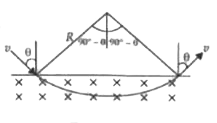
|
|
| 3. |
Show on a plot the nature of variation of the (i) electric field (E), and (ii) potential (V) of a small electric dipole with the distance (r) of the field point from the centre of the dipole. |
Answer» Solution :Variation of E and V with r for a short electric dipole has been SHOWN in figure. It is DUE to the FACT that `V PROP 1/r^2 and E prop 1/r^3`. 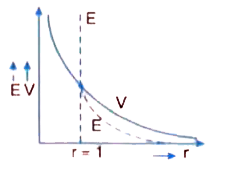
|
|
| 4. |
Consider an infinite ladder of network asshown in the adjacent figure. A voltage is A applied between points A and B. If the voltage is halved after each section, find the ratio of R_(1)//R_(2) |
| Answer» SOLUTION :`1//2V0It` | |
| 5. |
A radioactive element ""_(92) X^(238) emits one alpha- particle and one beta' particle in succession. What is the mass number of new element formed? |
|
Answer» Solution :Mass number of the new element = 234. (Since the mass number DECREASES by 4 UNITS in alpha DECAY but it does not change in BETA decay) |
|
| 6. |
Can the potential barrier across a p-n junction be measured by simply connecting a voltmeter across the junction ? |
| Answer» SOLUTION :No, we cannot MEASURE the potential barrier across a p-n JUNCTION by SIMPLY connecting a voltmeter across the junction because resistance across the junction is almost INFINITE and no current will flow through the voltmeter. | |
| 7. |
The young's slit experiment is donein a medium of refractive index 4//3 .A light of 600 nm wavelength is falling on the slits having 0.45 mm separation . The lower slit S_(2) is covered by a thin galss sheet of thickness 10.4 mum and r3efractive index 1.5 .The interferecnce pattern is observed on a screen placed 1.5 m form the slits as shown in figure .Find the light intensity at point O relative to the maximum fringle intensity (Given : cos3.4 =sqrt(0.75) |
|
Answer» `1/4` `Delta = (mu-1)t` `"Phase difference" = (32pi)/(LAMBDA)xxDelta=6.8 rad` `THEREFORE (I)/(I_(0)) = cos^(2) (PHI)/(2)=cos^(2) (6.8)/(2) = 0.75` |
|
| 8. |
The ends of a stretched wire of length 'L' are fixed at x = 0 and x = L. In one experiment, the displacement of the wire is y_(1) = A "sin"(pi x)/(L) sin wt and the energy is E_(1) and in another experiment its displacement is y_(2)=A "sin" (2pi x)/(L) sin 2 wt and the energy E_(2) then |
|
Answer» `E_2 = E_1 ` |
|
| 9. |
The work function for AI, K and Pt is 4.28 eV, 2.30 eV and 5.65 eV respectively. Their respective threshold frequencies would be |
|
Answer» `PT GT AL gt K` `V_(0) ("pt") gt V_(0) ("AL") gt V_(0) (K)` |
|
| 10. |
A rivulet , which10m long is flowing northward along an insulated bedwitha velocityof 0.3 ms^(-1).Calculate the potenitaldifference betweenthe water and thesides of the rivulet . (B_(0) = 34 xx 10^(-6) tesla and dip = 60^(@)). |
|
Answer» |
|
| 11. |
Is there any invisible spectrum ? |
| Answer» Solution :YES, its wavelength LIE beyond lie beyond the visibleregion. | |
| 12. |
Two point charges 5 xx 10^(-8) C and 3 xx 10^(-8)C are locate 16 m apart. At what points on the line joining the two charges is the electric potential zero ? |
|
Answer» Solution :`V = (1)/(4PI epsi_0) q/r` Between the two CHARGES `(1)/(4pi epsi_0 )(q_1)/(X) = (1)/(4pi epsi_0) ((q_2)/(16-x))` 10 cm from +ve charge Outside the two charges `(1)/(4pi epsi_0) (q_1)/(x) = (1)/(4pi epsi_0) ((q_2)/(16 + x))` 40 cm from +ve charge |
|
| 13. |
A tuning fork gives 5 beats /sec with another fork of 500Hz . When first fork is loaded , then no. of beats /sec remain unchanged. Then frequency of the first fork will be |
|
Answer» 505Hz |
|
| 14. |
A parallel plate capacitor, with a slab of dielectric constant k between its plates, has a capacitance C. It is charged to a potential V. Now the dielectric slab is first brought out of the capacitor and is then introduced again. The work done in this process will be |
| Answer» Answer :D | |
| 15. |
If a change in current of 0.01 A in one coil produces a change in magnetic flux of 2xx10^(-2)weber in the other coil, then the mutual inductance of the two coils in henry is |
|
Answer» 0 |
|
| 16. |
At distance of 5 cm and 10 cm outwards from the surface of a uniformly charged solid sphere. The potentials are 100 V and 75 V respecty. Then |
|
Answer» potential at its surface is 150 V. |
|
| 17. |
Symbols have their usual meanings. Match the Column-I with Column-II: |
|
Answer» |
|
| 18. |
A plane electromagnetic wave E=E_(m) cos ( omega t-kx) propagating in vacuum induces the emf E_("ind"), in a square frame with side l. The orientation of the frame is shown in figure. Find the amplitude value epsilon_("ind") , if E_(m)=0.50m V//m, the frquency v=5.0 MHz and l=50 cm. |
|
Answer» SOLUTION :`xi_(i nd)=oint vec(E). dvec(l)=E_(m)l ( cos OMEGAT - cos ( omegat -kl))` `=-2E_(m) l sin ( (omegal)/( 2 c )) sin (omegat-(omegal)/( 2 c ))` Putting the values `E_(m)=50m V//m, l =(1)/(2) metre` `(omegal)/(c)=(2pi vl)/( c) =(pixx10^(8))/( 3 xx 10^(8))=(pi)/( 3)` `xi_(i nd)=50 m V(-sin ((pi)/( 6)))sin ( omegat-((pi)/(6)))` `=-25 sin (omegat+(pi)/(6)-(pi)/(2))=25 cos (omegat-(pi)/( 3))mV` |
|
| 19. |
A converging beam of lgiht forms a sharp image on a screen. A lens is placed in the path of the beam, the lens being 10 cm from the screen. It is found that the screen has to be moved 8 cm further away from the lens to obtain as sharp image. Find the focal length and nature of lens. |
|
Answer» 22.5 CM, convex |
|
| 20. |
Assertion (A) : The earth's magnetic field is due to the iron present in its core. Reason (R) A bar magnet experiences a torque when placed at some angle to uniform magnetism field. |
|
Answer» If both ASSERTION and REASON are true and the reason is the correct EXPLANATION of the assertion |
|
| 21. |
Mirage is formed due to the phenomenon of _____ |
| Answer» SOLUTION :TOTAL INTERNAL REFLECTION | |
| 22. |
What is a thermistor? |
| Answer» Solution :A material with a NEGATIVE TEMPERATURE COEFFICIENT is CALLED a THERMISTOR. Eg: Insulator and semiconductor. | |
| 23. |
A physical pendulum shown in Fig. is made up of a rod 60 cm long with mass 0.50 kg and a disk of 3.0 cm radius with mass 0.60 kg. Find the period of this pendulum. |
|
Answer» `I=(1)/(3)m_(1)l^(2)+(1)/(2)m_(2)r^(2)+m_(2)(l+r)^(2)` The distance between the centre of mass and the axis is `a=(1//2m_(1)l+m_(2)(l+r))/(m_(1)+m_(2))` Hence we find the period. |
|
| 24. |
Can the instantaneous power output of an AC source ever be negative ? Can average power output be negative ? Justify your answer. |
|
Answer» Solution :YES, Instantaneous POWER output of an AC source can be negative. Instantaneous power output `P= EI = (E.I.)/( 2)[cos phi - cos (2 omega t + phi)]` No, `P_("avc") = V_("rms") I_("rms") cos f` `P_("avc" gt 0)` `cos phi = (R )/(Z ) gt 0` |
|
| 25. |
The co-efficient of absorption and reflection of a thin uniform plate are 0.75 and 0.2 respectively. Then co-efficient of transmission is |
|
Answer» a)0.05 |
|
| 26. |
A particle executes SHM of type x= a sin omega. It takes time t_1 from x=0 to x= (a)/(2) and t_2 from x= (a)/(2) to x= a. The ratio of t_1: t_2 will be |
|
Answer» `1:1` |
|
| 27. |
Two capacitor of capacitance 2muF and 3muF respectively are charged to potential difference 20 V each. Now the capacitors are connected such that the positively chargd plate of one capacitory is connected to the negatively charged plate of the other. after the current in the circuit has become negligible, the potential difference across the 2muF capacitor is ____V. |
|
Answer» Let the final charges on the TWO capacitors be `Q_(1) and Q_(2)` respectively. When steady state is ACHIEVED, the polarity of the capacitor that initially had a lower amount of charge, i.e. the `2muF` capacitor, has reversed, and the potential difference across the capacitors is equal so, `(Q_(1))/(2)=(Q_(2))/(3)` Now, we can choose a PAIR of connected PLATES and conserve the total charge on them as they are an isolated system. `Q_(1)+Q_(2)=60+(-40)` Solving, we get `Q_(1)=8muC and Q_(2)=12muC`. so, potential differenec across the `2muF` capacitor `=(8)/(2)4V`. |
|
| 28. |
Aparallel beam of monochromatic light of wavelength 4000 Å is incident normally on a single narrow slit of width 0.0008 mm. The light is focused by a a convex lens on a screen placed in focal plane. The first minimum will be formed for the angle of diffraction equal to |
|
Answer» `0^(@)` `d sin THETA= n lambda=1 lambda [ :. N=1]` `sin theta=(lambda)/(d)` `=(5000xx10^(-10))/(0.001xx10^(-3))=0.5` `:. theta=30^(@)` |
|
| 29. |
Each of two concentric spheres of radii 5 cm and 10 cm are given a charge of 10 mu C. (i) The electric potential at a point situated at a distance of 2.5 cm from the centre is |
|
Answer» `27 xx 10^(5) V` |
|
| 30. |
Express the de Broglie wavelength in terms of the kinetic energy of a relativistic particle. What is the kinetic energy for which the nonrelativistic formula leads to an error of less than 1% ? |
|
Answer» `lamda=h/p=(hc)/(sqrt(K(2epsilon_(0)+K)))` For `Kltlt epsilon _(0)`, we obtain the nonrelativistic APPROXIMATION: `lamda_("nonrel")=(hc)/(sqrt(2epsilon_(0)K))=h/(sqrt(2mK))` The error due to the substitution of the nonrelativistic formula for the relativistic one is `delta=(lamda_("nonrel")-lamda)/lamda=sqrt((2epsilon _(0)+K)/(2 epsilon_(0)))-1`, which gives `K/(2epsilon_(0))=(1+delta)^(2)-1~~1delta` Since `deltaltlt1`. Hence, the error introduced by the substitution of the nonrelativistic formula for the relativistic one will be less than `delt , ifKltlt4delta epsilon_(0)`. |
|
| 31. |
In a typical nuclear reaction, e.g. ""_(1)^(2) H+ ""_(1)^(2) H to ""_(2)^(3) He +n + 3.27 Mev, although number of nucleons is conserved, yet energy is released. How ? Explain. |
| Answer» SOLUTION :Since the total initial mass of nuclei on the LEFT side of REACTION is greater than the total final mass of nucleus on the RIGHT hand side, this difference of mass appears as the energy is released. | |
| 32. |
What we call the opposition offered by the conductor due two collisions ? |
| Answer» SOLUTION :RESISTANCE | |
| 33. |
Electric lines of force about a positive point charge are : |
|
Answer» CIRCULAR, ANTICLOCKWISE |
|
| 34. |
What are the contributions of Faraday and Maxwell in Electromagnetism? |
|
Answer» SOLUTION :Faraday - VARYING magnetic FIELD produces ELECTRIC field. Maxwell - Varying electric field produces magnetic field. |
|
| 35. |
Assuming that energy released by the fission of a single ""_(92)^(235)U nucleus is 200MeV, calculate the number of fissions per second required to produce 1 kilowatt power. |
|
Answer» <P> Solution :The fission of a single `""_(92)^(235)"U"` nucleus RELEASES 200 MEV of energyEnergy released in the fission is given by the formula, `E = (Pt)/(n) Rightarrow (n)/(t) = (P)/(E)` `E = 200 MeV = 200 xx 10^(6) xx 1.6 xx 10^(-19)` `E = 320 xx 10^(-13)` `E = 3.2 xx 10^(-11)`J `(n)/(t) = (P)/(E) = (1)/(3.2 xx 10^(-11)) = 0.3125 xx 10^(11) = 3.125 xx 10^(10)` `(n)/(t) = 3.125 xx 10^(10)` |
|
| 36. |
Light of wavelength 390 nm is directed at a metal electrode. To find the energy of electrons ejected, an opposing potential difference is established between it and another electrode. The current of photoelectrons from one to the other is stopped completely when the potential difference is 1.10 V. Determine (i) the work function of the metal and (ii) the maximum wavelength of light that can electrons from this metal. |
|
Answer» Solution :(i) The work function is GIVEN by `phi_(0) = h UPSILON - K_(MAX) = (hc)/(lambda) - eV_(0)` SINCE `K_(max) = eV_(0)` `= [(6.626 xx 10^(-34) xx 3 xx 10^(8))/(390 xx 10^(-9))] - [1.6 xx 10^(-19) xx 1.10]` `= 5.10 xx 10^(-19) - 1.76 xx 10^(-19) = 3.34 xx 10^(-19)` J = 2.09 eV (ii) The threshold WAVELENGTH is `lambda_(0) = (hc)/(phi_(0)) = (6.626 xx 10^(-34) xx 3 xx 10^(8))/(3.33 xx 10^(-19))` `= 5.969 xx 10^(-7) m = 5963 Å` |
|
| 37. |
A concave mirror forms a real image three times larger than the object on a screen. Object and screen are moved until the image becomes twice the size of object. If the shift of object is 6 cm, the shift of the screen & focal length of mirror are |
|
Answer» 36CM, 36cm |
|
| 38. |
The figure given below shows a charge array known as an 'electric quadrupole'. For a point on the axis of the quadrupole, obtain the dependence of potential on r for (r )/(a) gt gt 1. Contrast your result with that due to an electric dipole and an electric monopole (i.e. a single charge). |
|
Answer» Solution :As we know that the electric potential at a point due to a system of n charges is given by: `V=(1)/(4pi epsilon_(0)) sum (q_(n))/(r_(n))` Electric potential at point P due to the given charge array can be calculated as: `V=(1)/(4pi epsilon_(0))((q)/(r+a)+2xx(-q)/(r )+(q)/(r-a))=(1)/(4pi epsilon_(0)) ((2qa^(2))/(r(r^(2)-a^(2))))` `RARR V=(1)/(4piepsilon_(0))((2qa^(2))/(r(r^(2)-a^(2))))=(1)/4pi epsilon_(0)((2qa^(2))/(r^(3)(1-(a^(2))/(r^(2)))))` As, `(r )/(a ) gt gt 1, rArr V=(1)/(4piepsilon_(0))((2qa^(2))/(r^(3)))` Thus, `V prop (1)/(r^(3))` For a monopole (SINGLE charge) electric potential varies as: `V prop (1)/(r )` For large VALUES of r electric potential due to an electric dipole varies as `V prop (1)/(r^(2))`and that due to quadrapole as `V prop (1)/(r^(3))` |
|
| 39. |
What is the SI unit of permeability ? |
| Answer» SOLUTION :WEBER `ampere^(-1)` meter^(-1)((WB)//A^(-1)m^(-1))` or Tesla `ampere^(-1)meter(TA^(-1)m)` ? | |
| 40. |
In the sum vecA + vecb + cecC. vector vecA has a magnitude of 12.0 m and is angled 40.0^(@) counterclockwise from the +x direction, and vector vecC has a magnitude of 16.0 m and is angled 20.0^(@) counterclockwise from the -x direction. What are (a) the magnitude and (b) the angle (relative to +x) of vecB ? |
| Answer» SOLUTION :`(a) 276 m, (B) 209 ^(@) (or - 151^(@))` | |
| 41. |
Two concentric, thin metallic spheres of radii R_(1) and R_(2) (R_(1) gt R_(2)) charges Q_(1) and Q_(2) respectively Then the potential at radius r between R_(1) and R_(2) will be (k = 1//4pi in) |
|
Answer» `K((Q_(1) + Q_(2))/(R))` |
|
| 42. |
Find the value of R in Fig. so that there is no current in the 15Omega resistor. |
|
Answer» Solution :This is the Wheatstone bridge with the GALVANOMETER REPLACED by `15Omega` resistor. There bridge is balanced because there is no CURRENT in `15Omega` resistor, hence, `20//10=40R""THEREFORE R=(40xx10Omega)/(20)=20Omega`. |
|
| 43. |
A point mass m is suspended by means of a light metallic wire The mass is given enough horizontal velocity so that it moves in a vertical circle Now temperature is increased but the wire continues to move in a circle of increased radius if T_(H) and T_(1)are the value of tension in the wire at its highest and lowest point respectively then due to increase in temperature the value of (T_(1)-T_(H)) will: |
|
Answer» DECREASE `u=sqrt(5gL) &v=sqrt(gL)` `T_(L) = MG+mu^(2)/L = 6mg` `T_(H)=mg-(mv^(2))/L = 0` `(T_(L)-T_(H))=6mg`ie independent of temperature 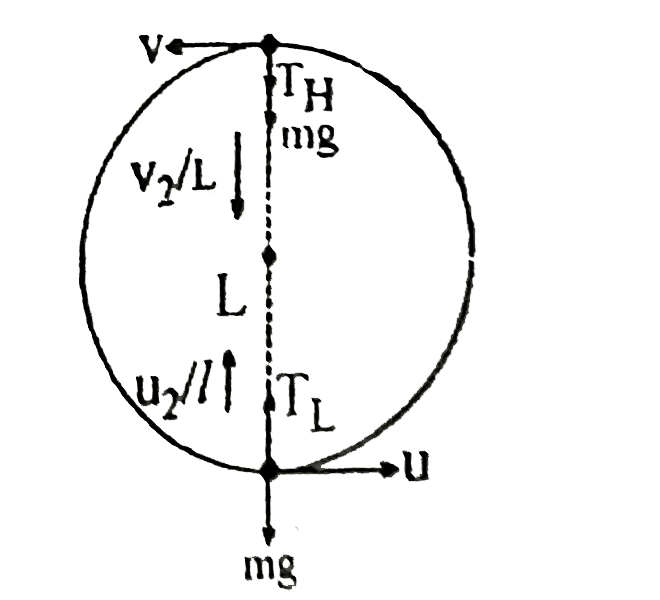
|
|
| 44. |
A battery of emf 10 V and internal resistance 3Omegais connected to a resistor. If the current in thecircuit is 0.5 A, find (i) the resistance of the resistor, (ii) the terminal voltage of the battery. |
|
Answer» SOLUTION :Here emf`epsi`= 10 V, internal resistance r = 3`Omega` and current drawn I = .5 A (i) As `I = (epsi)/(R + r) ` HENCE `0.5 = (10)/(R+3) rArr R = 17 Omega` (ii) The internal voltage of BATTERY `V = epsi - IR = 10 - 0.5 xx 3 = 8.5 V` |
|
| 45. |
The practical simple pendulum is a |
|
Answer» heavy metallic sphere SUSPENDED from a LIGHT weight slightly extensible STRING |
|
| 46. |
Assertion:Nuclear sources will give a million times larger energy than conventional sources. Reason:Nuclear energy sources are massive than conventional energy sources. |
|
Answer» If both assertion and REASON are true and reason is the correct explanation of assertion . |
|
| 47. |
A beam of alpha-particle projected along +x - axis, experiences a force due to a magnetic field along the +y-axis. What is the direction of the magnetic field? |
Answer» Solution :As `alpha`-particle are PROJECTED along +x-AXIS and foece experienced under a magnetic FIELD is along + y AIXS, so from Fleming.s left HAND rule magnetic field is along - z axis. 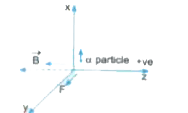
|
|
| 48. |
For which of the following dependences of drift velocity v_(d) on electric field E, is Ohm's law obeyed? |
|
Answer» `v_(d) PROP E` |
|
| 49. |
Radium ""^(226) Ra , spontaneously decays to radon with the emission of an alpha- particle and a gamma-ray . If the speed of the alpha particle upon emission from an initially stationary radium nucleus is 1.5 xx 10^(7) m/s, what is the recoil speed of the resultant radon nucleus ? Assume the momentum of gamma ray is negligible compared to that of alpha particle |
|
Answer» `2.0 xx 10^(5)` m/s |
|
| 50. |
THe S.I. unit of magnetic flux density is |
|
Answer» henry |
|