Saved Bookmarks
This section includes 7 InterviewSolutions, each offering curated multiple-choice questions to sharpen your Current Affairs knowledge and support exam preparation. Choose a topic below to get started.
| 1. |
Magnetic field lines are always nearly normal to the surface of a ferromagnet at every point.Why? |
| Answer» Solution :Proof of this important fact is based on boundary conditions of magnetic fields `(vecB and vecH)` at the INTERFACE of TWO media (When one of the media has , `mu gt gt ` 1, the field lines MEET this medium nearly NORMALLY.) | |
| 2. |
A basic communication system consists of (A) transmitter(B) information source (C) user of informatio (D) channel(E)receiver Choose the correct sequence in which these are arranged in a basic communication system |
|
Answer» ABCDE |
|
| 3. |
Two metallic spheres of radii 1 cm and 3 cm are given charges of -1xx10^(-2) C and 5xx10^(-2) C respectively . IF these are connected by a conducting wire the final charge on the bigger sphere is …………. . |
|
Answer» `3 xx 10^(-2)` C |
|
| 4. |
Consider the two following statements I and II, and identify the correct choice given in the answers 1. In photovoltaic cells, the photoelectric current produced is not proportional to the intensity of incident light. 2. In gas-filled photoemissive cells, the velocity of photoelectrons depends on the wavelength of the incident radiation. |
|
Answer» Both 1 and 2 are TRUE |
|
| 5. |
A small solid ball is released from rest while fully sub merged in a liquid and then its kinetic energy is measured when it has moved 2.0 cm in the liquid. Figure 14.46 gives the results after many liquids are used: The kinetic energy K is plotted versus the liquid density rho_(liq) and K_(s) = 2.4 J sets the scale on the vertical axis. What are (a) the density and (b) the volume of the ball? |
| Answer» Solution :(a) `1.5 g//cm^(3)` (or 1500 kg /`m^(3)) , (b) 8.16 XX 10^(-3) m^(3)` (or `8.16 xx 10^(-3) m^(3)` in TWO SIGNIFICANT digits) | |
| 6. |
Number of autosomes in human primary spermatocyte is |
|
Answer» 22 |
|
| 7. |
Two persons A and B are standing at the origin and 210 meter away from the origin along the y-axis, respectively. A starts to move along x axis with acceleration 3.2 m//s^(2) and thereafter with the same retardation and comes to rest after moving 320 m B moves with a constant velocity and catches A in 15 s. The speed of B is (10n)/(3)m//s. Find the value of n. |
|
Answer» |
|
| 8. |
The potential barrier at a P-n junction is due to the charges on either side of the junction. These charges are |
|
Answer» FIXED ions |
|
| 9. |
Ultraviolet light of 200 nm wavelength is incident on nickel surface having work function of 5.01 eV.Potential difference of ……… Volt should be applied to stop electron emitted with maximum speed. |
|
Answer» 2.4 V `=(12375)/(lambda (In Å))-5.01` `(12375)/(2000)-5.01` `=6.1875-5.01` `=1.1787~~1.2 V` |
|
| 10. |
At what temperature is the Fahrenheit scale reading equal to (a) three time that of the Celsius scale and (b) one-third that of the Celsius scale ? |
|
Answer» |
|
| 11. |
Derive an expression for magnetic dipole moment of a revolving electron. |
|
Answer» SOLUTION :Atom as a Magnetic Dipole Every atom consists of a central part, called nucleus, where the entire mass and positive charge of the atom are concentrated. An equal number of negative charges (i.e. electrons) revolve around the nucleus in CIRCULAR orbits. The revolution of electron i.e., negative charge in anticlockwise direction is equivalent to conventional current I in the clockwise direction. The upper face with clockwise current acts as south pole and the lower face acts as north pole. Thus an electron revolving in an orbit is equivalent to a magnetic dipole. 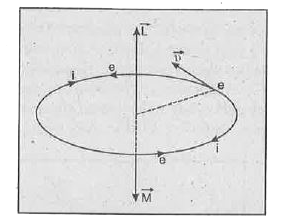 Suppose e is the charge on an electron revolving in a circular orbit of radius r with a uniform angular velocity, `omega`. If T is the time period of revolution of the electron, then Current = `"charge"/"time"` or `I=e/T` = `e/(2pi//omega)""(becauseT=(2pi)/omega)` or `I=(eomega)/(2pi)""...(1)` If M is the magnetic dipole moment of the magnetic dipole M = IA Using (1), and putting `A=pir^(2)`, we get `M=(eomega)/(2pi)pir^(2)` `M=1/2eomegar^(2)""...(2)` Relation between orbital angular momentum and magnetic dipole momentum. Because of orbital motion, the revolving electron has an orbital angular momentum L given by `L=mvr=mromegar=momegar^(2)` `therefore` From (2), `M=1/2e/mmomegar^(2)` `M=1/2e/mL` In vector form, `VECM=-(e/(2m))vecL""...(3)` This shows that like `vecL`, magnetic dipole moment `vecM` of the atom is perpendicular to the plane of the orbit. Negative sign shows that direction of `vecM` is opposite to the direction of `vecL` , as is clear from the figure. According to BOHR.s theory, an electron cannot revolve in any orbit it likes. It can revolve only in those orbits for which the total angular momentum is an integral multiple of `h//2pi`, where h is the Planck.s constant i.e. Angular momentum of the electron, `L=(nh)/(2pi)` or `mr^(2)omega=(nh)/(2pi)` (angular momentum, `L=mvxxr=mromegaxxr=mr^(2)omega`) where n = 1, 2, 3, ........ `therefore""r^(2)omega=(nh)/(2pim)""...(4)` From (2) and (4), `M=e/2*(nh)/(2pim)=n*(eh)/(4pim)=nmu_(B)""...(5)` It is obvious that `(eh)/(4pim)` is the least value of the magnetic moment. `(mu_(B)=9.27xx10^(-24)JT^(-1)orAm^(2))`. Bohr Magneton It is DEFINED as the magnetic dipole moment associated with an electron due to its orbital motion in the first orbit of hydrogen atom. |
|
| 12. |
What is the value of impedance of a resonant series LCR circuit? |
| Answer» SOLUTION :IMPEDANCE Z = RESISTANCE R | |
| 13. |
(a) In Young's double-slit experiment, describe briefly how bright and dark fringes are obtained on the screen kept in front of a double-slit. Hence obtain the expression for the fringe width. (b) The ratio of the intensities at minima to the maxima in the Young's double-slit experiment is 9:25. find the ratio of the widths of the two slits. |
|
Answer» Solution :(b) Here `(I_("min"))/(I_(MAX))=(9)/(25)`. Let the ratio of the widths of the two slits `(w_(1))/(w_(2))` be r. then `(I_("min"))/(I_(max))=((sqrt(r)-1)/(sqrt(r)+1))^(2)=(9)/(25)implies(sqrt(r)-1)/(sqrt(r)+1)=(3)/(5)implies sqrt(r)=4 or r=(w_(1))/(w_(2))=(16)/(1)`. |
|
| 14. |
A slab of material of dielectric constant K has the same area as the plates of a parallel-plate capacitor but has a thickness (3/4)d, where d is the separation of the plates. How is the capacitance changed when the slab is inserted between the plates? |
|
Answer» SOLUTION :Let `E_(0) = V_(0)//d`be the electric field between the plates when there is no dielectric and the potential difference is `V_(0)`. If the dielectric is now inserted, the electric field in the dielectric will be `E= E_(0)//K`. The potential difference will then be `V = E_(0)(1/4d) + E_(0)/K (3/4 d)` `E_(0)d(1/4 + 3/(4k)) =V_(0) (K+3)/(4K)` The potential difference decreases by the factor (K + 3)/4K while thefree CHARGE `Q_(0)`on the plates remains UNCHANGED. The capacitance THUS increases `C = Q_(0)/V = (4K)/(K+3). Q_(0)/V_(0) = (4K)/(K+3)C_(0)`. |
|
| 15. |
A luminous point source 's' is placed between a plane mirror and a screen in the situation as shown in figure. Then the length of screen which will receive direct light as well as reflected light is |
|
Answer» 50cm |
|
| 16. |
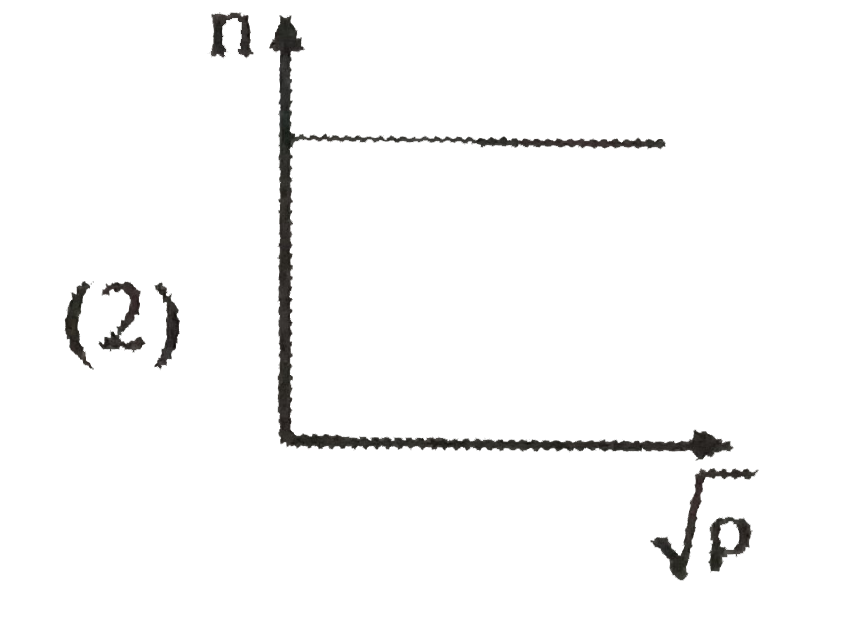
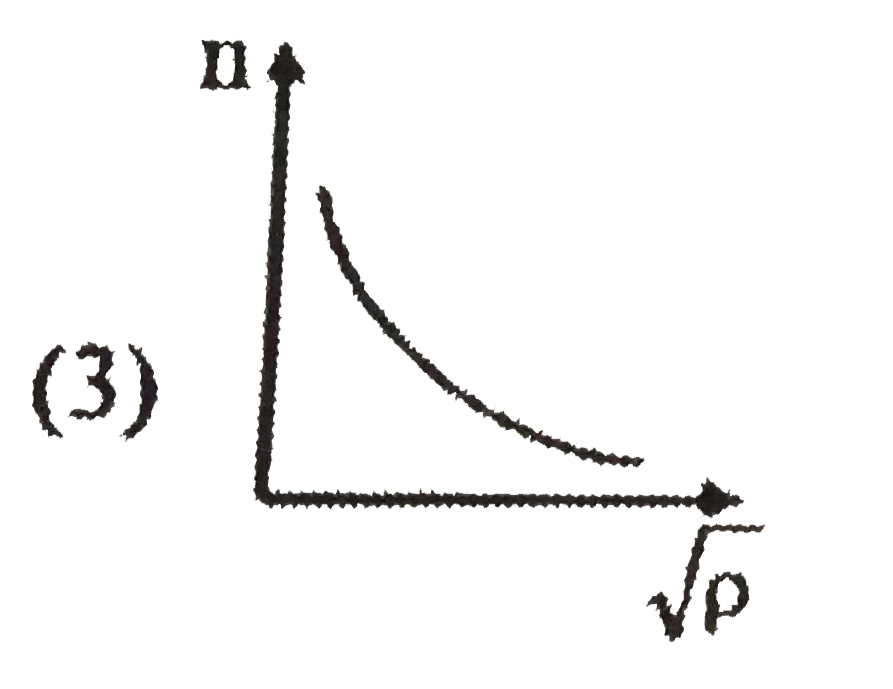
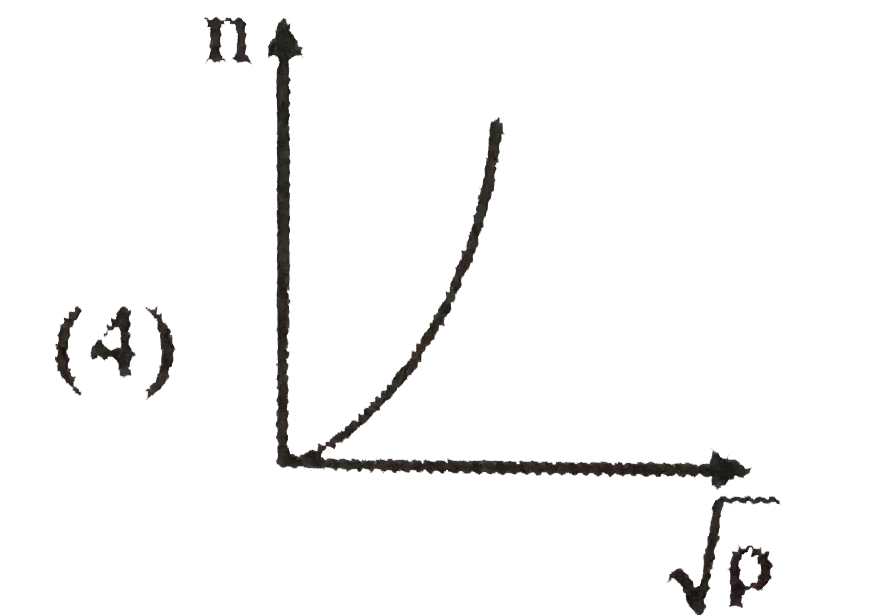
The correct graph between the frequecny n and square root of density (p) of a wire, keeping its length, radius and tension constant, is |
|
Answer»
`rArrnprop(1)/(SQRTP)` i.e., GRAPH between n and `sqrtp` will be hyperbola. |
|
| 17. |
For a p-type semiconductor, which of the following statements is true? |
|
Answer» Electrons are the majority carriers and PENTAVALENT atoms are the DOPANTS. "DOPANT" means suitable impurity to be ADDED with suitable AMOUNT. |
|
| 18. |
Electrostatic force is a…..force |
|
Answer» Conservative |
|
| 19. |
If vecB_(1),vecB_(2) and vecB_(3) are the magnetic field due to l_(1),l_(2) and l_(3), then in Ampere's circuital law ointvecB.vec(dl)=mu_(0)l, vecB is |
|
Answer» `vecB=vecB_(1)-vecB_(2)` |
|
| 20. |
A galvanometer of resistance 20Omega is shunted by a 2Omega resistor. What part of the main current flows through the galvanometer ? |
|
Answer» SOLUTION :`(i_(g))/i=G/(G+S)`. Given `G = 20Omega , S = 2OMEGA` `THEREFORE(i_(g))/i=2/22=1/11,1/11`TH part of CURRENT is passing through galvanometer. |
|
| 21. |
There is a hemisphere whose radius of curvature is r and inner side of it is made completely reflecting . A point source of light of power P is kept at the centre of curvature of hemisphere . Calculate the force exerted by the light falling on inner side of hemispherical surface. |
Answer» Solution :If P is power of point source , then intensity of light which means energy crossing per unit area per unit time can be WRITTEN as `P//4pir^2` . Let us select a small are `DeltaA` at angle `THETA` with the vertical radius of hemisphere as shown in the following figure: 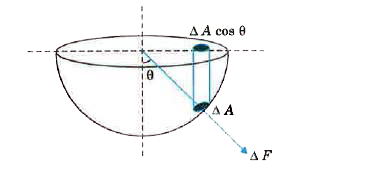 Amount of energy falling on this area will be `(PDeltaA)/(4pir^2)` per unit time . Hence , amount of linear momentum imparted to the surface per unit time can be written as `(PDeltaA)/(4pir^2c)` . Since surface is COMPLETELY reflecting and hence it will reflect back the light and hence rate of change of linear momentum will be double to this value , hence equal to `(2PDeltaA)/(4pir^2c)` . From Newton.s second law , we known that rate of chane of linear momentum is equal to the force exerted , and hence force exerted by the light on the surface area `DeltaA` selected can be written as follows : `DeltaF=(2PDeltaA)/(4pir^2c)` We can see that horizontal component of this force `DeltaF sin theta` will be balanced by the force on corresponding area selected on hemisphere due to symmetry , and hence CONTRIBUTION to the net force by this selected area will be `DeltaF COS theta` and direction will be vertically downward as per figure . Net vertical downward force applied by the light on this hemisphere can be calculated by summig up forces on such small areas selected . `F=sumDeltaFcostheta=sum(2PDeltaAcostheta)/(4pir^2c)` `F=(2P)/(4pir^2c)sumDeltaAcostheta""...(i)` In the above expression , we can see that `DeltaA cos theta` is projected area of selected are `DeltaA` as shown in figure . We can understand that total projected area will be `pir^2` and hence force can bewritten as follows : `F=(2P)/(4pir^2c)pir^2=P/(2c)` |
|
| 22. |
Two pulses in a stretched string, whose centres are initially 8cm apart, are moving towards each other as shown in the figure. The speed of each pulse is 2cm/s. After 2s the total energy of the pulses will be: |
|
Answer» zero |
|
| 23. |
Two identical conducting balls A and B have charges -Q and +3Qrespectively . They are brought in contact with each other and then separated by a distance dapart. Find the nature of the coulumb force between them. |
| Answer» Solution :Charge on either SPHERE after sharing =+Q. Hence FORCE between them is REPULSIVE in NATURE. | |
| 24. |
In the circuit shown in the figure, two resistors R_(1) and R_(2) have been connected in series to an ideal cell. When a voltmeter is connected across R_(1) its reading is V_(1) = 4.0 volt and when the same voltmeter is connected across R_(2) its reading is V_(2) = 6.0 volt. The reading of the voltmeter when it is connected across the cell is V_(3) = 12.0 volt. Find the actual across R_(1) in the circuit. |
|
Answer» |
|
| 25. |
A ball is moving in a circular path of radius 5 m. Iftangential acceleration at any instent is m//s^(2) and the net acceleration makes an angle 30^(@) with the centripetal accelaration, then the instantaneous speed is |
|
Answer» `50sqrt(3)m//s` |
|
| 26. |
Under minimum deviation condition in a prism, if a ray is incident at an angle 30^@ , the angle betweenthe emergent ray and the second refracting surface of the prism is |
| Answer» ANSWER :D | |
| 27. |
In a series LCR circuit, the voltage across an inductor, a capacitor and a resistor are 20 V, 20 V and 40 V, respectively. What is the phase difference between the applied voltage and the current in the circuit ? |
| Answer» Solution : Zero, because V and VC NULLIFY each other and effectively the circuit is resistive in NATURE. | |
| 28. |
Bombardment of lithium with protons gives rise to the following reaction : ._3Li^7 + ._1H^1 to 2 (._2He^4)+Q.Find the Q-value of the reaction. The atomic masses of lithium, proton and helium are 7.016 u, 1.008 u and 4.004 u respectively. |
|
Answer» 12.904 Mev |
|
| 29. |
A galvanometer having a resistance of20 Omega and 30 divisions on both sides has figure of merit 0.005 ampere/division. The resistance that should be connected in series such that it can be used as a voltmeter upto 15 volt, is |
|
Answer» `120 Omega` |
|
| 30. |
When a conducting loop of resistance 10 Omega and area 10 cm^(2) is removed from an external magnetic field acting normally, the variation of induced current in the loop with time is shown in the figure. Find the (i)total charge passed through the loop. (ii) change in magnetic flux through the loop. (iii) magnitude of the magnetic field applied. |
|
Answer» Solution :(i) Total charge pased through the loop q=Area of l-t graph `= (1)/(2)xx(1.0s) xx(0.4) A=0.2 C` (ii) Since |q| = `("Change in magnetic FLUX" Deltaphi_(B))/("Resistance of loop R") ` and R = 10 `Omega` `implies Delta phi_(B) = Rxxq = 10xx0.2 = 2.0 WB` (iii) Since `Delta phi_(B)= phi_(1)-phi_(2)` and `phi_(2)=0` `:. Deltaphi_(B)= phi_(1)= vecB_(1).vecA= B_(1) A cos theta` and here A =` 10 CM^(2) = 10^(-3) m^(2) ` and `theta = 0^(@)` i.e., cos `theta = 1` hence Magnitude of magnetic field `B_(1) = (phi_(1))/(A cos theta)= (Deltaphi_(B))/(A cos theta)= (2.0)/(10^(-3)xx1)= 2.0xx10^(3)` T |
|
| 31. |
An amplifier is represented by the adjoining circuit . r_(i) is the input resistance of the amplifier and the voltage v_(i) is appearing across it. This voltage is amplified by a factor of A_(v) and apears across the load as voltage v_(0). |
|
Answer» |
|
| 32. |
If work function of a metal plate is negligible, then find the K.E. of the photoelectrons emitted when radiations of 1000Å are incident on the metal surface |
|
Answer» 11.6 eV |
|
| 33. |
How does one cane understand the temperature dependence resistivity of a conductor ? |
|
Answer» Solution :Temperature dependence of resistivity: The resistivity of a material is DEPENDENT on temperature. It is experimentally found that for a wide range of temperatures, the resistivity of a conductor increases with increase in temperature according to the expression, `rho_(T)=rho_(0)[1+alpha(T-T_(0))] "" ...(1)` where `rho_(T)` is the resistivity of a conductor at `T_(0)C, rho_(0)` is the resistivity of the conductor at some reference temperature To (usually at `20^(@)C`) and `alpha` is the temperature coefficient of resistivity. It is DEFINED as the ratio of increase in resistivity per degree rise in temperature to its reisstivity at `T_(0)`. From the equation (1), we can write `rho_(T)-rho_(0)=alpha rho_(0)(T-T_(0))` `therefore alpha=(rho_(T)-rho_(0))/(rho_(0)(T-T_(0)))=(Delta rho)/(rho_(0)DeltaT)` where `Deltarho=rho_(T)-rho_(0)` is change in resistivity for a change in temperature `DeltaT=T-T_(0)`. Its unit is per `""^(@)C`. `alpha ` of conductors: For conductors `alpha` is positive. It the temperature of a conductor increases, the average KINETIC energy of electrons in the conductor increases. This results in more frequent collisions and hence the resistivity increases. Even though, the resistivity of conductors like metals varies linearly for wide range of temperatures, there also exists a nonlinear region at very low temperatures. The resistivity approaches some finite value as the temperature approaches absolute zero. As the resistance is directlyproportional to resistivity of the material, we can also write the resistance of a conductor at temperature`T^(@)C` as `R_(T)-R_(0) = [1+alpha(T-T_(0))]"" ...(2)` The temperature coefficient can be also be OBTAINED from the equation (2), `R_(T)-R_(0)=alpha R_(0)(T-T_(0))` `therefore alpha=(R_(T)-R_(0))/(R_(0)(T-T_(0)))=(DeltaR)/(R_(0)DeltaT)` `alpha= (DeltaR)/(R_(0)DeltaT)"" ...(3)` where `DeltaR=R_(T)-R_(0)` is change in resistance during the change in temperature `DeltaT=T-T_(0)` `alpha` of semiconductors: For semiconductors, the resistivity decreases with increase in temperature. As the temperature increases, more electrons will be liberated from their atoms (Refer unit 9 for conduction in semi conductors). Hence the current increases and therefore the resistivity decreases. a semiconductor with a negative temperature coefficient of resistance is called a thermistor. We can understand the temperature dependence of resistivity in the following way. The electrical conductivity, `sigma = (n e^(2)tau)/(m) (m)/(n e^(2)tau)`. As the resistivity is inverse of `sigma`, it can be written as, `sigma=(n e^(2)tau)/(m) (m)/(n e^(2)tau) "" ...(4)` The resistivity of materials is (i) inversely proportional to the number density (n) of the electrons (ii) inversely proportional to the average time between the collisions `(tau)`. In metals, if the temperature increases, the average time between the COLLISION `(tau)` decreases and n is independent of temperature. In semiconductors when temperature increases, n increases and `tau` decreases, but increase in n is dominant than decreasing `tau`, so that overall resisitivity decreases. |
|
| 34. |
Consider the situation shown in the figure. A mass is hanging from a inextensible string which is passing over a pulley. The pulley itself is attached to a massless spring of stiffness k as shown in the figure. Find the time period of vertical oscillations of mass m if pulley is slightly displaced from its mean position. Assume that string does not slip over pulley. |
Answer» Solution :At equilibrium POSITION let `x_(0)` be the deformation in the spring 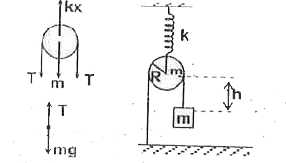 `:. x_(0) = (3mg)/(k)` Let the pulley is displaced by x then total energy of system `E = (-mg x + (1)/(2) mv^(2) + (1)/(2) l omega^(2)) + ((1)/(2) m (2v)^(2) - mg(h + 2x)) + (1)/(2) k (x_(0) + x)^(2)` As string does not slip over pulley so `omega = v//r`. So `E = (-mg x + (1)/(2) mv^(2) + (1)/(4) mv^(2)) + (2mv^(2) - mg (h + 2x) + (1)/(2) k (x_(0) + x)^(2))` `(dE)/(DT) = 0 , :. 0 = - mg + m (dv)/(dt) + (m)/(2) (dv)/(dt) - 2mg + 4m (dv)/(dt) + k (x_(0) + x)` `rArr kx + (m + (m)/(2) + 4m) (dv)/(dt) = 0` `rArr (dv)/(dt) = (2k)/(11m) x` `rArr omega = SQRT((2k)/(11m)) or T = 2pi sqrt((11m)/(2k))` |
|
| 35. |
The magnetic induction at a distance (d) from a short bar magnet in longitudinal and transverse positions are in the ratio : |
| Answer» ANSWER :C | |
| 36. |
A Yo-Yo of mass m has an axle of radius b and a spool of radius R. The Yo-Yo is placed upright on a table and string is pulled with a horizontal force vecF to the right as shown in figure. The static friction coefficient between Yo-Yo and table is mu_(s). Now there are two cases. case (a): The string is pulled very gently? case (b): The string is jerked hard? |
|
Answer» Clockwise in CASE (a) |
|
| 37. |
मन लीजिये कि U = { 1, 2, 3, 4, 5, 6, 7, 8, 9, 10 } और A = { 2, 3, 4, 5, 6, 7, 8 } है तो A होगा |
|
Answer» {3, 5, 7} |
|
| 38. |
A thin plano-convex lens acts like a concave mirror of focal length 0.2 m when silvered from its plane surface. The refractive index of the material of the lens is 1.5. The radius of curvature of the convex surface of the lens will be |
|
Answer» 0.4 |
|
| 39. |
A: When white light passes through lens then refraction of violet light is more than that of red light.R: For given lens, focal length of red light is more than that of violet light. |
|
Answer» Both ASSERTION and REASON are TRUE and the reason is CORRECT EXPLANATION of the assertion. |
|
| 40. |
In a moving coil galvanometer the current 'I' is related to the deflection theta as |
|
Answer» I `ALPHA THETA` |
|
| 41. |
Name the different series of lines observed in hydrogen spectrum. |
| Answer» SOLUTION :Lyman series, Balman series,PASCHEN series ,BRACKETT series ,PFUND series. | |
| 42. |
An AND gate |
|
Answer» IMPLEMENTS LOGIC addition |
|
| 43. |
For an electron is the second orbit of hydrogen, what is the moment of momentum as per the Bohr's model? |
|
Answer» `2 pi h` |
|
| 44. |
A tuning fork of frequency 440 Hz is attached to a long string of linear mass density 0.01 kg/m kept under a tension of 49 N. The fork produces transverse waves of amplitude 0.50 mm on the string. At what average rate is the tunig fork transmitting energy to the string? |
| Answer» SOLUTION :`0.67 W` | |
| 45. |
A tuning fork of frequency 440 Hz is attached to a long string of linear mass density 0.01 kg/m kept under a tension of 49 N. The fork produces transverse waves of amplitude 0.50 mm on the string. Find the maximum speed of the particle. |
| Answer» SOLUTION :`13.8 km//s` | |
| 46. |
A tuning fork of frequency 440 Hz is attached to a long string of linear mass density 0.01 kg/m kept under a tension of 49 N. The fork produces transverse waves of amplitude 0.50 mm on the string. Find the wave speed and the wavelength of the waves. |
| Answer» SOLUTION :`70 m//s,16 CM` | |
| 47. |
A block of weight 100N is pushed by a force F on a horizontal rough plane moves with an acceleration 1 m/s^2, when force is doubled its acceleration becomes 10m/s^2. The coefficient of friction is (g=10ms^(-2)) |
|
Answer» `0.2` |
|
| 48. |
Statement : Inside a charged conducting spherical shell electric potential at any point is (Kq)/( R) and at a point outside it, field is (Kq)/(r^(2)). Electri field inside the shell at any point is zero and outside it field is (Kq)/(r^(2)). Here K is (1)/(4piepsilon_(0))R. is the radius of shell and r the distance from centre of shell. Two concentric spherical shells of radii R and 2R have charges Q and 2Q as shown in figure. If we draw a graph between electric field E and distance r from the centre, it will be like : |
|
Answer»
|
|
| 49. |
Statement : Inside a charged conducting spherical shell electric potential at any point is (Kq)/( R) and at a point outside it, field is (Kq)/(r^(2)). Electri field inside the shell at any point is zero and outside it field is (Kq)/(r^(2)). Here K is (1)/(4piepsilon_(0))R. is the radius of shell and r the distance from centre of shell. Two concentric spherical shells of radii R and 2R have charges Q and 2Q as shown in figure. If we draw a graph between potential V and distance r from the centre, the graph will be like |
|
Answer»
|
|
| 50. |
Statement : Inside a charged conducting spherical shell electric potential at any point is (Kq)/( R) and at a point outside it, field is (Kq)/(r^(2)). Electri field inside the shell at any point is zero and outside it field is (Kq)/(r^(2)). Here K is (1)/(4piepsilon_(0))R. is the radius of shell and r the distance from centre of shell. Two concentric spherical shells of radii R and 2R have charges Q and 2Q as shown in figure. Choose the correct option |
|
Answer» At a distance r `(R lt r lt 2R)` from the centre ELECTRIC POTENTIAL is `(KQ)/(r^(2))` |
|