Saved Bookmarks
This section includes 7 InterviewSolutions, each offering curated multiple-choice questions to sharpen your Current Affairs knowledge and support exam preparation. Choose a topic below to get started.
| 1. |
Trivalent and pentavalent impuritiesare ….., respectively in terms of electric. |
|
Answer» NEGATIVE and POSITIVE |
|
| 2. |
Explain effect of potential on photoelectric current. |
Answer» Solution : Photoelectric effect is the phenomenon of emission of electrons by certain substances when they are illuminated by radiations like X-rays, ultraviolet raysand EVEN visible light.  Variation of Stopping Potential with the frequency of the incident radiation. Take radiations of different frequencies, say of `v_(1), v_(2),v_(3)` ... but of the same intensity. Study variation of photoelectric CURRENT and potential of PLATE Q for each frequency and plot. A graph as shown in the figure will be observed. If `v_(3) gt v_(2) gt v_(1)`the stopping potential `V_(3)` will-be observed to be most negative and `V_(1)` the least negative. This means HIGHER the frequency higher the energy of photoelectrons and more the negative have potential to be applied to stop it. |
|
| 4. |
Which of the following spectral series of hydrogen atom is lying in visible region of electromagnetic wave ? |
|
Answer» PASCHEN SERIES These lines were seen and studeies fro the first time by Balmer in 1885. The longest wavelength of this series (for N=3) is 6563 Å and the shortest wavelength `("for n="oo)` is 3646Å. So, Balmer series is present in visible range of electromagnetic wave. |
|
| 5. |
Statement (A): In a step up transformer primary is made of thick insulated copper wire and the secondary is made of thin wire. Statement (B): A step up transformer converts large current at low voltage to a low current at high voltage. |
|
Answer» A is TRUE, B is FALSE |
|
| 6. |
A current I = 100sqrt2 cos(omegat - phi) is passed through a D.C. ammeter . The ammeter will read : |
|
Answer» `100 SQRT2` |
|
| 7. |
What is power of a lens? |
|
Answer» SOLUTION :The power of a lens P is defined as the reciprocal of its focal LENGTH. `p = (1)/(F)` The unit of power is diopter D. |
|
| 8. |
A particle P is to be projected from a fixed point A on the ground with a fixed speed u. Another particle Q is also to be projected from a point B which is directly above the point A. The trajectory of the particle Q touches all possible trajectories (for different angle of projection) of the particle P in the vertical x-y plane. Find the equation of trajectory of the particle Q. (Take the point A as origin, horizontal axis x- axis and vertical axis y-axis Consider the figure.) |
|
Answer» Solution :In order for the TRAHECTORY of `Q` to touch that of `P` when the latter is projected vertically upward, `Q` must be projected horizontally from the highest point. To visualize this, consider the trajectories of `P` as the angle of projection of `P`(`theta`,say), approaches `90^(@)` (i.e. for vertical projection).Let `Q` be projected horizontally from `B` with a SPEED `V`, where `A=(u^(3))/(2g)`. The point of impact of `Q` on the horizontal plane represents the point of maximum range for `P` along the horizontal. `OC=(u^(2))/(g)=vsqrt((2h)/(g))`, where `h=(u^(2))/(2g)` i.e., `v=u` The TRAJECTORY of `Q` is `(u^(2))/(2g)-y=(1)/(2)"gt"^(2)`. where `t=x//v(v-=u)` 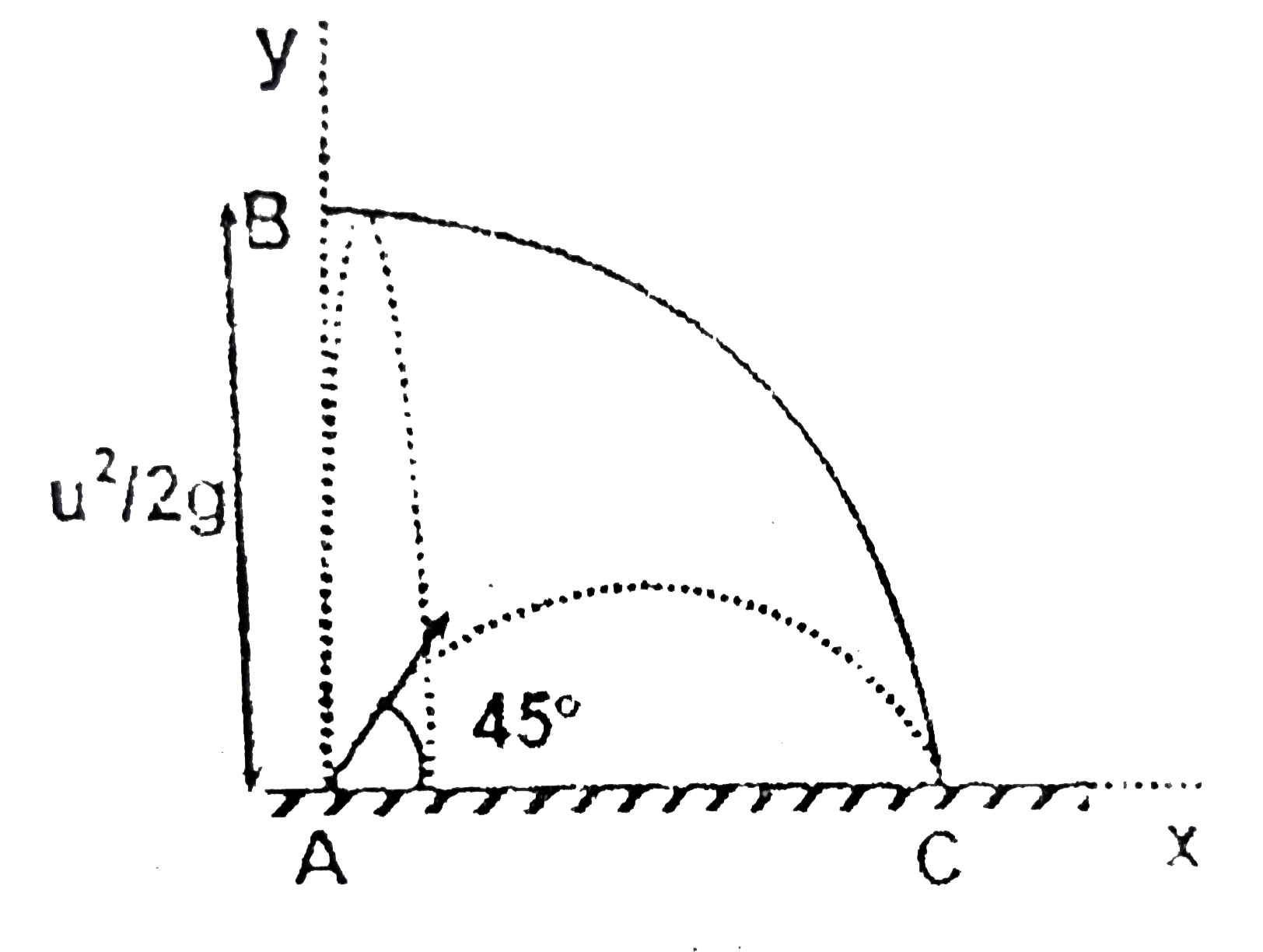
|
|
| 9. |
(a) Draw the ray diagram of an astronomical telescope when the final images is formed at infinity. Write the expression for the resolving power of the telescope. (b) An astronomical telescope has an objective lens of focal length 20m and eyepiece offocal length 1 cm. (i) Find the angular magnification of the telescope. (ii) If this telescope is used to view the Moon, find the diameter of the image formed by the objective lens. Given the diameter of the Moon is 3.5 xx 10^(6) m and the radius of lunar orbit is 3.8 xx 10^(8)m. |
Answer» Solution :(a) A ray digram of an astronomical telescope when the final image is formed at infinity is drawn here.  Resolving POWER of the telescope is given as: R.R. `=A/(1.22 lambda)` where A is the aperature (diameter) of the objective LENS of telescope and `lambda` is the wavelength of light coming from distant object. (b) Here `f_(0)=20cm, f_(e)=1cm=0.01m`, diameter of moon `D=3.5 xx 10^(6)m`, and distance of moon lunar orbbit `=d=3.8 xx 10^(8)m` (i) Angular agnification of telescope `=f_(0)/f_(e)=(20)/(0.01) =2000` (ii) Since image of moon is formed by the objective lens at its FOCAL PLANE. If diameter of image by `D_(V)`, then `D_(i)/f_(0)=D/d` `rArr D_(i)=(f_(0) xx D)/(d)=(20 xx 3.5 xx 10^(6))/(3.8 xx 10^(8)) =0.184 m=18.4m` |
|
| 10. |
Every rational number is a/an - |
|
Answer» Integer |
|
| 11. |
In Young's double slit experiment, the intensity of central maximum is I. What will be the intensity at the same place if one slit is closed ? |
| Answer» Answer :C | |
| 12. |
A myopic person has been using spectacles of power -1.0 dioptre for distance vision. During old age he also needs to use separate reading glass of power +2.0 dioptres. Explain what may have happened. |
| Answer» Solution :The far point of the person is 100 cm, While his point may have been normal (about 25 cm ). Objects at infinity produce virtual image at 100 cm (using spectacles ). To view CLOSER objects i.e., those which are (or WHOSE images using the spectacles are ) between 100 cm and 25 cm, the person uses the ability of ACCOMMODATION of his eye-lens. This ability usually gets partially lost in old age (PRESBYOPIA). the near point of the person RECEDES to 50 cm . To view objects at 25 cm clearly. the person needs converging lens of power + 2 dioptres. | |
| 13. |
A current which varies periodically with time and reverses its direction every half a cycle is called ……. , current . |
|
Answer» TRANSIENT |
|
| 15. |
Function x = Asin^(2)omegat + Bcos^(2)omegat + C sinomegat represents SHM |
|
Answer» for any value of `A,B` and `C` (EXCEPT `C = 0`) Choose different combination of `A, B` & `C` to get LINEAR combination of `sin` & `COS` functions. |
|
| 16. |
If 10^(9) electronsmove outof a body to another body every second how much time is requiredto get a total charge of 1 C on the otherbody |
| Answer» Solution :In onesecond`10^(9)` electrons move outof the BODY thereforethe charge given out in one seconds is `1.6 xx10^(-19) xx 10^(9) C=1.6 xx10^(-10) C`the time required to accumulate a charge of 1ccan thenbe estimeated to befrom a body from which `10^(9)`elelctons move out every second we will unit for many practical purposes it ishowever also importantto know what is roughtly the number of a cubic piece of coper of SIDE 1 CM contains about`2.5 xx10^(24)`electrons | |
| 17. |
The binding energy/nucleon of deuteron (""_(2)H^(4)) and the helium atom (He) are 1.1 MeV and 7 Mev respectively. If the two deuteron atoms fuse to form a single helium atom, then the energy released is : |
|
Answer» <P>26.9 MeV and BE/nucleon for `""_(2)He^(4)=7MeV` and `""_(1)H^(2) +""_(1)H^(2) to ""_(2)He^(4)+Q` `Q=BE_(p)-BE_(R)` `=4 XX 7-4 xx 1.1=23.6MeV` |
|
| 18. |
If we need a magnification of 375 from a microscope of tube length 15 cm and an objective of focal length 0.5 cm, what focal length eye lens should be used ? |
|
Answer» Solution :`M = - 375, L = 15 cm, f_(0) = 0.5 cm, f_(e) = ?, d = 25 cm` `M = (v_(0))/(-u_(0))(1 + (d)/(f_(e)))` As focal length of OBJECTIVE lens is small `u_(0) ~~ f_(0)`. ALSO, as focal length of EYE lens is small, `v_(0) ~~ L` `:. M = (L)/(- f_(0))(1 + (d)/(f_(e)))``- 375 = (15)/(- 0.5)(1 + (25)/(f_(e)))` `(25)/(f_(e)) = (375)/(30) - 1 = 11.5f_(e) = (25)/(11.5) = 2.2 cm` |
|
| 19. |
The heaviest and lightest strings on a certain violin have linear densities of 3.2 and 0.26 g/m. What is the ratio of the diameter of the heaviest string to that of the lightest string, assuming that the strings are of the same material? |
|
Answer» |
|
| 20. |
An object AB is placed parallel and close to the optical axis between focus f and center of curvatureC of a covering minor of focal length f as shown in the figure. Then |
|
Answer» IMAGE of A will be closer then that of B from the mirror |
|
| 21. |
Transformer is used to |
|
Answer» a. convert ac to DC VOLTAGE |
|
| 22. |
(a) the electron drift speed is estimated to be only a few mm s ^(-1) for currents in the range of a few amperes ? How then is current established almost the instnat a circuit is closed ? (b) The electron drift arises due to the force expectenced by electrons in the electric field inside the conductor. But force should cause acceleration. Why then do the electrons acqutre a steady average drift speed ? (c ) If the electron drift speed is so small, and the electrons's charge is small, how can we still obtain large amounts of current in a conductor ? (d) When electrons drift in a metal from lower to higher potential, does it mean that all the 'free' electrons of the metal are moving in the same direction ? (e) Are the paths of electrons straight lines between successive collisions (witht the positive ions of the metal) in the (i) absence of electric field, (ii) presence of electric field ? |
|
Answer» Solution :(a) ELECTRIC field is established throughout the circuit, almost instantly (with the speed of LIGHT) causing at every point a local electron drift, Establishment of a current does not have to wait for electrons from one end of the conductor travelling to the other end. However, mIt does take a little while for the current to reach its steady value. (B) Each .free. electron does accelerate, increasing its drift speed until It collides with a POSITIVE ion of the metal. It loses its drift speed after collision but starts to accelerate and increases its drift speed again only to suffer a collision again and so on. On the average, therefore, electrons acquire only a drift speed. (c) Simple, because the electron number density is enormous, ` ~~10 ^(29)m^(-3).` (d) By no means. The drift velocity is superposed over the large random VELOCITIES of electrons. (e) In the absence of electric field, the paths are straight lines, in the presence of electric field, the paths are, in general, curved. |
|
| 23. |
State Kirchhoff's rules. Use these rules to write the expressions for the currents I_1,I_2and I_3in the circuit diagram shown in Fig. |
|
Answer» SOLUTION :In the network given here as per Kirchhoff.s first law, we have `I_3 = I_1 + I_2`....(i) In LOOP ECDEF, we have `- 1- 3I_2 - 2I_3 + 4 = 0` `rArr 2I_3 + 3I_2 = 3 `...(ii) Again in loop EABFE, we have ` - 2 - 4I_1 - 2I_3 + 4 = 0` ` rArr 2I_3 + 4I_1 = 2 `...(iii) On solving these equations, we GET`I_1 = 2/13 A, I_2 = 7/13 A` and `I_3= 9/13A` |
|
| 24. |
The limit of resolution of a 100 cm telescope for lamda = 5000 A is approximately equal to : |
|
Answer» 0.14'' |
|
| 25. |
An alternating e.m.f. is applied to an inductance (L) and capacitance © joined in series. It is foundthat the current through them is maximum for particular value of frequency (f). If L and C are connected in parallel to the same source, then at what frequency the current through the combination is minimum ? |
|
Answer» f/2 |
|
| 26. |
In a p-n junction diode, the currentI can be expressed as I=I_(0)exp ((eV)/(2K_(B)T)-1) whereI_(0)is called the reversesaturation current,V is the voltage across the diodeandis positive for forward bias and negative for reverse biase,and I is the current through the diode, k_(B) is the Boltzmannconstant ( 8.6 xx10^(-5) eV//K) and T is the absolute temperature. If fora given diodeI_(0)=5 xx10^(-12) A and T = 300K, then (i) What will be the forward current at a forward voltage of 0.6V? (b) What will be the increase in the current if the voltage across the diode is increasedto 0.7 V ? (c ) What is the dynamic resistance ? (d) What will be the current if reverse biase voltage changes from 1V to 2V ? |
|
Answer» Solution :Given `I_(0) =5xx 10^(-12) A,T=300K ` `K_(B) = 8.6xx 10^(-5) EV//K =8.6xx 10^(-5) xx 1.6 xx10^(-19) J//K ` (a) Given, voltage `V= 0.6 V ` `(eV)/(K_(B) T)=( 1.5 xx 10^(-19) xx0.6)/(8.6 xx 10^(-5) xx 1.6 xx 10^(-19) xx 300)=23.26` The CURRENT I through a junction diode is given by `I= l_(0)e((e_(v))/(2K_(B)T)-1)= 5xx 10^(-12) ( e^(23.26)-1)= 5xx 10^(-12)( 1.259xx10^(-10)-1)` Change in current`Delta I = 3.025 -0.693 = 2.9A ` (b) Given voltage `V =0.7 V ` `(eV)/( K_(B)T)= ( 1.6xx10^(-19)xx0.7)/( 8.6 xx 10^(-5)xx1.6 xx10^(-19) xx 300) = 27.14 ` Now, `1=I_(0)( eV)/(K_(B)T)-1 =5xx10^(-12) ( e^(27.14 ) -1)` `=5 xx 10^(-12) ( 6.07 xx 10^(11) -1)` `=5 xx 10^(-12)xx 5.07 xx 10^(11) =0.035 A ` Change in current `Delta I =3.035 -0.693 =2.9A` (c )`DeltaI =2.9 A `,voltage`DELTAV= 0.7 - 0.6 =0.1V ` Dynamicresistance `R_(d) = ( Delta V )/(Delta I) = ( 0.1)/( 2.9 ) =0.0336Omega ` (d) As the voltage CHANGES from 1V to 2V , the current 1 will be almostequal to`I_(0) = 5 xx 10^(-12) A ` It is due to that the diodepossesses practically infinite resistance in the reverse bias . |
|
| 27. |
The percentage of empty space in BCC arrangement is- |
|
Answer» 74 |
|
| 28. |
If we deuterium nuclei get close enough to each other, the attraction of the strong nuclear force will fuse them to make an isotope of helium. This process releases a huge amount of energy. The range of nuclear force is 10^(-15) m. This is the principle behind the nuclear fusion reactor. The deuterium nuclei moves to fast that, it is not possible to contain them by physical walls. Therefore they are confined magnetically (Assume coulomb law to hold even at 10^(-18) m) Which of the following strength of magnetic field will make deuterium nuclei moving at minimum possible speed in pervious question, to be confined in a circle of diameter 2.5m |
|
Answer» 122mT |
|
| 29. |
The velocity of sound in diatomic gas is 300 m/s, the root mean square velocity of molecules is of order of : |
|
Answer» 440 m/s `therefore (C_(rms))/(C_("sound")) = sqrt((3)/(gamma))` ` C_(rms) = 300 sqrt((3)/(1.44)) = 437 ms^(-1)` Hence the correct choice is (a) . |
|
| 30. |
Three charges Q, +q and +q are placed at the vertices of an equilateral triangle of side I as shown in the figure. If the net electrostatic energy of the system is zero, then Q is equal to |
| Answer» ANSWER :D | |
| 31. |
If we deuterium nuclei get close enough to each other, the attraction of the strong nuclear force will fuse them to make an isotope of helium. This process releases a huge amount of energy. The range of nuclear force is 10^(-15) m. This is the principle behind the nuclear fusion reactor. The deuterium nuclei moves to fast that, it is not possible to contain them by physical walls. Therefore they are confined magnetically (Assume coulomb law to hold even at 10^(-18) m) Two deuterium nuclei having same speed undergo a head on collision. Which of the following is closest to the minimum value of v (in km/sec) for which fusion occurs |
|
Answer» 1000 |
|
| 32. |
When a tiny circular obstacle is placed in the path of light froma distant source,a bright spot is seen at the centre of the obstacle. Explain why. |
| Answer» SOLUTION :Waves DIFFRACTED from the EDGE of the circular obstacle produce constructive interference at the centre and form a BRIGHT spot. | |
| 33. |
A charged 30 muF capacitor is connected to a 27 mH inductor. What is the angular freuqency of free oscillations of the circuit? |
|
Answer» Solution :For free LC oscillations, `omega = ( 1)/( sqrt( LC))` ` = ( 1)/( sqrt(27 xx 10^(-3) xx 30 xx 10^(-6)))` `= (1)/(sqrt(81 xx 10^(-8)))` `= ( 10000)/( 9)` `= 1111 ( rad)/(s)` `= 1.111 xx 10^(3) ( rad )/(s)` |
|
| 34. |
Which photons is more energetic ? A red or violet ? |
| Answer» SOLUTION :VIOLET photon has more energy, because energy of photon E= hv = `V_voilet > V_red` | |
| 35. |
A point object is placed at a distance of 24 cm from a convex surface of a medium (mu = 1.5) andradius of curvature 24 cm in air. What is the distance of image position from the pole ? |
|
Answer» real image, 36 CM in air |
|
| 36. |
Transverse waves are generated in two steel wires A and B by attaching their free ends to a vibrating source of frequency 500 Hz. The diameter of A is half that of B and tension on B is double that on A. What is the ratio of the velocities of waves in wires A and B? |
|
Answer» `1:2` |
|
| 37. |
Figure given here shows the variation of velocity of a particle with time. Find the following: (i) Displacement during the time intervals. (a) 0 to 2 sec., (b) 2 to 4 sec. and (c) 4 to 7 sec (ii) Accelerations at (a)t = 1 sec, (b) t = 3 sec. and (c)t = 6 sec. (iii) Average acceleration (a) between t = 0 to t = 4 sec. (b) between t = 0 to t = 7 sec. (iv) Average velocity during the motion. |
|
Answer» Solution :(i)DISPLACEMENT =Area enclosed between v-t GRAPH and time axis. (ii) Acceleration = slope of v-t curve (iii) AVERAGE acceleration=`"TOTAL change in velocity"/"Total time"` (iv) Average velocity =`"Total displacement "/"Total time "` |
|
| 38. |
Range of conductivity of conductors is ………. |
|
Answer» `10^(-2)` to `10^(-4)` |
|
| 39. |
A composition string is made up by joining two strings of different masses per unit length 1g/ mand 4 g/m. The composite string is under the same tension. A transverse wave pulse : Y = (6 mm) sin(5t + 40x), where it is in seconds and 'x' in meters, is sent along the lighter string towards the joint. The joint is at x = 0. The equation of the wave pulse reflected from the joint is |
|
Answer» (2 MM) sin(5T – 40x) |
|
| 40. |
The current in a coil of self inductance 0.1H varries from 2A to 5 Ain a time of 1ms.Find the induced emf across the coil. |
| Answer» SOLUTION :`absepsilon=L(dI//dt)`=`0.1(5-2)//1xx10^-3`=300V | |
| 41. |
A rod lies along the X-axis with one end at the origin and the other at x rarr oo. It carries a uniform charge lambda Cm^(-1). The electric field at the point x=-a on the axis will be |
|
Answer» `E=lambda/(4PI epsi_(0)a) (-HAT(i))` |
|
| 42. |
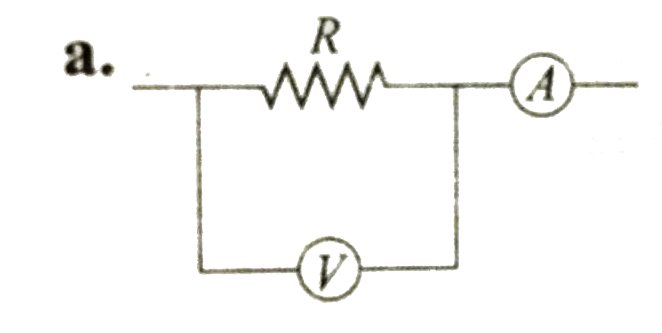
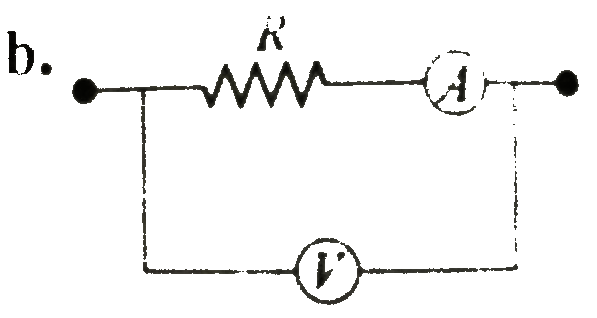
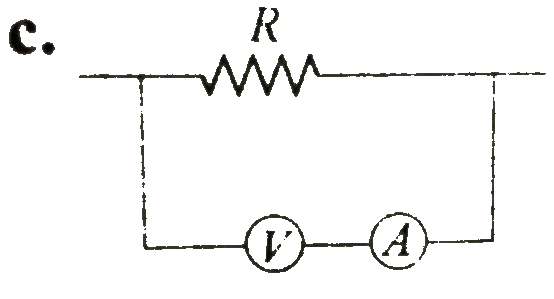
Which of the following circuits gives the correct value of resistance, when computed by using R = (V//I) where V and I are voltmeter and ammeter reading, respectively? The meters are not ideal. |
|
Answer»
third ONE is absolutely WRONG. So, none of the circuit diagrams is giving correct value of R. |
|
| 43. |
A parallel platecapacitor of capacitance 90 pF is connected to a battery of emf 20 V. If a dielectricmaterial of dielectric constant K =(5)/(3) is inserted between the plates the magnitude of the charge will be : |
|
Answer» `1.2 ` nC `= (5)/(3) xx90 xx10^(-12) xx20` `3000xx10^(-12)C = 3 n C `  Current INDUCED in dielectric `Q - Q (1- (1)/(K))` `= 3 n C (1-(1)/(5//3))` `= 3 (1-(3)/(5))n C ` `= 3xx(2)/(5) n C = 1.2 n C ` |
|
| 44. |
Calculate the current drawn by the primary of a transformer, which steps down 200 V to 20 V to operate a device of resistance 10 Omega.Assume the efficiency of the transformer to be 80%. |
|
Answer» SOLUTION :Here, `V_(p) = 200 V, V_(s) = 20V`, efficiency `eta = 80% = 80/100 = 0.8` and resistance in secondary circuit `R = 20 Omega` `therefore I_(s) = V/R = (20 V)/(20 Omega) = 1A` As efficiency `eta = ("OUTPUT")/("Input") =(V_(s).I_(s))/(V_(p).I_(p)) rArr I_(p) =(V_(s).I_(s))/(V_(p).eta) = (20 xx 1)/(200 xx 0.8) = 0.125 A` |
|
| 45. |
In a transistor connected in CE mode,R_C=4KOmega, R_1=1KOmega,I_C=1mAand I_B=20muA.The voltage gain is |
|
Answer» 100 |
|
| 46. |
What will happen to the focal length of concave mirror when it isimmersed in water ? |
|
Answer» |
|
| 47. |
In a p-type semi-conductor, with an increase in temperature |
|
Answer» The concentration of HOLES INCREASES while that of CONDUCTION electrons REMAINS constant |
|
| 49. |
In Young's double slit experiment, 62 fringes are seen in visible region for sodium light of wavelength 5893 Å. If violet light of wavelength 4359 Å is used in place of sodium light, then what is the number of fringes seen? |
| Answer» SOLUTION :To obtan SUSTAINED INTERFERENCE. | |