

Saved Bookmarks
This section includes 7 InterviewSolutions, each offering curated multiple-choice questions to sharpen your Current Affairs knowledge and support exam preparation. Choose a topic below to get started.
| 1. |
What is the effect on the interference pattern observed in a Young's double-slit experiment in the following cases: (i) screen is moved away from the plane of the slits, (ii) separation between the slits is increased, (iii) width of the slits are doubled. Give reason for your answer. |
|
Answer» SOLUTION :(i) As fringe width `BETA=(lamdaD)/(d)`, hence `betapropD`. Thus, as the screen is moved away from the plane of the slits, the fringe width increases. (II) As fringe width `betaprop(1)/(d)`. Thus, as the separation between the slits is increased, the fringe width decreases. (iii) Each slit of the double-slit produces its own diffraction effect. ANGULAR width of central diffraction band due to each slit `theta=(lamda)/(a)` where a=width of each slit) should be much more that the angular width of interference band `alpha=(lamda)/(d)`. it is so because waves from two slits will interfere only when they DIFFRACT widely so as to superimpose on one another. hence, for good visibility and formation of good quality interference fringes `(lamda)/(a) gt gt (lamda)/(d)` and it leads to the combination of narrow slits and each narrow slit forms its own intererence pattern. due to their overlapping resultant pattern becomes blurred. |
|
| 2. |
प्रतिमुखी कोशिकाएँ वह होती है, जो उपस्थित होती है |
|
Answer» निभागी छोर पर |
|
| 3. |
An electric dipole is held in a uniform electric field. Show that the net force acting on it is zero. |
|
Answer» Solution :Consider an ELECTRIC dipole AB HELD in a uniform electric field held at an angle `theta` with the direction of electric field `vec E`. Now FORCE acting on +Q charge, `F_1 = qE` along direction of `vec E ` and force acting on -q charge, `F_2 = qE` in a direction opposite to that of `vec E`. SINCE `F_1 and F_2` are equal but in mutually opposite directions, hence the net linear force acting on the electric dipole will be zero. |
|
| 4. |
The isotope ""_(90)^(238)U decays successively to form ""_(90)^(234)Th, ""_(91)^(234),Pa""_(92)^(234)U,""_(90)^(230)Th and ""_(88)^(226)Ra. What are the radiations emitted in these steps ? |
|
Answer» |
|
| 5. |
The half life of polonium is 140 days. In what timewill 15 g of polonium be disintegrated out of its initial mass of 16 g ? |
|
Answer» 230 days As `m/m_0=(1/2)^N` or `1/16=(1/2)^4=(1/2)^n` `rArr` n=4 Time taken to disintegrate = `T_(1//2)xxn = 140 xx 4` =560 days |
|
| 6. |
If vec(A).vec(B)=|vec(A)xxvec(B)|, then the resultant of vec(A) and vec(B) is: |
|
Answer» `vec(A) + vec(B)` `IMPLIES costheta=sinthetaimplies theta=45^@` `:. R=sqrt(A^(2) + B^(2) + 2AB cos45^@)` `R=sqrt(A^(2) + B^(2) + sqrt(2)AB)` |
|
| 7. |
A ray of light falls on a transparent glass slab of refractive index 1.62. What is the angle of incidence if the reflected ray and refracted ray are mutually perpendicular? |
|
Answer» `TAN^(-1)(1.62)` `i+R=90^(@)` `r=(90^(@)-i)` From Snel's law `mu=(sin i)/(sin r)=(sin i)/(sin(90^(@)-i))` `=(sin i)/(cos i)=tan i` `mu=tani` `i=tan^(-1)(mu)` `i=tan^(-1)(1.62)` 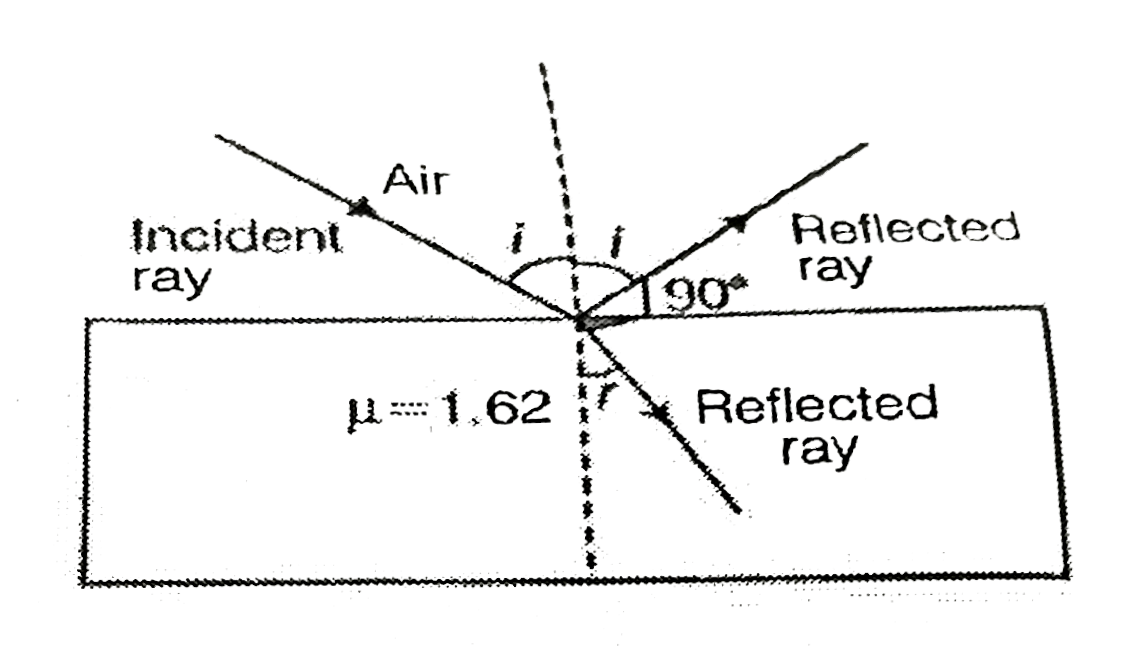
|
|
| 8. |
Find the current through R_(0) when the rod rotates through an angle theta . Therod AD is pushed with initial angular velocity omega_(0) at the position AC on a semicircular conductor about A in a uniform magnetic field perpendicular to the plane of semicircular loop. The length of the rod is r and resistance R & the rod rotates in a horizontal plane . [ Ignore the resistance of semicircular conductor ). |
|
Answer» |
|
| 9. |
The speed of sound in oxygen (O_(2)) at a certain temperature is 460 ms^(-1). The speed of sound in helium (He) at the same temperature will be (assumed both gases to be ideal) |
| Answer» Answer :A | |
| 10. |
Obtain the relation of phase between instantaneous current and voltage with the help of phase diagram for series LCR circuit. |
Answer» Solution :In circuit L-C-R are in series. Therefore, the ACT current in each element is the same at any time having the same amplitude and PHASE.  Let it be `I = I_(m ) sin ( omega t + phi )`…(1) where `phi` is the phase difference between the voltage across the source and the current in the circuit. Let `vec(I )`be the phasor representing the current in the circuit and `vec( V_(L)) , vec( V_(C )) , vec( V_(R )) ` and `vec( V )`represent the voltage across the inductor, resistor, capacitor and the source respectively. `vec( V _(R ))` is PARALLEL to `vec( I )` `vec( V_(C ))` is `( pi )/( 2)`behind ` vec( I)` and `vec( V_(L))` is `( pi )/(2)` aheadof `vec(I)`. `vec( V_(L)), vec( V_(C )), vec( V_(R ))` and `vec( I)` are shown in figure with appropriate phase relation.  The amplitude of phasor are as follow. `V_(RM) = I_(m) R, V_(CM ) = I_(m) X_(c ), V_(Lm) = I_(m) X_(L)` The voltage equation for the circuit can be written as, `L(dI)/( dt) + IR + ( q)/( C ) = V ` can be written as below `vec(V_(L)) + vec( V_(R )) + vec( V_(C )) = vec( V )`where `V_(L) = L(dI)/( dt) , V_(R ) = IR `and `V_( C ) = ( q )/( C )` `:. ` The phasor relation `vec( V_(L)) + vec( V_(R )) + vec( V_(C )) = vec( V )` This relation is represented in below figure.  Since `vec( V_( C ))` and `vec( V_(L))` are in opposite directions, so the resultant value of phasor. `vec( V _(C )) - vec( V_(1)) = V_(Cm ) - V_(Lm)` Since `vec( V )` is representedas the hypotenuse of a right triangle whose sides are `vec( R )` and `vec( V_(C ))+ vec( V _(L))` the Pythagorean theorem gives. `V_(m)^(2)= V_(Rm)^(2) + ( V_(Cm ) - V_(Lm))^(2)` `:. V_(m)^(2) = ( I_(m)R)^(2) + [(I_(m) X_(C ))-(I_(m)X_(L))]^(2)` `:. V_(m)^(2)= I_(m)^(2) [ R ^(2) + ( X_(C ) - X_(L))^(2) ]` `:. I_(m)^(2) = ( V_(m)^(2))/(R^(2) + ( X_(C )-X_(L))^(2))` `:. I_(m)= ( V_(m))/([R^(2) + ( X_(C )-X_(L))^(2) ]^((1)/(2)))` but `SQRT(R^(2) + ( X_(C )-X_(L))^(2)) =Z`where Z is called impedance. `:. I_(m) = ( V_(m))/(Z)` is the amplitude of current. Since phasor `vec(I)` is always parallel to phaosr `vec( V_( R ))` the phase angle `phi` is the angle between `vec( V_(R ))` and `vec( V )` can be determined from figure,  `tan phi = ( V_(Cm ) - V_(Lm))/(V_(Rm))` `= ( I_(m) X_(C ) - I_(m) X_(L))/(I_(m)R )` `:. tan phi = ( X_(C ) - X_(L))/(R )` gives phase angle. Impedance Z of circuit can be determinedby figure. This is called impedance diagram which is a right triangle with Z as its hypotenuse. Impedance from impedance diagram, `Z = sqrt( R^(2) + (X_(C ) - X_(L))^(2))` |
|
| 11. |
Luminous Intensity is measured in |
|
Answer» Lumen |
|
| 12. |
Two nicols are so oriented that the maximum amount of light is transmitted .To what fraction of its maximum value is the intensity of the transimitted light reduced when the analyser is rotated through (i) 45^(@) (ii)90^(@) (iii)180^(@) |
|
Answer» |
|
| 13. |
A charged particle enters into a uniform magnetic foeld and experiences an upward force as indicated in the Fig. What is the charge sign on the partcle ? |
| Answer» Solution :`+v e` CHARGE in ACCORDANCE with Flaming.s LEFT HAND RULE. | |
| 14. |
The wavelength of sodium light is 589 nm in air. What will be the wavelength of sodium light if it travels in glass of refractive index 1.5? |
|
Answer» 589 NM |
|
| 15. |
A radioactive substance x decays into another radioactive substance y. Initially only x was present lamda_(x) and lamda_(y)are the disintegration constants of X and Y. N_(x) and N_yare the number of nuclei of X and Y at any time t. At the time of number of nuclei N_ywill be maximum write the relation between known quantities. |
|
Answer» |
|
| 16. |
Figure shows a charge array known as an 'electric quadrupole'. For a point on the axis of the quadrupole, obtain the dependence of potential on r for r/a gt gt 1, and contrast your results with that due to an electric dipole, and an electric monopole (i.e., a single charge). |
|
Answer» Solution :For the ELECTRIC QUADRUPOLE SHOWN in the above figure, net electric potential at point P is `V = 1/(4pi epsi_0)[q/((r+a)) -(2q)/r + q/((r-a))]= q/(4pi epsi_0)[1/(r + a) + 1/(r-a) - 2/r]` `=q/(4piepsi_0)[(r(r-a) + r(r + a) -2(r^2 - a^2))/(r(r^2 - a^2))]=q/(4piepsi_0).(2a^2)/(r(r^2-a^2))` `=(q.2a^2)/(4piepsi_0r^3(1- a^2/r^2)) = (2qa^2)/(4pi epsi_0 r^3(1 - a^2/r^2))` For` r/agt gt 1`i.e.,`a/r gt gt 1` we have : `V = (2qa^2)/(4piepsi_0r^3)` Thus, `V prop 1/r^3` i.e., electric potential due to a quadrupole is inversely proportional to the cube of the distance along its AXIS. However, for a dipole `V prop 1/r^2` and for a MONOPOLE `V prop 1/r`. |
|
| 17. |
A double convex lens of focal length 30 cmis made of glass. When it is immersed in a liquid of refractive index 1.4, the focallength is found to be 126 cm.The critical angle between glass and the liquid is |
|
Answer» `SIN^(-1)(3/4)` |
|
| 18. |
Obtain an epressionfor thefrequencyof radiationemitted whena hydrogen atom de- excites from levle(n-1). Forlarge n, show thatthis frequency equals to classical frequency of revolutionof the electron in the orbit . |
|
Answer» Solution :We know that energy of an electron in hydrogenatom in in level is given by `E_(n) = ( me^(4))/(8 in_(0)^(2) n^(2) h^(2))` `THEREFORE `Frequency of radiation emiited when a hydrogen ATOM de - excits from level n to level (n -1) . ` v = (1)/(h) [E_(n) - E_(n-1)] = (m e^(4))/( 8in_(0)^(2) h^(3))[(1)/((n-1)) - (1)/(n^(2))] = (m e^(4))/(8 in_(0)^(2) h^(3)). ((2n-1))/(n^(2) (n-1)^(2))` If n is very LARGE , then `1 lt lt n`andhence , the aboverelationis modified as . `v = (m e^(4))/(4 in_(0)^(2) h^(2))` As perclassical model of atom , linear SPEED of electron in an ORBITOF radius r is given by . ` v= (e)/(sqrt(4 pi in_(0) mr))` andfrequency of radiation = frequencyof orbitat motionof electron . `v_(0) = (v)/(2pir) = sqrt((e^(2))/(16pi^(2) in_(0) mr^(3)))` If we calculatethe value of v and `v_(0)`thenwe findthat theanswerare almostthe same . |
|
| 19. |
The K.E. of photoelecttron emitted from a metal are K_(1) and K_(2) ,when it is irradiated with lights of wavelength lambda_(1) and lambda_(2) respectively .The work function of metal is ….. |
|
Answer» `(K_(1)lambda_(1)-K_(2)lambda_(2))/(lambda_(2)-lambda_(1))` `THEREFORE hc=philambda_(1)+K_(1)lambda_(1)` and `hc=philambda_(2)+K_(2)lambda_(2)` `therefore philambda_(1)+K_(1)lambda_(1)=philambda_(2)+K_(2)lambda_(2)` `therefore phi=(K_(1)lambda_(1)-K_(2)lambda_(2))/(lambda_(2)-lambda_(1))` |
|
| 20. |
मौलिक इकाई कोशिका में संकुलन दक्षता होती है |
|
Answer» 0 .54 |
|
| 21. |
For L-C-R A.C. circuit resonance frequency is 5000 Hz and frequencies at half power points are 4950 Hz and 5050 Hz. The Q-factor is …… |
|
Answer» 100 `=f_0/(f_2-f_1)` `=5000/(5050-4950)` `=5000/100` =50 |
|
| 22. |
Three capacitors of 2pF,3pF and 4pF are connected in parallel . What is the total capacitance of a network? |
|
Answer» `9PF` |
|
| 23. |
(a) Find the current I supplied by the battery in the network as shown in steady state. (b) Find the steady state charge on the capacitor. (c) Find the initial current through the battery. |
Answer» Solution :Here we do not have a simple RC circuit as seen in Section 27.7. So, we cannot apply Eqs. 27-43 and 27-44 here. We have studied in Section 27.7 that an uncharged  capacitor will intially behave LIKE short circuit and after a long time behave lika a broken wire. Calcualations (a) Once the capacitor is CHARGED, no current will go through it and the current through the middle branch of the circuit is zero in steady state. The `4 Omega` resistor will have no current in it and may be omitted for current analysis. The `2 Omega and 6 Omega` resistors are therefore connected in series and hence `i=(2V)/(2 Omega+6Omega)=0.25A` (B) The potential drop the across the `6Omega" resistor is "6Omega =0.25A=1.5V`. As there is no current in the `4 Omega` resistor there is no potential drop across it. The potential difference acrossthe capacitor is, therefore, 1.5V. The charge on this capacitor is `Q=CV=2muF xx 1.5V=3muC` (c) At the initial moment, an uncharged capacitor can be assumed to be short circuited. So, the EQUIVALENT reisistance of the circuit will be `4.4Omega`. The current through the battery will be `(2)/(4.4)A=0.45 A` |
|
| 24. |
A hollow charged conductor has a tiny hole cut into its surface. Show that the electric field in the hole is (sigma//epsi epsi_(0))hat(n), where hat(n) is the unit vector in the outward normal direction and sigma is the surface charge density near the hole. |
|
Answer» <P> Solution :Surface charge density NEAR the hole `=sigma`Unit vector `=hat(n)` (normal directed outwards) LET P be the point on the hole the electric field at point P closed to the surface of conductor, according to Gauss's theorem, `oint E.dS=q/epsi_(0)` where q is the charge near the hole. `E ds cos theta=(sigma dS)/epsi_(0)( :' sigma =q/(dS) :. q =sigma dS)` where `dS =` area `:'` Angle between electric field and area vector is `0^(@)`. `EdS=(sigma dS)/epsi_(0)` `E=sigma/epsi_(0)` `E=sigma/epsi_(0) hat(n)` This electric field is DUE to the filled up hole and the field due to the rest of the charged conductor. The two fields inside the conductor are equal and opposite. So, there is no electric field inside the conductor. Outside the conductor, the electric fields are equal and area in the same direction. So, the electric field at P due to each part `=1/2 E=sigma/(2 epsi_(0)) hat(n)` 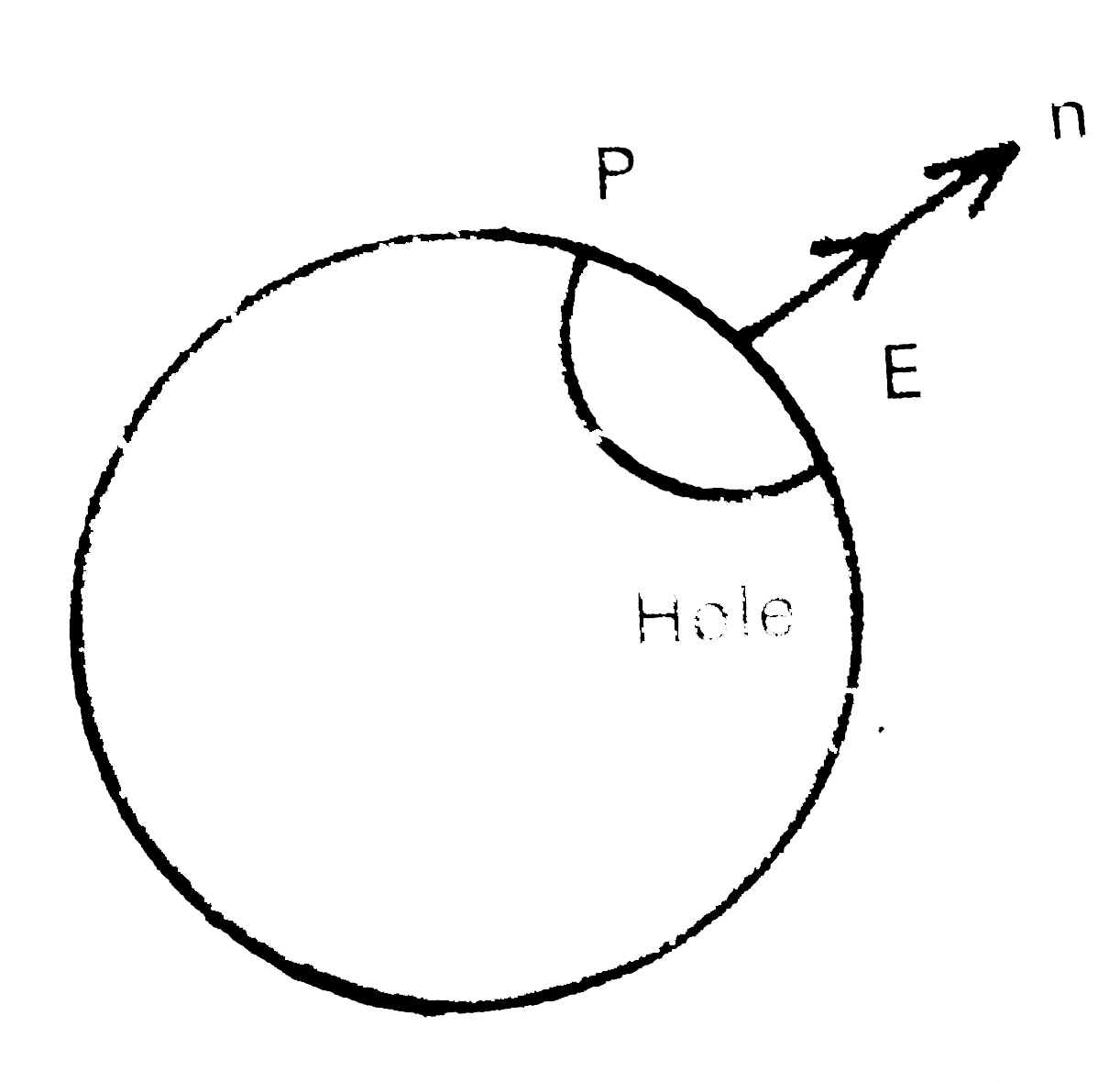
|
|
| 25. |
Which of the following statements are is not correct about a photon? |
|
Answer» PHOTON exerts no pressure. |
|
| 26. |
A fuse with a circular cross-sectional radius of 0.15 mm blows at 15A. What is the radius of a fuse, made of same material which will blow at 120 A? |
|
Answer» SOLUTION :For FUSE WIRE `Ipropr^(2//3)` so `(r_(2))/(r_(1))`=`((I_(2))/(I_(1)))^(2//3)`=`((120)/(15))^(2//3)`=`(8)^(2//3)`=4`rArr` `r_(2)`=`4r_(1)`=0.60mm |
|
| 27. |
A zener diode offers ______ resistance for voltages V lt V_(z) : and offers _____resistance for voltages V gt V_(z). |
| Answer» SOLUTION : HIGH, LOW | |
| 28. |
माना f = {(1, 1), (2, 3), (0, -1), (-1, -3)} समुच्चय Z से Z मे इसप्रकारफलन हो कि f(x) = ax + b), जहाँ a,bEZ, तब a,b है , |
|
Answer» 1,2 |
|
| 29. |
The magnetic potential at an equatorial point due to a short magnetic dipole is : |
|
Answer» `V = mu_0/(4PI) M/r^2` |
|
| 30. |
Two particles are executing simple harmonic motion. At an instant of time t their displacement are y_(1)=a cos(omegat) and""y_(2)=a sin(omegat) Then the phase difference between y_(1) and y_(2) is: |
|
Answer» `120^(@)` `y_(2)=a sin omegat`. `:.` Phase difference between `y_(1)` and `y_(2)` is `90^(@)` Correct CHOICE is (a). |
|
| 31. |
A wheel of radius 2m having 8 conducting concentric spokes is rotating about its geometrical axis with an angular velocity of 10 rad/s in a uniform magnetic field of 0.2T perpendicular to its plane. The value of induced emf between the rim of the wheel and centre is ......... V |
|
Answer» 2 |
|
| 32. |
Three point charges +q, -2q and +q are placed at points (x = 0,y = a,z = 0), (x = 0,y = 0,z = 0)and.(x=a,y =0, z = 0) dipole moment vector of this charge assembly are : |
|
Answer» `SQRT(2q)`a along the LINE joining points .(x = 0,y = 0,Z = 0)and(x = a,y = a,z = 0) |
|
| 33. |
If momentum of alpha,beta and gamma waves is equal then which out of these will have maximum wavelength? |
|
Answer» ALPHA rays `P=(hf)/(c )` For photon `lambda=(H)/(p)` (de-Broglie wavelength) If momentum of both is equal then de-Broglie wavelength also will be equal `alpha` and `Beta` particle have equal de-Broglie wavelength and photon (`gamma`-rays) can be considered having equal wavelength. |
|
| 34. |
An astronomical telescope in normal adjustment hasa tube length of 93 cm and magnification (angular) of 30. If the eye-piece is to be drawn out by 3 cm to focus a near object, with the final image at infinity, find how far away is the object and the magnification (angular) is this case. |
|
Answer» |
|
| 35. |
A charge Q is uniformly distributed over the surface of nonconducting disc of the radius R. The disc rotates about an axis perpendicular to its planes and passing through its centre with an angular velocity omega. As a result of this rotation a magnetic field of induction B is obtained at the centre of the disc if we keep both the amount of charge placed on the disk and its angular velocity to be constant and varying the radius of the disc then the variation of the magnetic induction at the centre of the disc will be represented by the figure. |
|
Answer»
|
|
| 36. |
A man is slipping on a frictionless inclined plane and a bag falls down from the same height. Then the velocity of both is related as (V_(B)= velocity of bag and V_(m)= velocity of man) |
|
Answer» `V_(M) LT V_(B)` |
|
| 37. |
Explain why alkali metals are most suitable for photoelectric emission. |
| Answer» Solution :WORK function of alkali metals are LOW. When visible light INCIDENT on it, they EMIT PHOTOELECTRONS. | |
| 38. |
A conducting sphere of radius 10 cm has an unknown charges. If the electric field 20 cm from the centre of the sphere is 1.5 xx10^(3)N//Cand points radially inward, What is the net charges on the sphere? |
|
Answer» Solution :Here radius of sphere ` R= 10 cm =0.1 m, `distance of point from the centre of sphere `r=20 cm -0.2 mand `electric FIELD E = ` 1.5 XX 10^(3) N//C ` As`r lt R , `hence E = `(Q)/(4pi in _0 r^(2))` `rArr "" q= E. 4pi in _0r^(2)=(1.5 xx10^(3) xx(0.2)^(2))/(9xx10^(9)) =6.67 xx10^(-9) C or 6.67 nC ` As electric field points radially inward, it means that the charges is negative. |
|
| 39. |
A polarized light of intensityI_(0) is passed through another polarizer whose pass axis makes an angle of 60^(@) with the pass axis of the former. What is the intensity ofpolarized light from second polarizer ? |
|
Answer» `I = I_(0)` |
|
| 40. |
A sphere of mass m of radius 'R' is dropped in a liquid then terminal velocity of sphere is proportional to |
|
Answer» a)R |
|
| 41. |
Two soap bubbles of radii r_(1) and r_(2) equal to 4 cm and 5 cm respectively are touching each other over a commonsurface AB (shown in fig.) Its radius will be : |
| Answer» Answer :D | |
| 42. |
In a series LCR circuit, at resonant frequency: |
|
Answer» the IMPEDANCE and the CURRENT are maximum |
|
| 43. |
(A): Potential near infinetly long charged rod is not defined (B): Potential difference between two points at distance a & b from infinetly long charged rod is (lambda)/(2rhoepsilon_(0))xin((b)/(a)) |
| Answer» Answer :B | |
| 44. |
Assertion (A) : Ultraiolet radiations are used for LASIK eye surgery. Reason (R ) : Being of shorter wavelength, UV radiations can be focussed into very narrow beams for high precision applications. |
|
Answer» If both assertion and RASON are TRUE and the REASON is the correct EXPLANATION of the assertion. |
|
| 45. |
A machine which is 75 % efficient uses 12 J of energy lifting up a 1 kg mass through a certain distance . The mass is then allowed to fall through that distance. What will be its velocity at end of fall: |
|
Answer» `sqrt(24) m//s` `1/2mv^(2)=9impliesv=sqrt((2xx9)/(1))=sqrt(18)ms^(-1)`. |
|
| 46. |
A nucleus of " "_(92)^(238)U, originally at rest, emits an alpha-particle with a speed nu. Recoil speed of the daughter nucleus will be |
|
Answer» `(4nu)/234` |
|
| 47. |
The ratio between the base - emitter voltage to the corresponding change in base current is …………… . |
|
Answer» INPUT IMPEDANCE |
|
| 48. |
(A ): The Earth without its atmosphere would be inhospitably cold. (R) : All the heat radiated and reflected by earth would escape in the absence of atmosphere. |
|
Answer» Both 'A' and 'R' are TRUE and 'R' is the CORRECT EXPLANATION of 'A'. |
|
| 49. |
स्क्रोटम का तापमान जो वृषण के क्रियात्मक रहने हेतु आवश्यक होता है, सदैव शरीर के तापमान से लगभग कम होता है। |
|
Answer» `2^(@)C` |
|
| 50. |
the voltage across the capacitor, which is equal to V, is kept constant in the process. |
|
Answer» ` ( in _0 SV^(2)( ( 1)/( x_1)-( 1)/(x_2) ))/( 2 ) ` |
|


