

Saved Bookmarks
This section includes 7 InterviewSolutions, each offering curated multiple-choice questions to sharpen your Current Affairs knowledge and support exam preparation. Choose a topic below to get started.
| 1. |
Two small balls A and B of positivecharge Q each and masses m and 2m respectively are connected by a non conducting light rod of length L. Thissystem is released in a uniform electric field of strength E as shown. Just after the release (assume no other force acts on the system) |
|
Answer» rod has zero angular ACCELERATION `a_C=(2QE)/(3m)` (towards right) As per CONSERVATION of angular MOMENTUM `QE((2L)/3)-QE(L/3)=[mxx(4L^2)/9+2mxxL^2/9]alpha` `rArr alpha =(QE)/(2mL)` (clockwise) From constrant equation, we get `a_A=a_C+alpha ((2L)/3)` `=(2QE)/(3m)+(QE)/(2mL)((2L)/3)` `=(3QE)/(3m)=(QE)/m` (towards right) 
|
|
| 2. |
A uniform rope of mass m and length L hangs from a ceiling. (a) Show that the speed of a transverse wave on the rope is a function of y, the distance from the lower end, and is given by v=sqrt(gy). (b) Show that the time a transverse wave takes to travel the length of the rope is given by t=2 sqrt(L//g). |
|
Answer» |
|
| 3. |
A hydrogen atom initially in the ground level absorbs a photon, which excites it to the n=4 level. Determine the wavelength and frequency of photon. |
|
Answer» Solution : As initially the hydrogen atom is in its ground STATE n = 1, its initial energy `E_(i)=- (13.6)/((1)^(2))= - 13.6 eV` . On excitation to n = 4 LEVEL, new energy of electron becomes `E_(f) = (13.6)/((4)^(2))= -0.85 eV` . `therefore ` Energyof photon absorbed `E = E_(f) - E_(i) = (-0.85) - (-13.6) eV` ` = 12.75 eV = 12.75 xx 1.6 xx 10^(-9)J` `therefore ` Frequencyof absorbed photo `v = (E)/(H) = (12.75 xx 1.6 xx 10^(-19))/(6.63 xx 10^(-34)) = 3.1 xx 10^(15 )HZ` and`""` wavelenght`lambda = (c)/(v) = (3 xx 10^(8))/(3.1 xx 10^(15)) = 9.7 xx 10^(-8) m` |
|
| 4. |
Calculate the smallest kinetic energy which an electron may have and still excite a hydrogen atom initially at rest. What minimum kinetic energy is necessary to ionize the hydrogen atom? |
| Answer» SOLUTION :10.2 EV, 13.6 eV | |
| 5. |
समीकरण को संतुलित करना क्यों आवश्यक है |
|
Answer» द्रव्यमान सरक्षित रहता है |
|
| 6. |
An a.c. I = I_(m) sin omega tproduces certain heat H in a resistor R over a time T= (2pi)/omega.Write the valueof d.c. that would produce the same heat in the same resistor in the same time. |
| Answer» Solution :EQUIVALENT VALUE of d.c `=I_("effective") = I_(omega)/sqrt(2)` | |
| 7. |
What is the condition of balanced wheatstone's bridge? |
| Answer» SOLUTION :[P/Q=R/S] | |
| 8. |
Obtain the law of radioactivity. Law of radioactive decay |
|
Answer» Solution :Law of radioactive decay: At any INSTANT t, the number of decays per unit time, called rate of decay `((dN)/(dt))` is proportional to the number of nuclei (N) at the same instant. `(dN)/(dt)prop N` By introducing a PROPORTIONALITY constant, the relation can be written as `(dN)/(dt)=-lambdaN` ...(1) Here proportionality constant `lambda` is called decay constant which is different for different radioactive sample and the NEGATIVE sign in the equation implies that the N is decreasing with time. By rewriting the equation (1), we get `dN = -lambdaNdt` ...(2) Here dN REPRESENTS the number of nuclei decaying in the time interval dt. Let us assume that at time t = 0 s, the number of nuclei present in the radioactive sample is `N_(0)` . By integrating the equation (2), we can calculate the number of undecayed nuclei N at any time t. From equation (2), we get `(dN)/N=-lambdadt` ...(3) `int_(N_(0))^(N) (dN)/N=- int_(0)^(1)lambdadt` `In[N/N_(0)]=-lambdat` Taking exponentials on both sides, we get `N=N_(0)e^(-lambdat)`...(4) Equation (4) is called the law of radioactive decay. Here N denotes the number of undecayed nuclei present at any time t and No denotes the number of nuclei at initial time t = 0. Note that the number of atoms is decreasing exponentially over the time. This implies that the time taken for all the radioactive nuclei to decay will be infinite. Equation (4) is plotted. We can also define another USEFUL quantity called activity (R) or decay rate which is the number of nuclei decayed per second and it is denoted as R=`|(dN)/(dt)|` Note: that activity R is a positive quantity. From equation (4), we get `R=|(dN)/(dt)|=lambdaN_(0)e^(-lambdat)`...(5) `R=R_(0)e^(-lambdat)`...(6) `R_(0)=lambdaN_(0)` The equation (6) is also equivalent to radioactive law of decay. Here Ro is the activity of the sample at t = 0 and R is the activity of the sample at any time t. From equation (6), activity also shows exponential decay behavior. The activity R also can be expressed in terms of number of undecaycd atoms present at any time t. From equation (6), since `N = N_(0)e^(-lambdat)` we write `R = lambdaN`...(7) Equation (4) implies that the activity at any time t is equal to the product of decay constant and number of undecaycd nuclei at the same time t. Since N decreases over time, R also decreases. 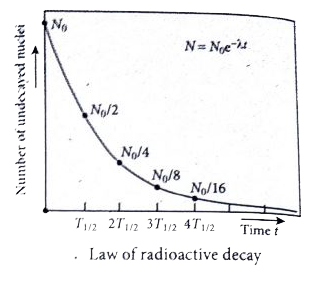
|
|
| 9. |
A block of metal is heated to a temperature much higher then the room temperature and placed in an evacuated cavity. The curve which correctly represents the rate of cooling ( T is temperature of the block and t is the time ) |
|
Answer»
`(dT)/dt=k.(T - T_(0))` where `k. = k/(ms) ` and negative sign shows the rate of heat loss. The given expression can be rearranged by integrating as, `int (dT)/(T-T_(0))= - k.int dt` `log_(e) (T-T_(0))=-k.t + log_(e)A (because log_(e) A =" Constant")` `-(dT)/(T-T_(0))=k.dt` `rArr ln (T-T_(0))=-k.t` `rArr T = e^(-k.t)+T_(0)" at " t rarr infty` `rArr T=T_(0)," at " t = 0 rArr T rarr infty ` Hence, the graph as shown below, shows TEMPERATURE of a body (done) varies exponentially with time from T to `T_(0) ( T_(0) lt T)`.  THUS, the correct option is (b). |
|
| 10. |
A convex lens is placed between an object and a screen which are a fixed distance apart. For one positioin of the lens the magnification of the image obtained of the screen is m_(1). When the lens is moved by a distance d, the magnification of the image obtained on the same screen is m_(2). The focal length of the lens is (m_(1)gtm_(2)) |
|
Answer» `d/((m_(1)-m_(2)))` |
|
| 11. |
A 3000 kg rocket is fired. If the exhaust speed is 500 ms^(-1), how much gas must be ejected per second to supply the thrust needed, (a) to overcome the weight of the rocket, (b) to give the rocket an initial acceleration of 19.6 ms^(-2)? |
|
Answer» 58.8 Kg/s , 176.4 Kg/s |
|
| 12. |
A sample of radioactive material has mass m, decay constant lambda, and molecular weight M. Avogadro constant =N_(A). The initial activity of the sample is: |
|
Answer» `LAMBDAM` where N = the TOTAL number of nuclei ALSO, N = number of MOLES x `N_A=(m/M)N_A` `therefore ` Initial activity=`(lambda mN_A)/M` |
|
| 13. |
Water is filled in uniform container of area of cross section A. A hole of cross section area (a lt lt lt A)is made in the container at a height of 20m above the base. Water stream out and hits a small block on surface at some distance from container. Block is moved on surface in such a way that stream always hits the block. The initial velocity of the block (in m//s) will be if (a)/(A)=(1)/(20).(g=10m//s^(2)) |
|
Answer» `t=sqrt((2xx20)/(10))=2sec` `S=2sqrt(2g(H-20))` `S^(2)=80 (H-20)` `S^(2)=80H-1600` `(ds)/(DT)=1m//s` 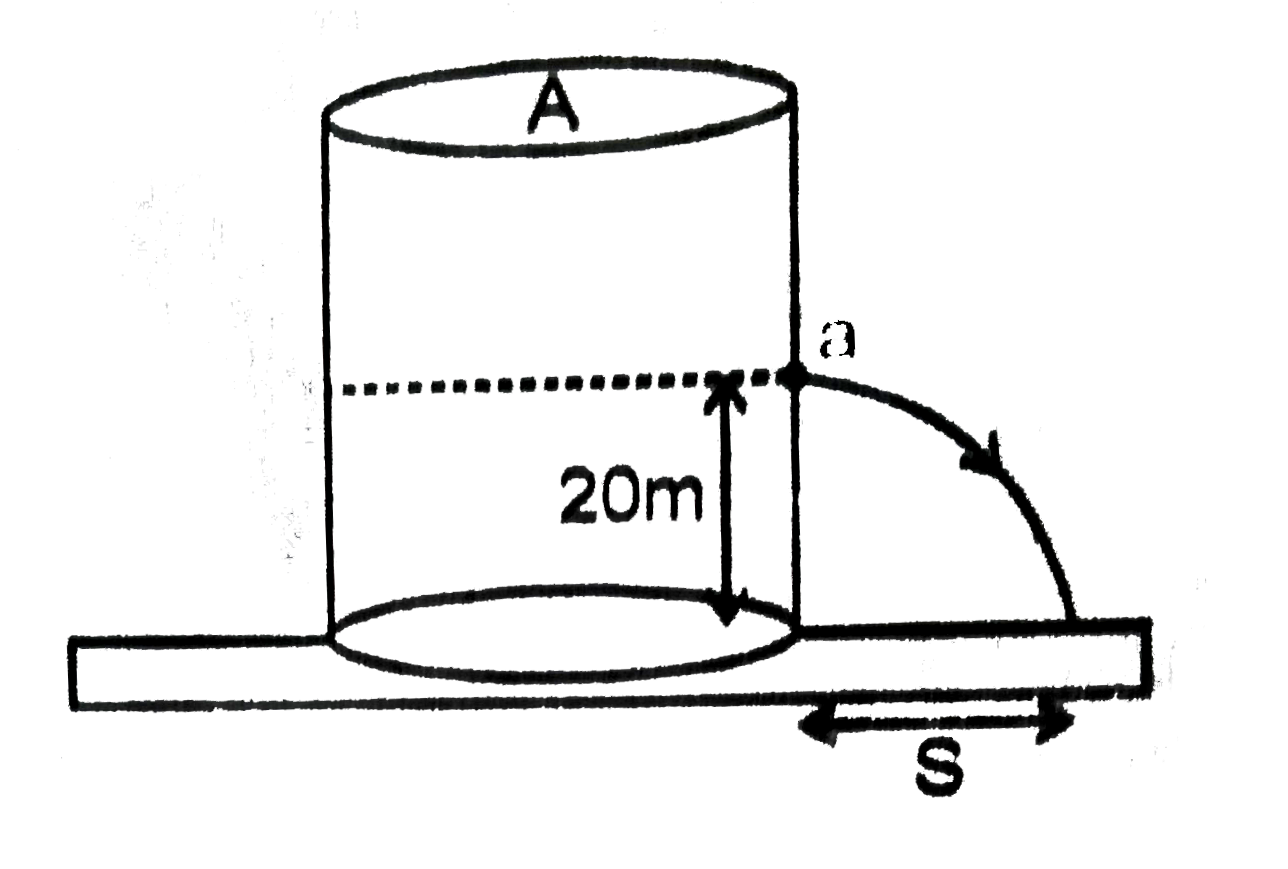
|
|
| 14. |
One mole of a monoatomic gas undergoes a linear process A rarr B in P - v diagram. The volume of the gas when the process turns from an endothermic to an exothermic one is |
|
Answer» `(5)/(8)v_(0)` 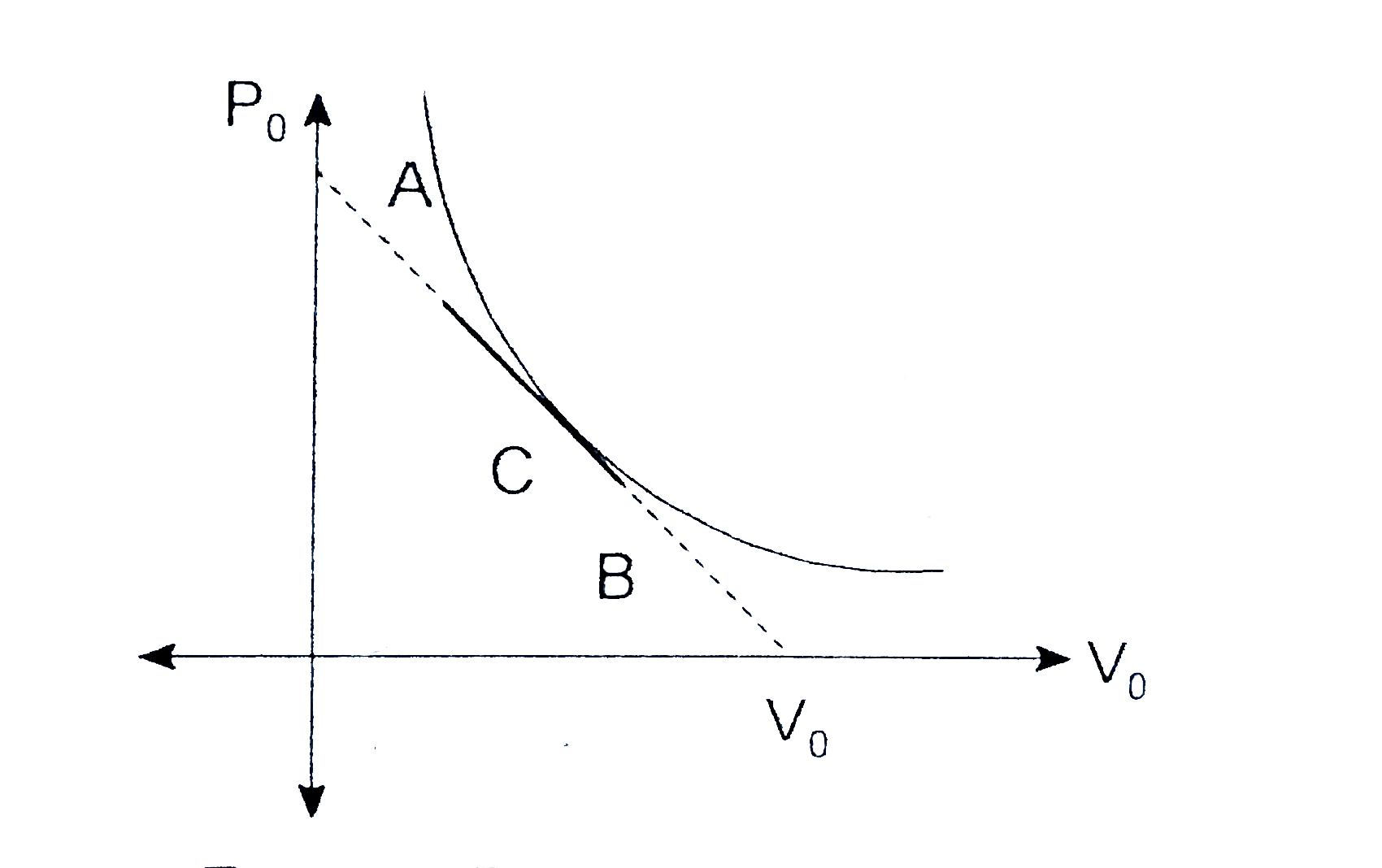 `-(P_(0))/(v_(0))=-gamma(P)/(V)` `-m=-(gamma(-mv+P_(0)))/(V) m =+(P_(0))/(V_(0))` `mv(1+gamma)=gammaP_(0) "" V=(gammaP_(0))/(m(1+gamma))=(5)/(8)V_(0)` |
|
| 15. |
A uniform electric field vecE exists between the plates of a charged condenser. A charged particle enters the space between the plates and perpendiculars to vecE. The path of the particle between the plates is a |
|
Answer» STRAIGHT line `y=1/2((QE)/m)(x/4)^(2)`  This is the equation of parabola. |
|
| 16. |
A motion is described by y = 3e^(x).e^(-3t) where y,x are in metre andt is in seconds. |
|
Answer» This REPRESENTS equation of progressive wave propagating along -X direction with `3MS^(-1)` |
|
| 17. |
How can you convert a galvanometer into an voltmeter? |
|
Answer» Solution :Conversion of galvanometer into ammeter and voltmeter : A galvanometer is very sensitive instrument to detect the current . It can be easily converted into ammeter and voltameter. (i) Galvanometer to an Ammeter: Ammeter is an instrument used to measure current flowing in the electrical circuit . the ammeter must offer low resistance such that it will not CHANGE the current PASSING through it. So ammeter is connected in series to measure the circuit current. A galvanometer is converted into an ammeter by connecting a low resistance in parallel with the galvanometer . this low resistance is called shunt resistance S. The scale is now calibrated in ampere and the range of ammeter depends on the values of the shunt resistance. Let I be the current passing through the circuit. When current I reaches the junction A.it divides into two components . Let `I_(g ) ` be the current passing through the galvanometer of resistance `R_(g)` through a path AGE and the REMAINING current `(I-I_(g))` passes along the path ACDE through shunt resistance S. the value of shunt resistance is so adjusted that current `I_(g)` produces full scale deflection in the galvanometer . the potential differenceacross galvanometer is same as the potential difference across shunt resistance. `V_("galvanometer") = V_("shunt") "" rArr I_(g) R_(g) = (I - I_(g)) S ` ` S = (I_(s))/((I - I_(g))) R_(g) (or ) I_(g) = (S)/(S + R_(g)) I rArrI_(g) prop I` Since, the deflection in to galvanometer is proportional to the current passing through it . `theta = (1)/(G) I_(g) rArr theta prop I g rArr theta prop I ` So, the deflection in the galvanometer measures the current I passing through the circuit (ammeter). Shunt resistance is connected in parallel to galvanometer. therefore, resistance of ammeter can be determined by computing the effective resistance, which is `(l)/(R_("eff")) = (1)/(R_(g))+ (1)/(S) rArr R_("eff") = (R_(g) S)/(R_(g) + S) = R_(a) ` Since, the shunt resistance is a very low resistance and the ratio `(S)/(R_(g))` is also small. This means , `R_(g)` is also small, i.e., the resistance offered by the ammeter is small. so, when we connect ammeter in series, the ammeter will not change the resistance appreciably and also the current in the circuit. for an ideal ammeter, the resistance must be equal to zero. Hence, th reading in ammeter is always lesser than the actual current in the circuit. Let `I_("ideal")` be current measured from ideal ammeter and `I_("actual")` be the actual current measured in the circuit by the ammeter . Then , the percentage error in measuring a current through an ammeter is ` (Delta I)/(I) XX 100%= (I_("ideal") - I_("actual"))/(I_("actual")) xx 100%` (ii) Galvanometer to a voltmeter : A voltmeter is an instrument used to measure potential difference across any two points in the electrial circuits. it should not draw any current from the circuit otherwise the value of potential difference to be measured will change . Voltmeter must have high resistance and when it is connected i parallel, it will not draw appreciable current so that it will indicate the true potential difference. A galvanometer. is converted into a voltmeter by connecting high resistance `R_(h)` in series with galvanometer. the scale is now calibrated in volt and the range of voltmeter depends on the values of the resistance connected in series i.e., the value of resistance is so adjusted that only current `I_(g)` produces full scale deflection in the galvanometer. Let `R_(g)` be the resistance of galvanometer and `I_(g)` be the current with which the galvanometer produces full scale deflection . since the galvanometer is connected in series with high resistance , the current in the electrical circuit is same as the current passing through the galvanometer. I `= I_(g)` I = `I_(g)rArr I_(g) = ("Potential difference ")/("total resistance ") ` Since the galvanometer and high resistance are connected in series, the total resistance or effective resistance gives the resistance of voltmeter. The voltmeter resistance is `R_(v) = R_(g) + R_(h)` Therefore, `I_(g) = (V)/(R_(g) + R_(v)) rArr R_(h) = (V)/(I_(g)) - R_(g)` Note that `I_(g) prop` V the deflection in the galvanometer is proportional to current `I_(g)`. But corrent `I_(g)` is proportional to the potential difference. Hence the deflection in the galvanometer is proportional to potential difference. Since the resistance of voltmeter is very large, a voltmeter connected in an electrical circuit will draw least current in the circuit . An ideal voltmeter is one which has infinite resistance.  
|
|
| 18. |
A gardener is watering plants at the rate 0.1 litre/sec using a pipe of cross - section 1 cm^(2). What additional force he has to exert if he desires to increase the rate of watering two times ? |
|
Answer» Solution :`F=Adv^(2)=((Av)^(2)d)/(A)` If rate of watering plant (Av) is DOUBLED, it means amount of water poured / SEC is doubled which is possible only if VELOCITY is doubled. Hence force is to be made 4 times. `THEREFORE` additional force = 3 times initial force `=3 Adv^(2)=3((Av)^(2))/(A)d` `=(3xx0.1xx0.1xx10^(3))/(10^(-4))=3xx10^(5)N` |
|
| 19. |
Find the current through resistor R. |
|
Answer» 9A `i=(20xx31)/52A` `i_(1)=i_(2):i_(3)=1/3:1/1:1/7=7:21:3` `i_(2)=21/31xx(20xx31)/52=(21xx20)/52=105/13=8A` 
|
|
| 20. |
The plates of parallel plate capacitor have an area of 90 cm^2 each and area separated by 2.5mm. The capacitor is charged by connecting it to a 400V supply. (a) How much electrostatic energy is stored by the capacitor ? (b) View this energy as stored in the electrostatic field between the plates , and obtain the energy per unit volume n, Hence arrive at a relation between u and the magnitude of electric field E between the plates. |
|
Answer» Solution :Here `A = 90 cm^(2) = 90 xx 10^(-4) m^(2)` `= 9 xx 10^(-3) m^(2)` `d = 2.5 MM = 2.5 xx 10^(-3) m` V = 400 volt, `E^(1) = ?` `E^(1) = (1)/(2) CV^(2) = (1)/(2) = (1)/(2) (epsilon_(0)A)/(d) V^(2)` `E^(1) = (8.85 xx 10^(-12) xx 9 xx 10^(-3) (400)^(2))/(2 xx 2.5 xx 10^(-3))` `= 2.55 xx 10^(-6) J` (b) volume of capacitor `V = A xx d` `= 90 xx 10^(-4) xx 25 xx 10^(-3) m^(3)` `= 2.25 xx 10^(-4) m^(3)`. Energy volume `= U = (2.55 xx 10^(-6))/(2.25 xx 10^(-4))` `= 0.113J//m^(3)` As `U = (E^(1))/(V) = ((1)/(2) CV^(2))/(Ad) = ((epsilon_(0)A)/(2d)V^(2))/(Ad) = (1)/(2) epsilon_(0) ((V)/(d)^(2)` But `(V)/(d)` = E, Electric intensity `:. U = (1)/(2) epsilon_(0) epsilon^(2)` |
|
| 21. |
The diagram of a logic circuit is given below. The output of the circuit is represented by |
|
Answer» SOLUTION :`F=(W+X).(W+Y)` `=W.W+W.Y+X.W+X.Y=W+W.Y+X.W+X.Y` `=W(1+Y)+XW+X.Y=W+XW+X.Y=W(1+X)+X.Y=W+X.Y` |
|
| 22. |
An AC source of frequency omega when fed into a RC series circuit, current is recorded to be l. If now frequency ischanged to (omega)/(4) (keeping voltage same), the current is found to 1/2. The ratio of reactance to resistance at original frequency omegais |
| Answer» Answer :B | |
| 23. |
According to Dulong & Petits law, molar heat capacity of solids at room temperature is nearly equal to 3R. This can be explained using law of equipartition. Each atom of solid is boned to neighboring atoms by interatomic forces. Each atom can vibrate about its equilibrium positum. So each atom has 6 degrees of freedom. But in relaity, the molar heat capacity of solids varies. with temperature as shown in figure. At low temperature, the heat capcities decrease with decreasing temperature. This is due to the fact that variational degrees of freedom are frozen out at low temperatures. Selec the correct statement(s). |
|
Answer» A sample of lead requires less heat to go from 100K to 150K then to go from 300K to 350K |
|
| 24. |
A 20 cm long capillary tube is dipped in water. The water rises up to 8 cm. If the entire arrangement is put in a freely falling elevator the length of water column in a capillary tube will be : |
|
Answer» 8 cm |
|
| 25. |
Electric current through a metallic conductor is given by I=______. |
| Answer» SOLUTION :`[ne/t]` | |
| 26. |
Give reasons for the Sunlight is not always required for the working of a solar cell. |
| Answer» SOLUTION :A solar cell panel transforms solar energy into electrical energy, when solar radiations are incident on it. This electrical energy is STORED in storage batteries. When sunlight is not available, these storage batteries SUPPLY electrical energy for use at that time. THEREFORE, sunlight is not always REQUIRED for the working of a solar cell. | |
| 27. |
In a certain region of space, electric field is along the z-direction throughout. The magnitude of electric field is, however not constant but increases uniformly along the positive z-direction at the rate of 10^(5)NC^(-1)m^(-1). What are the force and torque experienced by a system having a total dipole moment equal to 10^(-7) Cm in the negative z-direction? |
| Answer» Solution :Only (c ) is RIGHT the REST cannot represent electrostaicfield lines (a) is wrong becausefield lines MUST be normal to a conlductor (B) is wrong because field lines cannot startwrong becauseelectrostaticfield lines cannotform CLOSED loops | |
| 28. |
Two particles X and Y having equal charges, after being accelerated through the same potential difference, enter a region of uniform magnetic field and describes circular path of radius R_(1) and R_(2) respectively. The ratio of mass of X to that of Y is |
|
Answer» `((R_(1))/(R_(2)))^(1//2)` |
|
| 29. |
(a) Photoelectric threshold of metallic silver is lambda =3800 Å. Ultravilolet light of lambda =260 nm is incident on silver surface. Calculate : (i) the value of work function in joule and eV K_(max) of the emitted photoelectrons (iii) v_(max) of the photoelectrons (b) Ultraviolet light of wavelength 280 nm is used in an experiment on photoelectric effict with lithium (phi =2.5 eV) cathode. Find (i) the maximum kinetic energy of the photoelectrons (ii) the stopping potential (c) Find the maximum magnitude of the linear momentum of a photelectron emitted when light of wavelength 400 nm falls on a metal (phi =2.5 eV). (d) A monochromitc light source of intensity 5 mW emits 8xx10^(5) photons per second. This light ejects photoelectrons from a metal surface. The stopping potential for this set up is 2.0 V . Calculate the work function of the metal. (e) The maximum kinetic energy of photoelectrons emitted from a certain metallic surface is 30 eV when imonochromatic radiation of wavelength lambda falls on it. When the same surface is illuminated with light of wavelength 2 lambda the maximum kinetic energy of photo electrons is observed to be 10 eV. Calculate the wavelength lambda and determine the maximum wavelength of incident radiation for which photoelectrons can be emitted by this surface. |
|
Answer» SOLUTION :(a) `lambda_(0) =3800 Å =380 nm, lambda =260 nm` (i) `phi =(1242)/(lambda_(0)(nm))EV =(1242)/(380) =3.3 eV` `=3.3xx16xx10^(-19) =5.3xx10^(-19) J` (ii) `E =(1242)/(lambda(nm))eV =(1242)/(260) =4.8 eV` `E=phi + K_(max) implies 4.8 =3.3 + K_(max)` `K_(max) =1.5 eV` (III) `K_(max) =1.5 eV =1.5xx1.6xx10^(-19) J` `K_(max) =(1)/(2)mv_(max)^(2)` `v_(max) =sqrt((2K_(max))/(m)) =sqrt((2xx1.5xx1.6xx10^(19))/(9.1xx10^(-31)))` `=0.73xx10^(6) m//sec` (b) `E =(1242)/(lambda(nm))eV =(1242)/(280) =4.48 eV` `E = phi + K_(max)``implies 4.4 =2.5 + K_(max)` `K_(max) =1.9 eV` `K_(max) =eV_(s) implies V_(s) =1.9 V` (c) `E=(1242)/(400) =3.1 eV, phi =2.5 eV` `E =phi + K_(max) implies 3.1 =2.5 + K_(max)` `K_(max) =0.6 eV` `P= sqrt(2mK_(max)) =sqrt(2xx9.1xx10^(-31)xx0.6xx1.6xx10^(-19))` `=4.2xx10^(-25) kg m//sec` (d) `P= N(hc)/(lambda)` `(hc)/(lambda) =(P)/(n) =(5xx10^(-3))/(8xx10^(15))=0.625xx10^(-18) J` `=(0.625xx10^(-18))/(1.6xx10^(-19)) =3.9 eV =E` `K_(max) =eV_(s) =2 eV` `E=phi + K_(max)implies 3.9 = phi + 2` `phi =1.9 eV` (e) `(hc)/(lambda) =phi +30` `(hc)/(2 lambda) =phi +10` (i)/(ii) `2=(phi+30)/(phi+20) implies 2phi + 20=phi +30 implies phi =10 eV` `(hc)/(lambda) =40 eV` `lambda =(1242)/(40) =31 nm` `lambda_(0) =(1242)/(phi(eV))nm =(1242)/(10) =124.2 nm` |
|
| 30. |
A train at a constant 60.0 km/h moves east for 40.0 min, then in a direction 50.0^(@) east of due north for 20.0 min, and then west for 50.0 min. What are the (a) magnitude and (b) angle of its average velocity during this trip? |
| Answer» SOLUTION :(a) 7.59 km/h, (B) `67.5^(@)` (NORTH of EAST), or `22.5^(@)` east of DUE north | |
| 31. |
The kinetic energy of the ground state electron in hydro- gen is +13.6 eV. What is its potential energy? |
|
Answer» `-13.6` EV |
|
| 32. |
Find the current in the sliding rod AB (resistance = R) for the arrangement shown in figure. vecB is constant and is out of the paper. Parallel wires have no resistance, v is constant. Switch S is closed at time t = 0. |
|
Answer» Solution :A rod of length d is moving with velocity v perpendicular to magnetic field B which produces emf between TWO ends of rod induced emf `epsilon=BVD` Now when SWITCH is on at t = 0, capacitor start charging, suppose charge on capacitor at t time is Q(t). Now according to Kirchhoff.s second law, `epsilon=V_R+V_C` `Bvd=IR+Q/C` `THEREFORE R=(dQ)/(dt)+Q/C=Bvd` `therefore (dQ)/(dt)+1/(RC)Q=(Bvd)/R` Now solution of this linear different equation, `Q=(Bvd//R)/(1//RC)+A "exp"(-1/"RC"t)` `Q=BvdC+Ae^(-t//RC)`...(1) where A is constant that can be found by initial CONDITION. At t=0, Q=0 `therefore ` 0=BvdC+A(1) `therefore` A=-BvdC From equation (1) `Q=BvdC-BvdC e^(-(t/(RC)))` `Q=BvdC-(1-e^(-(t/(RC)))` Induced charge `I=(dQ)/(dt)=BvdC [ 0-("-1"/"RC")e^(-(t/"RC"))]` `I=(BvdC)/(RC)e^(-(t)/(RC))` `I=(Bvd)/R e^(-(t/"RC"))` which is required equation of current. |
|
| 33. |
An object of mass 5 kg moves at a constant speed of 6 m/s in a circular path of radius 2m. Find the magnitude of the object's acceleration and the net force responsible for its motion. |
|
Answer» Solution :By definition, an object moving at constant speed in a circular path is undergoing uniform circular motion. Therefore, it experiences a centripetal acceleration of magnitude `v^(2)//r`. Which is always directed toward the center of the CIRCLE. `a_(c)=(v^(2))/(r)=((6m//s)^(2))/(2m)=18m//s^(2)` Newton's second Law, coupled with the equation for centripetal acceleration, gives: `F_(c)=ma_(c)=m(v^(2))/(r)` This equation gives the magnitude of the force. as for its DIRECTION, remember that because F=ma, the DIRECTIONS of F and a are always the same. since centripetal acceleration points towards the center of the circular path, so does the force that PRODUCES it. therefore, it's called centripetal force. the centripetal force acting on this object has a magnitude of `F_(c)=ma_(c)(5KG)(18m//s^(2))=90N`. |
|
| 34. |
Find the current in the sliding rod AB (resistance = R) for the arrangement shown in figure. vecB is constant and is out of the paper. Parallel wires have no resistance, v is constant. Switch S is closed at time t = 0. |
|
Answer» Solution :When rod having length d is moving with velocity v perpendicular to MAGNETIC field EMF is induced between two end of rod. Induced emf `epsilon`= Bvd When switch is on at t = 0 time, current from inductor start increasing Suppose current in inductor is I at t = t time, ACCORDING to Kirchhoff.s second law, `epsilon=V_R+V_L` `Bvd=IR+L (dI)/(dt)` `therefore (dI)/(dt) +R/L I=(Bvd)/L` Solution of this linear differential equation, `I=(Bvd//L)/(R//L)+A "exp" (-R/L t)` `I=(Bvd)/R +Ae^(-R/L t)`...(1) Where A is constant that can be found by INITIAL condition , when t=0, I=0 `therefore 0=(Bvd)/R+A(1)` `A=(Bvd)/R` From equation (1), `I=(Bvd)/R-(Bvd)/R e^(-R/L t)` `I=(Bvd)/R(1-e^(-R/Lt))` which is required equation of current. |
|
| 35. |
A field of 100Vm^(-1)is directed at 30° to positive x-axis. Find (V_A -V_B) if OA = 2m and OB = 4m |
|
Answer» `100 ( sqrt(3) -2) V` |
|
| 36. |
What is band energy gap ? |
| Answer» Solution :The difference between ENERGIES of conduction band and VALENCE band is known as band energy gap GIVEN by `E_g=E_c-E_v` energy in conduction bond `E_v` - energy in valence band. `E_v` -energy in valence band. | |
| 37. |
In the circuit below, A and B represent two inputs and C represents the output. The circuit represents |
| Answer» Answer :D | |
| 38. |
One mole of a van der Waals PA gas obeying the equation P (P + a/V^(2)) (V - b) = RT undergoes the quasi-static cyclic process which is shown in the P-V diagram. The net heat absorbed by the gas in this process is |
|
Answer» `1/2 (P_(1) - P_(2)) (V_(1) - V_(2))` 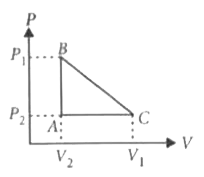 For a cyclic process , `Delta U = 0 ` ` :. ` According to first law of thermodynamics, the net heat absorbed by the GAS is ` Delta Q = " WORK DONE , " Delta W = " Area of " Delta ABC ` ` = 1/2 (P_(1) - P_(2)) (V_(1) - V_(2))` |
|
| 39. |
An astronomical refractive telescope has an objective of focal length 20 m and en eyepiece of focal length 2 cm. |
|
Answer» the length of the telescope tube is 20.02 m. |
|
| 40. |
The electrical pulse sent by the RADAR travel with a speed of __________ m/s. |
|
Answer» `3xx10^8` |
|
| 41. |
(A): Physical relations involving addition and subtraction cannot be derived by dimensional analysis. (R) Numerical constants cannot be deduced by the method of dimensions. |
|
Answer» Both (A) and (R) are TRUE and (R) is the CORRECT explanation of (A) |
|
| 42. |
Potential energy of an electric dipole in a uniform electric field is ________in stable equilibrium position and _________ in its unstable equilibrium position. |
| Answer» SOLUTION :`-PE, +pE` | |
| 43. |
The Third Estate comprised of: |
|
Answer» POOR servants and small peasants, LANDLESS labourers |
|
| 44. |
The figure shows two large, closely placed, parallel, nonconducting sheets with identical (positive) uniform surface charge densities, and a sphere with a uniform (positive) volume charge density. Four points marked as 1,2,3, and 4 are shown in the space in between. If E_1, E_2, E_3, and E_4 are magnitude of net electric fields at these points, respectively, then |
|
Answer» `E_1gtE_2gtE_3gtE_4` 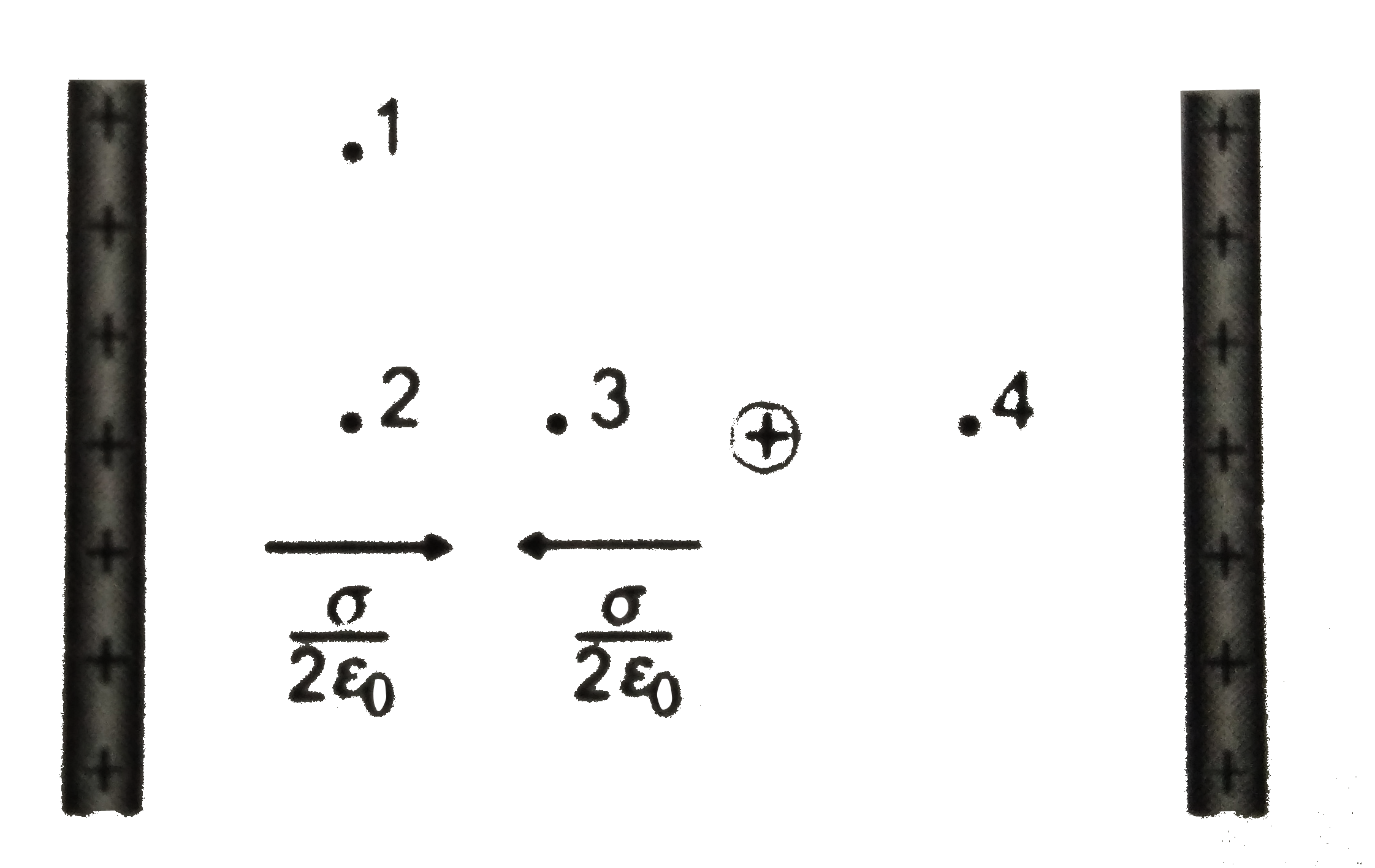
|
|
| 45. |
In Problem 51, what are the magnitudes of (a) the horizontal component and (b) the vertical component of the net force acting on the block at point Q ? (c) At what height h should the block be released from rest so that it is on the verge of losing contact with rest so that it is on the verge of losing contact with the track at the top of the loop ? (On the verge of losing contact means that the normal force on the block from the track has just then become zero. ) (d) Graph the magnitude of the normal force on the block at the top of the loop versus initial height h, the range h=0 to h=6R. |
|
Answer» |
|
| 46. |
What is the work done in rotating the dipole in the field ? |
|
Answer» Solution :The work done in ROTATING a dipole through an ANGLE `theta` from the equilibrium position is given by W=MB `(1- cos theta)` |
|
| 47. |
Which experiment could established nuclear size ? |
| Answer» Solution :By performing scattering experiments using HIGH energy probes such as FAST moving protons, neutrons and electrons, NUCLEAR size of different elements have been ACCURATELY measured, assuming nuclei to be spherical, their volumes could be estimated. | |
| 48. |
Give the brief history of discovery of knowledge of electromagnetic waves. |
|
Answer» Solution : Faraday from his experimental study of electromagnetic induction magnetic field changing with time, gives rise to an electric field. ii) Maxwell in 1865 from his theoritical study CONCLUDED that, an electric field changing with time gives rise to magnetic field. iii) It is a consequence of the displacement current being a source of magnetic field. iv) It means a CHANGE in electric (or) magnetic field with time produces the other field. v) Maxwell concluded that the variation in electric and magnetic field vectors perpendicular to each other leads to the production of electromagnetic waves in space. vi) These electromagnetic waves travel in space without any material medium. vii) Both electric and magnetic fields vary with time and space and have the same frequency. 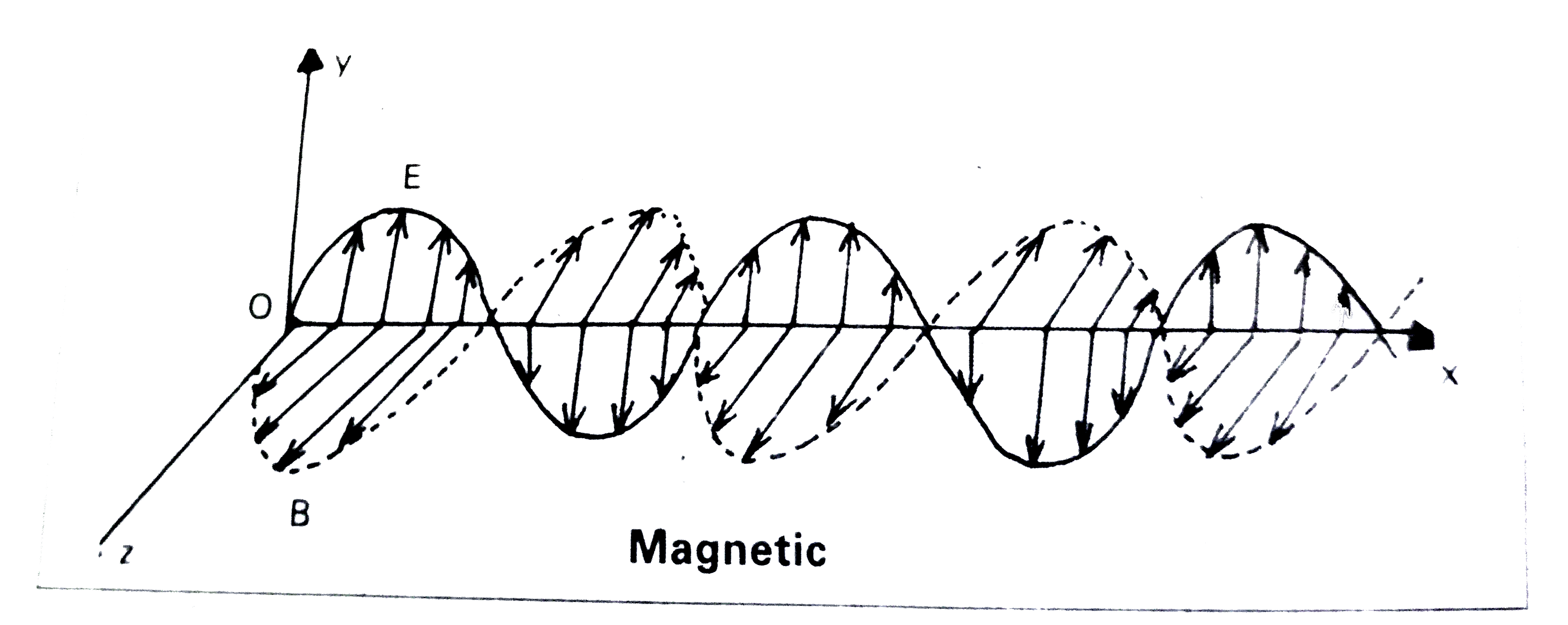 viii) The electric field vector `vec E` and magnetic field vector `vecB` are vibrating along y and z axis and propagation of electromagnetic waves along x- axis. ix) Maxwell found that the electromagnetic waves travel in vacuum with a speed is GIVEN by `C=(1)/(sqrt(mu_(0)epsi_(0)))=3xx10^(8)` m/s Where `mu_(0)=4pixx10^(-7)` H/m=permeability in free space. `epsi_(0)=8.85xx 10^(-2) c^(2)N^(-1) m^(-2)`=permittivity in free space. x) The velocity of electromagnetic waves in a medium is given by `v=(1)/(sqrt(muepsi))`. xi) Maxwell also concluded that electromagnetic waves are transverse in nature. xii) In 1988 Hertz demonstrated experimentally the production and detection of E.M waves using spark oscillator. XIII) In 1895 Jagadish Chandra Bose was able to produce E.M waves of wavelength 5m.m to25 m.m. xiv) 1899 Marconi was the first to establish a wireless communication at a distance of about 50 km. |
|
| 49. |
The small particle of mass m is given an initial high velocity in the horizontal plane and winds its cord around the fixed vertical shaft of radius 1m. All motion occurs essentially in the horizontal plane. If the angular velocity of the cord is 0.8 rad/s when the distance from the particle to the tangency point is 5m, determine the angular velocity omega (in rad//s) of the cord after it has turned through an angle 1 rad. |
|
Answer» |
|
| 50. |
A charged particle, having charge q_(1) accelerated through a potential difference V enter a perpendicular magnetic field region in which it experiences a force F. If V is increased to 5V, the particle will experience a force |
| Answer» ANSWER :D | |


