Saved Bookmarks
This section includes 7 InterviewSolutions, each offering curated multiple-choice questions to sharpen your Current Affairs knowledge and support exam preparation. Choose a topic below to get started.
| 1. |
A 10 wire potentiometer has a resistance of 10 Omega and is connected to fan accumulator of 2 V and negligible internal resistance.There are two resistance boxes R_(1) and R_(2) in series with the accumulator and one can have any intergral values of resistance from resistance boxes . A standard-cellof 1.018 V with a sensitive galvanometer in series with it is connected across R_(1).How would you proceed with the above arrangement to obtain potential drop of 1 mu V per mm of the potentiometer wire? Calculate the vlue3s of R_(1) and R_(2) requried. What length of this potentiometer will balance the thermo emf of and copper couple at 300^(@)C which develops 17muV//^(0)C? |
|
Answer» |
|
| 2. |
If the focal length is 150 cm for a glass lens, what is the power of the lens? |
|
Answer» <P> Solution :Give: forcal length, F = 150 cm (or) f = 1.5 mEQUATION for power of lens is ,`P = (1)/(f)` `P = (1)/(1.5) = 0.67` diopter As the power is POSITIVE, it is a converging lens. |
|
| 3. |
Assertion : If an electron, while coming vertically from outerspace, enter the earth's magnetic field, it is deflected towards west. Reason : Electron has negative charge. |
|
Answer» If both ASSERTION and REASON are TRUE and the reason is the CORRECTEXPLANATION of the assertion. |
|
| 4. |
A plane wave of wavelength 420 nm is incident on a slit with a width of a=0.60 mm. A thin converging lens of focal length +70 cm is placed between the slit and a viewing screen and focuses the light on the screen. (a) How far is the screen from the lens? (b) What is the distance on the screen from the center of the diffraction pattern to the first minimum? |
| Answer» SOLUTION :(a) 70 CM, (B) 0.49 mm | |
| 5. |
(A) : At resonance, LCR series circuit have a minimum current. (R) : At resonance, in LCR series circuit, the current and e.m.f are out of phase with each other. |
|
Answer» Both 'A' and 'R' are TRUE and 'R' is the correct explanation of 'A'. |
|
| 6. |
In the case of forward biasing of a p - n junction diode, which one of the which one of the following figures correctly depicts the direction of conventional current (indicated by an arrow mark) ? |
|
Answer» <P> |
|
| 7. |
Predict the direction of the induced current in the rectangular loop abcd as it is moved into the region of a uniform magnetic filed vecB directed normal to the plane of the loop. |
|
Answer» |
|
| 8. |
A man having height 6 m, want to see full height in mirror. They observe image of 2 m height erect, then used mirror is |
Answer» Solution :Let US assume a person a heigh h is standing in front of a vertical plane mirror. The person could see his/her head when lightfrom the head falls on the mirror and gets REFLECTED to the eyes. Same way, light from the feet falls on the mirror and gets reflected to the If the distancebetween his head H and eys E is `h_(1)` and distance between his feet F and eye E is `h_(2)`. The person.s TOTAL height h is, h = `h_(1) + h_(2)`. By the law of reflection, the angle of incidence and angle of reflection are the same in the two extreme reflections. Thenormals are now the bisector of angles between incident and reflected rays in the two reflections. By geometr. the height of the mirror needed is only half of the heigh of the person. `(h_(1) + h_(2))/(2) = (h)/(2)` |
|
| 9. |
maximum acceleration of the train in which a 50 Kg bx lying on its florr will remain stationary (Given : Co - efficient f static friction between the box and the trains floor is 0.3 and g=10ms^(-2) |
|
Answer» `5.0ms^(-2)` `F=ma` But `F_(MAX)=MUMG` So `F_(max)=ma_(max)` `mumg=ma_(max)` `a_(max)=mug=0.3xx10=3m//s^(2)` |
|
| 10. |
Calculate the potential energy of the system of charges shown in the figure. |
Answer» Solution :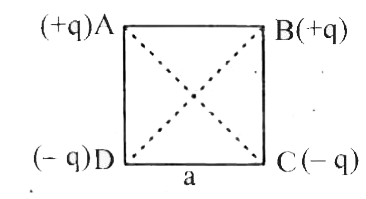 AC=BC=CD=DA=a `AC=BD=sqrt2.a` Potential energy of the system of CHARGES, `U=(1)/(4pi epsi_(0)) (SUM q_(1)q_(2))/(r)` `U=(1)/(4pi epsi_(0)) [q^(2)/a+(-q^(2))/(a)+(+q^(2))/(a)+(-q^(2))/(a)+(-q^(2))/(sqrt2.a)+(-q^(2))/(sqrt2.a)]=(1)/(4piepsi). (-2q^(2))/(sqrt2a)=(-sqrt2.q^(2))/(4pi epsi_(0)a)` |
|
| 11. |
Statement I : The B - H curve of a ferromagnetic material is not linear which means that these materials do not obey vec(B)=muvec(H) rule. Statement II : Permeability of a ferromagnetic material is not constant , it can even have a negative value . |
|
Answer» Statement I is true , statement II is true , statement II is a CORRECT EXPLANATION for statement I . |
|
| 12. |
An atom is located in a magnetic firld of induction B = 2.50kG. Find the value of the total splitting of the following terms (expressed in eV units): (a) .^(1)D, (b).^(3)F_(4). |
|
Answer» Solution :(a) For the `.^(1)D_(2)` term `g=1+(2xx3+0-2xx3)/(2xx2xx3)=1` and `Delta E= -mu_(B)M_(J)B` `M_(J)= -2,-1,0+1,+2`. Thus the spliting is `deltaE=4mu_(B)` SUBSTITUTION gives `deltaE= 57.9mu eV` (b) For the `.^(3)F_(4)` term `g=1+(4xx5+1xx2-3xx4)/(2xx4xx5)=1+(10)/(40)=(5)/(4)` and `Delta=-(5)/(4)mu_(B) BM_(J)` where `M_(J)= -4 t o +4`. Thus `deltaE=(5)/(4)mu_(B) Bxx8= 10mu_(B)(= 2g Jmu_(B))` Substitution gives `deltaE=144.7 mueV` |
|
| 13. |
Centre of mass is at point X (1,1,1) when system consists of particles of masses 2, 3, 4 and 5 kg. If the centre of mass shifts to point Y (2, 2, 2) on removal of the mass of 5 kg. What was its position ? |
|
Answer» Solution :Let `VEC(r )_(1), vec(r )_(2), vec(r )_(3)`, are the position vectors of the PARTICLES of mass `m_(1)=2KG, m_(2)=3 KG, m_(3)=4 kg`and `m_(4)=5 kg` respectively. Initially, the centre of mass was at the point `xx(1,1,1)`, then `hat(i)+hat(J)+hat(k)=(m_(1)vec(r )_(1)+m_(2)vec(r )_(2)+m_(3)vec(r )_(3)+m_(4)vec(r )_(4))/(m_(1)+m_(2)+m_(3)+m_(4))` `rArr (2vec(r )_(1)+3vec(r )_(2)+4vec(r )_(3)+5vec(r )_(4))/(2+3+4+5)=hat(i)+hat(j)+hat(k)` `rArr 2vec(r )_(1)+3vec(r )_(2)+4vec(r )_(3)+5vec(r )_(4)=14hat(i)+14hat(j)+14hat(k)` ....(1) On removing the mass `m_(4)=5 kg`, the centre of mass shifts to the point Y (2, 2, 2), then `2hat(i)+2hat(j)+2hat(k)=(m_(1)vec(r )_(1)+m_(2)vec(r )_(2)+m_(3)vec(r )_(3))/(m_(1)+m_(2)+m_(3))` `rArr 2vec(r )_(1)+3vec(r )_(2)+4vec(r )_(3)=18hat(i)+18hat(j)+18hat(k)`....(2) By subtracting the equation (2) from (1). `vec(r )_(4)=-(4)/(5)(hat(i)+hat(j)+hat(k))` |
|
| 14. |
A bob of mass m = 100 gm having charge q = 50 mu C connected with a non-conducting string of length l = 1m is whirled in vertical plane with minimum speed such that it can complete a circular path in space where electric field of strength E=2 xx 10^(4)N//Cis switched on as shown in figure. The velocity of bob at the point where tension in string become zero is |
|
Answer» `vec(v)=(sqrt(5)hat(i)+sqrt(3)hat(j))` `L(B_(0)IL)=3(lambdaL)g((L)/(2)+(L)/(6))=3lambdaLg((2L)/(3))` `B_(0)=(2lambdag)/(I)` No external force, so COM cannot displace initial coordinate of `COM=(3(lambdaL)("zero")+2lambdaL((L)/2)+lambdaL(L))/(6lambdag)=(L)/(3)` Final coordinate of `COM=(L)/(3)("same")` But COM displaces with respect to QT by `(2L)/(3)`. So displacement of `QPUT=(2L)/(3)`. Initial magnetic DIPOLE moment M MAKES an angle of `(pi)/(4)` ACW from +ive x-axis and finally it makes angle `(3pi)/(4)` ACW from `+"ive x-axis" (M=sqrt(2)IL^(2))` So change in `PE=-MB(cos theta_(2)-costheta_(1))=MB_(0)[cos135^(@)-cos45^(@)]=2B_(0)IL^(2)="Gain in KE"=(1)/(2)I omega ^(2)` `I("about QT")=2[(2lambdaL^(3))/(3)+lambdaL^(3)]=(10lambdaL^(3))/(3),2B_(0)IL^(2)=(1)/(2)(IOMEGA^(2))=(1)/(2)((10lambdaL^(3))/(3))omega^(2),omega^(2)=(6B_(0)I)/(5lambdaL)` |
|
| 15. |
Explain briefly the action of a transistor as a tuned collector oscillator. |
|
Answer» Solution :Circuit diagram, Working: When the circuit is switched on, the surge current flows in the collector current though the current does not REACH the maximum value instantaneously, it rises sinusoidally and due to feedback, current will be in the same phase. Hence the nature of feedback is positive. When the current reaches the saturation point, magnetic field becomes CONTANT. the feedback stops and hence EMITTER current begins to FALL. this causes the magnetic field in the collector current to decay until emitter current is is nearly zero. In the absence of collector current and emitter current , the transistor will be driven to cut-off. The frequency of change from saturation to cut-off is given by the formula v = `(1)/(2pi sqrt(LC))` Hz 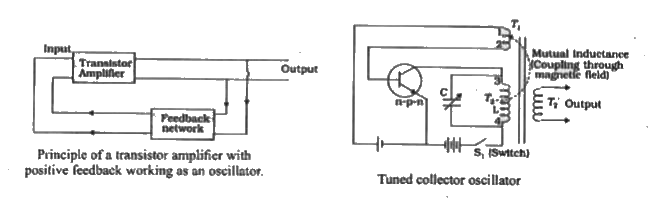
|
|
| 16. |
A glassplate the thickness t and ref. index mu.At what angle of incidence (from air), the reflected and refracted rays by plate be perpendicular to each other: |
|
Answer» `sin^(-1) mu` By LAW of refraction `mu = (sin i)/(sin r)` `thereforemu=(SINI)/(sin(90-i))=(sini)/(cosi)=tani` `therefore I = tan^(-1) mu` |
|
| 17. |
Mr Kamath, the chief mechanical engineer in Northern railways went to Tokyo to attend a seminar on fast moving trains. His friend Mr. Hiroki explained how Japnese people are concentrating on energy conservation and saving fossil fuels using maglev trains. Mr. Kamath travelled from Tokyo to Osaka in maglev train and found that the sound is less, travel is smooth and understood the Japanese technology in mass transporting system. Maglev trains work on the principle of Meissner's effect. (a) Mention two values which Mr Kamath found in Mr. Hiorki. (b) Which values in Mr Kamath do you appreciate ? (c) What is Meissner's effect ? Write the value of magnetic permebility for perfect diamagnetism. |
|
Answer» Solution :(a) Mr. Kamath found that Mr Hiroki is friendly to the environment and a good narrator. (b) Mr. Kamath exhibits learning ATTITUDE and appreciation of eco-friendly BEHAVIOUR. (c) A conductor, when cooled below the transition temperature `T_(c)` in a uniform magnetic field pushes away the magnetic field LINES as if no magnetic field exists inside the conductor. This phenomena is Meissner effect. Magnetic field Induction B within the sample is more than the magnetic field intensity, i.e., `B GT H or (B)/(H) gt 1, or MU gt 1` |
|
| 18. |
A compass needle is placed in the gap of a parallel plate capacitor. The capacitor is connected to battery through a resistance. The compass needle : |
|
Answer» DEFLECTS and gradually comes to the ORIGINAL position in a TIME which is large compared to the time constant |
|
| 19. |
Two places A and B on the same longitude are h km apart along thesurface of the earth, A is at the equator. The shadow of a vertical pole is zero at A at some hour of observation and the shadow of an identical pole at B is just half its length at the same hour of observation. Show that these observations enable us to find the radius of the earth. |
|
Answer» |
|
| 20. |
Vector vecA is 2 cm long and is 600 above the x-axis in the first quadrant, vector B is 2cm long and is 600 below the x-axis in the fourth quadrant. Find vecA+vecB |
Answer» Solution :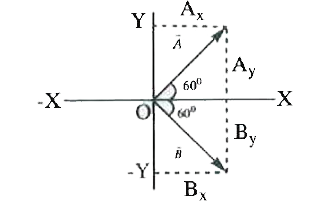 `vecR=vecA+vecB` `vecR= 2 COS 60^(@) hati+2 sin 60 HATJ+ 2 cos 60 hati-2 sin 60 hatj` `vecR=4 cos 60 hati=2hati` `:. 2cm` ALONG x-aixs |
|
| 21. |
Pure Si at 500 K has equal number of electron (n_(e )) and hole (n_(h)) concentrations of 1.5xx10^(16)m^(-3). Doping by indium increases n_(h) to 4.5xx10^(22)m^(-3). The doped semiconductor is of ……… |
|
Answer» n-type semiconductor, electron CONCENTRATION`n_(e )=5XX10^(22)m^(-3)` `n_(i)^(2)=n_(e )n_(h)` `THEREFORE (1.5xx10^(16))^(2)=n_(e )(4.5xx10^(22))` `rArr n_(e )=0.5xx10^(10) or n_(e )=5xx10^(9)` Now `n_(h)=4.5xx10^(22) rArr n_(n) GT gt n_(e )` `therefore` Semiconductor is p-type and `n_( e)=5xx10^(9)m^(-3)` |
|
| 22. |
What is meant by plane polarised light? What type of waves show the property of polarisation ? Briefly discuss polarisation by reflection. |
|
Answer» SOLUTION :Plane polarised light. Only transverse waves show the property of polarisation. Polarised light by reflection. When UNPOLARISED BEAM is reflected from a transparent (glass) surface, the reflected beam will become partially polarized depending on the angle of incidence. For one particular angle of incidence, called polarizing angle (or Brewster.s angle) the reflected beam is completely polarized. The condition for this phenomenon to occur is shown in the given. In incident light, double arrows represent radiation polarised in plane of paper and dots represent radiations polarised perpendicular to the plane. 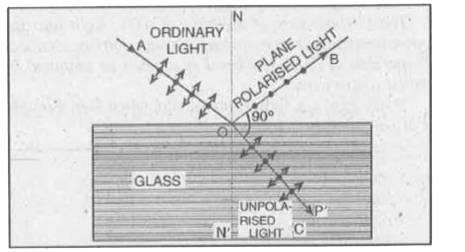 Explanation. In the FIGURE we find that the vibrations perpendicular to the plane of paper are always parallel to the reflecting surface for all angles of incidence and the other vibrations make different angles with the reflecting surface and at a particular angle of incidence called polarising angle, the vibrations parallel to the reflecting surface are reflected along OB and the other components are transmitted, hence reflected light is polarised. |
|
| 23. |
As shown in the figure, a thin rod AB of length 10 cm is placed on the principal axis of a concave mirror such that it.s end B is at a distance of 40 cm from the mirror. If the focal length of the mirror is 20 cm, find the length of the image of the rod |
|
Answer» Solution :`rArr` / = 20 cm and the END B is at distance 40 cm =2f = R. Thus the image of B is FORMED at B only. Now for end A, u = - 50cm, f = - 20 cm, v=? In `1/u + 1/v = 1/f,` putting these values `- 1/50 + 1/v = - 1/20` `therefore 1/v = 1/50 -1/20 = (20-50)/(20 xx 50) = - (30)/(1000)` `therefore v = - (1000)/(30 = - 33.3 cm ` This image `Lambda` is on the same side as the object Now, LENGTH of the image = 40 - 33.3 = 6.70 cm =0 .0670 m |
|
| 24. |
what is modulation ? What is a modulated wave.? |
| Answer» Solution :The PROCESS of producing a high FREQUENCY WAVE, some characteristic of which VARIES a a function of the instantaneous vale of AUDIO signal, is called modulation. The signal wave that result on supermposing the modulated wave on carrier wave is called a modulated wave. | |
| 25. |
In the given table, Columns I and II give statements regarding the velocity and acceleration of particle in different types of motionalong a straight line and Column III shows figuresdepicting the motion. (1)Which combination of statements explains about instantaneous acceleration ?(a) (III) (iv) (J)(b) (I) (i) (K)(c) (III)(iii) (K)(d)(I)(ii)(L) |
|
Answer» (I) (iii) (L) |
|
| 26. |
Light from a hydrogen discharge tube is incident on the cathode of a photocell. The work function of cathode surface is 4.2 eV.In order to reduce the photocurrent to zero, the voltage of the anode relative to the cathode must be made : |
|
Answer» `-4.2 V` |
|
| 27. |
Using Gauss' law deduce the expression for the electric field due to uniformalycharged spherical conducting shell of radius R at point (i) outside ,and (ii)inside the shell. Plot a graph showing variation of electric field as a functions or r forr ltR and .(r being the distance from the centre of the shell). |
| Answer» SOLUTION :For expresion of electric FIELD at a point outside the SHELL ,see SHORT Answer Question NUMBER 37 and for field at a point inside the shell , see Short AnswerThe Plotted E-r graph has been shown | |
| 28. |
An object is kept at a distance of 4 cm form the first focus of a convex lens. A real image is formed at a distance of 9 cm from its second focus. What is the focal length of that lens is ___________(in cm) |
|
Answer» |
|
| 29. |
What is the de-Broglie wavelength of the alpha-particle accelerated through a potential difference of V volt ? (mass of alpha-particle = 6.6455 xx 10^(-27) kg) |
|
Answer» `(0.287)/(sqrt(V)) Å` `LAMBDA = (h)/(sqrt(2mK)) = (h)/(sqrt(2M xx 2eV)) = (h)/(sqrt(4meV))` `= (6.63 xx 10^(-34))/(sqrt(4 xx 6.6465 xx 10^(-27) xx 1.6 xx 10^(-19) V)) m = (6.63 xx 10^(-11))/(6.52 sqrt(V))m = (0.101)/(sqrt(V)) Å` |
|
| 30. |
Let R be a relation on the set N of natural numbers defined by nRm if n devides m,Then R is |
|
Answer» REFLEXIVE and symmetric |
|
| 31. |
Find the magnetic induction of the field at the point O of a loop with current I, whose shapeis ilustrated (a) in Fig. the radil a and bas welll as the anglevarphi are known, (b) In Fig , the radiusa and theside bare known. |
|
Answer» Solution :(a) From the Biot-Savart law, `dB = (mu_(0))/(4pi) i ((d vec(i) xx vec(r)))/(r^(3))` So, magnetic field induction DUE to TEH segment 1 at `O`, `B_(1) = (mu_(0))/(4pi) (i)/(a) (2pi - varphi)` also `B_(2) = B_(4) = 0`, as d `vec(L) uarr uarr vec(r)` and `B_(3) = (mu_(0))/(4pi) (i)/(b) varphi` Hence, `B_(0) = B_(1) + B_(2) + B_(3) + B_(4)` `= (mu_(0))/(4pi) [(2pi - varphi)/(a) + (varphi)/(b)]` (b) Here, `B_(1) = (mu_(0))/(4pi) (i)/(a) (3pi)/(a). vec(B_(2)) = 0`, `B_(3) = (mu_(0))/(4pi) (i)/(a) sin 45^(@)`, `B_(4) = (mu_(0))/(4pi) (i)/(a) sin 45^(@)`, and `B_(5) = 0` So, `B_(0) = B_(1) + B_(2) + B_(3) + B_(4) + B_(5)` `(mu_(0))/(4pi) (i)/(a) (3pi)/(2) + 0 + (mu_(0))/(4pi) (i)/(a) sin 45^(@) + (mu_(0))/(4pi) (i)/(a) sin 45^(@) + 0` `= (mu_(0))/(4pi)i [(3x)/(2a) + (SQRT(2))/(b)]`  
|
|
| 33. |
A charge of 10^(-10C is placed at the origin. The electric field at (1, 1) m due to it (in NC^(-1)) is |
|
Answer» `bar(i) + bar(J)` |
|
| 34. |
Young's double slit experiment is performed with monochromatic light. A thin film is introduced in front of one of the slits |
|
Answer» INTENSITY at the position of CENTRAL maxima must decrease |
|
| 35. |
A metal wire of diameter 1 mm is held on two knife edges separated by a distance of 50 cm. The tension in the wire is 100 N. The wire vibrating with its fundamental frequency and a vibrating tuning fork together produce 5 beats per sec. The tension in the wire is then reduced to 81 N. When the two are excited, beats are heard again at the same rate. Calculate (a) the frequency of the fork and (b) the density of the material of the wire. |
|
Answer» SOLUTION :Since `f PROP sqrt(T)`, `(f+5)/(f-5)=(10)/(9) or f=95 Hz.` Substituting in `f=(1)/(2L) sqrt((T)/(pi r^(2)d))` We have `d=12.74xx10 kg m^(-3)` |
|
| 36. |
In the question number 73, for the coil given the magnetic moment is |
|
Answer» `12.95A m^(2)` `m=NIA = NIPI r^(2)=100xx3.2xx3.14xx(10xx10^(-2))^(2)` `=100xx3.2xx3.14xx10^(-2)="10 A m"^(2)` |
|
| 37. |
Let A be the set of all points in a plane and let O be the origin Let R={(P,Q):OP=OQ}. then ,R is |
|
Answer» REFLEXIVE and SYMMETRIC but not TRANSITIVE |
|
| 38. |
Heat produced in a conductor of resistance 4.2Omega with 10A current is _____ cal/sec |
|
Answer» 100 |
|
| 39. |
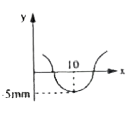
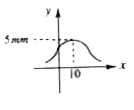
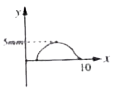
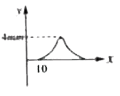
A travelling wave on a long stretched string along the positIve x-axis is given by y = 5mm e^(((T)/(5s) - (x)/(5cm))^2). Using this equation answer the following questions.At t = 0, x = 0, the displacement of the wave is |
| Answer» Answer :C | |
| 40. |
Two point sources ofsound are placed at a distance d and a detector moves on a straight line parallel to the line joining the sources as shown in figure-6.27 at a distance D away from sources. Initially Detector is situated on the line so that it is equidistant from both the sources. Find the displacement of detector when it detects n^(th) maximum sound and also find its displacement when it detects n^(th) minimum sound. |
Answer» Solution :The situation is shown in figure-6.28. 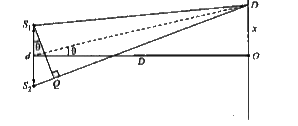 Let us consider the situation when detector move by a distance Xas shown. Let at this position the path difference between the waves from `S_(1)` and `S_(2)` to detector be `Delta` then we have `Delta = S_(2)D - S_(1)D` `cong S_(2)Q` Here if `theta` is SMALL angle as D>>d, we have `S_(2)Q = d sin theta cong d theta` = `d(x)/(D)` Thus at the position of detector, path deference is `Delta = (dx)/(D)` The expression for path difference in equation-(6.109) is an important formula for such problems. Students are advised to keep this formula in mind for FUTURE use. When detector was at point O, path difference was zero and it detects `n^(th)` a maxima, now ifdetector detects maximum then its path difference at a distance x from O can be given as `Delta = nlambda` `(dx)/(D)= lambda` `x = (nlambdaD)/(d)` Similarly if detector detects `n^(th)` minima then the path difference between two waves at detector can be given as `Delta = (2n -1)(lambda)/(2)` `(dx)/(D) = (2n - 1) (lambda)/(2)` `x = ((2n - 1)lambdaD)/(2d)` |
|
| 41. |
A travelling wave on a long stretched string along the positIve x-axis is given by y = 5mm e^(((T)/(5s) - (x)/(5cm))^2) . Using this equation answer the following questions.The velocity of the wave is |
|
Answer» 1m/s |
|
| 42. |
Describe briefly with the help of a circuit diagram, how the flow of current carriers in a p-n-p transistor is regulated with emitter-base junction forward baised and base-collector junction reverse baised. |
|
Answer» Solution :p-n-p transistor : It is a single crystal containing two p-n junctions such that there is a very thin central LAYER of n-type semi-conductor enclosed on either side by p-type semiconductor. The central layer has a thickness of about `10^(-4)`cm and is called the base. The p-type semiconductors on LEFT and right side of base are RESPECTIVELY called the emitter and COLLECTOR. Then p-n-p transistor and its symbol is from emitter to base. 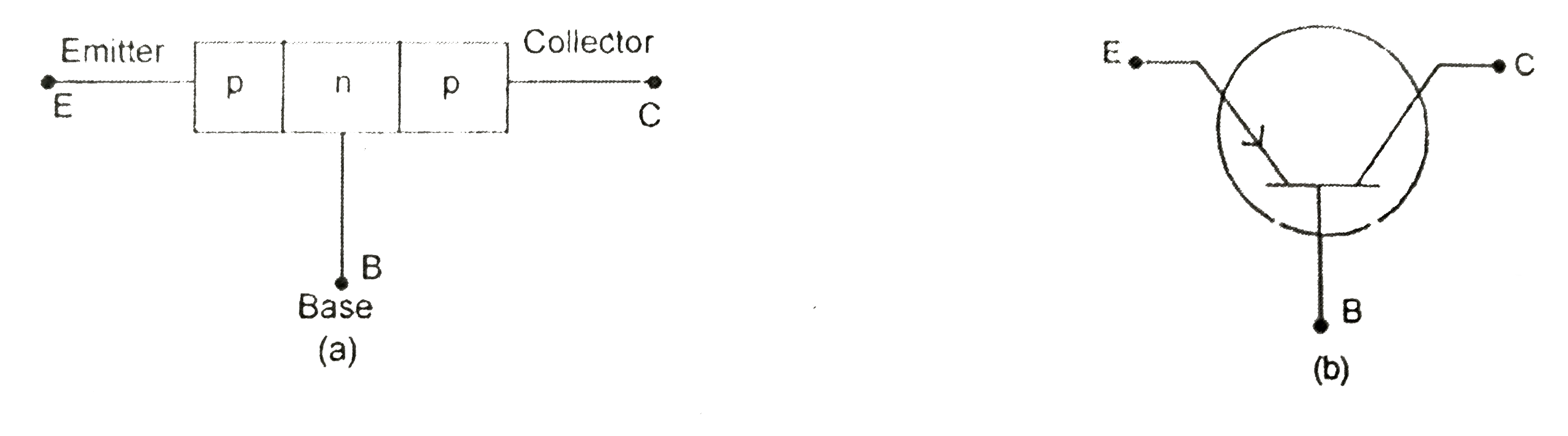
|
|
| 43. |
A travelling wave on a long stretched string along the positIve x-axis is given by y = 5mm e^(((T)/(5s) - (x)/(5cm))^2). Using this equation answer the following questions. The plot of y and x at t = 10 s is best indicated by |
|
Answer»
|
|
| 44. |
In a circuit, L, C and R are connected in series with an alternating voltage source of frequency ƒ The current leads the voltage by 45^(@). The value of C is |
|
Answer» `(1)/(2PI F(2pifL+R))` |
|
| 45. |
A double slit experiment is performed with light of wavelength 500 nm. A thin film of thickness 2mu m and refractive index 1.5 is introduced in the path of the upper beam. The location of the central maximum will |
|
Answer» remain unshifted |
|
| 46. |
Two fixed identical metallic spheres A and B of radius R=50cm each are placed on a non-conducting plane at a very large distance from each other and they are connected by a coil of inductance L=9mH as shown in figure. One of the spheres (say A) is imparted an initial charge and the other is kept uncharged. The switch S is closed at t=0. After what minimum time t does the charge on the first sphere decrease to half of its initial value ? |
|
Answer» `pixx10^(-6)sec` required time is one forth of the time period |
|
| 47. |
In accordance with the Bohr's model find the quantum number than characterises the Earth revolution around the sun in an orbit of radius 1.5 times 10^11m with orbital speed 3 times 10^4 ms^-1 |
| Answer» SOLUTION :`2.6 XX 10^(74)` | |
| 48. |
Electromagnetic waves with wavelength(i)lambda_(1)is used in satellite communication.(ii)lambda_(2) is used to kill germs in water purifies.(iii)lambda_(3) is used to detect leakage of oil in underground pipelines.(iv)lambda_(4) is used to improe visibility in runways during fog and mist conditions.Arrange these wavelengths in ascending order of their magnetude. |
|
Answer» Solution :`lambda_("X - rays")lt lambda_(UV)lt lambda_(IR)lt lambda_("MICRO")` `lambda_(3)lt lambda_(2)lambda_(4)lt lambda_(1)` |
|
| 49. |
Acyclist moves from Oto D along path as shown. What is the is the distance moved by him ? |
| Answer» Answer :A | |
| 50. |
In a biprism experiment, the screen is 1 m away from the two virtual sources which are 1 mm apart. If the source of light having wavelength 6000 Å is replaced by one having wavelength 5500 Å, the fringe width |
|
Answer» decreases by `50 mu m` |
|