

Saved Bookmarks
This section includes 7 InterviewSolutions, each offering curated multiple-choice questions to sharpen your Current Affairs knowledge and support exam preparation. Choose a topic below to get started.
| 1. |
Predict the polarity of the plate A of the capacitor, when a magnet is moved towards it, as shown in the figure. |
| Answer» SOLUTION :A has POSITIVE POLARITY. | |
| 2. |
A source contains two phosphorus radio nuclides ""_(15)^(32)P (T_(1//2) = 14.3 d) and ""_(15)^(33)P(T_(1//2) = 25.3 d). Initially , 10% of the decay come from ""_(15)^(33)P. How long one must wait until 90% do so? |
|
Answer» <P> SOLUTION :`T_(1//2) "of " ""_(15)^(32)P` is 14.3d`T_(1//2) " of " ""_(15)^(33)P "is " 25.3d` `A_(33)(0) = 10% = 1/10 = 0.1` `A_(33)(0) = 10% = 1/10 = 0.1` `A_(33) (t) = 90% = 0.4` 10% of activity BELONG to `""_(15)^(33)P` P out of the total `A_(33)(0) + A_(32)(0)` i.e., `A_(33)(0) = 0.1 (A_(33)(0) + A_(32) (0)) = 0.1 A_(33)(0) + 0.1A_(32)(0)` `:. 9 A_(33)(0) =A_(32)(0) " or " (A_(33)(0))/(A_(32)(0)) = 1/9` At the reqired time t, `A_(33)(t) = 90% = 0.9` (of total) i.e., `A_(33)(t) = 0.9A_(33)(t) + 0.9A_(32)(t) = 0.9A_(33)(t) + 0.9A_(32)(t)` `A_(33)(t) = 9A_(32)(t) "" :. (A_(33)(t))/(A_(32)(t)) = 9` Also , `A_(33)(t) = A_(33)(0)e^(-lambda_33 t)` `A_(32)(t) = A_(32)(0) e^(-lambda_(32) t)` `(A_(33)(t))/(A_(32)(t)) = (A_(33)(C ))/(A_(32)(e )) cdot e^(lambda_(32) - lambda_(33))t` `9= 1/9 e^(lambda_(32) - lambda_(33)t` `(lambda_(32) - lambda_(33))t = log_(e ) 81 "" :. t = (log_(e) 81)/((lambda_(32) - lambda_(32)) ........(a)` `lambda_(32) = (0.6931)/(14.3), lambda_(33) = (0.6931)/(25.3)` From `(a) t = (log_e 81)/((lambda_(32) - lambda_(33)) ..........(a)` `lambda_(32) = (0.6931)/(14.3) , lambda_(33) = (0.6931)/(25.3)` From (a) `t = ((log_e 81)/((0.6931)/(14.3) - (0.6931)/(25.3))) = 208.5 dys`. |
|
| 3. |
A bird looking down vertically into a pond from 12cm above the surface sees a fish apparently 18 cm below the surface. What is the actual depth of the fish? What is the apparent height of bird as seen by the fish? [Refractive index of water = 4/3] |
| Answer» Solution :24 CM and 16 cm from the water SURFACE | |
| 4. |
Photons absorbed in matter are converted to heat.A source emitting n photon /sec of frequency v is used to convert 1 kg of ice at 0 ""^(@)C to water at 0""^(@)C.Then the time T taken for the conversion |
|
Answer» decreases with increasing n,with v fixed. `P=(E_(n))/(t)=(n.hv)/(t)=((n.)/(t))hv` `therefore` P=nhv (`because` Here `(n.)/(t)`=no. of photons) emitted per unit time =n(given) Energy obtained by given amount of ICE in time T,E.=PT `therefore` mL=(nhv)T(From equation (1)) L=latent HEAT of fusion of ice) `therefore T=(mL)/(nhv)` `therefore Tprop(1)/(nv)` (`BEACUSE` m,L,h are constant).....(2) From equation (2), (i)If v=constant then by increasing n,T will DECREASE. `implies` Option (A) is correct. (ii)If n =constant then by increasing v,T will decrease `implies`Option (B) is correct . (iii)If nv=constant then T=constant. `impliesOption (C) is correct. |
|
| 5. |
A battery (or batteries) connected to two parallel plates produces theequipotential lines between the plates as shown. Which of the following configurations is most likely to produce these equipotential lines? |
|
Answer»
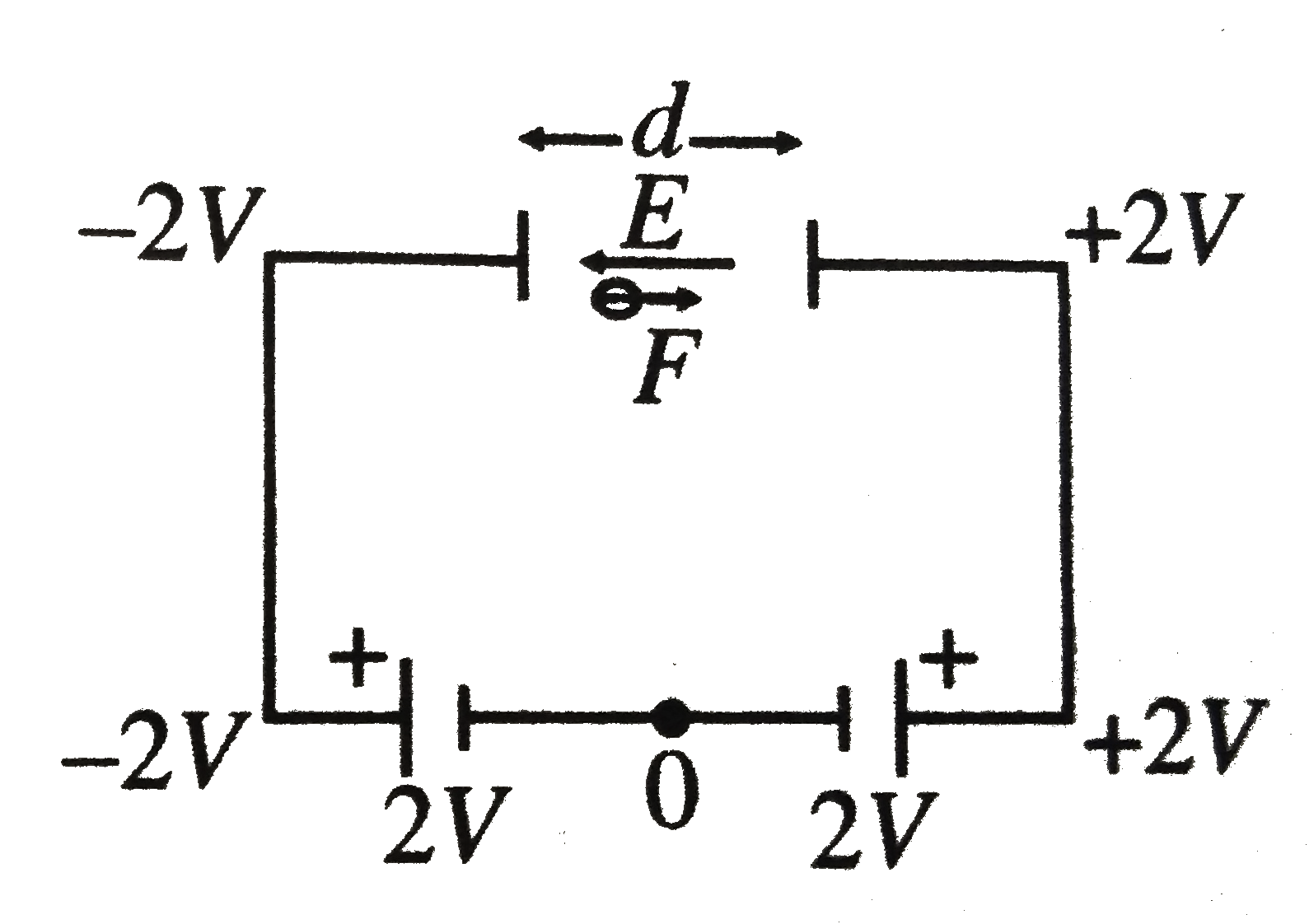
|
|
| 6. |
Electric field in one electromagnetic wave, propagating in vacuum is E=40 cos(kz - 6xx10^(8)t)hat(i) (where all the values are in SI units).Then value of wave vector of this wave is ……. . |
|
Answer» `2m^(-1)` `vec(E ) =E_(0)cos (KZ - OMEGA t)hat(i)` weget`omega = 6xx10^(8)` rad/s Now, we know `c=(omega)/(k)rArr k=(omega)/(c ) =(6xx10^(8))/(3xx10^(8))` `THEREFORE k = 2`rad/m |
|
| 7. |
For an achromatic combination, three different lenses are combined. Dispersive power of their material are 0.066,0.055 and 0.040 and their main focal length are - 22 cm, -11cm, and 'f' respectively then find the value of 'f' (in cm.) |
|
Answer» `omega/f=omega_(1)/f_(1)+omega_(2)/f_(2)+omega_(3)/f_(3)` for achromastism `omega=0 Rightarrow (-0.066)/22-(0.055)/11+(0.040)/f=0` `Rightarrow -3-5+40/f=0` `f=5` CM |
|
| 8. |
The electric potential between a proton and an electron is given byV= V_(0) In((r)/(r_(0))) where r_(0) is a constant. Assume that Bohr atom model is applicable to potential, then variation of radius of n^(th) orbit r_(n) with the principal quantum number n is |
|
Answer» `r INFTY (1)/(n)` `V = V_(0) In(((r_(n))/(r_(0)))` Thus the coulomb force `|F_(e)| = e((DV)/(dr)) = e(((V_(0))/(r_(n)))` This coulomb force is balance by the centripetal force `(mv^(2))/(r_(n)) = e ((V_(0))/(r_(n))) Rightarrow V = sqrt((eV_(0))/(m))` Now from `mvr_(n) = (NH)/(2pi)` `r_(n) infty n` |
|
| 9. |
Making use of the values of the critical parameters of water ( 35.5) check whether those parameters satisfy the ideal gas law. Explain the result. |
|
Answer» Solution :`(R)/(M) RHO _(er)T_(r)=9.8xx10^(7)` Pa, at the same time `p_(er)=218` ATM `=2.2xx10^(7)Pa`. HENCE the Mendeleev-Clapeyron equation is INAPPLICABLE to the critical state. This is because of the large part played in this case by  molecular interactions, which are neglected in the case of an IDEAL gas. |
|
| 10. |
A body when released from the top of a tower of height h reaches the ground in time T. At what time it is at a height h/2above the ground? |
|
Answer» `T/2` Now `(h)/(2)=(1)/(2) g t^(2):. (1)/(2)((1)/(2)g t^(2))=(1)/(2) g t^(2)implies t=(t)/(sqrt(2))` |
|
| 11. |
A cannon after firing recoils due to: |
|
Answer» Conservation of energy |
|
| 12. |
The internal energy of one gram of helium at 100 K and one atmospheric pressure is: |
|
Answer» 100 J Thus CORRECT CHOICE is (c ). |
|
| 13. |
If voltage applied on a capacitor is increased from V to 2V: |
|
Answer» Q REMAINS the same C is doubled |
|
| 14. |
The wire loop formed by joining two semicircular sections of radii R_(1) and R_(2) and centre C, carries a current I as shown. The magnetic field at C has a magnitude |
|
Answer» `(mu_(0)I)/(2)((1)/(R_(1))-(1)/(R_(2)))` 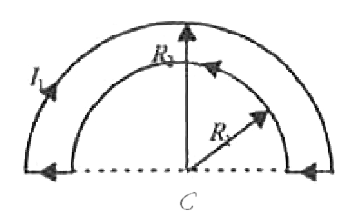 Magnetic field at the CENTRE C of a semicircular conductor is GIVEN by `B=sumdB` `=sum(mu_(0))/(4pi)(Idlsin90^(@))/(r^(2))` `=(mu_(0))/(4pi)(I)/(r^(2))sumdl=(mu_(0))/(4pi)*(I)/(r^(2))(pir)=(mu_(0)I)/(4r)` Here, magnetic field at C due to the current in the CIRCULAR loop of smaller radius, `vecB_(1)=(mu_(0)I)/(4R_(1))` upwards perpendicular to the plane of the PAPER. Magnetic to the plane of the paper. Magnetic field at C due to the current (I) in the circular loop of bigger radius, `vecB_(2)=(mu_(0)I)/(4R_(2))` downwards perpendicular to the plane of the paper. Also magnetic field due to straight portions is zero. Hence, net magnetic field at C `=vecB_(1)+vecB_(2)=|vecB_(1)|-|vecB_(2)|` `=(mu_(0)I)/(4R_(1))-(mu_(0)I)/(4R_(2))=(mu_(0)I)/(4)[(1)/(R_(1))-(1)/(R_(2))]` upwards. |
|
| 15. |
Two short bar magnets have magnetic moments 1.20 Am^(2) and 1.00 Am^(2) respectively . They are kept on a horizontal table parallel to each other with their north poles pointing towards the south . They have a common magnetic equator and are separated by a distance of 20.0 cm. The value of the resultant horizontal magnetic induction the mid point O of the line joining their centers is (Horizontal components of Earth's magnetic induction is (3 xx 10^(-5) Wb m^(-2) ) ............... |
|
Answer» `3.60 xx 10^(-5) Wb m^(-2)` |
|
| 16. |
Three resonant frequencies of a string are 90, 150 and 210 Hz. Which harmonics of the fundamental are the given frequencies? |
| Answer» SOLUTION :`3^(RD), 5^(TH) and 7^(th)` | |
| 17. |
A ray of light is incident on a rectangular plate at an angle of incidence 606@. The light ray suffers a deviation which is 25% of the angle of incidence. The refractive index of the glass will be |
|
Answer» `SQRT3` |
|
| 18. |
A conducting circular loop of radius r carries a current I. It is placed in a uniform magnetle field B such that B is perpendicular to the plane of the loop, The magnetic force acting on the loop is given by |
| Answer» ANSWER :C | |
| 19. |
Three indential polaroid sheets P_(1), P_(2) and P_(3) are oriented so that the pass axis of P_(2) and P_(3) are inclined at 60^(@) and 90^(@) resp. with respect to pass axis of P_(1). A monochromatic source of intensity I_(0) is Kept in front of the polaroid sheet P_(1). Find the intensity of this light as observed by O_(1), O_(2), O_(3) positioned as shown in Fig. |
|
Answer» Solution :When UNPOLARISED light PASSES through a polaroid, the intensity of transmitted light becomes half the intensity of unpolarised light. `:.` Intensity of light observed by `O_(1)` is `I_(1) = I_(0)//2` (ii) Now, angle between `P_(1) and P_(2)` is `theta = 60^(@)`. `:.` Intensity of light observed by `O_(2)` is `I_(2) = I_(1) cos^(2) 60^(@) = (I_(0))/(2)((1)/(2))^(2) = (I_(0))/(8)` (iii) Angle between `P_(2) and P_(3)` is ltbr. `theta = 90^(@) - 60^(@) = 30^(@)`. `:.` Intensity of light observed by `O_(3)` is `I_(3) = I_(2) cos^(2) 30^(@) = (I_(0))/(8)(SQRT(3)/(2))^(2) = (3 I_(0))/(32)` |
|
| 20. |
Let f: Nrarr Q be defined by f (x) = (2x-1)/2 and g: Qrarr R be another functin defined by g(x) = x+2.then (gof)3/2 is- |
|
Answer» 1 |
|
| 21. |
What happens to the fringe pattern when the Youngs double slit experiment is performed in water instead of air ? |
|
Answer» Solution :`:.` Fringe width will DECREASE in water as `lambda_(W) LT lambda_(a)` |
|
| 22. |
A wire of resistivity rho is stretched to twice its length. What will be its new resistivity ? |
| Answer» SOLUTION :Resistivity will remain unchanged at `rho`, because resistivity of a MATERIAL is independent of its DIMENSIONS. | |
| 23. |
Take A and B inputwaveforms similar to that in Example .Sketch the output waveform obtained from AND gate. |
|
Answer» Solution :For `t le t_(1), A=0,B=0, `HENCE `Y = 0` For `t_(1)` to `t_(2), A = 1 ,B= 0 ,`Hence Y =0 For `t_(2) ` to `t_(3), A= 1 , B = 1 , ` Hence `Y = 1 ` For ` t_(3)` to `t_(4), A = 0,B= 1 ,` Hence `Y = 0` For `t_(4)` to `t_(5), A = 0, B = 0,` Hence `Y =0 ` For `t_(5) `to ` t_(6), A = 1, B=0 ,` Hence `Y = 0 ` For `t GT t_(6) , A = 0 , B = 1 ,` Hence Y = 0 Basedon the above, the output waveform for AND GATE can be drawn as GIVEN below . 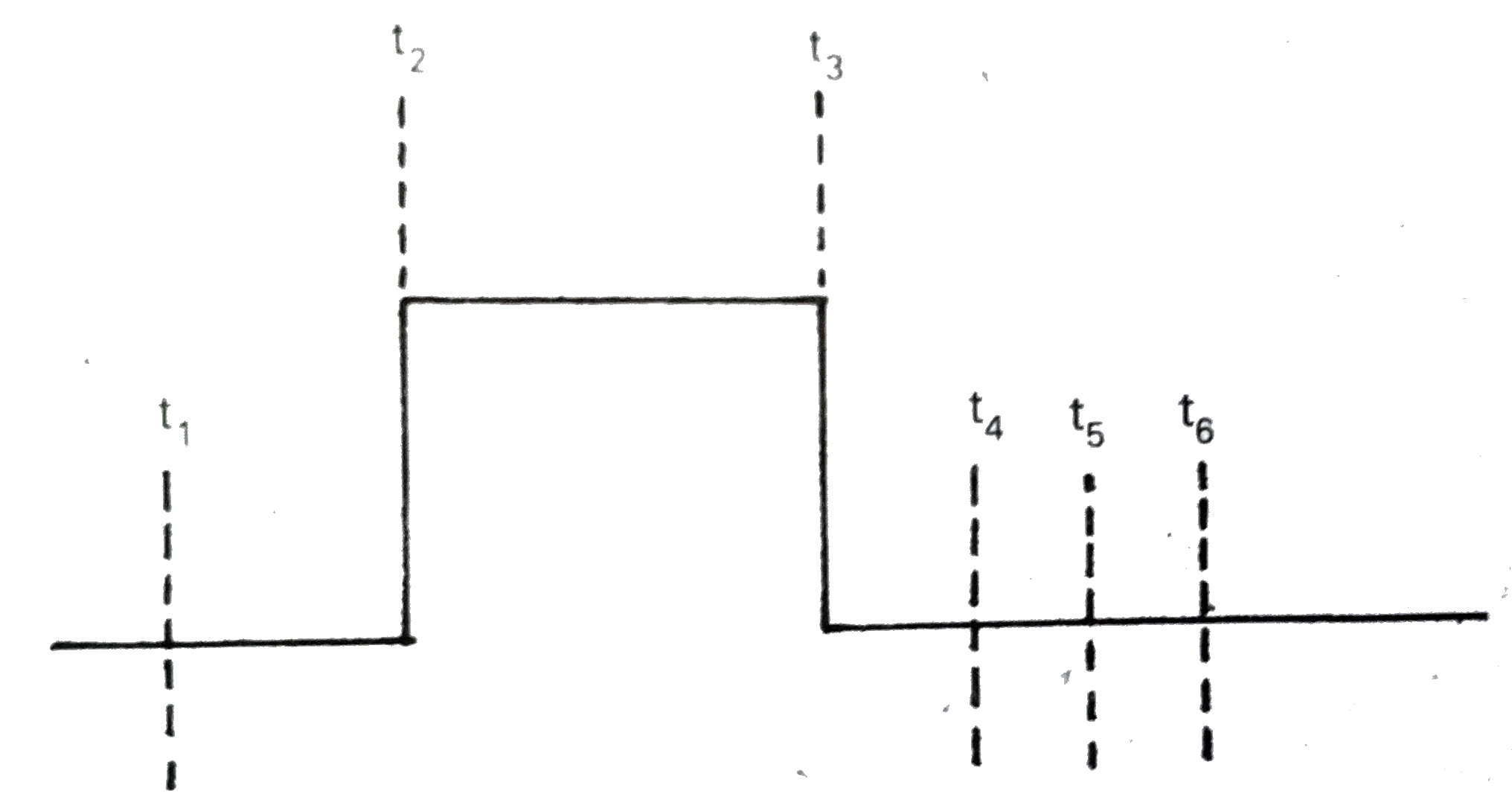
|
|
| 24. |
The value of capacitive reactance of capacitor X_C. If the values of capacitance and frequency becomes double, the value of capacitive reactance becomes ……… |
|
Answer» `4X_C` `therefore X._C=1/(4(2pifC))=X_C/4` |
|
| 25. |
The north pole of a freely suspended magnet points towards geographical north. Why ? |
| Answer» Solution :Earth is a huge magnet with its N - pole situated near geographic SOUTH and S - pole near the geographic no the . So a FREELY suspended magnet always points along north - south DIRECTION due to the FORCE of attraction of the opposite poles of earth.s magnet. | |
| 26. |
Assertion (A) : The current lags behind the voltage by a phase angle , when an a.c. flows through an inductor. Reason (R) : The inductive reactance increases as the frequency of a.c. source increases. |
|
Answer» If both assertion and reason are TRUE and the reason is the CORRECT EXPLANATION of the assertion. |
|
| 27. |
Two cells, of voltage 10 V and 2 V and internal resistances 10Omega and 5Omega respectively, are connected in parallel as shown in Fig. Find the effective voltage and effective resistance of the combination. |
|
Answer» Solution : Here `epsi_1 = 10V , epsi_2 = 2V , r_1 = 10 Omega " and " r_2 = 5OMEGA` Since +ve terminal of first cell is connected to - ve terminal of second cell, hence equivalent emf of COMBINATION : `epsi_(eff) = (epsi_1 r_2 - epsi_2 r_1)/(r_1 + r_2) = (10 xx 5 - 2 xx 10)/(10+ 5) = 2V` and EFFECTIVE resistance `r_(cell) = (r_1 r_2)/(r_1 + r_2) = (10 xx 5)/(10 + 5) = 3.33 Omega` |
|
| 28. |
Assertion : Sky is maximum red in morning Reason : Smallest wavelength scatter maximum |
|
Answer» If both ASSERTION and REASON are TRUE and reason is the CORRECT EXPLANATION of assertion. |
|
| 29. |
When light travels from one medium to the other medium of which the refractive index is different, thenwhich of the following will change? |
|
Answer» Frequency, WAVELENGTH and velocity |
|
| 30. |
Water enters in a turbine at a speed of 500 m/s and leaves at 400 m/s. If 2 xx 10^(3) kg/s of water flows and efficiency is 75%, then output power is |
|
Answer» `6.75xx10^(7) W` `E=1/2mv_1^2-1/2mv_2^2` =`1/2m(v_1^2-v_2^2)` =`1/2xx2xx10^3[(500)^2-(400)^2]` =`10^3xx10^4[25-16]` =`9xx10^7 J//sec or WALTS`. `:.` Real output POWER=`9xx10^7xx(75)/(100)=6.75xx10^7W` |
|
| 31. |
Assertion (A) : A cyclotron cannot accelerate neutrons. Reason (R) : Neutron cannot accelerate neutrons. |
|
Answer» If both ASSERTION and reason are TRUE and the reason is the correct EXPLANATION of the assertion. |
|
| 32. |
Two events occur on the x axis separated in time by Deltat and in space by Deltax. A reference frame, traveling at less than the speed of light, in which the two events occur at the same time |
|
Answer» Exists no MATTER what the values of `Deltax` and `Deltat` |
|
| 33. |
A point charge Q is moving in a circular orbit of radius R in the x-y plane with an angular velocity omega. This can be considered as equivalent to a loop carrying a steady current Qomega//2pi. A uniform magnetic field along the positive z-axis is now switched on, which increases at a constant rate from 0 to B in one second. Assumethat the radius of the orbit remains constant. The application of the magnetic field induces an emf in the orbit. The induced emf is defined as the work done by an induced electric field in moving a unit positive charge around a closed loop. It is known that , for an orbiting charge, the magnetic dipole moment is proportional to the angular momentum with a proportionally constantgamma The change in the magnetic dipole moment associated with the orbit, at the end of the time interval of the magnetic field change is : |
|
Answer» `-gammaBQR^(2)` |
|
| 34. |
The nuclei of which one of the following pairs of nuclei are isotones |
|
Answer» `" "_(34)^(74)Se, " "_(31)^(71)Ga` |
|
| 35. |
"_____________" are those orbits which contain the complete waves of electron. |
|
Answer» STABLE orbits |
|
| 36. |
Suppose that a simple pendulum consists of a small 60.0g bob at the end of a cord of negligible mass. If the angle theta between the cord and the vertical is given by theta= (0.0800 "rad") cos [(6.80 "rad"//s) t + phi] what are (a) the pendulum's length and (b) its maximum kinetic energy? |
| Answer» SOLUTION :(a) L= 0.212m, (b) `3.99 xx 10^(-4)J` | |
| 37. |
A block of mass 20kg is placed on a rough horizontal plane and a horizontal force of 12N is applied. If coefficient of friction is 0.1 the frictional force acting on it is, |
|
Answer» 20 N |
|
| 38. |
The potential barrier existing across an unbiased p-n junction is 0.2 volt. What minium kinetic energy a hole should have to diffuse from the p - side to the n - side if (a) the junction is unbiased, (b) the junction is forward-biased at 0.1 volt and (c) the junction is reverse-biased at 0.1 volt ? |
|
Answer» 0.2 EV, 0.1 eV, 0.3 eV |
|
| 39. |
The electric field in a region is radially outward with magnitude E = (A)/(gamma). The charge contained in a sphere of radius gamma_(0) centered at the origin is |
|
Answer» `(1)/(4piepsi_(0)) Agamma_(0)^(2)` |
|
| 40. |
The suface integral of electrostatic field vec(E) produced by any sources over any closed surface S enclosinga volume V in vacumm, i.e.,total electric flux over theclosed S in vacumm is 1//in_(0) times the total charge(Q) contained inside S, i.e, phi_(E) = oint vec(E). vec(ds) = (Q)/(in_(0)) The charge insideS may be pointchargesor evencontinous charge distributions. There is no contribution to total electric flux fromthe charges outside S. Further, the location at Qinside S does not affectthe value of surface integral. Read the above passageand answerthe following questions : (i) what are the SI unitand dimensions of electric flux ? (ii) A closedsurfacein vacumm encloses charge -q, + 3q and +5q. Another charge+4q lies outsidethe surface. What is total electricflux over the surface ? (iii) A point charge q lies insidea sphericalof radius r. How will the electric flux be affected if radius of thesphere is doubled ? (iv) What values of life do yo+-earn from the theorem ? |
|
Answer» Solution :(i) SI UNITS of electricflux are `NC^(-1) m^(2)`. Dimensional formula of electric FLUX is `phi = ((MLT^(-2)) L^(2))/(AT) = [M^(1) L^(3) T^(-3) A^(-1)]` (ii) `phi = (Sigma q_(inside))/(in_(0)) = (-q + 3q + 5q)/(in_(0)) = (7q)/(in_(0))` As `phi = (q)/(in_(0))` , therfore, electric flux is not affected by area//shape of the surface. So the electric flux remains unaffected. (iv) This theorem empahsisesthat total normal electric flux formthe surface depends only on algebraic sum of chargesenclosedby the surface, irrespective of their locations. The charges outside the surface do not affect the electricflux. In day to daylife, the theorem implies that the knowledge you can impart depends only on what you havestoredwithin you. You cannotemanite what youhavenot absorbed or what lies outside your reach. In the examnination, you can WRITE what you havelearnt by heart. Extraneous help from outside by UNFAIR means will never serve your purpose. |
|
| 41. |
Two moles of a certain ideal gas at temperature T_0= 300 K were cooled isochorically so that the gas pressure reduced eta= 2.0 times. Then, as a result of the isobaric process, the gas expanded till its temperature get back to the initial value. Find the total amount of heat absorbed by the gas in this process. |
|
Answer» Solution :In the first process, under isochoric process W= 0 (as `DeltaV=0`). From gas law, IFTHE pressure is reduced to `eta` times, then the temperature is ALSO reduced to `eta` times i.e., the new temperature becomes `T_0//eta`. Thus from firstlaw of thermodynamics, we have `Q_1=DeltaU_1=n C_V DeltaT=(nR)/(gamma-1)DeltaT` or `Q_1=(nR)/(gamma-1)[T_0/eta-T_0]=(nRT_0(1-eta))/(eta(gamma-1))` During second process (under ISOBARIC process), workdone is equal to `PDeltaV=nRDeltaT`. And from first law of thermodynamics, we have `Q_2=DeltaU_2+W_2 =(nRDeltaT)/(gamma-1)+nR DeltaT` `=nRDeltaT[1/(gamma-1)+1]=nR DeltaT[gamma/(gamma-1)]` `=(nRgamma)/(gamma-1)[T_0-T_0/eta]=(nRgamma(eta-1))/(eta(gamma-1))` Now total amount ofheat supplied is `Q=Q_1+Q_2` `=(nRT_0(1-eta))/(eta(gamma-1))+(nRgamma(eta-1))/(eta(gamma-1))` `=nRT_0 (1-1/eta)` Here we haven=2, R=8.3, `T_0` =300 K and `eta=2` Thus `Q=2xx8.3xx300(1-1/2)J` or =2490 J = 2.5 kJ |
|
| 42. |
The velocity of sound is not affected by change in |
|
Answer» temperatuer |
|
| 43. |
The red light of wavelength 5400 Å from a distant source falls on a slit 0.80 mm wide. Calculate the distance between the first two dark bands on each side of the central bright band in the diffraction pattern observed on a screen place 1.4m from the slit. |
|
Answer» 1.89 mm |
|
| 44. |
A U shaped rod is kept stationary with plane vertical. A washer of mass 'm' which can slide on the rod is released from rest from a height r from the centre of the circular portion of the rod. The arrangement is shown in the figure. The radius of the circular portion is r.Find the average force imparted by the semicircular portion on the washer. Neglect any friction. |
|
Answer» |
|
| 45. |
Repeat the above problem if the semicircular part is replaced with a quarter circle (see figure). |
|
Answer» |
|
| 46. |
In all metallic conductors, electric conduction is due to drifting of free electrons. But the resistivity of different metals are different. Name the factors on which resistivity of a metal depends. |
| Answer» SOLUTION :TEMPERATURE and NATURE of METAL | |
| 47. |
The transition from the state n = 4 to n = 3 in a hydrogen like atom results in ultraviolet radiation. Infrared radiation will be obtained in the transition from : |
|
Answer» `3TO2` |
|
| 48. |
In all metallic conductors, electric conduction is due to drifting of free electrons. But the resistivity of different metals are different. Explain the variation of resistivity with temperature. |
| Answer» Solution :When temperature increases, the AMPLITUDE of oscillation of ATOM increases. This will decrease the RELAXATION TIME and hence resistivity increases. | |
| 49. |
Round off to 3 significant figure. 20.96 |
|
Answer» Solution :(i) 20.96 has FOUR significant FIGURES. The fourth significant figure is more than 5 and hence on rounding off to three significant figures, the GIVEN measurement will become 20.9 +0.1 i.e., 21.0. (ii) 0.0003125 has four significant figures. The fourth Significant figure is 5 and hence on rounding off to three Significant figures, the given measurement will become`0.000312` or `3.12xx10^(4)` . This is because 2 before 5 is an EVEN number . |
|
| 50. |
A paisa coin is made up of Al-Mg alloy and weighs 0.75 g. It has a square shape and its diagonal measures 17 mm. It is electrically neutral and contains equal amounts of positive and negative charges. Treating the paisa coins made up of only Al, find the magnitude of equal number of positive and negative charges. What conclusion do you draw from this magnitude ? |
|
Answer» Solution :Mass of coin W = 0.79 g Molar mass of Al = 26.9815 g Avogadro number `N_(A) = 6.023 xx 10^(23)` No. of atoms in 26.9815 g = `6.023 xx 10^(23)` No. of atoms in 0.75 g = N = ? `N=(6.023 xx 10^(23) xx 0.75)/(26.9815)` `=0.16742 xx 10^(23)` `=1.6742 xx 10^(22)` Atomic no. of Al, Z = 13. Hence, there are 13 protons and 13 electrons. `therefore` Amount of positive and negative CHARGE in one coin, Q = NZe `=1.6742 xx 10^(23) xx 13 xx 1.6 xx 10^(-19)` `=3.48 xx 10^(4)` C `therefore Q = +- 3.48 xx 10^(4)` C This amount is very large hence, we can conclude that there are positive and negative CHARGES in large amount in neutral MATTER. |
|


