

Saved Bookmarks
This section includes 7 InterviewSolutions, each offering curated multiple-choice questions to sharpen your Current Affairs knowledge and support exam preparation. Choose a topic below to get started.
| 1. |
Outline the production of an Amplitude Modulated Wave. |
Answer» Solution : Theory : Let `m(t)=A_(m) sin omega_(m)t " and "c(t) = A_c sin omega_(c) (t)`, where m(t) is a message signal and c(t) is the carrier wave. On modulation, the resultant wave becomes `x(t) = A_(m) sin omega_(m) t+A_c sin omega_(c)t` (Theorem of SUPERPOSITION of waves). The combined wave is applied to a NON linear device called square law device which produces the output `y(t)= BX(t)+Cx^2(t)` where B and C are constants. On simplification we get, `y(t) = [BA_(m)sin omega_(m)t - ((CA_(m)^2)/(2) cos2 omega_(m)t + (CA_(c)^2)/(2) cos2 omega_(c)t)] + [(C )/(2) A_(m)^2 +(C )/(2) A_(c)^2]` `+[BA+(c)sin omega_(c)t + CA_(m)A_(c) cos (omega_(c) - omega_(m)) t - CA_(m)A_(c) cos (omega_(c)+ omega_(m))t]` If signal y(t) is passed through the band pass filter centred at `omega_c` , it rejects the sine terms of `omega_(m),2omega_(m) " and " 2omega_(c)` (I term ) and the DC terms (II term). The output of the band pass filter consists of only `omega_(c),omega_(c)+omega_(m) " and "omega_(c) - omega_(m)`. This output is the mdolulated carrier wave (III term) which is further amplified before transmitting. |
|
| 2. |
Which of the following is responsible fo glittering of a diamond ? |
|
Answer» INTERFERENCE |
|
| 3. |
what is resonance in series LCR circuit ? |
|
Answer» Solution :Impedance for a series LCR circuit is given by the following relation: ` Z = sqrt( R^(2) + ( (1)/(OMEGA C ) - omega L )^(2) )` rms current in the circuit can be written as follows , ` i_(rms) = (e_(rms))/(sqrt( R^(2) + ( (1)/(omega C ) - omega L )^(2) ))` In the above equation , we can see that rms current depends on frequency of the AC source. if we can change the frequency fo supply voltage , then at a particular frequency current given by the above equation BECOMES maximum. To calculate this frequency, we can see that magnitude of impedance is at its minimum when `(1)/(omega C) = omega LrArr omega = (1)/(sqrt(LC)) `. this Frequency is called resonance frequency of the circuit . whenthis frequency is applied to the circuit , then impendance Z becomes minimum and equal to R and corresponding current ATTAINS maximum value . This phenomenon is called resonance. |
|
| 4. |
Two fixed point charges +9e and +4e units are placed on a straight line AB= a at A and B respectively . Where should the third point charge be placed on AB for it to be in equilibrium ? |
|
Answer» Solution :For .q. to be in equilibrium, ` F_( qq_1) =F_(qq_2) ` ie. `(1)/( 4pi in _0) (q_1q)/( x^(2)) =(1)/( 4pi in _0) (q_2q)/( (a-x)^(2)) ` ` (9e)/( x^(2)) =( 4E)/((a-x) ^(2)) ` `9( a-x)^(2) =4x^(2) "" 3(a-x) =+- 2x` ` (##JYT_AJP_AIO_PHY_XII_C01_SLV_012_S01##) ` Hence charges q should be placed at a distance of `(3A)/( 5) ` from the charge 9e on AB |
|
| 5. |
The electric field intensity at a point 20 cm away from a charge of 2 xx 10^(-5) C is |
|
Answer» `4.5 XX 10^(6) NC^(-1)` |
|
| 6. |
विद्युत द्विध्रुव के अक्ष पर कुछ दुरी पर रखा बिंदु आवेश F बल का अनुभव करता है। यदि बिंदु आवेश की अक्ष पर दुरी को दोगुना कर दिया जाये, तब उस पर बल का मान ज्ञात कीजिए । |
|
Answer» 2F |
|
| 7. |
Four point charge of +10^(-7)C, -10^(-7)C, -2xx10^(-7)C and +2 xx 10^(-7)C are placed respectively at the corners A, B, C, D of a 0.05m square. Find the magnitude of the resultant force on the charge at D. |
|
Answer» 0.2 dyne |
|
| 8. |
Find the force experienced by the wire carrying a current 2A if the ends P and Q of the wire have coordinates (1,2,-3) m and (-2,-5,1)m respectively when it is placed ina magnetic field B=(hati+hatj+hatk)T |
|
Answer» Solution :The FORCE ACTING on the wire is `vecF=vec(iR_(21))xxvecB` `=i(vecr_(2)-vecr_(1))xxvecB` `=2(-3hati-7hatj+4hatk)xx(hati+hatj+hatk)` `=2(-11hati+7hatj+4hatk)N` 
|
|
| 9. |
The velocity amplitude of a particle is equal to half the maximum value at the frequencies omega_(1) and omega_(2)of external harmonic force. Find: (a) the frequency corresponding to the velocity resonance, (b) the damping coefficient beta an dthe dampedoscillation frequency omega of the particle. |
|
Answer» Solution :`x=(F_(0))/(m)((omega_(0)^(2)-omega^(2)) cos OMEGAT + 2 BETA sinomegat )/(sqrt((omega^(2)- omega_(0)^(2))^(2)+ 4 beta^(2) omega^(2)))` Then`dot(x)=(F_(0)omega)/(m)(2 beta omega cos omegat + ( omega^(2) - omega_(0)^(2)) sin omegat)/( ( omega_(0)^(2)- omega^(2))^(2) + 4 beta^(2) omega^(2))` Thus the velocity AMPLITUDE is `V_(0)=( F_(0 ) omega)/( m sqrt(( omega_(0)^(2)- omega^(2))^(2) + 4 beta^(2) omega^(2)))` ` = ( F_(0))/(msqrt(((omega_(0)^(2))/( omega)-omega)^(2)+ 4 beta^(2)))` This is maximum when `omega^(2)=omega_(0)^(2)=omega_(res)^(2)` and then `V_(0 res) =(F_(0))/(2 m beta)` Now at half maximum `((omega_(0)^(2))/( omega)-omega)^(2)=12 beta^(2)` or ` omega^(2)+-2 sqrt(3) beta omega - omega_(0)^(2)=0` `omega=+- betasqrt(3)+ sqrt(omega_(0)^(2)+ 3 beta^(2))` where we have rejecteda solution with `- ve ` sign before there dical . Writing `omega_(1)=sqrt(omega_(0)^(2)+3 beta^(2))+ betasqrt(3), omega_(2)=sqrt(omega_(0)^(2)+ 3 beta^(2))- betasqrt(3)` we GET `(a) omega_(res)=omega_(0)=sqrt(omega_(1)omega_(2))` (Velocity resonance FREQUENCY ) (b) `beta=(| omega_(1)-omega_(2)|)/( 2 sqrt(3))` and damped oscillation frequency `sqrt(omega_(0)^(2)-beta^(2))=sqrt(omega_(1)omega_(2)-((omega_(1)-omega_(2))^(2))/( 12))` |
|
| 10. |
Explain by drawing a figure for the pattern of diffraction occurs by two slits. |
Answer» Solution : In figure, the actual double slit interference pattern the envelope shows the single slit diffraction. In the double slit experiment the pattern on the screen is a superposition of single slit diffraction from each slit and the double slit interference pattern. This is SHOWN in figure. Figure shows a BRODER diffraction peak in which there APPEAR several fringes of smaller width DUE to double slit interference. The number of interference fringes OCCURRING in the broad diffraction peak depends on the ratio `(d)/(a)` that is the ratio of the distance between the two slits to the width of a slit where d is the distance between the two slits. In the limit of a becoming very small the diffraction pattern will become very flat. To obtain interference pattern, diffraction phenomenon does not need to happen but to obtain diffraction pattern, phenomenon of interference needs to happen. |
|
| 11. |
Which of the following type did the duck belong to? |
|
Answer» A shoveller |
|
| 12. |
The current through 2 Omega resistor is(diodes are considered as ideal) ##AAK_MCP_39_NEET_PHY_E39_027_Q04## |
|
Answer» 3A |
|
| 13. |
(a) What is plane polarised light? Two polaroidsare placed at 90^(@) to each other and the transmittedintensityis zero. Whathappens when one more polaroid is placed between these two,bisecting the angle betweenthem? How will the intensityof transmittedlight vary on further rotating the third polaroid? (b) If a light beam shows no intensityvariation when transmitted through a polaroid which is rotated, does it mean that the light is un-polarised? Explain briefly. |
|
Answer» Solution :(a) PLANE polarised LIGHT : When unpolarised light is passed through a tourmaline crystal cut with its face parallel to its crystallographic axis AB. Only those vibrations of light passthrough the crystal, which are parallel to AB. All other vibrations are ABSORBED. The emerged light from the crystal is said to be plane polarised light. If E is the amplitude of electric field component emanating from Ist polaroid then from 2nd polaroid at `45^(@)`. The amplitude of electric field component is `E_(1)=E cos 45^(@) = E XX (1)/(sqrt(2))=(E)/(sqrt(2))`. Again amplitude of electric field component coming from 3rd polaroid at `45^(@)` to 2nd polaroid would be `E_(2)=E_(1) cos 45^(@)=(E)/(sqrt(2)).(1)/(sqrt(2))=(E)/(2)`= half of E Asintensity `alpha E^(2)`, `:.` INTENSITY transmitted from three polaroids will be `(1)/(4)`th of the intensity transmitted from the first polaroid. (b) No. The light which is made up of electric field components Ex, Ey with `90^(@)` phase difference but equal amplitudes. The tip of electric vector executes uniform circular motion at the frequency of the light itself. When such light is passed through a polaroid, which is rotated, the transmitted average intensity remains constant. |
|
| 14. |
A unit cube or copper and iron have |
|
Answer» Same R and same `SIGMA ` |
|
| 15. |
The temperature coefficient of resistance of platinum is alpha=3.92xx10^(-3)K^(-1) at 0^(@)C. Find the temperature at which the increase in the resistance of platinum wire is 10% of its value of 0^(@)C. |
|
Answer» SOLUTION :Let RESISTANCE of the wire be `R_1 ` at `t_1^0 C (=0^@ C) ` At `t_2^0 C` resistance of the wire `R_2` `R_2 =(110 R_1)/(100) = 1.1 R_1 , ALPHA = 3.92xx10^(-3) K^(-1)` `Deltat = (R_2 - R_1)/(R_1 alpha) implies= (1.1 R_1 - R_1)/(R_1 alpha)` `=(R_1(1.1-1))/(R_1 alpha) =(0.1 R_1)/(R_1 alpha) = (0.1)/(3.92xx10^(-3))Deltat = 25.51^@ C` `t_2 = 25.51 +0 = 25.51^@ C` |
|
| 16. |
The current through a wire varies with time as I= I_(0) + alpha t , where I_(0)= 1A and alpha =4 As^(-1) . The charge that flows across a cross-section or the wire In first 10 seconds is .... |
|
Answer» 210 C CURRENT , I`(DQ)/(dt) =I_(0) + alpha` t `therefore dq = (I_(0) + alpha t ) ` dt Integrating on both sides, Q=`int dq =int_(t = 0 )^(t = 10 ) ( I_(0) + alpha t ) ` dt = `int_(0)^(10) I_(0) dt + int_(0)^(10) alpha t dt ` `= I_(0) int_(0)^(10)dt+ alpha int_(0)^(10)t dt ` =` I_(0) [t]_(0)^(10) + alpha[(t^(2))/(2) ]_(0)^(10)` `= 10 I_(0) + 50 alpha ` Substituting `I_(0) = 10 and alpha = 4 ` Q = 10 (10) + 50 (4) 300 C |
|
| 17. |
What is the importance of Oersted's experiment? |
| Answer» Solution :CONCLUSION of Oersted.s experiment is that a CURRENT carrying conductor produces a magnetic field AROUND it. This LED to various important APPLICATION. | |
| 18. |
What we call a step down transformer ? |
| Answer» SOLUTION :It CONVERTS HIGH alternating VOLTAGE to low alternating voltage. | |
| 19. |
If the frequency of incident light is tripled, the stopping potential will |
|
Answer» be tripled |
|
| 20. |
A resistance R is connected across of a cell of emf epsi and internal resistance r and the potential difference between the terminals of cell is found to be V. The internal resistance of the cell is given by the relationr = _____ |
| Answer» SOLUTION :`R = (EPSI - V)/(V) .R` | |
| 21. |
Prove that a charged particle entering a strong uniform magnetic field experiences specular reflection, if its speed is below some limiting value (the "magnetic mirror" principle, Fig. 28.20). Find the kinetic energy of the electrons which experience specular reflection, if the electron beam is perpendicular to the magnetic mirror" magnetic field with an induction B= 0.1 T is established in a large region, the thickness of the magnetic mirror" is d= 10 cm. |
|
Answer» <P> Since, according to the conditions of the problem, the electrons move perpendicularly to the "magnetic mirror" they will be reflected backwards, provided that the radius of the semicircle is less than the thickness of the "mirror" Hence `p/(e B) lt d`. The total energy of the electron is `epsi=sqrt(epsi_(Psi)^2+l^(2) c^2) lt sqrt(e_(v)^2)+e^2B^2a^2c^2)`the kinetic energy is K `=epsi-epsi_(0)`. Finally, we get `K lt epsi_(0) (sqrt(1+(eBd//m_(e)c)^2)-1)` |
|
| 22. |
Two different coils have self-inductances l_(1)= 16 mH and L_(2)= 12mH. At a certain instant, the current in the two coils is increasing at the same rate and power supplied to the two coils is the same. Find the ratio of (i) induced voltage (ii) current (iii) energy stored in the two coils at that instant |
|
Answer» Solution :(i) `V_(1)= L_(1) (dI)/(DT), V_(2)= L_(2) (dI)/(dt)` `(V_(1))/(V_(2))= (L_(1))/(L_(2))= (16)/(12)= (4)/(3)` (ii) `V_(1)I_(1)= V_(2)I_(2), (I_(1))/(I_(2))= (V_(2))/(V_(1))=(3)/(4)` (iii) `(W_(1))/(W_(2))= ((1)/(2)L_(1)I_(1)^(2))/((1)/(2)L_(2)I_(2)^(2))= ((L_(1))/(L_(2))) ((I_(1))/(I_(2)))^(2)= (4)/(3) ((3)/(4))^(2)= (3)/(4)` |
|
| 23. |
Describe Hallwach's and Lenard's observation regarding photoelectric effect in short. |
|
Answer» Solution :During 1886 and 1902,Hallwach and Lenard studied phenimenon of photoelectric emission . Lenard.s experiment:  As shown in figure ,two metal electrodes are kept at OPPOSITE ends inside evacuated glass tube. One ELECTRODE is called cathode (emitter) which is photo sensitive surface second electrode is called collector A.Potential difference is applied between C and A. quartz window is provided in this tube through which ultraviolet rays are incident on cathode C. When ultraviolet rays are incident on cathode (C) is stopped then current in circuit will become zero. anode (A) is kept at positve voltage w.r.t. cathode (C ) hence it attracts electrons emitted and there is flow of electron.Hence,current flows in the circuit. When ultraviolet radiation are stopped,current flowing through the circuit will STOP Lenard studied how photo current changes with collector plate potential with frequecny and intensity of incident light. Hallwach.s experiment: Hallwach in 1888,connected electroscope with negatively charged zinc plate as shown in figure  Following were his observations: (i)When UV light was incident on zinc plate it LOST its charge. (ii)Iniially when UV light was incident on chargeless zinc plate,it became positively charged. (iii)When initially zinc plate was kept positively charged and UV light was incident,positive charge on the plate increased. From these observation he concluded when UV light is incident on zinc plate,negatively charged particles are emitted from the plat. He ALSO concluded that when frequency of incident radiation is less than some minimum frequency ,photoelectrons are not emitted. |
|
| 24. |
Derive an expression for centripetal acceleration in terms of angular speed. |
| Answer» Solution :For an object revolving with linear speed V at a distance r from the center of rotation, the CENTRIPETAL ACCELERATION is given by the equation `a_(c)=v^(2)//r`. Using the FUNDAMENTAL equation v=r`omega`, we find that ,BRGT `d_(c)=(v^(2))/(r)=((romega)^(2))/(r)=omega^(2)r`. | |
| 25. |
A particle moves from point (hati+hatj)m to a point (6hati-2hatj)m under the action of force (10hati-2hatj)N. The work done by the force is |
|
Answer» 8 J |
|
| 26. |
जीवों के द्वारा उपयोग में लाये जाने वाले जैव-उत्प्रेरकों को कहते है- |
|
Answer» हार्मोन |
|
| 27. |
In a parallel plate capacitor, if the intervening medium of permittivity & between the plates is replaced by another medium of permittivity epsi/2, then its capacitance is |
|
Answer» HALVED |
|
| 28. |
The radiowaves from transmitting antenna propagating through sky so as to rach the receiving antenna after reflection in the ionosphere is called? |
| Answer» SOLUTION :SKY WAVE PROPAGATION | |
| 29. |
A srone is dropped from top of a tower 300 m high and at the same time another is projected vertically upward with a velocity of 100 ms^(-1) Find when and where the two stones meet. |
|
Answer» 2s,200.9 m |
|
| 30. |
(A) : In case of frequency modulation, the frequency of the RF carrier is changed by the AF signal and the change is proportional to the amplitude of the AF signal at any instant. (R) : When the AF signal is positive, the carrier frequency increases but it decreases when the AF signal is negative. |
|
Answer» Both 'A' and 'R' are true and 'R' is the correct EXPLANATION of 'A'. |
|
| 31. |
A progressive wave of frequency 500 Hz is travelling with a speed of 350 m/s. A compressional maximum appears at a place at a given instant. Find the minimum time interval after which of a rarefaction maximum occurs at the same place. |
| Answer» SOLUTION :`1/1000 s` | |
| 32. |
A monoenergetic (18 KeV) electron beam initially in the horizontal direction is subjected to a horizontal magnetic field of 0.40 G normal to the initial direction. Estimate the up or down deflection of the beam over a distance of 30 cm (m_e = 9.11 xx 10^(-19) C) . |
|
Answer» Solution :Here `m= 9.11xx10^(-31) kg, e= 1.6xx10^(-19) C, B = 0.40 G = 4 xx 10^(-5) T ` and kinetic energy of ELECTRON beam K = 18 keV `= 18 xx 1.6xx10^(-16) J = 2.88 xx 10^(-15) J`. Radius of circular PATH of electron beam `r =(mv)/(eB) = (sqrt(2Km))/(eB) = sqrt(2 xx 2.88 xx 10^(-15) xx 9.11 xx 10^(-31))/(1.6 xx 10^(-19) xx 4 xx 10^(-5)) = 11. 32 m ` Fig. shows and electron covering a path PQ = 30 cm = 0.3 m and radius of the circle OP = OQ = 11.32 m . It is clear that electron beam will undergo a deflection PA in the downward direction. If `theta` be the angle subtended by PQ at centre point O, then `theta = (PQ)/(OP) =(0.3)/(11.32) = 0.0265 "rad" =1^@ 31.` `therefore PA = OP - OA =r-rcos theta = r(1-cos theta ) = 11.32 (1-cos 1^@ 31.)` `=11.32 (1-0.996) =4 xx 10^(-3) m = 4` mm 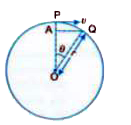
|
|
| 33. |
A circular coil of radius 4 cm has 50 turns. In this coil a current of 2 A is flowing. It is placed in a magnetic field of 0.1 weber//m^(2). The amount of work done in rotating it through 180^(@) from its equilibrium position will be |
|
Answer» `0.1J` |
|
| 34. |
A bomb at rest explodes into three parts of the same mass. The momentum of the parts are 2Phatiand Phatj The momentum of the third part will have a magnitude of: |
| Answer» Answer :B | |
| 35. |
Resistivity of a conductor depends upon |
|
Answer» area of cross - section |
|
| 36. |
Choose the correct alternative from the clues given at the end of the each statement : A classical atom based on .......... is doomed to collapse. (Thomson's model/Rutherford's model) |
| Answer» SOLUTION :Rutherford.s MODEL | |
| 37. |
The frequency for which a 5muF capacitor has a reactance of (1)/(1000)Omega is given by |
| Answer» Answer :B | |
| 38. |
If A is the atomic mass number of an element , N is the Avogardro number and a is the lattice parameter, then the density of the element , if it has crystal structure , is : |
|
Answer» `A/(Na^3)` |
|
| 39. |
Draw electrostatic field lines due to a small conducting sphere having negative charges on it. |
Answer» SOLUTION :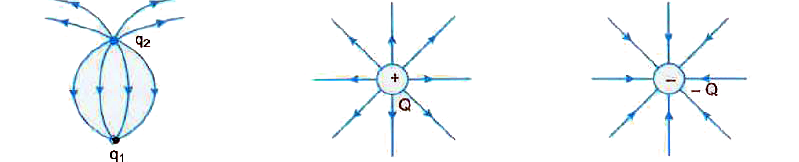
|
|
| 40. |
A vessel is fully filled with liquid having refreactive index 5/3 . At the bottom of the vessel a point-like source of light is kept. An observer looks at the source of light from the top. Now, an opaque circular disc is kept on the surface of the water in such a way that its centre just rests above the light source. Now liquid is taken out from the bottom gradually. Calculate the maximum height ofthe liquid to be kept so that light source cannot be seen from outside. (Radius of the disc is 1 cm.) |
|
Answer» Solution :`rArr n = 5/3 OA = OB = r= 1 cm` `rArr` At the bottom of vessel S is source opaque disc AB is on water surface ray of light coming out of S are `vec SB and vec SA`. Water surface goes down as water comes out bottom of vessel SLOWLY so disc goes down ar `angle SBR` increases. `rArr` When `angleSBR` = critical angle C ray goes in direction of BP and experiences total internal reflection. `therefore` Taking `angleSBR` = C in `Delta` SOB, We can SOLVE it in two ways. Method : 1 `tan C = (OB)/(OS) thereforetan C = (1 cm )/(h) ....... (1)` but , `sin C = 1/n = 3/5` `thereforecos C = sqrt(1 - sin^2C)= sqrt((1-9)/(25)) = sqrt(16/25)` `thereforecos C = 4/5` `therefore tan C = (sin C )/(cos C) = 3/4` `therefore(1)/(h) = (3)/(4)`[From (1)] `therefore h = 4/3 = 1.33 cm = 133 mm ` Method : 2 `sin C = 1/n` `thereforesin C = 3/5 = 0.6` `thereforeC = 36^@ 54.` From figure , `tan C = r/h` `thereforeh = (r)/(tan 36^@54) thereforeh= (1)/(0.7508) = (1)/(0.75) = 4/5` `thereforeh = 1.33 cm = 1.33 mm` |
|
| 41. |
An ideal solenoid has a core of relative permeability 500 and its winding has 1000 turns per metre. If a steady current of 1.5 A is passed through its winding, find (i) the magnetization M_(z) (ii) the magnetic induction B within the solenoid. Assume that M_(z) is directly proportional to H and single valued. |
|
Answer» Solution :Data: `mu_(r )=500, n=1000 m^(-1), I=1.5A, mu_(0) = 4pi xx 10^(-7) T.m//A` The magnetic field strength (or magnetic intensity) of the ideal solenoid, `H=nI = 1000 xx 1.5 = 1.5 xx 10^(3) A//m` (i) The magnetization of the core, `M_(z) = X_(m)H=(mu_(r)-1)H` `=(500-1) xx 1.5 xx 10^(3)` `=499 xx 1.5 xx 10^(3) = 7.485 xx 10^(5) A//m` (II) The magnetic induction WITHIN the core of the solenoid, `B=mu_(r)mu_(0)H` `=(500)(4 xx 3.142 xx 10^(-7)) (1.5 xx 10^(3))` `=30 xx 3.142 xx 10^(-2) = 0.9426` T |
|
| 42. |
Choose the physical quantity whose dimensions are different from others |
|
Answer» KINETIC energy |
|
| 43. |
Thebasecurrentin atransistoris 100mu Aand thecollectorcurrentis3 mA. Theemittercurrentis |
|
Answer» `3.9 mA` |
|
| 44. |
Give the construction and working of photo emissive cell. |
|
Answer» Solution :Photo emissive cell: Its working depends on the electron emission from a metal cathode due to IRRADIATION of light or other radiations. Construction: • It consists of an EVACUATED glass or quartz bulb in which two metallic electrodes - that is, a cathode and an anode are fixed. • The cathode Cis semi-cylindrical in shape and is coated with a photo sensitive material. The anode A is a thin ROD or wire kept along the axis of the semi-cylindrical cathode . • A potential difference is APPLIED between the anode and the cathode through a galvanometer G. Working: . When cathode is illuminated, electrons are emitted from it. These electrons are attracted by anode and hence a current is PRODUCED which is measured by the galvanometer • For a given cathode, the magnitude of the current depends on (i) the intensity to incident radiation and (ii) the potential difference between anode and cathode 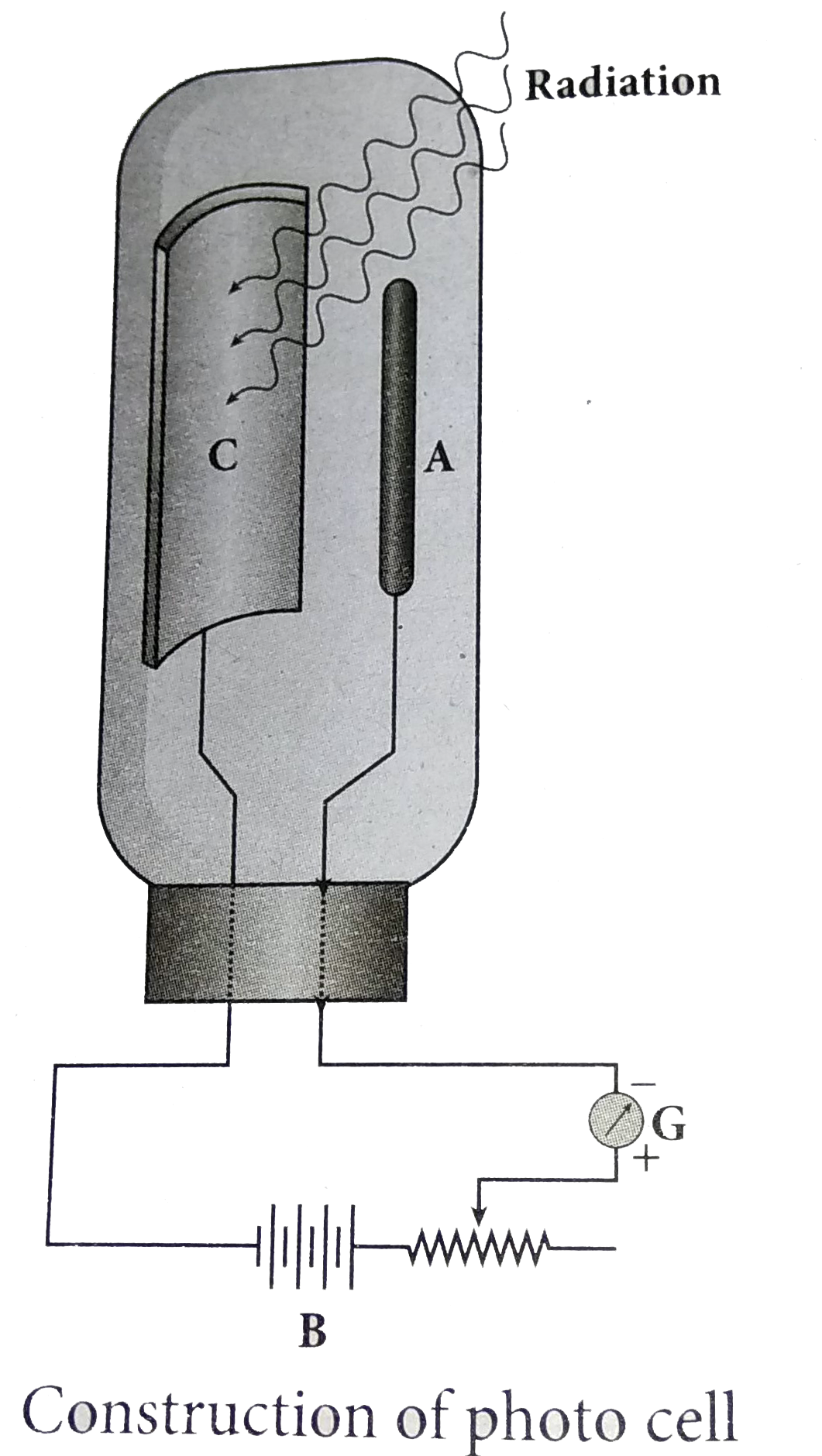
|
|
| 45. |
If one mole of a monoatomic gas gamma =(5)/(3), is mixed with one mole of diatomic gas gamma =(7)/(5), what is the value of gamma for the mixture ? |
|
Answer» `(3)/(2)` Average `C_(p) =C_(v)+R =2R +R =3R` `therefore" Average "GAMMA =(3R)/(2R) =(3)/(2) =1.5` `therefore` Correct choice is (a). |
|
| 46. |
which of the following quantities has not been expressed in proper units. |
|
Answer» `wbA^-1m^-1` |
|
| 47. |
In a galvanometer 5% of lhe lotal current in the circuit passes through it. If the resistance of the galvanometer is G, the shunt resistance 'S' connected to the galvanometer is |
|
Answer» 19 |
|
| 48. |
Continuous locus of all the points vibrating in same phase condition is called_____. |
| Answer» SOLUTION :WAVEFRONT. | |
| 49. |
The wavelengths involved in the specturm of deuterium (""_(1)D^(2)) are slightly different from that of hydrogen specturm, because |
|
Answer» the SIZE of the nuclei are different |
|
| 50. |
What is the required condition, if the light incident on one face, does not emerge from the other face ? |
|
Answer» Solution :For no EMERGENCE, `r_(2)gttheta_(c)` `A-r_(1)gttheta_(c)` `sin(A-r_(1))gtsintheta_(c)` `sinAcosr_(1)-cosAsinr_(1)gt(1)/(mu)` `SINA[cosr_(1)]-cosA[(sini)/(mu)]gt(1)/(mu)` `impliesmusinAsqrt(1-sin^(2)r_(1))-cosAsinigt1` `impliesmusinAsqrt((1-(sin^(2)i)/(mu^(2))))gt1+COS Asini` `impliessinA*SQRT(mu^(2)-sin^(2))igt(1+cosAsini)` Squaring both sides, `sin^(2)A(mu^(2)-sin^(2)i)gt(1+cosAsini)^(2)` `mu^(2)sin^(2)A-sin^(2)Asin^(2)igt1+cos^(2)Asin^(2)i+2cosAsini` `mu^(2)sin^(2)Agt1+(cos^(2)A+sin^(2)A)sin^(2)i+2cosAsini` `mu^(2)sin^(2)Agt1+sin^(2)i+2cosAsini` The greatest value of sin `i=1` `impliesmu^(2)sin^(2)Agt1+1+2cosA` `mu^(2)(2^(2)sin^(2).(A)/(2)cos^(2).(A)/(2))gt2(1+cosA)` `4mu^(2)sin^(2).(A)/(2)cos^(2).(A)/(2)gt4cos^(2).(A)/(2)impliesmu^(2)gt(1)/(sin^(2).(A)/(2))` `mugtcosec((A)/(2))` . 
|
|