Saved Bookmarks
This section includes 7 InterviewSolutions, each offering curated multiple-choice questions to sharpen your Current Affairs knowledge and support exam preparation. Choose a topic below to get started.
| 1. |
The vector which must be added to the sum of the two vectors hat i+2 hat j-hat kand hat i-2hat j+2 hat k to get a resultant of unit vector along z-axis is : |
|
Answer» `2 hat i+hat J` |
|
| 2. |
A vertical circular coil of radius 8 cm and 20 turns is rotated about its vertical diameter with angular velocity 50 rev/s in a uniform horizontal magnetic fieldof 3xx10^(-2)T. If the coil forms a closed loop of resistance, the average power loss due to joule's heating effect is (R=10Omega) |
|
Answer» SOLUTION :emf induced in coil is `E=NBA_(omega). Sin (omegat)` `"Max emf "E_(0)=NBA_(omega)=NB(pir^(2))omega` `E_(0)=20xx3xx10^(-2)xxpixx64xx10^(-4)xx2pi(50)` `60xx10^(-2)xxpi^(2)xx64xx10^(-4)xx100=3.84V` `"Max current "i_(0)=(E_(0))/(R)=0.384A` `"Average power loss "=E_("RMS")xxi_("rms")XX COS Phi=(1)/(2)E_(0)xxi_(0)` `=(1)(1)/(2)(E_(0)^(2))/(R)=0.737W` |
|
| 3. |
Hanging from a horizontal beam are nine simple pendulums of the following lengths: (a) 0.10, (b) 0.30, (c ) 0.70, (d) 0.80, (e ) 1.2 (f) 2.6 (g) 3.5 (h) 5.0 and (i) 6.2m. Suppose the beam undergoes horizontal oscillations with angular frequencies in the range from 2.00 rad/s to 4.00 rad/s. Which of the pendulums will be (strongly) set in motion? |
| Answer» SOLUTION :PENDULUM DISCUSSED in (C ), (d) and (E ) | |
| 4. |
A short object of length L is placed along the principal axis of a concave mirror away from focus. The object distance is u. If the mirror has a focal length f, what will be the length of the image ? You may take L lt lt |v- f|. |
|
Answer» SOLUTION :Distance of closect end of an object (of length L ) from the pole of concave mirror, `u_1 = u + 1/2` `RARR` Similarly distance of farthest end of above object from the pole of concave mirror, `mu_2 = u +L/2` `therefore u_1 - u_2 = - L` `therefore | mu_1 - mu_2| = L` If image distance for above two ends are repectively `v_1` and `v_2` then length of image will be `L. = |v_1 - v_2|` `rArr` From mirror formula `1/f = 1/u + 1/v` we have `1/v = 1/f - 1/u` `therefore 1/v = (u-f)/(fu)` `rArr` From above equation `therefore= (fu)/(u-f)` `v_ = (f(u-L/2))/(u-L/2-f) and v_2 = (f(u+L/2))/(u+L/2-f)` `therefore ` Length of image `L. = | v_1 - v_2|` `= (fu-(fL)/(2))/(u-f-L/2) - (fu+(fL)/(2))/(u-f + L/2)` ` =1/((u-f)^(2) - L^2/4)xx [ fu^2-f^2u + (FUL)/(2)-(fuL)/(2) + (f^2L)/(2)-(fL^2)/(4)-fu^2 + f^2u + (fuL)/(2) - (fuL)/(2) + (f^2L)/(2) + (fL^2)/(4)]` `= (f^2L)/((u-f^2)-L^2/4)` `rArr` Hence we have `(L^2)/(4) lt lt (u- f)^2` andneglecting `(L^2)/(4)` from the denominator, `therefore L. = |v_1 - v_2| = (f^2)/((u-f)^2)L` |
|
| 5. |
A radioactive isotope has a half-life of 10 year.How long will it take for the activity to reduce to 3-125% ? |
|
Answer» Solution :We have ` ""= 3.125% =( 3.125)/( 100) = (1)/(32) = (1)/(2^(5))` Half life =10 years ` therefore `Required time `= 5xx 10 `years `""= `50 years |
|
| 6. |
Find the equivalent resistance of the networks shown in Fig. 4.51 between the points A and B. |
|
Answer» |
|
| 7. |
In the above question find the acceleration of both the block whenF = 36 N |
|
Answer» SOLUTION :When `F = 36 N ` When `F GT 30` both the blocks will move separately so we treat each treat each BLOCK independently F.B.D. of 2KG block 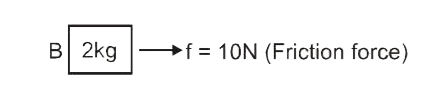 `a_(B) = 5 m//s^(2)` F.B.D. of 4 kg block 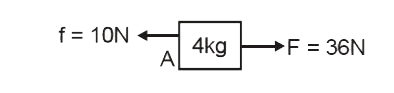 `a_(A) = ( 36-10)/( 4) = (26)/( 4)m//s^(2)` |
|
| 8. |
Clear the meanings of optical density and mass density. |
|
Answer» Solution :Mass density is mass PER UNIT volume. Optical density is the ratio of the speed of light in two media. It is possible that mass density of an optically denser medium may be less than that of an optically rarer medium. Mass density of TURPENTINE is less than that of water but its optical density is higher. |
|
| 9. |
In the previous problem, calculate the amount of work done in moving a charge of 0.1 nC from (i) centre of the square to the midpoint of side AB (ii) centre of the square to the midpoint of side BC. |
| Answer» SOLUTION :`(3.99xx10^(-7))/(a)J`, ZERO | |
| 10. |
The shape of the wavefront originating from a tube light is |
|
Answer» plain |
|
| 11. |
The phase difference between two light waves from two slits of Young's experiment is pi radian. What will be nature of central fringe in the fringe pattern ? |
| Answer» SOLUTION :CENTRAL FRINGE will be dark. | |
| 12. |
The object distance u, the image distance v and the magnification m in a lens follow certain linear relations. |
| Answer» Answer :A::D | |
| 13. |
A parallel plate capacitor has a uniform electric field E in the space between the plates. If the distance between the plates is ‘d and area of each plate is ‘A’, the energy stored in the capacitor is |
|
Answer» `1/2 epsi_0 E^2 Ad` VOLUME of capacitor `V = Ad` `:.` TOTAL energy strored in the capacitor `u = u.V= 1/2 epsi_0 E^2 Ad` |
|
| 14. |
The work done by carrying, unit positive charge in an electric field under repulsive force from infinity to a given point, its ...... |
|
Answer» KINETIC ENERGY INCREASES |
|
| 15. |
Utilizingthe solutionof the foregoingproblemm,find teh electric field strengthE_(0)in a sphericalcavityin an inifitestaticallypolarizedunifromdielectricif the dielectricpolarizationis P, and far fromthe cavity the field strength is E. |
|
Answer» <P> Solution :The electric FIELD `VEC(E_(0))` in a spherical cavity in a uniform dielectric of permitivity `epsilon` is related to the FAR away field `vec(E)`, in the followingmanner. Imaginethe cavityto be filledup with the dielectric. Then there will be a uniform field `vec(E)` everywhere and a ploarization `vec(P)`, given by,`vecc(P) = (epsilon - 1) epsilon_(0) vec(E)` Now take out the sphere making the cavity, the electric field inside teh sphere will be`- (vec(P))/(3epsilon_(0))` By SUPERPOSITION `vec(E_(0)) - (vec(P))/(3epsilon_(0)) = vec(E)` or, `vec(E_(0)) = vec(E) + (1)/(3) (epsilon - 1) vec(E) = (1)/(3) (epsilon + 2) vec(E)` 
|
|
| 16. |
Which of the following frequencies will be suitable for beyond-the-horizon communication using sky waves ? |
|
Answer» 10KHz |
|
| 17. |
Two plano concave lenses of glass of refractive index 1.5 have radii of curvature of 20cm and 30cm. If they are placed in contain with curved surfaces towards each other and the space between them is filled with water (mu_w = 4/3)find the focal length of the system. |
| Answer» Answer :C | |
| 19. |
Draw an intensity distribution graph for diffraction due to a single slit. |
Answer» Solution : SEE figure. The PATTERN consists of a BROAD central maxima and on EITHER side of it we get few secondary maxima with RAPIDLY decreasing intensities. |
|
| 20. |
A series circuit contains a resistor of 20Omega, a capacitor and an ammeter of negligible resistance. It is connected to a source of 200 V, 50 Hz. If the reading of ammeter is 2.5 A, calculate the reactance of the capacitor. |
|
Answer» SOLUTION :Here `R=20Omega, E_("rms")=200V, v=50Hz, I_("rms")=2.5A` The circuit is CR circuit. Impedance of circuit `Z_(CR)=(E_("rms"))/(I_("rms"))=(200)/(2.5)=80OMEGA` But, `Z_(CR)=SQRT(R^(2)+X_(C)^(2)) or Z_(CR)^(2)=R^(2)+X_(C)^(2)` `or X_(C)^(2)=Z_(CR)^(2)-R^(2)` `or X_(C)=sqrt(Z_(CR)^(2)-R^(2))=sqrt((80)^(2)-(20)^(2))=77.46ohm` |
|
| 21. |
In the binary system the number 100 represents |
|
Answer» ONE |
|
| 22. |
A parallel - plate air capacitorwhose electrodes are shaped as discs of radius R=6.0 cm is connected to a source of an alternating sinusoidal votage with frequency omega=1000s^(-1). Find the ratio of peak values of magnetic and electric energies within the capacitor. |
|
Answer» SOLUTION :Inside the condenser the peak electrical enegry `W_(e) = (1)/(2)CV_(m)^(2)` `= (1)/(2)V_(m)^(2)(epsilon_(0)piR^(2))/(d)` `(d=` separation between the plates, `piR^(2) =` area of each plate.) `V = V_(m) sin omegat, V_(m)` is the maximum voltage Changing electric field causes a displacement current `j_(dis) = (delD)/(delt) = epsilon_(0)E_(m) cos OMEGA t` `= (epsilon_(0)omega V_(m))/(d) cos omegat` This gives rise to a magnetic field `B(r)` (at a radial distance `r`from the centre of the plate) `B(r).2pir = mu_(0)pir^(2) j_(dis) = mu_(0)pir^(2) (epsilon_(0) omega V_(m))/(d) cos omega t` `B = (1)/(2)epsilon_(0)mu_(0) omega (r )/(d) V_(m) cos omega t` Energy associated with this field is `= intd^(3) r(B^(2))/(2mu_(0)) = (1)/(8) epsilon_(0)^(2) (omega^(2))/(d^(2)) pi underset(0)overset(R )int r^(2) rdr xx d xx V_(m)^(2) cos^(2) omegat` `=(1)/(16) pi epsilon_(0)^(2)mu_(0)(omega^(2)R^(4))/(d) V_(m)^(2)cos^(2) omegat` Thus the maximum magnetic enegry `W_(m) = (epsilon_(0)^(2)mu_(0))/(16)(omegaR)^(2) (piR^(2))/(d)V_(m)^(2)` Hence `(W_(m))/(W_(e)) = (1)/(8)epsilon_(0)mu_(0)(omegaR)^(2) = (1)/(8) ((omega R)/(c))^(2) = 5xx10^(-15)` The approximation are valid only if `omega R lt lt c`. |
|
| 23. |
The excess temperature of a hot body above its surroundings is halved in t = 10 minutes. In what time will it be (1)/(10) of its initial value. Assume Newton's law of cooling. |
|
Answer» Solution :USING NEWTON's law of cooling we have `(T-T_(s)) = (T_(0) -T_(s))e^(-kt)` at `t =10 min(T-T_(s)) = (T_(0)-T_(s))/(2)` `RARR e^(-k(10)) =(1)/(2)` or `k = (In(2))/(10)` Then at `t = t_(0)` `T-T_(s) =(T_(0)-T_(s))/(10)` `rArr e^(-kt)0 = (1)/(10)` `t_(0) (In(10))/(In(2)) xx 10` =33.23 min |
|
| 24. |
Let V be electric potential and E the mangitude of the electric field. At a given position, which of the statement is true ? |
|
Answer» E is always zero where V is zero |
|
| 25. |
For a CE transistor amplifier , the audio signal voltage across the collector resistance of 2.0 k Omega is 2.0 V . Suppose the current amplification factor of the transistor is 100 . What should be the value of R_(R) in series with V_(BB) supply of 2.0V if the dc base current has to be 10 times the signal current . Also calculate then de drop across the collector resistance . Take VBE=0.6V |
|
Answer» Solution :The output ac voltage is 2.0 V , So the ac COLLECTOR current `i_(c) = (2.0)/(2000) = 1.0 mA` . The signal current through the BASE is , therefore given `i_(B) = (i_(C))/(beta) = (1.0 mA)/(100) = 0.010 mA` . The DC base current has to bc `10 XX 0.10 = 0.10` mA We have , `R_(B) = ((V_(BB) - V_(BE)))/(I_(B))` . Assuming `V_(BC) = 0.6 V , R_B = ((2.0 - 0.6))/(0.10)= 14 k Omega` The de collector current `I_(C) = 100 xx 0.10= 10 mA` |
|
| 26. |
A flat coil consists of N turns of wire and has area A. The coil is placed so that its plane is at an angle theta to a uniform magnetic field of flux density B. Obtain an expression for magnetic flux linked with the coil. The magnetic flux density B in the coil is now made to vary with time t as shown in Fig. Sketch the variation with time t of the e.m.f. induced in the coil. |
|
Answer» Solution :(a) As is clear from Fig. component of magnetic FIELD along the normal to the plane of the coil is `B_("normal") = B cos (90^(@) - theta) = B sin theta` 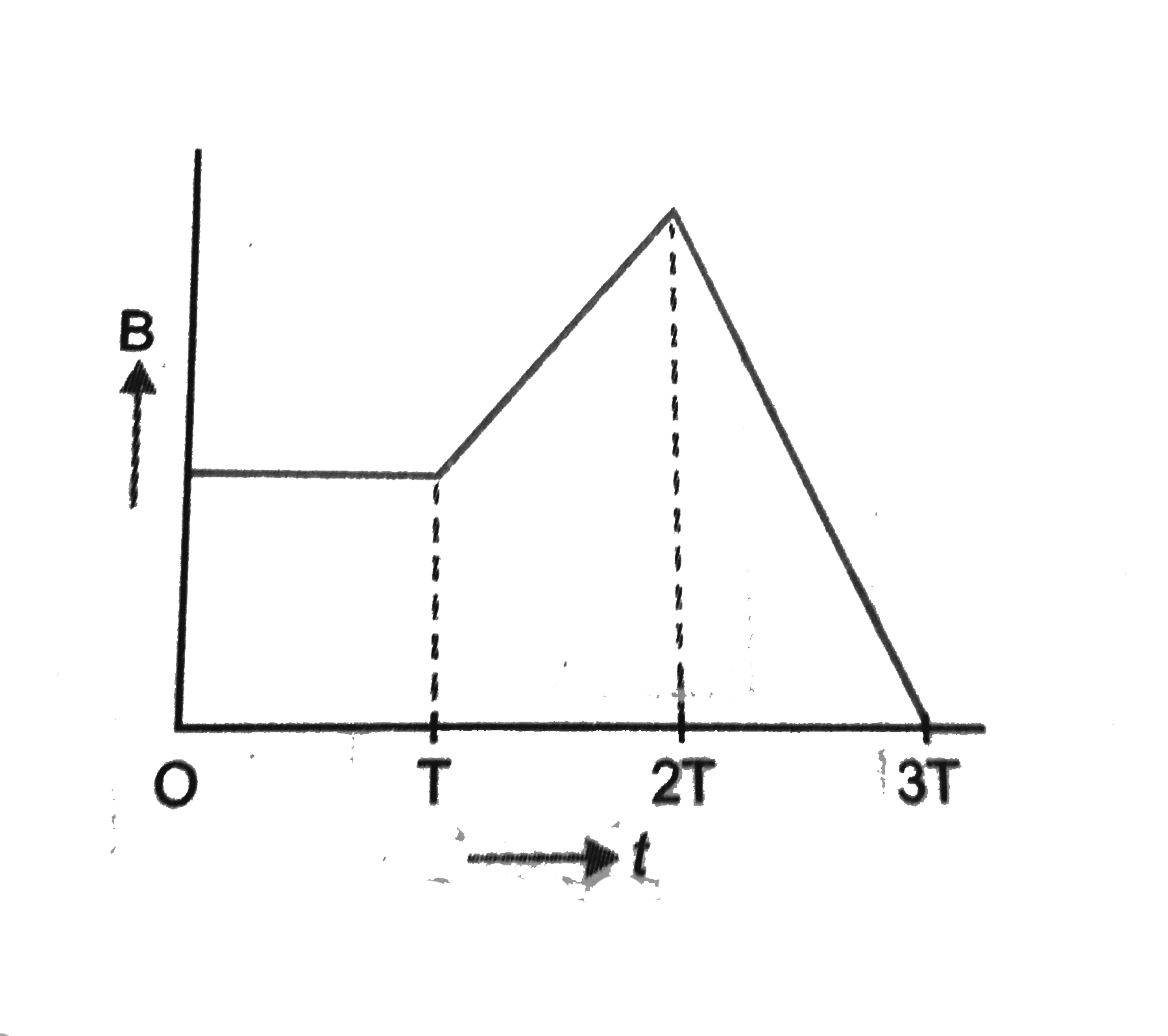 Magnetic flux linked with the coil `phi = NB_(normal) xx A = N (B sin theta) xx A` `= N BA sin theta` (b) From t = 0 to t = T, magnetic flux density B is constant. Induced e.m.f. `e = (d phi)/(DT) =` Zero: during this interval, as shown in fig. 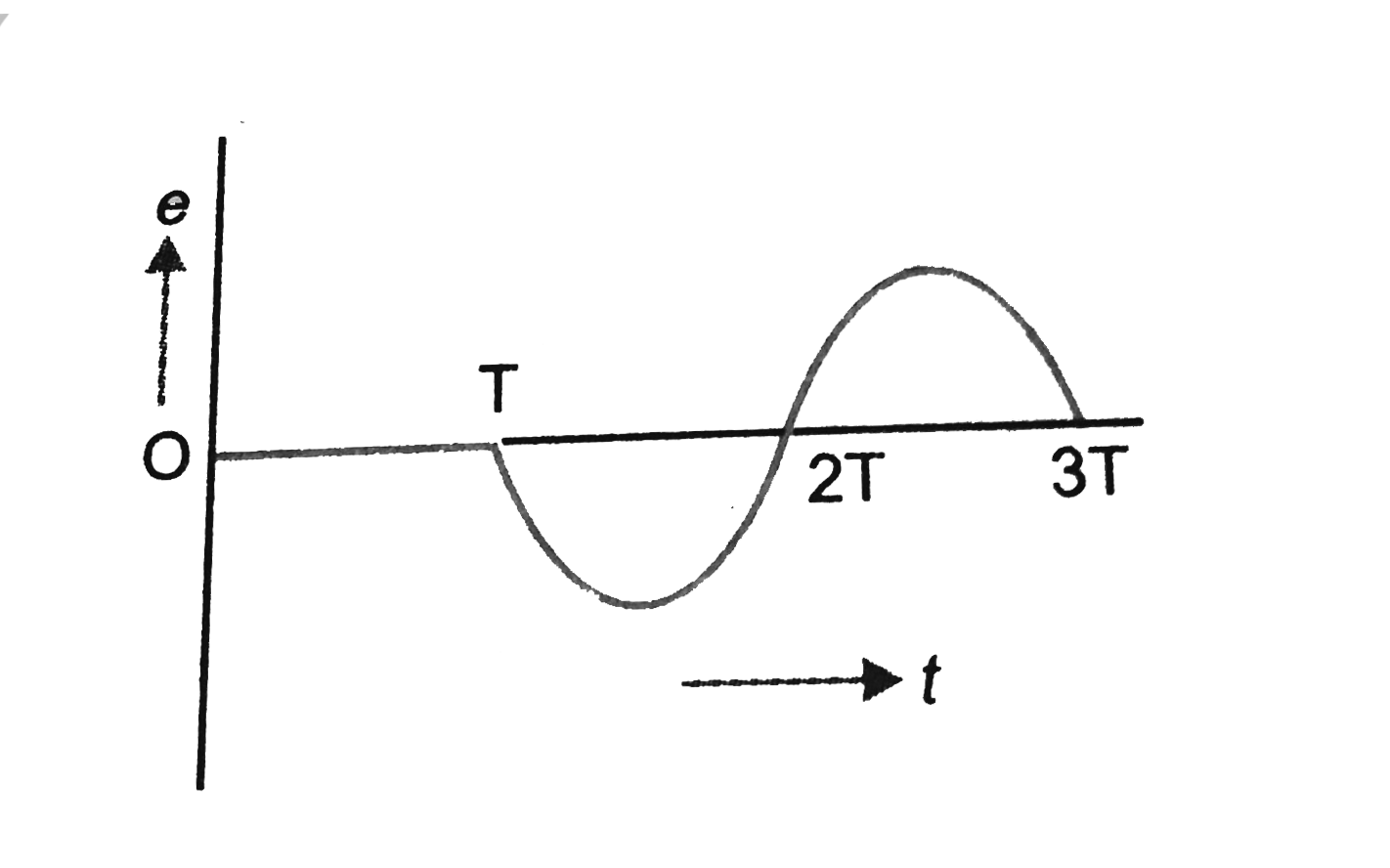 Between t = T and t = 2T, magnetic flux density increases from a certain value to some maximum value, Therefore, induced e.m.f. increases from zero to certain value in negative direction and becomes zero as shown in Fig. Between t = 2T and t = 3T, magnetic flux density decreases from maximum value to zero. Therefore, induced e.m.f. increases from zero to certain value in positive direction and then again becomes zero at t = 3T. The variation of induced e.m.f. with time is as shown Fig. |
|
| 27. |
A wire of resistance R is cut into n equal parts. These parts are connected in parallel. The equivalent resistance of the combination is |
|
Answer» nR |
|
| 28. |
A weight is suspended from a thread of length l. What is the initial speed that has to be imparted to it at the lowest point to make it complete a full revolution? The mass of the thread is to be neglected. |
|
Answer» mg + T = `mv^2//l` To find the minimum speed at the uppermost point , put T = 0. We have `mg = mv^2 "min"//l " or " v^2 min = 2gl` Taking the potential energy to be zero at point O(the axis of rotation) we obtain ACCORDING to the law of conservation of energy `(mv_0^2)/(2) -MGL = (mv^2min)/2 +mgl` Hence `v_(0) ge sqrt(5gl)` 
|
|
| 29. |
Gauss law can be used to compute which of the following? |
|
Answer» Permittivity |
|
| 30. |
A charger Q is distributed uniformly on a ring of radius of r. A sphere of equal radius r is constructed with its centre a t the periphery of the ring. The flux of the electric field through the surface of the sphere is (Q)/(n epsilon_(0)) , The value of n is |
|
Answer» |
|
| 31. |
A number of bullets are fired horizontally with different velocities from the top of a tower they reach the ground |
|
Answer» at same TIME with same velocity |
|
| 32. |
Relation between de-Broglie wavelength and absolute temp.is given by ……. |
|
Answer» <P>`lambda PROP T` but `p=sqrt(2mE)` and `E=(3)/(2)kT` `therefore p=sqrt(2mxx(3)/(2)kT)` `therefore p=sqrt(3mKT)` Other TERMS are constant, ` therefore lambda =(h)/(sqrt(3mkT))` `therefore lambda prop (1)/sqrt(T)` |
|
| 33. |
Drift velocity of electrons is ....... . |
|
Answer» in the direction of CURRENT density |
|
| 34. |
A dipole of dipole moment P is kept at the centre of a ring of radius R and charge Q. If the dipole lies along the axis of the ring. Electric force on the ring due to the dipole is : (K = (1)/(4pi epsilon_(0))) |
|
Answer» zero |
|
| 35. |
A : Y.D.S.E, as the source slit width increases, fringe pattern gets less and less sharp. R : When the source slit is so wide that the condition (s)/(S) lt (lambda)/(d) is not satisfied, the interference pattern is appears. |
|
Answer» Both A and R are TRUE and R is the correct EXPLANATION of A |
|
| 36. |
Two electric charges q_(1) = q and q_(2) = -2q are placed at a distance l = 6a apart. Find the locus of points in the plane of the charges where the field potential is zero |
|
Answer» SOLUTION :Direct the coordinate axes as shown in FIG. 24.2. Let M be one of the points where the potential is zero: `varphi=varphi_(1)=(q)/(4pi eposi_(0)r_(1))-(2q)/(4pi epsi_(0)r_(2))=0` Hence `r_(2)=2r_(1)` Substituting `r_(1)= sqrt((3a-x)^(2)+y^(2)) and r_(2)= sqrt((3a+x)^(2)+y^(2))`, we OBTAIN after some manipulations `(x-5a)^(2)+y^(2)=16a^(2)` This is the equation of a circle of radius 4a, with centre at (5a, 0) 
|
|
| 37. |
Suppose that the electric field amplitude of an electromagnetic wave is E_(0) = 120 N//C and that its frequency is ν = 50.0 MHz. (a) Determine,B_(0) omega, k, and lamda. (b) Find expressions for E and B. |
|
Answer» Solution :(a) `400 nT. 3.14 xx10^(8)" rad//s"1.05" rad//m ".6.00 m`. (b) `E={(120 N//C) SIN (1.05" rad/m ")]x-(3.14xx10^(8)" rad/s")t]} HAT J` `B={(400 nT) sin (1.05" rad/m")]x-(3.14xx10^(8)" rad/s")t]} hat K` |
|
| 38. |
An alpha particle of charge3.2xx 10 ^(-19)Candmass6.8 xx 10 ^(-27)Kgis initially moving at speed10 ^(7) m/s when it is at far distance from another fixed pointcharge112 xx 10 ^(-19)C. Find the distance of closest approach. |
| Answer» SOLUTION : ` R =9.4 XX 10 -15 m ` | |
| 39. |
In the following question a statement of assertion (A) is followed by a statement of reason (R ) A : Electric potential of a positively charged body may be negative. R : The potential of a conductor does not depend on the charge of the conductor. |
|
Answer» If both ASSERTION & REASON are true and the reason is the CORRECT explanation of the assertion , then MARK (1). |
|
| 40. |
The speed of an electric fan is reduced with the help of a regulator . What will happen in the energy consumption ? |
|
Answer» Solution :If an ELECTRIC fan of resistance R runs under potential difference V for time t , then work done , `W=I^(2)Rt=(I^(2)R^(2)t)/(R)=(V^(2)t)/(R)` To REDUCE the speed , some resistance , say`R_(1)` is added in series through a regulator . So the potential difference at the two ends of the combination of R and `R_(1)` is V . So , work done in time `t,W_(1)=(V^(2)t)/(R+R_(1))` EVIDENTLY , `W_(1)` is less than W . So , energy CONSUMPTION decreases. |
|
| 41. |
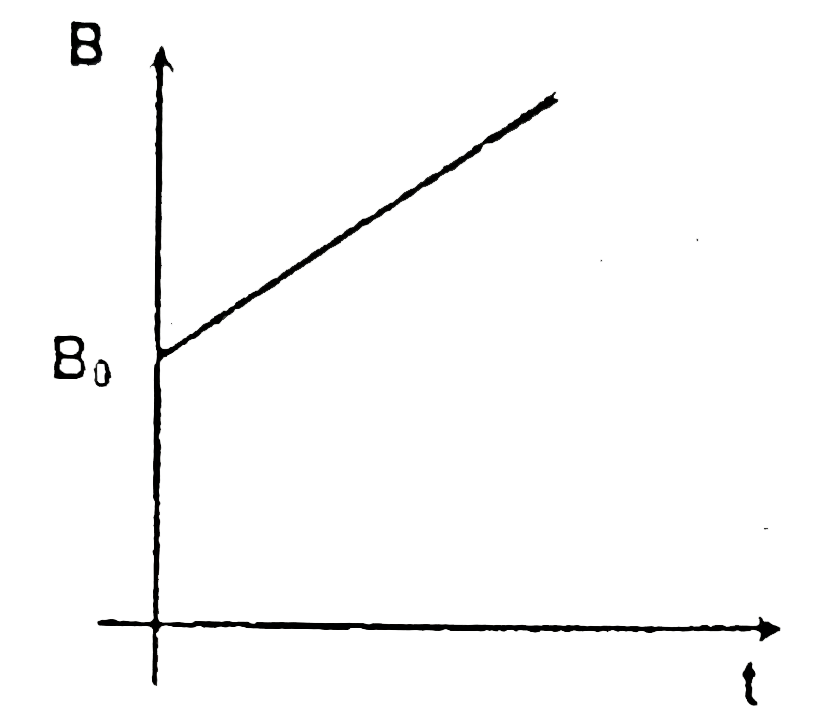
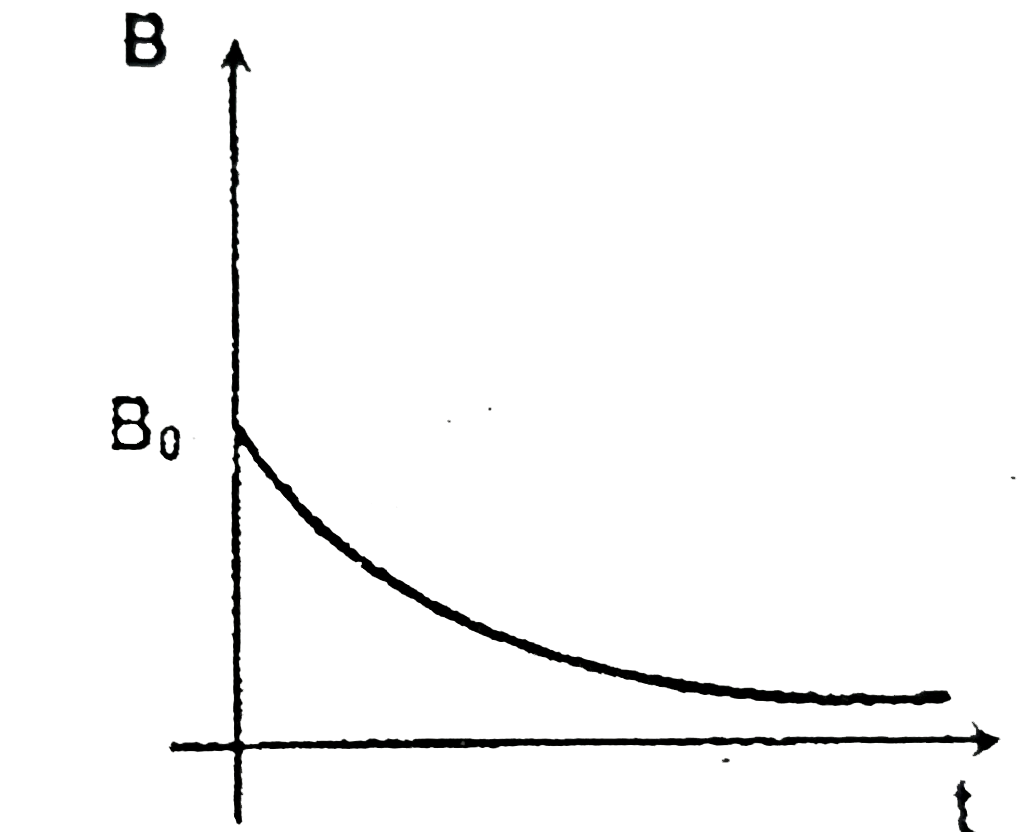
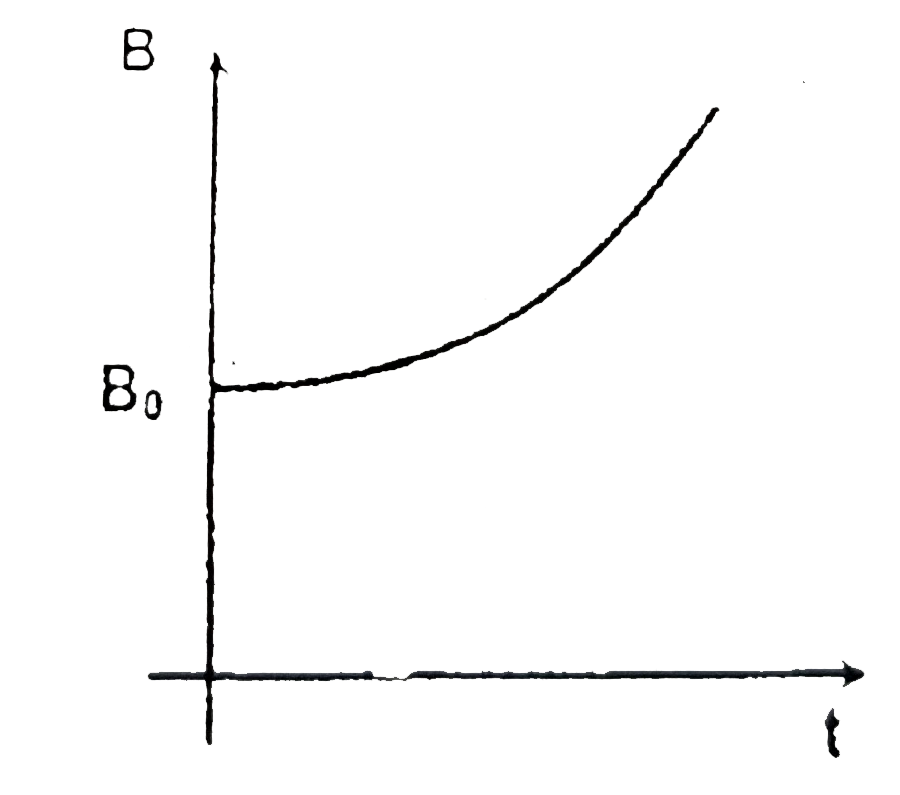
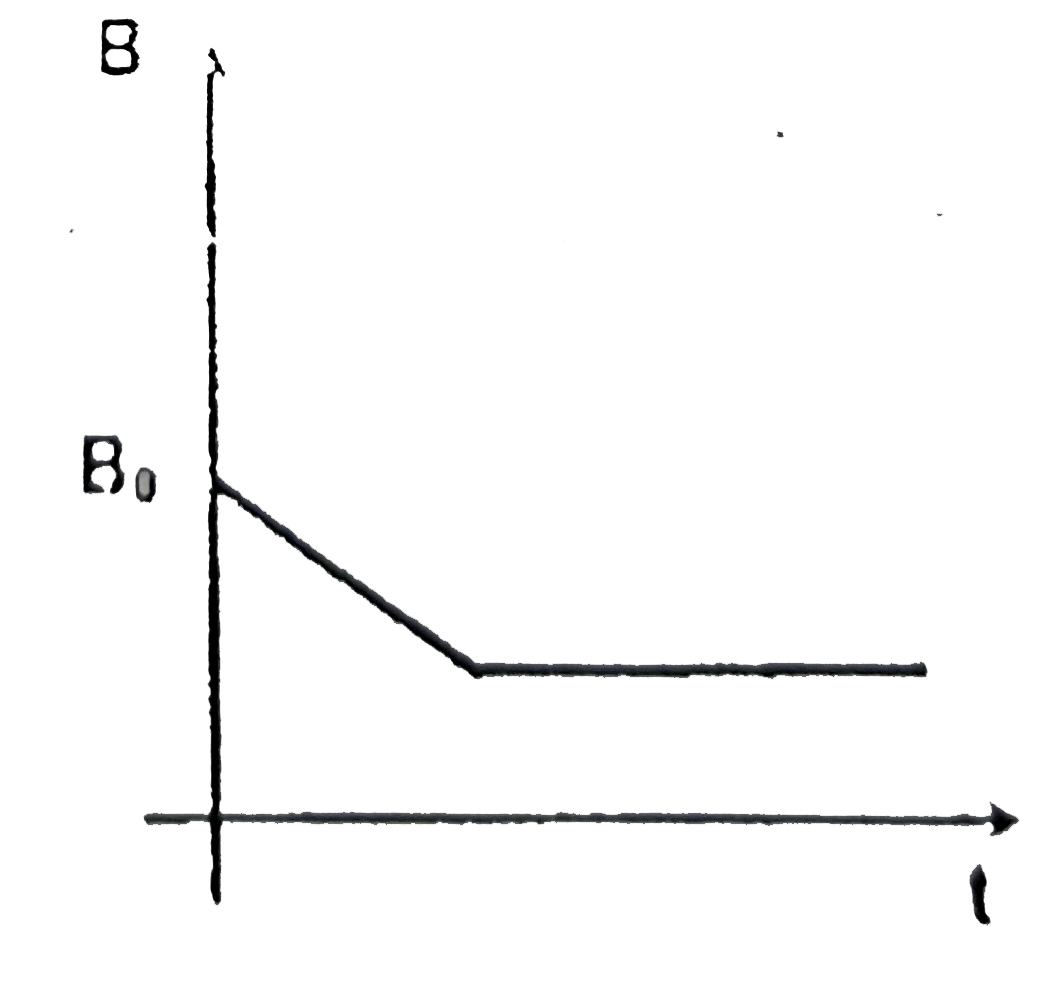
A conducting movable rod AB lies across the frictionless parallel conducting rails in a uniform magnetic field vecB whose magnitude at t=0 is B_(0). The rod AB is given velocity v right ward and it continues to move with same velocity through out the motion [The acceleration due to gravity is along negative z-axis, i.e. vecg=10m//s^(2)(-hatk), mass of rod =m.] Which of the following graphs will be the best representation of magnitude of magnetic field versus time. |
|
Answer»
`e=lBv+l(b+vt)(dB)/(dt)=0` `rArr (b+vt)(dB)/(dt)=-BV` `rArr int_(B_(0))^(B)(dB)/(B)=-vint_(0)^(t)(dt)/(b+vt)` `rArrlnB//B_(0)=-v[(1)/(v)LN((b+vt)/(b))]=ln((b)/(b+vt))` `rArr B=(B_(0)b)/(b+vt)` Second Method : So flux does not change with time, so `phi(1)=phi(t+dt)` `rArrBl(b+vt)=(B+dB)l[b+v(t+dt)]` `rArr (b+vt)dB+Bvdt=0` `rArr (dB)/(B)=-V(dt)/(b+vt)rArrB=(B_(0)b)/(b+vt)` |
|
| 42. |
Over what distance in free space will the intensity of a 5eV neutron beam be reduced by a factor one half ? |
|
Answer» 23808 km `v=sqrt((2 xx 5 xx 1.6 xx 10^(-19))/(1.67 xx 10^(-27)) =31.0"km//sec"` During a time to half PERIOD T=12.8 min, half the neutron would have decayed from the beam. The distance travelled by undecayed NEUTRONS during this time is `S=v xx T=31.0 xx 12.8 xx 60km` =23808 km |
|
| 43. |
A small coin is placed at the bottom of a cylindrical vessel of radius R and height h. If a transparent liquid of refractive index mu completely filled into the cylinder, find the minimum fraction of the area that should be covered in order not to see the coin. |
|
Answer» Solution :When the rays coming from the coin incident at an ANGLE `theta ge theta_(c)`, they will be TOTALLY REFLECTED. `implies` Minimum area that should be COVERED = `A = pir^(2)` where r = RADIUS of the circular aperture r can be found as `r = htan theta_(c)` where `theta_(c)` can be determined by the formula `sin theta_(c) = mu_(a)/mu = 1/mu` `implies tan theta_(c)= 1/sqrt(mu^(2)-1)` `therefore A = pir^(2) = (pih^(2))/(mu^(2)-1)` 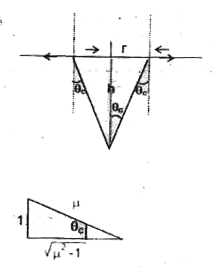
|
|
| 44. |
For destructive intergerence, what is the value of resultant amplitude and intensity of light? |
| Answer» SOLUTION :ZERO, Zero | |
| 45. |
Radio waves are reflected from which layer of atmosphere ? |
|
Answer» Mesosphere |
|
| 46. |
A unifrom electric field of strengthE = 100 V//mis generatedinside a ball made of uniformistropicdielectricwith permitivityepsilon = 5.00. The radiusof the ball is R = 3.0 cm. Find the maximum surfacedensityof the boundchagres and the total boundcharge of one sign. |
|
Answer» Solution :Within the ball the electric field can be RESOLVED into normal and tangential components. `E_(n) = E cos theta, E_(r ) = E SIN theta` Then, `D_(n) = epsilon epsilon_(0) E cos theta` and`P_(n)= (epsilon - 1) epsilon_(0) E cos theta` or, `sigma' = (epsilon - 1) epsilon_(0) E cos theta` so, `sigma_(max) = (epsilon - 1) epsilon_(0) E`, and TOTAL of ONE sign, `q' = int_(0)^(1) (epsilon - 1) epsilon_(0) E cos theta 2 pi R^(2) d ( cos theta) = pi R^(2) epsilon_(0)(epsilon - 1) E` (Since we are intersted in the total CHARGE of one signwe mustintergative`cos theta` from0 to 1 only). 
|
|
| 47. |
Radiations of wavelenght 200nm propagating in the form of a parallel beam, fall normally on a plane metallic surface. The intensity of thebeam is 5nW and its cross sectional area 1.0mm^(2). Find the pressure exerted by the radiation on the metallic surface, if the radition is completely reflected. |
|
Answer» <P> Number of photons passing a point per second is `n=(P)/(E)=(5xx10^(-9))/(10^(-18))=5xx10^(9)` momentum of each photon. `p=(E)/(C)=3.3xx10^(-27)j//s.` Change in momentun after each STRIKE `2p = 6.6x 10^(-27) j//s` Total momentum change per second is `F=(dp)/(dt)=(nxx2p)/(t)=5xx10^(9)xx6.6xx10^(-27)` `=33 xx 10^(-18)N` `therefore` pressure `(F)/(A) = 33 xx 10^(-12) N//m^(2)` |
|
| 48. |
If the mean deviation of the data set 3, 10, 10, 4, 7, 10, 5 from the mean is M then the greatest integer less then or equal to M is |
Answer»  `MD=18/7=2.57` |
|
| 49. |
A particle stars from rest. Its acceleration (a) versus time (t) is as shown in the figure . The maximum speed of the particle will be: |
|
Answer» 110 m/s `v_(MAX)=(1)/(2)xx11xx10=55ms^(-1)` |
|
| 50. |
Choose the correct alternative |
|
Answer» Alloys of METALS usually have GREATER resistivity than that of their constituent metals. |
|