Saved Bookmarks
This section includes 7 InterviewSolutions, each offering curated multiple-choice questions to sharpen your Current Affairs knowledge and support exam preparation. Choose a topic below to get started.
| 1. |
A uniform electric field and a uniform magnetic field are acting along the same direction in a certain region. If an electron is projected along the direction of the fields with a certain velocity then |
|
Answer» it will TURN TOWARDS RIGHT of DIRECTION of motion |
|
| 2. |
Read the pasage given below as well as theadjoining energylevel diagram and then answer the questions given afterthe passage . As per Bohr'stheory oghydrogen atom the energy of an atom in a statecorresponding to principal quantum numbern is given as : E_(n) = - (13.6)/(n^(2)) eV Theenergyof an atom is the least when itselectron is revolvingin an orbit closets to thenucleus i.e.,theone forwhich n =1. This stateis called the groundstate. When a hydrogen atom receives energyby processes suchas electron collision, theatom may acquire sufficientenergyto raise theelectron to higherenergystates and the atom is then saidto bein an excited state . From theseexcited states the electron can then fall back to a state of lower energy , emitting a photon in the process. The energy level diagram for thestationary states of a hydrogen atom , compouted from Bohr'srelation for energy, is givenin Fig.12.02. Theprincipalquantum number n labels the stationary states in the ascendingorderof energy . Obviously , thehighestenergycorrespondsto n = ooandhasan energy of 0 eV. Thisis the energy of the atom when the electron is completely removed (r= oo) from the nucleus and is at rest. Now answer the follwoingquestions: Which atomic transition correspond to spectral linesof hydrogen in visiblelight ? |
| Answer» Solution :TRANSITION of electron from `n_(i) = 3,4,5`…. Stateto `n_(F) = 2 ` stateinhydrogenatom gives riseto spectral LINES in visible LIGHT. | |
| 3. |
Two masses M and m(M gt m) are joined by a light string passing over a smooth light pulley. |
|
Answer» The acceleration of each BLOCK is `((M-m)/(M+m))g` |
|
| 4. |
The sigma of a material is 0.20. If a longitudinalstrain of 4.0xx10^(-3) is caused, by what percentate with the volume change |
|
Answer» 0.0048 |
|
| 5. |
A tank filled with water upto 1.25 m has two outlets (i) a rounded orifice A or area of cross section10^(4) m^(2) and (ii) a pipeBwith well rounded entryandof length 55cm , Pick the correctcombination |
| Answer» Answer :B | |
| 6. |
An electron is not deflected while passing through a certain region of space. Can we conclude that there is no magnetic field? |
| Answer» Solution :No. If the initial VELOCITY of the electron is parallel to the MAGNETIC FIELD, force ACTING on it will be zero and it can move UNELECTED. | |
| 7. |
Body1 and body 2 are in a completely inelastic one-dimensional collision. What is their final momentum if their initial momenta are , respectively , (a)10 kg m/s and 0 , (b) 10 kg m/s and 4 kg m/s, (c ) 10 kg m/s and -4 kg m/s ? |
|
Answer» |
|
| 8. |
Draw the circuit symbol of n-p-n transistor |
Answer» SOLUTION :
|
|
| 9. |
What is photoelectric effect ? Draw a neat figure of the experimental arrangement used to study photoelectric effect. |
Answer» Solution : Photoelectric effect is the phenomenon of emission of electrons from the surface of a METAL when light of suitable high frequency (i.e., having frequency equal to or greater than the threshold frequency) is allowed to fall ont he metal surface. if we design a photoelectric tube ad maintain a suitable potential DIFFERENCE between photosensitive cathode C (emitter plate) and an anode A, due to motion of photoelectrons towards the anode (collector plate), a photoelectric current is SET up in the circuit. photoelectric current is set up in the circuit arrangement USED is shown in figure. |
|
| 11. |
(a) The current density in a cylindrical wire of radius R=2.0mm is uniform across a cross section of the wire and is J=2.0 xx 10^(5) A//m^(2). What is the current through the outer portion of the wire between radial distances R/2 and R? (b) Suppose, instead, the current density through a cross section varies with radial distance r as J=ar^(2), in which a=3.0 xx 10^(11)A//m^(4) and r is in meters. What now is the current through the same outer portion of the wire? |
|
Answer» Solution :(a) Because the current density is UNIFORM across the cross section, the current density J, the current I, and the cross-sectional AREA A are related by (J=i/A). Calculation: We want only the current through a reduced cross-sectional area A. of the wire (rather than the entire area), where `A.=pi R^(2)-pi (R/2)^(2)=pi ((3R^(2))/(4))` `=(3pi)/(4) (0.0020 m)^(2)=9.424 xx 10^(-6) m^(2)`. So, we REWRITE Eq. 26-5 as i=JA. and then substitute the data to find `i=(2.0 xx 10^(5) A//m^(2)) (9.424 xx 10^(-6) m^(2))` =1.9A (b) Because the current density is not uniform across a cross section of the wire, we must resort to `(i=int vecJ.d vecA)` and integrate the current density over the portion of the wire from r=R/2 to r=R. Calculations: The current density vector `vecJ` (along the wire.s length) and the differential area vector dA (perendicular to a cross section of the wire) have the same direction. Thus, `vecJ=d vecA=JdA cos 0=jdA`. we need to replace the differential area dA with something we can actually integrate between the limits r=R/2 and r=R. The simplest replacement (because J is given as a function of f) is the area of `2pir` of a thin RING of circumference `2pir` and width dr. We can then integrate with r as the variable of integration. Eq 26-4 then gives as `i=int vecJ.d vecA=int JdA` `=int_(R//2)^(R) ar^(2) 2pir dr=2pi a int_(R/2)^(R) r^(2) dr` `=2pia [r^(4)/]_(R//2)^(R) =(pi a)/(2) [R^(4)-(R^(4)/(16))]=(15)/(32) piaR^(4)` `=(15)/(32) pi (3.0 xx 10^(11) A//m^(4)) (0.0020 m)^(4)=7.1A` |
|
| 12. |
From where did the orders come to teach only German in the districts of Alsace and Lorraine? |
|
Answer» France |
|
| 13. |
In the above, the change in speed is:- |
|
Answer» ` U COS theta` `(u cos theta)HATI-[(u cos theta)hati+(u sin theta)hatj]=-(u sin theta) hatj` `|Deltavecv|=u sin theta` CHANGE in speed `=(u cos theta)-v` |
|
| 14. |
Magnitude of focal lengths of a convex lens, a concave lens, a convex mirror and a concave mirror are 20 cm each. An object is placed 30 cm from pole/optical centre of each. Regarding the image match the following two columns. |
|
Answer» |
|
| 15. |
Give band gap Eg value for conductor, Insulator and semiconductor |
|
Answer» |
|
| 16. |
A few electric field lines for a system of two charges Q_(1) and Q_(2) fixed at two different points on the x-axis are shown in the figure. These lines suggest that |
|
Answer» `|Q_(1)|gt|Q_(2)|` |
|
| 17. |
Light ray travels from air to glass and air to water, as shown in figure (i) and (ii) respectively. What is refraction angle for figure (iii) ? |
|
Answer» SOLUTION :`""^a mu_g=(sin60^@)/(sin35^@)`…......(1) `""^a mu_w=(sin60^@)/(sin41^@)`…......(2) `""^w mu_g=(sin41^@)/(sintheta^@)`…......(3) `""^amu_g=""^amu_wxx""^wmu_g` `(sin 60^@)/(sin35^@)=(sin60^@)/(sin41^@)xx(sin41^@)/(sintheta)` `therefore sin theta=sin 35^@` `therefore theta=35^@` |
|
| 18. |
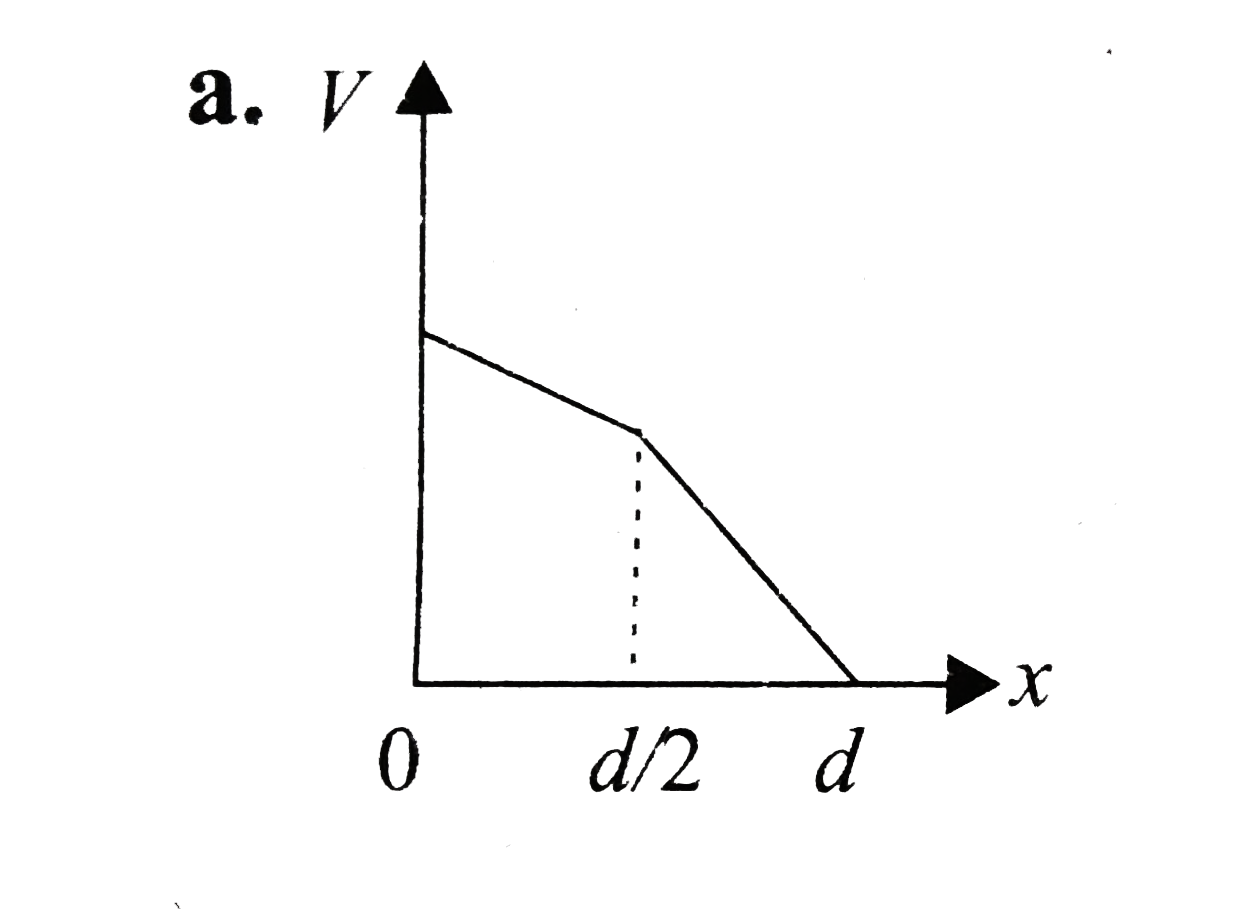
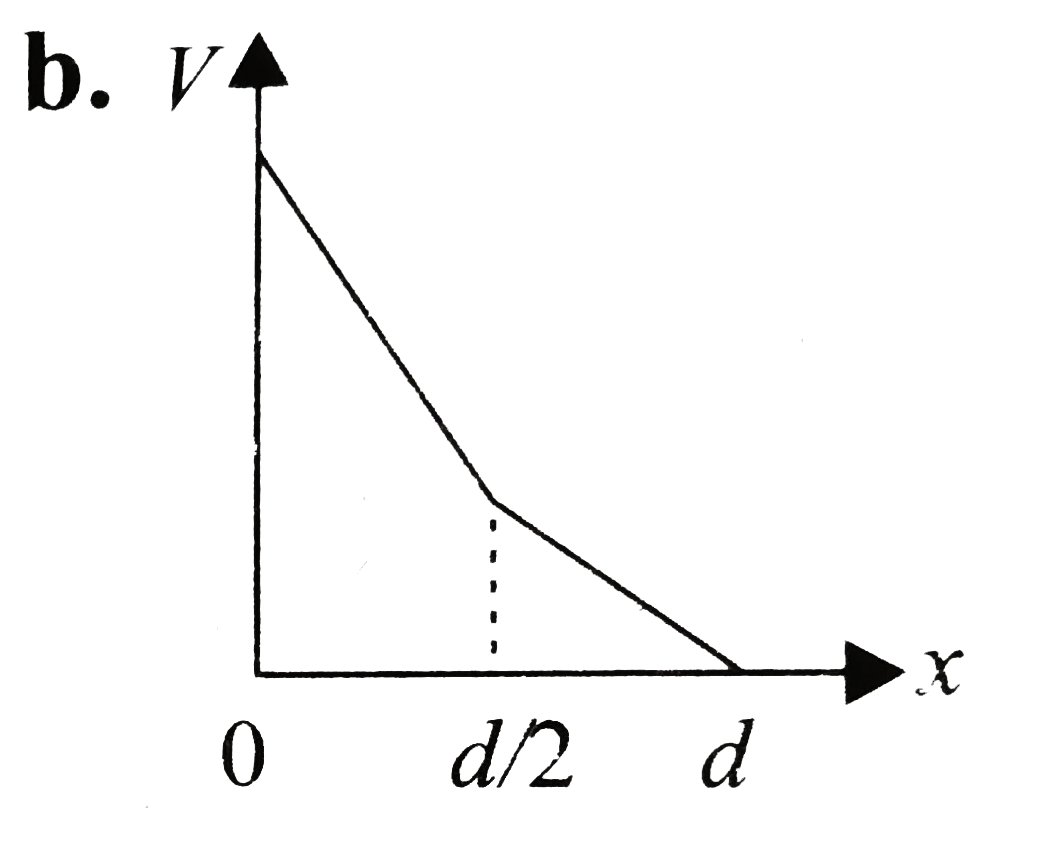
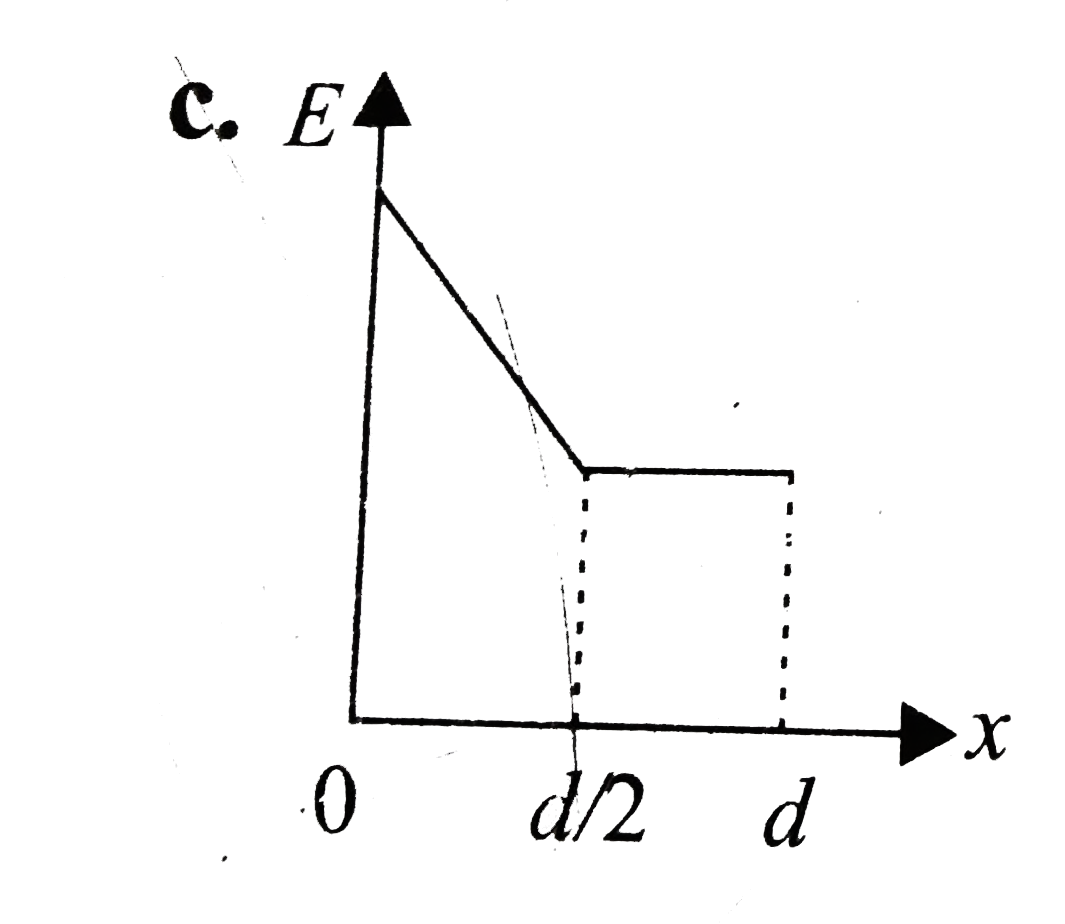
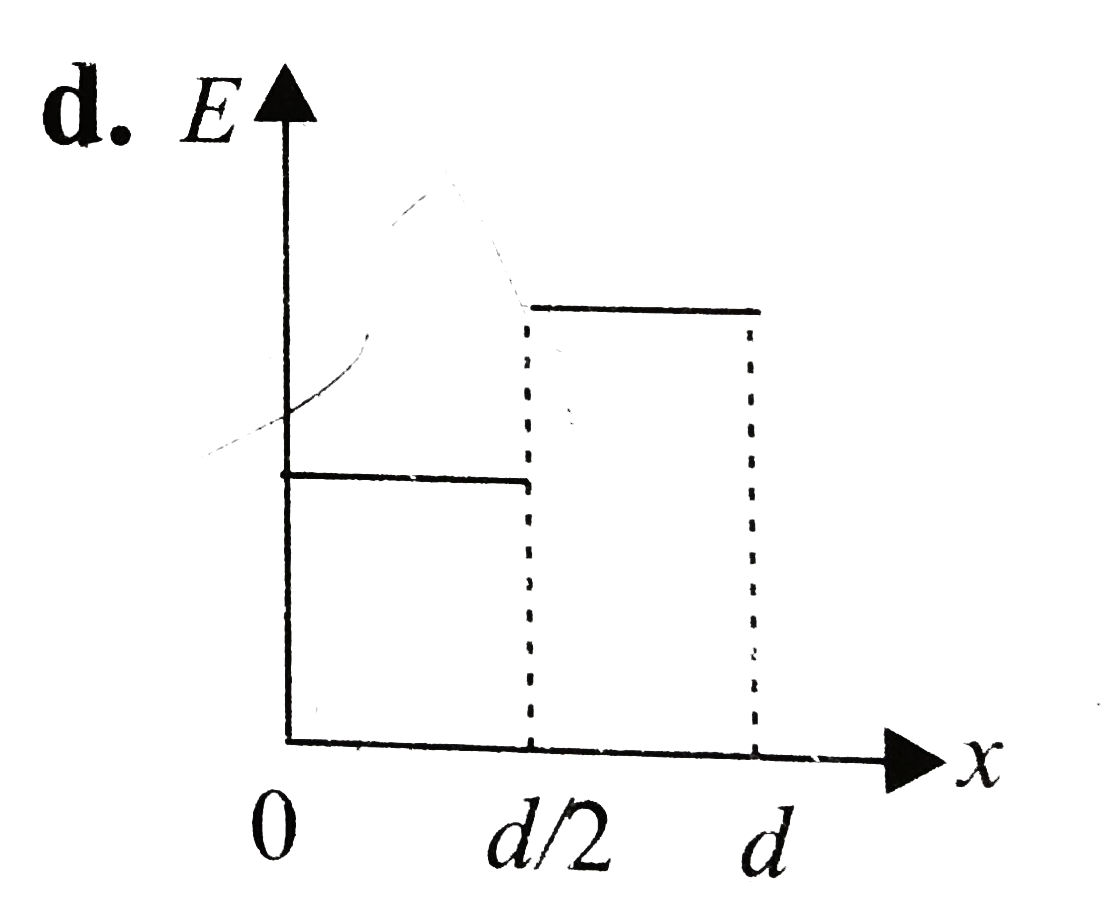
In figure half of the space between the plates of a parallel plate capacitor is filled with dielectric material of constant K. Then which of the plots are possible? |
|
Answer»
Suppose field in air GAP is `E`. Then in dielectric it is `ElK`. For dielectric medium `DV=-(E)/(K)DX` or `V=(E)/(K)x` For air gap medium , `V=-Ex`. |
|
| 19. |
A thin flake of mica (n = 1.58) is used to cover one slit of a double-slit interference arrangement. The central point on the viewing screen is now occupied by what had been the fifth bright side fringe (m = 5). If lambda= 550 nm, what is the thickness of the mica? |
| Answer» SOLUTION :`4.74 XX 10^(6)` m | |
| 20. |
When a metallic sphere is moved in a magnetic field , it gets heated due to :- |
|
Answer» DIRECT CURRENT |
|
| 21. |
(a) Light, from a sodium lamp, is passed through two polaroid sheets P_(1) and P_(2) kept one after the other. Keeping P_(1) fixed, P_(2) is rotated so the its 'pass-axis' can be at different angles, theta, with respect to the pass-axis of P_(1) An experimentalist records the following gata for the intesity of light coming out P_(2) as a function of the angle theta. [I_(0)= Intensity of beam falling on P_(1)] One of these observation is not is agreement with expected theoretical variation of l. ldentify this observation and write the correct expression. (b) Define Brewster angle and write the expression for it in terms of the refractive index of the medium. |
|
Answer» Solution :(a) If `l_(0)` is the irradiate of incoming beam, then the irradiance is reduced to `l_(1)=l_(1)=(l_(0))/(2)` after passing through the first polariser. `therefore l_(2)=l_(1) cos^(2)30^(@)[therefore l=l_(0) cos^(2) theta]` `=(l_(0))/(2)((sqrt3)/(2))^(2)=l_(0)/(2)xx(3)/(4)=(3l_(0))/(8)` `l_(3)=l_(2) cos^(2)45^(@)` `=(3l_(0))/(8)((1)/(sqrt2))^(2)=(3l_(0))/(8)xx(1)/(2)=(3l_(0))/(16)` `l_(4)=l_(4) cos^(2)60^(@)` `=(3l_(0))/(64)xx0=0` Obesrvations `(3) and (4)` are not in agreement with the expected theoretical variations of `l`.`thereore` Conrrect observations are `l_(3)=(3l_(0))/(16) and l_(4)=(3l_(0))/(64)` (b) Brewster's angle : The angle of incidence at which, when ORDINARY LIGHT is incident on transparent refracting medium, the reflected light becomes maximum in plane, POLARISED light is called Brewster's angle or POLARISING angle. It is denoted by in. The relation between retroactive index `mu` and in is `mu=tan i_(p)`. |
|
| 22. |
A rock is dropped off a cliff and strikes the ground with an impact velocity of 30 m//s. How high was the cliff ? |
|
Answer» 15m `v^(2)= v_(0)^(2)+2aDelta s = 2a DELTA s implies Delta s = (v^(2))/(2 a)=(v^(2))/(2g)=((30 m//s)^(2))/(2(10 m//s^(2)))=45 m` |
|
| 23. |
The plates of a parallel plate capacitor have an area of 100 cm^(2) each and are separated by 3mm. The capacitor is charged by connecting it to a 400 V supply. (a) Calculate the electrostatic energy stored in the capacitor. (b) If a dielectric of dielectric constant 2.5 is introduced between the plates of the capacitor then find the electrostatic energy stored and also change in the energy stored. |
|
Answer» Solution :Given `A = 100 CM^(2) = 100 xx 10^(-4) m^(2), d = 3mm = 3 xx 10^(-3)m, V = 400 V, u_(1) = ?, K = 2.5, u_(2) = ?` ALSO `u_(2) - u_(1) = ?` We have `U = (1)/(2) C V^(2)` `C = (epsilon_(0)A)/(d) = (8.854 xx 10^(-12) xx 100 xx 10^(-4))/(3 xx 10^(-3)) = (8.854 xx 10^(-16))/(3 xx 10^(-3)) = 295.13 xx 10^(-13)` `C = 29.513 xx 10^(-12) F` (i) `U_(1) = (1)/(2)CV^(2)` `= (1)/(2) 29.513 xx 10^(-12) xx (400)^(2) = (4722080)/(2) xx 10^(-12) = 2361040 xx 10^(-12)` `U_(1) = 23.610 xx 10^(-7) J` (ii) If dielectric medium K = 2.5 is introduced between the PLATES of the capacitors, the its capacitance is `C = (epsilon_(0) KA)/(d) = (8.854 xx 10^(-12) xx 2.5 xx 100 xx 10^(-4))/(3 xx 10^(-3)) = (2213.5)/(3 xx 10^(-3)) xx 10^(16) = 737.833 xx 10^(-13)` `C = 73.7833 xx 10^(-12) F` `U_(2) = (1)/(2) C V^(2) = (1)/(2) 73.7833 xx 10^(-12) xx (400)^(2) = 5902661 xx 10^(-12)` `U_(2) = 59.02664 xx 10^(-7)J` CHANGE in energy `Delta U = U_(2) - U_(1) = 59.02664 xx 10^(-7) - 23.610 xx 10^(-7)` `Delta U = 35.14661 xx 10^(-7)J` |
|
| 24. |
A thin insulating wire is stretched along the diameter of an insulated circular hoop of radius E. A small bead of mass m and charge –q is threaded onto the wire. Two small identical charge= are tied to the hoop at points opposite to each other, so that the diameter passing throughtheL-is perpendicular to the thread (see figure). The bead is released at a point which is a distance-, from the centre of the hoop. Assume that x_0 ltlt R. a. What is the resultant acting on the charged bead? b. Describe (qualitatively) the motion of the bead after it is released. c. Use the assumption that x//Rltlt1 to obtain an approximate equation of motinand find the dislacemet ad velocity of the bead as functuions of time. d. When will the velocity of the bead will become zero for the first time? |
|
Answer» `=(2kQ.q)/(sqrt(R^2+x_0^2)^2).x_0/sqrt((R^2+x_0^2)("Here", k=1/(4piepsilon_0)` `=(2kQqx_0)/((R^2+x_0^2)^(3/2))` 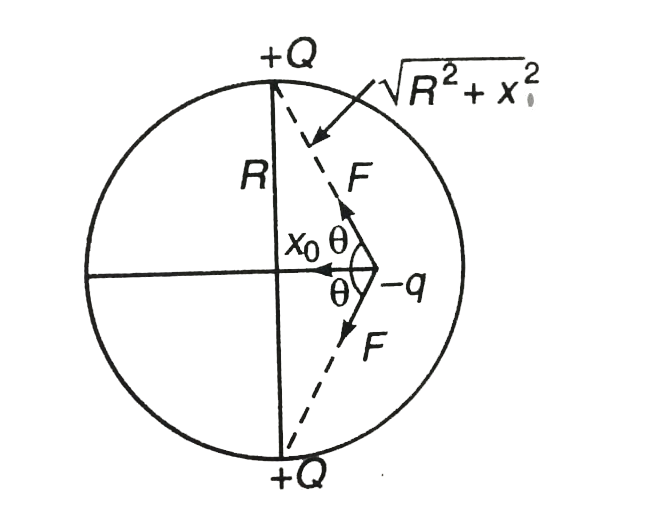 We can generalised the FORCE by putting `x_0=x` we have `F=-(2kQqx)/((R^2+x^2)^(3/2))` Motion of bead will be periodic between `x=+-x_0` c. for x/Rltlt1, R^2+x^2=R^2` `or F=-((2kQq)/R^3)xor a=F/m=-((2kQq)/(mR^3))x` since `aprop-x` motion will be simple ha.rmonic in nature. Comparing with `a=-omea^2x, omega=sqrt((2kQq)/(mR^3))` `x=x_0cos OMEGAT` (as the particle starts form extreme position) `v=(dx)/(dt)=-omegax_0sinomegat` d. Velociyt wil become ZERO at `t=T/2=pi/omega` 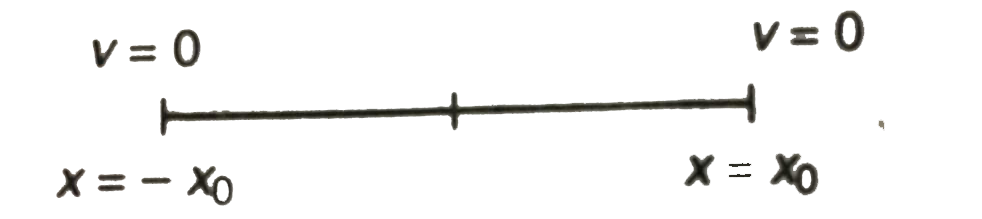 or `t=pisqrt((mR^3)/(2kQq))` |
|
| 25. |
The electric field between two infinitely charged plates with air mediuun in between, in terms of the surface charge density sigma "is |
|
Answer» `4PI epsi_(0)` |
|
| 26. |
All the capacitors were uncharged before they are connected in circuit. Now the charge on 4muFcapacitor is |
| Answer» ANSWER :A | |
| 27. |
200 alkaline accumulators are to be charged by a dynamo generating a voltage of 230 V. The e.m.f. of each accumulator is 1.4 V, the internal resistance 0.01 ohm, the charging current 30 A. Suggest the circuit diagram and calculate the resistance of the rheoslat. |
Answer» 
|
|
| 28. |
One magnet is cut perpendicular to its axis and divided into two pieces with the lengths in the ratio 2 : 1. Then ratio of their pole strength is ...... |
|
Answer» `2:1` |
|
| 29. |
A toy car is moving on a closed track whose curved portions are semicircles of radius 1m. The adjacent graph describes the variation of speed of the car with distance moved by it (starting from point P). The time t required for the car to complete one lap is equal to 6k second. Find k (take piln2~~2) |
|
Answer» Solution :For the motion from `A` to `B` applying `s=vt`, `2=0.25 t_(AB)` `t_(AB)=8` For the motion from `B` to `C` `-(dv)/(DL)=(0.125)/((pi)/(2))=(1)/(4pi)=-(dv)/(dl)xx(dt)/(dt)` `int_(0)^(t_(BC))(dt)/(4pi)=int_(0.25)^(0.125)-(dv)/(v)` `rArr t_(BC)=4piln2` `t_(BC)=t_(CD)=t_(EF)=t_(FG)` `t_(AB)=t_(DE)` total time will be sum of all times `=16(1+piln2)` 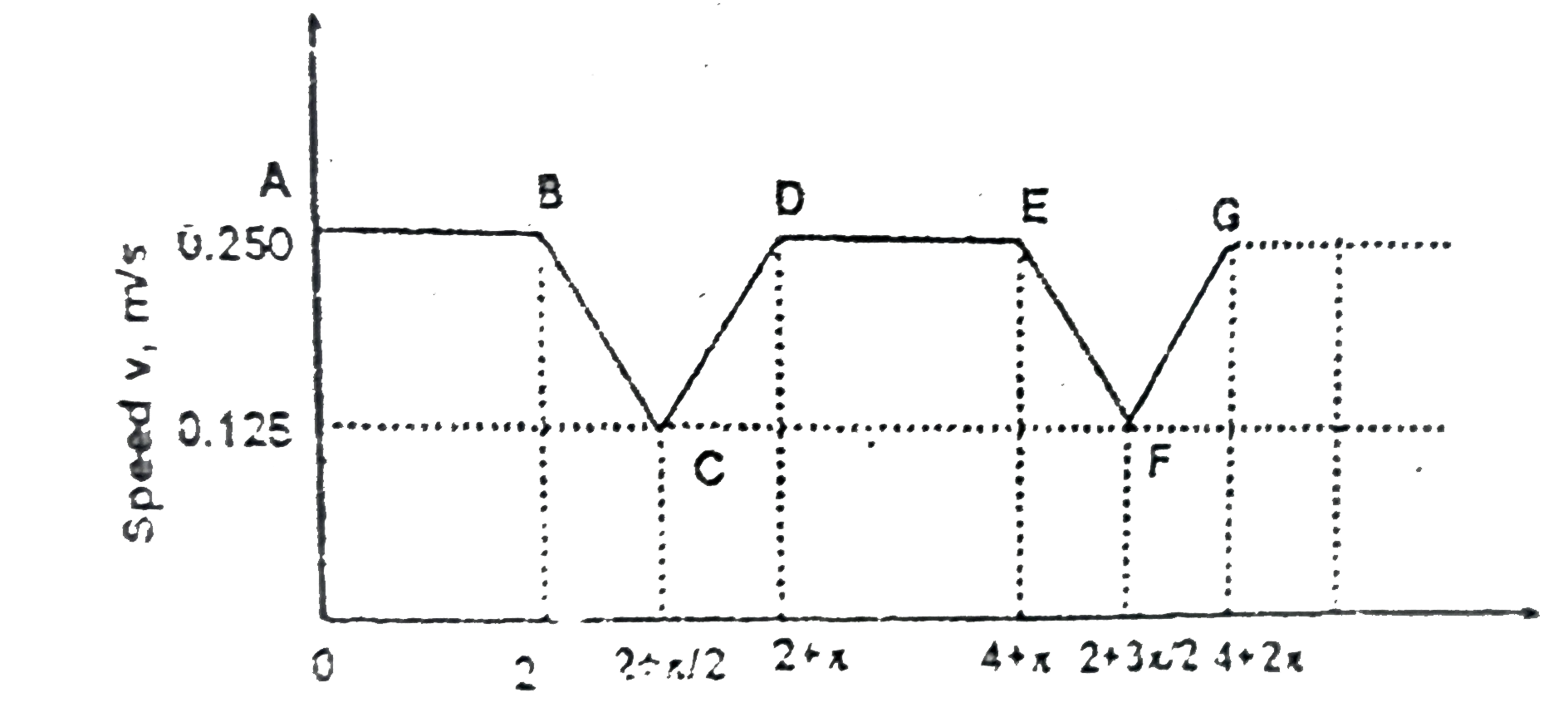
|
|
| 30. |
The time taken by a ray of light to travel through 5 cm of glass is the same as that through x cm of air. If the R.I. of glass is 1.5, then the value of x is : |
|
Answer» 7.5 cm |
|
| 31. |
Consider a transparent hemisphere (n=2) in front of which a small object is placed in air (n=1) as shown. For which value of x of the following will final image of object at O be virtual |
|
Answer» 2R Taking refraction first at CURVE surface `2/v_(1)+1/x=1/R Rightarrow v_(1)=(2Rx)/(x-R)` for PLANE surface `v'=v_(1)-R Rightarrowv'=(xR+R^(2))/(x-R)Rightarrow1/v-(2(x-R))/(R(x+R))=0` `1/v=(2(x-R))/(R(x+R))` for virtual image `1/vlt0 Rightarrow(2(x-R))/(R(x+R))LT0` `xltR` (2)For`x=2R` `v_(1)=(4R^(2))/R=4R Rightarrow u=-2R` `m_(1)=mu_(1)/mu_(2).v/u=1/2. (4R)/((-2R))=-1` `m_(2)=1 Rightarrow m_(1)m_(2)=-1` Image is real inverted and same size. 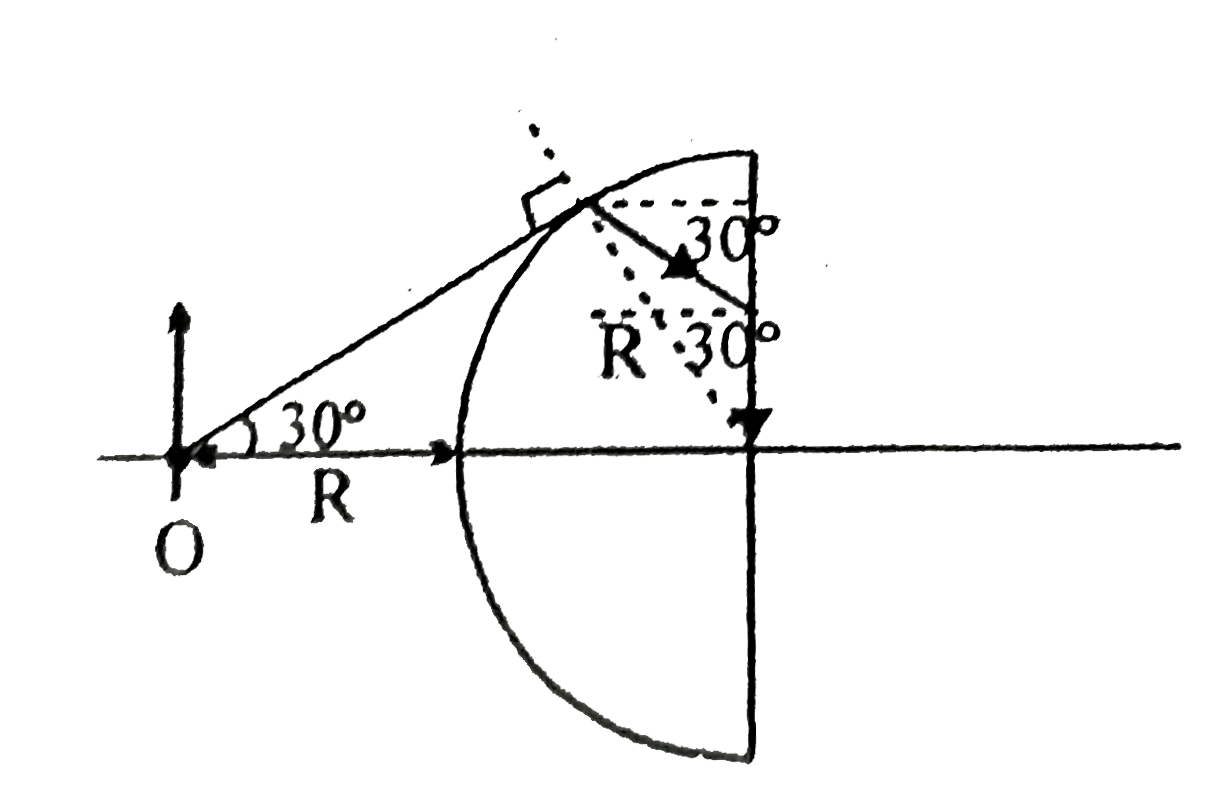 Hence correct answer is `90^(@)` Hence correct answer is `90^(@)`
|
|
| 32. |
The earth's atmosphere are divided into various regions like _____, _____, _____ and _____. |
| Answer» SOLUTION :TROPOSPHERE, STRATOSPHERE, MESOSPHERE and IONOSPHERE | |
| 33. |
If a magnetic dipole of moment M situated in the direction of a magnetic field B is rotated by 180^@ then the amount of work done is |
| Answer» Answer :B | |
| 34. |
A thin prism P_1 with angle 4^@ and made for glass of refractive index 1.54 is combined with another thin prism P_2 made from glass refractive index 1.72 to produce dispersion without deviation. The angle of prism P_2 is |
|
Answer» |
|
| 35. |
It is desired to set up an undriven L-C circuit in which the capacitor is originally charged to potential difference of 100.0 V . The maximum current is to be 1.0 A and the oscillation frequency is to be 1000 Hz . What are the required values of L and C ? |
|
Answer» |
|
| 36. |
Current density in a cylindrical wire of radius R is given as J={{:(J_(0)((x)/(R)-1)" for "0 lexlt(R)/(2)),(J_(0)(x)/(R)" for "(R)/(2)lexleR):} . The current flowing in the wire is : |
|
Answer» `(7)/(24)piJ_(0)R^(2)` |
|
| 37. |
Two coils are placed close to each other. The mutual inductance of the pair of coils depends upon |
|
Answer» the CURRENTS in the two coils. |
|
| 38. |
When any neutral conductor is made charged, its mass …………………….. |
|
Answer» will INCREASE |
|
| 39. |
Describe the construction and working of an AC generator and arrive at the expression for the emf induced in it. |
Answer» Solution :Construction : AC generator consists of a rectangular coil abcd of insulated copper WIRE wound on a soft iron core. The coil (armature) is rotated in a strong uniform magnetic field. There axis of rotation is perpendicular to the direction of magnetic field. The two ENDS of rectangular coil are connected to slip rings `R_1` and `R_2` which are insulated each other. The two carbon stationary brushes` B_1 and B_2` make contact with `R_1` and `R_2` WORKING  In the above figure N and S are poles of a MAGNET, `theta ` is the angle between the directions of magnetic field B and area vector A. When the coil is rotated in the magnetic field, the flux linked with the coil varies: At" , any instant of time .t., A cos `theta ` is the component of area vector along the direction B: The magnetic flux linked with the coil at any instant of time .t. is given by `phi_n =B xx`component of area vector along the field direction. For I turn `phi_B .=BA cos theta ` For n turns `phi_B =nAB cos theta ` `phi _B n ABcosomega t -------(1)[ :.theta = omega t]` where `. omega `. is the angular velocity of the coil at time t. From the Faraday.s second LAW, `e=- ( d phi)/(dt) ` ` =- (d)/(dt) [ nABcosomegat] [from(1) phi=nAB cosomega ]` `e=- (-nAB)[- sinomega t]xx omega ` ` e= nABomegat ` ` e=e_0sin( omegat)` where `e_0` is the peak value of `emf = nAB omega ` |
|
| 40. |
The magnetic field at the centre of ring carrying electric current is ____ of area of the ring. |
|
Answer» inversely proportional to square ROOT But `A=pia^(2)` `thereforea=(A/pi)^(1/2)` `thereforeB=(mu_(0)Ixxpi^(1/2))/(2xxA^(1/2))` `thereforeBprop1/A^(1/2)" "[because"Other TERMS are constant"]` |
|
| 41. |
State the underlying principle of a transformer and obtain the expression for the ratio of secondary to primary voltage in terms of the three (i) number of secondary and primary winding send (ii)primary and secondary currents. |
|
Answer» Solution :PRINCIPLE of a transformer : When the alternating current flows through the primary coil and EMF is induced in the neighbouring (secondary) coil (i) Let `(d phi)/(d t)` be the rate of change of FLUX through each TURN of the primary and the secondary coil `(epsilon_(1))/(epsilon_(2)) = -N_(1).(d phi)/(d t)//-N_(2).(d phi)/(d t) = (N_(1))/(N_(2))` or `(V_(1))/(V_(2)) = (N_(1))/(N_(2))` ...(i) (ii) But for an ideal transformer , `V_(1)I_(1) = V_(2)I_(2)` `(V_(1))/(V_(2)) = (I_(2))/(I_(1))` ...(ii) from equation (i) and (ii) `(V_(1))/(V_(2)) = (N_(1))/(N_(2)) = (I_(2))/(I_(1))` |
|
| 42. |
Figures (a) and (b) show refraction of a ray in air incident at 60^(@) with the normal to a glass-air and water-air interface, respectively. Predict the angle of a refraction in glass when the angle of incidence in water is 45^(@) with the normal to a water-glass interface . |
|
Answer» Solution :FIG (a) `n_(ga) = (SIN 60)/( sin 35) ` = 1.51 ` n_(gw)= (n_(ga))/(n_(wa)) = (1.51)/(1.32) = 1.14` Also `n_(gw) = (sin 45)/(sin R)"" therefore sin r = (sin 45)/(1.14) = (0.7071)/(1.14) = 0.6203` `r = sin^(-1) (0.6203) = 38^(@)21` |
|
| 43. |
Isogonic lines on magnetic map will have |
|
Answer» ZERO ANGLE of dip |
|
| 44. |
An equilateral deviates a ray through 45^(@) for the two angle of incidence differing by 20^(@). The angle of incidence is |
|
Answer» `60^(@)` `:.` Angle of prism `=60^(@)` ALSO, `i-i'=20` `:' delta=i+i'-A` or `delta+A=i+i'` or `40^(@)+60^(@)=i+i'` or `i+i'=100` Adding eqs (i) and (II) we get `2i=120` `i=60^(@)` |
|
| 45. |
What is telescope? |
| Answer» SOLUTION :It is a device USED to VIEW the DETAILS of distant objects. | |
| 46. |
A parallel plate capacitor is charged and then isolated. What is the effect of increasing the plate separation on charge, potential, capacitance respectively |
|
Answer» CONSTANT, DECREASES, decreases |
|
| 47. |
String vibrates according to equation, y= 5 sin (pix)/3 cos400pit. At what time potential energy of string will be zero? |
|
Answer» |
|
| 48. |
A conducting ring of radius R is rotating as well as translating on a smooth horizontal surface where a uniform magnetic field B is present . Velocity of centre of mass is given as v = 2R omega where omega is the angular velocity of the ring. Matche the following cases. Motional emf across |
|
Answer» <P>`{:(P,Q,R,S),(2,1,3,4):}` |
|
| 49. |
Which of the following statement(s) is/are true ? "Internal energy of an ideal gas _____ " |
|
Answer» decreases in an ISOTHERMAL process |
|
| 50. |
The force between two alpha-particles separated by a distance .r. is F. In order to have same force F, the distance between singly ionized chlorine atoms separated by a distance of |
|
Answer» 2r |
|