

Saved Bookmarks
This section includes 7 InterviewSolutions, each offering curated multiple-choice questions to sharpen your Current Affairs knowledge and support exam preparation. Choose a topic below to get started.
| 1. |
In an experiment on measuring the velocity of light by Focault's method the fixed and the fixed and the revolving mirror were 3 km apart, the latter revolving at 500 revvolutions per second. The angular diviation of the return ray was 7^(@)12'. Calcualte velocity of light. |
|
Answer» |
|
| 3. |
A hollow insulating spherical shell has a surfac charge distribution placed upon it, such that the upper hemisphere has a uniform surface charge density sigma. While the lower hemisphere has a uniform surface charge density -sigma.as shown in the figure. Their interface lies in x-y plane which |
|
Answer» The field at all POINTS of x-yplane within the SPHERE points in the - ve z-directior. |
|
| 4. |
In an optics experiment, with the position of the object fixed, studen varies the position of a convex lens and for each position, the screen is adjusted to get a clear image of the object. A graph between the object distance u and the image distance v, from the lens is plotted using the same scale for the two axes. A straight line passing through the origin and making an angle of 45^(@) with the x - axis meets the experimental curve at P. The coordinates of P will be : |
|
Answer» (2f, 2f) One has a take that u is negative again for calculation, it effectively come to `(1)/(v) + (1)/(u) = (1)/(f)` If u = radius of curvature, 2f, v = 2f i.e.,`(1)/(2f) + (1)/(2f) = (1)/(f)` v and u have the same value when the object is at the centre of curvature. According thereal and virtual system, u is + ve and v is also + ve as both REAL if u = v, u = 2f = radius of curvature `therefore (1)/(v) + (1)/(u) = (1)/(f) rArr (1)/(2f) + (1)/(2f) = (1)/(f)`. |
|
| 5. |
Wavelengths of some electromagnetic waves are given below. Arrange them in increasing order. Short radiowaves -lambda_(1), Microwaves - lambda_(2),Ultraviolet waves - lambda_(3) |
|
Answer» `lambda_(1), lambda_(3), lambda_(2)` |
|
| 6. |
In the Q.23, the maximum height attained by the arrow is:- |
|
Answer» 25m [time for downward journey `=(T)/(2)=(5)/(2)`] In this time it will fall a DISTANCE equal to MAXIMUM height. |
|
| 7. |
If there had been one eye of the man, then |
|
Answer» IMAGE of the object would have been inverted |
|
| 8. |
Discuss the pattern of interference fringes obtained on the screen away from the two point sources. |
|
Answer» Solution :For TWO waves, ratio of their intensities, `(I_(1))/(I_(2))=alpha` (given) But we know that `IpropA^(2)`, where A is an AMPLITUDE. `:.(I_(1))/(I_(2))=(A_(1)^(2))/(A_(2)^(2))=alpha` `:.(A_(1))/(A_(2))=(SQRT(alpha))/(l)` Taking componendo and dividendo, `:.(A_(1)+A_(2))/(A_(1)-A_(2))=(A_(max))/(A_(min))=(sqrtalpha+1)/(sqrtalpha-1)` `:.(I_(max))/(I_(min))=(A_(max)^(2))/(A_(min))=(sqrtalpha+1)^(2)/((sqrtalpha-1)^(2))=(alpha+2sqrtalpha+1)/(alpha-2sqrt+1)` `(I_(max)+I_(min))/(I_(max)-I_(min))=((alpha+2sqrtalpha+1)+(alpha-2sqrtalpha+1))/((alpha+2sqrtalpha+1)-(alpha-2sqrtalpha+1))` `=(alpha+1)/(2sqrtalpha)` Note : Reciprocal of the above term, i.e. `(I_(max)-I_(min))/(I_(max)+I_(min))` is KNOWN as visibility of fringes. |
|
| 9. |
Two sirens situated one kilometer apart are producing sound of frequency 330 Hz. An observer starts moving from one siren to the other with a speed of 2 m/s. if the speed of sound be 330 m/s. What will be the beat frequency heard by the observer ? |
|
Answer» 8 = 328 Hz. and `"" f_(2)= (330 + 2)/(330) xx 330`= 332 Hz Beat freq. = 332 - 328 = `4s^(-1)` . CORRECT choice is (b) . |
|
| 10. |
(a) Differentiate between self inductance and mutual inductance. (b) The mutual inductance of two coaxial coils is 2 H. The current in one coil is changed uniformly from zero to 0.5 A in 100 ms. Find the : (i) change in magnetic flux through the other coil. (ii) emf induced in the other coil during the change. |
Answer» Solution :(a) 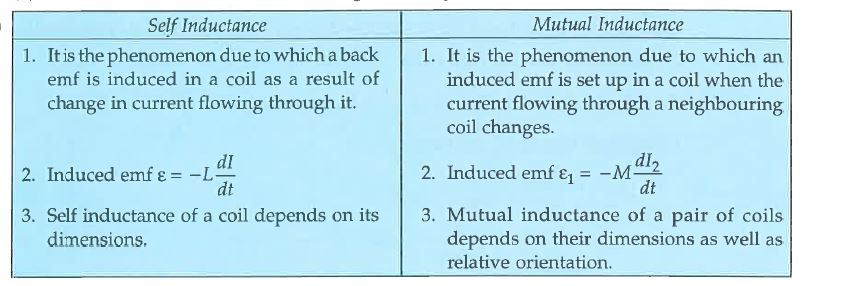 (b) Here M = 2 H, `DeltaI_1=(0.5)=0.5A and Deltatau= 100 ms = 0.1 s` (i) CHANGE in magnetic flux through coil no . 2 `Deltaphi_(2)=MDeltaI_(1)=2xx0.5=1.0 Wb` (ii) INDUCED EMF in coil no . 2 `|epsilon|=M(DeltaI_1)/(Deltat) = 2xx(0.5)/(0.1)=10 V` |
|
| 11. |
What are partially polarised light ? |
|
Answer» Solution :Plane POLARISED: If the vibrations of awave are peresent in only ONE direction on a plane perpendicular to the direction of PROPAGATION of the wave is said to be polarised or planepolarised light. Unpolarised: A transverse wave which has vibrations in all directions in a plane perpendicular to the directionof propagation is said to the unpolarised light. Partially polarised light: If the INTENSITY of light varies between maximum and minimum for every rotation of `90^(@)` of the ANALYSER, the light is said to be partially polarised light. |
|
| 12. |
What is the minimum energy required to launch a satellite of mass m from the surface of a planet of mass M and radius R in a circular orbit at an altitude of 3R ? |
|
Answer» `(7"GMM")/(8R)` Gravitatinal potential energy =` (-"GMm")/(r)` and orbital velocity, `v_(0) = SQRT(GM//R+h)` `E_(f) = (1)/(2) mv_(0)^(2) - ("GMm")/(3R) = (1)/(2) m (GM)/(4R) - ("GMm")/(4R)` ` = ("GMm")/(4R) ((1)/(2) - 1) = (-"GMm")/(8R)` `E_(i) = (-"GMm")/(R) + K` `E_(i) = E_(f)` therefore minimum required energy, K = `(7"GMm")/(8R)` |
|
| 13. |
A,B and C are parallel conductros of equal length carrying currents I. I and 2I respectively. Distance between A and B is x. Distance between B and C is also x. F_(1) is the force exerted by B on A and F_(2) is the force exerted by B on A choose the correct answer |
|
Answer» `F_(1)=2F_(2)` |
|
| 14. |
Is an induced e.m.f developed in a conductor, when moved in a direction parallel to the magnetic field? |
| Answer» SOLUTION :No, because there is no CHANGE of MAGNETIC FLUX | |
| 15. |
The wavelength of the matter waves is independent of |
|
Answer» <P>CHARGE From the above relation it is clear that wavelength of matter wave is independent the charge. |
|
| 16. |
A 280 days old radioactive substance showe an activity of 6000 dps. 140 days later its acitivity becomes 3000 dps. What was its initial acitivity? |
|
Answer» 2000 dps `N/N_(0)=(1/2)^(3) rArr (3000)/(N_(0))=1/8, N_(0)=24000` |
|
| 17. |
A source of sound and an observer are approaching each other with the same speed, which is equal to (1/10)times the speed of sound. The apparent relative change in frequency of source is |
|
Answer» 22.2% INCREASES |
|
| 18. |
Which of the following transitions in hydrogen atoms emit photons of highest frequency? |
|
Answer» n = 1 to n = 2 |
|
| 19. |
A light bulb is rated at 200W for a 230 V supply. Findthe peak voltage of the source |
| Answer» SOLUTION :`V_m`= 325.22 V | |
| 20. |
"Electrons alone are the current carriers in conductors". Explain whether this statement is correct or not? |
| Answer» Solution :Yes, In a metallic conductor, on an AVERAGE there will be one free ELECTRON AVAILABLE per ATOM. | |
| 21. |
Statement I : When light of a given intensity falls on a surface is independent of frequency . Statement II : Momentum of a photon is directly proportional to its frequency and number of photons hitting the surface number of photons hitting the surface per unit time is inversely proportional to frequency. |
|
Answer» Both statement -1 and statement -2 are true and statement -2 is the CORRECT EXPLANATION of statement -1. |
|
| 22. |
The average power dissipation on a pure inductor L in an ac circuit is |
|
Answer» `1/2 CV^2` |
|
| 23. |
If the flux of magnetic induction through each turn of a coil of resistance R and having N turns changes from phi_(1) to phi_(2) then the magnitude of the charge that passes through the coil is |
|
Answer» `(phi_(2)-phi_(1))/(R)` |
|
| 24. |
The polarising angle depends upon the ___ of the medium. |
| Answer» SOLUTION :REFRACTIVE INDEX | |
| 25. |
In a transistor amplifier, IE = 6 mA , IC= 2 mA. The current amplification factor α is… |
| Answer» SOLUTION :NA | |
| 26. |
Name the quantity that plays an identical role in an electrical circuit as is played by inertia in mechanics? |
| Answer» SOLUTION :INDUCTANCE | |
| 27. |
Two positive charges q_(1) and q_(2) are located at points with radius vectors vecr_(1) and vec r_(2). Findthe negative charge and its radius vector which would make the force on all the charges zero. |
|
Answer» |
|
| 28. |
The electric field in the region between two concentric charged spherical shells |
|
Answer» is zero |
|
| 29. |
Read the pasage given below as well as theadjoining energylevel diagram and then answer the questions given afterthe passage . As per Bohr'stheory oghydrogen atom the energy of an atom in a statecorresponding to principal quantum numbern is given as : E_(n) = - (13.6)/(n^(2)) eV Theenergyof an atom is the least when itselectron is revolvingin an orbit closets to thenucleus i.e.,theone forwhich n =1. This stateis called the groundstate. When a hydrogen atom receives energyby processes suchas electron collision, theatom may acquire sufficientenergyto raise theelectron to higherenergystates and the atom is then saidto bein an excited state . From theseexcited states the electron can then fall back to a state of lower energy , emitting a photon in the process. The energy level diagram for thestationary states of a hydrogen atom , compouted from Bohr'srelation for energy, is givenin Fig.12.02. Theprincipalquantum number n labels the stationary states in the ascendingorderof energy . Obviously , thehighestenergycorrespondsto n = ooandhasan energy of 0 eV. Thisis the energy of the atom when the electron is completely removed (r= oo) from the nucleus and is at rest. Now answer the follwoingquestions: Write the formulaforspectral linestheof hydrogen atom in visiblelightin termsof Rydberg's constant. |
|
Answer» Solution :Wavelenght ofspectral LINES of Balmer series may be expressed as : `(1)/(lambda) = BAR(v) = R [(1)/((2)^(2)) - (1)/(n^(2))]` , where ` n = 3,4,5`……. Here, R isRydberg.sconstanthavinga value `1.097 xx 10^(-7) m^(-1)`. |
|
| 30. |
Sodium and copper have work functions of 2.3eV and 4.5 eV respectively, then the ratio of the wavelengths is nearest to |
|
Answer» `1 : 2` |
|
| 31. |
Calculate the e.m.f of the following concentration cell at 298K, Zn(s)| Zn^(2+)(0.1) || Zn^(2+) (1.0)|Zn(s) |
|
Answer» 50A, DC |
|
| 32. |
Find the electric field at the center of the sphere due to the induced charges on the surface of the sphere, as shown in Fig. 22-30. |
|
Answer» Solution :KEY IDEA Here, we note that the induced charges will form a certain pattern on the surface of the sphere which cannot be predicted. But we can find the electric field due to q at any point. The NET electric field inside the conductoris zero. This is produced by the induced charged and the external charge. Calculations: At the CENTER this electric field due to q in the positive direction will be (Fig. 22-31): `E_(Q)=(q)/(4pi epsilon_(0)d^(2))`. 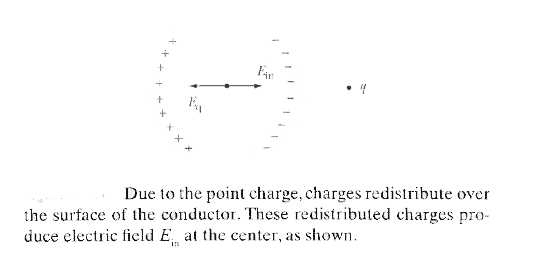 Since the net electric field at the center has to be zero. `E_("induced")+E_(Q)=0 RARR E_("induced")= -(q)/(4pi epsilon_(0)d^(2))`. Here, the charges will be induced on the surface of the sphere, but they will not be uniformly distributed. So, we cannot apply the formula for the electric field due to a uniformly charged spherical SHELL. Learn: When we say the electric field is zero, this implies that electric field should be zero inside the core of a solid metal. These are the points where the free electrons are present within the LATTICE. These free electrons should not experience any force. |
|
| 33. |
What is the meaning of 'marshy'? |
|
Answer» wetland |
|
| 34. |
Let vec(M) and vec(L) represent magnetic moment and angular momentum vectors for the electron in the above example. What is the sign of the dot product, vec(M).vec(L). (positive, negative or zero) ? |
|
Answer» |
|
| 35. |
Derive an expression for torque on a current loop placed in a magnetic field . |
|
Answer» Solution :Consider a single rectangular loop PQRS kept in a uniform magnetic field`vecB` . Leta and b bethe LENGTH and breadth of the rectangular loop respectively . LET` hatn` be the unit VECTOR normal to the plane of the current loop . This unit vector `hat n`completely describes the orientation of the loop. Let `vecB`directed from north pole to south pole of the magnet as shown in Figure.  When an electric current is sent through the loop , the net force acting is zero but there will be net torque acting on it. For the sake of UNDERSTANDING, we shall consider two configurations of the loop , (i) unit vector `hatn`points perpendicular to the field (ii) unit vector points at an angle `theta ` with the field. when unit vector `hat n` is perpendicular to the field In the simple configuration , the unit vector `hatn` is perpendicular to the field and plane of the loop is lying on xy plane as shown in Figure. Let the loop be divided into four sections PQ, QR , RS and SP. The Lorentz force on each loop can be calculated as follows : (a) Force on section PQ , `veci = - a hatj " and " vecB = B hati ` ` vecF_("PQ")= vec(Il) xx vecB ( hatj xx hati) = I a Bhatk ` Since the unit vector normal to the plane ` hat n` is along the direction of ` hatk ` (b) The force on section QR `vecl = vec(bi) " and " vecB = B hat i ` ` vecF_("QR") =vec(Il) xx vecB = - I bB ( hati xx hati) = vec0 ` ( c )The force on section RS `vecl = a hatj " and " vecB = B hati ` ` vecF_("RS") = vec(Il) xx vecB = I aB ( hatj xx hati) = - I a B hatk ` Since, theunit vector normal to the plane is along the direction of ` - hat k `. (d) The force on section SP `vecl = - b hatj " and " vecB = B hati ` ` vecF_("SP") = vec(Il)xx vecB = - IbB ( hati xx hati) = vec0 ` The net forceon the rectangular loop is `vecF_("net") = vecF_("PQ") + vecF_("FS") + vecF_("SP") ` ` vecF_("net") = I a B hatk + vec0 - IaB hatk + vecF_("net") = vec0 ` Hence, the net force on the rectangular loop in this configuration is zero . Now let us calculate the net torque due to these dorces about an AXIS passing through the center `vectau_("net") = sum_(i=1)^(4) vectau_(i) = sum_(i=1)^(4) vecr_(i) xx vecF_(i) ` ` = (b/2 IaB + 0 + b/2 Ia B + 0 ) hatj ` ` vectau_("net") = abIB hatj` Since, A = ab is the area of the rectangular loop PQRS, therefore, the net torque for this configuration is ` vectau_("net") = ABI hatj` |
|
| 36. |
Define impact parameter. |
| Answer» Solution :The impact parameter is DEFINED as the perpendicular DISTANCE between the centre of the gold NUCLEUS and the direction of velocity vector of ALPHA PARTICLE when it is at a large distance. | |
| 37. |
यदि p(x)=2x^4-5x^2+2x+1 तो p(1) का मान है |
|
Answer» 0 |
|
| 38. |
Rutherford's experiments suggested that the size of the nucleus is about |
|
Answer» `10^(-14)` m to `10^(-12)` m |
|
| 39. |
Read the pasage given below as well as theadjoining energylevel diagram and then answer the questions given afterthe passage . As per Bohr'stheory oghydrogen atom the energy of an atom in a statecorresponding to principal quantum numbern is given as : E_(n) = - (13.6)/(n^(2)) eV Theenergyof an atom is the least when itselectron is revolvingin an orbit closets to thenucleus i.e.,theone forwhich n =1. This stateis called the groundstate. When a hydrogen atom receives energyby processes suchas electron collision, theatom may acquire sufficientenergyto raise theelectron to higherenergystates and the atom is then saidto bein an excited state . From theseexcited states the electron can then fall back to a state of lower energy , emitting a photon in the process. The energy level diagram for thestationary states of a hydrogen atom , compouted from Bohr'srelation for energy, is givenin Fig.12.02. Theprincipalquantum number n labels the stationary states in the ascendingorderof energy . Obviously , thehighestenergycorrespondsto n = ooandhasan energy of 0 eV. Thisis the energy of the atom when the electron is completely removed (r= oo) from the nucleus and is at rest. Now answer the follwoingquestions: Finda relation between wavelengths of firstlineand series limit of hydrogen spectrum in vissible light. |
|
Answer» Solution :As `(h_(C))/(lambda_(1)) =E_(3) - E_(1) =1.89 eV and(h_(c))/(lambda_("LIMIT")) = E_(oo)- E_(2)= 0 - (-3.40) = 3.40 eV` `rArr ""(lambda_("limit"))/(lambda_(1)) = (1.89)/(3.40) or lambda_("limit") = (1.89)/(3.40) lambda_(1) = 0.556 lambda_(1)` |
|
| 40. |
The diagram correctly represent the direction of flow of charge carriers in the forward bias of p-n junction is |
|
Answer»
|
|
| 41. |
Obtain the equivalent capacitance of the network in Fig. For a 300 V supply, determine the charge and voltage across each100 pFcapacitor. |
|
Answer» Solution :The arrangement is redrawn in FIG. Here `C_2 and C_3` are in series, hence their combinaed CAPACITANCE C. will be `C. = (C_2C_3)/(C_2 + C_3) = (200 xx 200)/(200 + 200) pF = 100 pF` Now this combination C. is in parallel arrangement to `C_1`, hence their combined capacitance `C..=C. + C_1 = 100 + 100 pF = 200pF` Finally C" is in series with `C_4`, hence resultant capacitance C will be `C=(C..C_4)/(C.. + C_4) = (200 xx 100)/(200 + 100) pF = 200/3 pF` `:.` TOTAL charge on whole arrangement `Q = CV = 200/3 pF xx 300V` `=2 xx 10^4 pC= 2 xx 10^(-8) C` `:.` Charge on combination C.. = Charge on `C_4 = 2xx 10^(-8)C` If potential difference ACROSS C.. and `C_4` be V.. and `V_4` respectively, then `V.. + V_4 = 300 V and (V..)/V_4 = C_4/(C..) = (100 pF)/(200 pF) = 1/2` `rArr V.. = 100 V and V_4 = 200 V` In the arrangement C.., `C_1` and C. are in parallel, hence `V_1 = V. = V.. = 100V` `:. Q_1= C_1 V_1= 100 pF xx 100V = 10^4 pC = 10^(-8) C` As in the arrangement C., capacitors `C_2 and C_3` are connected in series and `C_2 = C_3`, hence `V_2 = V_3 = (V.)/2 = (100V)/2 = 50V` `:. Q_2 = Q_3 = C.V. = 100pF xx100V = 10^4 pC = 10^(-8)C` 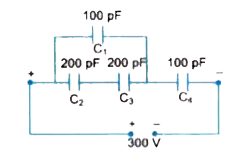
|
|
| 42. |
A coil of inductance L and resistance R is connected to a battery of emf E. The final current in the coil is ______. |
|
Answer» |
|
| 43. |
The instrument used to measure resistance is the Wheatstone bridge with a slide resistance-a wire of high resistivity of length L (Fig. 26.6). Here R is a calibrated resistance, R_x, the unknown resistance. By moving the sliding contact, the current in the galvanometer is made to drop to zero. Making use of this condition (of bridge balance), find the resistance being measured. |
|
Answer» |
|
| 44. |
Read the pasage given below as well as theadjoining energylevel diagram and then answer the questions given afterthe passage . As per Bohr'stheory oghydrogen atom the energy of an atom in a statecorresponding to principal quantum numbern is given as : E_(n) = - (13.6)/(n^(2)) eV Theenergyof an atom is the least when itselectron is revolvingin an orbit closets to thenucleus i.e.,theone forwhich n =1. This stateis called the groundstate. When a hydrogen atom receives energyby processes suchas electron collision, theatom may acquire sufficientenergyto raise theelectron to higherenergystates and the atom is then saidto bein an excited state . From theseexcited states the electron can then fall back to a state of lower energy , emitting a photon in the process. The energy level diagram for thestationary states of a hydrogen atom , compouted from Bohr'srelation for energy, is givenin Fig.12.02. Theprincipalquantum number n labels the stationary states in the ascendingorderof energy . Obviously , thehighestenergycorrespondsto n = ooandhasan energy of 0 eV. Thisis the energy of the atom when the electron is completely removed (r= oo) from the nucleus and is at rest. Now answer the follwoingquestions: Calculate the wavelenghtof firstspectral lines of series mentioned in part (g) of question. |
|
Answer» SOLUTION :Firstline of Balmer seriescorresponds totransition from `n_(1) = 3` to `n_(G) = 2 ` . Hence, we have `(h_(c))/(lambda_(1)) =E_(3) - E_(2) = (-1.51) - (-3.40) = 1.89 eV` `rArr""lambda_(1) = (h_(c))/(1.89eV) = ((6.63 XX 10^(-34)) xx (3XX10^(8)))/(1.89 xx(1.6 xx 10^(-19))) = 6.577 xx 10^(-7) m = 657.7nm` |
|
| 45. |
A force is removed after applying on a body for a 5 sec and the body covers 25 m in the next 5 sec. Calculate the value of the force if the mass of body in 10 kg. |
|
Answer» 20 N |
|
| 46. |
Read the pasage given below as well as theadjoining energylevel diagram and then answer the questions given afterthe passage . As per Bohr'stheory oghydrogen atom the energy of an atom in a statecorresponding to principal quantum numbern is given as : E_(n) = - (13.6)/(n^(2)) eV Theenergyof an atom is the least when itselectron is revolvingin an orbit closets to thenucleus i.e.,theone forwhich n =1. This stateis called the groundstate. When a hydrogen atom receives energyby processes suchas electron collision, theatom may acquire sufficientenergyto raise theelectron to higherenergystates and the atom is then saidto bein an excited state . From theseexcited states the electron can then fall back to a state of lower energy , emitting a photon in the process. The energy level diagram for thestationary states of a hydrogen atom , compouted from Bohr'srelation for energy, is givenin Fig.12.02. Theprincipalquantum number n labels the stationary states in the ascendingorderof energy . Obviously , thehighestenergycorrespondsto n = ooandhasan energy of 0 eV. Thisis the energy of the atom when the electron is completely removed (r= oo) from the nucleus and is at rest. Now answer the follwoingquestions: Namethe spectral series of hydrogen atom observed in visible light region. |
| Answer» SOLUTION :BALMER SERIES | |
| 47. |
Light enters in a glass slab ofrefractive index 3/2 and covers a distance 20 cm . |
| Answer» Answer :B | |
| 48. |
On which of the following stopping potential depend? |
| Answer» Solution :Frequency of incident light. | |
| 49. |
Find the equivalent resistance between A and B in the resistance structure shown in the adjacent circuit |
|
Answer» R |
|
| 50. |
Read the pasage given below as well as theadjoining energylevel diagram and then answer the questions given afterthe passage . As per Bohr'stheory oghydrogen atom the energy of an atom in a statecorresponding to principal quantum numbern is given as : E_(n) = - (13.6)/(n^(2)) eV Theenergyof an atom is the least when itselectron is revolvingin an orbit closets to thenucleus i.e.,theone forwhich n =1. This stateis called the groundstate. When a hydrogen atom receives energyby processes suchas electron collision, theatom may acquire sufficientenergyto raise theelectron to higherenergystates and the atom is then saidto bein an excited state . From theseexcited states the electron can then fall back to a state of lower energy , emitting a photon in the process. The energy level diagram for thestationary states of a hydrogen atom , compouted from Bohr'srelation for energy, is givenin Fig.12.02. Theprincipalquantum number n labels the stationary states in the ascendingorderof energy . Obviously , thehighestenergycorrespondsto n = ooandhasan energy of 0 eV. Thisis the energy of the atom when the electron is completely removed (r= oo) from the nucleus and is at rest. Now answer the follwoingquestions: Whendoesa hydrogenatom emit a photon ? |
| Answer» Solution :An ATOM EMITS a photon WHENELECTRON of atom fallsback from an excited stateofspectral lines in visible lights. | |


