

Saved Bookmarks
This section includes 7 InterviewSolutions, each offering curated multiple-choice questions to sharpen your Current Affairs knowledge and support exam preparation. Choose a topic below to get started.
| 1. |
The constant of a thermocouple is 7.6mu V//K, the temperature of its cold junction is -80^(@)C (dry ice), and that of the hot 327^(@)C (molten lead). What charge will flow through the thermocouple, if the hot junction absorbs quantity of heat equal to one joule? The efficiency of the thermocouple is 20%. |
|
Answer» |
|
| 2. |
State Gauss's Law ? |
|
Answer» Solution :Gauss.s LAW states that if a CHARGE Q is enclosedby an arbitrary closed SURFACE , them the total electric flux `Phi_E`through the closed surface is `Phi_E= ointvecE.d VECA=(Q_("encl"))/(epsi_0)` |
|
| 3. |
(I) Germanium atom has 32 orbiting electrons. (II) Diode has 2 terminals. (III) mA is the unit used to represent the level of a diode forward current I_(F) (IV) The diffused impurities with 3 valence electronsare called donor atoms. |
|
Answer» I , II and III only |
|
| 4. |
In the circuit diagram, all the bulbs are identical. Which bulb will be the brightest? |
|
Answer» A |
|
| 5. |
Modem is a contraction of two terms. Name these two terms. |
| Answer» SOLUTION :The TWO TERMS are MODULATOR and DEMODULATOR. | |
| 6. |
A beam of light of frquency omega, equal to the resonant frequency of transition of atoms of the gas, passes through that gas heated to temperature T. In this case ħ omega gt gt kT. Taking into account induced radiation, demonstrate that the absorption coefficient of the gas x varies as x=x_(0)(1-e^(-ħ omega//kT)), where x_(0) is the absorption cofficient for T rarr 0. |
|
Answer» Solution :Because of the RESONANT nature of the process we can ignore nonresonant processes. We also ignore SPONTANEOUS emission since it does not contribute to the absorption coefficient and is a SMALL term if the beam is intense enough. Suppose `I` is the intensity of the beam at some point. The decrease in the value of this intensity on passing through the layers of the substance of thickness `d x` is equal to `dI=XIdx=(N_(1)B_(12)-N_(2)B_(21))((I)/(c ))ħ omega dx` Here `N_(1)=` No, of atoms in lower level `N_(2)=`No of atoms in the upper level per unit volume. `B_(12), B_(21)` are Einstein coefficients and `I_(c )=` energy density in the beam, `c=` velocity of light. A factor `ħ omega` arises beacuse each trnsition result in a loss or gain of energy `ħ oemga` Hence `x(ħ omega)/(c )N_(1)B_(12)(1-(N_(2)B_(21))/(N_(1)B_(12)))` But `g_(1)B_(12)=g_(2)B_(21)`so `(1-(g_(1))/(g_(2))(N_(2))/(N_(1)))` By Boltzman factor `(N_(2))/(N_(1))=(g_(2))/(g_(1))e^(-^(-H omega//kT)` When ` ħ omega gt gt kT` we can PUT `N_(1)=N_(0)` the total number of atoms per unit volume. Then `x=x_(0)(1-e^(-^h omega//kT))` where `x_(0)=( ħ omega)/(c )N_(0)B_(12)` is the absorption coefficient for `T rarr 0` |
|
| 7. |
A mass of 3kg is suspended by a rope of length 2m from the ceiling. A force of 40N in the' horizontal direction is applied at midpoint P of the rope as shown. What is the angle the rope makes with the vertical in equilibrium and the tension in part of string attached to the ceiling ? (Neglect the mass of the rope, g = 10m//s^2) |
|
Answer» Solution :In equilibrium `T_(2) =W = 30 N` Resolving the TENSION `T_(1)`into TWO mutually perpendicular COMPONENTS, we have `T_(1) cos_(x) = T_(2) = 30 N rArr T_(1)sin theta = 40 N` `tan theta = 4/3 rArr theta = 53^(@)` The tension in part of string attached to the ceiling `T_(1) = sqrt(W^(2) + F^(2)) = sqrt(30^(2) + 40^(2) N) = 50 N` |
|
| 8. |
Calculate the steady p.d. across the capacitors of the above problem when the two batteries are in parallel. |
|
Answer» |
|
| 9. |
A fly wheel of 0.4 kg(m^-2) M.I. and of 0.2 m radius can rotate about its axis. A rope is wrapped around its circumference and pulled with 10 N force. The value of angular acceleration in rad/sec^2will be? |
|
Answer» 5 |
|
| 10. |
In a certain region of space, electric field is along the z-direction throughout. The magnitude of electric field is, however, not constant but increases uniformly along the positive z- direction, at the rate of 10^5 NC^(-1) per metre. What are the force and torque experienced by a system having a total dipole moment equal to 10^(-7) Cm in the negative Z-direction? |
| Answer» Solution :Only (C ) is RIGHT the rest cannot REPRESENT electrostaicfield lines (a) is wrong becausefield lines must be NORMAL to a conlductor (B) is wrong because field lines cannot startwrong becauseelectrostaticfield lines cannotform closed loops | |
| 11. |
For electromagnetic wave propagating along x - axis, E_max = 30V/m. what is the amplitude of the magnetic field ? |
|
Answer» `10^-7T` |
|
| 12. |
If the torque on a body is zero, then? |
|
Answer» `Jomega=constant` |
|
| 13. |
Predict a point where electric field is zero but potential is not equal to zero ? |
| Answer» Solution :That electrostatic potential is not NECESSARILY zero when the E.F. is zero.Example: Inside a charged conducting HOLLOW sphere there is a value for the potential inside the spherical shell EVEN THOUGH the field is zero. | |
| 14. |
In Young’s double-slit experiment, the pot source s is placed slightly off the central axis as. shown in fig. If Z=500 nm, then match the following. Pick the correct option |
| Answer» Answer :D | |
| 15. |
In Young’s double-slit experiment, the pot source s is placed slightly off the central axis as. shown in fig. If Z=500 nm, then match the following.Pick the correct option |
|
Answer» <P>) (I) (i) (S) |
|
| 16. |
In Young’s double-slit experiment, the pot source s is placed slightly off the central axis as. shown in fig. If Z=500 nm, then match the following. Pick the correct option |
|
Answer» <P>(III) (i) (P |
|
| 17. |
What is the shape of the wavelength in each of the following cases: (a) Light diverging from a point source. (b) Light emerging out of a convex lens when a point source is placed at its focus. (c) The portion of the wavelength of light from a distant star intercepted by the Earth. |
|
Answer» SOLUTION :(a) SPHERICAL wavelength with point SOURCE as the centre of sphere. (b) PLANE wavefront (c) Plane wavefront. |
|
| 18. |
A molecule of a substance has a permanent electric dipole moment of magnitude 10^(-29)C m. A mole of this substance is polarised (at low temperature) by applying a strong electrostatic field of magnitude 10^(6) V m^(-1) . The direction of the field is suddenly changed by an angle of 60^(@) . Estimate the heat released by the substance in aligning its dipoles along the new direction of the field. For simplicity, assume 100% polarisation of the sample. |
|
Answer» Solution :Here dipole MOMENT of each molecules `=10^(-29)` C As 1 mole of the substance contains `6 xx 10^(23)` molecules. total dipole moment of all the molecules `p = 6 xx 10^(23) xx 10^(-29)Cm = 6 xx 10^(-6)` Cm INITIAL potential energy, `U_(1) =-pE cos theta =-6 xx 10^(-6) xx 10^(6) cos 0^(@) =-6 J` Final potential energy (when `theta = 60^(@)`), `U_(f) = -6 xx 10^(-6) xx 10^(6) cos 60^(@) = - 3J` CHANGE in potential energy `=-3 J -(-6J) = 3J` So, there is loss in potential energy. This must be the energy released by the substance in the form of HEAT in aligning its dipoles. |
|
| 19. |
Show s tracks of three charged particles in a uniform electrostatic field.Give the signs of the three charges. Which particle has the highest charges to mass ratio?(##U_LIK_SP_PHY_XII_C01_E01_014_Q01.png" width="80%"> |
|
Answer» Solution :Infigure PARTICLES number 1 and 2 are negativelycharged because these are DEVIATED towards the positively CHARGED plate. As particlenumber 3 is being deviated towards negatively charged plate, it is positively charged particles. As deflection of particle number 3 is maximum and the deflection is directlyproportional to the ratio of CHARGES to mass of the particle, we conclude that ratio of charges to mass is maximum for particle number 3. is maximum and the deflectionis directly proportional to the ratio of charges to mass of the particle, we conclude that ratio of charge to mass is maximum for particle number 3. |
|
| 20. |
A solenoid is placed inside another solenoid, the length of both being equal carrying same magnitude of current. The other parameters like radius and number of turns are in the ratio 1:2 for the two solenoids. The mutual inductance on each other would be |
|
Answer» `M_(12)=M_(21)` |
|
| 21. |
Figure shows a metal rod PQ resting on the smooth rails AB and positioned between the poles of a permanent magnet. The rails, the rod, and the magnetic field are in three mutual perpendicular directions. A galvanometer G connects the rails through a switch K. Length of the rod =15 cm, B =0.50 T, resistance of the closed loop containing the rod 9.0 mOmega.Assume the field to be uniform. (a) Suppose K is open and the rod is moved with a speed of 12 "cm s"^(-1)in the direction shown. Give the polarity and magnitude of the induced emf. (b) Is there an excess charge built up at the ends of the rods when K is open ? What if K is closed ? (c) With K open and the rod moving uniformly, there is no net force on the electrons in the rod PQ even though they do experience magnetic force due to the motion of the rod. Explain. (d) What is the retarding force on the rod when K is closed ? How much power is required (by an external agent) to keep the rod moving at the same speed (= 12 cm s^(-1)) when K is closed ? How much power is required when K is open? (f)How much power is dissipated as heat in the closed circuit ? What is the source of this power ? (g) What is the induced emf in the moving rod if the magnetic field is parallel to the rails instead of being perpendicular ? |
|
Answer» Solution :(a)Here `vecB BOT vecv bot vecl` and so induced emf is , `epsilon=Bvl` =(0.5)(0.12)(0.15) `therefore epsilon=9xx10^(-3)` V Here along with the motion of rod, free electrons acquire velocity `vecv` towards right. Magnetic field `vecB` is vertically downward. Now, magnetic force exerted on the free electrons in the rod is`vecF_m=e(vecBxxvecv)` which is in the DIRECTION from P to Q. Hence end P of rod will become positive and end Q of rod will become negative because electrons displace from P to Q. (b) When K is open, induced charge gets accumulated more and more across the two ends P and Q of moving rod, till equilibrium is reached. Here, there is no induced current. When K is closed, excess charge at Pand Q is steadily maintained by the continuous flow of induced current. (c) After the induced emf reaches its maximum value `epsilon` = Bvl, electric force `F_e = eE` (from Q to P) and magnetic force `F_m` = Bev (from P to Q) become equal in magnitude and opposite in direction. Hence, there is no net force on the electrons in the rod. Here `F_m` =Bev is constant in magnitude but `F_e = eE` goes on increasing because of increase in E (Because of increase in p.d. across the rod). Finally when `F_e = F_m`, net force on the electron becomes zero. (d) Here retarding force (also known as Lenz.s force) is given by Ampere.s law, `vecF=I(veclxxvecB)` Direction of above force is opposite to `vecv` (velocity of rod) `therefore F=IlBsin90^@ "" (because vecl bot vecB)` `=(epsilon/R)lB` `=(9xx10^(-3))/(9xx10^(-3))xx0.15xx0.5` `therefore` F=0.075 N (e) For making velocity of rod constant mechanical power required is equal to electrical power (assuming no resistance provided by the rails on the rod) `therefore P_m=P_e` `=epsilon^2/R` `=(9xx10^(-3))^2/(9xx10^(-3))` `=9xx10^(-3)` W If K is open and if rails offer no resistance then no power is required to keep the rod moving with constant velocity. (f) In the absence of FRICTION, power dissipated in the form of HEAT will be equal to electrical power produced (= mechanical power spent). Hence, it will be `P=I^2R=(epsilon/R)^2 R=epsilon^2/R=9xx10^(-3)` W Source of above power is the EXTERNAL agent which does mechanical work on the rod. (g)If `vecB || vecv` , no emf gets induced across the rod (because of no magnetic force acting on the electrons in the rod). |
|
| 22. |
Transform Planck's formula for space spectral density u_(omega) or radiation form the variable omega to the variables v (linear frequency) and lambda (wavelength). |
|
Answer» Solution :We write `u_(omega)d omega = overset~(U)_(v)dv` where `omega = 2pi v` Then`overset~(u)_(v) = (2picancelh(2PIV)^(3))/(pi^(2)c^(3)) (1)/(e^(2picancelhv//kT)-1) = (16pi^(2)cancelhv^(3))/(c^(3))(1)/(e^(2picancelhv//kT)-1)` ALSO `-overset~(u)(lambda, T)d lambda = u_(omega)d omega` where `lambda = (2pic)/(omega)`, `d omega =- (2pic)/(lambda^(2))d lambda` `overset~(u)(lambda,T) = (2pic)/(lambda^(2))u((2pic)/(lambda),T)` `= (2pic)/(lambda^(2))((2pic)/(lambda))^(3)(cancelh)/(pi^(2)c^(3)) (1)/(e^(2cancelhc//lambdakT)-1) = (16pi^(2)c cancelh)/(lambda^(5))(1)/(e^(1picancelhc//lambdakT)-1)` |
|
| 23. |
Two identical metallic spheres A and B of exactly equal masses are given equal positive and negative charges respectively. Then |
|
Answer» MASS of A `gt` Mass of B |
|
| 24. |
Draw a graph showing variation of binding energy per nucleon with mass number. Write two main inferences drawn from the graph. |
|
Answer» Conclusion. (i) There EXISTS PEAKS in the curve corresponding to MASS number `A=4, 12, 16, 20`. The nuclei corresponding to those mass number `""_(2)He^(4), ""_(6)C^(12), ""_(8)O^(16), ""_(10)Ne^(20)`, the peaks indicate that these nuclei have more binding energy per nucleon than their immediate neighbours. So they are more stable nuclei. (ii) Binding energy per nucleon is smaller for light and heavier nuclei i.e. light and heavier nuclei are less stable than middle one. In order to attain higher value of binding energy per nucleon, the heavier nuclei may SPLIT into lighter nuclei (process of fission) and lighter nuclei may unite to form heavier nuclei (process offusion). In both of these nuclear processes, a large AMOUNT of energy is released. 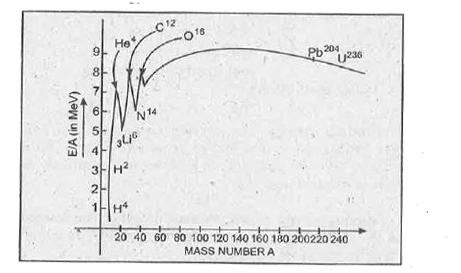
|
|
| 25. |
A battery of the emf 18 V and internal resistance of 1omega are connected as shown in figure. Then, the voltmeter reading is |
|
Answer» 10 V = 18 - 10 - 8 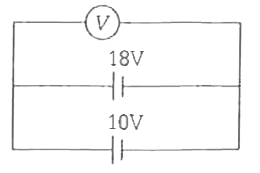 Net resistance of the CIRCUIT = 3 + 1 = 4 Current in the circuit I `= (8)/(4) = 2A` `therefore` Potential difference (V) = E - ir = 18 - 6 12 V |
|
| 26. |
A proton and an alpha particle are accelerated through the same potential difference . The ratio of the de - Broglie wavelength will be : |
|
Answer» `2:1` |
|
| 27. |
The resultant resistance of two resistance in series is 50 Omega and it is 12 Omega , when they are in parallel. The individual resistances are |
|
Answer» `20Omegaand15 OMEGA ` |
|
| 28. |
In a direct vision sperctroscope there are four crown glass prisms of angle 5^(@) each and three flint glass prisms. The dispersive powers of crown and flint glass are 0.03 and 0.05, repectively and their refractivities ar 0.518 and 0.655. Calculate the dispersion produced and the angle of the flint glass prisms required for no deviation. |
|
Answer» |
|
| 29. |
A message signal of frequency 20 KHz and peak voltage of 20 volts is used to modulate a carrier signal of frequency 2 MHz and peak voltage of 40 volts. Determine (i) modulation index, (ii) the side bands produced. Draw the corresponding frequency spectrum of amplitude modulated signal. |
|
Answer» SOLUTION :Condition `qE=qvB` `v=E/B` TRAJECTORY becomes helical about the direction of magnetic field (1) (b) To derive the expression of magnetic force acting per UNIT length of the wire `(FM)/(l)=(mu l_(1)l_(2))/(2pih)`, upwaqrds on wire AB (2). At equilibrium Magnetic Force per unit length = mass per unit length X G `(mu_(0) I_(1)I_(2))/(2pih)=m/l g(1)` |
|
| 30. |
For a spherical capacitor shown at which points the electric field will be zero ? ( r is the distance of point from centre O ) |
|
Answer» At point `r gt R_(2)` Field exist only between the spheres in the annular gap |
|
| 31. |
The outputs of two NOT gates are fed to a NOR gate. Draw the logic circuit of the combination of gates. Give its truth table. Identify the gate represented by this combination. |
Answer» SOLUTION : IDENTIFICATION : AND GATE. |
|
| 32. |
Figure shows the electric field lines around three point charges A, B and C. (a) Which charges are positive ? (b) Which charge has the largest magnitude ? Why ? In which region or regions of the picture could the electric field be zero ? Justify your answer. (i) Near A, (ii) Near B (iii) Near C, (iv) Nowhere |
|
Answer» Solution :(i) Electric field lines of A and C are outwards. HENCE, charges of A and C are positive. (ii) No. of Electric field lines from C is MAXIMUM. Hence, magnitude of charge C is maximum. (III) Electric field lines of like charges are OPPOSITE to each other. Hence, the electric field can be zero between A and C only. The magnitude of charge at C is greater than that at A. Hence, the electric field is zero at point near A. |
|
| 33. |
The concept of electric field was developed by : |
|
Answer» Newton |
|
| 34. |
Number of the a-particle deflected in Rutherford's a-particle scattering experiment varies with the angle of deflection. The graph between the two is best represented by |
|
Answer»
|
|
| 35. |
The frequency from 3xx10^(9) Hz to 3xx10^(10)Hz is |
|
Answer» HIGH FREQUENCY band |
|
| 36. |
How do you feel about the character of the grandmother in the chapter? |
|
Answer» Emotional |
|
| 37. |
An electron and a positron pair is produced by a gamma ray of 2.1 MeV. Find the K.E imparted to each of the charged particle. |
|
Answer» |
|
| 38. |
If alpha particle, proton and electron move with the same momentum, then their respective de Broglie wavelengths lambda_(alpha), lambda_(p), lambda_(e ) are related as |
|
Answer» a. `lambda_(ALPHA)=lambda_(p)=lambda_(E ) ` |
|
| 39. |
Magnetic field lines are always nearly normal to the surface of a ferromagnet at every point. (This fact is analogous to the static electric field lines being normal to the surface of a conductor at every point.) Why? |
| Answer» Solution :(e) This is because of uniform distribution of magnetic dipoles, PERPENDICULAR to the cross-section of a ferromagnet which compels the magnetising FIELD LINES to be incident normally (PERPENDICULARLY) on the surface at the ENDS. | |
| 40. |
What are ohmic and non ohmic devices? Give examples. |
|
Answer» Solution :The resistor which obeys ohm.s LAW is ohmic resistor. Eg : Metals The resistor which does not obey ohm.s law is non-ohmic resistor. Eg : SEMICONDUCTORS (Silicon and Germanium), VACUUM tubes, THERMISTORS ETC. |
|
| 41. |
In February 1955, a paratrooper fell 370 m from an air plane without being able to open his chute but happened to land in snow. suffering only minor injuries. Assume that his speed at impact was 56 m/s (terminal speed), that his mass (including gear) was 85 kg, and that the magnitude of the force on him from the snow was at the survivable limit of 1.2 xx 10^5 N. What are (a) the minimum depth of snow that would have stopped him safely and (b) the magnitude of the impulse on him from the snow? |
|
Answer» |
|
| 42. |
A point object is placed at a distance of 12 cm on the principal axis of a convex lens of focal length 10cm. A convex mirror is placed coaxially on the other side of the lens at a distance of 10cm. If the finalimage coincides with the object, sketch the ray diagram and find the focal length of the convex mirror. |
Answer» Solution :Here FOCAL length of convex lens `f=+10`cm, distnce of object O from convex lens `u=-12`cm and distance between the lens and convex mirror M = 10cm.  In the absence of convex mirror the lens forms an image I. of GIVEN object O at distance v, whereas from lens formula `(1)/(v)-(1)/(u)=(1)/(f.)` `(1)/(v)= (1)/(f)-(1)/(u)=(1)/((10))+(1)/((-12))=(1)/(60) rArr v=60cm`. However, when mirror M is placed behind the convex lens, the light rays RETRACE their path after reflection from the mirror and final image I is formed at the position of object. It is possible only if rays FALL normally on the mirror i.e., distance `PI.=60-10=50` cm is the radius of curvature of the convex mirror. Thus, radius of curvature of given convex mirror R = 50 cm `rArr` Focal length of convex mirror `f=(R )/(2)=25cm` |
|
| 43. |
A wave is travelling along a string. Its equation is given as y =0.1 sin2 pi (100t + 10x) (All SI units) Position of different particles at some instant is shown in figure. What is velocity of particle Pat this instant? |
| Answer» SOLUTION :10m/s DOWNWARD | |
| 44. |
In Phasor's method, magnitude (or length) of vector (known as Phasor) gives ……… |
|
Answer» phase of harmonic FUNCTION |
|
| 45. |
A conducting rod AB moves parallel to x-axis in the x-y plane. A uniform magnetic field B pointing normally out of the plane exists throughout the region. A force F acts perpendicular to the rod, so that the rod moves with uniform velocity v. The force F is given by (neglect resistance of all the wires) |
|
Answer» `(VB^(2)l^(2))/(R)e^(-t//RC)` |
|
| 46. |
For a heavily doped n-type semiconductor, fermi-level lies |
|
Answer» a little below the CONDUCTION BAND |
|
| 47. |
A person cannot see objects clearly beyond 50 cm. The power of lens to correct the vision |
| Answer» ANSWER :3 | |
| 48. |
Statement I : The stream of water flowing at high speed from a garden hose pipe tends to spread like a fountain when held vertically up , but tends to narrow down when held vertically down and Statement 2 : In any steady flow of an incompressible fluid, the volume flow rate of the fluid remains constant. |
|
Answer» Statement-I is true, Statement-II is true and Statement-II is correct explanation for Statement-I. where a = area of cross-section and v = velocity `rArr` If v decreases a INCREASES and vice -versa. When stream of water moves up, its speed (v) decreases and therefore .a. increases i.e. the water spreads out as a fountain. When stream of water from hose pipe moves down, its speed increases and therefore, area of cross section decreases. Therefore, statement - 1 is true and statement - 2 is the correct explanation of statement. - 1 |
|
| 49. |
In th electric potential on the axis of an electric dipole at a distance 'r' from it is V, then the potential at a point on its equatorial line at the same distance away frornt it will be |
| Answer» Answer :C | |
| 50. |
A boy converted a galvanometer into a high current measuring device and he connected the device parallel to the load. What will be the observation. Justify. |
| Answer» Solution :Ammeter is a low RESISTANCE DEVICE. HENCE it draws high current. This high current will damage it. | |


