

Saved Bookmarks
This section includes 7 InterviewSolutions, each offering curated multiple-choice questions to sharpen your Current Affairs knowledge and support exam preparation. Choose a topic below to get started.
| 1. |
Using Gauss' law porve that the electric field at a point due to a uniformaly charged infinite plane sheet is independent of the distance form it. How is the field directed if the sheet is (i) positively charged, (ii)negatively charged. |
|
Answer» Solution :For Gauss. theorem , see point number 47 under the heading "Chapter At A Glance"Consider an infinite thin plane sheet having a surface density ` sigma. ` To find electric field at a point Psituated at a NORMAL distance r from the sheet , consider an imaginary cylinder of cross-section ara DS around point P and length 2r, passing through the sheet ,as the GAUSSIAN surface. From symmetry consideration , only side faces1 and 2 of cylinder contribute towards the flux because here ` oversetto E and hatn ` parallel but the curved surface of cylinder does not contributed towards the flux because here `oversetto Eand hatn ` are mutually perpendicular. ` therefore ` Total electric flux ` phi_in =2 E ds` As per Gauss theorem total electric flux `pi_in =(1)/( in_0)` (CHARGE encloesd)`=(1)/( in _0) .(sigma ds) ` Comparing (i) and (ii) , we get ` 2 E ds =(sigma)/( in_0) . ds RARR E= ( sigma)/( 2 in _0)` Thus, the electric field at a point due to a uniformalycharged infinite plane sheet is independent of the distance from it . Vectorially ` oversetto (E) =(sigma)/(2 in _0) hatr ` Thus for (i)positively charged sheet electric field `oversetto E ` is directed outwards and for (ii)negatively charged sheet the field is directed inwards. 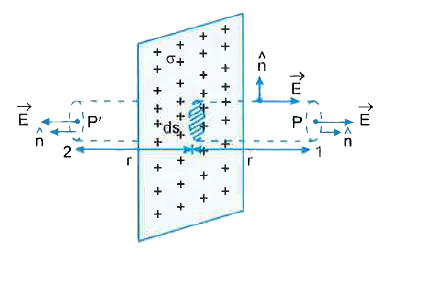
|
|
| 2. |
If the electri potential of theinner metal sphere is 10 volt & that of the outer shellis 5 volt, then the potential at the centre will be : |
|
Answer» 10 volt |
|
| 3. |
संख्या 5.2333... एक |
|
Answer» परिमेय संख्या है |
|
| 4. |
Rutherford's a-scattering experiment concludes that ........ |
|
Answer» electron are revolving round the nucleus |
|
| 5. |
(a) Two cells of emf epsi_1 and epsi_2having internal resistances r_1 and r_2respectively are connected inparallel as shown in Fig. Deduce the expressions for the equivalent emf and equivalent internal resistance of a cell which can replace the combination between the points B_1 and B_2 .(b) Calculate the current shown by the ammeter in the circuit diagram given below |
| Answer» SOLUTION :(B) ` - 5A` | |
| 6. |
A wire of length 1 metre is to be wound in the form of a coil have maximum magnetic moment. The suitable number of turns among the following is |
|
Answer» 1 |
|
| 7. |
What will happen if a hydrogen atom absorbs a photon of energy greater than 13.6 eV? |
| Answer» Solution :Since the energy of the photon is greater than the binding energy of the hydrogen atom, the hydrogen atom will IODINE and the REMAINING extra energy will be converted into KINETIC energy of the excited electrons. | |
| 8. |
The total resistance of a simple circuit is 80 Omega including the resistance of a tangent galvanometer which is 4Omega. The galvanometer shows a deflection of 60^(@). It is then shunted with 1Omega. What is the new deflection? |
|
Answer» |
|
| 9. |
A galvanometer of resistance 200 ohm given full scale deflection with deflection for a current of 1 mA.To convert it into An ammeter capable of measuringupto one ampere what resistance should be connected in parallel with it? |
|
Answer» `2XX10^6` OHM |
|
| 10. |
Two point charges q_1= 2 muC and q_2 = 1 mu C are placed at distances b = 1cm 7 and a = 2cm from the origin, on the y and x axes. The electric field vector at point P (a,b) will subtend an angle 'theta' with the x-axis given by |
|
Answer» TAN `theta = 1` |
|
| 11. |
Neglecting friction at the axle and the inertia of the two step pulley shown in figure find the acceleration 'a' of the falling weight P in (m//s^(2)) (assume P=2 kg Q=2 kg & r_(2)=2r_(1)) |
Answer» 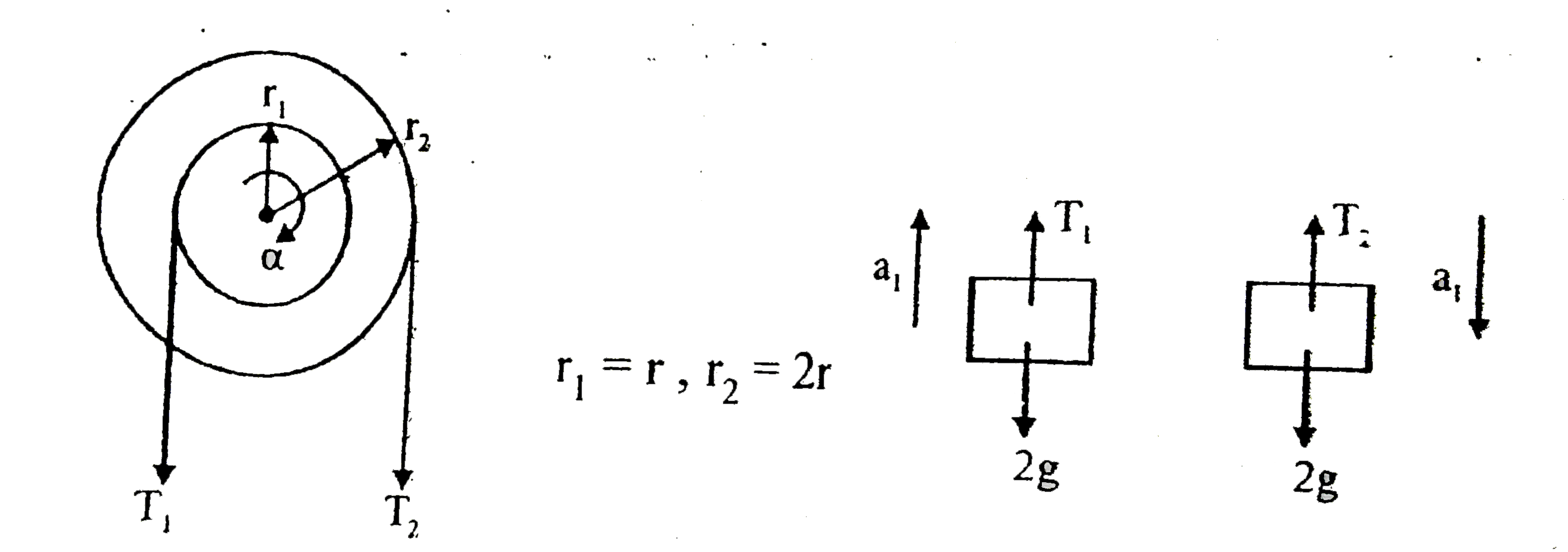 `a_(1)=ralpha , a_(2)=2ralpha` ….(1) `T_(2) 2r-T_(1)r=Ialpha` …..(2) `:.(I=10 r^(2))` `T_(1)-2g=2a_(1)` ……(3) `2g-T_(2)=2a_(2)` …..(4) on solving above EQUATION `a_(2)=4 m//s^(2)` |
|
| 12. |
STATEMENT-1 When a sound wave in air is reflected from awall ,it does not suffer a phase charge. STATEMENT-2 For sound waves ,air is denser as compare to wall. |
|
Answer» Statement-1 is true Statemetnt-2 is True,Statement -2 is a correct explanation for statement -1. |
|
| 13. |
In electromagnetic waves the electric and magnetic field, oscillating in space and time, sustain each other in vacuum. |
|
Answer» |
|
| 14. |
A load of 20 kg is suspended by a steel wire as shown in figure-6.109. Velocity of wave when rubbed with a resined cloth along the length is 20 times the velocity of the wave in the same string when it is plucked. Find the area of cross - section of the wire if Y for streel is 19.6 xx 10^(10) N//m^(2) and g = 9.8 m//s^(2) |
|
Answer» |
|
| 15. |
Hydrogen atoms in the ground state (E = - 13.6 eV) are excited by monochromatic radiation of photon energy 12.1 eV. The maximum number of spectral lines emitted by hydrogen atoms as per Bohr's theory will be |
|
Answer» 1 |
|
| 16. |
Which one of the following represents the correct dimensions of the coefficient of viscosity ? |
|
Answer» `[ML^(-1)T^(-2)]` `ETA=("Force")/("Area"xx"Velocity gradient")` `([MLT^(-2)])/([L^(2)][T^(-1)])=[ML^(-1)T^(-1)]` Hence CORRECT choice is `(c )`. |
|
| 17. |
A circular planar wire loop is dipped in a soap solution and after taking it out, held with its plane vertical in air assuming thickness of film at the very small as sunlight falls on te soap film & observer receives reflected light. |
|
Answer» Th top portion appears dark while the first colour to be OBSERVED as one MOVES down is red. |
|
| 18. |
How many set of 4 quantum numbers are possible for last electron of Sc? [Divide your answer by 2] |
|
Answer» Solution :`Sc_(21)[Ar]_(18)4s^(2)3d^(1)rArr` Fove d prnotals two TYPES of spin quantum number so TOAL set `=5xx2=10` `(10)/(2)=5` |
|
| 19. |
Find the effective resistance between P and Q points P and Q of the electrical circuit shown in the figure |
Answer» SOLUTION : (Hint : EFFECTIVE resistance between P and Q is `(1)/(R_("eff"))=(1)/(4R)+(1)/(2r)+(1)/(4R),R_("eff")=(2Rr)/(R+r)` |
|
| 20. |
Zns है |
|
Answer» अतिशीतलन द्रव |
|
| 21. |
A battery of emf 20V is connect to two capacitors 1 mu F and 3 mu F in series. 1 mu F capacitor withstands a maximum of 9V and 3 mu F withstands a maximum voltage of 6V then |
|
Answer» `1 MU F `CAPACITORS break |
|
| 22. |
The susceptibility of a ferromagnetic material is K is 27^@ C, its susceptibility will be 0.5 at temperature |
|
Answer» 600°C |
|
| 23. |
In the given figure what is the magnetic field induction at point O? |
|
Answer» `(mu_(0)I)/(4pi r)` Field at O due to horizontal part `=(mu_(0)I)/(4pi r)` (upwards) `:.` Net field at O, `B= (mu_(0)I)/(4r) + (mu_(0)I)/(4pi r)` |
|
| 24. |
A gamma ray photon of energy 1896 MeV annihilates to produce a proton - antiproton pair. If the rest mass of each of the particles involved be 1.007276 a.m.u approximately, find how much K.E each particle will carry ? |
|
Answer» Solution :Working on the same liens as an ELECTRON - positron PAIR PRODUCTION , wenotice that the reaction. `gamma rarr`PROTON + antiproton, has the energy balance `E=m_(0)` (proton) `c^2+K.E`(antiproton) But `m_(0).c^2`= energy equivalent of 1.007276 a.m.u `~~938 MeV [ :. 1.00726 xx931 ~~938]` Thus K.E of each particle = `1/2[1896 MeV -2xx938 ] MeV = 10 MeV` |
|
| 25. |
M_(n) and M_(p) represent mass of neutron and proton respectively. If an element having nuclear mass M has N neutron and Z protons, then the correct relation will be |
|
Answer» <P>`Mlt[NM_(N)+ZM_(p)]` |
|
| 26. |
How can you convert a galvanometer into an voltmeter? Can you use Voltmeter to measure current in a circuit? |
| Answer» Solution :By connecting a required HIGH resistance in SERIES with the GALVANOMETER and suitably calibrat ING the dial. | |
| 27. |
In figure , an external torque changes the orientation of loop fro one of lowest potential energy to one of highest potential energy. The work done by the external torque is closest to |
|
Answer» 0.5 J |
|
| 28. |
Consider the junction diode as ideal. The value of current flowing through AB is |
|
Answer» OA or `I=10/1000=10^(-2)A` |
|
| 29. |
A: When a pure semiconductor is doped with a pentavalent impurity, the number of conduction electrons is increased while the number of holes is decreased R: Some of the holes get recombined with the conduction electrons as the concentration of the conduction electrons is increased. |
|
Answer» If both Assertion & Reason are TRUE and thereasonis the not the correctexplanation of theassertion , then mark (1) |
|
| 30. |
The brass scale of a mercury barometer has been graduated at 0^(@)C. At 18^(@)C the barometer shows a pressure of 760 mm. Reduce the reading of the barometer to 0^(@)C. The coefficient of linear expansion of brass =1.9xx10^(-5)=1 and the coefficient of volume expansion of mercury gamma=1.8xx10^(-4).^(@)C^(-1) |
|
Answer» |
|
| 31. |
A rod of length 1m rotates about one of its end points with an angular velocity 2 rad//sec in a plane perpendicular to the magnetic field B=2T as shown in the figure. Then find magnitude of electric field (in SI unit) at the mid point of the rod. |
|
Answer» SOLUTION :For a CHARGE to be in equlibirum, `qE=qvBrArrE=omegaLB//2=BL omega//2=2` |
|
| 33. |
A satellite revolves from east to west in a circular equatorial orbit of radius R=1.00*10^4km around the Earth. Find the velocity and the acceleration of the satellite in the reference frame fixed to the Earth. |
|
Answer» Solution :The velocity of the SATELLITE in the inertial space fixed frame is `sqrt((gammaM)/(R))` east to west. With respect to the Earth fixed frame, from the `overset(rarr')v_1=vecv-(vecwxxvecr)` the velocity is `V^'=(2piR)/(T)+sqrt((gammaM)/(R))=7*03km//s` Here M is the mass of the earth and T is its period of rotation about its own axis. It would be `-(2piR)/(T)+sqrt((gammaM)/(R))`, if the satellite were moving from west to east. To find the acceleration we note the formula `moverset(rarr')w=VECF+2m(overset(rarr')vxxvecomega)+momega^2vecR` Here `vecF=-(gammaMm)/(R^3)VECR` and `overset(rarr')v_|_vecomega` and `overset(rarr')vxxvecomega` is directed towards the centre of the Earth. Thus `w^'=(gammaM)/(R^2)+2((2piR)/(T)+sqrt((gammaM)/(R)))(2pi)/(T)-((2pi)/(T))^2R` toward the earth's rotation axis `=(gammaM)/(R^2)+(2pi)/(T)[(2piR)/(T)+2sqrt((gammaM)/(R))]=4*94m//s^2` on substitution. |
|
| 34. |
Consider the situation shown in figure , The two slits S_(1) and S_(2) placedsymmetrically aroundthe central line are illumated by a monocharmoticby a monocharomatic light of wavelength lambda . The separation betweenthe slits is d . The light transmittedby the slits falls on a screen Sigma_(1) placedat a distanceD from theslits . The slitS_(3)is at the central lineandthe slit S_(4)is at a distance z from S_(3) .Another screen Sigma_(2)is placed a further distance D away from Sigma_(1).Find the ratio of the minimum intensity observed on Sigma_(2) if z is equalto (1) z = (lambdaD)/(2d) (2) (lambdaD)/d (3) (lambdaD)/(4d) |
|
Answer» `2,25,oo` |
|
| 35. |
If V_(r ) is the reflected voltage and V_(i) the incident voltage of a transmission line, then reflection coefficientK_(r ) of the line is given by : |
|
Answer» `K_(r )=(V_(r ))/(V_(i))` |
|
| 36. |
The magnetic flux through a coil perpendicular to its plane is varying according to the relation phi_B = (5t^3+4t^2 +2t-5)weber. Calculate the induced current through the coil at t = 2 second. The resistance of the coil is 5Omega |
|
Answer» SOLUTION :`phi = 5t^3 + 4t^2 + 2t - 5` `|e| = (dphi)/(dt) = 15t^2 + 8t + 2` at, t = 2sec, e= -78 V`e = IR = 15t^2 + 8t + 2` `I xx 5 = 15 xx 4 + 8 xx 2 + 2 RARR I = 15.6 A` |
|
| 37. |
The magnetic field inside a solenoid is |
Answer» Solution :Consuder a solenoid of length L having N turns. The diametre of the solenoid is assumed to be much smaller when compared to its length and the coil is WOUND very closely. In order to calculate the magnetic field at any point inside the solenoid , we use Ampere's circuital law. Consider a rectangular loop abcdas shown in Figure. Then from Ampere's circuital law, `underset(C) oint vecB . vec(dl) = mu_(0)I_("ENCLOSED")` ` = mu_(0) xx `( total current enclosed by Amperian loop ) The left hand side of the EQUATION is `underset(C) ointvecB . vec(dl) = underset(a) overset(b)intvecB. vec(dl) + underset(b) overset(c) int vecB.vec(dl) + underset(c)overset(d)intvecB.vec(dl) + underset(d) overset(a)int vecB. vec(dl) ` Sincethe elemental lengths along bc and da are perpendicular to the magnetic field which is along the axis of the solenoid , the integrals `underset(b) overset(c) intvecB.vec(dl) = underset(b) overset(c) int |vecB||vec(dl)|cos90^(@) = 0 ` ` underset(d) overset(a) int vecB.vec(dl) = 0 ` Since the magnetic field OUTSIDE the solenoid is zero , the integral `underset(c) overset(d) int vecB.vec(dl) ` For thepath along AB , the integral is `underset(a) overset(b)int vecB.vec(dl) = B underset(a) overset(b) int dl cos 0^(@) = B underset(a) overset(b) int dl ` where the length of the loop ab as shown in the Figure is h. But the choice of length of the loop ab is arbitrary. We can take very large loop such that it is equal to the length of the solenoid L . Therefore the integral is `underset(a) overset(b) int vecB. vec(dl) = BL ` Let NI be the current passing through the solenoid of N turns, then `underset(a) overset(b) vecB.vec(dl) = BL = mu_(0) NI rArr B = mu_(0) (NI)/ L ` The number of turns per unit length is given by `N/L = n , ` Then `B = mu_(0) (n LI)/L = mu_(0) n I ` Since n is a constant for a given solenoid and `mu_(0)` is also constant. For a fixed current I , the magnetic field inside the solenoid is also a constant. |
|
| 38. |
We are provided 10 capacitors each of 1 muF capacitance. We can employ them so as to have a minimum capacitance of 0.1 muF and maximum capacitance of 10 muF. |
| Answer» Solution :True – In SERIES ARRANGEMENT `C_s=0.1 MUF` and in parallel arrangement `C_p = 10 muF`. | |
| 39. |
Statement A : The resistance of ideal ammeter is zero Statement B : The resistance of ideal voltmeter is infinity Choose the correct option among the following. |
|
Answer» Only A is correct |
|
| 40. |
For photoelectric emission from certain metal the cutoff fequency is v.If radiation of frequency 2 v impinges on the metal plate,the maximum possible velocity of the emitted electron will be (m is the electron's mass), |
|
Answer» `SQRT((hv)/((2m)))` |
|
| 41. |
What is the torque on a current carrying loop placed in a uniform magnetic field? |
| Answer» SOLUTION :`TAU = NIAB SIN THETA` | |
| 42. |
Unpolarized light of intensity 6.5 mW//m^(2) is sent into a polarizing sheet as in Fig 32-11 . What are (a) the amplitude of the electric field component of the transmitted light and (b) the radiation pressure on the sheet due to its absorbing some of the light ? |
| Answer» SOLUTION :(a) `1.6 V//m , (B) 1.1 xx10^(-11) ` PA | |
| 43. |
C.M. of system gives the _____ of the forces acting on the system. |
| Answer» SOLUTION :[RESULTANT] | |
| 44. |
A car moves from A to B with a speed of 30 kmph and fromB to A with a speed of 20 kmph. What is the average speed of the car ? |
|
Answer» 25 kmph |
|
| 45. |
The force constant of a spring corresponds to …….. in electrical circuit. |
|
Answer» C |
|
| 46. |
Electric flux is......quantity. (a) Vector (b) Scalar (c) Dimensionless (d) Tenser |
|
Answer» vector |
|
| 47. |
Two identical traveling waves, moving in the same direction are out of phase by 0.70pi rad. What is the amplitude of the resultant wave in terms of the common amplitude of the two combinag waves |
|
Answer» |
|
| 48. |
(x^(2))/("mass") has the dimensions of kinetic energy. Then x has the dimensions of |
| Answer» Answer :D | |
| 49. |
Electrical energy is transmitted over large distances at high alternating voltages. Which of the following statements is (are) correct ? |
|
Answer» For a given power level, there is a lower CURRENT. `P=V_"rms" I_"rms"`, P is given so, `V_"rms" I_"rms"` is same. Hence, when `V_"rms"` is high `I_"rms"` is low So in power loss = `I_"rms"^2` R=low (`because I_"rms"` is low) Now at the receiving end high voltage is REDUCED by using step-down transformers. |
|
| 50. |
In the electric ntework shown in the figure, use Kirchhoffs rules to calculate the power consumed by the resistance R = 4Ω. |
|
Answer» SOLUTION :For LOOP ABCDA `-12 + 2I _(1) + 4 ( I _(1) + I _(2)) =0` `therefore 3I_(1) + 2I _(2) =6""…(i)` For loop ADFEA `-4 ( I _(1) + I _(2)) + 6=0` `therefore 2I _(1) + 2I_(2) =3""…(ii)` Solving (i) and (ii), we get `I _(1) = 3 A` `I _(2) =- 1. 5 A` Hence, power consumed by the resistor `R = ( I _(1) + I _(2)) ^(2) R` `= (1.5) ^(2) xx 4 =9 ` watt |
|