Saved Bookmarks
This section includes 7 InterviewSolutions, each offering curated multiple-choice questions to sharpen your Current Affairs knowledge and support exam preparation. Choose a topic below to get started.
| 1. |
A mixed ray of red and green colour incidents obilquely on surface of rectangular glass slab. After passing through slab, the rays of red and violet colour emerging out surface parallel to incident surface are….. |
|
Answer» emerging out from same point and MOVING in same direction. 
|
|
| 2. |
A body cools from 50^(@)C to 40^(@)C in 5 minutes and from 40^(@)C to 30^(@)C in 8 minutes. Then the temperature of the surrounding is |
|
Answer» `25^(@)C` `:.` average temperature `T+(T_(1)+T_(2))/(2^(@)C)` CHANGE in temperature `dT+=0^(@)C` `:.(dT)/(dt)+_k(T-T_(c))RARR(10)/(5)=-k(45-T_(c))`. . .(i) For `2^(ND)` case `(10)/(8)=-k(35-T_(c))`. . . (ii) DIVIDING (i) by (ii) `(8)/(5)=(45-T_(c))/(35-T_(c))rArr8xx35-8T_(c)=5xx45-5T_(c)` `T_(c)~=18^(@)C` So correct choice is (b). |
|
| 3. |
Who is the main character of this story? |
|
Answer» Tarakratna |
|
| 4. |
What is mass defect? |
|
Answer» <P> Solution :The mass of any nucleus is ALWAYS LESS than the SUM of the mass of its individual constituents.The difference in mass `Delta m` is CALLED mass defect.`Delta m = (Zm_(p) + Nm_(n))-M` |
|
| 5. |
A canon ball is fired with a velocity 200 m^(-1) at an angle of 60^(@) with horizontal. At the highest point it explodes into 3 equal parts. One moves vertically upwards with 100 ms^(-1), second moves vertically downwards with 100 ms^(-1). The third moves with velocity : |
|
Answer» `100 ms^(-1)` horizontally along horizontal `= 100 m//s` Let m be the MASS of each part. APPLYING conservation of momentum along x-axis.3m (100) `= m xxupsilon impliesupsilon= 300 m//s` Hence the correct choice is (b). |
|
| 6. |
In the figure given below is : (i) the emitter and (ii) the collector forward or reverse biased ?Justify. |
|
Answer» Solution :It is a n-p-n transistor , so here `(i)` EMITTER is reverse biased and `(II)` Collector is FORWARD biased. 
|
|
| 7. |
If a positive charge is displaced against the electric field in which it was situated, then |
|
Answer» work will be done by the ELECTRIC field on the charge. |
|
| 8. |
A nonrelativistic particle collides inelastically with an identical stationary particle. What is the kinetic energy of the body thus formed? What happened to the rest of the kinetic energy? |
|
Answer» |
|
| 9. |
The distance of nth bright frings from the centre of the interference pattern is : |
|
Answer» `X_n=nlambda (D)/d` |
|
| 10. |
A car accelerates from rest at a constant rate alpha for some time,after which it decelerates at a constant rate beta and comes to rest .If the total time elapsed is t,then the maximum velocity acquired by the car is |
|
Answer» `((ALPHA^(2)+beta^(2))/(ALPHABETA))t` |
|
| 11. |
Consider a point object situated at a distance of 30 cm from the centre of sphere of radius 2 cm and refractive index 1.5 as shown in the figure. If the refractive index of the region surrounding this sphere is 1.4, then the position of the image due to refraction by sphere with respect to the centre is |
|
Answer» 30cm For first surface , `n_1 = 1.5 , n_2 = 1.4` `(n_2)/(v)-(n_1)/(v) = (n_2 - n_1)/(R )`u = - 30 cm `R = + 2CM` `(1.4)/(v) - (1.5)/(-30) =(1.5 - 1.4)/(2) RARR (1.4)/(v) = (0.1)/(2) - (1.5)/(30)` `(1.4)/(v) = (3-3)/(30) rArr v= oo` For second surface `(n_2)/(v) - (n_1)/(u) = (n_2 -n_1)/(R)u = oo R = - 2cm ` ` (1.5)/(v) - (1.4)/(oo) = (0.1)/(-2) rArr (1.5)/(v) = 1/20` `v =20 xx 1.5 = 30 cm ` |
|
| 12. |
(i)with the help of a labelled diagram, describe briefly the underlying principle and working of a stepup transformer. (ii)Write any two sources of energy loss in a transformer. (iii)A step-up transformed converts a low input voltage into a high output voltage. Does it violate law of conservation of energy ? Explain. |
|
Answer» Solution :(ii)Sources of energy loss in transformer (any TWO) : flux leakage / Joule's loss in the resistance of windings /loss due to eddy currents /hysteresis loss/hymming loss. (III) No. A step-up transformer steps up the voltage while it steps down the CURRENT. So, the input and output POWER remain same (provided there is no loss). Hence, there is no VIOLATION of the principle of energy conservation. |
|
| 13. |
Show graphically the variation of electric field E (y-axis) due to a charged infinite plane sheet with distance r (x-axis) from the plate. |
| Answer» SOLUTION :It INDEPENDENT of the DISTANCE. It STRAIGHT line parallel to x-axis. | |
| 14. |
What was the occupation of the author? |
|
Answer» Businessman |
|
| 15. |
Newton postulated his corpuscular theory on the basis of |
|
Answer» NEWTON's rings |
|
| 16. |
Two charges4muC and 1 muC are placed at distance of 10 cm. Whereshould a third charge be placed between them so that it does not experience any force . |
|
Answer» Solution :`Q_(1)=4muC = 4xx10^(-6)C` `Q_(2) =1muC = 1XX10^(-6)C` `d=10cm` Let the THIRD CHARGE Q be placed at a DISTANCE at a distance of X from `Q_(1)` then x = ? `(Q_(1))/(x^(2)) =(Q_(2))/((10-x)^(2))` `(4xx10^(-6))/(x^(2)) =(1xx10^(-6))/((10-x)^(2)), (2)/(x)=(1)/(10-x)` `x=(20)/(3)cm` from `4muC`. |
|
| 17. |
A toroid has 500 turns per metre length. If it carries a current of 2 A, the magnetic energy density inside the toroid is |
|
Answer» `6.28J//m^3` |
|
| 18. |
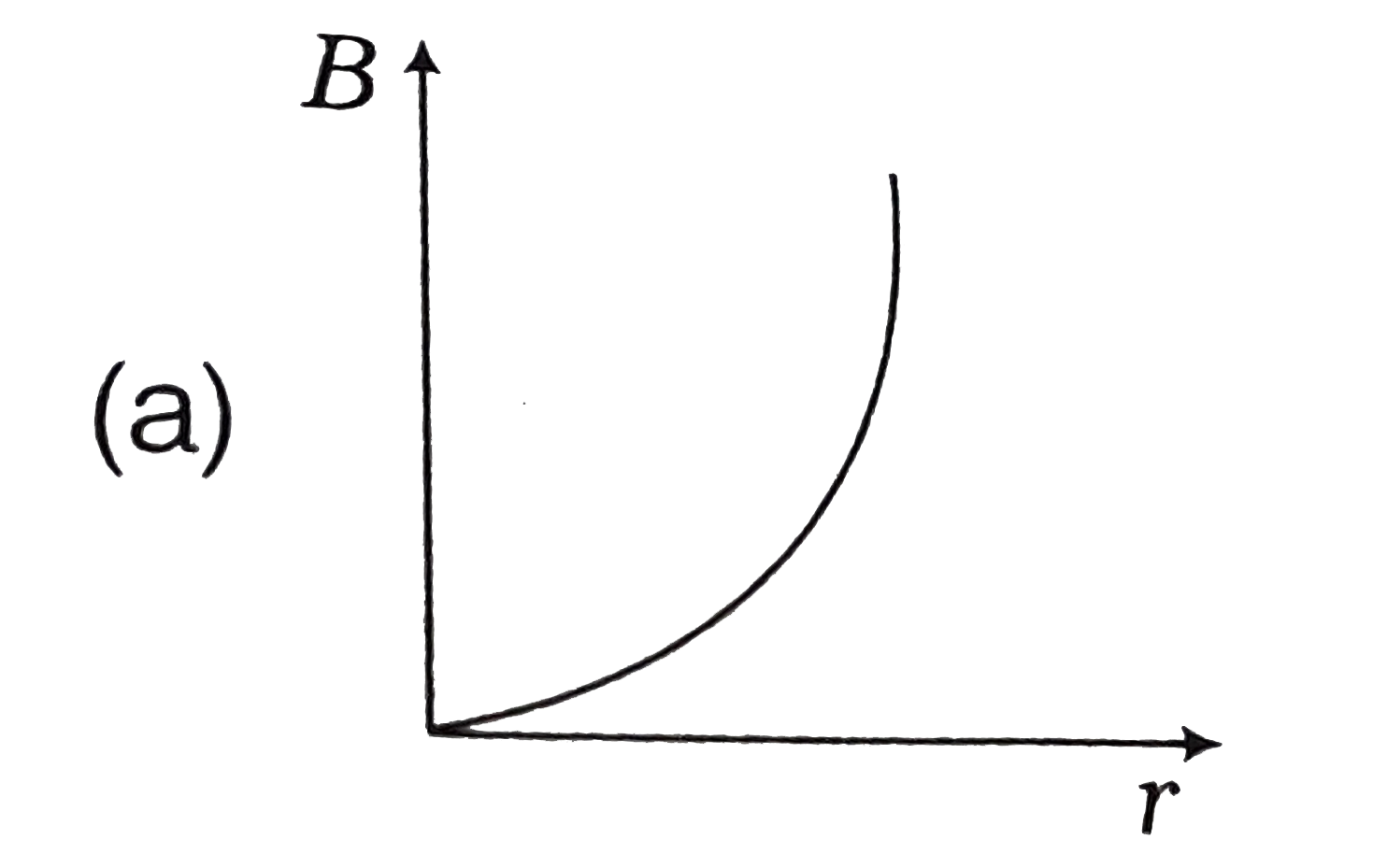
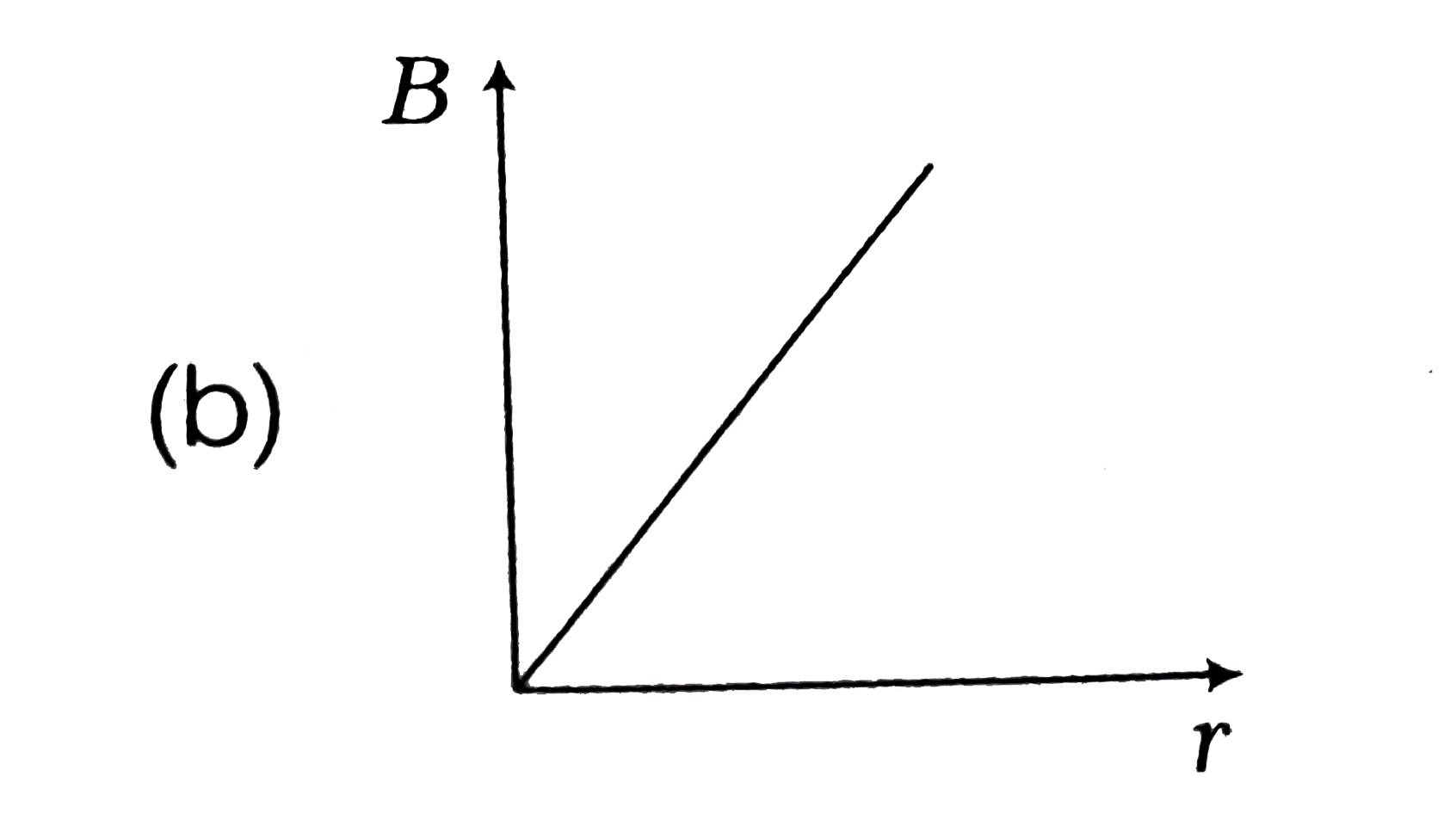
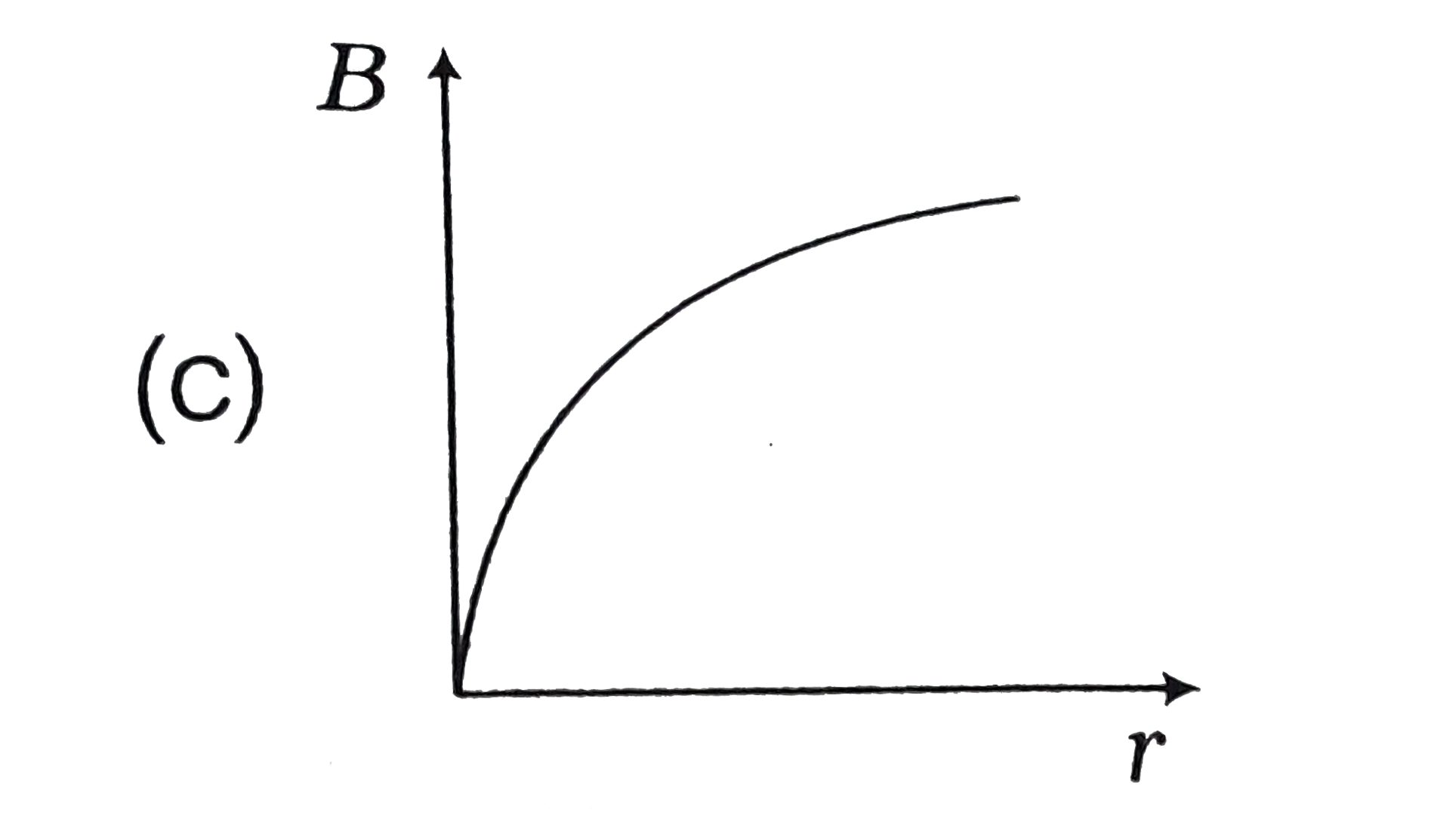
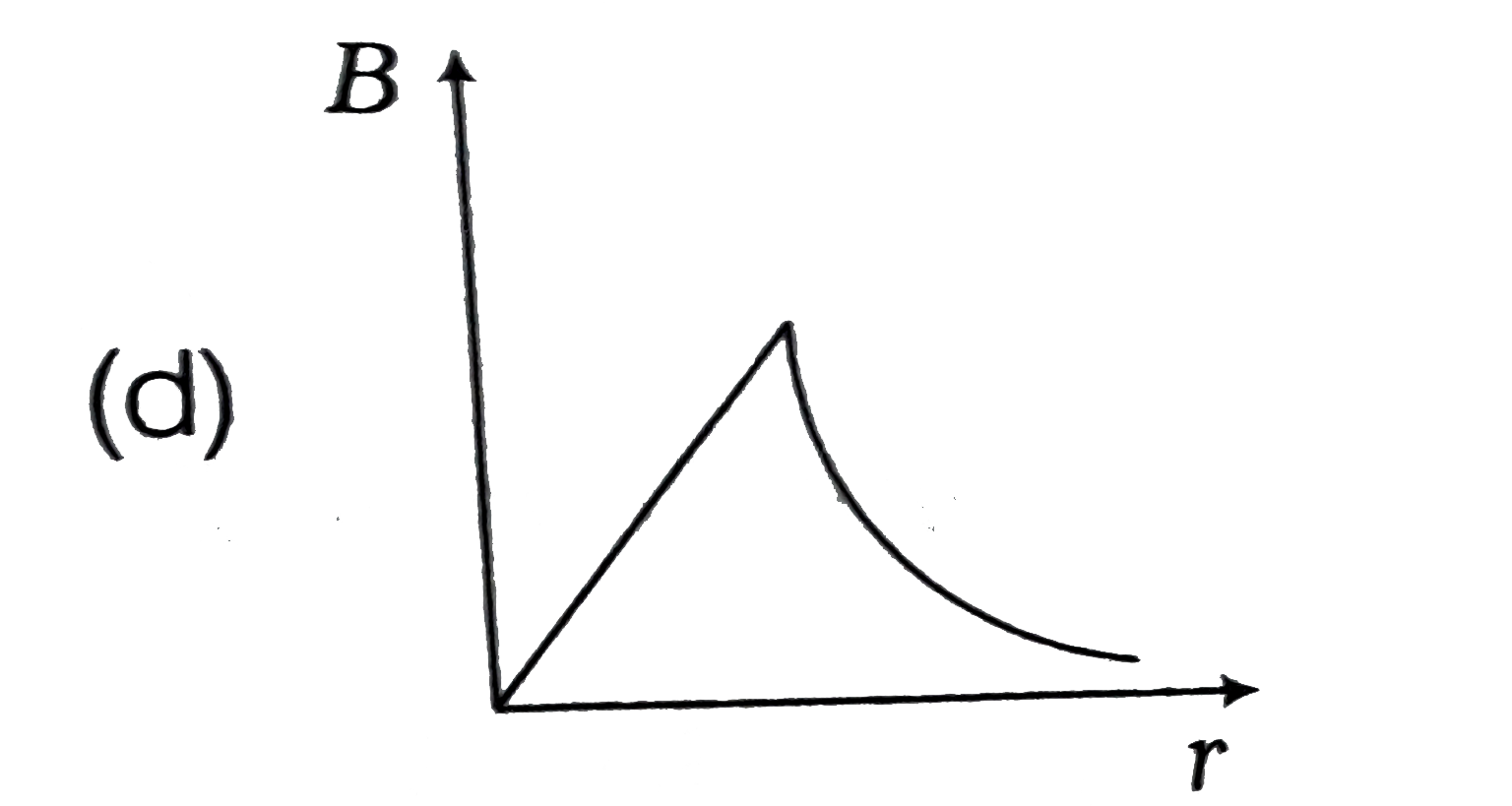
Which of the following figure shown the magnetic flux denstiy b at a distance r from a long straight rod carrying a steady current I ? |
|
Answer»
|
|
| 19. |
Give the logic symbol, Boolean expression and truth table of a NAND gate? |
|
Answer» SOLUTION :This is an AND GATE FOLLOWED by a NOT gate LOGIC SYMBOL: 
|
|
| 20. |
A laser beam can be focussed on an area equal to the square of its wavelength A He - Ne laser radiates energy at the rate of 1 mW and its wavelength is 632.8 nm . The intensity of focussed beam will be |
|
Answer» `1.5 xx 10^(13) W//m^(2)` |
|
| 21. |
Electromagnetic waves can be produced by |
|
Answer» a charge at rest |
|
| 22. |
What is the force on a charged particle of charge strength q moving with a velocity v in a uniform magnetic field of induction B? When is it maximum. |
|
Answer» SOLUTION :Force on a CHARGED particle`F = B q v SIN theta` F is MAXIMUM when `theta= 90^0 , F_("max") = Bqv` |
|
| 23. |
(a) Explain with the help of suitable diagram , the two processes which occur during the formations of a p -n junction diode . Hence , define the terms :(i)depletion region and (ii) potential barrier :(b)Draw a circuit diagram of a p - n junction diode under forward bias and explain its working . |
|
Answer» Solution :(a)(i) Depletion region : Two important processes occur during the formation of - p - n junction :diffusion and drift . Inn type semiconductor , the concentration of electron is more compared to the concentration of holes is more than the concentration of electrons . Duringthe formation ofp - n junction , and due to theconcentration gradient across p - and n - sides holes diffuse from p side to n side and electron diffuse from n - side to p - side . When an electron diffuses from`n to p`, itleaves behind an ionised donor onn side . This ionised doner is immobile as it is bonded to the surrounding atom . When the hole diffuses from` p to n` due to concentration gradiant , it leaves behind an ionised acceptor negative ION .This space charge region on either side of the junction together is known as depletion region. (ii)Barrier potential: When there is a diffusion of holes from p region to n region and diffusion of electrons in the reverse direction takes place , PART ofdepletion layer on n side ofjunction becomes positively charged and the part of depletion layer on p side of the junction becomes negatively charged.Due to this , a junctionpotential is DEVELOPED , which opposes further diffusion of holes and electrons .Hence , this potential acts as a barrier and ISKNOWN as ' barrier potential'. 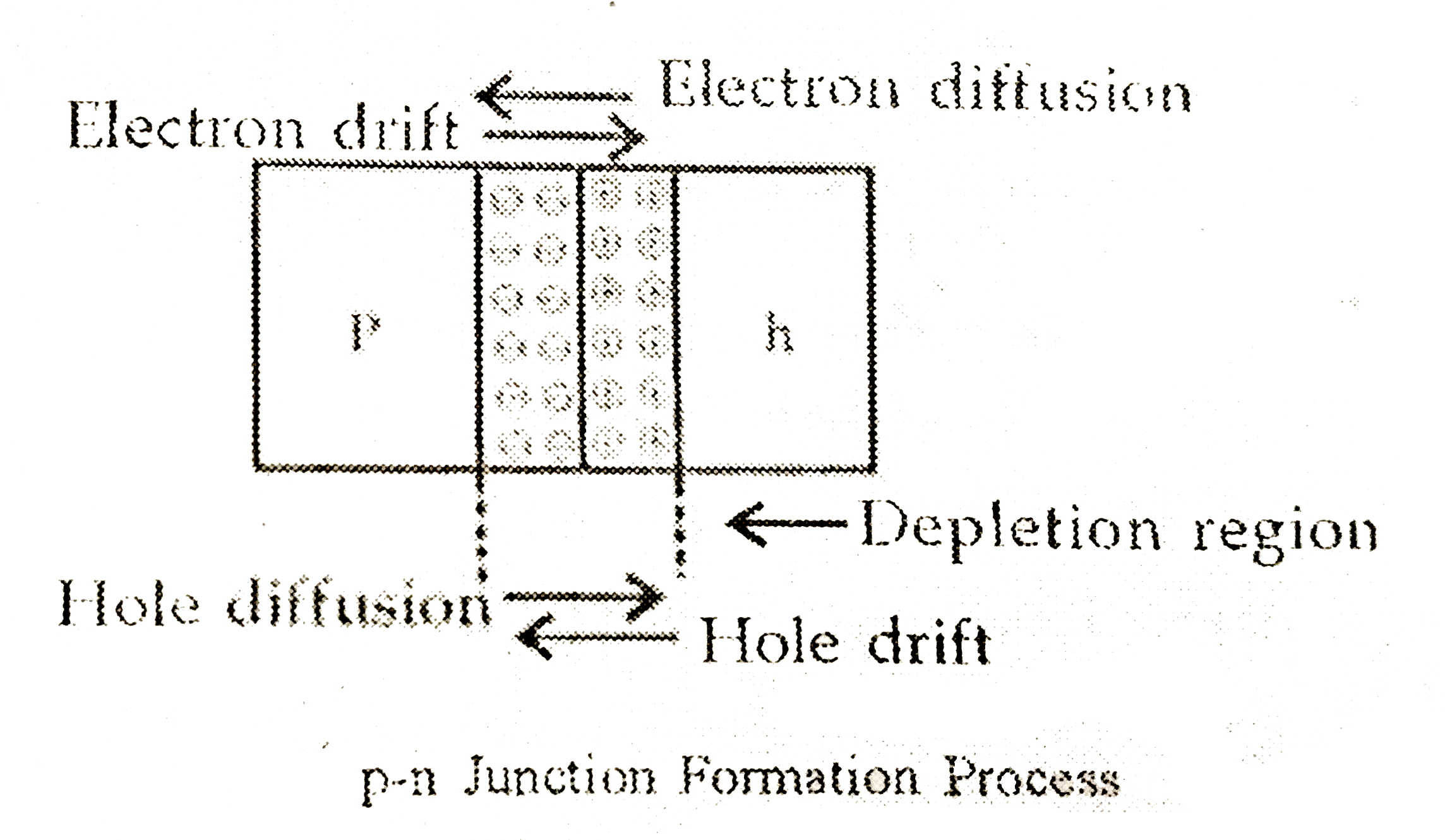
|
|
| 24. |
Identify the correct statements. |
|
Answer» Both the `4MUF` capacitors carry EQUAL charges in opposite sense. |
|
| 25. |
Which day was the largest gathering of international leaders on South African soil for the installation of South Africa's first democratic, non racial government? |
|
Answer» 9TH May |
|
| 26. |
What is the need for doing modulation ? |
|
Answer» To INCREASE the intensity of audio signal |
|
| 27. |
The space between the two plates of an isolated charged parallel plate air capacitor is filled with an insulator. What will be the nature of change of the charge accumulation? |
| Answer» SOLUTION :No CHANGE | |
| 28. |
How much positive and negative charges is there in a cup of water? |
|
Answer» SOLUTION :LET us assume that the mass of one cup of water is 250 g. The molecular mass of water is 18g Thus, one mole (`= 6.02 XX 10 ^(23)` molecules)of water is 18g. Therefore the number of molecules in one cup of water is ` ((250)/( 18) ) xx 6.02 xx10 ^(23) ` Each molecules of water contains two hydrogen atoms and one oxygen atom. i.e.10 electrons and 10 protons.Hence the total positive and total negative charges has the same megnitude .It is equal to ` ((250)/( 18) ) xx 6.02 xx10 ^(23) xx 10 xx 1.6 xx 10 ^(-19) C =1.34 xx 10 ^(7)C ` |
|
| 29. |
theta is the polarising angle for two optical media, whose critical angles are C_(1) and C_(2). The correct relation is : |
|
Answer» `sin theta = (sin C_(1))/(sin C_(2))` `therefore tan theta = (sin C_(1))/(sin C_(2))` |
|
| 30. |
The constant of a constantan-copper thermocouple is: 4.3xx10^(-2)mV//K. The resistance of the thermocouple is 0.5 ohm, that of the galvanometer 100 ohm. One junction of the thermocouple is immersed in melting ice, the other in a hot liquid. What is its temperature if the current in the circuit is 56muA ? |
|
Answer» |
|
| 31. |
The effective capacitance of two capacitors connected in series is |
| Answer» SOLUTION :`(1)/(C_5) = (1)/(C_1) + (1)/(C_2) + (1)/(C_3) + ……… ` | |
| 32. |
Solution set of the inequality x^2-5x+6 |
|
Answer» `(1,2)` |
|
| 33. |
A Zener diode is specified as having a breakdown voltage of 9.1 V, with a maximum power dissipation of 364 mW. What is the maximum currentthe diode can handle? |
|
Answer» <P>40 mA `I_(Z_("max))=(P)/(V_(Z))=(364xx10^(-3))/(9.1)=40mA` |
|
| 34. |
A 100 Omega resistor is connected to a 220 V , 50 Hz are supply . a.What is the rms of current in the circuit ? b.What is the net power consumed over a full cycle ? |
|
Answer» Solution :a.`I_(RMS)= (V_(rms) )/(R ) = 220/100 = 2.2 A` B. Power ` = V_(rms) . I_(rms) = 220 xx 2.2 = 484 W` |
|
| 35. |
Which of the following tasks Mini could do on her own? |
|
Answer» EAT with a spoon |
|
| 36. |
A radio transmitter works at a frequency of 880 KHz and a power of 10 KW. The no. of photons emitted per second are : |
|
Answer» `1.72xx10^(31)` `=(10xx10^(3))/(6*6XX10^(-34)xx88xx10^(4))=1*72xx10^(31)` |
|
| 37. |
Asnwer the following : (a) Name the em waves which are used for the treatment of certain forms of cancer. Write their frequency range. (b) Thin ozone layer on top of stratosphere is crucial for human survival. Why ? (c) Why is the amount of the momentum transferred by the em waves incident on the surface so small? |
|
Answer» SOLUTION :(a) Gamma `(gamma)` rays are used for the treatment of certain forms of cancer. Their frequency range is `3xx10^(19)Hz" to "5xx10^(24)Hz.` (b) The thin ozone layer on top of stratosphere absorbs most of the HARMFUL ultraviolet rays coming from the sun towards the Earth. They include UVA, UVB and UVC radiaations, which can destroy the life system on the Earth. Hence, this layer is crucial for human survival. (c) Momentum transferred = (Energy) (Speed of light) `hvc ~~ 10^(-22)(fpr V~ 1020 Hz).` Thus, the amount of the momentum transferred by the em waves incident on the surface is very small. |
|
| 38. |
If f(x) is double differentiable function such that|f"(x)|le5 for each x in the interval [0,4] and f takes its largest value at an interior point of this interval , then value of |f'(0)|+|f,'(4)|cannot be - |
|
Answer» 10 |
|
| 39. |
State Kirchhoff's current rule. |
| Answer» Solution :Kirchhoff.s current rule statesthat the ALGEBRAICSUM of the CURRENTS at any JUCTION of a circuit is zero. It is a STATEMENT of CONSERVATION of electric charge . | |
| 40. |
Interference pattern is observed at 'P' due to superimposition of two rays coming out from a source 'S' as shown in the figure. The value of '1' for which maxima is obtained at 'P' is : (R is perfect reflecting surface) |
|
Answer» `1=(2nlamda)/(sqrt3-1)` |
|
| 41. |
The speed with which a buller can be fired is 150 ms^(-1). Calculate the greatest distance to which it can be projected and also the maximum height to which it would rise. |
|
Answer» Solution :`R=(u^(2)SIN 2ALPHA)/(g)=((150)^(2)SIN90^(@))/(9.8)=2295 1M` `H_("max")=(u^(2) sin^(2) alpha)/(2g)=((150)^(2) sin45^(@))/(2xx9.8)=573.97 m` |
|
| 42. |
A closely wound rectangular coil of 200 turns and size 0.3mxx0.1m is rotating in a magnetic field of induction 0.005 Wbm^(-2) with a frequency of revolution 1800 rpm about an axis normal to the field. Calculate the maximum value of induced emf. |
|
Answer» |
|
| 43. |
When a brass plate is introduced between two charges, the force between the charges |
|
Answer» Decreases |
|
| 44. |
किसी तत्व A के पास 5 प्रोटॉन तथा 6 न्यूट्रॉन है तो उसका amu भार होगा |
|
Answer» 11 |
|
| 45. |
If a semi conductor has an intrinsic carrier concentration of 1.41 xx 10^(16)// m^3. When doped with 10^(21)// m^3 phosphorous atoms, then the concentration of holes / mat room temperature will be |
|
Answer» `2 XX 10^(21)` |
|
| 46. |
Six charges are placed at the vertices of a regular hexagon as shown in the figure. The electric field on the line passing through point O and perpendicular to the plane of the figure at a distance of x ( gt gt a) from O is 1) (Qa)/(pi epsilon_0 x^3) ""2) (2Qa)/(pi epsilon_0 x^3) 3) (sqrt(3) Qa)/(pi epsilon_0 x^2) "" 4) zero. |
|
Answer» <P> Solution :This is BASICALLY a problem of finding the electric field DUE to three dipoles. The DIPOLE moment of each dipole is P = Q(2a)Electric field due to each dipole will be `E = (KP)/(x^3)`. The direction of electric field due to each dipole is as shown below: `E_("net") = E + 2 E cos 60^@ = 2E` `= 2(1/(4 pi epsilon_0)) ((2Qa)/(x^3)) = (Qa)/(pi epsilon_0 x^3)`. 
|
|
| 47. |
A quarter horse power motor runs at a speed of 600 Ep.m. Assuming 40% efficiency the work done by the motor in one rotation will be: |
|
Answer» 7.46 J POWER of motor=`1/4hp=(746)/(4)W` EFFECTIVE power=`(40)/(100)xx(746)/(4)=74.6 W` `Work W=("Effecttive powre")/("No. of rotations/sec")` =`(746)/(10)=7.46 J`. |
|
| 48. |
The photoelectric work function of a metal is5.5eV . Calculate the maximum speed of the fastest photoelectrons emitted when radiation of photon energy 5.8 eV is incident on themetal surface. |
|
Answer» Solution :Data : `phi = 5.5 EV, HV = 5.8eV, e = 1.6 xx 10^(-19) C, m_(e ) = 9.1 xx 10^(-31) kg` ` 1/2 m_(e)v_("max")^(2) = hv - phi` ` = 5.8 - 5.5 = 0.3 `eV ` = 0.3 xx 1.6 xx 10^(-19)` ` = 4.8 xx 10^(-20)J` ` :. v_("max") = sqrt((2(4.8 xx 10^(-20)))/(9.1 xx 10^(-31)))` ` = sqrt(96/(9.1) xx 10^(10))` ` = 3.248 xx 10^(5) m//s` `{:(log 96,," "1.9823),(log 9.1,,ul(-0.9590)),(,," "1.0233),(,,ul(""xx1/2)),(,,ul(" "0.5116)):}` AL ` 0.5116 = 3.248` |
|
| 49. |
Prove that mechanical power which needed to move the rod in uniform magnetic field is converted into electrical power. |
|
Answer» Solution :Let r be the resistance of MOVABLE arm PQ of the rectangular conductor shown in figure. We assume that the remaining arms QR, RS and SP have NEGLIGIBLE resistances compared to r. Thus, the overall resistance of the rectangular loop is r and this does not change as PQ is moved. The CURRENT I in the loop is, `I=epsilon/r=(Bvl)/r`...(1) 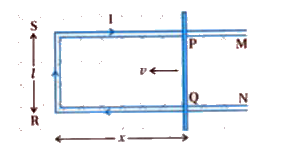 On account of the presence of the magnetic field, there will be a force on the arm PQ. This force `VECF = Ivecl xxvecB` is acting in the direction opposite to the velocity of the rod. The magnitude of this force is, `F=IlB=(B^2l^2v)/r`...(2) This force is due to drift velocity of charge and Lorentz force. Power DELIVERED by external force : Now to push the arm PQ with a constant speed u, we need to apply same force in the direction of velocity. So, the power required to do this is, P=Fv `=(B^2l^2v^2)/r`...(3) Electrical power produced : Now electric power produced can be found by, `P_e`=voltage x current `therefore P_e= epsilonl=(Bvl)xx((Bvl)/R)=(B^2v^2l^2)/R`...(4) which is identical to equation (3), Thus, mechanical energy which was needed to move the arm PQ is converted into electrical energy (the induced emf) and then to thermal energy. |
|