

Saved Bookmarks
This section includes 7 InterviewSolutions, each offering curated multiple-choice questions to sharpen your Current Affairs knowledge and support exam preparation. Choose a topic below to get started.
| 1. |
A solid metallic sphere has a charge + 3Q. Concentric with this sphere is a conducting spherical shell having charge -Q. The radius of the sphere is a and that of the spherical shell is b (bgta). What is the electric field at a distance R (a ltRltb) from the centre. |
|
Answer» `Q/(2PI epsilonR)` |
|
| 2. |
A solid metal sphere of radius R has a charg +2Q. A hollow spherical shell of radius 3R placed concentric with the frist sphere has net charge -Q. If the inner sphere is earthed, what is the charge on it. |
| Answer» Answer :D | |
| 3. |
A solid metal sphere of radius R has a charg +2Q. A hollow spherical shell of radius 3R placed concentric with the frist sphere has net charge -Q. What would be the final distribution of charges if the sphres are joined by a conducting wire |
|
Answer» ZERO on outer and Q on outer SPHERE |
|
| 4. |
A solid metal sphere of radius R has a charg +2Q. A hollow spherical shell of radius 3R placed concentric with the frist sphere has net charge -Q. Find the electric field between the sphere at a distance r from the centre of the inner sphere. [R lt r lt 3R]. |
|
Answer» `(Q)/(2PI epsilon_(0)R^(2))` |
|
| 5. |
A square loop of mass m and side length a lies in xy plane with its centre at origin. It carries a current I. The loop is free to rotate about x axis. A magnetic fieldvec(B)=B_(0 )= B_(0)vec(j)is switched on in the region. Calculate the angular speed acquired by the loop when it has rotated through 90°. Assume no other force on the loop apart from the magnetic force. |
|
Answer» |
|
| 6. |
If an electron in hydrogen atom jumbs from an orbit of level n = 3 to an orbit of level n = 2, the emitted radiation has a frequency |
|
Answer» `(5RC)/(36)` |
|
| 7. |
Only P is a pentavalent impurity atom,its doping with germanium produces a p-types semi-conductor |
|
Answer» INDIUM |
|
| 8. |
जिन जीवों की कोशिकाओं में केन्द्रक झिल्ली होती है, उन्हें कहते हैं : |
|
Answer» प्रोकैरियोट |
|
| 9. |
Set A has 3 elements and the set B has 4 element.Then the number ofinjective mappings that can be defined from A to B is- |
|
Answer» 144 |
|
| 10. |
Find the total - m groups attached to the benzene ring in the given compound ? |
|
Answer» |
|
| 11. |
Electrostatic field lines of forces do not form closed loops. If they form closed loops then the work done in moving a charge along a closed path will not be zero. From the above two statements can you guess the nature of electrostatic force? |
| Answer» SOLUTION :It is a CONSERVATIVE FORCE. | |
| 12. |
Liquid in a capillary rises to a height h. What column of liquid will remain in the capillary, if it is filled in a horizontal position and then placed in a vertical position? Assume the capillary to be sufficiently long. |
|
Answer» Solution :When the FLUID reaches the lower end of the tube, a convex meniscus will be FORMED there with a shape identical to that of the UPPER meniscus (Fig. 21.7). The EXCESS pressure is `DELTA mu=2xx2 sigma //r` ]. But `2 sigma//r=rho g, h` `Deltap=rho gH`, from which H=2h. 
|
|
| 13. |
If a person can jump on the earth surface upto a height 2 m . His jump on a satellite where acceleration due to gravity is 1.96 m //s^2will be - |
|
Answer» 5 m |
|
| 14. |
Wavelenght . |
| Answer» SOLUTION :Wavelenght is defineed as the distance beween consecutive PARTICLESOF the medium which are moving in EXACTLY the same way at a given TIME and have the same displacement from their equilibriumpositions at that time . | |
| 15. |
The SI units of magnetising force or magnetising intensity are same as those of |
|
Answer» magnetic INDUCTION |
|
| 16. |
Figure shows the shape of part of a long string in which transverse waves are produced by attaching one end of the string to tuning fork of frequency 250 Hz. What is the velocity of the waves? |
|
Answer» `1.0 MS^(-1)` |
|
| 17. |
निम्नलिखित में से कौन सी भौतिकी की शाखा नहीं है ? |
|
Answer» यांत्रिकी |
|
| 18. |
The magnetic moment of a bar magnet is M. If it is cut into two pieces in the ratio 1:2 perpendicular to its length, what is the ratio of their magnetic moments. |
|
Answer» Solution :Given that, `l_1 : l_2 = 1:2` NEW magnetic moment of first piece, `M_1 = (M)/(3)` New magnetic moment of SECOND piece, `M_2 = (2M)/(3)` `:.` RATIO of magnetic moments, `(M_1)/(M_2)=(1)/(2)`. |
|
| 19. |
The instantaneous value of emf and current in an A.C. circuit are; E=1.414sin(100πt−4π ) , I=0.707sin(100πt) . The impedance of the circuit will be |
| Answer» SOLUTION :No, it is not true for RMS voltage because the potential differences across various parts of the CIRCUIT may not be in the same phase. | |
| 20. |
A closely wound solenoid 80 cm long has 5 layers of windings of 400 turns each. The diameter of the solenoid is 1.8 cm .If the current carried is 8.0 A, estimate the magnitude of B inside the solenoid near its centre. |
|
Answer» Solution :l= 80 cm `= 80 xx 10^(-2) m p =5 ,N = 400` `n=(N)/(l) = (400)/(80 xx 10^(-2)) = 500` `I = 8 A` For one TURN , `B= mu_(0) nl ` `B= 4pi xx 10^(-7) xx 500 xx 8` For p turns `= pB = 5 xx 4 pi xx 10^(-7) xx 500 xx 8 = 8 pi xx 10^(-3)`T |
|
| 21. |
A 4.5 cm needle is placed 12 cm away from a convex mirror of focal length 15 cm . Give the location of the image and the magnification. Describe what happens as the needle is moved farther from the mirror. |
|
Answer» Solution :u = - 12 cm , f = 15 cm , `h_(0) = 4.5` cm ` (1)/(v) + (1)/(u) = (1)/(f) , (1)/(v) + (1)/((-12)) = (1)/(15) "" v = (15 xx 12)/(15 + 12) = (15 xx 12)/(27)= (20)/(3) = 6.67` cm Image is 6.67 cm behind the mirror .M = `(h_(i))/(h_(0)) = (-v)/(u) , (h_(i))/(4.5) = ( - ((20)/(3)) )/(12) = (20)/(3 xx 12) = (5)/(9)` `h_(i) = (5 xx 4.9)/(9) = 2.5 ` cm image is VIRTUAL , erect and DIMINISHED |
|
| 22. |
What is the net charge on a charged capacitor ? |
| Answer» SOLUTION :ZERO, becauseone platehas positivechargeand the other carriesan equalnegativecharge. | |
| 23. |
A person wears glases of power -2.5 D. The defect of the eye and far point of the person without glasses are respectively |
|
Answer» farsightness 40 CM |
|
| 24. |
A thin lens made of glass (refractive index = 1.5) of focal length f= 16 cm is immersed in a liquid of refractive index 1.42. If its focal length in liquid is f_1, then the ratio f_1lf is closest to the integer |
|
Answer» 9 `(1)/(f_a)=((mu_g)/(mu_a)-1)[(1)/(R_1)-(1)/(R_2)]` In liquid medium, `(1)/(f_L)=((mu_g)/(mu_L)-1)((1)/(R_1)=(1)/(R_2))` `therefore(f_a)/(f_L)=((mu_g)/(mu_L)-1)/((mu_g)/(mu_a)-1)=(mu_g-mu_L)/(mu_g-mu_a)xx(mu_a)/(mu_L)` `=(1.5-1.42)/(1.5-1.0)xx(1)/(1.42)` `=(0.08)/(0.5)xx(1)/(1.42)` `therefore(f_L)/(f_a)=(0.71)/(0.08)` `=8.875~~9` |
|
| 25. |
IDENTIFY THE CORRECT SPELLING |
|
Answer» INADVERTANTLY |
|
| 26. |
Obtain the answers (a) to(b) in Exercise 13 if the circuit is connected to a high frequency supply (240 V, 10 kHz). Hence, explain the statement that at very high frequency, an inductor in a circuit nearly amount to an open circuit. How does an inductor behave in a dc circuit after the steady state ? |
|
Answer» SOLUTION :Given frequency `f=10kHz = 10^(4)Hz` the rms VALUE of voltage `V_("rms")=240 v` from Exercise 13 Resistance `R = 100 Omega`, Inductance `L = 0.5 H` Inductance `Z = sqrt(R^(2)+X_(L)^(2))` `= sqrt(R^(2)+(2pi fL)^(2))` `= sqrt((100)^(2)+(2xx3.14xx10^(4)xx0.5)^(2))` `= 31400.15 Omega` The rms value of current `I_(0)=sqrt(2)I_("rms")=1.414xx0.00764` `= 0.01080 A` and `tan phi = (X_(L))/(R )=(2pi xx1000xx0.5)/(100)` `tan phi = 100 pi` (very large). |
|
| 27. |
Two parallel conductors A and B separated by 5 cm carry electric current of 6A and 2A in the same direction. Find the point between A and B where the field is zero. |
|
Answer» Solution :When the field is zero `B_(1) = B_(2) : therefore (mu_0i_1)/(2PIX) = (mu_0i_2)/(2pi(d-x))` where .d. is the DISTANCE between them `therefore(i_1)/(x) = (i_2)/(d-x)` `(6)/(x) = (2)/(5x-x) rArr 3(5-x) = x or 4X = 15` ` x= 3.75` cm `therefore` Field is zero at a distance of 3.65 cm from A |
|
| 28. |
A radioactive element .A decays into another element .B. with decay constant 4lamda, which them decays into a third element .C. (decay constant =9lamda). If all the atoms in the begining consisted of type .A. only then the ratio of number of atoms of A to that of type .Bis maximum (i.e. N_(A)//N_(B) ) when the number of atoms of .B. is maximum ( N_(B)is maximum) |
| Answer» Answer :B | |
| 29. |
The effect of the emission from a metal surface when illuminated by light or any other radiation of suitable wavelength what we call ? |
| Answer» SOLUTION :PHOTOELECTRIC EFFECT. | |
| 30. |
Suppose that the electric field part of an electromagnetic wave in vacuum isE={(3.1 N//C) cos [(1.8 rad//m)y+(5.4xx10^(6)rad//s)t]}hat(i).a.What is the direction of propagation ?b.What is the wavelength lambda ?c.What is the frequency upsilon ?d. What is the amplitude of the magnetic field part of the wave ?e.Write an expression for the magnetic field part of the wave. |
|
Answer» Solution :a.`-j` B.We have `E={3.14 N//C cos (1.8 rad//m)y+5.4xx10^(6)rad//s t}t` The standard EQUATION is `x=A sin [(2pi)/(T)t+(2pi)/(lambda)y]` Comparing the above equation,`(2pi)/(lambda)y=1.8y` `lambda = (2xx3.14)/(1.8)=3.5 m` c.We have`(2pi)/(T)t=5.4xx10^(6)t` `(1)/(T)=(5.4xx10^(6))/(2xx3.14)` `upsilon = 0.859xx10^(6)Hz` d.`c=(E_(0))/(B_(0))` `B_(0)=(E_(0))/(c )=(3.1)/(3xx10^(8))=(3.1xx10^(-8))/(3)=1.03xx10^(-8)T` e.`B={(1.03xx10^(-8)T)cos (1.8 rad//m)y+(5.4xx10^(6)rad//s)t}hat(k)` |
|
| 31. |
write types of logic system. |
|
Answer» Solution :There are two types of systems USED in logic CIRCUIT. (1) Positive logic system: In this type of system the higher positive voltage is taken as HIGH level of .1. and the less positive voltageis taken as low level or .0.. (2) Nagative logic system: In this type of system the more NEGATIVE voltage is taken as .1. and the less negative voltage is taken as .0.. 
|
|
| 32. |
What is the electric field in between the plates of the capacitor, if sigma is the surface charge density? |
Answer» Solution :In figure, a Gaussian surface, in the from of a pill box is shown. It is of area `triangleA` (on end faces) and of negligible THICKNESS. Let `vecE_(1)` be the field below and `vecE_(2)`, the field above. 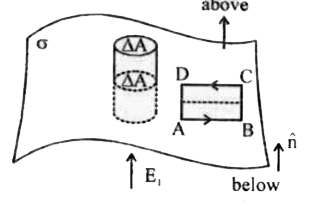 The FLUX through upper surface `=vecE_(2).triangle vecA` `=(vecE_(2).hatn)triangleA` Similarly flux through lower face `=vecE_(1). triangle vecA=(-vecE_(1).hatn) triangleA` Hence by Gauss theorem `(vecE_(2)-vecE_(1)). hatn. triangleA=(q)/(epsi_(0)) =(sigma triangleA)/(epsi_(0)) therefore (vecE_(2)-vecE_(1)).hatn=(sigma)/(epsi_(0))` Inside a conducting surface, E=0 `therefore vecE_(2)=vecE=(sigma hatn)/(epsi_(0))` b. Considera closed path ABCD. If `E_(1)^(n) and E_(2)^(n)` are the tangential COMPONENTS, then work done is `E_(1)^(n) TRIANGLEL+E_(2)^(n) (-trianglel)=0 ("property of electric field")` `E_(1)^(n)-E_(2)^(n)=0 or E_(1)^(n) =E_(2)^(n)`, showing that tangetial components are continuous. |
|
| 33. |
A particle is projected vertically upwards from a point A with initial speed of 29.4m/s. During what interval of time is the particle more than 39.2 from A. |
|
Answer» 2s,4s |
|
| 34. |
For a transistor to work as an amplifier |
|
Answer» Its EMITTER JUNCTION is in reverse bias and COLLECTOR junction is in forward bias |
|
| 35. |
Which world in the passage stands for worship ? |
|
Answer» Adore |
|
| 36. |
In the circuit shown the switch is closed at time t = 0. Plot the following graphs: (i) current (I) in the circuit V_(s) time (t) (ii) voltage across the capacitor (V_C) Vs ‘t’ (iii) power absorbed by the capacitor V_(s) ‘t’. |
|
Answer» |
|
| 37. |
If there are n capacitors in parallel connected to V volt source, then energy stored is equal to: |
|
Answer» CV |
|
| 38. |
0.12 moleH_(3)PO_(x) is compeltely neutralized by5.6g KOH thenthetruestatement is :- |
|
Answer» x= 3 and givenacid is dibasic `thereforeMol xx V.F =(5.6)/(56)` ` THEREFORE` V.F or Basicity =1 `thereforeH_(3) PO_(2)` is correctItis MONO basicanddoesnot FORM acid salt |
|
| 39. |
In semiconductor at a room temperature ……… |
|
Answer» the conduction band is completely empty. At `0^(@)K` conduction band is empty and valence band is filled. At this temperature the conduction electrons do not move to valence band, but at the ROOM temperature, group of electrons moves into conductionband from valence band [due to small forbidden gap (1eV)]. |
|
| 40. |
A proton beam enters a magnetic field of 10^(-4) " Wb " m^(-2)Wb normally. If the specific charge of the proton is10^(11) " C " kg^(-1) and its velocity is 10^(9) " m "s^(-1) then the radius of the circle described will be |
|
Answer» 1m |
|
| 41. |
The K.E. of the electron is E, when the incident wavelength is lamda. To increase the K.E. of the electron to 2E, the incident wavelength must be : |
|
Answer» `(HC)/(Elamda-hc)` `or (hc)/(lambda)-E=(hc)/(x)-2E,` SOLVING `x=(hc lambda)/(lambda+hc)` |
|
| 42. |
A ray of light is incident at an angle of 60^(@) on face of a prism of angle 30^(@) The emergent ray makes an angle of 30^(@) with the incident ray. Calculate the refractive index of the material of the prism. |
|
Answer» SOLUTION :`i_(1)=60^(@), R=30^(@), i_(2)=30^(@)` `MU=(SIN i)/(sin r)` `mu=(sin 0^(@))/(sin 30^(@))` `mu=(sqrt3)/(2xx(1)/(2))` `mu=sqrt3` `mu=1.732` |
|
| 43. |
A postive charge projected along the axis of a current caryying solenoid coil moves undeviated from its orginal path. |
|
Answer» |
|
| 44. |
What is zener diode ? |
| Answer» Solution :ZENER diode is a SPECIALLY designed JUNCTION diode, which can operate in the REVERSE breakdown VOLTAGE region continuously without being damaged. | |
| 45. |
The dielectric constant of dielectric cannot be |
|
Answer» 3 |
|
| 46. |
A 1000mega carbon resistor is marked overset+-10% tolerance, What do you mean by it ? |
| Answer» Solution :TOLERANCE means maximum possible ERROR expected in the value. THUS, a 100`omega` resistor with 10% tolerance means that resistance will be within10% of 100`Omega` i.e. 90`Omega` or 110`0mega`. | |
| 47. |
"If you illuminate two pinholes using two lamps, the interference pattern will not b observed" - Explain. |
Answer» Solution :Make TWO SMALL holes close to each other on th cardboard and illuminated the holes with tw sodium lamps and PLACING the screen behind i we will not see the bright and dark points interference. This is shown in the FIGURE.  If two sodium lamps in the figure, illuminate the two pin holes `S_(1)` and `S_(2)` then the intensity i added and the interference points will not be seen on the screen. Because, the light wave emitted from a sodiun lamp undergoes abrupt phase change in time of the order of `10^(-9)` seconds. Thus the ligh waves coming out from two independen sources of light will not have any fixed phase relationship. So this source is INCOHERENT. And from the incoherent source, the screen intensity will be added to each other so the screen will only appear bright. |
|
| 48. |
Energy per unit volume for a capacitor having a plate area 'A' and plate seperation 'd' kept at a potential difference 'V' is given by |
|
Answer» `1/2 epsilon_0 V^2/d^2` |
|
| 49. |
During X-ray formation, if voltage is increased |
|
Answer» minimum wavelength DECREASES |
|
| 50. |
State Stefan's law of radiation. Derive an expression for the rate of loss of radiant energy per unit area by a perfect blackbody in a cooler surroundings. |
|
Answer» Solution :Stefan's law of radiation : The quantity of radiant energy emitted by a perfect blackbody per unit time per unit surface area of the body is directly proportional to the fourth POWER of its ABSOLUTE temperature. Consider a perfect blackbody at absolute temperature T. We shall assume its surroundings also to act as a perfect blackbody at absolute temperature `T_(0)`, where `T_(@) lt T`. The energy radiated per unit time per unit surface area by a blackbody at temperature T is its emissive power `E_(b)` at that temperature. According to Stefan's law, `E_(b)rhoT^(4)` is the Stefan CONSTANT. At the same time, the body absorbs radiant energy from the surroundings. The radiant energy absorbed per unit time per area by the blackbody is `rhoT_(0)^(4)`. Therefore, the rate of loss of radinat energy per unit area by the blackbody is `rho(T^(4)-T_(0)^(4))`. |
|