

Saved Bookmarks
This section includes 7 InterviewSolutions, each offering curated multiple-choice questions to sharpen your Current Affairs knowledge and support exam preparation. Choose a topic below to get started.
| 1. |
Direction : The questions 60 and 61 are based on following paragraph : An X-ray tube operated at a D.C, voltage of 40 kV produces heat at the target at the rate of 720 W. If 0.5% of the energy of the incident electron is converted into X-ray radiation, then (sp. charge is 1.8xx10^(11)C//kg). Number of electrons striking the target per/sec is |
|
Answer» `2.2xx10^(-17)` No heat produced/sec. `=(955)/(100)IV` `=0.955xIXx40,000` Then `n=(I)/(e)=(0.018)/(1.65xx10^(-19))=1.1xx10^(7)` |
|
| 2. |
When is H, line of the Balmer series in the emission spectrum of hydrogen atom obtained ? |
| Answer» Solution :The H, line of Balmer SERIES in emission spectrum of HYDROGEN atom corresponds to the transition from `n_(i) = 3` to `n_(f)=2` ORBIT. | |
| 3. |
What is mean by balanced wheatstone's bridge ? |
| Answer» Solution :A wheatstone.s bridge is SAID to be balance if no CURRENT FLOWS through the gavanometer ARM. The condition is …. | |
| 4. |
Two large metalplates of area 6.0 m^(2)face each other . The plates are 3 cm apart and carry equal and opposite charges on their inner surfaces. If electric field at a point between the plates is5 xx 10 ^(4)NC ^(-1), then calculate the magnitude of charge on each plates. |
|
Answer» SOLUTION :Let MAGNITUDE of charge on the inner surface of each plate be Q . It is given that A = `6.0 m^(2)and E = 5 XX 10^(4)C ^(-1) ` At point P between the two PLATES , electric field due to both plates is equal and directed in same direction ,i.e. ` oversetto (E_1) =oversetto (E_2)=(sigma)/( 2 in _0) "" ` [From plate 1 TOWARDS plates 2 ] ` therefore ` Net electric field at point P ` "" E=E_1 +E_2 =(sigma )/( in_0)= (Q)/( in_0A ) ` `rArr ""Q= in _0 AE = 8.85 xx 10 ^(-12)xx 6.0 xx 5 xx 10 ^(4) ` ` "" =2.655 xx10 ^(-6) C or 2.66 muC ` ` (##U_LIK_SP_PHY_XII_C01_E10_023_S01.png" width="80%"> |
|
| 5. |
Assertion : The presence of large magnetic flux through a coil maintains a current in the coil if the circuit is continuous. Reason : Magnetic flux is essential to maintain an induced current in the coil. |
|
Answer»
|
|
| 6. |
(A) : A particle is found to be at rest when seen from a frame S,and moving with a constant velocity when seen from another frame S_2. We can say both the frames are inertial ( R) : All frames moving uniformly with respect to an inertial frame are themselves inertial |
|
Answer» Both (A) and (R) are true and (R) is the correct explanation of (A) |
|
| 7. |
In a Young's double slit experiment the separation between slits is 2 xx 10^(-3)m whereas the distance of screen from the plane of slits is 2.5m. Light of wavelengths in the range 2000-8000 Å is allowed to fall on the slits. Find the wavelengths in the visible region that will be present on the screen at 10^(-3) m from the central maxima. |
| Answer» SOLUTION :`4000Å` only | |
| 8. |
The two soap of bubbles of equal radii (r and r) coalesce. Then what will be the radius of curvature of the interface between two bubbles? |
|
Answer» Solution :For two soap BUBBLE of RADII `r_1` and `r_2` where `r_2 gt r_1`, the radius of CURVATURE of the common interface is GIVEN by `R = (r_1r_2)/(r_2 - r_1)` But, in this case `r_1 = r_2` therefore r_2 - r_1` = 0 R = (`r_1r_2`)/0 = 8 |
|
| 9. |
A hydrogenatom in the groundstate is excited by an electron beam of 12.5 eV energy. Findout themaximum numberof linesemittedby theatom from its excited state. |
|
Answer» Solution :We know that energy of anelectron in nth orbit of hydrogen is `E_(n) = - (13.6)/(n^(2)) E V`andenergyis groundstateof HYDROGENIS - 13.6 eV. When an electron beam of 12.5 eVis used, hydrogen atom cannotbe ionisedbut at the mostexcitedto n = 3state whereenergyof theelectron will be ` - (13.6)/((3)^(2)) = - 1.51 eV`(as MAXIMUM energy ofelectron can be` - 13.6 + 12.5 = - 1.1 eV` and electroncannot beexcited to n = 4statehavingenergy- 0.85 e V). So, only three transitions are possibleas show here . Heretransitions No.1and2 represent lines of LYMAN series andtransition No.2 represents lineofBalmer series . 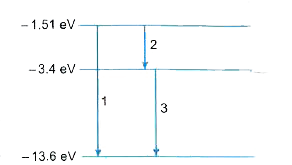
|
|
| 10. |
In the given diagram, a small magnetised needle is placed at a point O. The arrow shows the direction of its magnetic moment. The other arrowsshown different positions and orientations of the magnetic moment of another identical magnetic needs B. (b) In which configuration is the system. (i) stable and (ii) unstable equilibrium? |
| Answer» Solution :(b) (i) for stable equilibrium, the DIPOLE MOMENTS should be PARALLEL, examples : `AB_5 and AB_6` (ii) for unstable equilibrium, the dipole MOMENT should be anti parallel examples : `AB_3 and AB_4`. | |
| 11. |
Figure shows a small magnetised needle P placed at a point O. The arrow shows the direction of magnetic moment. The other arrows show different positions (and orientations of the magnetic moment) of another identical magnetised needle Q. (a) In which configuration is the system not in equilibrium? (b) In which configuration is the system in (i) stable and (ii) unstable equilibrium? (c) Which configuration corresponds to the lowest potential energy among all the configurations shown? |
| Answer» Solution :(a) For equilibrium, the DIPOLE MOMENT should be PARALLEL or AUTO parallel to B. Hence, `AB_1 and AB_2` are not in equilibrium. | |
| 12. |
In the given diagram, a small magnetised needle is placed at a point O. The arrow shows the direction of its magnetic moment. The other arrowsshown different positions and orientations of the magnetic moment of another identical magnetic needs B. (c) Which configuration corresponds to the lowest potential energy among all the configurations shown? |
| Answer» Solution :POTENTIAL energy is MINIMUM when angle between M and B is `0^@`, i.e. `U = MB` EXAMPLE : `AB_(6)`. | |
| 13. |
The earth's surface has a negative surface charge density of 10^(-9)C m^(-2). The potential difference of 400 kV between the top of the atmosphere and the surface results (due to the low conductivity of the lower atmosphere) in a current of only 1800 A over the entire globe. If there were no mechanism of sustaining atmospheric electric field, how much time (roughly) would be required to neutralise the earth's surface ? (This never happens in practice because there is a mechanism to replenish electric charges, namely the continual thunderstorms and lightning in different parts of the globe.) (Radius of earth = 6.37xx10^6 m) |
| Answer» Solution :Using the radius of earth, obtain total charge of the globe. DIVIDE it by current to obtain TIME = 283 s. Still this method GIVES you only an estimate, it is not strictly CORRECT. | |
| 14. |
suppose an electron is attracted towards the origin by a force k//r, where k is a constant and r is the distance of the electron form the origin. By applying bohr model to this system, the radius of n^(th) orbit of the electron is found to be r_n and |
|
Answer» E Now for hydrogen `(._1H^2)Z_H=1`, and `E_H=E` and for helium `(._2He^4)`,`Z_(He)=2`. `thereforeE_(H)/(E_(He))=(Z_H)^2/((Z_(He))^2)RARR((Z_He)/(Z_H))^2E_(H)=(2)^2E=4E`. |
|
| 15. |
Obtain the expression for the electric fieldat any point on the equatorial plane of an electric dipole. |
Answer» Solution :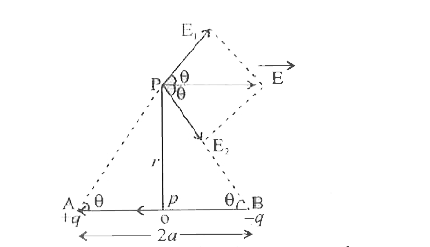 Consider an electric dipole consisting of two point charges +q and -q , separated by a small distance 2a. To find the electric field intensity at P on the equatorial line of the dipole . When OP=r, `E_l`the electric field intensityat P due to charge +q is `(E_1)=1/(4piepsilon_0)q/(AP^2) "" because AP^2 = a^2 + r^2` `(E_1)=1/(4piepsilon_0) q/(a^2+r^2)` The magnetic of the electric field intensity`E_2` at P due to charge -q is `(E_2)=1/(4piepsilon_0) q/(a^2+r^2)` The DIRECTIONOF `vecE_1` is away from the charge +q and the direction of `vecE_2` is TOWARDS the charge-q as shown . `vecE_1` and `vecE_2` can be resolved into two components . The components NORMAL to the dipole axiscancel away each other each being equal and opposite .The componentsalong the dipole axis add up. `therefore vecE_1=(E_1 cos theta + E_2 cos theta) - hatP` Here the directionof `vecE`is oppositeto dipole MOMENT P.`therefore -hatP` is unit vector. `vecE=(E_1+E_2)cos theta -hatP` From the figure , `cos theta = a/((r^2+a^2)^(1//2))` `vecE=[1/(4piepsilon_0)q/((a^2+r^2))+1/(4piepsilon_0) q/((a^2+r^2))]a/((a^2+r^2)^(1//2))-hatP` `vecE=1/(4piepsilon_0)q/((a^2+r^2)) [1+1] a/((a^2+r^2)^(1//2)) -hatP =1/(4piepsilon_0)(2qa)/((a^2+r^2)^(3//2))-hatP` `vecE=1/(4piepsilon_0)P((a^2+r^2)^(3//2))-hatP` P=q 2a `vecE=1/(4piepsilon_0)vecP/((a^2+r^2)^(3//2)) "" because hatP=vecP/P` As a < < < r , a can be neglected `vecE=1/(4piepsilon_0)vecP/((r^2)^(3//2))` `vecE=1/(4piepsilon_0)vecP/r^3` |
|
| 16. |
A radioactive isotope X has a half life of 3 second Initially a given sample of this isotope contains 8000 atoms. Calculate (a) its decay constant , (b) the time t_1 when 1000 atoms of the isotope X remain in the sample , and (c) the number of decay per second in the sample at t =t_1. |
|
Answer» Solution :(a)`lambda=0.693/T_(1//2) = 0.693/3=0.231 s^(-1)` (b)`N=N_0e^(-lambdat)` `t_1=1/lambda log_e N_0/N = 1/0.231 log_e 8000/1000`=9 SEC (c)`|(DN)/(DT)|_(t=t_1)=lambdaN=0.231xx1000=231 s^(-1)` |
|
| 17. |
Where were the parents of the author? |
|
Answer» Abroad |
|
| 18. |
If P, Q and R are physical quantities having different dimensions, which of the following combinations can never be a meaningful quantity ? |
|
Answer» `(PQ)/(R)` |
|
| 19. |
Light from a point source in air falls on a spherical glass surface (n = 1.5 and radius of curvature = 20 cm). The distance of the light source from the glass surface is 100 cm. At what position the image is formed ? |
|
Answer» Solution :It is given that `U=-100 cm, R = +20 cm, n_(1) =1` (for AIR) and `n_(2)=1.5` (for glass) We know that for refraction through a spherical surface `n_(1)/v - n_(1)/u = (n_(2)-n_(1))/R` `THEREFORE (1.5-1)/20` or `1.5/v - 1/100 = 1.5/100 rArr v= 100 cm` Thus, the IMAGE is formed at a distance of 100 cm from the pole of spherical svirface in the direction of the incident light. |
|
| 20. |
Describe a procedure formeasuring the velocity of sound in a stretched string. |
|
Answer» Solution :The velocity of a transversewave travelling along a stretched string in fundamental mode is given by `V = 2vl` , where v =frequency, l = RESONATING length . Measuring of velocity of sound in a stretched string using sonometer`:` (1) THEWIRE is subjected to a fixed tension with suitable load. (2) A tunning fork of known frequency(v), is exicted and the stem is held against the sononmeter box. (3) The distance between the two bridges is adjusted such that a small paper rider at the middle of `B_(1)B_(2)`VIBRATES vigorouslyand flies off due to resonance. (4)The resonating length 'l' can be measuredbetween two bridges with scale. (5) By knowingv and l, we can find the velocityof a wave using `upsilon = 2vl`. 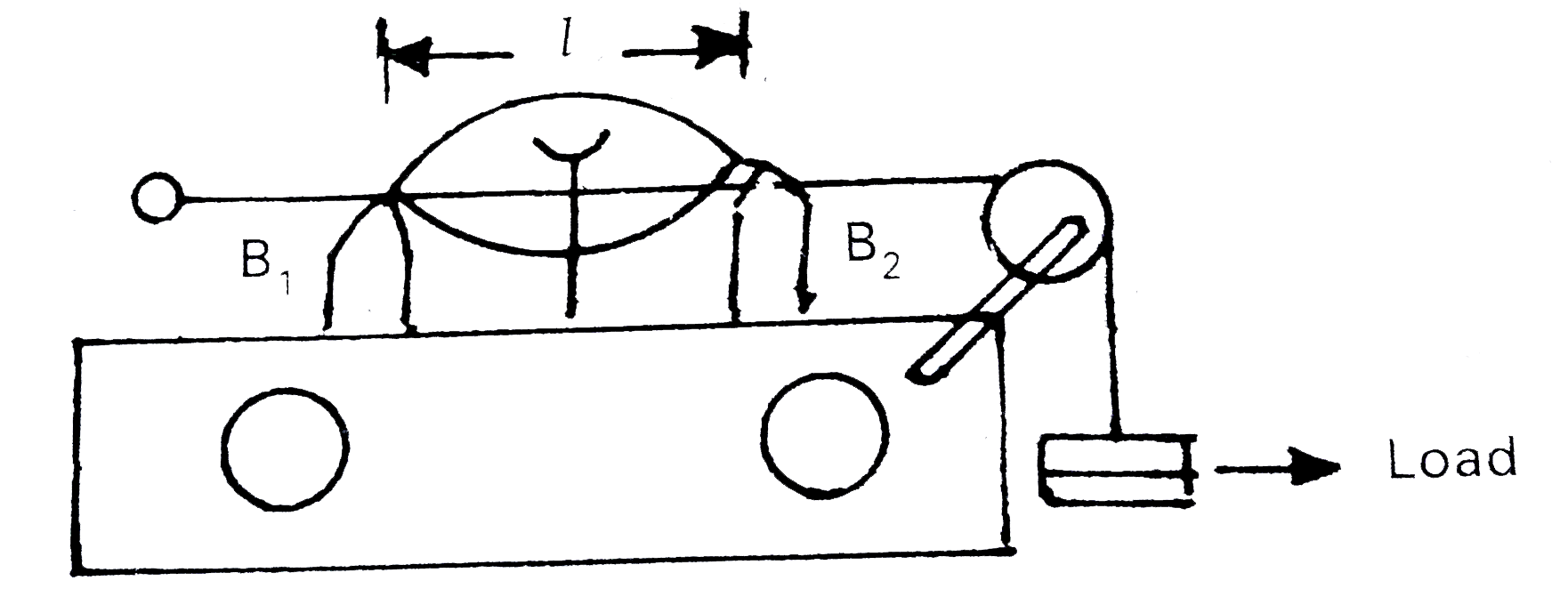
|
|
| 21. |
A communication between a fixed base station and several mobile units, located on ships or aircraft utilizing two way radio communication in the VHF and UHF is of frequency band |
| Answer» Solution :30 to 470 MHz | |
| 22. |
An electric field is acting vertically upwards. A small body of mass 1 gm and charge -1 mu C is projected with a velocity 10 m/s at an angle 45^@ with horizontal. Its horizontal range is 2m then the intensity of electric field is : (g=10 m/s^2) |
|
Answer» `20,000 N//C` |
|
| 23. |
According to Maxwell's hypothesis, a changing electric field gives rise to : |
|
Answer» an emf |
|
| 24. |
If an iron wire is drawn to decrease its radius by 0.5 %. Then percentage of increase in its resistance will be |
| Answer» ANSWER :B | |
| 25. |
The angle between incident ray and reflectedray is 70^@and reflecting ray is 70^@. What is the angle of incident ? |
| Answer» ANSWER :D | |
| 26. |
The figure shows an infinitely long current wire out of the plane of the paper ( shown as a dot 'o.'). A current carrying loop ABCD is placed as shown in figure. The loop |
|
Answer» experiences no net force |
|
| 27. |
If the intensities of the two interfering beams in Young.s double -Slit experiment be I_1" and "I_2 then the contrast between the maximum and minimum intensity is good when |
|
Answer» `I_1` is MUCH GREATER than `I_2` |
|
| 28. |
Express 6.45372 upto four significant figures |
|
Answer» 6.454 |
|
| 29. |
Which of the four Maxwell's equations shows that magnetic lines of force cannot form closed loops. |
| Answer» SOLUTION :Faraday.s LAWS of ELECTROMAGNETIC INDUCTION i.e `ointvecE.vecdl =- (dphi)/(DT)` | |
| 30. |
ABC is an equilateral triangle. Three identical charges each +q are placed at each corner. Electric intensity at the centroid of triangle is |
|
Answer» `(1)/(4PI in_(0)) (q)/(r^(2))` |
|
| 31. |
An airplane is flying in a horizontal circle at a speed of 600 km/h. If its wings aire tilted at theta=40^(@) to the horizontal what is the radius of the circle in which the plane is flying? Assume that the required force is provided entirely by an aerodynamic lift that is perpendicular to the wing surface. |
|
Answer» |
|
| 32. |
If two charges and q_1are separated by a distance r, q_2then potential energy of the system is |
|
Answer» |
|
| 33. |
In an NPN transistor, the emitter current is |
|
Answer» SLIGHTLY more than the collector CURRENT |
|
| 34. |
Equal temperature difference exists between the ends of two metallic rods 1 and 2 of equal lengths. Their thermal conductivityis K_(1) and K_(2) and cross-sectionalareas are respectively A_(1) and A_(2). The condition for equal rate of heat transfer will be |
|
Answer» `K_(1)A_(1)^(2)=K_(2)A_(2)^(2)` |
|
| 35. |
In the given diagram [Fig. 14.171, is the junction diode forward biased or reverse biased ? |
Answer» SOLUTION :The JUNCTION DIODE is REVERSE BIASED. 
|
|
| 36. |
At the Earth's equator, B is horizontal and to the north, with a magnitude of approximately 7 xx 10^(-5) T. (a) What is the magnetic flux through a loop of radius 0.1 m, lying flat on the ground? (b) If the same loop is balanced on its edge such that its axis points northwest, what is the magnetic flux through the loop? (c) If the loop is now rotated such that its axis points north, what is the magnetic flux through the loop? (d) If the loop is now rotated such that its axis points west, what is the magnetic flux through the loop? |
| Answer» Solution :(a) zero, (b) `11sqrt2xx10^(-7)Tm^(2), (C) 22 XX 10^(-7) Tm^(2)`, (d) zero | |
| 37. |
In the circuit in figure, V is high resistance voltmeter and A is a low resistance ammeter. Switch S is open. What is the effect on the voltmeter and ammeter reading when switch S is now closed? Voltmeter reading and Ammeter reading respectively |
|
Answer» READING of voltmeter and Ammeter increases |
|
| 38. |
Two charges 3 xx 10^(-8) C and - 2 xx 10^(-8) C are located 15 cm apart. At what point on the line joining the two charges is the electric potential zero ? Take the potential at infinity to be zero. |
Answer» Solution :Suppose charge of `3 xx 10^(-8)` C be TAKEN on the origin O and charge of `- 2 xx 10^(-8)` C be taken on point A along positive x-axis at distance 15 cm as shown in figure.  The potential at point P is zero. As seen logically the potential due to both charges cannot be zero for left side of O (x `LT` 0) and hence there are two possibilities for point P. (i) If point P is between O and A, then suppose P is from O at distance x cm and hence point A is at distance (15 - x) cm from P. Potential at P due to charge on point O is `V_(1) =(k(3xx10^(-8)))/(x xx 10^(-2))` and Potential at P due to charge on point A is `V_(2)=(k(-2xx10^(-8)))/((15-x)xx10^(-2))` but potential at P is `V=V_(1)+V_(2)` `O=(kxx3xx10^(-8))/(x xx10^(-2))-(kxx2xx10^(-8))/((15-x)xx10^(-2))` `O =(3)/(x)-(2)/(15-x)` `:. (2)/(15-x)=(3)/(x)` `:. 2X= 45 -3x` `:. 5x=45` `:. x=9` cm (ii) If neutral point obtain from right side of A them .  `:.` Now potential at P due to charge on point O is `V_(1)=(k(3xx10^(-8)))/(x xx10^(-2))` Potential at P due to charge on point A `V_(2) =(k(-2xx10^(-8)))/((x-15)xx10^(-2))=-(k(2xx10^(-8)))/((x-15)xx10^(-2))` Total potential at point P, `V= V_(1)+V_(2)` `:. O = (k(3xx10^(-8)))/(x xx10^(-2))-(k(2xx10^(-8)))/((x-15)xx10^(-2))` `:. (3)/(x)=(2)/(x-15)` `:. 3x-45=2x` `:. x= 45 cm` THUS, electric potential is zero at 9 cm and 45 cm away from the positive charge on the side of the negative charge . Note : Here, CHOOSING a potential to be zero at infinity. |
|
| 39. |
Figure shows charged hollow metal spheres (exceptX) each with internal radius a and external radius b Match each charged distribution with the corresponding E- field graph. |
|
Answer» W-II,X-I,Y-III,Z-IV 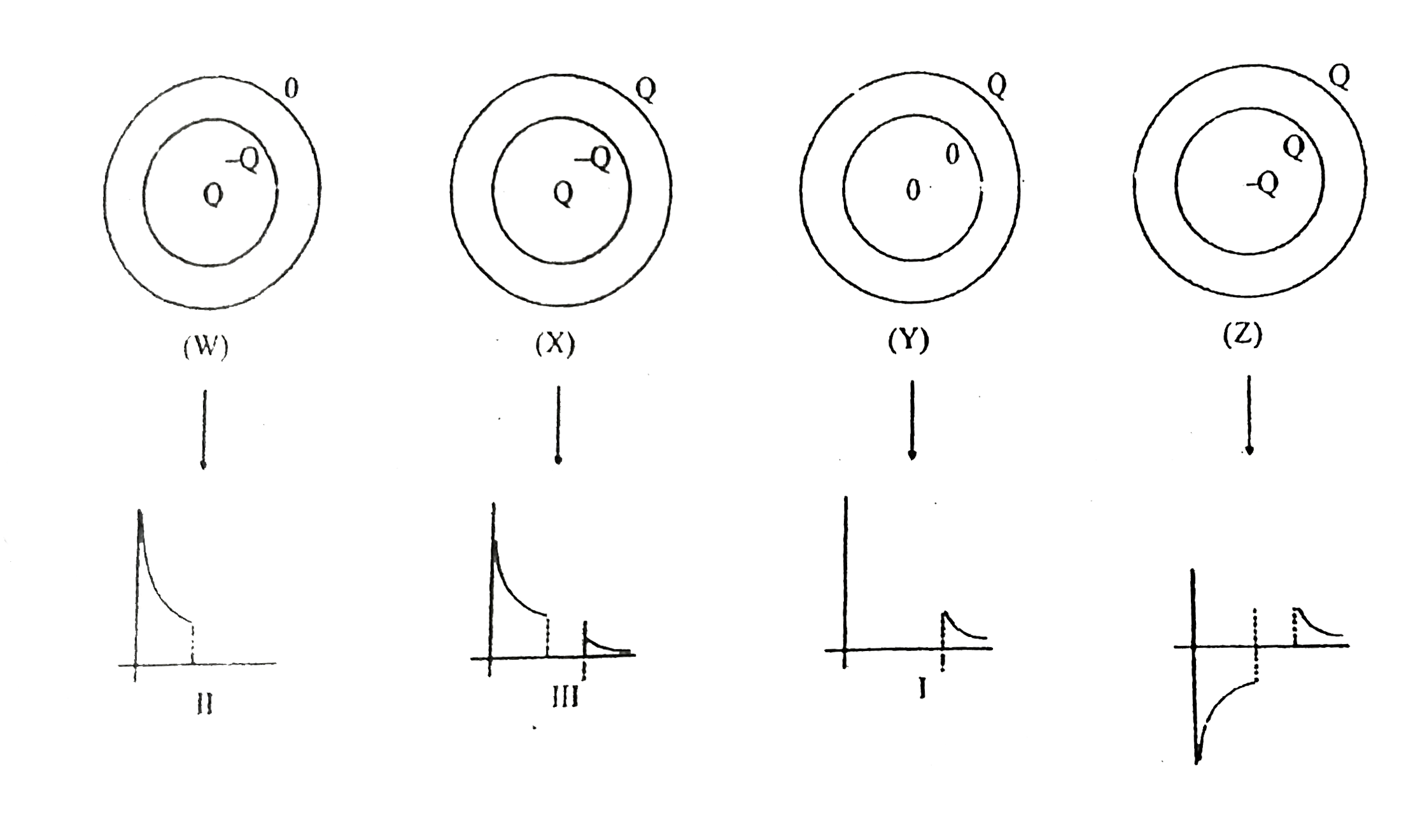
|
|
| 40. |
Why are alloys used for making standard resistance coils ? |
| Answer» Solution :ALLOYS are sensitive at LOW temperature. Temperature coefficient of resistivity of alloys is very SMALL. Hence for small interval of temperature resistance of wire made up of alloys is almost constant. For GIVEN length and crosssection area resistance R `prop rho [ because R =(rho L)/(A)] ` hence alloys are used to prepare standard resistors. | |
| 41. |
In remeasurement of mass of a given object by the principle of moments, the meter scale is hung from its midd -point. A known weight of mass 2kg is hung at one end of meter scale and unknown weight of mass m kg is bung at 20cm from the centre on other side. The Value of m is |
|
Answer» 2kg |
|
| 42. |
OR gate operation means : |
|
Answer» OUTPUT exists when EITHER of input exists |
|
| 43. |
How we represent electric and magnetic fields at a distance x from the origin ? |
| Answer» Solution :`E(X)=E_0 Sinomega(t-x/c)` B(x)`B_0sinomega(t-x/c)`Where C= velocity of electromagnetic waves. `B_0` and `E_0`= AMPLITUDE of magnetic and ELECTRIC fields. | |
| 44. |
The 6563 Å Ha line emitted by hydrogen in a star is found to be red-shifted by 15 Å. Estimate the speed with which the star is receding from the Earth. |
|
Answer» Solution :Given, `lambda'-lambda=15Å =15xx10^(-10)m, lambda=6563Å=6563xx10^(-10)m,V=?` Since, `lambda'-lambda=(vlambda)/(2)THEREFORE v=(c(lambda'-lambda))/(lambda) Rightarrow v=(3xx10^(8)xx15xx10^(-10))/(6563xx10^(-10))=6.86xx10^(5)m//s` |
|
| 45. |
The central fringe of the interference pattern produced by light of wavelength 6000A is found to shift to the position of 4th bright fringe after a glass plate of refraction index 1.5 is introduced in front of one slit in young's experiment. The thickness of the glass plate will be |
|
Answer» `4.8 MU m` |
|
| 46. |
A rectangular wire loop of sides 8 cm and 2 cm with a small cut is moving out of a region of uniform magnetic field of magnitude 0.3 T directed normal to the loop. What is the emf developed across the cut if the velocity of the loop is 1 cm s_(1) in a direction normal to the (a) longer side? (b) shorter side of the loop ? For how long does the induced voltage last in each case ? |
|
Answer» Solution :Here length of loop? l = 0.08 m, breadth of loop B = 2 cm = 0.02 m, MAGNETIC field B = 0.3T, VELOCITY of the motion of loop `v = 1 cm s = 10^-2 m/s` (a) When motion is in a direction normal to the longer side, the induced emf `|varepsilon| = Blu = 0.3 xx 0.08 xx 10^(-2) = 2.4 x 10^(-4) V` and the time for which the induced voltage lasts `t = b/v=(0.02)/10^(-2)=2s` (b) When motion is in a direction normal to the shorter side, induced emf `|varepsilon| = B b v = 0.3 xx 0.02 xx 10^(5) V` amd the time for which the induced voltage lasts `t = l/v= 0.08/10^(-2) = 8s`. |
|
| 47. |
Calculate the values of drift velocities of holes and electrons at 300 K if the electric field is 100 V/cm in germanium. Given, carrier mobility for electron - 3600 cm^(2)/volt-sec. Carrier mobility for holes 1700 cm^(2)/ volt-sec. |
| Answer» SOLUTION :3600 m/s,1700 m/s | |
| 48. |
A longitudnal wave is represented by x=x_(0) sin 2pi(nt - x/lambda). The maximum particle velocity will be four times the wave velocity if |
|
Answer» `lambda = (pi x_(0))/4` `x =x_(0) sin2pi(nt -x/lambda)` `x =x_(0)sin(2pint -(2PIX)/lambda)` Compare it with the standard wave equation, `x =A sin(omega t-kx)` we get, `omega =2pin, K =(2pi)/lambda` Wave velocity, `v= omega/k =(2pi n)/(2pi//lambda) = nlambda`.......(i) Particle velocity, `v_(p) =(dx)/(dt) = 2pin x_(0) cos(2pint -(2pix)/lambda)` Maximum particle velocity, `(v_(p))_("max") = 2pinx_(0)`......(ii) According to given problem, `(v_(p))_("max") = 4v` Using (i) and (ii), we get `2pinx_(0) = 4nlambda` `rArr lambda = (2pi nx_(0))/(4n) = (pi x_(0))/2` |
|
| 49. |
How much average power, over a complete cycle, does an a.c. source supply to a capacitor ? |
| Answer» SOLUTION :ZERO, because current and VOLTAGE differ in PHASE by `pi/2`. | |
| 50. |
The speed of an electron having a wavelength of 10^(-10) m is |
|
Answer» `7.25 XX 10^(6) ms^(-1)` `therefore V = (h)/(m lambda) = (6.6 xx 10^(-34))/(9.1 xx 10^(-31) xx 10^(-10)) = 7.25 xx 10^(6) ms^(-1)` |
|