

Saved Bookmarks
This section includes 7 InterviewSolutions, each offering curated multiple-choice questions to sharpen your Current Affairs knowledge and support exam preparation. Choose a topic below to get started.
| 1. |
An electric motor works from an accumulator battery with an e.m.f. of 12 V With the rotor stalled the current in the circuit is 10 A. What is the motor's power at nominal load, if the respective current is 3 A? |
|
Answer» <P> |
|
| 2. |
Alpha particles are |
|
Answer» `2` FREE protons |
|
| 3. |
Find the breaking stress of an ionic crystal neglecting the effect of all the ions except the nearest neighbours. Do numerical calculations for a sodium chloride crystal in which the distance between the centres of neighbouring ions (the lattice constant a) is, according to data obtained with the aid of X-ray structural analysis, equal to 2.81 Å. Do the same for a lithium fluoride crystal, in which a = 2.01 Å. |
|
Answer» Hence `sigma_m = (e^2)/(4PI epsilon_0 alpha^4)` 
|
|
| 4. |
A 20 cm thick glass slab of refractive index 1.5 is kept in front of a plane mirror. Find the position of the image (relative to mirror) as seen by an observer through the glass slab when a point object is kept in air at a distance of 40 cm from the mirror. |
|
Answer» Solution :As THICKNESS of glass slab is 20 cm and its `MU = (3//2)`, so shift produced by it will be `x=d[1-(1)/(mu)]=20[1-(2)/(3)]=(20)/(3) cm` (towards the mirror)  The image of object in the mirror is `(100)/(3)`cm from the mirror. The glass slab shift this image towards the observer by `(20)/(3) cm` Therefore the position of the final image from the 100 20 80 mirror w.r.t observer is `(100)/(3) -(20)/(3) =(80)/(3) cm` |
|
| 5. |
When cells are arranged in parallel |
|
Answer» The CURRENT CAPACITY decreases |
|
| 6. |
In an amplitude modulated wave, the circular frequency of the carrier wave is Omega and that of the data signal lies in the range between omega and omega' gt omega. Then the width of a single sideband is |
|
Answer» `OMEGA + omega'` |
|
| 7. |
A particle projected horizontally from the top of an inclined plane inclined at an angle theta with the horizontal with velocity u. What is the distance along the plane from the point of projection at which the projectile strikes the inclined plane ? |
|
Answer» `(2U^(2)TAN(THETA))/G` |
|
| 8. |
Two small charged blocks of charges 5mu C and 3mu C are kept on a rough surface (mu = 0.5) at a separation of 0.1 m Find the separation between the two blocks when they come to rest. |
|
Answer» 0.36 m |
|
| 9. |
(A) : An electric lamp connected in series with a variable capacitor and A.C. source, its brightness increases with increase in capacitance. (R): Capacitive reactance decreases with increase in capacitance of capacitor. |
|
Answer» Both 'A' and 'R' are TRUE and 'R' is the CORRECT EXPLANATION of 'A'. |
|
| 10. |
A car and a truck are going on a straight road each having a velocity of 72 km/h. The car cannot come to a stop in less than 3.0 sec and the truck takes 5.0 seconds time to stop on the high-way. The car is behind the truck. The truck gives a signal for stopping at a tollplaza. What should be the least distance of the car from the truck so that it does not bump onto the truck? (Take human response time to be 0.5 sec) |
|
Answer» 1.25 m Then`a_t=(20)/(5)=4 ms^(-2)` and `a_c=(20)/(3) ms ^(-2)` Applyings v=u+at For truck `v_t=20-4t` `=-(1)/(2)XX(20)/(3)[(5)/(4)-0.5]^(2)` `S_(C)`=23.125 m Thus `S_(c)-S_(t)`=1.25 m. Hence the speed of the car will always be less than the truck and they will never collide if they maintain these speeds |
|
| 11. |
Which is correct sequence of male accessory ducts starting from testis? |
|
Answer» RETE testis, VASA efferentia, epididymis, VAS DEFERENS |
|
| 12. |
Refraction of ray incident on a boundary of another plane A ray given by -hati-2hatj is incident on xz plane as shown in Fig. 34-4. Above the xz plane, refractive index is n_(1)=2 and below the xz plane refractive index is n_(2)=sqrt(5//2). Find a unit vector in the direction of the refracted ray. |
|
Answer» Solution :(1) Note that although the incident ray is drawn in the first quadrant, its direction is in the third quadrant. This is because the direction of a vector is given by the direction in which its arrow points. To represent this vector in a vector form, we have to redraw it in such a way that its tail is at the origin. Note that refraction deviates a ray from its path, it does not changes the quadrant. For the complete direction of the refracted ray, we can use Snell.s law. (2) First , we canvert the incident ray vector into a unit vector by dividing it by its magnitude. Then we can apply Snell.s law. As seen from FIG. 34-4, we can say that the tangential component of the incident ray is 1 sin THETA because the magnitude of the incident ray vector has been MADE unity. Similarly, the tangential component of the refracted ray is given by `1sinphi`. By Snell.s law, `n_(1)sintheta=n_(2)sinphi` So, we can say that `n_(1)xx` tangential component of incident ray `=n_(2)xx` tangential component of refracted ray. Once we get the tangential component of the refracted ray, we get the normal component by using the fact that the refracted ray is ALSO a unit vector. So , its magnitude is 1. 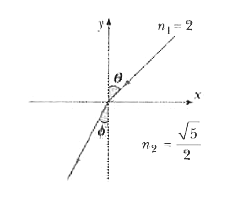 A ray travelling in x-y plane is incident on a boundary which separates the two media. The boundary of the media is `x-z` plane. Calculation : Converting the incident ray vector to a unit vector : `hatei=((-hati-2hatj))/(sqrt((-1)^(2))+(-2)^(2))=-(hati)/(sqrt(5))-(2)/(sqrt(5))hatj`. From Fig. 34-4, it can be seen that the normal is in the y direction. The component of this vector in the tangential direction (x direction in this case) is `-hati//sqrt(5)`. So, by Snell.s law, we can say that `-(hati)/(sqrt(5))xx2=(sqrt(5))/(2)xx` tangential component of refracted ray. Tangential component of refracted ray `=-(4i)/(5)` Let the normal component of the refracted ray be `-chatj`. (The refracted ray should also travel in the third quadrant). Threfore, `hate_(r )=-(4hati)/(5)-chatj` So, `1=sqrt(((-4)/(5))^(2)+(-c)^(2))` `c=(3)/(5)`. Therefore, `hate_(r )=-(4)/(5)hati-(3)/(5)hatj` Learn : In more involved problems , we can also involve the fact that incident ray, refracted ray, and normal all three lie in the same plane. Hence, their scalar triple product is ZERO. If one finds it encourging , then one must try this our : `hate(hate_(r )xxhatn)=0` |
|
| 13. |
A thin ring of 10 cm radius carries a uniformly distributed charge. The ring rotates at a constant. speed of 1200 r.p.m. about its axis passing through the centre of the ring perpendicular to ity plane. Find the charge carried by the ring, if the magnetic field induction in its centre is 3.8 XX 10^(-9)T. |
|
Answer» |
|
| 14. |
An electron is accelerated through a potential difference of 100 volts. What is the de-Broglie wavelength associated with it ? To which part of the electromagnetic spectrum does this value of wavelength correspond ? |
|
Answer» SOLUTION :The ACCELERATING VOLTAGE `V=100V` `therefore`de-Broglie wavelength of ELECTRON `lamda=(h)/(sqrt(2emV))=(6.626xx10^(-34))/(sqrt(2xx1.602xx10^(-19)xx9.1xx10^(-31)xx100))` `=1.227xx10^(-10)m or 1.227Å` The value of de-Broglie wavelength corresponds to X-rays PART of the electromagnetic spectrum. |
|
| 15. |
A capacitor joined in parallel with the load in a full-wave rectifier serves the purpose of a ___________. |
| Answer» SOLUTION :ELECTRONIC FILTER | |
| 16. |
In the given circuit, mark the correct statement// statements. |
|
Answer» The CURRENT through 10 V BATTERY is `35//4A`. 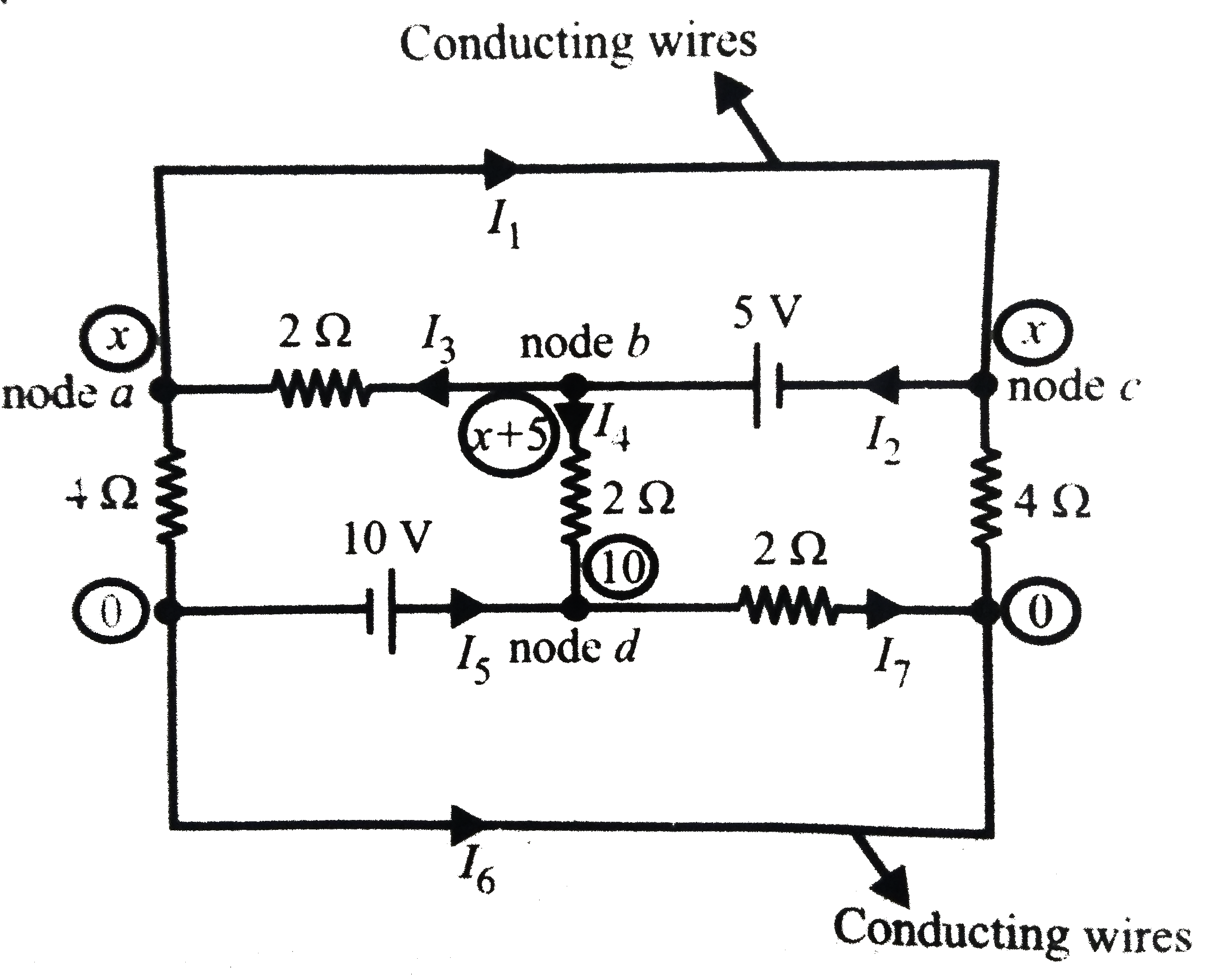 From diagram it is clear `I_3 = ((x+5)-x)/2 = 5/2A` and `I_7 = (10-0)/2 = 5A` At node a `I_3 = I_1 + x/4 or 5/2 = I_1 + x/4` At node b `I_3 +(x+5-10)/2 = I_2 or 5/2 + ((x-5)/2) = I_2` `x/2 = I_2` At node c `I_1 = I_2 + (x-0)/4` `5/2 - x/4 = x/2 + x/4 or x= 5/2` or `I_1 = 5/2 - 5/8 = 15/8 A` (current through upper conducting wire) And `I_2 = 5/4A` (current through 5V battery) The current `(I_4)` in `2Omega` wire `I_4 = ((5/2+5)-10)/2 = (5/2-5)/2 = -5/4A` At node d: `I_5 - 5/4 = 5 or I_5 = 5+ 5/4 = 25/5A` (current through 10 V battery) Hence `I_6-I_5 = (x-0)/4 = ((5/2-0)/4)` or `I_(6) - (25)/(4) = 5/8` or `I_(6) = 5/8 + 25/4 = 55/8A`. (Current through lower conducting wire). |
|
| 17. |
Nanaji narrated the story of his own |
|
Answer» Grandson |
|
| 18. |
A straight conductor of length L and carrying a current I is kept in a uniform magnetic field of induction vec B. Write theexpressions for the force on the conductor and the magnitude of the maximum force. |
|
Answer» Solution :The force on the current- carrying conductor is ` vecF = VEC(IL) XX vecB` where vecL is in the direction of the current. ` |vecF| = ILB sin theta` ` :. |vecF_("max")| = ILB` when the ANGLE ` theta` between `vecL and vecB " is " 90^(@)`. |
|
| 19. |
A person jumps from a chair. He gets accelerated towards the earth. Does the earth also accelerate towards him? |
| Answer» Solution :Yes, but the acceleration is so small that it cannot be detected. We KNOW that acceleration is given by the PERSON's weight DIVIDED by the mass of the EARTH. | |
| 20. |
In a biprism experimentn the distance between thetwo virtual images of the slite in the magnified and diminished position are 2.4 mm and 0.6 resepectively. The distance the two virtual images of the slit is |
| Answer» SOLUTION :`d=SQRT(d_(1)d_(1))= sqrt(2.4xx0.6)=1.2 mm` | |
| 21. |
In which of the following cases frictional force is impulsive |
|
Answer»
|
|
| 22. |
Choose the correct ray diagram of a thin equi-convex lens which is cut from upper half as shown in the figure |
|
Answer»
|
|
| 23. |
In an n-type silicon , which of the following statements is true ? |
|
Answer» a. ELECTRON are majority carriers and TRIVALENT atoms are the dopants |
|
| 24. |
Explain the advantage and disadvantages of AC over DC. |
|
Answer» Solution :Advantages of AC:- (i) AC can be stepped up or stepped down by using a transformer. (ii) AC can be EASILY converted into DC, using electronic power supply units. (iii) AC devices are more durable since power dissipation is less. (iv) Transmission of electrical power is more efficient and economical in the form of AC. (v) Current in an AC circuit can be reduced using reactive elements like choke COILS and CAPACITORS which consume very little power. Disadvantages of AC:- (i) It cannot be used for ELECTROPLATING. (ii) The average value of alternative current over a half cycle is less than its rms value. Hence for a given value of current, wires carrying AC require better insulation. (iii) AC meters have a non-linear scale. As a result, accuracy of measurement is not UNIFORM throughout the range. |
|
| 25. |
The earth may have even reversed the direction of its field several times during its history of 4 to 5 billion years. How can geologists know about the earth's field in such distant past? |
| Answer» Solution :Earth.s magnetic field gets weakly .recorded. in CERTAIN rocks during solidification ANALYSIS of this ROCK MAGNETISM offers clues to geomagnetic history. | |
| 26. |
Fuse wire is a wire of |
|
Answer» LOW MELTING point and low value of `alpha` |
|
| 27. |
a man in a balloon rising vertically with an acceleration of 4.9m/s^2 releases a ball 2 seconds after the balloon is let go from the ground. The greatest height above the ground reached by the ball is |
|
Answer» 14.7m |
|
| 28. |
A biconvex lens of focal length 20 cm is made of glass of refreactive index (3)/(2), when placed completely in water (n_(w)=(4)/(3)), its focal length will be |
|
Answer» 20 cm `RARR""f_(w)=4xx20=80cm` |
|
| 29. |
Statement-I: Average power loss in series LC circuit or in parallel LC circuit is always zero. Statement-II: Average values of voltage and current in A.C. is zero. |
|
Answer» If both STATEMENT- I and Statement- II are true, and Statement - II is the correct EXPLANATION of Statement– I. |
|
| 30. |
Energy of the hydrogen atom in its ground state is -13.6eV the energy corresponding to the second excited state is |
|
Answer» `-1.51eV` |
|
| 31. |
How many neutrons are there in the hundredth generation if the fission process starts with N_(0)= 1000 neutrons and takes place in a medium with multiplication constant k=1.05? |
|
Answer» Solution :No. of nuclei in the first generation=No. of nuclei INITIALLY`=N_(0)` `N_(0)` in the second generation`=N_(0)XX` multiplication factor `=N_(0).k` `N_(0)` in the `3rd` generation `=N_(0).k.k=N_(0)k^(2)` `N_(0)` in the nth generation `=N_(0)k^(N-1)` SUBSTITUTION gives `1.25xx10^(5)` neutrons |
|
| 32. |
Define critical angle for a pair of media. |
| Answer» Solution :It is angle of INCIDENCE in the denser MEDIUM for which the angle of refraction is `90^@`. | |
| 33. |
In an LC circuit, resistance of the circuit is negligible. If time period of oscillation is T then : (ii) at what time is the energy stored completely magnetic |
| Answer» SOLUTION :(II) t = T/4, 3T/4, 5T/4........... | |
| 34. |
A charged particle is released from rest in a region of steady and uniform electric and magnetic fields which are parallel to each other. The particle will move in a |
|
Answer» STRAIGHT line |
|
| 35. |
The radio nuclide .^(11)C decays according to ._(6)^(11)C rarr _(5)^(11) B+e^(+)+v. The maximum energy of the emitted positron is 0.960 MeV. Given, the rest mass of c-11=11.011434 uand rest mass of B-11=11.009304 u, calculate 'Q' and compare it with the maximum energy of the positron emitted. |
|
Answer» Solution :`""_(6)^(11) C to ""_(5)^(11)B + e^(+) + v + Q` `Q = [m_N (""_(6)^(11)C) - m ""_(5)^(11)B - m_e] c^2` where the masses used are those of nuclei and not of atoms. If we use atomic masses, we have to add `6m_e` in case of `""_(6)^(11)C` and `5m_e` in case of `_""_(5)^(11)B`. HENCE `Q = [m (""_(6)^(11)C) - m ""_(5)^(11)B - 2m ] c^2 ` (Note `m_e` has been doubled) Using given masses, `Q = 0.961 MeV` `Q = E_d+ E_e+ E_n` The DAUGHTER nucleus is too heavy compared to `e^+` and v, so it CARRIES negligible ENERGY `(Ed ~~ 0)`. If the kinetic energy `(E_v)` carried by the neutrino is minimum (i.e., zero), the positron carries maximum energy, and this is practically all energy Q, hence maximum `E_e ~~ Q`). |
|
| 36. |
A beam of hydrogen molecules (H_2) is directed toward a wall, at an angle of 32^@ with the normal to the wall. Each molecule in the beam has a speed of 1.0 km/s and a mass of 3.3 xx10^(-24) g. The beam strikes the wall over an area of 2.0 cm?, at the rate of 4.0 xx10^(23) molecules per second. What is the beam's pressure on the wall? |
| Answer» SOLUTION :`1.1 XX 10^4Pa` | |
| 37. |
The work done in turninga magnet of magnetic moment M by an angle 90^(@) to the work done in turning it throughan anlge of 60^(@)is |
|
Answer» `1/2` |
|
| 38. |
In ideal junction diode as shown in figure the current flowing through AB is………A. |
|
Answer» `10^-2` `I=(DELTA V)/R=10/10^3=10^-2A` |
|
| 39. |
Ultrasonic waves are those sound waves having frequency |
|
Answer» between 20hertz and 1000 HERTZ |
|
| 40. |
A plate of thickness t madeof a material of refractive index mu is placed in front of one of the slits in a double slit experiment. What should be the manimum thickness t which will make the intensity at the centre of the fringe pattern zero? |
|
Answer» Solution :INTENSITY at the centre will be zero if path difference `=(LAMBDA)/(2)" (or) "(mu-1)t= (lambda)/(2)" (or) "t= (lambda)/(2(mu-1))`. |
|
| 41. |
In an atomic bomb, the tempearture of 10 million degrees is developed at the moment of explosion. In what region of the spectrum do the wavelength corresponding to maximum energy density lie ? (b=0.28xx10^(-2)"S.I. unit") |
|
Answer» ultra-violet `lamdam=(288xx10^(-2))/(10^(7))` `lamda=288xx10^(-9)`. which is -RAY. THUS correct choice is (d). |
|
| 42. |
The diagrams below show regions of equipotentials. A positve charge is moved from A to B in each diagram. |
|
Answer» MAXIMUM WORK is required to move Q in figure (c ). |
|
| 43. |
If the iconisation potential of the hydrogen atom is omega then it's energy in the first excited state is equal to: |
|
Answer» `omega/5` |
|
| 44. |
An electron is moving in an orbit of a hydrogen atom from which there can be a maximum of six transition. An electron is moving in an orbit of another hydrogen atom from which there can be a maximum of three transition. The ratio of the velocities of the electron in these two orbits is : |
|
Answer» `(1)/(2)` `N=(n(n-1))/(2)` I Case `6=(n_(1)(n_(1)-1))/(2)` `rArr n_(1)=4` II Case `e=(n_(2)(n_(2)-1))/(2)` `rArr n_(2)=3` VELOCITY of electron in hydrogen atom in nth orbit `v_(n) prop (1)/(n)` `(v_(n))/(v_(n))=(n_(2))/(n_(1))` `rArr (v_(6))/(v_(3))=(3)/(4)` |
|
| 45. |
Charges 5mC, 4inC and 6mC are placed at the three corners A, B and C respectively of a square ABCD of side X metre. Find, what charge must be places at the fourth corner so that the total potential at the centre of the square is zero. |
|
Answer» Solution :`q_1= 2 xx 10^(-6)C, q_2= 4 xx 10^(-6)C, q _3 = 6 xx 10^(-6) C, q_4 =?` AB =BC =CD =DA =X from fig ` AC^2 = AB^2 +BC^2` ` AC^2 =X^2 +x^2` ` AC= sqrt(2) X ` `AO = (sqrt(2))/(2) X=(x )/( sqrt(2)) = BO =CO=DO ` The total electric potential is zero at the centre of the square is `(1)/(4 pi epis_0) [(q_1)/(AO) +(q_2)/(BO) +(q_3)/(CO)]=-(1)/(4 pi epsi_0) [(q_4)/(DO)]` `[(2xx 10^(-6))/((x)/(sqrt(2)))+(4 xx 10^(-6))/((x)/(sqrt(2)))+(6xx 10^(-6))/( (x)/(sqrt(2)))]=-(q_4)/((x)/(sqrt(2)))` ` ( sqrt(2))/(X ) [2 xx 10^(-6) + 4 xx 10^(-6) +6 xx 10^(-6)]=-(sqrt(2))/(X)[q_4]` ` q_4 =- 12 xx 10^(-6) C ` ` q_4=- 12mu C ` 
|
|
| 46. |
The four resistances of a wheatstone brige are 1Omega each. When the bridge is balaced,the cell has an emf of 1 volt.The current drawn from the cell is |
|
Answer» 1A |
|
| 47. |
A coil having an areaA_0is placed in a magnetic field which changes from B_0 to 4B_0in time interval t. The emf induced in the coil will be |
|
Answer» `3A_0B_0 // t` |
|
| 48. |
The current decays from 5A to 2A in 0.01s in a coil. The emf induced in a coil nearby it is 30V. Calculate the mutual inductance of the coil. |
|
Answer» 0.1H |
|
| 49. |
In the circuit shown the potential difference across the 3 - muF capacitor is V, and the equivalent capacitance between A and B is C_(AB) |
| Answer» Answer :A::D | |


