

Saved Bookmarks
This section includes 7 InterviewSolutions, each offering curated multiple-choice questions to sharpen your Current Affairs knowledge and support exam preparation. Choose a topic below to get started.
| 1. |
(A): The area to be covered for T.V telecast is doubled, then the height of transmitting antenna will have to be halved (R): For T.V signal, population covered is equal to population density and area covered |
|
Answer» ASSERTION and reason are true and reason is the correct EXPLANATION of assertion |
|
| 2. |
Which one of the following combinations of radioactive decay results in the formation of an isotope of original nucleus ? |
|
Answer» ONE ALPHA, FOUR beta |
|
| 3. |
Resistivity of the mateial of potentiometer wire is (rho) and area of its uniform cross section is A, Hence potential gradient on the wire is = ..... . |
|
Answer» `(I)/(RHO A)` Potential gradient `SIGMA = (V)/(L) = (IR)/(l) = (I rho l)/(lA) = (I rho)/(A)` |
|
| 4. |
How much work in required to carry a 6 mu C charge from the negative terminal to the positive terminal of a 9V battery |
|
Answer» `54 xx 10^(-3)J` |
|
| 5. |
who showed great respect to his ancestor? |
|
Answer» puru |
|
| 6. |
Huygen was the first scientist who proposed the idea of wave theory of light. He said that the light propagates in form of wavefronts. A wavefront is an imaginary surface at every point of which waves are in the same phase. For example the wavefronts for a point source of light is collectionof concentric spheres which have centre at the origin. w_(1) is a wavefront. w_(2) is another wavefront. The redius of the wavefront at time 't' is 'ct' in this case where 'c' is the speed of light. The direction of propagation of light is perpendicular to the surface of the wavefront. The wavefronts are plane wavefronts in case of a parallel beam of light. Huygen also said that every point of the wavefront acts as the source of secondary wavelets. The tangent drawn to all secondary wavelets at a time is the new wavefront at that time. The wavelets are to be consid-ered only in the forward direction (i.e. the direction of propagation of light) and not in the reverse direction. If a wavefront w_(1) at time t is given, then to draw the wavefront at time t+Deltat0 take some points on the wavefront w_(1) and draw spheres of radius 'cDeltat'. They are called secondary wavelets Draw a surface w_(2) which is tangential to all these secondary wavelets. w_(2) is the wavefront at time 't+Deltat'. Huygen proved the laws of reflection and laws of refraction using concept of wavefronts. A point source of light is placed at origin, in air. The equation of wave front of the wave at time t, emitted by source at t=0, is (take refractive index of air as 1) |
|
Answer» `x + y + z = ct` |
|
| 7. |
If an ideal junction diode is connected as shown , then the value of the current iis |
|
Answer» `0.013 A` |
|
| 8. |
In Joule's heating law, when I and t are constant, if the H is taken along they axis and I^(1) along the x axis, the graph is |
| Answer» Solution :straight line | |
| 9. |
While Mahadevi Verma was not well what dis gillu not eat? |
|
Answer» Kaju |
|
| 10. |
The efficiency of transformer is very high because |
|
Answer» There is no moving PART in a TRANSFORMER |
|
| 11. |
Answer the questions : When a low flying aircraft passes overhead, we sometimes notice a slight shaking of the picture on our TV screen. Suggest a possible explanation. |
| Answer» Solution :Interference of the DIRECT SIGNAL received by the ANTENNA with the (weak) signal reflected by the passing AIR CRAFT. | |
| 12. |
Which of the following are false for electromagnetic waves |
|
Answer» TRANSVERSE |
|
| 13. |
The ratio of the intensities at minima to maximain the interference pattern is 9:25 .What will be the ratio of the widths of the two slits in the young.s double slit experiment ? |
|
Answer» `8:1` |
|
| 14. |
Two choherent waves represented byy_1 = A sin ((2pi x_1)/(lamda) - wt + pi/3) " and " y_2 = A sin ((2pi x_2)/(lamda) - wt + pi/6) are superposed. The two waves will produce |
|
Answer» Constructive interference at `(x_1-x_2) = 2lamda` |
|
| 15. |
Which of the following velocity-time graph is not possible? |
|
Answer»
|
|
| 16. |
If elements with principal quantum number n greater than four were not allowed in nature, then number of elements would be: |
|
Answer» 60 Maximum number of electrons in a SHELL `=2n^(2)` Thus, there are 2 electrons in K-shell (n=1) and 8 electron in L-shell (n=2) 18 electron in L-shell (n=2) 18 electron in M- shell (n=3) and 32 electron in N-shell (n=4) Total number of electrons =2+8+18+32=60 |
|
| 17. |
Two cars are moving in the same direction with a speed of 30 kmh. They are separated from each other by 5 km. Third car moving in the opposite direction meets the two cars after an interval of 4 minutes. What is the speed of the third car ? |
|
Answer» `30 km H^(-1)` |
|
| 18. |
(A): A high tension supply must have very large internal resistance (R): A short circuited cell gives very high current, that may exceed safety limits of cell. |
|
Answer» Both 'A' and 'R' are true and 'R' is the CORRECT explanation of 'A' |
|
| 19. |
On a glass plate a light wave is incident at an angle of 60^(@). If the reflected and the refracted waves are mutually perpendicular, the refractive index of material is |
|
Answer» `SQRT(3)/2` |
|
| 20. |
Two parallel plate condensers A and B have capacities 1 mu F and 5 mu F are charged sepe-rately to same potential of 100V. Now the positive plate of A is connected to the negative plate of B and the negative plate of A to the positive of plate of B then |
|
Answer» FINAL charge on A and B are `(200 MU C )/( 3) and( 100 mu C )/( 3) ` |
|
| 21. |
Which source is associated with a line emission spectrum? |
|
Answer» ELECTRIC fire |
|
| 22. |
The typical ionisation energy of a donor in silicon is |
|
Answer» `10. 0 eV` For `Si,epsilon_(r) =12` and for `n=1,E=0.1 eV` |
|
| 23. |
A point object is moving with a speed v before an arrangement of two mirrors as shown in figure. Find the velocity of image in mirror M_(1) with respect to image in mirror M_(2) |
|
Answer» 2v SIN (`THETA`/2) =2v`sin(theta//2)` 
|
|
| 24. |
If the number of turns per unit length of a coil of a solenoid is doubled. The self-inductance of the solenoid will: |
|
Answer» BECOMES double |
|
| 25. |
A 2 MeV proton is moving perpendicular to a uniform magnetic field of 2.5 T the force on the proton is (mass of proton = 1.6 xx 10^(-27) kg ) |
|
Answer» `10xx10^(-12)N` |
|
| 26. |
A straight rod 2m long is placed in an aeroplane in the east-west direction. The aeroplane lifts itself in the upward direction at a speed of 36km/hour. Find the potential difference between the two ends of the rod if the vertical component of earth's magnetic field is (1//4sqrt3) gauss and angle of dip = 30^(@). |
| Answer» Solution :`5 XX 10^(-4)V` | |
| 27. |
Obtain the equation of electric field at a point by system of 'n' point charges. |
|
Answer» <P> Solution :As shown in figure, `q_(1), q_(2),`………. `q_(n)` charges are at `vecr_(1), vecr_(2)`,………..`,vecr_(n)` from origin O.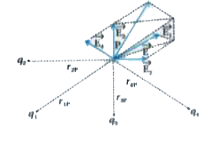 Electric FIELD at P of position vector `vecr_(1P)` `vecE_(1) = 1/(4pi epsilon_(0)).q_(1)/q_(2)hatr_(1P)` where `vecr_(1P)`is unit vector in direction from `q_1` to E Electric field at P of position vector `vecr_(2P)` `E_(2) = 1/(4pi epsilon_(0)).q_(2)/r_(2P)^(2) hatr_(2P)` Similarly electric fields by `q_(3), q_(4)`,.........`q_(n)` at P are `vecE_(3), vecE_(4)`,..........`vecE_(n)`can be OBTAINED and resultant field `vecE`can be obtained. `vecE(vecr) = vecE_(1)(vecr) + vecE_(2) (vecr) +`........`vecE_(n)(vecr)` `vecE(vecr) = 1/(4pi epsilon) sum^(n) q_(1)/q_(2)hatr_(iP)`, where i=1,2,...........,n `vecE` is vector quantity and it varies by point to point in space and it is decided by positions of source charges |
|
| 28. |
From equation (i) and (ii) end correction can be calculated Estimate the diameter of the tube using formula (epsilon~~ 0.3d) . |
|
Answer» `2.5cm` |
|
| 29. |
A police van moving on a highway with a speed of 30 km h^(-1)fires a bullet at a thief'scar speeding away in the same direction with a speed of 192 km h^(-1). If the muzzle speed of the buller is 150 m s^(-1) ,The speed with which the bullet hit the thief's car is |
|
Answer» 42 m/s |
|
| 30. |
In a biprism experiment biprism is ued to produc : |
|
Answer» an INTERFERENCE pattern |
|
| 31. |
a. Is free neutron a stable particle? b. Give reason. |
|
Answer» SOLUTION :a. No b. A free NEUTRON spontaneously DECAYS into a PROTON, ELECTRON and an antineutrino. |
|
| 32. |
A plane EM wave travelling in vacuum along z direction is given by vecE=E_0sin (kz-omegat) hati and vecB=B_0 sin (kz-omegat)hatj. (i) Evalute ointvecE.vec(dl) over the rectangular loop 1234 shown in fig. (ii) Evalute ointvecB.vec(ds) over the surface bounded by loop 1234. (iii) Use equation ointvecE.vec(dl)=(-dphi_B)/(dt) to prove (E_0)/(B_0)=c. (iv) By using similar process and the equation ointvecE.vec(dl)=mu_0I+epsilon_0(dphi_E)/(dt), prove that c=1/(sqrt(mu_0epsilon_0)) |
|
Answer» Solution :(i) During the propagation of e.m. wave along z-axis, let electric field vector `vecE` be along x- axis and magnetic field vector `vecB` be along y-axis i.e., `vecE=E_0hati and vecB=B_0hatj`. Line integral of `vecE` over the closed rectangular, path 1234 in x-z plane is `oint vecE.vec(dl)=int_1^2vecE.vec(dl)+int_2^3vecE.vec(dl)+int_3^4vecE.vec(dl)+int_4^1vecE.vec(dl)` `=int_1^2Edl cos 90^@+int_2^3Edl cos 0^@+int_3^4Edl cos 90^@+int_4^1Edl cos 180^@` `=0+E_(z_2)h+0-E_(z_1)h=E_(z_2)-E_(z_1)=E_0h[SIN (kz_2-omegat)-sin (kz_1-omegat)]......(i)` (ii) For evaluting `ointvecB.vec(dl)` over the surface bounded by loop1234, let us consider a rectangle 1234 be made of small strips. One small strip of area ds=h dz is shown in fig. `oint_("Surface bounded by strips 1234")vecB.vec(ds)=oint Bds cos0^@=oint B ds` `=int_(z_1)^(z_2)B_0sin (kz_2-omegat)hdz` `=-(B_0h)/k[cos (kz_2-omegat)-cos(kz_1-omegat).....(ii)` (iii) Given, `oint vecE.vec (dl)=-(dphi_B)/(dt)=-d/(dt) oint vecB.vec(ds)` Puting the values from (i) and (ii), we get, `E_0h[sin (kz_2-omegat)-sin (kz_1-omegat)]` `=-d/(dt)[-(B_0h)/k{cos (kz_2-omegat)-cos(kz_1-omegat)}]` `=(B_0h)/k omega[sin (kz_2-omegat)-sin(kz_1-omegat)}]` or `E_0=(B_0omega)/k=B_0c ( :' omega/k=c) or E_0//B_0=c` (iv) For evaluting `oint vecB.vec(dl)`, let us consider a LOOP 1342 in y-z plane as shown in fig. `oint vecB.vec(dl)=oint_1^3vecB.vec(dl)+oint_3^4vecB.vec(dl)+oint_4^2vecB.vec(dl)+oint_2^1vecB.vec(dl)` `int_1^3Bdl cos0^@+int_3^4Bdl cos90^@+int_4^2Bdl cos180^@+int_2^1Bdl cos90^@=int_1^3Bdl +0-int_4^2Bdl +0` `=B_(z_1)h-B_(z_2)h=h(B_(z_1)-B_(z_2))=B_0h [sin (kz_1-omegat)-sin(kz_2-omegat)]....(iii)` To evalute `phi_E=oint vecE.vec(ds)`, let us consider the rectangle 1342 to be made up of strips, each of area ds=hdz. fig. `phi_E=oint vecE.vec(ds)=ointEdscos0^@=ointEds` `int_(z_1)^(z_2) E_0sin (kz_1-omegat)hdz` `=-(E_0h)/k[cos (kz_2-omegat)-cos(kz_1-omegat)]` `:. (dphi_E)/(dt)=(E_0homega)/k[sin (kz_1-omegat)-sin(kz_2-omegat)....(iv)` In the relation, `ointvecB.vec(dl)=mu_0[1+epsilon_0(dphi_E)/(dt)]` I is the conduction CURRENT. The value of I=0 (in vacuum) `:. oint vecB.vec(dl)=mu_0epsilon_0(dphi_E)/(dt)` Putting values form (iii) and (iv), we get `B_0h[sin (kz_1-omegat)-sin(kz_2-omegat)]=mu_in_0 (E_0h omega)/k [sin (kz_1-omegat)-sin(kz_2-omegat)]` or `B_0h=mu_0in_0E_0h omega/k or (E_0)/(B_0) omega/k=1/(mu_0in_0) [as (E_0)/(B_0) =c and omega=CK]` `:. c (ck)/k=1/(mu_0in_0) or c^2=1/(mu_0in_0) or c=1/(sqrt(mu_0in_0))` 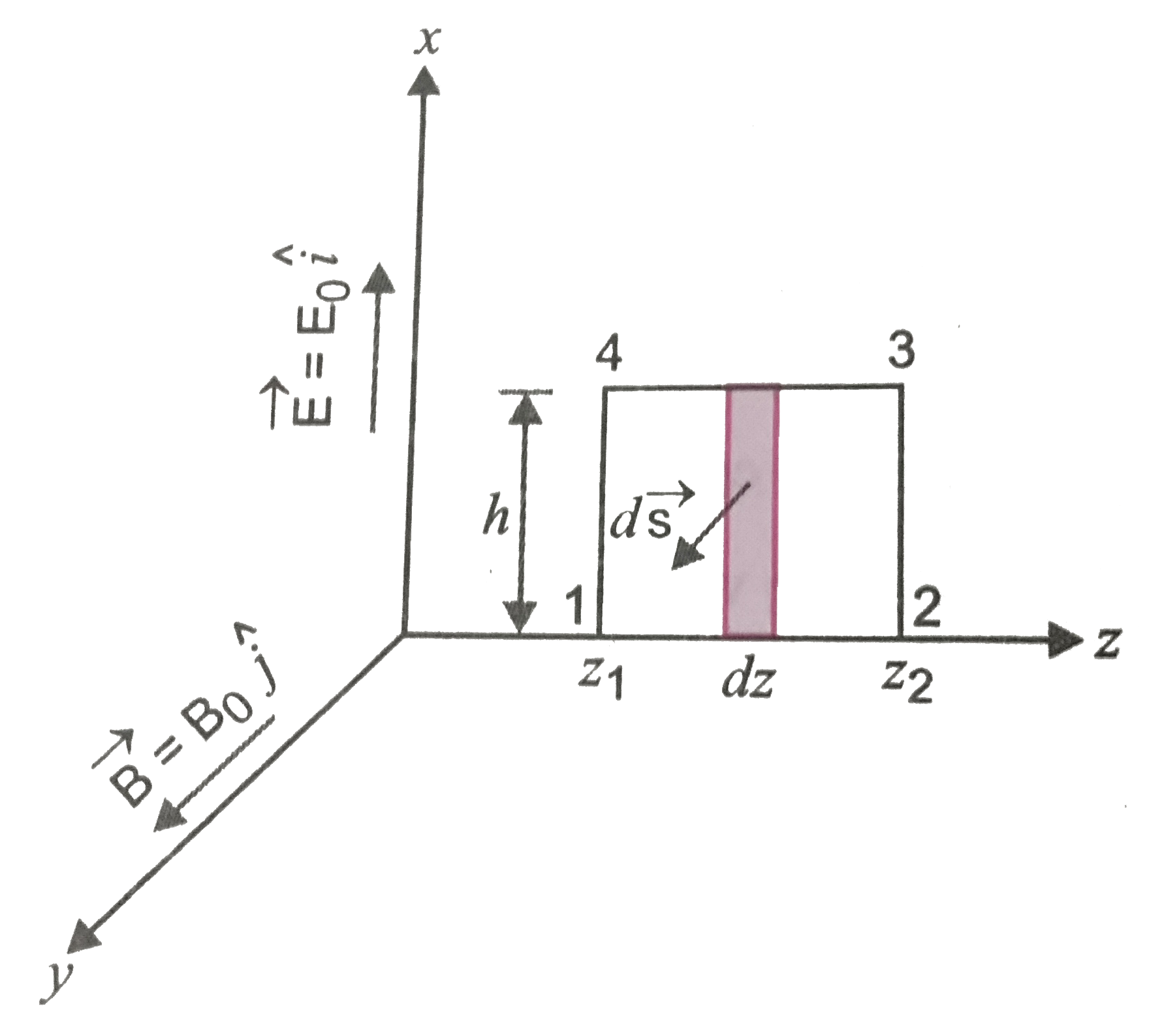 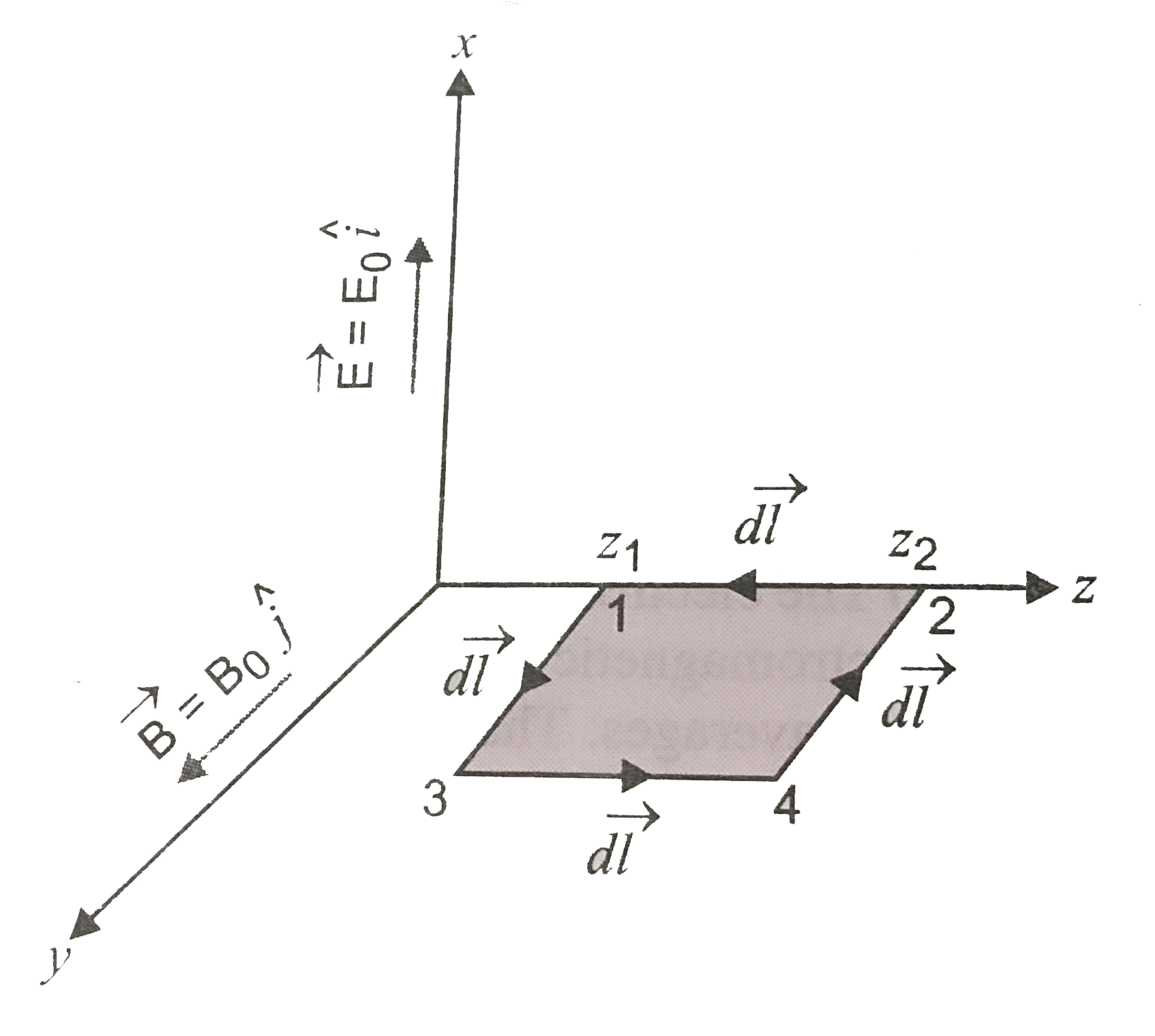 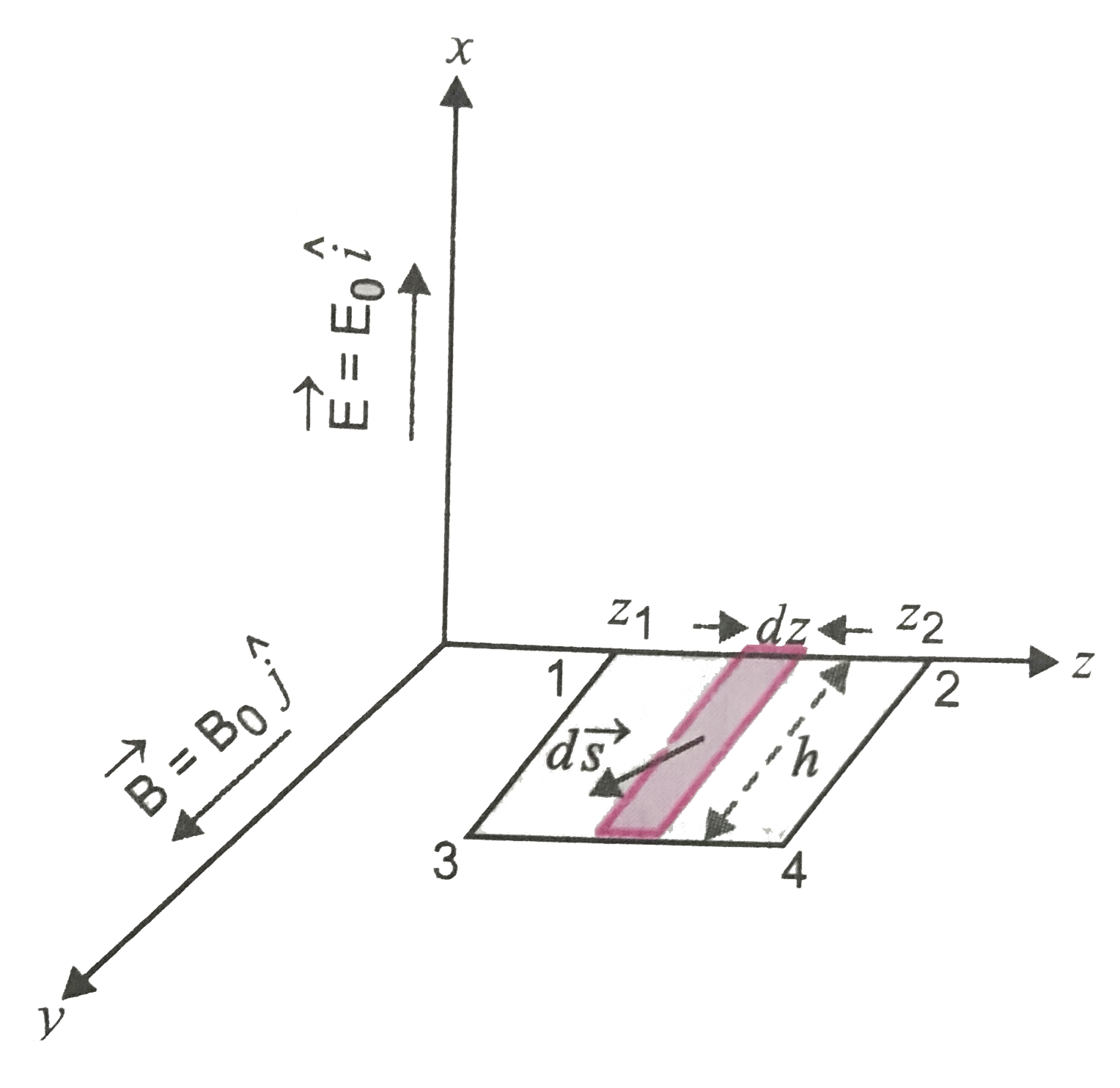
|
|
| 33. |
Explain ferromagnetism and ferromagnetic substance. |
|
Answer» SOLUTION :Ferromagnetic substance are those which gets strongly magnetised when placed in an external magnetic field. They have strong tendency to move from a region of weak magnetic field to strong magnetic field. They get strongly attracted to a magnet. The INDIVIDUAL atoms (or ions or molecules) in a ferromagnetic material possess a dipole moment as in a paramagnetic material. Domain is found in paramagnetic substance. In that domain atoms arranged so that their dipole moment can be found in the same direction. Hence, each domain has net magnetisation. But, if the entire substance is considered then the different domain have randomly dipole moment and hence net magnetisation will be ZERO. This is shown in figure.  Typical domain size is 1 mm and the domain contains about `10^11` atoms. When we apply an external magnetic field `overset(to) (B_0)` the domains ORIENT themselves in the direction of `overset(to) (B_0)`and domain grow in big size and whole substance have been magnetised. In a ferromagnetic material the field lines are highly concentrated. In non-uniform magnetic field, the sample tends to move towards the region of high field. Iron, COBALT, Nickel, Gadolinium Gd (Z = 64) and Dysprosium (Dy) Z = 66 are ferromagnetic substances. |
|
| 34. |
A 100 W bulb B_(1) and two 60 W bulbs B_(2) and B_(3) are connected to a 250 V source as shown. Now W_(1),W_(2) and W_(3) are the output powers of the bulbs B_(1),B_(2)and B_(3) respectively, then : |
|
Answer» `W_(1) gt W_(2)= W_(3)` |
|
| 35. |
A ray of light incidents on a refracting surface at 30^(@) with the surface . If the angle of refraction is 45^(@) refractive index of the medium is |
|
Answer» `SQRT(3)` |
|
| 36. |
Length of the horizontal arm of a uniform cross - section U - tube is l = 5 cm and both ends of the vertical arms are open to the surrounding pressure of "7700 N m"^(-2). A liquid of density rho=10^(3)" kg m"^(-3) is poured into the tube such that the liquid just fills the horizontal part of the tube. Now, one of the open ends is sealed and the tube. Now, one of the open ends is sealed and the tube is then rotaed about a vertical axis passing through the other veritcal arm with angular velocity omega due to which the liquid rises up to half the length of the vertical arm. If length of each vertical arm is a = 6 cm. What is the value of omega("in rad s"^(-1))? |
|
Answer» |
|
| 37. |
Obtain an expression for the capacitance of a combination of three capacitors in parallel . |
|
Answer» Solution :Let three capacitors of a capacitances `C_1 , C_2` and `C_3` ,respectively are JOINED in parallel such that one plate of all the three capacitors has been joined at one point A and the other plates are another point B . Here potential difference across all the three capacitors is same (say V) and charges on different capacitors are `Q_(1) = C _(1) V , Q_(2)= C_(2) V` and `Q_(3) = C_(3) V` Total charge on all the three capacitors TAKEN together `Q = Q_(1) + Q_(2) + Q_(3) = C_(1) V + C_2 V + C_3 V` If a single capacitor of CAPACITANCE C is joined instead of given capacitors such that the potential difference across it still remains V , then Q = CV `CV = C_1 V + C_2 V + C_3 V` `implies` RESULTANT capacitance `C = C_1 + C_2 + C_3` 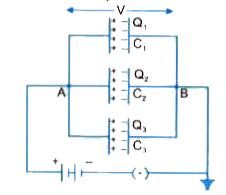
|
|
| 38. |
How does the total energy stored in the capacitors in the circuit shown in the figure change when first switch K_(1) is closed (process-1) and then switch K_(2) is also closed (process-2) Assume that all capacitor were initially uncharged? |
|
Answer» Increases in process-1 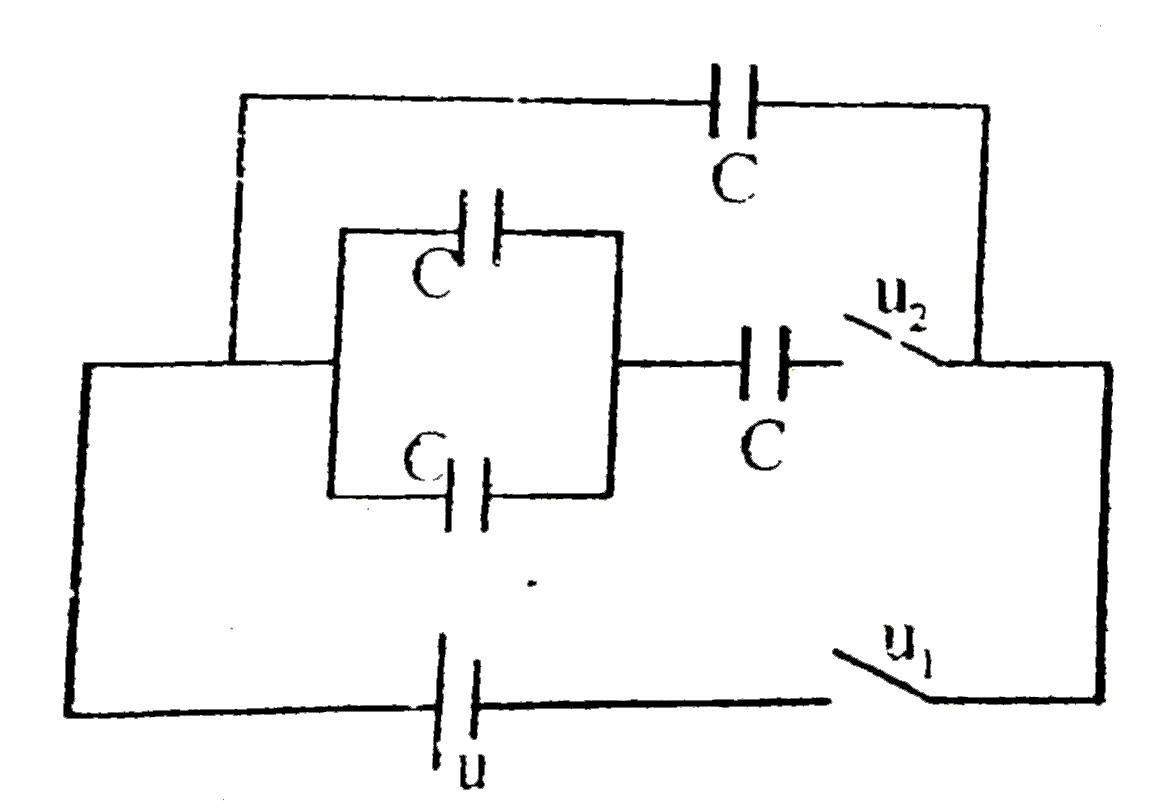 equivalent CAPACITANCE `=(5C)/3` When `k_(2)` is closed no increasing in ENERGY when `k_(1)` is closed `E=1/2cqV^(2)=1/2(5C)/3V^(2)=(5CV^(2))/6` |
|
| 39. |
Net charge on object having 9 xx 10^13 protons and 6 xx 10^13 electrons is ...... |
|
Answer» `-4.8 muC` `=4.8 xx 10^(-6) muC` |
|
| 40. |
The angle between polariser and analyser is 30^(@) . The ratio of intensity of incident light and transmitted by the analyser is |
|
Answer» `3:4` |
|
| 41. |
In Davisson and Germer's experiment, state the observations which led to (i) show the wave nature of electrons, and (ii) confirm the de-Broglie relation. |
|
Answer» Solution :(i) In Davisson and Germer.s experiment the electron beam shows diffraction effect. It shows the wave nature of electrons because only the waves can exhibit diffraction effect. (ii) When variation of INTENSITY of scattered electrons with the angle of SCATTERING is NOTED, a peak is observed in a PARTICULAR direction due to the constructive interference of electrons scattered from this angle we can calculated the VALUE of wavelength of electrons and confirm the de-Broglie relation. |
|
| 42. |
Distance of the centre of mass of a solid uniform cone from its vertex is z_(0). If the radius of its base is Rand its height is h, the z_(0) is equal to : |
|
Answer» `(3H)/(4)` `y_(CM)=(intydm)/(intdm)` `=(int_(0)^(h)pir^(2)dyxxrhoxxy)/((1)/(3)piR^(2)hrho)` `=(3h)/(4)` 
|
|
| 43. |
An object 1.5 cm is size is placed on the side of the convex lens in the arrangement (a) above. The distance between the object and the convex lens is 40 cm. Detemine the maguificatin produced by the two-lens system an the size of the image. |
|
Answer» Solution : `(1)/(v_(1)) - (1)/(u_(1)) = (1)/(f_(1)) "" (1)/(v_(1)) - (1)/((-40))= (1)/(30) ` `(1)/(v_(1)) = (1)/(30) - (1)/(40) = (1)/(120) "" THEREFORE v_(1) = 120 cm ` `m_(1) = (v_(1))/(|u_(1)|)= (120)/(40)= 3` `u_(2) = 120 - 8 = 112 cm , f_(2)=- 20 ` cm `(1)/(v_(2)) - (1)/(u_(2)) = (1)/(f_(2)) "" (1)/(v_(2)) - (1)/(112)= (1)/(-20)` `(1)/(v_(2)) = (1)/(112) - (1)/(20) = (-23)/(560)"" therefore v_(2) = (-560)/(23) cm "" m_(2) =(|v_(2)|)/(u_(2)) = (((560)/(23)))/(122)= (5)/(23)` Net MAGNIFICATION, m=`m_(1) m_(2) = (3xx5)/(23) APPROX 0.65 ` Size of the image = 0.98 cm |
|
| 44. |
A ring of radius R is with a uniformly distributed charge Q on it. A charge q is now placed at the centre of the ring. Find the increment in tension in the ring |
Answer» Solution : Consider an element of the ring. Its enlarged view is as shown. For equilibrium of this segment, we can write. `F= 2 Delta T sin ((d theta)/(2))` Here F is the repulsive force between q and elemental charge `DQ [ because dQ = (Q)/(2pi R) (R d theta)]` The electric outward force on element is `F= (1)/(4pi in_(0))(qdQ)/(R^(2))` From the above three EQUATIONS, we can write `(1)/(4pi in_(0)) (q)/(R^(2)) (QR d theta)/(2pi R) ~~ 2 Delta T ((d theta)/(2)) ( because sin ALPHA ~~ alpha " for small ANGLE")` `Delta T= (Qq)/(8pi^(2) in_(0)R^(2))` |
|
| 45. |
The mobility of free electrons (charge e, mass m and relaxation time tau) in a metal is proportional to |
|
Answer» `(E)/(m)TAU` |
|
| 46. |
A handclap on stage in an amphitheater sends out sound waves that scatter from terraces of width w = 0.75 m (see figure). The sound returns to the stage as a periodic series of pulses, one from each terrace, the parade of pulses sound like a played note. Assuming that all the rays in Figure are horizontal, find the frequency at which the pulses return (that is, the frequency of the perceived note). Take the speed of sound to be 330m//s |
Answer» Solution :Consider a string of pulses returning to the stage. A pulse that came back just before the previous ONE has traveled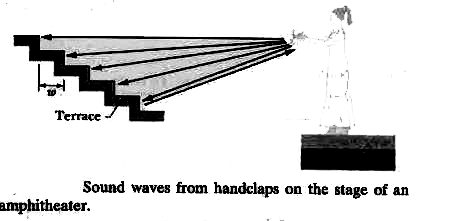 an extra distance of 2W, taking an extra amount of time `Delta t = 2w//v` . (a)The frequency of the pulse is therefore `f = (1)/(Delta t) = (v )/(2w) = (343 m//s)/(2(0.65m)) = 2.6 xx 10^2 Hz` (b) Since `f PROP 1// w` , the frequency would be high if w were SMALLER. |
|
| 47. |
A capacitor has capacity C and reactance X. If the capacitance and frequency are doubled,the reactance will be: |
|
Answer» 2X |
|
| 48. |
Ordinary light incident incident in a glass slab at the polarising angle suffers a deviation of 22^@. In this case, the angle of refraction is : |
| Answer» ANSWER :B | |
| 49. |
Isocline are the lines joiningthe places of |
|
Answer» equal dip |
|
| 50. |
An electron moves in a circular orbit with a uniform speed v. It produces a magnetic field B at the centre of the circle. Prove that the radius of the circle is proportional to sqrt(V/B). |
|
Answer» SOLUTION :The MAGNETIC field PRODUCE by moving electron in CIRCULAR path. `B=(mu_0i)/(2r) "" i=q/r `, q=e `=(mu_0q)/(2rt) "" t=(2pir)/v` `B=(mu_0qv)/(4pir^2) rArr r=SQRT((mu_0qv)/(4piB)) rArr r prop sqrt(v/B)` |
|


