

Saved Bookmarks
This section includes 7 InterviewSolutions, each offering curated multiple-choice questions to sharpen your Current Affairs knowledge and support exam preparation. Choose a topic below to get started.
| 1. |
A wire of resistance 10Omega is elongated by 10%, by streching without changing its density. The resistance of the elongated wire is |
|
Answer» `10.1Omega` |
|
| 2. |
The shortest wavelength line in Lyman series is ____A.U. |
|
Answer» 1215 |
|
| 3. |
Use the formula λ_(m) T = 0.29 cm K to obtain the characteristic temperature ranges for different parts of the electromagnetic spectrum. What do the numbers that you obtain tell you? |
|
Answer» Solution :A body at TEMPERATURE T produces a continuous spectrum of wavelengths. For a black body, the wavelength corresponding to MAXIMUM INTENSITY of radiation is given according to Wein’s law by the relation: `lamda_(m) = 0.29 cm K//T." For "lamda_(m) = 10^(-6) m, T = 2900 K`. Temperatures for other wavelengths can be found. These numbers tell us the temperature ranges required for obtaining radiations in different PARTS of the electromagnetic spectrum. Thus, to obtain visible radiation, say `lamda = 5 xx 10^(-7) m`, the source should have a temperature of about 6000 K. Note: a lower temperature will also produce this wavelength but not the maximum intensity. |
|
| 4. |
Refferring to the previous illustration . If the pressure of the gas in the container is equalto2xx10^(5)Pa , findthe corresponding length of the water column |
| Answer» SOLUTION :`h_(w) = ((P-P_(ATM)))/(rho_(w)g) = (2xx10^(5) - 1xx 10^(5))/((10^(3))(9.8))= 10 m ` | |
| 5. |
For a monoatomic gas in adiabatic process, the relation between the pressure and absolute temperature time T is P prop T where C equal to: |
|
Answer» `(2)/(5)` `P^(1-GAMMA). T^(gamma)=` CONST `(T^(gamma))/(P^(gamma-1))=k rArr T^(gamma)=k P^(gamma-1)` `rArr P=(1)/(k) cdot [T](gamma)/(gamma-1)` `P prop [T] (gamma)/(gamma-1)` For monoatomic gas `gamma=5//3` `P prop T^(((5//3)/((5)/(3)-1))) rArr P prop T^(5//2)` Thus, correct choice is (c ). |
|
| 6. |
P and Q are two infinitely long straight pärallel conductors placed in air 'r' distance apart. Let I_1 and I_2 be the current on P and Q respectively flowing in the same direction. Then a. What is the magnetic field on Q due to I_1? b. What is the force experienced by Q? C. Is there any attraction or repulsion between P and Q? |
|
Answer» Solution :`(B_p = (mu_0I)/(2PI r) b. F = (mu_0I_1I_2l)/(2pi r) ` (over a LENGHT l) c. Yes There is an attaraction between P and Q. |
|
| 7. |
Explain the confusion with telescope and microscope. |
|
Answer» Solution :A telescope produces images of FAR objects NEARER to our eye. Therefore objects which are not RESOLVED at far distance can be resolved by looking at them through a telescope. Hence a telescope RESOLVES. While a microscope MAGNIFIES objects and produces their larger image. Hence a microscope magnifies. |
|
| 8. |
A block at rest explodes into 3 parts of the same mass. The momentum of the two parts are -2Phati and Phatj. The momentum of the third part will have a magnitude of |
|
Answer» <P>P |
|
| 9. |
चींटी द्वारा परागण को कहते है : |
|
Answer» एंटोमोफिली |
|
| 10. |
Three resistances 1Omega,2Omega and 3Omega are connected in parallel. The ratio of currents passing through them when a p.d. is applied across the ends is |
|
Answer» `2:3:6` |
|
| 11. |
पर परागण की अनुकूल स्थिति है : |
|
Answer» भिन्नकालपक्वता |
|
| 12. |
In a biprism experiment, the fringe width is 1.4mm with light of wavelength 6000 Å. What will be the fringe width if light of wavelength 5400 Å is used, with no other change in the experimental setup? |
|
Answer» SOLUTION :`X_(2)/X_(1) = lambda_(2)/lambda_(1)` `therefore` The new fringe width, `X_(2) = (lambda_(2))/(lambda_(1))X_(1) = (5400)/(6000) xx 1.4` `=0.9 xx 1.4 = 1.26` mm |
|
| 13. |
Transistor Radio does not work satisfactorily when used inside a railway carriage . a . Justify your answer . b . What happens in a transistor when both the emitter and collector are reverse biased ? c. What is this condition known as ? d. Under what condition a transistor works as an open switch ? |
|
Answer» Solution :a. The iron frame of RAILWAY carriage acts as a magnetic screen . It does not allow the electromagnetic wave signal coming from TRANSMITTER to enter the carriage . b . No current FLOWS through the transistor . C. Cutoff state d. When both the EMITTER and collector are reversed biased |
|
| 14. |
Fig shows that energy levels of a mercury atom. Electrons with kinetic energies of 7.0 eV are introduced into mercury vapor. (a) Convert the energy levels to the system that sets the ground state at 0 eV. (b) What is the kinetic energy of an electron after an elastic collision with a mercury atom? (c ) What are the possible kinetic energies of an electron after an inelastic collision with a mercury atom? (d) What are the energies of the photons coming from the mercury vapor? |
| Answer» Solution :(a) 0 EV, 4.9 eV, 6.7 eV, 8.8 eV and so on, (b) 7 eV, (C ) 2.12 eV, 0.3 eV, (d) 6.7 eV, 4.9 eV, 1.8 eV | |
| 15. |
A pushed dye laser emits light of wavelength 585 nm. Because this wavelength is strongly absorbed by the haemoglobin in the blood, the method is especially effective for removing various types of blemishes due to blood. To get a reasonable estimate of the power required for such laser surgery, we can model the blood as having the same specific heat and geat of vaporization as water. [S=4.2xx10^(3)J(kgK)^(-1),L=2.25xx10^(6)Jkg] Q. The number of photons that each pulse delivers to the blemish is |
|
Answer» `1.5xx10^(16)` `((3.18xx10^(16)eV)(585nm))/((1240 eV nm))=1.5xx10^(16)` |
|
| 16. |
A pushed dye laser emits light of wavelength 585 nm. Because this wavelength is strongly absorbed by the haemoglobin in the blood, the method is especially effective for removing various types of blemishes due to blood. To get a reasonable estimate of the power required for such laser surgery, we can model the blood as having the same specific heat and geat of vaporization as water. [S=4.2xx10^(3)J(kgK)^(-1),L=2.25xx10^(6)Jkg] Q. The power output of laser must be |
|
Answer» <P>5.5 W `P=(E)/(t)=(5.088xx10^(-3))/(450xx10^(-6))=11.3approx11W` |
|
| 17. |
If U^(238) nucleus at rest decays by emitting an alpha particle with a speed of V m/s. The recoil speed of residual nucleus in m//s is: |
|
Answer» `(-V)/(4)` `0 = m_(1)upsilon_(1) + m_(2)upsilon_(2)` ` 0 = (4 amu) V+ (234 amu) nu_(2)` `impliesupsilon_(2)=(-4)/(234)Vm//s` Hence the CORRECT choice is (d). |
|
| 18. |
Discuss the types of AC generator . How much power they deliver ? What is the frequency of AC generator ? |
|
Answer» Solution :(1)In commercial generators , the mechanical energy required for rotation of the armature is provided by water falling from a height , for example , from dams. These are called hydroelectric generators. (2) Water is heated to produce steam using coal or other sources. The steam at HIGH pressure produces the rotation of the armature. These are called thermal generators. (3) Nuclear fuel is USED we get nuclear power generators. Modern day generators produce electric power as high as 500 MW, i.e., one can light up 5 million 100 W bulbs! In most generators, the coils are held stationary and it is the ELECTROMAGNETS which are rotated. The frequency of rotation is 50 Hz in India. In certain countries such as USA it is 60 Hz. |
|
| 19. |
चाल किस प्रकार की राशि है |
|
Answer» अदिश |
|
| 20. |
The wave described by y = 0.25 sin (10 pi x - 2 pi t )where x and y are in metres and t in seconds, is a wave travelling along the : |
|
Answer» `+` ve x -direction with frequency `pi` HZ and wavelength `lambda` = 0.2 m. y = 0.25 sin `(2 pi t - 10 pi x)` We know that WAVE travelling along. + x -direction is y = r sin `(omega t - kx)` `therefore "" omega = 2pi and k = 10 pi `. `rArr "" (2pi)/(lambda) = 10 pi"" therefore lambda = 0.2 ` m Now `omega = 2pi ` f `2 pi = 2 pi f "" rArr f = 1 ` Hz. |
|
| 21. |
A plane monochromatic wave of natural light with intensity I_(0) falls normally on a screen composed of two touching Polaroid half-planes. The principle direction of one Polaroid is parallel,and of the other perpendicular, to the boundary between them. What kind of diffraction pattern is formed behind the screen? What is the intensity of light behind the screen at the points of the plane perpendicualr to the screen and passing through the boundary between the Polaroids? |
|
Answer» Solution :Natural LIGHT can be considered to be an incoherent MIXTURE of two plane POLARIZED light of intensity `I_(0)//2` with mutually perpendicualr planes of vibration. The screen consisting of the two polaroid half-planes acts an opaque half-screen for one or the other of these light waves. The resulting diffraction pattern has the alterations in intensity (in the illuminated region) CHARACTERISTIC of a striaght edge on the both sides of the boundary. At the boundary the intensity due to either component is `((I_(0)//2))/(4)` and the total intensity is `(I_(0))/(4)`. (Recall that when light of intensity `I_(0)` is incident on a stright edge, the illuminance in front of the edge is `I_(0)//4)`. 
|
|
| 22. |
If the moment of inertia of a body is 2.5 kgm^2,then the torque required to produce an angular acceleration of 18 rad/sec^2 in the body is |
| Answer» Answer :A | |
| 23. |
A parabolic wire as shown in the figure is located in x-y plane and carries a current l=10 amp. A unifrom magnetic field of intensity 2sqrt(2T), making an angle of 45^(@) with x-axis exists throughout the plane. If the coordinates of end point 'P' of wire are (2m, 1.5 m) then the total force acting on the wire is: |
|
Answer» `40 NhatM` |
|
| 24. |
In above question, calculate the longest wavelength produced : |
|
Answer» 18800 Å `hv=E_(0) [1/3^(2)-1/4^(2)]` `(HC)/(lambda)=E_(0) [1/9-1/(16)]=E_(0) (7)/(144)` Then `lambda=18800 Å` |
|
| 25. |
Unplarised light falls on two polarising sheets placed one on the top of the other what must be the angle between the characteristic directions of the sheets if the intensity of the transmitted light is (a) one-third of the maximum intensity of the transmitted beam (b) one third of the intensity of the incident beam. |
|
Answer» |
|
| 26. |
Two moles of helium gas (gamma=5/3)are initially at temperature 27^@ C and occupy a volume of 20litres.The gas is first expanded at constant pressure until the volume is doubled. Then it undergoes an adiabatic change until the temperature returns to its initial value. What are the final volume and pressureof the gas ? |
|
Answer» <P> Solution : At point B,Pressure `P'=P=2.5xx10^5 N//m^2` , `V'=2V=40 xx10^(-3)m^3` As pressure is CONSTANT in the process AB, making its volume doubled, its temperature will also be doubled. Thus temperature at point B is T'= 600 K The gas now undergoes adiabatic expansion to cool down to T''=T=300K We know for an adiabatic process `TV^(gamma-1)` =constant `T'(V')^(gamma-1)=T''(T'')^(gamma-1)` `((V'')/(V'))=((T')/(T''))^(1//gamma-1) =(600/300)^(1//(5/3-1))` `=(2)^(3//2)=2sqrt2` Thus final volume is `V''=(2sqrt2)V'` `=2xx1.414xx40xx10^(-3)` `=113.14xx10^(-3) m^3` Similarly final pressure is given by process equation as `P'V'^(gamma)=P''V''^(gamma)` or `P''=P'((V')/(V''))^(gamma)` `=2.5xx10^5xx((40xx10^(-3))/(113.14xx10^(-3)))^(5//3)` `=4.42xx10^4` Pa |
|
| 27. |
A photon and an electron have energy 200 eV each. Which one of these has greater de-Broglie wavelength ? |
|
Answer» SOLUTION :`lambda=h/p` for PHOTON P `=E/C and 1=(hc)/E` for electron `P=sqrt(2M E)` `lambda_("photon")=6.2xx 10^(-9)m, lambda_("electron") =0.86 xx10^(-10)m` |
|
| 28. |
Why do Ge and Si behave as semiconductors ? |
| Answer» Solution :The energy gap in Ge and Si are of the order of 1 eV Electrons can be easily excited from valence bond to the conduction band to ENABLE them to CONDUCT electricity. So, Ge and Si BEHAVE as semiconductors. | |
| 29. |
If E and p are the energy and momentum of a photon respectively then on decreasing in the wavelength of photon. |
|
Answer» p and E both will DECREASE. So if `lambda` increases E and p both will DECREASES. |
|
| 30. |
Two coherent sources are placed 0.9 mm apart and the fringes are observed one metre away. The wavelength of monochromatic light used if it produces the second dark fringes at a distance of 10 mm from the central finge will be |
|
Answer» `6 xx 10^(-4) CM` |
|
| 31. |
In an experiment of single slit diffraction pattern first minimum for red light coincides with first maximum of some other wavelength. If wavelength of red light is 6600 A^(0), then wavelength of first maximum will be : |
|
Answer» `55000A^(0)` |
|
| 32. |
The self inductance of a coil is 5mH. If a current of 2A is flowing in it, then the magnetic flux produced in the coil will be |
| Answer» Answer :A | |
| 33. |
Two charges 2muC and 1muC are placed at a distance of 10cm. Where should a third charge be placed between them so that it does not experience any force. |
|
Answer» 7cm |
|
| 34. |
A rectangular loop PQMN with movable arm PQ of length 10 cm and resistance 2 Omega is placed in a uniform magnetic field of 0.1 Tesla perpendicular to the plane of the loop as shown in the figure. The resistances of the arms MN, NP and MQ are negligible. Calculate the (i) emf induced in the arm PQand (ii) current induced in the loop when arm PQ is moved with velocity 20 m/s. |
|
Answer» SOLUTION :(i) induced EMF `e=Blv` `= 0.1xx10xx10^(-2)xx20V` `=0.2` volt (ii) CURRENT in the loop `i=e/R` `=(0.2)/(2)=0.1 A` |
|
| 35. |
A transformer has 400 primary turns and 10 secondary turns. (a) If V_p is 120 V (rms), what is V_s with an open circuit? If the secondary now has a resistive load of 27 Omega what is the current in the (b) primary and (c) secondary? |
|
Answer» |
|
| 36. |
Assertion Fraunhofer diffraction occurs when all the rays passing through a narrow slit are approximately parallel to one another Reason Fraunhofer diffraction pattern can be achieved by placing the screen far from the slit. |
|
Answer» |
|
| 37. |
Two identical circular loops, P and Q, each of radius r and carrying currents I and 2 I respectively are lying in parallel planes such that they have a common axis. The direction of current in both the loops in clockwiseas seen from O, which is euqidistant from both loops. Find the magnitude of the net magnetic field at point O. |
|
Answer» <P> Solution :The point O lies at the axial line of both the current carrying loops at a distance x = r from centre of either loop.`:.` MAGNETIC field due to coil P, `B_P = (mu_0 I Nr^2)/(2[r^2 + r^2]^(3//2)) = (mu_0 I N)/(4sqrt(2)r)` along QP and magnetic field due to coil Q, `B_Q = (mu_0 (2I)Nr^2)/(2[r^2 + r^3]^(3//2)) = (mu_0 I N)/(2sqrt(2) r)` along PQ As `B_P and B_Q` are in mutually opposite directions, hence net magnetic field at point Q `B = B_Q - B_P = (mu_0 I N)/(4sqrt(2) r)` along `PQ` |
|
| 38. |
A : If a thin soap film is arranged vertically the spectrum of coloured fringes are spread equally on the film. R : The colours of the film is dependent on the thickness of film and wavelength of the light. |
|
Answer» Both A and R are true and R is the CORRECT EXPLANATION of A |
|
| 39. |
The figure shows two point charges 2Q(gt0) and -Q. The charges divide the line joining them in three parts I, II, and III. |
|
Answer» REGION III has a local maxima of electric field. Electric field is ZERO only at a point in region III. Equilibrium at this point will be stable for a negatie charge. 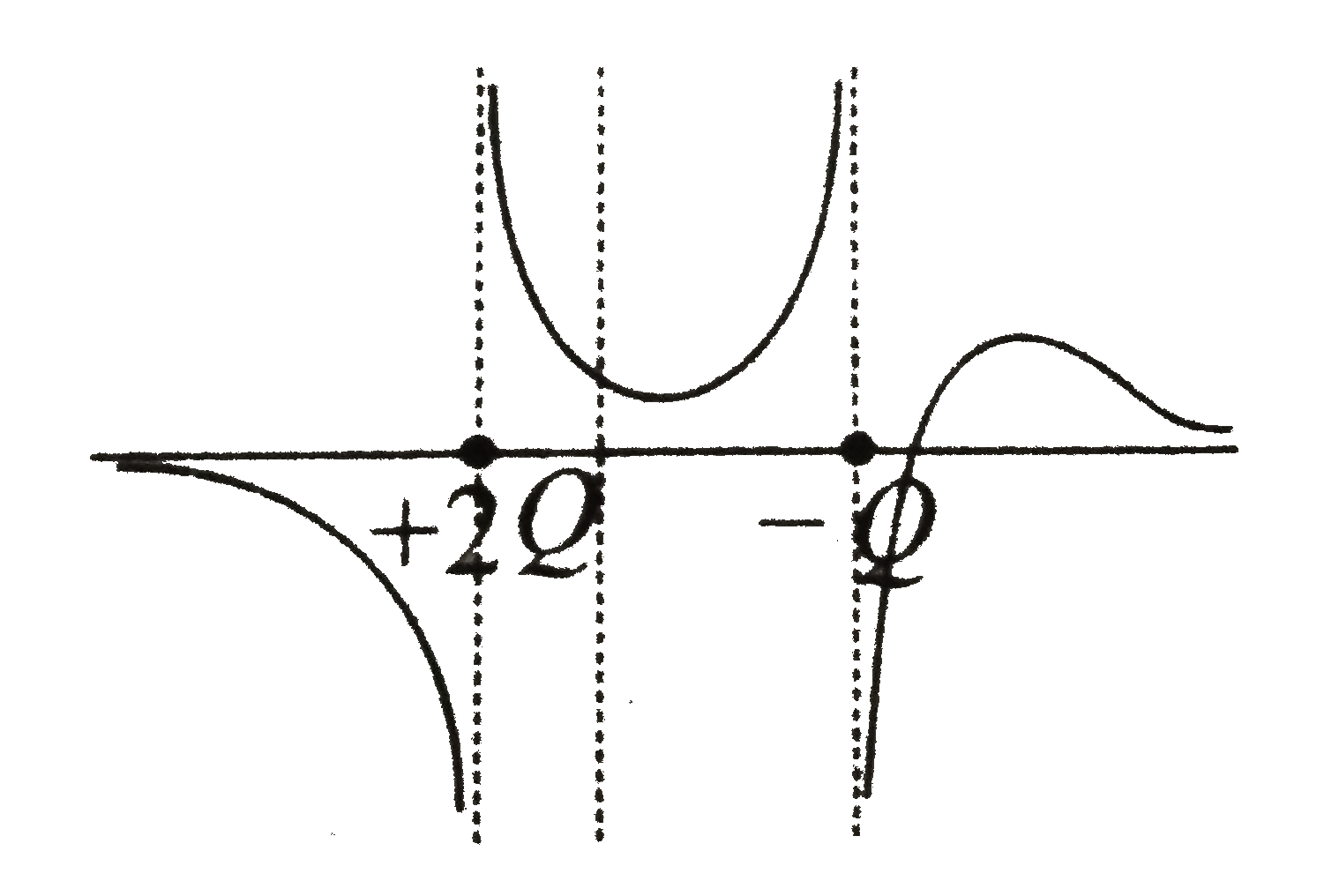
|
|
| 40. |
In a plane e.m. wave, the electric field oscillates sinusoidally at a frequency of 2.5 xx 10^(10) Hz and amplitude 480V // m. The amplitude of oscillating magnetic field will be: |
|
Answer» `1.52 XX 10^(-8) Wb // m^(2)` `:. B_(0)=(E_(0))/(C)=1.6 xx 10^(-6) Wb // m^(2)` |
|
| 41. |
An electron falls through a distance of 1.5cm in a uniform electric field of magnitude 2 times 10^4 NC^-1. The direction of the field is reversed keeping its magnitude unchanged and a proton falls through the same distance. Compute the time of fall in each case. |
|
Answer» Solution :Here, electric force, `F_(e) = qE = ma rArr a = (qE)/m` Linear distance travelledl at the end of time t is, `d = v_(0)t + 1/2 at^(2)` `therefore d = 1/2 (qE)/mt^(2), (therefore v_(0) =0 " and " a =(qE)/m)` `therefore t^(2) = (2md)/(qE)` `therefore t = sqrt((2md)/(eE))`......(1) (`therefore` For electron and proton magnitude of CHARGE is q=e) Linear distance travelled at the end of time t is, `d=v_(0)t + 1/2 at^(2)` `therefore d = 1/2((qE)/m)t^(2) (therefore v_(0)=0 " and " a =(qE)/m`) `therefore t^(2) = (2md)/(qE)` `therefore t = sqrt((2md)/(eE))`............(1) (`therefore` For electron and proton magnitude of charge is q = e) From equation (1), time taken by electron to pass through distance d (opposite to electric field) `t_(e) = sqrt((2m_(e)d)/(eE))` `= sqrt((2 xx 9.1 xx 10^(-31) xx 0.015)/(1.6 xx 10^(-19) xx 2 xx 10^(4))` `=2.92 xx 10^(-9)` s `therefore t_(e) = 2.92 ns` (Nano second)...........(2) From equation (1), time taken by proton to pass through distance d (PARALLEL to electric field) `t_(p) = sqrt((2m_(p)d)/(eE))` `=sqrt((2 xx 1.67 xx 10^(-27) xx 0.015)/(1.6 xx 10^(-19) xx 2 xx 10^(4))` `=1.251 xx 10^(-7)`s =`125.1 xx 10^(-9)`s `therefore t_(p) = 125.1`ns.............(3) From equation (2) and (3), `t_(p) GT t_(e)` (`therefore` Here, `t prop sqrt(m)` and `m_(p) gt m_(e)`) |
|
| 42. |
An equibiconvex lens of radius of curvature 0.20 and refractive index 1.5 immersed half inside water of RI 4//3 and the rest outside in air. A parallel beam of light in air is incident on it. Find the final position of the image. |
|
Answer» Solution :GIVEN`r=0.20m ` `n_(w)=(4)/(3)=1.333` `n_(G)=1.50` `u=oo`  For reflection through I surface `n_(0)=1, n_(1)=1.50, u=oo, v=?` By using `(n_(0))/(-u)+(n_(1))/(v)=(n_(0)-n_(1))/(r)` i.e., `(1)/(oo)+(1.5)/(v)=(1.5-1)/(0.2)` `(1.5)/(v)=(0.5)/(0.2)=2.5` `thereforev=(1.5)/(2.5)=0.6m` Real image serves as virtual object for II surface. Put `u.=0.6m` `(n_(g))/(-0.6)+(n_(w))/(v)=(n_(g)-n_(w))/(r)` `therefore (1.5)/(-0.6)+(1.333)/(v)=(1.5-1.333)/(0.2)` `-2.5+(1.333)/(v)=(0.1667)/(0.2)=0.8335` `(1.333)/(v)=3.333` `v=(1.333)/(3.333)=0.3999` `v=0.40m` from the SECOND surface in the direction of INCIDENT light. |
|
| 43. |
The maximum amplitude of an amplitude modulated wave is found to be 15V while its minimum amplitude is found to b e 3V. The modulation index is |
|
Answer» `(3)/(2)` `A_(c)-A_(m)=3V` Solving (i) and (ii), we get, `A_(c)=9V,A_(m)=6V` `therefore` MODULATION index, `mu(A_(m))/(A_(c))=(6)/(9)=(2)/(3)` |
|
| 44. |
A ball of mass 2 kg is gently pushed off the edge of a tabletop that is 1.8 m above the floor. Find the speed of the ball as it strikes the floor. |
|
Answer» Solution :IGNORING the friction due to the air, we can apply coservation of mechanical energy. Calling the floor our h=0 reference level, we write `K_(i)+U_(i)=K_(f)+U_(f)` `0+mgh=(1)/(2)mv^(2)+0` `v=sqrt(2gh)` `=sqrt(2(10m//s^(2))(1.8m))` `=6m//s` Notice that the ball's potential energy decreased, while its kinetic energy increased. this is the BASIC idea behind conservation of mechanical energy: One form of energy decreases while the other increases. (ALSO, notice that although the question gives you the MASS of the ball, it wasn't necessary since the mas m cancelled out of the equation.). |
|
| 45. |
A 100m long antenna is mounted on a 500m tall building. The complex can become a transmission tower for waves with lambda |
|
Answer» ~400m |
|
| 46. |
A system consists of a uniformly charged sphere of radius R and a surrounding medium filled by a charge with the volume density rho=alpha/r , where alpha is a positive constant and r is the distance from the centre of the sphere. Find the charge of the sphere for which the electric field intensity E outside the sphere is independent of R. |
|
Answer» `alpha/(2epsilon_0)` `int_0^r Eds=1/epsilon_0 int_0^r rho(r)DV` `rArr E4pir^2 =1/epsilon_0 (q+int_R^r alpha/r (4pir^2)DR)` `rArr E4pir^2 = ((q-2pialphaR^2))/epsilon_0+(4pialphar^2)/(2epsilon_0)` The intensity E does not depend on R if `(q-2pialphaR^2)/epsilon_0=0` or `q=2pialphaR^2` |
|
| 47. |
A conducting ring of radius r having charge q is rotating with angular velocity omega about its axes. Find the magnetic field at the centre of the ring. |
|
Answer» `(mu_0q omega)/(2pi R)` |
|
| 48. |
Two plane progressive waves having the same wavelength lambda And same frequencies with intensities 9I_0 and 4I_0 Suprimpose. Resulting intensity when the path difference between waves become (lambda)/(4) is |
|
Answer» `13 I_0` |
|
| 49. |
How long does it take light from the sun to reach to the earth (approximately)? |
| Answer» Solution :LIGHT takes about 8 minutes from the SUN to reach to the earth. | |
| 50. |
A ray of light enters a spherical drop of water of refractive index p as shown in the figure. An expression of the angle between incidence ray and emergent ray (angle of deviation) as shown in the figure is |
|
Answer» `0^(@)` `alpha=(phi-alpha)+THETA` `delta=pi-2theta=pi-4alpha+2phi` 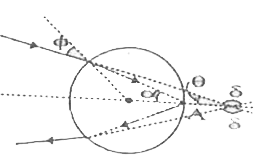
|
|