

Saved Bookmarks
This section includes 7 InterviewSolutions, each offering curated multiple-choice questions to sharpen your Current Affairs knowledge and support exam preparation. Choose a topic below to get started.
| 1. |
In case of a p-n junction diode a high value of reverse bias, the current rises sharply . The value of reverse bias is known as |
|
Answer» CUT - in |
|
| 2. |
Rydberg constant R is equal to: |
|
Answer» `R=((me^2)/(8h^3c(epsilon_0)^2))` |
|
| 3. |
The motion of a body along the circumference of the circle is called. |
|
Answer» ROTATIONAL motion |
|
| 4. |
Four monochromatic and coherent sources of light emitting waves in phase at placed on y axis at y = 0, a, 2a and 3a. If the intensity of wave reaching at point P far away on y axis from each of the source is almost the same and equal to I_(0), then the resultant intensity at P for a=(lambda)/(8) is nI_(0). The value of [n] is. Here [] is greatest integer funciton. |
|
Answer» |
|
| 5. |
Consider a nuclear power plant to be put up to deliver 4 xx 10^(3)MW power. (a) what will be the ratio of consumption of .^(235)U to operate this plant for 1 year ? (b) Typically 3% of the .^(235)U mass is converted into ._(38)^(90)Sr, which is a beta emitter, with half life 29 yrs. What is the beta activity in the Sr produced in curies, just after the end of 1 yr. Assume 200 MeV is the average yield per fission of .^(235)U. |
|
Answer» |
|
| 6. |
What is doping ? |
| Answer» Solution :The process of increasing conductivity of a pure SEMICONDUCTOR by adding impurity in controlled manner to an ATOM is called DOPANT and the impurity atoms are called DOPANTS | |
| 7. |
What are the effect of -ve feed back n an amplifier |
| Answer» Solution :NEGATIVE feedback reduces gain of the amplifier,it also reduces distortion.It statilise gain and increase BAND width.Input and OUTPUT umpendence IMPROVE. | |
| 8. |
The plates of a charged capacitor are connected to a voltmeter. If the distance between the plates is increased , then the reading of the voltmeter |
|
Answer» decrease |
|
| 9. |
The cross-section area and length of cylindrical conductor are A and l respectively. The specific conductivity varies as sigma(x)=sigma_(0)(l)/(sqrt(x)), where x is the distance along the axis of the cylinder from one of its ends. Compute the resistance of the system along the cylindrical axis. |
|
Answer» `(3sqrt(L))/(2A sigma_(0))` |
|
| 10. |
Statement -1 : On viewing the clear blue portion of the sky through a calcite crystal, the intensity of transmitted light varies as the crystal is rotated. Statement -2 : The light coming from the sky is polarized due to scattering of sunlight by particles in the atmosphere.The scattering is largest for blue light. |
|
Answer» Statement -1 is true, Statement -2 is false. 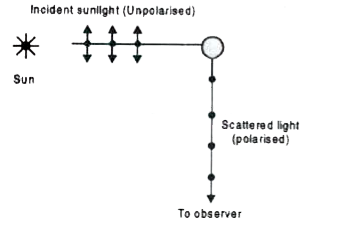
|
|
| 11. |
Focal length of concave lens shown in figure is 60 cm. Find image position and its magnification. |
|
Answer» Solution :For the given situation, `u=-30cm, f=-60cm` USING the LENS formula, we have `1/v-1/-30=1/-60` SOLVING this equation, we get `v=-20cm` Further, `m=v/u=(-20)/(-30)=+(2)/(3)`. POINT b is `2mm` above the principal axis. Therefore, its image b' will be `(2)((2)/(3))` or `4/3mm`, above the principal axis. Similarly, point a is 1mm below the principal axis. therefore, its image a' will be `(1)((2)/(3))` or `2/3mm` below the principal axis. The FINAL image is as shown in fig. `31.67` 
|
|
| 12. |
An object falls from a bridge which is 45 m above the water,It falls directly into a smaal row-boat moving with contant velocity that was 12m from the point of impact when the object was released.What was the speed of the boat? |
|
Answer» Solution :VELOCITY of boat=`V=(s)/(t)`,Here,s=12m t=time of fall of OBJECT from bridge `sqrt(2h)/(g)=sqrt(2xx45)/(10)=3s therefore V=(12)/(3)=4ms^(-1)` |
|
| 13. |
Electrons emitted with negligible speed from an electron gun are accelerated through a potential difference V along X-axis.These electrons emerges from a narrow hole into a unifrom magnetic field B directed along the axis.However, some of the electrons emerging from the hole make slightly divergent angles as shown in figure.These paraxial electrons meet for second time on the X-axis at a distance sqrt((Npi^(2)mV)/(eB^(2))).Then find value of N.(Neglect interaction between electrons) |
|
Answer» `=(2pisqrt(2meV))/(eB) (costheta~~1) rArr "pitch" =SQRT((8pi^(2)mV)/(eB^(2)))` `:.` Distance from POINT of DIVERGENCE `=sqrt((32pi^(2)mV)/(eB^(2)))` |
|
| 14. |
जब प्रकाश एक माध्यम से दूसरे माध्यम में जाता है तब अपवर्तन होता है |
|
Answer» प्रकाश की चाल में परिवर्तन होने के कारण |
|
| 15. |
A light satellite is initially rotating around a planet in a circular orbit of radius r. Its speed in this circular orbit was u_(0). It is put in an elliptical orbit by increasing its speed form u_(0) " to " v_(Q) ( instantaneously). In the elliptical orbit, the satellite reaches the farthest point P, which is at a distance R from the planet. Satellite's speed at farthest point is v_(P). At point Q, the speed required by satellite to escape the planet's gravitational pull is v_("esc") |
|
Answer» `v_("ESC")=2u_(0)` |
|
| 16. |
A black body radiates 3 J/cm^(2) s when its temperature is 127^(@)C. How much heat will be radiated/cm^(2) s when its temperature is 527^(@)C? |
|
Answer» 6 `E_(2)=((T_(2))/(T_(1)))^(4)E_(1)=((800)/(400))^(4)E_(1)=16E_(1)` `E_(2)=48J//s" "CM^(2)` |
|
| 17. |
The distance between two point sources of light is 24 cm. Where should a convergent lens of focal length 9 cm be placed between them to obtain images of both sources at the same point ? |
|
Answer» u = 6 or 18 cm  The lens has to be so adjusted that real IMAGE P.Q. of PQ COINCIDES with virtual image `P_(1).Q_(1). of P_(1) Q_(1)`. Let u be DISTANCE of lens from first source. For real image, `(1)/(v) - (1)/((-u)) = (1)/(9)` `(1)/(v) = (1)/(9) - (1)/(u)` For virtual image, `(1)/(-v)-(1)/(-(24-u))=(1)/(9)` `-(1)/(9) + (1)/(u) + (1)/(24-u) = (1)/(9)` `(2)/(9) = (1)/(24)-u + (1)/(u), therefore u^(2) - 24 u + 108 = 0` u = 6 or 18 cm |
|
| 18. |
A light source emit monochromatic lightof 5000 Å wavelength and produce 5 W power .When it is displaced by 0.5 m from photo sensitive surface photoelectron are emitted,when distance increased by 0.5, no.of photoelectron liberated will become …… |
|
Answer» 8 `N_(E)prop "INTENSITY"prop (1)/(("distance ")^(2))` `therefore` When distance become DOUBLE `N_(E)` will decrease `(1)/(4)` times. |
|
| 19. |
What does the term LOS communication mean ? Name the types of waves that are used for this communication. Which of the two heights of transmitting antenna and height of receiving antenna can affect the range over which this mode of communication remains effective? |
|
Answer» Solution :LOS communication is the line of sight communication. It is that communication in which electormagnetic WAVE travels in straight line from transmitting antenna to receiving antenna. TV frequencies and mocrowave links use this mode of communication. The maximum line of sight distance `d_m` (i.e., range of communication) between transmitting antenna of height `h_(T)` and receiving antenna of height `h_(R)` above the EARTH is given by `d_m = SQRT(2Rh_(T)) + sqrt(2Rh_R)` From this relation, it is clear that `d_m` depends on both, `h_(T)` and `h_(R)`. |
|
| 20. |
Give an exmple of amateral each for which temperature coefficient of resistivity is (i) positive, (ii) negative. |
|
Answer» |
|
| 21. |
A beam of the charged particles is passed through a magnetic field. The work clone on the beam by the field is |
|
Answer» zero |
|
| 22. |
A ball is released from the top of a tower of heighth metre. It takes T second to each the ground. What is the position of the ball at T/3second ? |
|
Answer» `h/9` meter from the GROUND In T/3 s the DISATNCE fallen is `=(1)/(2)gxx(T^(2))/(9)=(h)/(9)` `:.`DISTANCE from the ground `=h -(h)/(9)=(8h)/(9)` |
|
| 23. |
In photoelectric effect,for emission of electron metal surface ,incident light should have….. |
|
Answer» minimum wavelength |
|
| 24. |
The work done to move a charge along equipotential from A to B |
|
Answer» cannotbedefinedas ` - int_(A)^(B)Edl` and `V_(1)-V_(1)= -int_(1)^(2)` E dl `:. W = -q int_(1)^(2) ` E dl ` [ because` From equ. (1) and (2) ] but on equipotential surface, `V_(2)-V_(1)=0` `:. W =0` |
|
| 25. |
If one of the two slits of a Young's double slit experiment is covered by thin parallel sided glass slab, so that it transmit only half the light intensity of the other then |
|
Answer» the FRINGE system will get shifted towards the COVERED slit. |
|
| 26. |
Find the derivative of given functions w.r.t the corresponding independent varible. y = (x + 1/x)(x- 1/x + 1) |
|
Answer» |
|
| 27. |
What is the effect of keeping the dipole in the field? |
| Answer» Solution :If the DIPOLE is placed PARALLEL to the field, it is in stable EQUILIBRIUM and if placed antiparallel, it is in the unstable equilibrium. If it is inclined, it is subjected to a TORQUE and hence ROTATION. | |
| 28. |
A 10 m wire potentiometer has resistance 10Omega and is connected to an accumulator of 2 volt and negligible internal resistance. There are two resistance boxes R_(1) and R_(2) is series with the accumulator and one can have any integral values of resistance from resistance boxes. A standard Cd-cell of 1.018 V having a sensitive galvanometer in series with it is connected across R_(1). How would you proceed with the above arrangement to obtain a potential drop 1muV per mm of the potentiometer wire? Calculate value of R_(1) and R_(2) required. What length of this potentiometer will balance the thermo e.m.f. of iron-copper couple at 300^(@)C which develops 17muV//^(@)C? |
| Answer» SOLUTION :3.33 MILLIVOLT | |
| 30. |
The magnitude of the induced emf is equal to the time rate of change of …… |
|
Answer» MAGNETIC force |
|
| 31. |
In a diffraction pattern the width of any fringe is |
|
Answer» DIRECTLY PROPORTIONAL to SLIT width |
|
| 32. |
The escape velocity of a body on an imaginary planet which is thrice the radius of the earth and double the mass of the earth is (v_(e ) is the escape velocity of earth) : |
|
Answer» `sqrt(2//3) v_(E )` `v_(e )^(.)= sqrt((2)/(3)).v_(e )`. THUS correct choice is (a). |
|
| 33. |
An astronomical telescope has an angular magnification of magnitude 5 for distant objects. The separation between the objective and the eyepiece is 36 cm and the final image is formed at infinity. The focal length f_(0)of the objective and f_(e) of the eyepiece are respectively |
|
Answer» 45 cm and 9 cm |
|
| 34. |
A vector vecA of magnitude 5sqrt3 units, another vector vecB of magnitude of 10 units are inclined to each other at an angle of 30^@. The magnitude of the vector product of the two vectors is |
|
Answer» `5SQRT3 UNITS` |
|
| 35. |
The phenomena such as interference, diffraction and polarization can be explained on the basis of which theory ? |
| Answer» SOLUTION :WAVE THEORY. | |
| 36. |
The working of magnetic braking of trainsis based on |
|
Answer» ALTERNATING CURRENT |
|
| 37. |
The resultant magnetic moment for the following arrangement (non coplanar vectors) |
|
Answer» 1 M |
|
| 39. |
In the Young's double slit experiment , a point source of lambda = 5000Å is placed slightly above the central axis as shown in the figure. (a) Find the nature and order of the interference at the point P. (b) Find the nature and order of the interference at O. (c)Where should we place a film of refractive index mu=1.5 and what should be its thickness so that maxima of zero order is obtained at O. |
|
Answer» waves arriving at P is `Deltax = (y_1d)/(D_1) + (y_2d)/(D_2)` ` = ((1)(10))/10^3 + ((5)(10))/(2xx10^3)` ` = 3.5 xx 10^-2 mm = 0.035 mm` As, `Deltax = 70 LAMBDA` `:.` 70th order maxima is OBTAINED at P. (B) At O, `Deltax = (y_1d)/D_1 = 10^(-2) mm ` = 0.01 mm As `Delta x = 20 lambda` `:.` 20 th order maxima is obtained at O. (c) `(mu -1)t = 0.01 mm ` `:. t = (0.01)/(1.5 -1) = 0.02 mm = 20 mum ` Since, the pattern has to be shifted upwards, therefore, the film must be placed in front of `S_1` . |
|
| 40. |
An n-p-n transistor in a common emitter mode is used as a simple voltage amplifier with a collector current of 4 mA. The terminal of a 8 V battery is connected to the collector through a load resistance R_(L) and to the base through a resis-tance R_(B). The collector- emitter voltage V_(CE)=4V, base-emitter voltage V_(BE)=0.6Vand base current amplification factor beta_("d.e.")=100. Calculate the values of R_(L) and R_(B) |
Answer» Solution :Potential difference across `R_(L)`  `=8V-V_(CE)=8V-4V=4V`. Now `I_(C)R_(L)=4V` `R_(L)=(4)/(4XX10^(-3))=10^(3)Omega=1kOmega` Further for base emitter equation, `V_(C C)=I_(B)R_(B)+V_(BE)` or `I_(B)R_(B)=` Potential difference across `R_(B)` `=V_(C C)-V_(BE)=8-0.6=7.4V` Again, `I_(B)=(I_(C ))/(beta)=(4xx10^(-3))/(100)=4xx10^(-5)A` `THEREFORE R_(B)=(7.4)/(4xx10^(-5))=1.85xx10^(5)Omega=185kOmega` |
|
| 41. |
An object accelerates from rest to a velocity 27.5m/s in 10 secs,then find the distance covered by next 10s. |
|
Answer» 550m |
|
| 42. |
In given circuit capacitorinitially uncharged.Now at t = 0 switch S is closed then current given by source at any time t is |
|
Answer» `(2)/(R)(1 - e^((-2T)/(CR)))` `I_(2) = (epsilonC)/(2r) e^(-t/tau) = (epsilon)/(R) e^(-t/tau)` `I_(1) = (Vc)/(R) = (epsilon/2)/(R)(1 - e^(-t/tau))` `I_(1) = (epsilon)/(R) - e^(-t/tau) + (epsilon)/(2R) - (epsilon)/(2R) epsilon ^(-t/tau)` `(epsilon)/(2R) (1 + e^(-t/tau)) = (epsilon)/(2R)(1 + e^(-2t)/(CR))` 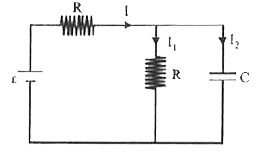
|
|
| 43. |
A metal sheet of silver is exposed to ultraviolet radiation of wavelength 1810A^(0). The threshold wavelength of silver is 2640A^(0) Calculate the maximum energy of emitted electron. |
|
Answer» 3.15 eV |
|
| 44. |
Derive the relation f=R/2 in the case of a concave mirror. |
|
Answer» <P> Solution :When a parallel beam of LIGHTIS incident on a CONCAVE mirror, the rays are paraxial ,i.e. they are incident at a point M , and make a small angle with principal axis. The reflected ray converges at a F on the principal axis. The point F is called the focus of the mirror ,the distance between the principalfocus and the pole is called focal LENGTH (f).Consider a ray parallel to the principal axis stricking the mirror at M, then `angleMFD=angleCMF+angleMCF=theta+theta=2theta` `angleMFD` is the external angle of the `angleMCF` In `triangle^"le"` MCD , `tan theta ="MD"/"CD"`...(1) In `triangle^"le"` MFD , tan `2theta ="MD"/"FD"` ...(2) `theta` is small , So `tan theta~~ theta , tan 2 theta ~~ 2 theta` , Substituting tan `theta` and tan `2theta` in the equations, `theta="MD"/"CD", 2theta="MD"/"FD"` `2xxcancel(MD)/(CD)=CANCEL(MD)/(FD) rArr 2/(CD)=1/(FD)` on CD =2FD Point D is very close to point P. `therefore DF ~~ PF ~~ f` and DC=PC=R `2/(CP)=1/(FP)`CP=3FP R=2f `f=R/2` 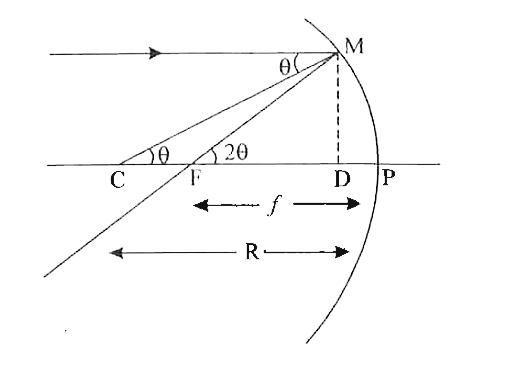
|
|
| 46. |
हिमालय के भूरे भालू इनमें से किस प्रकार के जाति वर्ग में रखा गया? |
|
Answer» स्थानिक |
|
| 47. |
A persons near point is 50 cm and his far point is 3m. Powers of the lenses he requires for (i) reading and (ii) seeing distant stars are |
|
Answer» `-2D " and " 0.33 D` |
|
| 48. |
A galvanometer measures current which passes through it. A galanometer can measure typically carrent of order of mA. To be able to measure currents of the order of amperes of main current, a shunt resistance 'S' is connected in parallel with galvanometer. The resistance of the shunt 'S' and resistance 'G' of the galvanometer should have the following relation. |
|
Answer» `S=G` |
|
| 49. |
Magnetic field lines can be entirely confined within the core of a toroid, but not within a straight solenoid. Why ? |
| Answer» Solution :In a solenoid field lines are along its axis escape from its ends. However, WITHIN the core of a toroid, magnetic field lines make a CLOSED path and can be entirely CONFINED. | |
| 50. |
The momentum of an electron is 1.60 times larger than the value computed non-relativistically. What is the speed (in xx10^(8) m/s) of the electron? |
|
Answer» |
|