

Saved Bookmarks
This section includes 7 InterviewSolutions, each offering curated multiple-choice questions to sharpen your Current Affairs knowledge and support exam preparation. Choose a topic below to get started.
| 1. |
A bdoy initially at 80^(@)C ools to 64^(@)C in 5 minutes and to 52^(@)C in 10 minutes. What will be the temperature (in ""^(@)C) after 15 minutes? |
|
Answer» Solution :If `T_(0)` be the temperature of the surroundings, then `-(dT)/(dt)=k(T-T_(0))` or `(80-64)/5=k((80+64)/2-T_(0))`…………I and `(80-52)/10=k((80+52)/2-T_(0))`………ii After simplifying above equations we get `T_(0)=16^(@)C` If T. be the temperature after 15 MINUTES, then `(80-T.)/15=k((80+T.)/2-16)`...........ii After simplify above equations we get `T_(0)=16^(@)C` If T. be the temperature after 15 minutes then `(80-T.)/15=k((80+T.)/2-16)`..........III From equation i and iii we get `T.=43^(@)C` |
|
| 2. |
In refrigerator one removes heat from a lower temperature and deposits to the surroundings at a higher temperature. In this process, mechanical work has to be done, which is provided by an electric motor. If the motor is of 1 kW power, and heat is transferred from 3^@C to 27^@C, find the heat taken out of the refrigerator per second assuming its efficiency is 50% of a perfect engine. |
|
Answer» 14 J `eta_"engine"=1-T_2/T_1=1-"270 K"/"300 K"=0.1` Since efficiencyof the refrigerator `(eta_"REF")` is 50% of `eta_"engine"` `therefore eta_"ref."-0.5 eta_"engine"=0.05` If `Q_1` is the heat transferred per SECOND at higher temperature by doing work W, then `eta_"ref."=W/Q_1` or `Q_1=W/eta_"ref."="1 kJ"/"0.05"`= 20 kJ (as W=1 kW x 1s = 1 kJ) Since `eta_"ref."`is 0.05 , heat REMOVED from the refrigerator per second, i.e., `Q_2=Q_1-eta_"ref." Q_1=Q_1(1-eta_"ref.")`=20 kJ (1-0.05) =19 kJ |
|
| 3. |
The electrical resistance of metals |
|
Answer» INCREASES with increases in temperature. |
|
| 4. |
Find the average illuminance of the irradiated part of an opaque sphere receiving. (a) a parallel luminous flux producing illuminance I_(0) at point of normal incidence, |
|
Answer» |
|
| 5. |
The angle between the earth's magnetic and the earth's geographic axis is |
|
Answer» ZERO |
|
| 6. |
Circuit has been set up for finding the internal resistance of a given cell . The main battery used across the potentimeter wire itself is 4 m long . When the resistance R , connected across the given cell,ha =s values of(i) infinity , (ii)9.5Omegathe balancing lengths on the potentiometer wire are found to be 3 cm and 2.85 m respectively .The value of internal resistance of the cell is |
|
Answer» `0.25Omega` `R=((l_(1))/(l_(2))-1)R=9.5((3)/(2.85)-1)=05Omega` |
|
| 7. |
A coil of inductive reactance 1// sqrt(3) Omega and resistance 1 Omega is connected to a 200 V, 50 Hz A.C. supply. The time lag between maximum voltage and current is |
|
Answer» `(1)/(300)S` Resistance (R ) `= 1 Omega` We know that, `tan phi = (omega L)/(R )` `tan phi = (X_(L))/(R )` `tan phi = (1//sqrt(3))/(1)` `phi = tan^(-1)((1)/(sqrt(3)))` `phi=30^(@)` `therefore omega t = (pi)/(6)` `t=(pi)/(6omega)` `t=(pi)/(6xx(2PI f))` `t=(1)/(12f)` Here, f = 50 Hz `t=(1)/(12xx50)=(1)/(600)s`. |
|
| 8. |
Twelve wire, each having equal resistance r, are joined to form a cube as shown in figure.Find the equivalent resistance between the diagonally opposite points a and f. |
|
Answer» SOLUTION :TAKING CIRCUIT ABFGA, i/3r + i/6r + i/3r = V ` RARR (2i/3r + i/6r) = V ` ` rArr (5i/6r) = V ` ` rArr R_eff = V/i=5/6r.` 
|
|
| 9. |
What is anomalous dispersion ? |
| Answer» Solution :If the DISPERSION through a prism do not FOLLOW the order GIVEN by VIBGYOR, it is said to be anomalous EXPANSION. | |
| 10. |
The maximum kinetic energy of a photoelectron is 3 eV. What is the stopping potential ? |
| Answer» SOLUTION :STOPPING POTENTIAL, `V_0 = k_max/E = (3eV)/e` = 3V. | |
| 12. |
Calculate the biding enery per nucleon of ""_(24)^(52)Cr which has a mass of 51.957 u. |
|
Answer» |
|
| 13. |
A ball is dropped from height of 1m. If coefficient of restituion between surface and ball is 0.6. The ball rebounds to a height of : |
|
Answer» 0.4 m |
|
| 14. |
Given three resistances of 30 Omega each. How can they be connected to given a total resistance of (i) 90 Omega (ii) 10 Omega (iii) 45 Omega ? |
|
Answer» |
|
| 15. |
Can the force on unit N - pole between two isolated equal like poles be zero at any point? |
| Answer» Solution :YES, at the MIDPOINT of the line JOINING the TWO poles. | |
| 16. |
Define the term' coherent sources' which are required to produce interference pattern in Young's double slit experiment. |
| Answer» Solution :TWO monochromatic SOURCES, which PRODUCE light WAVES, having a constant phase difference, are known as coherent sources. | |
| 17. |
A p-n photodiode is fabricated from a semiconductor with hand gap of 2.8 eV . Can it detect a wavelength of 6000 n m ? |
|
Answer» Solution :`E_(g)= 2.8 e V , lambda = 6000 NM= 6000 xx 10^(-9) `m `E = h upsilon = h ""(c)/(lambda) = (6.6 xx 10^(-34) xx 3 xx 10^(8))/(6000 xx 10^(-9)) = 3.315 xx 10^(-19) J = (3.315 xx 10^(-19))/(1.6 xx 10^(-19)) = 2.07 eV` No , Since `h upsilon` is less than `E_(g)` |
|
| 18. |
The equation of a stationary wave is given by y=0.03cos(2pix/0.03)sin15pit. The distance between one node and one another node is given by |
|
Answer» 0.075m |
|
| 19. |
Two closely spaced equipotential surfaces A and B with potentials V and V + deltaV (where SV is the change in V) are kept 8l distance apart as shown in the Fig. Deduce the relation between the electric field and the potential gradient between them. Write the two important conclusions concerning the relation between the electric field and the electric potential. |
|
Answer» Solution :Consider TWO closely SPACED equipotential surfaces A and B, having uniform potentials V and V + `DELTAV` in the direction of the electric field E. Let `deltal` be the perpendicular distance of the surface A from a point P on surface B. If we consider that a unit +ve charge is moved along this perpendicular from surface B to surface A againstthe electric field then work done `DELTAW = E deltaI` By definition the work done equals the potential DIFFERENCE `(V_A - V_B) = V- (V + deltaV) = deltaV` `rArr E delta I = - deltaV or E = - (deltaV)/(deltaI) (or -(dV)/(dl))` For two important conclusions. |
|
| 20. |
It is believed that the universe is expanding and hence the distant stars are receding from us. Lght from such a star will show |
|
Answer» SHIFT in frequency TOWARDS LONGER wavelength |
|
| 21. |
A cylinder of uniform mass density rho is in equilibrium under the pressure forces acting due to two ideal liquids of density, sigma_(1) and sigma_(2). Choose the correct alternative. |
|
Answer» This is only POSSIBLE if `sigma_(1)gt RHO gt sigma_(2)` `impliessigma_(1)h_(1)+sigma_(2)h_(2)=rhoh` `sigma_(1)h_(1)+sigma_(2)h_(2)=(h_(1)+h_(2))rho( :' h_(1)+h_(2)=h)` `implies(h_(2))/(h_(1))=(sigma_(1)-rho)/(rho-sigma_(2))` If the cylinder is displace down by `y` `F_("net")=rhoAhg-(sigma_(1)A(h_(1)-y)+sigma_(2)A(h_(2)+y))g` `impliesrhoAhg-(sigma_(1)h_(1)A+sigma_(2)h_(2)A)g+(sigma_(1)-sigma_(2))Agy=(sigma_(1)-sigma_(2))Agy` `impliesv=sqrt(|(sigma_(1)-sigma_(2))/(rho)|(gh_(1)^(2))/h)` |
|
| 22. |
How many products will form by reductive ozonolysis of ortho-xylene : |
|
Answer» 2  `underset((1)ZN,H_(2)O)overset((1)O_(3))rarrCH_(3)-underset(O)underset(||)(C)-underset(O)underset(||)(C)-CH_(3)+CH_(3)-underset(O)underset(||)(C)-CH=O+O=CH-CH=O` `underset((1)ZN,H_(2)O)overset((1)O_(3))rarrCH_(3)-underset(O)underset(||)(C)-underset(O)underset(||)(C)-CH_(3)+CH_(3)-underset(O)underset(||)(C)-CH=O+O=CH-CH=O`
|
|
| 23. |
Ring of radius R having uniformly distributed charge Q is mounted on a rod suspended by two identical strings as shown in fig. The tension in strings in equilibrium is T_0. Now a vertical magnetic field is switched on and the ring is rotated at constant angular velocity Omega. Find the maximum Omega with which the ring can be rotated if the strings can withstand a maxiumum tension (3T_0)/(2) |
| Answer» SOLUTION :`T_0 = (OMEGA QBR^2)/(D) or omega = (DT_0)/(QBR^2)` | |
| 24. |
It is desired to have a combination of two lenses placed very close to each other such that effective focal length of the combination for all the colours is same then |
|
Answer» Both must be biconvex lenses |
|
| 25. |
A small telescope has an objective lens of focal length 140 cm and an eyepiece of focal length 5.0 cm. What is the magnifying power of the telescope for viewing distant objects when (a) the telescope is in normal adjustment (i.e., when the final image is at infinity) ? (b) the final image is formed at the least distance of distinct vision (25 cm) ? |
|
Answer» Solution :Here, `f_(0) = 140 cm` and `f_(E) = 5.0 cm` (a) (a) For NORMAL ADJUSTMENT, magnifying power `=|m| =|f_(0)/f_(e)| = 28` (b) (b) When final image is FORMED at a distance d = 25 cm, the magnifying power will be `|m| =|f_(0)/f_(e) (1+f_(e)/D)| = 140/5 (1+5/25) = 33.6` |
|
| 26. |
Angle of minimum deviation for a prism of refractive index 1.5 is equal of the prism. When the angle of the prism is: |
|
Answer» `18^@36' ` |
|
| 27. |
A very small circular loop of radius a is initially coplanar & concentric with a much larger circular loop of radius b( lt lt a).A constant current I is passed in the large loop which is kept fixed in space & the small loop is rotated with constant angular velocity omega about a diameter.The resistance of the small loop is R & its inductance is negligible The induced emf in the large loop due to current induced in smaller loop as a function of time is equal to 1/x((pia^(2)mu_(0)omega)/b)^(2) (I cos 2omegat)/R.Find out value of x. |
|
Answer» |
|
| 29. |
In the given reaction CH_4 + 2O_2 →CO_2+ 2H_2O |
|
Answer» 2 mole `CH_4` REACTS with 1 mole `O_2` |
|
| 30. |
What is the relation between potential difference and electric field intensity? |
|
Answer» |
|
| 31. |
For observing interference in thin films with a light of wave length lamda the thickness of the film: |
|
Answer» MAY be of any magnitude |
|
| 32. |
The equivalent energy of 1 g of substance is |
|
Answer» `9xx10^13` J Here, m=1 g=`1 xx10^(-3)` KG , C=`3xx10^8 m s^(-1)` `therefore E=10^(-3) xx9xx10^16 = 9xx10^13` J |
|
| 33. |
In Fig 32-25 unpolarized light is sent into a system of three polarizing sheets. Which transmits 0.0500 of the initial light intensity . The polarizing directions of the first and third sheets are at angles theta_(1)=0^(@)and theta_(3) =90^(@) . What are the (a) smaller and (b ) larger possible values of angle theta_(2)( lt 90^(@)) for the polaring direction of sheets 2? |
| Answer» SOLUTION :(a) `19.6^(@), (B) 70.4^(@)` | |
| 34. |
The concepts of communication are (a) mode of communication (b) need for modulation (c ) types of modulation (d) delection of modulated wave |
|
Answer» a,B and C are true |
|
| 35. |
The size of the atom in Thomson's model is .......... the atomic size in Rutherford's model. (much greater than/not different from/much less than.) |
| Answer» SOLUTION : not DIFFERENT from | |
| 36. |
Theinternal resistance of a 2.1 V cell which gives a current of 0.2A through a resistance of 10 Omega is |
|
Answer» `0.2Omega` |
|
| 37. |
for the logic circuit givebelow , the outputs Y for A=0,B=0 and A=1,B=1 are- |
|
Answer» 0 and 1 
|
|
| 38. |
Sound waves do not exhibit- |
|
Answer» interference |
|
| 39. |
The force exerted by the conductor AB on the loop CDFG shown in figure is |
|
Answer» `8 XX 10^(-4)` N attraction |
|
| 40. |
Rainbow is formed due to combination of |
|
Answer» REFRACTION and scattering |
|
| 41. |
A simple pendulum of length 1 m has mass 2 gm and oscillates freely with amplitude 1 cm. What is it's potential energy at extreme position. (g=9.8 m//s^2) |
|
Answer» `9.8 XX 10^-7 J` |
|
| 42. |
हिमालय की चौड़ाई कश्मीर और अरुणाचल प्रदेश मे क्रमशः कितनी है - |
|
Answer» 400-135 |
|
| 43. |
If the waves of the form y=asin(omegat-kx) nad y=a cos (kx-omegat) are superposed, the resultant wave will have amplitude |
| Answer» ANSWER :C | |
| 44. |
Draw a neat labeled diagram of a prism. |
Answer» Solution :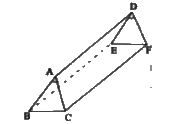 `ANGLEA` - angle of the PRISM BCFE - BASE of the prism ACFD ADN ABED are refracting rectangular faces. |
|
| 45. |
Explain why a bullet fired against a glass windowpane makes a hole in it but the glass pane is not cracked. |
| Answer» SOLUTION :Intially, the entire glass is in the state of rest. When a bullet strikes the glass pane, the part of the glass pane which comes in contact with the bullet immediately shares the large velocity of the bullet and files away MAKING a HOLE. The REMAINING part of the glass, remains at rest and is not cracked. | |
| 46. |
A charged particle is suspended at the center of two thin concentric spherical charged shells, made of nonconducting material. Figure shows cross section of the arrangement. Figure (b) gives the net flux phi through a Gaussian sphere centered on the particle, as a function of the radius r of the sphere. , In which range of the values of r is the electric field zero? |
|
Answer» `0 to r_A` `phi=(q_("in"))/(epsilon_(0))` or `2XX10^(5)=(q)/(8.85xx10^(-12))` or `q=1.77muC` ltBrgt Similarly `phi=-4xx10^(5)=(q+q_(A))/(epsilon_(0))"" q_(A)=-5.31muC` Where `q_(A)` is the charge on A. electric field is zero nowhere as `phi` is not zero anywhere. 
|
|
| 47. |
In a n-type semiconductor, which of the following statement is true? |
|
Answer» Electrons are majority CARRIERS and trivalent atoms are the dopants. |
|
| 48. |
A charged particle is suspended at the center of two thin concentric spherical charged shells, made of nonconducting material. Figure shows cross section of the arrangement. Figure (b) gives the net flux phi through a Gaussian sphere centered on the particle, as a function of the radius r of the sphere. , What is the charge on shell A? |
|
Answer» `5.31muC` `phi=(q_("in"))/(epsilon_(0))` or `2xx10^(5)=(q)/(8.85xx10^(-12))` or `q=1.77muC` LTBRGT SIMILARLY `phi=-4xx10^(5)=(q+q_(A))/(epsilon_(0))"" q_(A)=-5.31muC` Where `q_(A)` is the charge on A. electric field is zero nowhere as `phi` is not zero anywhere. 
|
|
| 49. |
A source of sound emitting a note of constant frequency is moving towards a stationary listener and then recedes from the listener with constant velocity maintained throughout the motion. The frequency heard by the listener (f). when plotted against time (t) will give the following curve(s). |
|
Answer»
|
|
| 50. |
A charged particle is suspended at the center of two thin concentric spherical charged shells, made of nonconducting material. Figure shows cross section of the arrangement. Figure (b) gives the net flux phi through a Gaussian sphere centered on the particle, as a function of the radius r of the sphere. , What is the charge on the central particle? |
|
Answer» `0.2 muC` `phi=(q_("in"))/(epsilon_(0))` or `2xx10^(5)=(q)/(8.85xx10^(-12))` or `q=1.77muC` LTBRGT Similarly `phi=-4xx10^(5)=(q+q_(A))/(epsilon_(0))"" q_(A)=-5.31muC` Where `q_(A)` is the charge on A. electric FIELD is zero nowhere as `phi` is not zero anywhere. 
|
|


