Saved Bookmarks
This section includes 7 InterviewSolutions, each offering curated multiple-choice questions to sharpen your Current Affairs knowledge and support exam preparation. Choose a topic below to get started.
| 1. |
……………is defined as drift velocity of charge developed per unit applied electric field. |
|
Answer» |
|
| 2. |
A flat square surface with sides of length L is described by the equations x = L, 0 lt y lt L,0 lt z lt L Find the electric flux through the square due to a positive point charge q located at the origin (x = 0, y = 0 z = 0) |
|
Answer» `(q)/(4 epsilon_(0))` |
|
| 3. |
In a potentiometer experiment, two cells connected in series get balanced at 9 m length of the wire. Now, if the connections of terminals of cell of lower emf are reversed, then the balancing length is obtained at 3 m. The ratio of emf's of two cells will be |
|
Answer» `1:2` |
|
| 4. |
Explain method to measure internal resistance of cell by using potentiometer. |
|
Answer» Solution :`rArr`As shown in FIGURE between point A and C, positive terminal of BATTERY (B) variable resistance R and key (K) are connected. `rArr` CELL whose internal resistance (r) is to be measured is connected in parallel with key `(K_(2))` and resistance box (R). `rArr` Positive of cell `(epsilon)` is connected with A and negative terminal of cell is connected with galvanometer Another end of galvanometer is connected with jockey key and moved on wire AC. When key `K_(2)` is open the null point obtained for zero DEFLECTION of galvanometer be `N_(1)`. Assume `AN_(1) = l_(1)` `thereforeepsilon = phi l_(1) ""` ...(1) `""` (For open circuit condition ) `rArr` When switch `K_(2)` is closed then current will pass through resistance box R and cell `(epsilon)`. Let null point obtained in this condition be `N_(2)`. Let `AN_(2) = l_(2)` `therefore ` If V is terminal voltage of cell `.epsilon.` then, `V = phi l_(2) ` .... (2) By taldng ratio of (1) and (2), `(epsilon)/(V) = (l_(1))/(l_(2))` but `epsilon ` = I (R + r) and V = IR `therefore (I (R + r))/(IR ) = (l_(1))/(l_(2))` `therefore (R + r)/(R) = (l_(1))/(l_(2))` `therefore 1 + (r)/(R) = (l_(1))/(l_(2))` `therefore (r)/(R) = (l_(1))/(l_(2)) - 1 ` `therefore r = R [ (l_(1) - l_(2))/(l_(2)) ] " or " r = R [ (l_(1))/(l_(2)) - 2 ] ` Advantage of potentiometer is suoh that cµrrent do not flow throughcell whose internal ressistance is to be measured. Hence, it do not affect internal resistance of the cell. |
|
| 5. |
Pure Si at 300 K has equal electron (n_(i)) concentrations of 1.5 xx 10^(16) m^(-3). Doping by indium increases n_(h) = 4.5 xx 10^(22) m^(-3). N_(e) in the doped Si is |
|
Answer» `5 xx 10^(9)` As PER GIVEN data, `n_(i?) =1.5 xx 10^(16) m^(-3)` `n_(h) = 4.5 xx10^(22) m^(-3)` Thus `n_(e)=(n_(i)^(2))/(n_(h)) =((1.5 xx10^(16))^(2)m^(-6))/(4.5 xx10^(22)m^(-3))=5.0 xx10^(9) m^(-3)`. |
|
| 6. |
निम्नलिखित में किसका उपयोग लेंस बनाने के लिए नहीं किया जा सकता |
|
Answer» प्लास्टिक |
|
| 7. |
In fig(a) electron is shot directly away from a uniformly charged plastic sheet, atspeed V_(s) the sheet is nonconducting flat , and very velical component versus time t until the return to the launch point. What is the sheet's surface charge density ? |
|
Answer» |
|
| 8. |
A battery B of emf 1.5V and internal resistance r=5Omega is first connected across a resistor of resistance 25Omega as in fig (a). Next, the same battery is connected across a resistor of resistance 52 as in fig (b). In which case, the voltmeter reading will be higher? |
|
Answer» SOLUTION :In the first CASE `I = (1.5)/(5+25) = (1.5)/(30)` and `V=1.5 - ((15)/(30)) 5 = 1.5 - 0.25 = 1.25 V ""….(1)` In the second case `i= (1.5)/(5+5) = (1.5)(10) and V=1.5 -((1.5)/(10))5 = 0.75 V ""….(2)` The voltmetre reading is HIGHER in the first case. |
|
| 9. |
When the transistor is used as an amplifier |
|
Answer» EMITTER - BASE JUNCTION must be reverse biased, Collector - base junction must be forwardbiased, |
|
| 10. |
The graphs of the equations 6x - 2y + 9 = 0 and 3x -y + 12 = 0 lines which are |
|
Answer» Coincident |
|
| 11. |
The diathermanous is |
|
Answer» a MEDIUM which does not ALLOW HEAT radiation |
|
| 12. |
The amount of work done in increasing the size of a soap film 10 cm x 6 cm to 10 cm x 10 cm is (surface tension T = 0·030 Nim) : |
|
Answer» `2.4xx10^(-2)J` Since soap bubble has TWO free surfaces. `therefore` Increase in area= `2 [10 xx 10- 10 xx 6] = 80 cm^(2)` `therefore` Work done= `0·030 xx 80 xx 10^(-4) = 2·4 xx 10^(-4) J`. Thus the correct choice is (B). |
|
| 13. |
How old was tommy? |
|
Answer» 13 |
|
| 14. |
A radioactive substance decays for an intervalof time equal to its mean life. Find the fraction of the amount of the substance which is left undecayed after this time interval. |
|
Answer» Solution :We know that `N_(t)=N_(0)e^(-LAMBDA t)` and AVERAGE (mean) life `TAU= (1)/(lambda)`, hence amount of substance left undecayed after a TIME interval `tau` will be `N_(tau)=N_(0) e^(-lambda t)=N_(0).e^(-lambda((1)/(lambda)))=N_(0) e^(-1)=(N_(0))/(e )=0.368N_(0)` `rArr (N_(tau))/(N_(0))=(1)/(e )=0.368` |
|
| 15. |
In a biprism experiment, the wavelength of monochromatic light is 6000overset@A. The distance between the two virtual images is 6 mm. The number of fringes formed per mm on a screen placed at a distance of 1 m is : |
|
Answer» 5 |
|
| 16. |
A yo-yo has a rotational inertia of 950 g cm^(2) and a mass of 120 g. Its axle radius is 3.2 mm, and its string is 120 cm long. The yo-yo rolls from rest down to the end of the string. (a) What is the magnitude of its linear acceleration? (b) How long does it take to reach the end of the string? As it reaches the end of the string, what are its (c) linear speed, (d) translational kinetic energy, (e) rotational kinetic energy, and (f) angular speed? |
| Answer» SOLUTION :(a) `~~13 cm//s^(2)`, (b) `~~4.4 s`, (c) `55 cm//s`, (d) `1.8 XX 10^(-2)` J, (e) `~~1.4 J`, (f) `27 "rev"//s` | |
| 17. |
In the circuit shown, which way would you move the sliding contact, to the left or to the right, in order to increase current through resistance R_(1) ? What will happen to current through R_(2) as you move the contact? |
|
Answer» |
|
| 18. |
What did Anju bring next day? |
|
Answer» A CAKE to celebrate MITRA's arrival |
|
| 19. |
The capacity of a parallel plate air condenser is 10muFIt is given a charge of 40 Ms. The electric energy stroed in capacitor is ... erg : |
|
Answer» 200 |
|
| 20. |
How is a wavefront defined? Using Huygen'sconstruction , draw a figure showing the propagation of a plane wave refractingat a plane surface separatingtwo media. Hence verify Snell's law of refraction. |
|
Answer» Solution :(i) Wavefront : The continuous locus of all the particles of amedium, which are vibrating in the same phase is called a wavefront. (ii) Snell's law of refraction : Let PP' represent the surface SEPARATING medium 1 and medium 2 as shown in FIG. Let `v_(1) and v_(2)` represent the speed of light in medium 1 and medium 2 respectively. We assume a plane wavefront AB propagating in the direction A' A incident on the interface at an angle i. Let i be the taken by the wavefront to travel the distance BC. `:. BC=v_(1)t` [distance = speed `xx`time] In order to determine the shape of the refracted wavefront, we draw a sphere of radius `v_(2) t` from the point A in the second medium (the speed of the wave in second medium is `v_(2)`). Let CE represent a tangent plane drawn from the point C. Then `AE=v_(2)t`. `:.` CE would represent the refracted wavefront. In `DeltaABC and DeltaAEC`, we have `sin i = (BC)/(AC)=(v_(1)t)/(AC) and sin r=(AE)/(AC)=(v_(2)t)/(AC)` where i and r are the ANGLES of incidentand refraction respectively. `:. (sin i)/(sin r)=(v_(1)t)/(AC). (AC)/(v_(2)t) rArr (sin i)/(sinr)=(v_(1))/(v_(2))` If C represents the speed of light in vacuum, then `n_(1)=(C)/(v_(1)) and n_(2)=(C)/(v_(2))` `rArr v_(1)=(C)/(n_(1)) andv_(2)=(C)/(n_(2))` where `n_(1) and n_(2)` are the refractive indices of medium 1 and medium 2. `:. (sin i)/(sin r)=(C//n_(1))/(C//n_(2)) rArr (sin i)/(sin r) = (n_(2))/(n_(1)) rArr n_(1) sin i=n_(2) sin r` This is theSnell's law of refraction. 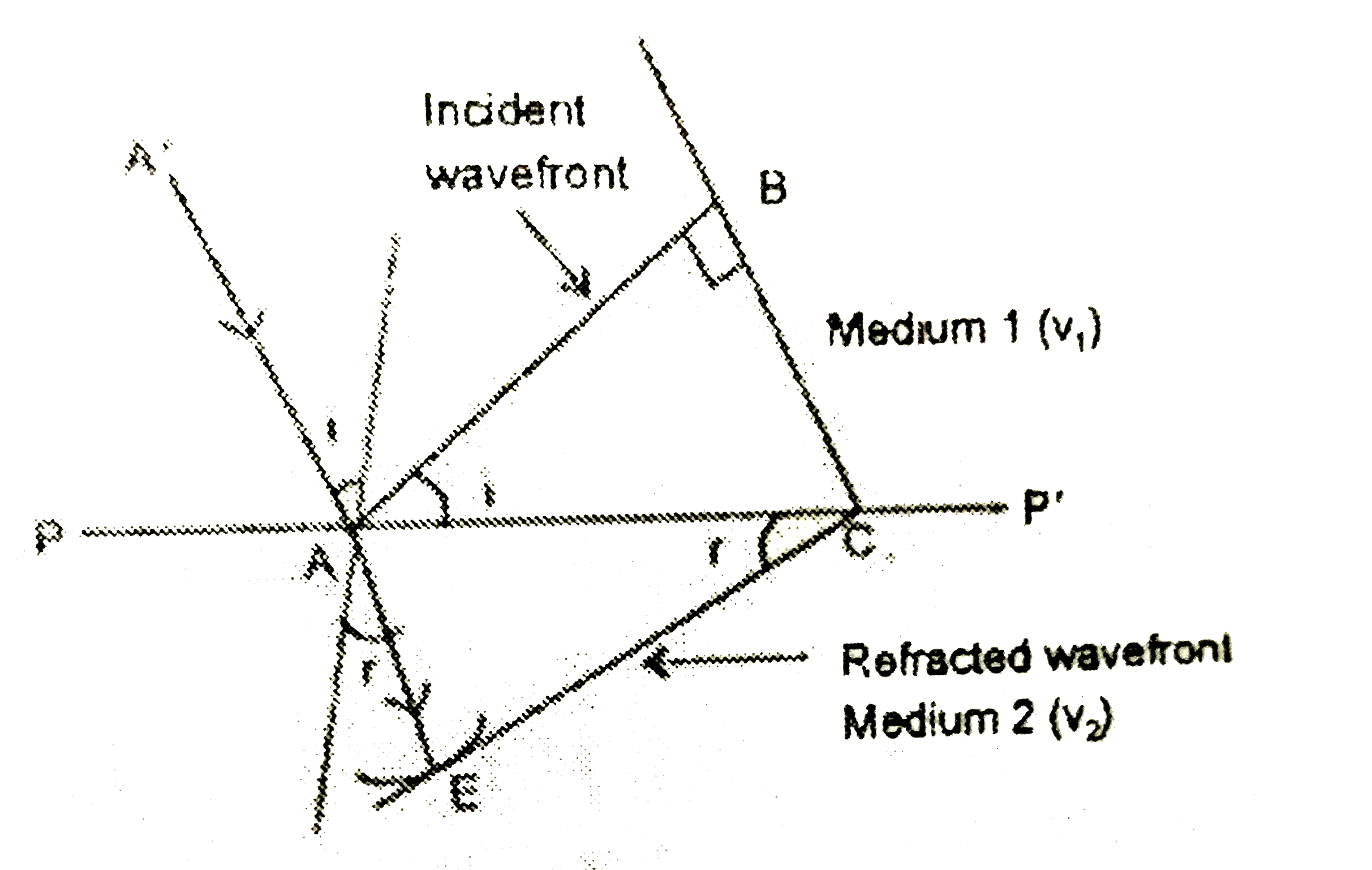
|
|
| 21. |
Obtain the binding energy of the nuclei ""_(26)^(56)Fe and ""_(83)^(209)Biin units of MeV from the following data: m (""_(26)^(56)Fe ) = 55.934939 u"" m (""_(83)^(209)Bi ) = 208.980388 u |
| Answer» SOLUTION :8.79 MEV, 7.84 MeV | |
| 22. |
The charges each of +Q and -Q coulomb are placed at corners A and B of an equilateral triangle ABC of side 'a'cm. 'D' is the mid point of AB. The work done if a charge of 'q' is moved from D to C is: |
|
Answer» ZERO |
|
| 23. |
Two pendulums oscillate in S.H.M. with a constant phase difference (pi)/(2) but with same amplitudes. Themaximum velocity of one is v, the maximum velocity of other will be : |
|
Answer» V |
|
| 24. |
y=5 |
|
Answer»
|
|
| 25. |
A coin is at the bottom of a trough containing three immiscible liquids of refractive indies 1.3. 1.4 and 1.5.poured one above the other of height 30 cm, 16 cm, and 20 cm respectively. What is the apparent depth at which the coin appers to be when seen from airmedium outside? In which medium the coin will be seen? |
Answer» Solution :When seen from top, the coin willstill appear to be at the bottom with each medium appearing to have with respect to the air medium outside. This SITUATION is ILLUSTRATED below.  The equation for apparent DEPTH for each medium is, `d_(1)=(d_(1))/(n_(1)),d_(2)=(d_(2))/(n_(2)),d_(3)=(d_(3))/(n_(3))` `d.=d_(1)+d_(2)+d_(3)=(d_(1))/(n_(1))+(d_(2))/(n_(2))+(d_(3))/(n_(3))` `d.=(30)/(1.3)+(16)/(1.4)+(30)/(1.5)=23.1+11.4+13.3` d. = 47.8 cm |
|
| 26. |
If a bar magnet of magnetic moment M is freely suspended in a uniform magnetic field of strength B , the work done in rotating the magnet through an "angle"theta is |
|
Answer» `MB(1-sintheta)` |
|
| 27. |
What are the technological applications of total internal reflection in nature ? Briefly explain it. |
| Answer» Solution :MIRAGE, sparkling of DIAGRAM, TOTAL reflecting prisms, optical FIBRE. | |
| 28. |
(a) Using de Broglie's hypothesis, explain with the help of a suitable diagram, Bohr's second postulate of quantization of energy levels in a hydrogen atom. The ground state energy of hydrogen atom is -13.6 eV. What are the kinetic and potential energies of the electron in this state ? |
|
Answer» <P> Solution :(a) `LAMBDA=(H)/(p)=(h)/(mv)``2pir = N lambda` `2pir =n(h)/(mv)` `rArr mvr=L =(nh)/(2pi)`  (b) Kinetic energy =13.6eV Potential energy =-27.2 eV |
|
| 30. |
In question 28, the equivalent resistances |
|
Answer» between 0 and 2 is `R//3` SINCE 1, 2, and 3 are all at same potential, so equivalent resistance between 0 and 1, 0 and 2m and 0 and 3 are all equal. Further, all three SIDE resistances will have no current in them, so they can be removed. The middle three resistances will be in PARALLEL between 0 and 1. So equivalent resistance between 0 and 1 is `R//3` . |
|
| 31. |
Equipotential surface through a point is………… to the electric field at that point. |
|
Answer» PARALLEL |
|
| 32. |
A gas has been subjected to isothermal-isochoric cycle 1-2-3-4-1 (Fig.). Plot the graph of this cycle in p-V, p-rho, and p-T coordinates. |
Answer» SOLUTION :The CYCLES are SHOWN in FIGS. 
|
|
| 33. |
Light of wavelength lambda is incident on a slit of width d. The resulting diffraction pattern is observed on a screen at a distance D.The linear width of the principal maximum is then equal to the width of the slit if D equals : |
|
Answer» `(d)/(lambda)` As CENTRAL max. = d `D = (d)^(2)/(2lambda)` |
|
| 34. |
Explain Ohm's law. |
|
Answer» Solution :At constant temperature the current passing through a conductor is proportional to the potential difference between its ends. If I is the strength of current flow through the conductor when the p.d. ACROSS its ends is V volt. Then `I prop V` V=IR R is a constant called ELECTRICAL resistance. Its value depends on the nature of the material of conductor, dimensions and temperature of the conductor. Ohm.s law gives the relation between the current and voltage. It is not a universal law. It is not APPLICABLE for all substances. It is applicable only at constant temperature. |
|
| 35. |
A particle is projected fro the ground with an initial speed v at an angle theta withhorizontal. The average velocity of the particle between its point of projection and highest point trajectory is |
Answer» Solution :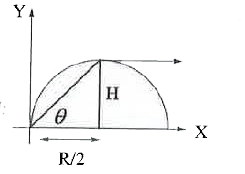 `vecv_(AVG)=(vecv+vecu)/(2)=(U cos THETA hati)+(u cos theta hati+ u SIN theta HATJ))/(2)` `v_(av)=(v)/(2) sqrt(1+3 cos^(2) theta)` |
|
| 36. |
If the potential energy of body on a planet is numerically U and the escape velocity for the same body is v_(e ) for same planet then (U)/(v_(e )) will be : |
|
Answer» `m sqrt((GM)/(2R))` `U=(GMm)/(R ) "" ` (NUMERICALLY) Escape velocity is `v_(E )=sqrt((2GM)/(R )) ` `THEREFORE (U)/(v_(e ))=(GMm)/(R ) xx sqrt((R )/(2GM))` `therefore (U)/(v_(e )) =m sqrt((GM)/(2R))`. THUS correct choice is (a). |
|
| 37. |
The collector plate in an experiment on photo electric effect is kept vertically above the emitter plate. Light source is put on and a saturation photo current is recorded. Parallel electric and magnetic fields are applied vertically downwards between the plates. Then |
|
Answer» The photo current will INCREASE |
|
| 38. |
Why do the electric field lines never cross each other ? |
| Answer» Solution :The tangent to a line of ELECTRIC field at any point gives the DIRECTION of the electric field atthat point. If any two lines of electric field CROSS each other, then at the intersection point, there would be two tangents and HENCE two directions for electric field, which is not possible, Hence, the electric field lines do not cross each other. | |
| 39. |
The frequency of a source of sound as measured by an observer when the source is moving towardshim with a speed of 30 m/s is 720 Hz. The apparent frequency when the source is moving away after crossing the observer is x xx 10^2 Hz what is the value of x. ......... (velocity of sound is 330 m/s) |
|
Answer» |
|
| 40. |
A resistor of 100Omega, a pure inductance coil of L=0.5 H and capacitor are in series in a circuit containing an a.c. source of 200 V , 50 Hz . In the circuit , current is ahead of the voltage by 30^@. Find the value of the capacitance. |
|
Answer» Solution :Here `R=100Omega`, L=0.5 H, C= ? , V=200 V , f=50 HZ, `f=30^@` We have, `TAN phi=(X_C-X_L)/R` `tan 30^@ =(X_C-X_L)/100 "" because X_L=omegaL` & `X_C=1/(omegaC)` `0.5xx100=1/(2pifC)-2pifL(because omega=2pif)` `0.5xx100=1/(2xx3.14xx50C)-2xx3.14xx50xx0.5` `50=1/(314C)-157` `50+157=1/(314C)` `207=1/(314C)` `C=1/64998=0.00001538` C=15.38 `muF` |
|
| 41. |
Two coherent sources S_(1) and S_(2) are situated as shown in figure. Here S_(1) is fixed but S_(2) is performing SHM with amplitude 2cm. Initially S_(2) is at right extem. At time t=(pi)/(2omega) (where omega= angular frequency of SHM) : |
|
Answer» Phase difference between waves PRODUCE by `S_(1)` and `S_(2)` at point `P` is `(pi)/2` `/_\phi=(2pi)/16xx4=(pi)/2` `I=4I_(0)"COS"^(2)(pi)/4=2I_(0)` |
|
| 42. |
The orbital period of sa satellite near the surface of the planet of radius Ris given by (rho is the density of the planet): |
|
Answer» `(3PI)/(rho G)^(1//2)` `&v=(2pir)/(T)` `therefore T=(2pir^(3//2))/(GM)^(1//2)` `For r =R & M = (4)/(3) pi R^(3) rho` `T=((3pi)/(rhoG))` |
|
| 43. |
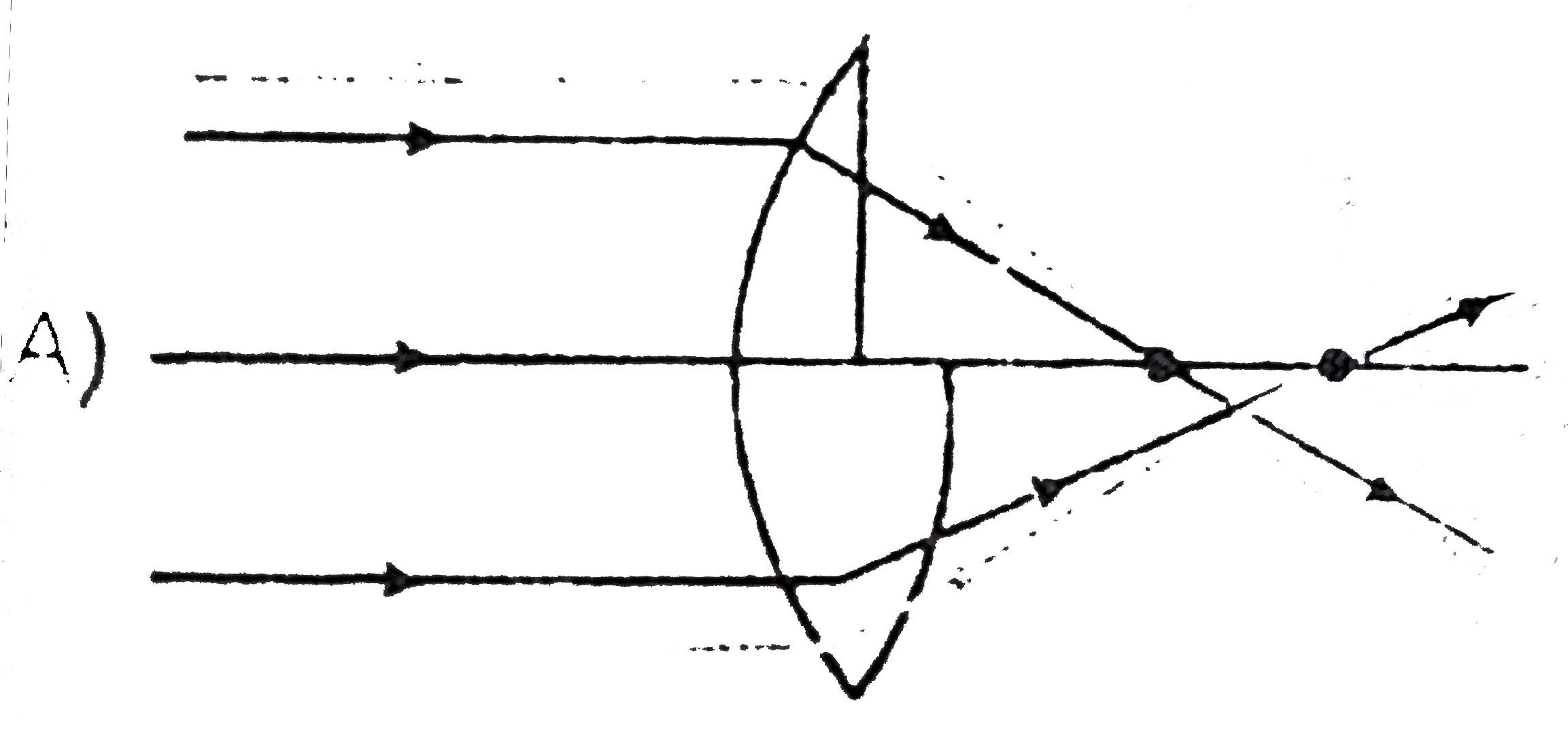
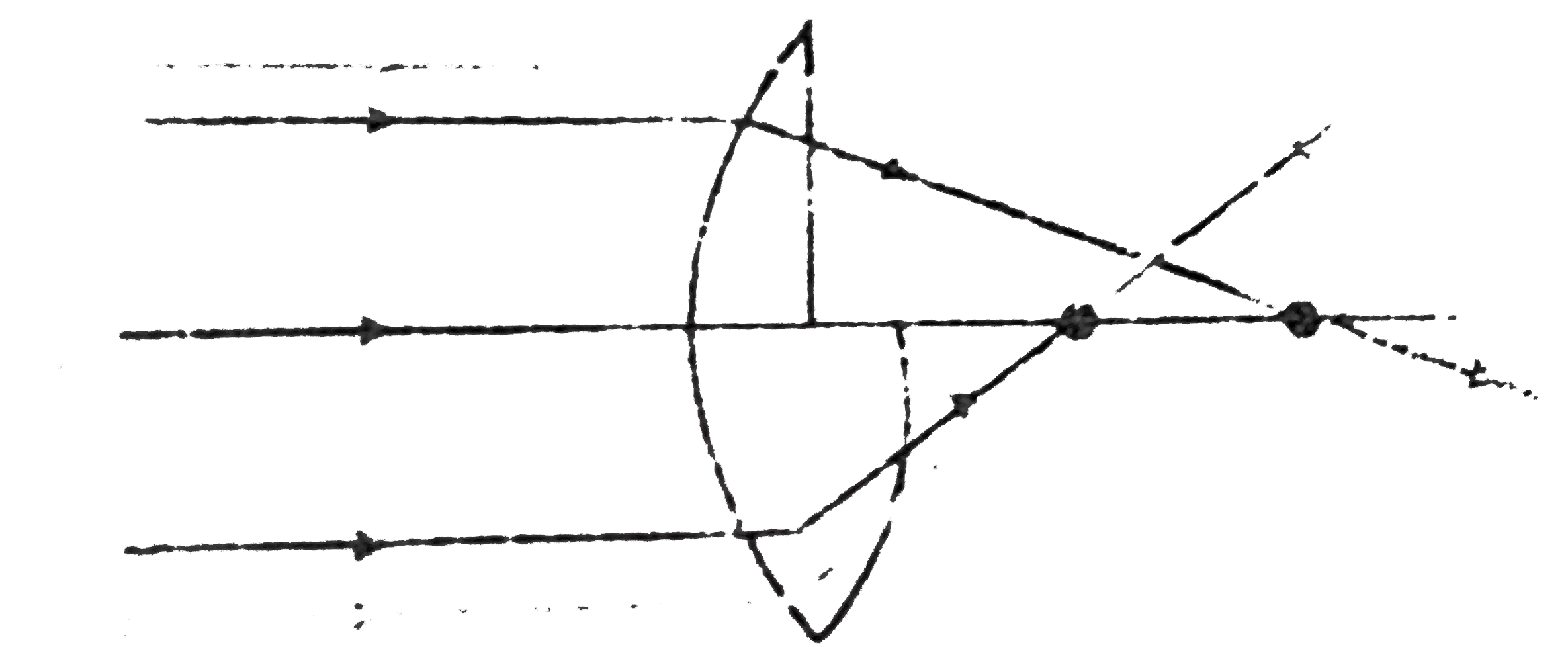
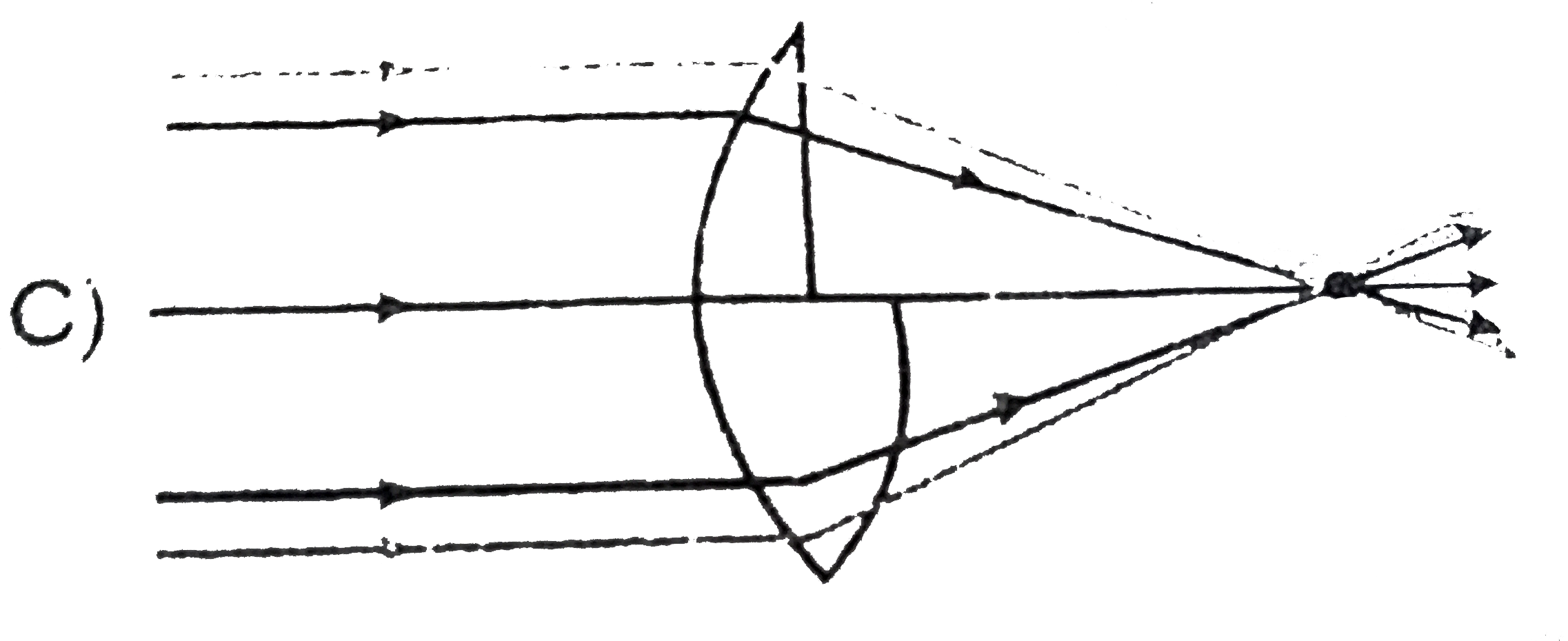
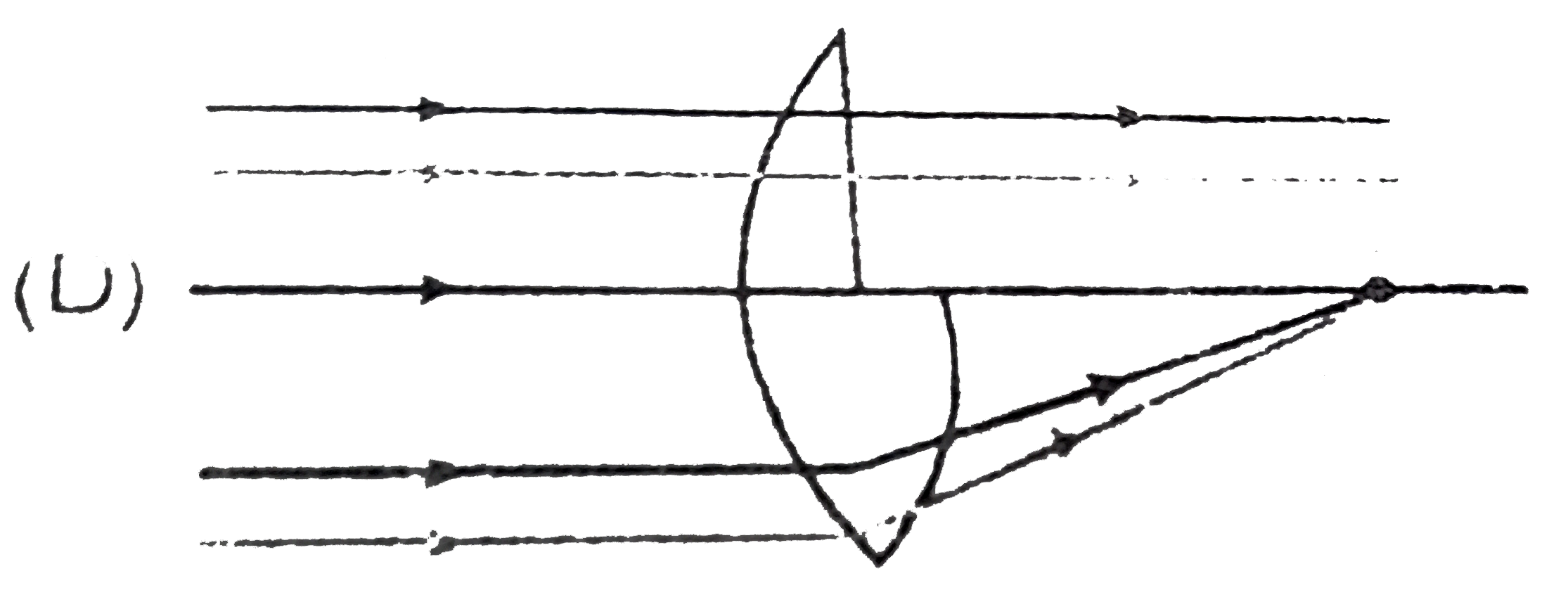
Choose the correct ray diagram of an equi convex lens which is cut as shown. |
|
Answer»
`rArr (1)/(f_("up"))=(mu_("rel")-1)(1)/(R)` `(1)/(f_("low"))=(mu_("rel")-1) (2)/(R)` `rArr (f_("lower"))/(f_("UPPER")) =(1)/(2)` `rArr f_("upp")=2 f_("lower")` Image by upper part will be at larger DISTANCE.\ |
|
| 44. |
Define electrostatic potential energy. |
| Answer» Solution :The potential energy of a system of point charges may be DEFINED as the AMOUNT of work done m assembling the charges at their LOCATIONS by bringing them in from infinity. | |
| 45. |
Initially the switch 'S' is open for a ling time. Now the switch 'S' is closed at t=0(R_(1)=2Omega, R_(2)=2Omega, C_(1)=1F and C_(2)=1F) Then |
|
Answer» The current through the WIRE `AB` at `t=2` sec is `1//2e` ampere 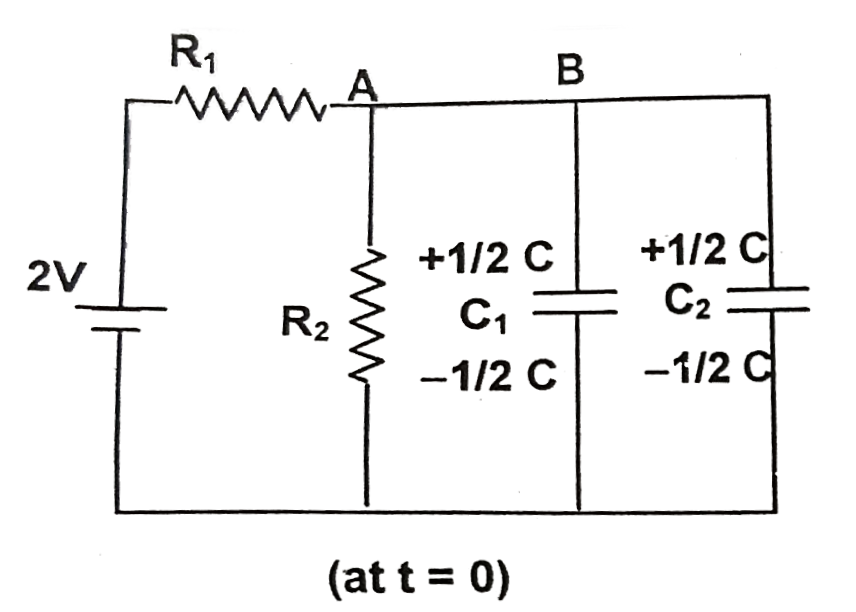 When the switch is closed then at `t=0` the distribution of the charge is shown in the figure. 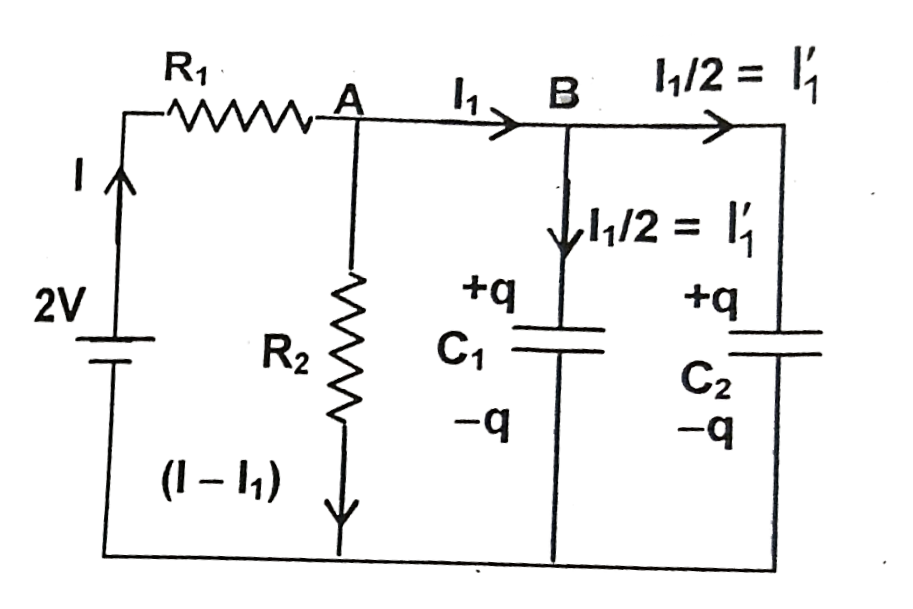 By applying Kirchooff's Law `I_(1)^(')=((1-q))/2` `int_(1//2)^(q) (dq)/(1-q)=int_(0)^(1) (dt)/2` `q=(1-1/2e^(-t//2))` `I_(1)^(')=(dq)/(dt)=1/4 e^(-t//2)` |
|
| 46. |
When Sun's rays pass through small holes in the ventilator of a room, they produce elliptical spots on the floor. The major and minor axes of the ellipses are a=4.9cm and b=4.6cm respectively. What is the height of the room? The angular dimensions of the Sun's disc are beta=(1)/(100)rad. |
|
Answer» |
|
| 47. |
The water level in a vertical glass tube 1.00 m long can be adjusted to any position in the tube. A tuning fork vibrating at 900 Hz is held just over the open top end of the tube, to set up a standing wave of sound in the air-filled top portion of the tube. (That airfilled top portion acts as a tube with one end closed and the other end open.) (a) For how many different positions of the water level will sound from the fork set up resonance in the tube's air-filled portion? What are the (b) least and (c ) second least water heights in the tube for resonance to occur? |
| Answer» SOLUTION :(a) 5 values of n (n= 1,3,5,7,9) , (B) n = 9 with h = 0.143m , (C ) n= 7 with h =0.333 m | |
| 48. |
What is the angle of dip at a place where the horizontal component of the earth's magnetic field is 1/sqrt3 times the vertical component ? |
|
Answer» Solution :If `theta` is the angle of dip, `TANTHETA = B_V/B_H = (B_Vsqrt3)/B_V = SQRT3 ` `THEREFORE ` angle of dip `theta = tan^-1 sqrt3 = 60^@` |
|
| 49. |
If two adjacent walls and the ceilling of a rectangular room are mirror surfaced, then how many images of himself, a man can see? |
|
Answer» 3 |
|