

Saved Bookmarks
This section includes 7 InterviewSolutions, each offering curated multiple-choice questions to sharpen your Current Affairs knowledge and support exam preparation. Choose a topic below to get started.
| 1. |
A simple pendulum of length 1 oscillates aboμt the mean position as shown in the figure. If the total energy of the pendulum is E, the velocity of the pendulum bob of mass m at point P is: |
|
Answer» `sqrt((2E)/( m) - (GL)/( h^2) )` |
|
| 2. |
Describe schmattecally, the equipotential surfaces corresponding to(a) a constant electricfield in the Z-direction (b) a field that uniformly increases in magnitudebut remains in a constant, say z direction (c ) a single positive charge at the origin. (d) a uniformgrid consistingof long equally spacedparallel charged wires in a plane. |
|
Answer» Solution :By defination, an equipotentialsurface is that at EVERY point of whichpotentialis the same. In the four cases given above : (a) EQUIPOTENTIAL SURFACES are planesparallel to X-Y plane. These are equidistant. (b) Eequipotential surfaces are planes parallel to X-Y plane. As the field increases uniformly, distance betweenthe planes (differeng by fixed potential) decreases. (c) Equipotentail surfaces are concetric spheres with origin at the center. (d) Equipotential surfaces have the surfaces have the shapewhich changesperiodically. At far off distancesfrom the grid, the shape of equipotenial surfaces BECOMES parallel to the grid itself. |
|
| 3. |
Define critical angle. Obtain a relation between the refractive index and critical angle for a pair of media. Does critical angle depend on the colour of light ? Explain. |
|
Answer» Solution :For definition, see Point Number 25 under the HEADING "CHAPTER At A Glance". Let as shown in Fig. 9.36, `i_c` be the critical ANGLE in an optically denser Rarer medium medium number 1 for which angle of refraction in rarer mediumnumber 2 is 90°. Then, from Snell.s law, we have `(sini_( c))/(SIN 90^(@)) = n_(21) = 1/n_(12)` But, `sin 90^(@)=1`, hence, `sin i_(c ) = n_(21) = 1/n_(12) =n_(2)/n_(1) ( or sin i_( c) = n_(rd) = 1/n_(dr)`)  Yes, critical angle depends on the COLOUR of light. We know that refractive index is least for red coloured light and maximum for violet colour light. As a result critical angle for a given pair of media is least for violet colour and has a maximum value for red colour. |
|
| 4. |
A particle with specific charge q//mmoves in the region of space where there are unifrommutuallyperpendicularelectric and magneticfieldswith strengthE and inductionB (fig). At the momentt = 0 the particlewas locatedat the pointO and had zero velocity. Forthe non-relativisticcase find: (a) the law of motionx(f) and y(t) of theparticle, the shape of the trajectory, (b) the lenghtof the segment of the trajectory betweentwo nearestpoints at whichthevelocityof the particleturns into zero, (c) the meanvalue of the particle's velocityvectorprojectionson the x axis(the drift velocity). |
|
Answer» Solution :The equaciton of motion is, `m(d^(2) vec(R))/(dt^(2)) = q(vec(E) + vec(v) xx vec(B))` Now, `vec(v) xx vec(B) = |(HATI,hatj,hatk),(DOT(x),dot(y),dot(z)),(0,0,B)| = vec(i) B doty - vec(j) B dotx` So, the equaction becomes, `(dv_(x))/(dt) = (q B v_(y))/(m), (dv_(y))/(dt) = (qE)/(m) - (qB)/(m) v_(x)`, and `(dv_(z))/(dt) = 0` Here, `v_(x) = dotx, v_(y) = doty, v_(z) = dotz`. The last equactions is easy to intergate, `v_(z)` = CONSTANT = 0, since `v_(z)` is zeroinitially. Thusintergating again, `z` = constant = 0, and motionis condifned to the `x-y` plane. We now multiply the secoundequaction by `i` and add to the first equatiion. `xi = v_(x) + iv_(y)` we get the equation, `(d xi)/(dt) =i omega xi omega = (qB)/(m)` This equation afterbeing mutiplied by `e^(i omega t)` can be rewrittenas, `(d)/(dt) (xi e^(iomega t)) = i omega e^(i omega t) (E)/(B)` and intergrated at once to give, `xi = (E)/(B) + C e^(-i omega t -i alpha)`, where `C` and `alpha` two real constants. Takingreal andimaginary parts. `v_(x) = (E)/(B) + C cso (omega t + alpha)` and`v_(y) = -C sin (omega t + alpha)` Since `v_(y) = 0`, when `t = 0`, we can takek `alpha = 0`, then`v_(x) = 0` at `t = 0` gives, `C = - (E)/(B)` we get, `v_(x) = (E)/(B) (1 - cos omega t)` and`v_(y) = (E)/(B) sin omega t`. Intergating again and using `x = y = 0`, at `t = 0`, we get `x(t) = (E)/(B) (t -(sin omega t)/(omega)), y(t) = (E)/(omega B) (1 - cos omegat)`. This is the equcation of a cycloid. (b) The velocityis zero, when `omega t = 2n pi`. We see that `v^(2) = v_(x)^(2) + v_(y)^(2) = ((E)/(B))^(2) (2 - 2 cos omega t)` pr, `v = (dx)/(dt) = (2E)/(B) |"sin" (omega t)/(2)|` The quanttiy inside the modulus is positive for `0 lt omega t lt 2pi`. Thuswe candropthe modulusand write for the distancetraversedbetween two successikve zeroesof velocity. `S = (4E)/(omega B) (1 - "cos" (omega)/(2))` Putting`omega t = 2pi`, we get `S = (8E)/(omega B) = (8 mE)/(q B^(2))` (c) The drift velocity is the x-directionand has the magnitude, `lt v_(s)gt = lt(E)/(B) (1 - cos omega t) gt = (E)/(B)`. |
|
| 5. |
(a) Find the energy needed to remove a neutron from the nucleus of the calcium isotopes ._(20)^(42)Ca (b) Find the energy needed to remove a proton from this nucleus (c ) Why are these energies different ? Atomic masses of ._(20)^(41)Ca and ._(20)^(42)Ca are 40.962278 u and 41.958622 u respectively. |
|
Answer» Solution :(a) Removing a neutron from `._(20)^(42)Ca` leaves `._(20)^(41)Ca`. The mass of `._(20)^(41)Ca` plus the mass of a free neutron is: `40.962278 u +1.008665 u =41.970943 u` The difference between this mass and the mass of `._(20)^(42)Ca` is `0.012321 u` , so the binding ENERGY of the mission neutron is: `(0.012321 u) (931.49 MeV//u)=11.48 MeV` (B) Removing a proton from `._(20)^(42)Ca` leaves the potassium isotope `._(19)^(41)K`. A similar CALCULATION gives a binding energy of `10.27 MeV` for the missing proton. (C ) The neutron was acted upon only by attractive nuclear whereas the proton was also acted upon by repulsive ELECTRIC forces that decrease its binding energy. |
|
| 6. |
A wire of 10^(-2) kgm^(-1) passes over a frictionless light pulley fixed on the top of a frictionless inclined plane which makes an angle of 30° with the horizontal. Masses m and M are tied at two ends of wire such that m rests, on the plane and M hungs free!) vertically downwards. The entire system is in equilibrium arid a transverse .jvave propagates along the wire with a velocity of 100 ms^(-1). Then |
|
Answer» M = 5 KG |
|
| 7. |
Two plates are 1 cm aprt and the potential difference between them is 10 V. the electric field between the plates is |
|
Answer» `10 NC^(1)` |
|
| 8. |
In the depletion region of a diode |
|
Answer» there are no mobile charges Inside a depletion layer, as many electrons are freed by breaking of covalent bonds, that many holes are produced. Hencedepletion layer is electrically neutral. Hence option (B) is also correct. Inside a depletion layer, there are positive and negative ions at fixed locations in the crystalline structure. Thus, option (D) is also correct. |
|
| 9. |
Can the instantaneous power output of an ac source ever be negative ? Can the average power output be negative ? |
|
Answer» Solution :Let the applied EMF, `E=E_m sin OMEGAT` and current DEVELOPED is, `I=I_m sin (omegatpmphi)` (Here E is taken INSTEAD of V) Instantaneous power output of the AC source, P=EI `=E_m sin omegat xx I_m sin (omegat + phi)` `=(E_m I_m)/2 [2 sin omegat sin (omegat+phi)]` `=(E_m I_m)/2 [cos phi - cos (2omegat+phi)]` .....(1) [`because` 2sinAsinB=cos(A-B) -cos(A+B)] (i) from equation (1), If cos `phi lt cos (2omegat+phi)`, then P `lt` 0 mean negative power `therefore` Yes, the instantaneous power output of an AC source can be negative . `therefore` Average power `lt P gt =V_m/sqrt2 I_m/sqrt2 cos phi` `lt P gt =V_"rms" I_"rms" cos phi`...(2) where `phi` is phase difference . (ii) and from equation (2) `lt P gt gt 0` because cos`phi=R/Z gt 0` No, the average power output of an AC source cannot be negative . |
|
| 10. |
A 1,00,000 kg engine is moving up a slope of gradient 5^(@) at a speed of 100 m/h. The coefficient of friction between the engine and rails is 0.1. If the engine ahs an efficiency of 4% for converting heat into work, find the amount of coal the engine has to burn up in one hour ( burning of 1 kg of coal yields 50,000 J ) |
|
Answer» `9.23xx10^(4)`KG |
|
| 11. |
In Figure, a broad beam of light of wavelength 420 nm is incident at 90^(@) on a thin, wedge-shaped film with index of refraction 1.70. Transmission gives 10 bright and 9 daik fringes along the film's length. What is the left- to-right change in film thickness? |
| Answer» SOLUTION :1.11 `MU m` | |
| 12. |
The lines of force are far apart, when electric field E is ..................... . |
|
Answer» |
|
| 13. |
When a unit positive charge moves from one point to another point in an electric field, work done on it ...... |
|
Answer» is ZERO. |
|
| 14. |
(a) Shown below with what angular speed 'omega' must 'm' with a radius 'r' rotate on a frictionless table so that 'M' does not move ?(b) If m=1.0kg, M=10.0 kg and r=0.5 m, find omega. |
|
Answer» SOLUTION :(a) Tension in the string = Weight of the hanging mass M. The tension in the string supplies the required CENTRIPETAL force to the body of mass m to revolve in a circular orbit of RADIUS r. 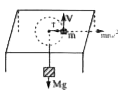 `T=mr omega^(2)` `therefore mr omega^(2)=Mg` Angular speed, `omega = SQRT((Mg)/(mr))=sqrt((10xx9.8)/(1xx0.5))=sqrt(196)=14 RAD s^(-1)`. |
|
| 15. |
What is inductive reactance ? |
|
Answer» Solution :Inductive reactance is the OPPOSITION offered by the inductor to the flow of current,and is given by `X_L= omega_L` where `OMEGA` = ANGULAR frequency of current. L = SELF inducatance. |
|
| 16. |
Given that force (F) is given F=Pt^(-1)+Qt. Here t is time. The unit of P is same as that of : |
|
Answer» displacement `Pt^(-1)=F` or `P=(Fxx1)/(t^(-1))=Fxxt=` momentum `:.(d)` is correct choice. |
|
| 17. |
Which of these options are not a function of ribosomes? I)It helps in manufacture of protein molecules II) It helps in manufacture of enzymes. III. It helps in manufacture of hormonesIV. In helps in manufacture of starch molecules. |
|
Answer» I and II |
|
| 18. |
As the intensity of radiation incident on a photosensitive material increases |
|
Answer» photoelectric current increases. |
|
| 19. |
In the following circuit, if the input wave form is as shown in the figure, what will be the wave form (i) across R in Fig.and (ii) across the diode in Fig. Assume that the diode is ideal. |
|
Answer» SOLUTION :(i) During the POSITIVE half of wave form, p-n junction is forward biased. Due to it we get output voltage ACROSS R. During NEGATIVE half of waveform, p-n junction is reversed biased. No output across R. (II) During the positive half of waveform, p-n junction is reverse biased and during negative half of wavefrom, p-n junction is forward biased. |
|
| 20. |
A clinic lines are thelines joiningplaces of |
|
Answer» ZERO DIP |
|
| 21. |
Statement 1: Equal quantities of salt is dissolved in two identical vessels filled with water m gm large crystal of salt is dissolved in vessel 1.In vessel 2 m gm salt power isadded. In both the cases salt and water had initially same, temperature. When the salt gets completely dissolved in water the temperature will behigher in vessel 2. because Statement 2: Energy required to dissolve salt crystal will bemore than the energy required to dissolve salt powder. |
|
Answer» Statement -1 is TRUE, Statement -2, is true, Statement-2 is a CORRECT EXPLANATION for statement-1. |
|
| 23. |
A compound slab is composed of two parallel layers of different materials with thickness 3 cm and 2 cm. The temp of outer face of the slab are maintained at 100^(@)C and 0^(@)C If the conductivities are 0.36 and 0.16 cgs units, then the temp. of junction is : |
|
Answer» `40^(@)C` `H_(1)=H_(2)`. `(k_(1)A(T_(1)-T))/(d_(1))=(k_(2)A(T-T_(2)))/(d_(2))` `(0.3xx(100-T))/(3)=(0.16xx(T-0))/(2)` `rArr""T=60^(@)c` Thus correct CHOICE is (b). |
|
| 24. |
Choose the only false statement from the following. |
|
Answer» In conductors the value of conduction BANDS may overlap. The resistivity (reciprocal of conductivity) DECREASES with increasing temperature. |
|
| 25. |
The magnetic induction at 10 cm from the centre of dipole is 4 xx 10^(-8) Wb xx m^2 along its equator, then its moment is : (mu_0 = 4 pi xx 10^(-7)SI units) |
|
Answer» `1.6pi XX 10^(-15) Am^2` |
|
| 26. |
When 2.5Omega shunt is connected with 25Omega resistance of galvanometer, what fraction of total current I would pass through galvanometer? |
|
Answer» `I_(G)/I=1/11` = `Ixx2.5/(2.5+25)` `thereforeI_(G)/I=2.5/27.5=1/11` |
|
| 27. |
A solenoid of 1000 turns is wound uniform on a glass tube of 50cm long and 10 cm in diameter. Find the strength of magnetic field at the centre of solenoid when 0.1 amp current is flowing through it |
|
Answer» 200 AMP-turns/meter |
|
| 28. |
block of mass 2 kg is resting on frictionless table. If it is struck by a jet releasing water at the rate of 1 kg/s and at the speed of 5 m/s, find initial acceleration of the block : |
|
Answer» `1.5 m//s^(2)` Now`a=(F)/(m)=2.5m//s^(2)` HENCE the CORRECT choice is (c) |
|
| 30. |
A closely wound solenoid of 2000 turns and area of cross-section 1.6 xx 10^(-4)m^(2)? carrying a current of 4.0 A. is suspended through its centre allowing it to turn in a horizontal plane. (a) What is the magnetic moment associated with the solenoid? (b) What is the force and torque on the solenoid if a uniform horizontal magnetic field of 7.5 xx 10^(-2)T is set up at an angle of 30^@ with the axis of the solenoid? |
|
Answer» Solution :(a) MAGNETIC moment of current carrying solenoid, `m_(s) = NIA` `therefore m_(s) = (2000) (4) (1.6 XX 10^(-4) )` `=1.28 Am^(2)` (b) (i) Resultant force exerted on a magnet in a UNIFORM exerted magnetic field is, `overset(to)(F) = -q_(m) overset(to)(B) + q_(m) overset(to) (B) = overset(to) (0)` (Where, `q_(m)=` pole strength of either pole of a magnet) (II) Torque exerted on above solenoid, `tau = m_(s) B sin theta` `= (1.28) (7.5 xx 10^(-2) ) (sin 30^(@) )` `= (1.28 ) (0.075 ) (0.5)` `= 0.048` Nm |
|
| 31. |
Read complete rotation the screw advances by (1)/(2)mm Circular scale has 50 division . |
|
Answer» SOLUTION :Object THICKNESS `= 6.5---` Object thickness `= 6.5 mm + 43 (1//2mm)/(50)` `=6.93 mm`  . .
|
|
| 32. |
The charge developed on 4 mu F condenser is (##AKS_NEO_CAO_PHY_XII_V02_B_APP_E02_135_Q01.png" width="80%"> |
| Answer» Answer :C | |
| 33. |
0.2 kg of water vanar al 100^(@)C is admitted into a mixture consisting of 5 kg of water and 3 kg of ice. What will happen? Neglect radiative losses. |
| Answer» Solution :The heat liberated in the PROCESSES of condensation of water vapour and of COOLING of water down to the melting point of ice is `Q=m_(3) (L+c Deltat)=5.2xx10^(5)J`. This is not enough to melt all the ice. For this the required heat is `Q_(m)=m_(2)lambda=10^(6)J`. THEREFORE the ice will only partially melt. | |
| 34. |
What is the pressure required to reduce the given volume of water of 1% (K = 2 xx 10^8 N/m^2) |
|
Answer» a)`2 xx 10^5 N /m^2` |
|
| 35. |
If an electron is accelerated by a potential of V volt, the numerical value of de-Broglie wavelength of electron wave can be easily calculated by employing the formula lamda=_____. |
| Answer» SOLUTION :`(1.227)/(sqrtV)NM`. | |
| 36. |
In the figure shown a positively charged particle of charge q and mass m enters into a uniform magnetic field of strength B as shown in the figure.The magnetic field points inwards and is present only within a region of width d.The initial velocity of the particle is perpendicular to the magnetic field and phi=30^(@).Find the time spent by the particle inside the magnetic field if d=0.2 m,B=1T,q=1C,m=1kg and v=1m//s.Use sin 45^(@)=0.7 if required . |
|
Answer» we assumed `d` to be sufficiently large so that the particle emerges out of region of magnetic field at `Q` figure `-(a)`. `therefore x=R-R COS 60^(@) =0.5 gt d` `therefore` The charge will CROSS the field and emerge from the right side. `therefore` The trajectory of the particle in the region of magnetic field is as shownin figure `-b` In the figure (b)`PQ` is the chord and `OC` is `_|_` bisector of line `PQ`.`Q` is the point from where the particle emerges out.We can see from the geometry that `/_APQ=phi+theta/2` `PQ=d sec (phi +theta/2)=2R sin theta/2` `rArr d=2R sin theta/2cos (phi+theta/2)=R[sin (theta/2+phi+theta/2)+sin (-phi)]` `rArr d=R [sin (theta+phi)-sin phi] rArr sin (theta+phi)=d/15+sin theta=0.7` `rArr theta+phi=45^(@) rArr t=pi12sec`. 
|
|
| 37. |
A closed coil with a resistance 2R is placedin a magnetic field. The flux linked with the coil is phi .if the magnetic field is suddenly reversed in direction , the charge that flows through the coil will be |
|
Answer» `phi//2R` |
|
| 38. |
An object of mass M_(1) moving horizontally with speed u colides elstically with another object of mass M_(2) at rest. Select correct statement. |
|
Answer» The momentum of SYSTEM is consered only in direction PQ |
|
| 39. |
In above question the wavelength of wave is : |
|
Answer» 0.5 m hence the CORRECT choice is (a) . |
|
| 40. |
A thin copper ring of radius 'a' is charged with q units of electricity. An electron is placed at the centre of the copper ring. If the electron is displaced a little, it will have frequency. |
|
Answer» `1/(2pi) SQRT((eq)/(4pi in_0 ma^3))` |
|
| 41. |
A glass rod rubbed with silk is brought close to two uncharged spheres in contact with each other inducing charges on them as shown in figure. a. What happens when the spheres are slightly separated. b.the glass rod is subsequently removed. c. the spheres are separated far apart. |
|
Answer» Solution :a. Charges REMAIN as such, with little displacement on their spheres. B. The charges are displaced so as to face each other on nearer SIDE. c. UNIFORM distribution takes place. |
|
| 42. |
Figure. Illustrates logarithmic electric conductance as a function on reciprocal temperature ( T in KK units) for some n type semiconductor. Using this plot, find the width of the forbiden band of the semiconductor and the activation energy of donor levels. |
|
Answer» Solution :At high temperatures (small values of `T^(-1))` most of the conductivity is infrinsic i.e, it is DUE to the transition of electrons from the upper LEVELS of the valance band into the lower levels of conduction vands. For this we can apply approximately the formula `sigma= sigma_(0) exp(-(E_(g))/(2kT))` or In `sigma= In sigma_(0)-(E_(g))/(2kt)` From this we get the band gap `E_(g)= -2k(Delta In sigma)/(Delta(1//T))` The SLOPE must be calculated at small `(1)/(T)`. Evaluation gives `-(Delta In sigma)/(Delta((1)/(T)))= 7000K` Hence `E_(g)= 1.21 eV` At low TEMPERATURE (high values of `(1)/(T))` the conductance is mostly due to impurities. If `E_(0)` is the ionization energy of donor levels then we can write the approximate formula (valid at low temperature) `sigma'= sigma'_(0) exp(-(E_(0))/(2kT))` So `E_(0)= 02kT (Delta In sigma')/(Delta((1)/(T)))` The slope must be calculated at low temperatures. Evaluation gives the slope `-(Delta In sigma')/(Delta ((1)/(T)))=(1)/(3)xx1000 K` Then `E_(0)~ 0.057eV` |
|
| 43. |
100g of water is heated from 30^(@)" to "50^(@)C. Ignoring the slight expansion of the water, the change in its internal energy is (specific heat of water is 4184 J/kg/K): |
|
Answer» `8.4 kJ` CORRECT choice : (a). |
|
| 44. |
A square loop of conducting wire is placed symmetrically near a long straight current carrying wire as shown. Match the statement in column-I with the corresponding results in column-II |
|
Answer» |
|
| 45. |
Explain amplitude modulation . |
|
Answer» Solution :Amplitude modulation : In amplitude modulation , the amplitude of carrier wave VARIES , but frequency and phase remains constant . Here we can explain AM using a sinusoidal signal as a modulating signal . Let C(t) = `A_(c) sin omega_(c)t ` t represent carrier wave `m(t) = A_(m) sin omega_(m) t` represent modulating signal . The modulating `C_(m)` (t) can be written as `C_(m) (t) = (A_(c) + A_(m) sin omega_(m) t) sin omega_(C) t` `C_(m) (t) = A_(c) (1 + (A_(m))/(A_(c)) sin omega_(m)t) sin omega_(c) t "" ...(1)` Where `omega_(m) = 2 pi f_(m)` is the angular frequency of message signal . Note that the MODULATED signal now contains the message signal . `C_(m) (t) = A_(c) sin omega_(c) t + mu A_(c) sin omega_(m) t sin omega_(c) t "" ... (2)` Where `mu = (A_(m))/(A_(c)) = ` Modulation index . To avoid DISTORTION KEEP `mu le 1` `C_(m) (t) = A_(c) sin omega_(c) t + (muA_(c))/(2) "" cos(omega_(c) + omega_(m)) t - (muA_(c))/(2) ""cos (omega_(c) + omega_(m)) t "" ... (3)` Here `(omega_(c) - omega_(m))` and `(omega_(c) + omega_(m))` are lower side and upper side frequencies . As long as broadcast frequencies (carrier wave) are sufficiently spaced out the side bands donot over lap . |
|
| 46. |
If alpha,beta,gamma are the zeros of the polynomial x^3 -6x^2-x+30 then (alphabeta + betagamma +gammaalpha)=? |
|
Answer» -1 |
|
| 47. |
Pointing vectors vec(S) is defined as a vector whose magnitude is equal to the wave intensity and whose direction is along the direction of wave propagation. Mathematically, it is given by vec(S)=(1)/(mu_(0))(vec(E )xx vec(B)). Show the nature of vec(S) vs graph. |
|
Answer» Solution :In electromagnetic wave let `vec(E )` is in y - direction `vec(B)` is in z - direction and electromagnetic wave propagate in X - direction energy propagating will be in direction of `vec(E )xx vec(B)` (in x - direction). `vec(E )=E_(0)SIN(OMEGA t-kx)HAT(j)` `vec(B)=B_(0)sin(omega t-kx)hat(k)` `therefore vec(S)=(1)/(mu_(0))(vec(E )xx vec(B))=(1)/(mu_(0))E_(0)B_(0)sin^(2)(omega t-kx)(hat(j)xx hat(k))` `therefore vec(S)=(E_(0)B_(0))/(mu_(0))sin^(2)(omega t-kx)hat(i)[because hat(j)xx hat(k)=hat(i)]` Variation in magnitude of `|vec(S)|` with time is shown in figure shown below. 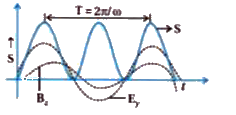
|
|
| 48. |
The Wheatstone's bridge shown in the Fig. A2.5 is balanced. If the positions of the cell C and the galvanometer F are now interchanged, G will show zero deflection |
|
Answer» in all cases |
|
| 49. |
1000 ग्राम विलायक में विलेय के मोलो की संख्या को कहते है |
|
Answer» नॉर्मलता |
|
| 50. |
At t=0, a force F=at^(2) is applied to a small body of mass m at an angle alpha resting on a smooth horizontal plane |
|
Answer» velocity of the body at the moment it brakes off the plane is `sqrt((mg^(3))/(9a tan^(2)alphasinalpha))` `F sin alpha=mg` `rArrat_(0)^(2)sinalpha=mg` `RARR t_(0)=sqrt((mg)/(asinalpha))` SPEED at time of breaking off `v=int_(0)^(t_(0))(at^(2)COSALPHA)/(m)dt=(at_(0)^(2)cosalpha)/(3m)` `=(acosalpha)/(3m)*(mg)/(asinalpha)sqrt((mg)/(asinalpha))` `=sqrt((mg^(3))/(9atan^(2)alphasinalpha))` `a=(Fcosalpha)/(m)=(at_(0)^(2)cosalpha)/(m)=(AMG)/(asinalpha)*(cosalpha)/(m)` `=gcotalpha` `s=intvdt=int_(0)^(t_(0))(at^(3))/(3m)cosalphadt` `=(a)/(12m)t_(0)^(4)=(a)/(12m)*(m^(2)g^(2)cosalpha)/(a^(2)sin^(2)alpha)` `=(mg^(2))/(12a tanalphasinalpha)` |
|