Saved Bookmarks
This section includes 7 InterviewSolutions, each offering curated multiple-choice questions to sharpen your Current Affairs knowledge and support exam preparation. Choose a topic below to get started.
| 1. |
Assertion : If the frequency of the incident light on a metal electrons is more than doubled. Reason : The metal will provide additional energy to the emitted photoelectron for light of higher frequency than for lower frequency. |
|
Answer» If both ASSERTION and REASON are TRUE and reason is the CORRECT EXPLANATION of assertion. |
|
| 2. |
In the Fig. two neutral spherical conductors of radii 2a and a are separated by a large distance. Initially, switch S_(1) is kept closed and S_(2) is open. Now S_(1) is opened and S_(2) is closed at t = 0. (a) Find the rate of fall in potential of the conductor of radius 2a as a function of time. (b) find the heat dissipated after S_(2) is closed. |
|
Answer» (b) `(4PI in_(0)aV^(2))/(3)` |
|
| 3. |
An antenna uses electromagnetic waves of frequency 5 MHz. For proper working, the size of the antenna should be |
|
Answer» 15 km |
|
| 4. |
एक द्विघात बहुपद जिसके शुन्यकों का योगफल 0 है तथा एक शून्यक 3 है |
|
Answer» `x^2 – 9` |
|
| 5. |
Coolness is felt in summer when we enter in an airconditioned room. This is explained by:– |
|
Answer» Newton's LAW of COOLING |
|
| 6. |
Cylindrical lensare used as a remedy for … fill in the blank. |
|
Answer» |
|
| 8. |
A box of mass 4 Kg is placed on a rough inclined plane of inclination 60^@. Its downward motion can be prevented by applying an upward pull F. And it can be made to slide upwards by applying a force 3F. The coefficient of friction between the box and inclined plane is |
|
Answer» `2/(sqrt3)` |
|
| 9. |
Gravitational force acts on a particle due to fixed uniform solid sphere. Neglect other forces. Then particle |
|
Answer» ALWAYS moves normal to the radial direction. |
|
| 10. |
(A) : A circular loop carrying current lies in XY plane with its centre at origin will have a magnetic flux in negative Z-axis. (R) : Magnetic flux direction is independent of the direction of current in conductor. |
|
Answer» Both 'A' and 'R' are TRUE and 'R' is the correct EXPLANATION of 'A'. |
|
| 11. |
किसी गतिमान वाहन की रुकने की दूरी निम्न में से किसके समानुपाती होती है? |
|
Answer» आरंभिक वेग के वर्ग के |
|
| 12. |
In Young's experiment the distance between the slits is reduced to half and the distance between the slit and screen is doubled then the fringe width |
|
Answer» will not change |
|
| 13. |
How would you use two plano-convex lenses of focal lengths 6cm and 4cm to design an eye-piece free from chromatic aberration. What will be its focal length and magnifying power for normal vision ? Will it be a positive or negative eye-piece ? |
|
Answer» |
|
| 14. |
State Kirchhoff's rules of current distribution in an electrical network. Using these rules determine the value of the currentI_1in the electric circuit of Fig. |
Answer» Solution :The circuit diagram can be REDRAWN as shown in Fig. 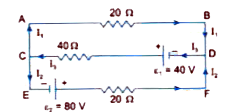 Here `I_3 = I_1 +I_2` In mesh CABDA, we have `-40.I_3 - 20.I_1 +40 = 0` ` - 40 (I_1+ I_2) - 20 I_1 + 40 = 0` ` RARR 60 I_1 + 40I_2 = 40`....(II) and in mesh EABFE, we have `-20.I_1 + 20I_2 + 80 = 0` `rArr 20 I_1 - 20 I_2 = 80 `....(iii) Multiplying (iii) by 2 and then adding with (ii), we get `100 I_1 = - 120 ` ` rArr I_1 = - 1.2 A ` The -ve sign SHOWS that the direction of current is OPPOSITE to that shown in figure with an arrow mark. |
|
| 15. |
When you have learned to integrate, try to analyze the process of shorting a circuit made up of a coil and a resistor connected to a power supply with constant e.m.f., i.e. the dependence of the current on time. Assume the coil to be without a ferromagnetic core. |
|
Answer» Divide by R and introduce the notation the stationary current, and `L//R=tau`, the relaxation time Me obtain the equation `I_(M)-tau (di)/(dt)= or -tau (dI)/(dt)=i-I_(M)` Multiplying by dt, we obtain `I-I_(M) dt, or (di)/(i-I_(M))=-(dt)/(tau)` INTEGRATING we obtain `int (dt)/(i-I_(M))=-1/tau int dt,"YIELDING ln "(i-I_(M))=-t/tau, ln C`. Where C is the INTEGRATION constant. Taking antilogarithms, we obtain `(t-I_(M))/(C)=` When l= 0, the current is l= (0), so `C =I_M.` After some simple transformations we obtain `i=I_(M) (1-e^(-t//tau))` The graph of this function is shown in 43.12, Fig. 43.6. |
|
| 16. |
There are two displacement vectors. One of magnitude 3 meter and the other is 4 m. How the two vector should be addedso that the resultant vector magnitude be 7 meter. |
| Answer» SOLUTION :at `0^@` | |
| 17. |
A contact combination is made of a thin convex lens (f = 9 cm) and a thin concave lens(f = 18 cm), the focal length of the combination is |
|
Answer» 6cm |
|
| 18. |
There are two displacement vectors. One of magnitude 3 meter and the other is 4 m. How the tow vector should be added so that the resultant vector magnitude be 5 meter. |
| Answer» SOLUTION :at `90^@` | |
| 19. |
A concave mirror of focal length 10 cm and a convex mirror of focal length 15 cm are placed facingeach other 40 cm apart. A point object is placed between the mirrors, on their common axis and 15 cm from the concave mirror. Find the position and nature of the image produced by the successive reflections, first at concave mirror and then at convex mirror. |
|
Answer» 5 cm behind the convex mirror and is virtual |
|
| 20. |
There are two displacement vectors. One of magnitude 3 meter and the other is 4 m. How the two vector be add so that the resultant vector magnitude be 1 meter. |
| Answer» SOLUTION :at `180^@` | |
| 21. |
The work done in carrying a charge 'q' once round a circle of radius 'r' carrying a charge 'Q' at the center is ------- |
|
Answer» `(QQ)/(4PI epsilon_0 R` |
|
| 22. |
(A) : A solenoid tend to contract when a current passes through it. (R) : The magnetic field inside the solenoid is uniform. |
|
Answer» Both 'A' and 'R' are true and 'R' is the correct EXPLANATION of 'A'. |
|
| 23. |
Two charged conducting spheres of radii a and b are connected to each other by a wire. What is theratio of electric fields at the surfaces of the two spheres ? Use the result obtained to explain why charge density on the sharp and pointed ends of a conductor is higher than on its flatter portions. |
|
Answer» SOLUTION :When two charged conducting spheres of RADII a and b are connected to each other by a wire, theyshare their charges and acquire same potential i.e., `V_1 = V_2`. If charges on two spheres be `Q_1 and Q_2`respectively, then it means that `Q_1/(4pi epsi_0a) = Q_2/(4pi epsi_0b) or (Q_1)/Q_2 = a/b` Now electric fields at the surfaces of two spheres will have a ratio `E_1/E_2 = (Q_1/(4pi epsi_0a^2))/(Q_2/(4pi epsi_0b^2)) = Q_1/(Q_2).b^2/a^2 = a/b.b^2/a^2 =b/a` As electric FIELD very near a conducting surface is given by `E = sigma/epsi_0`, hence surface charge densities will have the ratio `sigma_1/sigma_2 = E_1/E_2 = b/a` Thus, surface density of charge at a point of a conductor is inversely proportional to the radius (or THICKNESS). Hence, charge density of a conductor is much higher at the sharp and POINTED ends andless on its flatter portion. |
|
| 24. |
In above question.radius is related as :- |
|
Answer» `N^(2)//Z` |
|
| 25. |
An astronaut floating freely in space decides to use his flash light as a rocket. He shines a 10 watt light beam in a fixed direction so that he acquires momentum in the opposite direction. If his mass is 80 kg , how long must he need to reach a velocity of1ms^(-1) |
|
Answer» `9 SEC` |
|
| 26. |
Two bodies are projected at angles 30^(@) and 60^(@) to the horizontal from the ground such that the maximum heights reached by them are equal. Then (a) Their times of flight are equal (b) Their horizontal ranges are equal (c) The ratio of their initial speeds of projection is sqrt(3):1 (d) Both take same time to reach the maximum height. Mark the answer as |
|
Answer» If a, B, C and d are CORRECT |
|
| 27. |
Read the special type off vernier 20 division of vernier scale are matching with 19 divisions of main scale |
|
Answer» Solution :20 VERNIER scale DIVISIONS = 19 MM 1 vernier scale division `= (19)/(20)mm` where least COUNT= (Main scale division - vernier Scale division) `=1mm - 19//20mm` `= 0.05 mm` Thickness of the object = (main scale reading) + (vernier scalw Reading) (least coun) So thickness of the object `= 13 mm + (12) )0.05mm)` `13.60mm` . |
|
| 28. |
A bar magnet of l length and magnetic dipole moment M is bent in the form of an arc as shown in the figure. The new magnetic dipole moment will be |
|
Answer» M We assume that the POLES are situated at the ends. `"Angle" = "arc"/"RADIUS"` `therefore pi/3 = ("Arc"AB)/r="length of the magnet (l)"/r` `r=l/(pi//3)=(3l)/pi` ….(ii) But after bending the poles are at A and B. Distance `AB = AO + OB = rsintheta + rsintheta` `=2R sin theta= 2r xx 1/2=r` `therefore` New magnetio moment, m. = mr From (i) and (ii), `M. = M/l xx(3l)/pi xx (3M)/pi` 
|
|
| 29. |
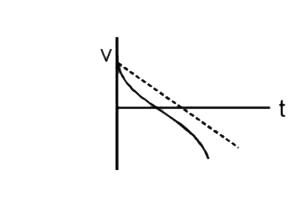
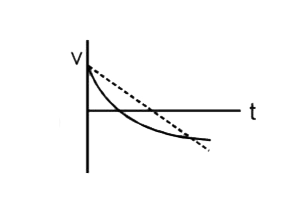
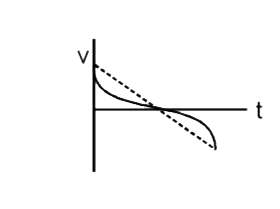
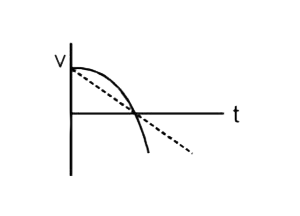
Which graph shows best the velocity-time graph for an object launched vertically into the air when air resistance is given | D | = bv? The dashed line shows the velocity graph if there were no air resistance. |
|
Answer»
|
|
| 30. |
Consider two hydrogen atoms H_(A)andH_(B) in ground state. Assume that hydrogen atom H_(A) is at rest and hydrogen atom H_(B) is moving with a speed and make head-on collide on the stationary hydrogen atom H_(A). After the strike, both of them move together. What is minimum value of the kinetic energy of the moving hydrogen atom H_(B), such that any one of the hydrogen atoms reaches one of the excitation state. |
|
Answer» Solution :Collision between hydrogen `H_(A)` and hydrogen `H_(B)` atom will be inelastic if a part of kineticenergy is used to EXCITE atom If `u_(1)` and `u_(2)` are speed of `H_(A)` and `H_(B)` atom after collision then mu = m`u_(1)` + m`u_(2)`...(1) `(1)/(2)` m`U^(2) = (1)/(2)` m`u_(1)^(2) + (1)/(2)` m`u_(2)^(2)` + DELTA E ....(2) `u^(2) = u_(1)^(2) + (u -u_(1))^(2) + (2 Delta E)/(m)` `u_(1)^(2) - uu_(1) + (2 DeltaE)/(m) = 0` For `u_(1)` to be real `u^(2) - (4 Delta E)/(m) ge 0` (m`u^(2))/(2) ge 2 xx Delta E` `Delta E = 10.2 eV` THUS (1)/(2) m`u^(2)_("min") = 2 xx 10.2 eV` `((1)/(2)` m`u^(2))_("min") = 20.4 eV` The minimum K.E of the moving hydrogen atom `H_(B) is 20.4 eV` |
|
| 31. |
Find odd one regarding polarity solenoid, torroid, current carrying loop, bar magnet |
| Answer» SOLUTION :Torroid (In this CASE NORTH and SOUTH POLE are absent) | |
| 32. |
The thickness of a rectangular steel girder equals h, find the deflection lambda caused by the weight of the girder in two cases: (a) one end of the girder is embedded into a wall with the length of the protruding section being equal to l (figure) (b) the girder of length 2l rests freely on two supports (figure). |
|
Answer» Solution :(a) In this case `N(x)=1/2rhogbh(l-x)^2` where b=width of the girder. Also `I=bh^3//12`. Then, `(Ebh^2)/(12)(d^2y)/(dx^2)=(rhogbh)/(2)(l^2-2lx+x^2)`. Integrating, `(dy)/(dx)=(6rhog)/(Eh^2)(l^2x-lx^2+(x^3)/(3))` using `(dy)/(dx)=0` for `x=0`. Again integrating `y=(6rhog)/(Eh^2)((l^2x^2)/(2)-(lx^3)/(3)+(x^4)/(12))` Thus `lambda=(6rhogl^4)/(Eh^2)(1/2-1/3+(1)/(12))` `=(6rhogl^4)/(Eh^2)(3)/(12)=(3rhogl^4)/(2Eh^2)` (b) As before, `EI(d^2y)/(dx^2)=N(x)` where `N(x)` is the bending moment due to section `PB`. This bending moment is clearly `N=underset(x)overset(2l)intwdxi(xi-x)-wl(2l-x)` `=w(2l^2-2xl+x^2/2)-wl(2l-x)=w(x^2/2-xl)` (Here `w=rhogbh` is weight of the beam PER unit length) Now integrating, `EI(dy)/(dx)=w(x^3/6-(x^2l)/(2))+c_0` or since `(dy)/(dx)=0` for `x=l`, `c_0=wl^3//3` Integrating again, `EIy=w((x^4)/(24)-(x^3l)/(6))+(wl^3x)/(3)+c_1` As `y=0` for `x=0`, `c_1=0`. From this we find `lambda=y(x=l)=(5wl^4)/(24)//EI=(5rhogl^4)/(2Eh^2)` 
|
|
| 33. |
The process of superimposing signal frequency (i.e. audio wave) on the carrier wave is known as: |
|
Answer» transmission |
|
| 34. |
AssertionIn a uniform magnetic field B=B_(0)hat(k),if velocity of a charged particle is v_(0)hat(i) at t = 0, then it can have the velocity v_(0)hat(j) at some other instant. Reason In uniform magnetic field, acceleration of a charged particle is always zero. |
|
Answer» If both Assertion and REASON are TRUE and Reason is the correct explanationof Assertion. |
|
| 35. |
A sine wave has an amplitude A and wavelength lamda. The ratio of particle velocity and the wave velocity is equal to (2piA=lamda) |
| Answer» Answer :A | |
| 36. |
Length contraction is known as "___________" . |
|
Answer» Gerner resolution |
|
| 37. |
A body of weight 64 N' is pushed with justs enough force to start it move in across a horizontal floor and the same force continues to act afterwards. If the coefficients of static and dynamic friction are 0.6 and 0.4 respectively, the acceleration of the body will be (Acceleration due to gravity = g): |
| Answer» Answer :D | |
| 38. |
On what fators angle of contact depends? |
| Answer» Solution :(i) The NATURE of SOLID and liquid in contact. (ii) nature of solid surface that is whether it is clean or not. (iii) Medium in contact with free surface of liquid. (iv) The TEMPRATURE of a liquid. (V)Presence of impurities. | |
| 39. |
The coefficients of apparent expansion of a liquid when determined using two different vessels A and B are gamma_(1)" and "gamma_(2)respectively. If the coefficient of linear expansion of the vessel A is alpha. The coefficient of linear expansion of the vessel B is |
|
Answer» `((alphagamma_(1)gamma_(2))/(gamma_(1)+gamma_(2)))` |
|
| 40. |
The length of a simple pendulum is 0.79m and the mass of the particle (the ''bob'') at the end of the cable is 0.24kg. The pendulum is pulled away from its equilibrium position by an angle of 8.50^(@) and released from rest. Assume that friction can be neglected and that the resulting oscillatory motion is simple harmonic motion. What is the angular frequency of the motion? |
|
Answer» 9.1 rad/s |
|
| 41. |
A particle strikes a horizontal smooth floor with a velocity u making an angle theta with the floor and rebounds with velocity v making an angle phiwith the floor. The coefficient of restitution between the particle and the floor is e. |
|
Answer» The impulse delivered by the floor to the BODY is MU (1+e) sin `theta`. |
|
| 42. |
A uniform vertical cylinder of cross-sectional area 'a' floats, 90% submerged, in an unknown liquid inside a tank -with cross-sectional area four times that of cylinder. When cylinderis pushed down gently and released it performs SHM. The maximum possible amplitude (in cm) for this SHM is |
|
Answer» Solution :Cylinder can perform SHM only TILL it is PARTIALLY SUBMERSED. When cylinder goes down x in GROUND from LIQUID level comes up by x.. (say). `(4a- a) x. = xa rArr x. = x//3` So the centre of the cylinder goes down by (w.r.t. the liquid surface) `(x + x.) = (4)/(3) x le (1)/(10) rArr x le (3l)/(40) = 6 cm` 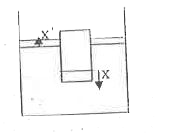
|
|
| 43. |
Lengths and cross-sectional areas of three copper wires are (l, A ), (2l, (A)/(2) ) , ((l)/(2) , 2A ) .Which of these wires has least (minimum) resistance ? |
|
Answer» Second wire Because resistance of wire, (i) R `alpha L (II) R alpha (1)/(A)` |
|
| 45. |
Draw a plot showing the variation of photoelectric current versus the intensity of incident radiation on a given photosensitive surface. |
Answer» Solution :Plot SHOWING the variation of photoelectric current versus the intensity of incident radiation of a GIVEN photosensitive SURFACE is SHOWN in here figure. 
|
|
| 46. |
Explain the concept of the hole in the semiconductor. |
|
Answer» Solution :At absolute zero temperature each of the valence electrons of semiconductor is bound by the covalent bond. As a consequence it behaves as insulator. The atoms of the crystal perform thermal oscillations at the room temperature. This results in the breaking of several covalent bonds and results in the electrons freeing from the covalent bond. These free electrons are RESPONSIBLE for ELECTRICAL conduction. Hence, thermal energy ionize atoms in the crystalline lattice and creates vacancy in the bond as shown in FIGURE (a).  In figure schematic model of generation of HOLE at site 1 and conduction electron due to thermal energy at moderate temperature is shown. The neighbourhood from which the free electron with charge -q has come out leaves a vacancy with an effective charge +q. This vacancy with the effective positive electronic charge is called a hole. The hole behaves as an apparent free particle with effective positive charge but the hole does not really have any electrical charge but the hole has the property of attracting electrons, so it is assumed to have a + q charge. In INTRINSIC semiconductors both the free electrons and the holes are electric charges. In intrinsic semiconductors, the number of fr electrons, `n_(e )` is equal to the number of holes n That is, `therefore n_(e )=n_(h)=n_(i)` where `n_(i)` is called intrinsic carrier concentration. |
|
| 47. |
_____ rule is used to find the direction of induced current in a conducting wire, moving in a magnetic field. |
|
Answer» Fleming's left hand |
|
| 48. |
A block of mass 10 kg pushed by a force F on a horizontal rough plane moves with an acceleration of 5ms^(-2). When force is doubled, its acceleration becomes 18ms^(-2). Find the coefficient of friction between the block and rough horizontal plane. (g=10 ms^(-2)). |
|
Answer» Solution :On a rough horizontal plane, ACCELERATION of a block of MASS .m. is given by`a=(P)/(m)-mu_(k) g ""`….(i) INITIALLY, `P =F , a=5 ms^(-2)` `5=(F)/(10) mu_(k)(10) …..(ii)(because m = 10 kg)` When force is doubled i.e., `P=2F , a = 18 ms^(-2)`. `18=(2F)/(10)-mu_(K)(10)`.....(III) MULTIPLYING Eq. (ii) with 2 and subtracting from Eq.(iii) `8=mu_(k)(10)rArr mu_(k)=(8)/(10)=0.8` |
|
| 49. |
How many electron constituete an electric charge of -16muC |
|
Answer» `10^13` |
|
| 50. |
A solenoid of 0.4111 length with 500 turns carries a current of 3A. A coil of 10 turns and of radius 0.01m carries a current of 0.4A. The torque required to hold the coil with its axis at right angles to that of solenoid in the middle point of it is |
|
Answer» `6PI^(2)xx10^(-7)Nm` |
|