

Saved Bookmarks
This section includes 7 InterviewSolutions, each offering curated multiple-choice questions to sharpen your Current Affairs knowledge and support exam preparation. Choose a topic below to get started.
| 1. |
Two plane mirrors A and B are aligned parallel to each other, as shown in the figure. A light ray is incident at an angle 30^@ at a point just inside one end of A. The plane of incidence coincides with the plane of the figure. The maximum number of times the ray undergoes reflections (including the first one) before it emerges out is |
|
Answer» 28 |
|
| 2. |
(a) Define a wavefront. How is it different from a ray ? (b) Depict the shape of a wavefront in each of the following cases: (i) Light diverging from a piont source. (ii) Light emerging out of a convex lens when a point source is placed at its focus. |
|
Answer» Solution :(a) A wavefront is defined as a surface of constant phase. The energy of the wave travels in a direction perpendicular to the wavefront. A ray is a straight LINE DRAWN ALONG the direction of energy propagation in wave. Thus, a ray is always perpendicular to a wavefront. (i) Wavefront corresponding to a BEAM of light diverging radially from a point source S is spherical in shape as SHOWN in Figure (i) The source S is the centre of spherical wavefront and the light rays are moving radially outwards.  (ii) Wavefront of light emerging out of a convex lens when a point source is placed at its focus is a plane wavefront as shown in figure. |
|
| 3. |
Electric potentiall at centre of non conducting sphere of radii .r. is ____ ["q is charge in it" k = (1)/(4 pi epsilon_(0))] |
|
Answer» `(3)/(2)(KQ)/(R )` |
|
| 4. |
Potentiometer is a better instrument than a voltmeter in measuring the emf of a cell.Why? |
| Answer» Solution :MEASURING emf by USING a potentiometer is a null current method.But a voltmeter TAKES some current when it is connected ACROSS the cell. | |
| 5. |
The speed of an electromagnetic wave in a material medium is given by v=(1)/(sqrt(mu epsilon)),mubeing the permeability of the medium and epsilon its permittivity. How does its frequency change ? |
| Answer» Solution :Frequency of an electromagnetic WAVE depends on the SOURCE of wave and is INDEPENDENT of the NATURE of a medium. | |
| 6. |
If an object reaches a maximum vertical height of 23.0 m when thrown vertically upwatd on earth how high would it travel on the moon where the acceleration due to gravity is about one sixth that on the earth?Assume that initial velocity is the same/. |
| Answer» SOLUTION :`Hprop(1)/(G)(h_(1))/(h_(2))=(g_(2))/(g_(1))=(1)/(6)impliesh_(2)=6h_(1)=6xx23=138m` | |
| 7. |
The lateral strain and lngitudinal strain of a given wire are 2 xx 10^(-6), 5 xx 10^(-6) respectively. The poisson's ratio will be |
| Answer» Answer :B | |
| 8. |
If Plank's constant (h) and speed of light in vacuum (c) are taken as two fundamental quantities, which one of the following can, in addition, be taken to express length, mass and time in terms of the three chosen fundamental quantities? A) Mass of electron (m_c) B) Universal gravitational constant (G) C) Charge of electron (e ) D) Mass of proton (m_p) |
|
Answer» C only |
|
| 9. |
a. A comb run through one's dry hair attracts small bits of paper. Why? What happens if the hair is wet or if it is a rainy day? (A paper does not conduct electricity.) b. Ordinary rubber is an insulator. But special rubber tyres of aircraft are made slightly conducting. Why is necessary? c. Vehicles carrying inflammable materials usually have metallic ropes touching the ground during motion. Why? d. A bird perches on a bare high power line, and nothing happens to the bird. A man standing on the ground touches the same line and gets a fatal shock. Why? |
|
Answer» Solution :a. This is because the comb gets charged by friction. The MOLECULES in the paper gets polarised by the charged comb, resulting in a net force of attraction. If the hair is wet, or if it is rainy day, friction between hair and the comb REDUCES. The comb does not get charged and thus it will not attract small bits of paper. b. To enable them to conduct CHARGE (produced by friction) to the ground, as too MUCH of static electricity accumulated may result in spark and fire. c. Reason similar to (b). d. Current PASSES only when there is difference in potential. |
|
| 10. |
The electrostaticforce on a small sphereof charge 0.4 muc dueto the distance bwtwen the two spheres (b)what is the force on the second spere due to the first |
|
Answer» SOLUTION :(a) 12 cm (b) 0.2 N (ATTRACTIVE) |
|
| 11. |
(a) Two long wires at a distance 2d apart carry equal, antiparallel current i. Find magnitude and direction of magnetic field at point A as shown.For what value of x, magnetic field is maximum? Also calculate maximum magnetic field. Sketch B versus x graph. |
Answer» Solution : 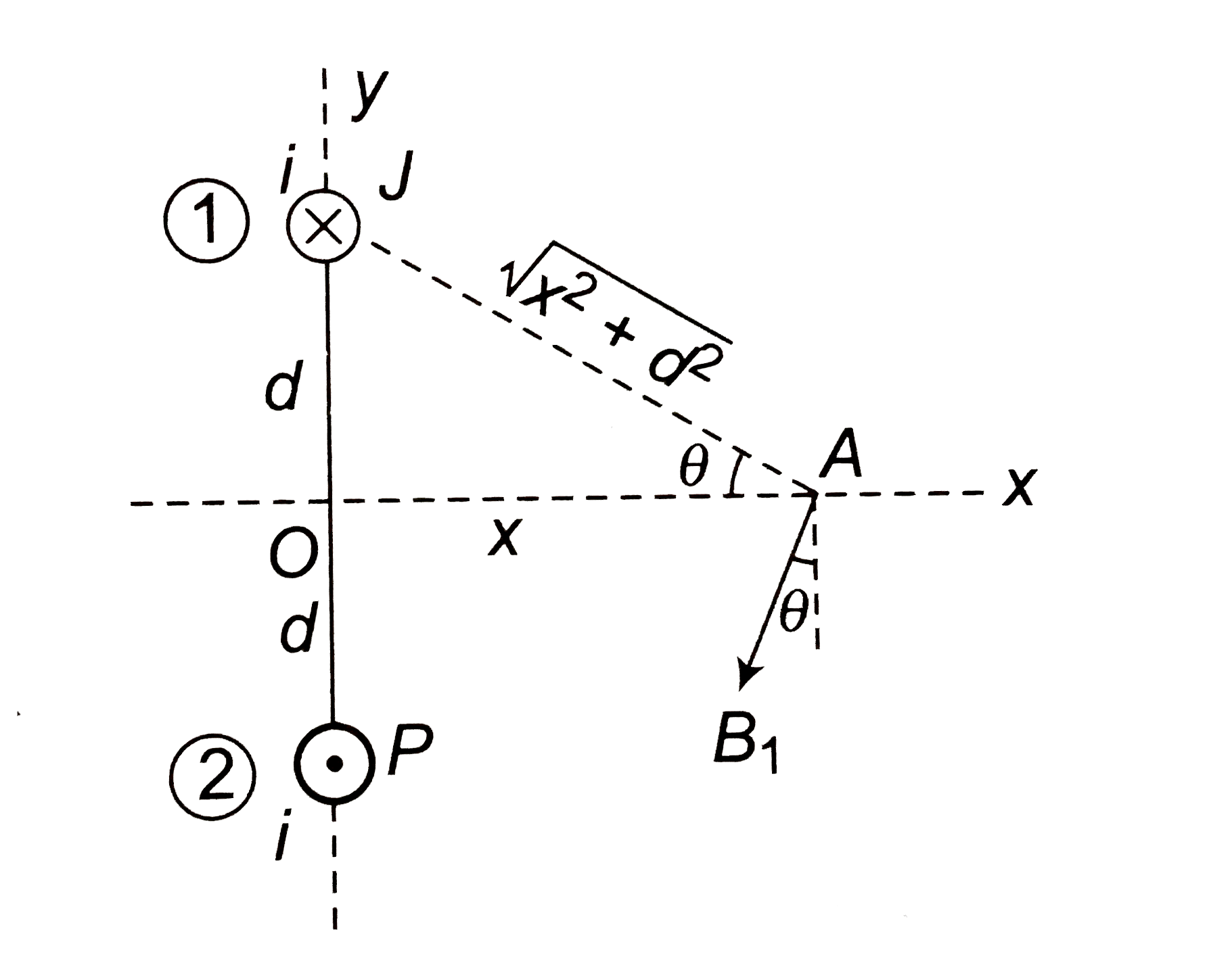 Magnetic field at `A` due to wire `①` `B_(1)=(mu_(0)i)/(2pisqrt(x^(2)+d^(2))), B_(1)` will be `bot^(ar)` to `JA` at `A` as SHOWN 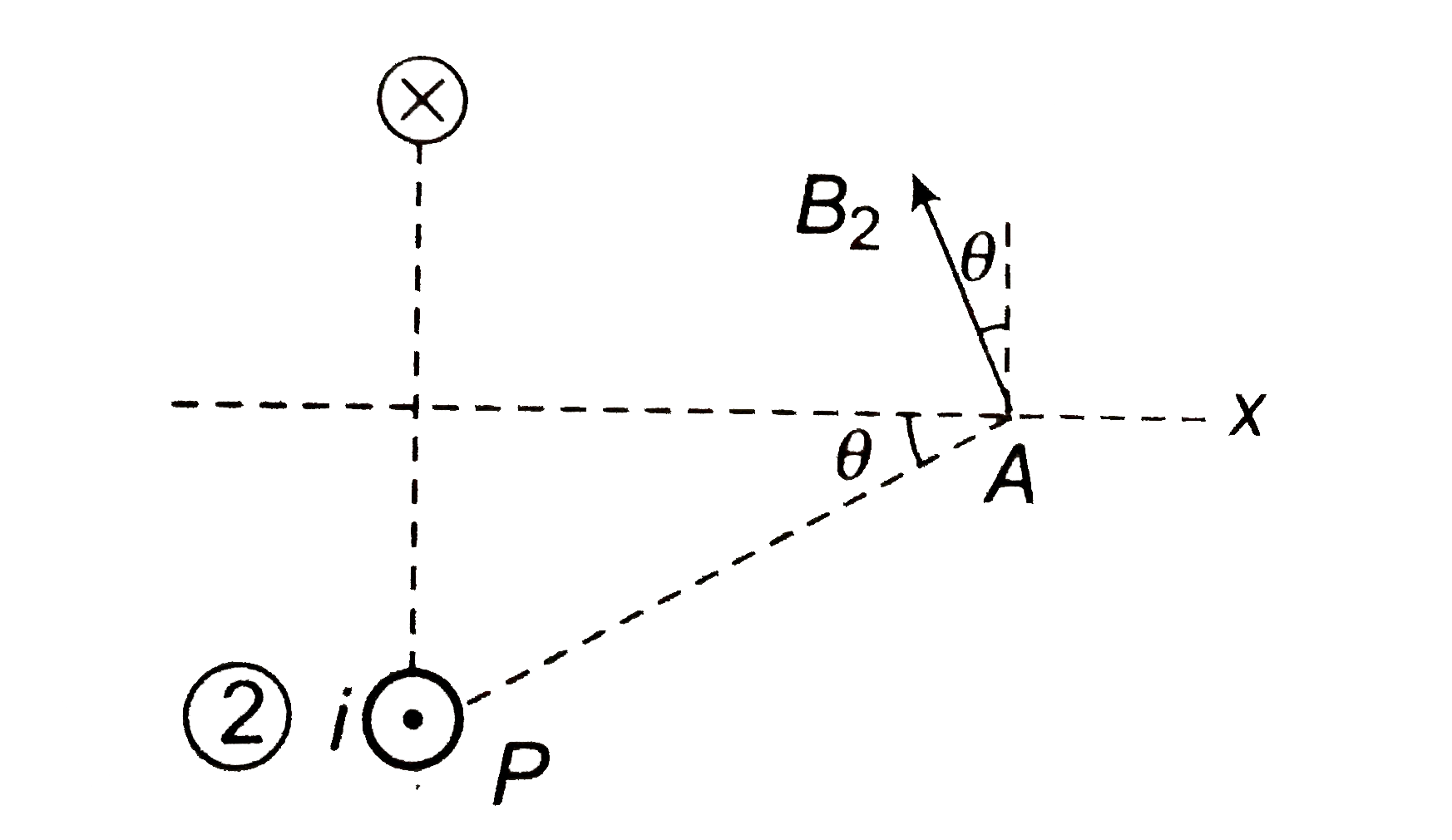 Magnetic field at `A` due to wire `②` `B_(2)=(mu_(0)i)/(2pisqrt(x^(2)+d^(2))), B_(2)` will be `bot^(ar)` to `PA` at `A` as shown 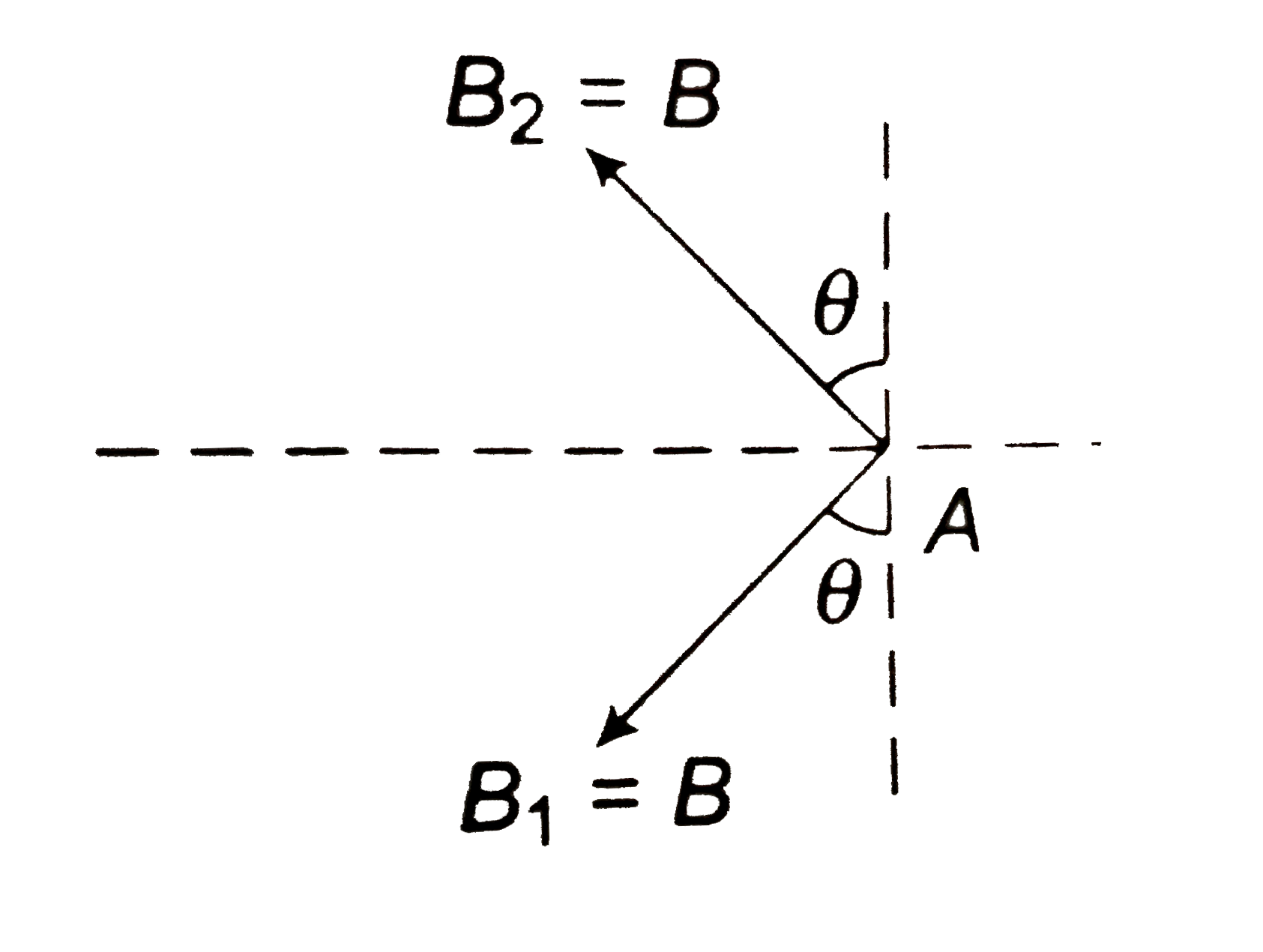 `B_(A)=2B sin theta=2.(mu_(0)i)/(2pisqrt(x^(2)+d^(2))).d/(sqrt(x^(2)+d^(2)))` `=(mu_(0)id)/(pi(x^(2)+d^(2)))`, towards left `B_(A)` is maximum at `x=0, (B_(A))_(MAX)=(mu_(0)i)/(pid)` Left of `O:`  The direction of magnetic field on the `x`-axis will be towards left. Taking magnetic field `-ve` towards the negative `x`-axis 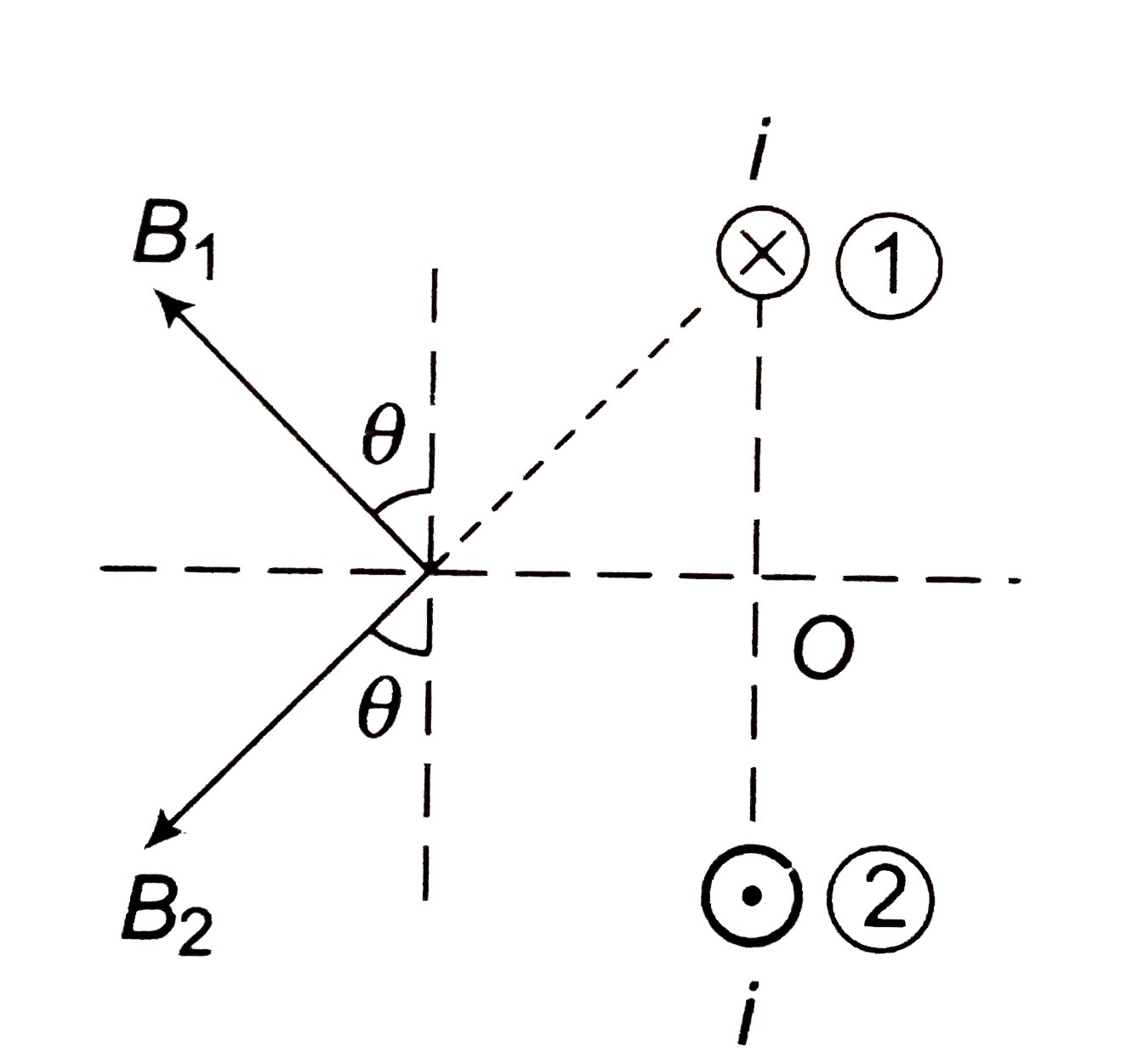 (b) 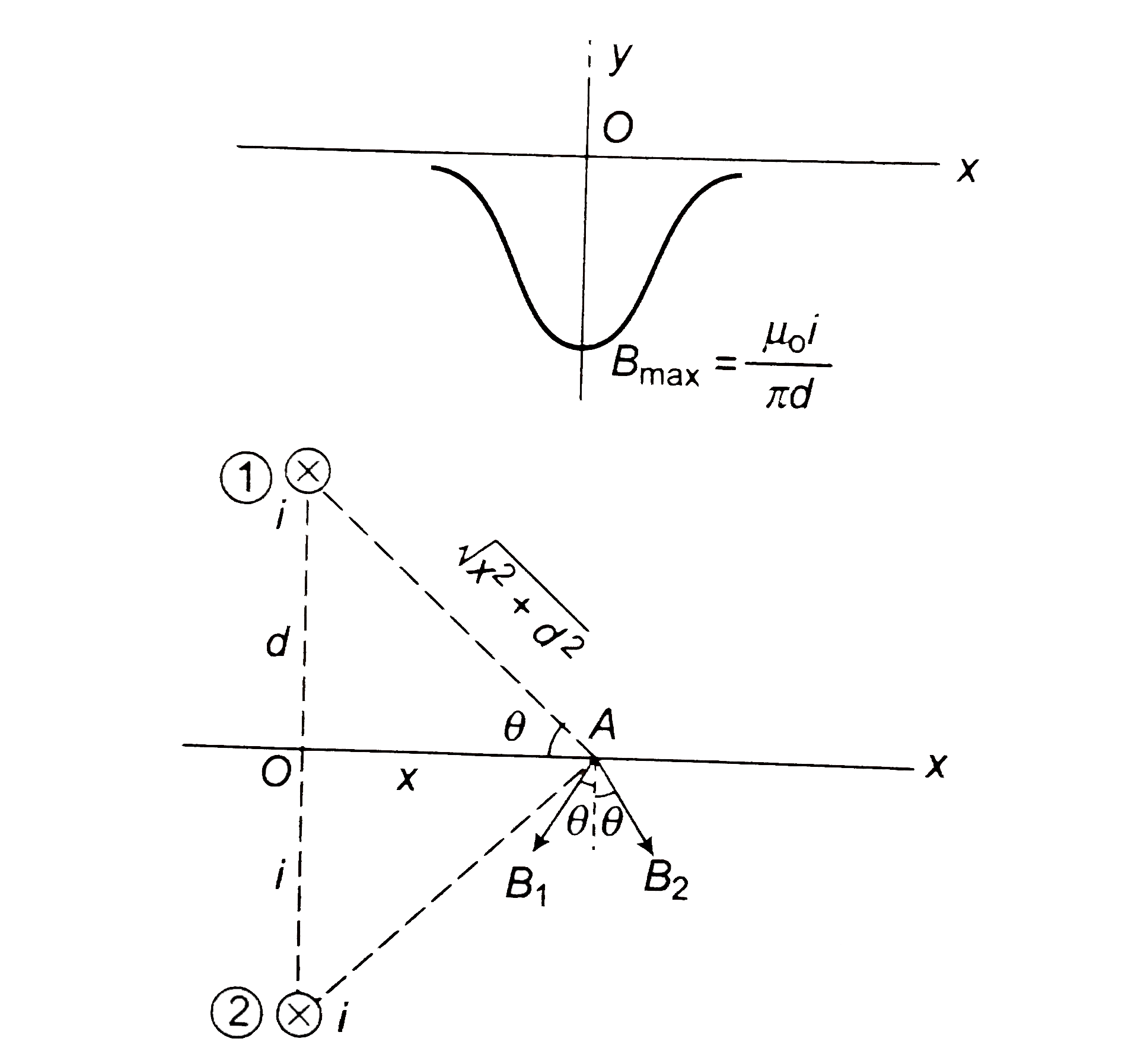 `B_(1) = B_(2) = (mu_(0)i)/(2 pi sqrt(x^(2) + d^(2))) = B` `= (mu_(0)ix)/(pi (x^(2) + d^(2)))` , downward For `B_(A)` to be maximum, `(dB_(A))/(dx) = 0 RARR ((x^(2) + d^(2)). 1 - x (2x + 0))/(pi(x^(2) + d^(2))^(2)) = 0` `x^(2) = d^(2) rArr x = -+ d` `(B_(A))_("max") = (mu_(0)i)/(2 pi d)` `x rarr OO, B rarr 0, x rarr - oo, B rarr 0` Direction of magnetic field left of O: 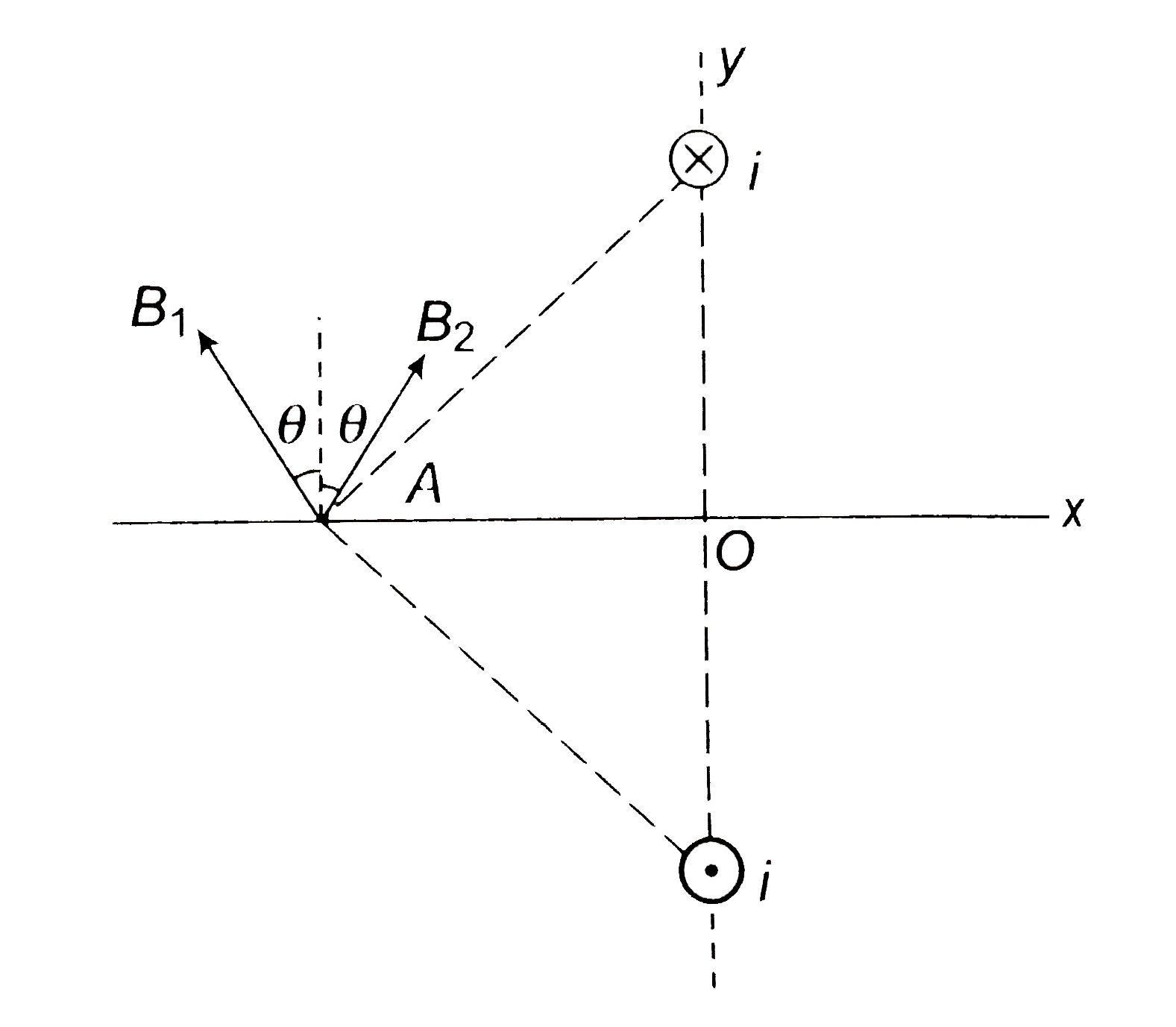 Left of O, magnetic field will be upward, taking upward direction positive. 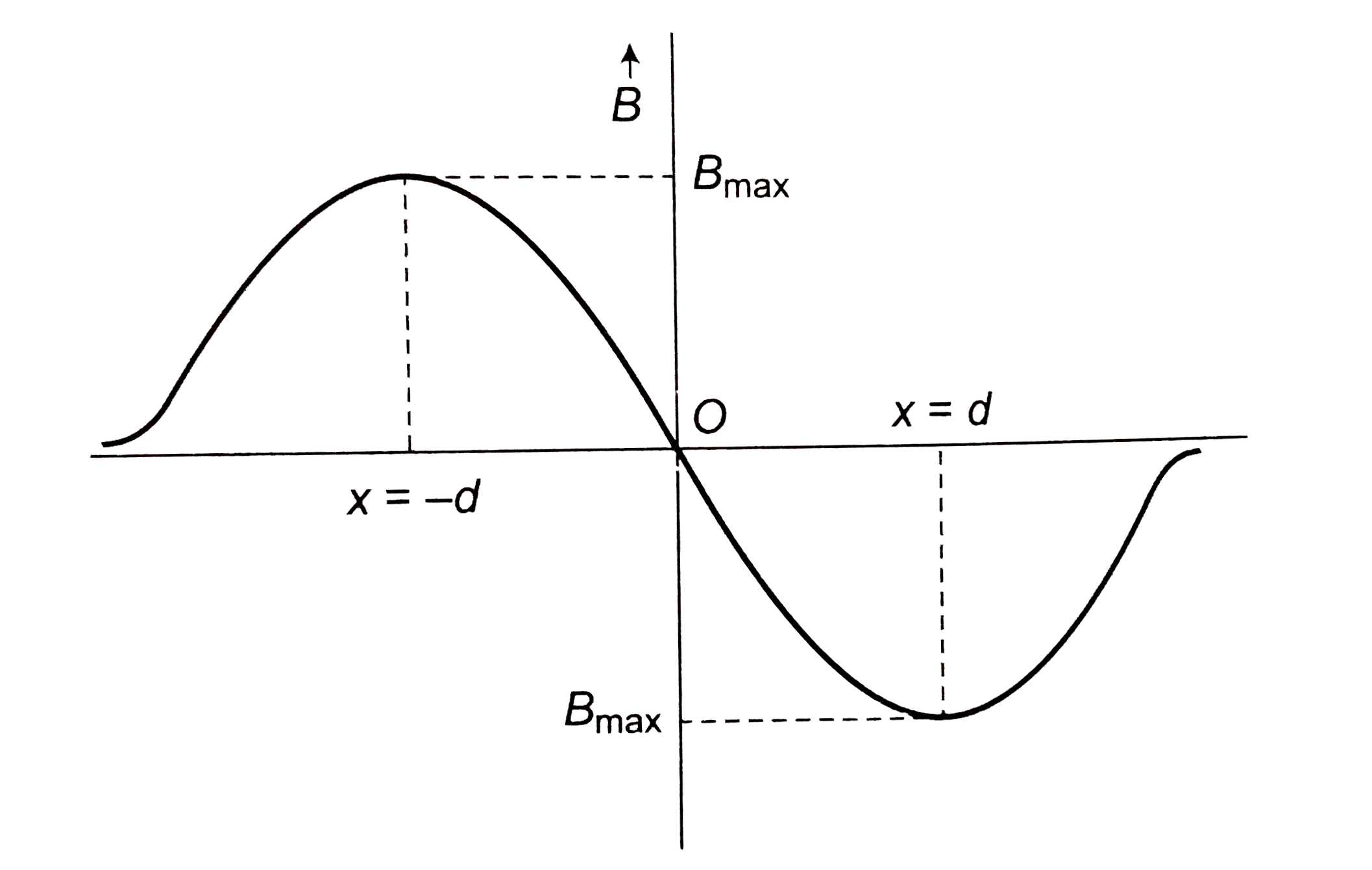
|
|
| 12. |
A train is travelling at vm//s along a level straight track Very near and parallel to the track is a wall On the wall a naughty boy has drawn a straight line that slopes upward at a 37^(@) angle with the horizontal A passanger in the train is observing the line out of window (0.90 m high 1.8 wide as shown in figure) The line first appears at window corner A and finally disappears at window corner B if it takes 0.4 sec between appearance at A and disappearance of the line at B what is the value of v (in cm//s)? |
Answer» 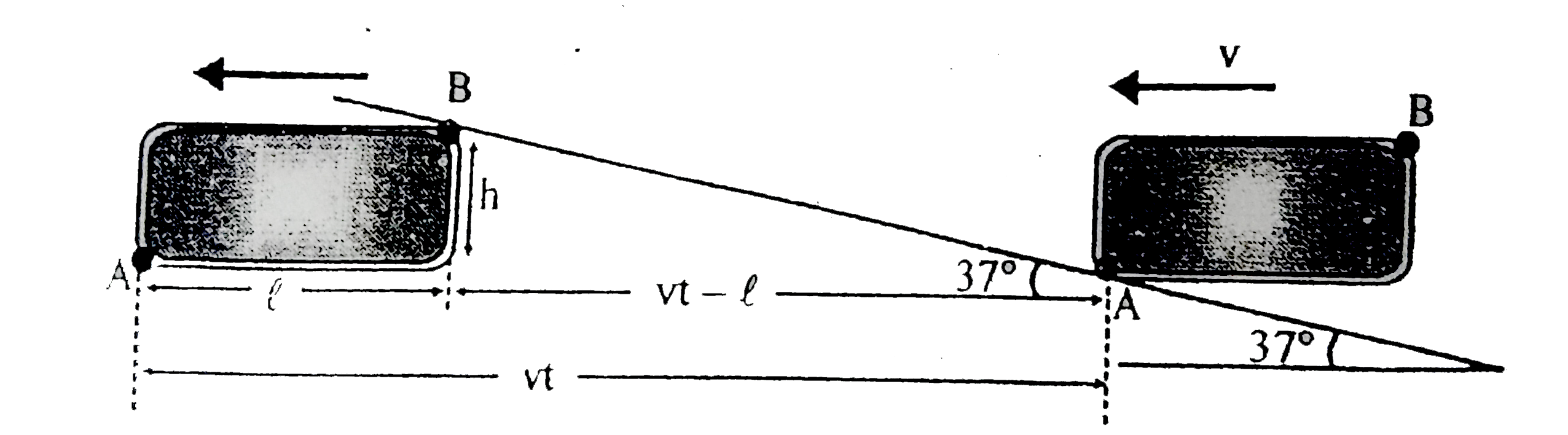 `H/(vt-l)=tan 37^(@)` Rightarrow V=`h(+l)/((tan 37^(@)/t)) = 7.5 m//s =750 cm//s]` |
|
| 13. |
Two charges of equal magnitude and at a distance .r. exert a force F on each other. If the charges and halved and distance between them is doubled, then the new force acting on each charge is |
|
Answer» F/8 |
|
| 14. |
The plates each of area A of a parallel plate caoacitor are given charges Q and -Q. The plates are joined by a non-conducting spring of force constant k. The natural length of the spring is d, the inital separation between the plates. The left plate is connected to a vertical wall through a massless non-conducting rope and the right plate is connected to ablock of mass m through similar rope. Assume the pulley to be massless, neglect dielectric effect of the spring and Q^(2) lt 2mAepsilon_(0)g If T be the time period of oscillation, then |
|
Answer» `T gt 2pisqrt((m)/(k))` |
|
| 15. |
The plates each of area A of a parallel plate caoacitor are given charges Q and -Q. The plates are joined by a non-conducting spring of force constant k. The natural length of the spring is d, the inital separation between the plates. The left plate is connected to a vertical wall through a massless non-conducting rope and the right plate is connected to ablock of mass m through similar rope. Assume the pulley to be massless, neglect dielectric effect of the spring and Q^(2) lt 2mAepsilon_(0)g. If the block is released from rest, the maximum elongation of the string is |
|
Answer» `(2)/(k)(mg-(Q^(2))/(Aepsilon_(0)))` |
|
| 16. |
If vecA=2hati-4hatj-2hatk and vecB=hati+hatj+6hatk . What is the angle made by vecA+vecB with the Y-axis. |
|
Answer» SOLUTION :Work done W=`vecFcdotvecr=(2hati+hatj+hatk)CDOT(hati-hatk+2hatk)`= 2-1+2=3 JOULE |
|
| 17. |
The resistance of galanometer is 100Omega, on passing a current of 25 mA it gives full-scaledeflection .In order to measure a P.D.of 120 volt the sries resistance will be : |
|
Answer» `3.9Omega` |
|
| 18. |
Why are bridges declared unsafe after long use ? |
| Answer» Solution :Due to constant use being subjected to alter NATION in stress repeatedly the AMOUNT of strain for a given stress increases. This ULTIMATELY MAKES it unsafe for use. | |
| 19. |
The plates each of area A of a parallel plate caoacitor are given charges Q and -Q. The plates are joined by a non-conducting spring of force constant k. The natural length of the spring is d, the inital separation between the plates. The left plate is connected to a vertical wall through a massless non-conducting rope and the right plate is connected to ablock of mass m through similar rope. Assume the pulley to be massless, neglect dielectric effect of the spring and Q^(2) lt 2mAepsilon_(0)g If Q^(2)=2mAepsilon_(0)g, the elongation of the string is |
|
Answer» zero |
|
| 20. |
The wavelenght of a light is 450 nm. Howphaseit will differ for a path of 3 mm? |
|
Answer» Solution :The wavelenght is, `lambda = 450 NM- 450 XX 10^(2)m` PATH difference is,`delta = 3 nm = 3 xx 10^(-3)m` Relation between phase difference and path difference is, `phi = (2pi)/(lambda) xx delta` Substituting,`phi=(2pi)/(450xx10^(-9))xx3xx10^(-3)=(pi)/(75)xx10^(6)` `phi=(pi)/(75)xx10^(6)rad` |
|
| 21. |
Regarding the fringe width choose the correctstatement. |
|
Answer» Interference fringes are of unequal width. |
|
| 22. |
Two plates are 2 cm apart. If a potential difference of 10 V is applied between them. The electric field between the plates will be |
|
Answer» `20 NC^(-1)` |
|
| 23. |
The temp. at which the speed of sound in air becomes double its value at 0^(@) C is : |
|
Answer» `273^(@)` C ` THEREFORE 2 = sqrt((T + 273)/(273) ) RARR = T + 273 = 4 xx 273 ` t = `4 xx 273- 273^(@) = 819^(@) ` C HENCE the correct choice is (c) . |
|
| 24. |
The radius of a conducting spherical shell is 10 mm and a 100 muCcharge is spread on it. The force acting on a 10 muC charge placed at its centre is……… (k = 9 xx 10^(9)) MKS |
|
Answer» `10^(3)` N |
|
| 25. |
A vitrual image larger than the object can be produced by |
|
Answer» CONVEX mirror |
|
| 26. |
The polaroids P_(1) and P_(2) are placed in crossed position. A third polaroid P_(3) is kept between P_(1) and P_(2) such that pass axis of P_(3) is parallel to that of P_(1). How would the intensity of light (I_(2)) transmitted through P_(2) vary as P_(3) is rotated ? Draw plot of intensity I_(2) versus angle theta between pass axis of P_(1) and P_(3). In which orientation will the transmitted intensity be minimum and maximum ? |
Answer»  If `THETA` is angle between `P_(1) and P_(3)`, the angle between `P_(3) and P_(2) = (90 - theta)` By Law of Malus, `I_(3) = I_(1) cos^(2) theta` and `I_(2) = I_(3) cos^(2)(90 - theta) = I_(3) sin^(2)theta` `= I_(1) cos^(2) theta sin^(2)theta = (1)/(4)I_(1)(2 sin theta cos theta)^(2)` `I_(2) = (1)/(4) I_(1) sin^(2) 2theta` The plot of `I_(2)` versus `theta` is as shown in Fig.  TRANSMITTED intensity `I_(2)` will be minimum. When `sin 2 theta = 0 or theta = 0^(@)`. Transmitted intensity will be maximum, when `sin 2 theta = 1, 2 theta = 90^(@), theta = 45^(@)` |
|
| 27. |
The work function of photometal is 6.626 eV. What is the threshold wavelength ? |
|
Answer» 3921 `Å` |
|
| 28. |
The phenomenon of photoelectric emission was observed by : |
|
Answer» Compton |
|
| 29. |
What is the amount of magnetic flux density on the equalorial line of magnetic dipole. |
| Answer» SOLUTION :`B=mu_0/(4PI).(MU)/d^3` | |
| 30. |
Source and observer both start moving simultaneously from origin one along X-axis an the other along y-axis with speed of source = 2 (speed of observer). The graph between the apparent frequency observed by observer (t) and time (t) would be: (Here, f0 = natural frequency of source) |
|
Answer»
|
|
| 31. |
एक स्कूटर सवार 36 km/h की चाल से चल रहा है, उसकी चाल को m/s में व्यक्त कीजिए।? |
|
Answer» 10m/s |
|
| 32. |
Name any two basic properties of electric charge. |
|
Answer» (i) QUANTIZATION of CHARGE (II) CONSERVATION of charge. |
|
| 33. |
The position of a particle moving in a x - y plane at any instant is given byx= (3t^(2)-6t) metres y = (t^(2)-2t) metres. Select the correct statement. |
|
Answer» Acceleration is zero at i = 0 and `(dy)/(dt)=v_(y)=2t-2` Both COMPONENTS will be zero for t =1 so velocity is ZERO for t= 1s |
|
| 34. |
A charged capacitor (C_(1) = 3 mu F) is getting discharged in the circuit shown. When the current I was observed to be 2.5 A, switch ‘S’ was opened. Determine the amount of heat that will be liberated in the circuit after ‘S’ is opened. |
|
Answer» |
|
| 35. |
A bar magnet is cut perpendicular to its axis into two equal halves. Its magnetic moment is |
|
Answer» Halved |
|
| 36. |
A positively charged particle is given an initial velocity v_(0) in XY plane as shown in diagram. Initially the particle was at origin and the region contains uniform, mutually perpendicular electric and magnetic field. Let vecE=-Ehatj and vecB=Bhatk. The minimum magnitude of the magnetic field so that the charge particle crosses the origin again during its subsequenty motion is B_("min")=(npiE)/(v_(0)), find the integer value n |
|
Answer» For corssing ORIGN, `k(2pim)/(QB)=(2(v_(0)//2))/(qE//m),k` is an integer `impliesB=((2piE)/(v_(0)))k` For minimum value, `k=1` `impliesB_("min")=(2piE)/(v_(0))` |
|
| 37. |
the electric field inside a sphere which carries a charge density proportional to the distance from the origin p=alpha r (alpha is a constant) is: |
|
Answer» `propto` `r^(3)/(4epsilon_(0))` |
|
| 38. |
A thin film of air between a plane glass plate and a convex lens is irradiated with parallel beam of monochromatic light and is observed under a microscope, you will see |
|
Answer» UNIFORM BRIGHTNESS |
|
| 39. |
Two similar helium-filled spherical balloons tied to a 5gweight with strings and each carrying a charge q floats in equilibrium as shown in figure-1.457. Find (a) the magnitude of q, assuming that the charge on each balloon acts as ifit were concentrated at the centre and (b) the volume of each balloon. Neglect weight of the unfilled balloons and take density ofair 1.29 kg//m^(3) and the density of helium in the balloons 0.2 kg//m^(3): |
|
Answer» |
|
| 40. |
Which is vector quantity |
|
Answer» Time |
|
| 41. |
The resistance of a material increases with temperature. It is a |
|
Answer» METAL |
|
| 42. |
A thin insulated wire forms a plane spiral of N = 100 tight turns carrying a current I = 8 mA. The radii of inside and outside turns are equal to a = 50 mm and b = 100 mm. Find the magnetic moment of the spiral with a given current |
|
Answer» `15 Am^(2)` Magnetic moment of a tum of radius R is `M = IPIR^(2)` Number of TURNS in next dr element `dN = N/(B-a)dr` `P = int M dN = int_(a)^(b) ipir^(2)N/(b-a)dr=(piiN(b^(3)-a^(2)))/(3(b-a))=15Am^(2)` |
|
| 43. |
Magnetic susceptibility and intensity are related by B = mu_0 _____ H. |
| Answer» SOLUTION :`[1 + CHI]` | |
| 44. |
यदिबहुपद x^2 -2x+2 के शून्यक alpha ,betaहो तो alphabetaका मान होगा - |
|
Answer» 2 |
|
| 45. |
Two masses 1 gm and 4 gm are moving with equal kinetic energies. The ratio of their momentum is : |
|
Answer» `1:6` |
|
| 46. |
In the following question a statement of assertion (A) is followed by a statement of reason (R ) A: For a given potential function, electric intensity function can be uniquely derived. R : For a given electric intensity function, electric potential function can be uniquely derived. |
|
Answer» If both Assertion & Reason are true and the reason is the correct EXPLANATION of the assertion , then mark (1). |
|
| 47. |
Two inductors each of self-inductance L is connected in parallel. If the value of equivalence, inductance of the connection is 5 mH, then the value of L is ____ |
|
Answer» `L/4` `L.=L/2` `THEREFORE L=2L.` `therefore L=2xx5` `therefore` L=10 MH |
|
| 48. |
Four infinitely long 'L' shaped wires, each carrying a current I have been arranged as shown in the figure. Obtain the magnetic field intensity at the point 'O' equidistant from all the four corners. |
|
Answer» `1wb//m^(2)` |
|
| 49. |
निम्न मे से कौन सा त्रिपद बहुपद है ? |
|
Answer» `x^3 +3x^2` |
|
| 50. |
Plasmolysis in a plant cell is defined as |
|
Answer» break down (LYSIS) of PLASMA MEMBRANE in hypotonic medium |
|


