

Saved Bookmarks
This section includes 7 InterviewSolutions, each offering curated multiple-choice questions to sharpen your Current Affairs knowledge and support exam preparation. Choose a topic below to get started.
| 1. |
A projectile is thrown with a velocity of 39.2 m/s on the upward direction making an angle of 60^@ with horizontal . Find time after which the inclination is 40^@ with horizontal. |
|
Answer» SOLUTION :LET the required time be t, `S= UT + 1/2 at^2` `39.2 = 29.4 xx t- 1/2 xx 9.8 t^2` `4.9 t^2- 29.4t +39.2= 0` solve for t. |
|
| 2. |
The coefficients off absorption and reflection of the surface of a thin plate are 0.74 and 0.22 respectively. If 150 J of radiant energy are incident on the plate, then the quantity of heatt transmitted is |
|
Answer» 6.0 J `t=1-(a+r)=1-0.96=0.04` `Q_(t)=tQ=0.04xx150=63` |
|
| 3. |
In diamagnetic materials the net magnetic moment of atoms is .............. . |
|
Answer» |
|
| 4. |
Two waves ofsame frequency, constant phase difference but different amplitude superpose at a point: |
|
Answer» The resultant INTENSITY varies periodically as a FUNCTION of time |
|
| 5. |
The length and the width of a rectangular plate are (16.30pm0.05)m and (13.80pm0.05)m, respectively. Calculate the area of the plate and also find the uncertainty in the area. |
|
Answer» Solution :In the case of multiplication or division of physical quantities, the total ERROR in the final result is EQUAL to the SUM of the relative errors of the individual quantities. LENGTH of the RECTANGULAR plate = `(16.30pm0.05)cm` Absolute error in the measurement of length, `Deltal=0.05cm` Breadth of the rectangular plate = `(13.80pm0.05)cm` Absolute error in the measurement of breadth, `Deltab=0.05cm`. |
|
| 6. |
The Q value of a nuclear reaction A + b toC + d is defined by Q = [m_A + m_b – m_C – m_d]c^2 where the masses refer to the respective nuclei. Determine from the given data the Q-value of the following reactions and state whether the reactions are exothermic or endothermic. (i) ""_(1)^(1)H + ""_(1)^(3)H to _(1)^(2)H + _(1)^(2)H (ii) ""_(5)^(12)C + ""_(6)^(12)C to ""_(10)^(20)Ne + ""_(2)^(4)He Atomic masses are given to be m (""_(1)^(2)H)= 2.014102 u m (""_(1)^(3)H) = 3.016049 u m (""_(6)^(12)C ) = 12.000000 u m (""_(10)^(20)Ne ) = 19.992439 u . |
|
Answer» Solution :(i) Q = –4.03 MEV, endothermic (ii) Q = 4.62 MeV, EXOTHERMIC |
|
| 7. |
Ifveca+ vecb = vecc anda^2 + b^2=c^2the anglebetweenthe vectorsvecc and veca is |
| Answer» SOLUTION :`TAN^(-1) ((B)/(a))` | |
| 8. |
Demonstrate that the wave functions of the stationary states of a particle confined in a unidimensional potential well with infinitely high walls are orthogonal i.e., theysatisfy the conditions int_(0)^(l)psi_(n)psi_(n),dx=0 if n'!=n. Herel is thewidth of the well ,n are integers. |
|
Answer» SOLUTION :The WAVE function is given in 6.77. we see that `int_(0)^(L)Psi_(n)(x)Psi_(n)(x)d(x)-(2)/(l)int_(0)^(1)`sin`(n pix)/(l)`sin`(n'pi x)/(l)dx` `=(1)/(l)int_(0)^(l)[cos(n-n')(pix)/(l)-cos(n+n')(pix)/(l)]dx` `=(1)/(l)[sin(n-n')pi x//l)/((n-n')(pi)/(l))-(sin(n+n')(pix)/(l))/((n+n')(pix)/(l))]_(0)^(l)e` If `n=n'`, this is zero as `n` ADN `n'` are integers. |
|
| 9. |
What is Fresnel's distance? Obtain the equation for Fresnel's distance. |
|
Answer» Solution :Fresnel.s distanceis the distance up to which the RAY optics is VALID in TERMS of r ectilinear propagation of LIGHT. Fresnel.s distance z as, z = `(a^(2))/(2lambda)`. |
|
| 11. |
A thermally insulated vessel contains an ideal gas of molecular mass M and ratio of specific heats gamma. It is moving with speed v and it is suddenly brought to rest. Assuming no heat is lost to the surroundings, its temperature increases by: |
|
Answer» `((gamma-1))/(2 gamma R)Mv^(2)K` So, LOSS in kinetic energy = CHANGE in internal energy of gas `(1)/(2) mv^(2)=nC_(v)Delta T=n(R )/(gamma-1)Delta T` `(1)/(2) mv^(2) =(m)/(M)(R )/(gamma-1)Delta T` `therefore Delta T =(Mv^(2) (gamma-1))/(2R) K` Correct choice : (c ). |
|
| 12. |
Assertion:An electron is not deflected on passing through certain region of space. This observation confirms that there is no magnetic field in that region. Reason: The deflection of electron depends on angle between velocity of electron and direction of magnetic field |
|
Answer» If both ASSERTION and REASON are true and the reason is the CORRECT explanation of the assert ion. |
|
| 13. |
One mole of monoatomic gas istaken through cyclic processas shown in the diagram. T_A=300 K. PL Process AB is defined PT=constant. Select the correct statements. |
|
Answer» Work done in PROCESS AB is - 400 R `rArr (nRT^2)/V=k rArr (dV)/(dT)=(2nRT)/k` `W_(AB)=int_A^B PdV=int_A^B k/T dV` `W_(AB)=int_(T_A)^(T_B)k/T. (2nRT)/k dT` Now, `P_A/P_B=T_B/T_A rArr 1/3 =T_B/T_A rArr T_B=300/3`=100 K `therefore W_(AB)=int_300^100 2nR dT=2nR(100-300)` `rArr W_(AB)=-400nR=-400R` (`because` n=1 mole) Process CA:P/T =constant `therefore T_A//T_C = P_A//P_C , T_A//T_C=P_A//P_B` `rArr T_A//T_C=1//3 rArr T_C=3T_A` `T_C` = 900 K , `DeltaU=nC_V DeltaT` `=(1)3/2Rxx(T_A-T_C)=3/2Rxx(300-900)`=-900 R Process BC : Isobaric , `Q=nC_P DeltaT` `therefore Q=(1)5/2 Rxx(T_C-T_B)` `Q=5/2R xx (900-100)=5/2Rxx800`=2000 R |
|
| 15. |
A point charge q moving with a velocity vecv at a given time in a magnetic field vecB experiences a force given as F = q [vec(v). vecB] |
|
Answer» |
|
| 16. |
Density .D. of nuclear matter varies with nuclear number a as |
|
Answer» `D PROP A^3` |
|
| 17. |
Show that the force on a wire between a and b of arbitrary of figure is the same as force on the straigth wire between the same two points when they carry the same current from a to b and are plassed in the same magnetic field. Also find the force. |
|
Answer» |
|
| 18. |
If the bio-convex lens is cut as shown in the figure, the new foacal length f' is |
|
Answer» `2f` `f=(mu-1)(1/R+1/R)` `f=(mu-1)2/R` ……….(i) and `f'=(mu-1)(1/R=1/(OO))` `f'=((mu-1))/R`………..(ii) From Eqs (i) and (ii) we GET `f'=2f` |
|
| 19. |
Consider the curves C_1:y^2=4k_1x AA k_1 in [1/8,1/4] C_2:x^2=4k_2(y-2)AA k_2 in [-1,(-1)/4] C_3:x=0 Then minimum area bounded by all of these three curves is |
|
Answer» Hence, `k_1=1/4` and`k_2=-1/4` So , the curves are `y^2=x` and `x^2=-(y-2)` hence, required minimum area `underset0overset1int((2-x^2)-sqrtx)dx=1` |
|
| 20. |
(i) In the explanation of photoelectric effect we assume one photon of frequency with v collides with an electron and transfers its energy.This lead to the equation for the maximum energy E_(max) of the emitted electron as E_(max)=hv-phi_(0) Where phi_(0) is the work function of the metal If an electron absorbs 2 photon (each of frequency v)What will be the maximum energy for the emitted electron? (ii)Why is this fact (two photon absorption)not taken into consueration in our discussion of the stopping potential? |
|
Answer» Solution :(i)Suppose one electron absorbs two phtons each having frequency f,out of which it SPENDS W amount of energy for its emission and REMAINING amount (2hf-W) is POSSESSED by it in the form of kinetic energy after getting emitted .Hence, K=2hf-W `therefore K_(MAX)=2hf-W_(min)` `therefore K_(max)=2hf-phi_(0)(becauseW_(min)=phi_(0))` (ii)If above assumption is true then according to work energy theorem, Taking `K_(max)=v_(0)e`, (where `V_(0)`=stopping potential) `therefore 2hf-phi_(0)=V_(0)e` `therefore V_(0)=((2h)/(e))f+(-phi_(0))` Above equation is like equation of a straight line y=mx+c.Hence if we plot graph of `V_(0)toF` experimentally then we should get its Slope equal to `((2h)/(e))`.But experimentally we get this slope only `((h)/(e))`.Hence above assumption is proved to be wrong.That is why only such assumption is not considered in the DISCUSSION of stopping potential. |
|
| 21. |
A copper disc of radius 0.1 m is rotated about its natural axis with 10 rps in a uniform magnetic field of 0.1 T with its plane perpendicular to the field, The emf induced across the radius of the disc is |
| Answer» Answer :C | |
| 22. |
In an unbiased p-n junction, holes diffuse from the p-region ton-region because (a) free electron in the n-region attract them. (b ) they move across the junctionby the potential difference. (c ) hole concentration in p-region is more as compared to n-region. (d ) All the above. |
|
Answer» FREE electrons in the n-region attract them. |
|
| 23. |
A 5000 kg rocket is set for vertical firing. The exhaust speed is 800 ms^(-1).To give an intial upward acceleration of 20 m//s^(2) , the amount of gas ejected per second to supply the needed thrust will be (g=10ms^(-2)) |
|
Answer» `127.5 KGS^(-1)` |
|
| 24. |
An electrle dipole with dipole moment 4 xx 10^(-9)Cm is aligned at 30^@ with the direction of a uniform clectric field of magnitude 5 xx 10^(4)NC^(-1) Calculate the magnitude of the torque acting on the dipole. |
|
Answer» Solution :`p=4 xx 10^(-9)Cm, theta=30^(@), ""E=5 xx 10^(4) NC^(-1)` `tau=p E SIN theta=4 xx 10^(-9) xx 5 xx 10^(4) xx sin 30^(@)=4 xx 10^(-9) xx 5 xx 10^(4) xx 1/2=10 xx 10^(-5)NM=10^(-4)Nm` |
|
| 25. |
A long wire with a small current element of length 1 cm is placed at the origin and carries a current of 10 A along the X-axis. Find out the magnitude and direction of the magnetic field due to the element on the Y-axis at a distance 0.5 m from it. |
|
Answer» Solution :Here length of current element `DL = 1 cm = 0.01 m, ` current I = 10 A, distance of the point from current element `r = 0.5 m and theta = 90^@` `:.` Magnitude of magnetic FIELD `dB = (mu_0)/(4 pi) (I dl sin theta)/(r^2)` `implies "" dB = (10^(-7) xx 10 xx 0.01 xx sin 90^@)/((0.5)^2) = 4.0 xx 10^(-8) T` The magnetic field ACTS ALONG +z axis. |
|
| 26. |
Full scale deflection is obtained when a current of 5mA is passed through a moving coil galvanometer of reistance 99.5Omega.In order to obtain an ammeter of range 1 A, a resistance of : |
|
Answer» `500Omega` should be connected in series with it |
|
| 27. |
A body is projected with a certain speed at angles of projection of theta and 90- theta The maximum height attained in the two cases are 20m and 10m respectively. The maximum possible range is |
|
Answer» 20 m |
|
| 28. |
A transformer is used to light a 140 W, 24 V bulb from a 240 V AC mains. The current in the main cable is 0.7 A. find the efficiency of the transformer. |
|
Answer» Solution :Efficiency `=("Output POWER")/("INPUT power")xx100` `eta=(140)/(240xx0.7)xx100=83.3 %` |
|
| 29. |
A block moves down a smooth plane of inclination theta. Its velocity on reaching the bottom is v. If it slides down a rough inclined plane some inclination, its velocity on reaching the bottom is v/n, where n is a number greater than 0. The coefficient of friction is given by: |
|
Answer» `mu = tan THETA (1- 1/n^(2))` `v^(2)/n^(2) = 2(G sin theta - mu g costheta)l` `sin theta(1-1/n^(2)) = mu cos theta` `mu = tan theta (1-1/n^(2))` |
|
| 30. |
A spherical conducting shell of inner radius r_(1) and outer radius r_(2) has a charge Q: (a) A charge q is placed at the centre of the shell. What is the surface charge density on the inner and outer surfaces of the shell? (b) Is the electric field inside a cavity (with no charge) zero even if the shell is not spherical, but has any irregular shape? Explain. |
Answer» Solution :(a) Charge placed at the centre is Q so INDUCED charge oninner surface of metallic sphere must be equal and opposite so charge -q must appear on inner surface of sphere. Net charge on spherical conductor cannot change: hence charge on OUTER surface must be `Q+q`. 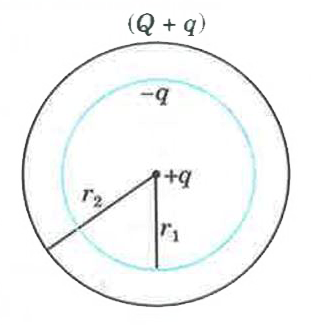 Surface charge density on inner surface of the spherical shell will be `sigma_(1)= -(q)/(4PI r_(1)^(2))` Surface charge density on outer surface of the spherical shell will be `sigma_(2)=(Q+q)/(4pi r_(2)^(2))` (b) Yes, the electric field inside a cavity (with no charge) is zero even if the shell is not spherical, but has any irregular shape because inside the volume of a conductor, the electric field is zero and if we make a cavity inside its volume even then electric field remains zero. This phenomenon is known as ELECTROSTATIC shielding. |
|
| 31. |
A 60^@ glass prism has a RI, mu=1.5, What is the angle of imergence at maximum deviation: |
|
Answer» `45^@` |
|
| 32. |
A block of mass M with a semi circular track of radius R, rests on a horizontal frictionless surface. A uniform cylinder of radius r and mass m is released from rest at the top point A. The cylinder slips on the semicurcular frictionless track. How far has the block moved when the cylinder reaches the bottom of the track ? How fast is the block moving when the cylinder reaches the bottom of the track ? |
|
Answer» |
|
| 33. |
निम्न फलनों के मान ज्ञात कीजिए -int_2^3 x^3dx |
|
Answer» `65/4` |
|
| 34. |
The waves set up in a closed pipe are |
|
Answer» TRANSVERSE and Progressive |
|
| 35. |
In a double slit experiment, at a certain point on the screen the path difference between the two interfering waves is 1/3 rdof a wavelength. The ratio of the intensity of light at that point to that at the centre of a bright fringe is: |
|
Answer» `0.25` `I/I_0=cos^2(((2PI)/lamdaxxlamda/3)/2)` `I/I_0=cos^(2)(pi/3), ""I/I_0=0.25` |
|
| 36. |
(a) If m is a particle's mass, p is its momentum magnitude, and K is its kinetic energy, show that m=((pc)^(2)-K^(2))/(2Kc^(2)) (b) For low particle speeds, show that the right side of the equation reduces to m. (c ) If a particle has K = 55.0 MeV when p = 121 MeV/c, what is the ratiom//m_(e ) of its mass to the electron mass? |
|
Answer» |
|
| 37. |
A cable 5 m above the ground carries a current of 50 A from south to north. Find the direction and magnitude of the magnetic field on the ground directly below the cable. |
| Answer» SOLUTION :`2.0 xx 10^(-6)` T from east to WEST ] | |
| 38. |
(A) : When the observation point lies along the length of the current element, magnetic field is zero. (R) : According to Biot-Savart's law field is defined only when position vector of a point relative to current element is non zero. |
|
Answer» Both 'A' and 'R' are TRUE and 'R' is the correct EXPLANATION of 'A'. |
|
| 39. |
Find the temperature when the r.m.s. velocity of oxygen will be the same as that of hydrogen molecule at 27°C |
|
Answer» 1600 K `rArr1=sqrt(300/(T_(O_(2)))xx32/2)` `rArrT_(O_(2)))=4800K` Thus CORRECT choice is (c). |
|
| 40. |
Which will roll down a hill faster a can of regular fruit juice or a can of frozen fruit juice? |
|
Answer» REGULAR FRUIT juice |
|
| 41. |
The lines are equipotential lines. The X and Y components of electirc field are (in V/m) |
|
Answer» `+100, - 200` |
|
| 42. |
In Young’s double slit experiment, the 8 th maximum with wavelength lambda_(1) is at a distance d_(1)from the central maximum and the 6 th maximum with a wavelength lambda_(2)is at a distance d_(2).Then (d_(1)//d_(2)) is equal to |
|
Answer» `(4)/(3)((lambda_(2))/(lambda_(1)))` |
|
| 43. |
A series circuit consisting of an inductance free resistance R =0.16k Omega and a coil with active resistance is connected to the mains effective voltage V =220V Find the heat power generated in the coil if the effective voltage values across the resistance R an the coil equal to V_(1) =80 V and V_(2) =180V respectively . |
|
Answer» Solution :Current in the circuit `V_(R) = i_(RMS)R` `80 = I_(rms) xx 160 implies i_(rms) = (1)/(2)A` `V_(Ro) = i_(rms) R_(0) = (R_(0))/(2)` `V_(L) =i_(rms) X_(L) = (X_(L))/(2)` `(V_(R) + V_(R_(0)))^(2) + V_(L)^(2) = (200)^(2)` `(80 + (R_(0))/(2))^(2) + ((X_(L))/(2))^(2) =(200)^(2) - (1800)^(2)` `(80 + R_(0)) (80) = (400) (40)` POWER consumed in coil ` P = i_(rms)^(2) R_(0) = ((1)/(2))^(2) xx 120 = 30 W` 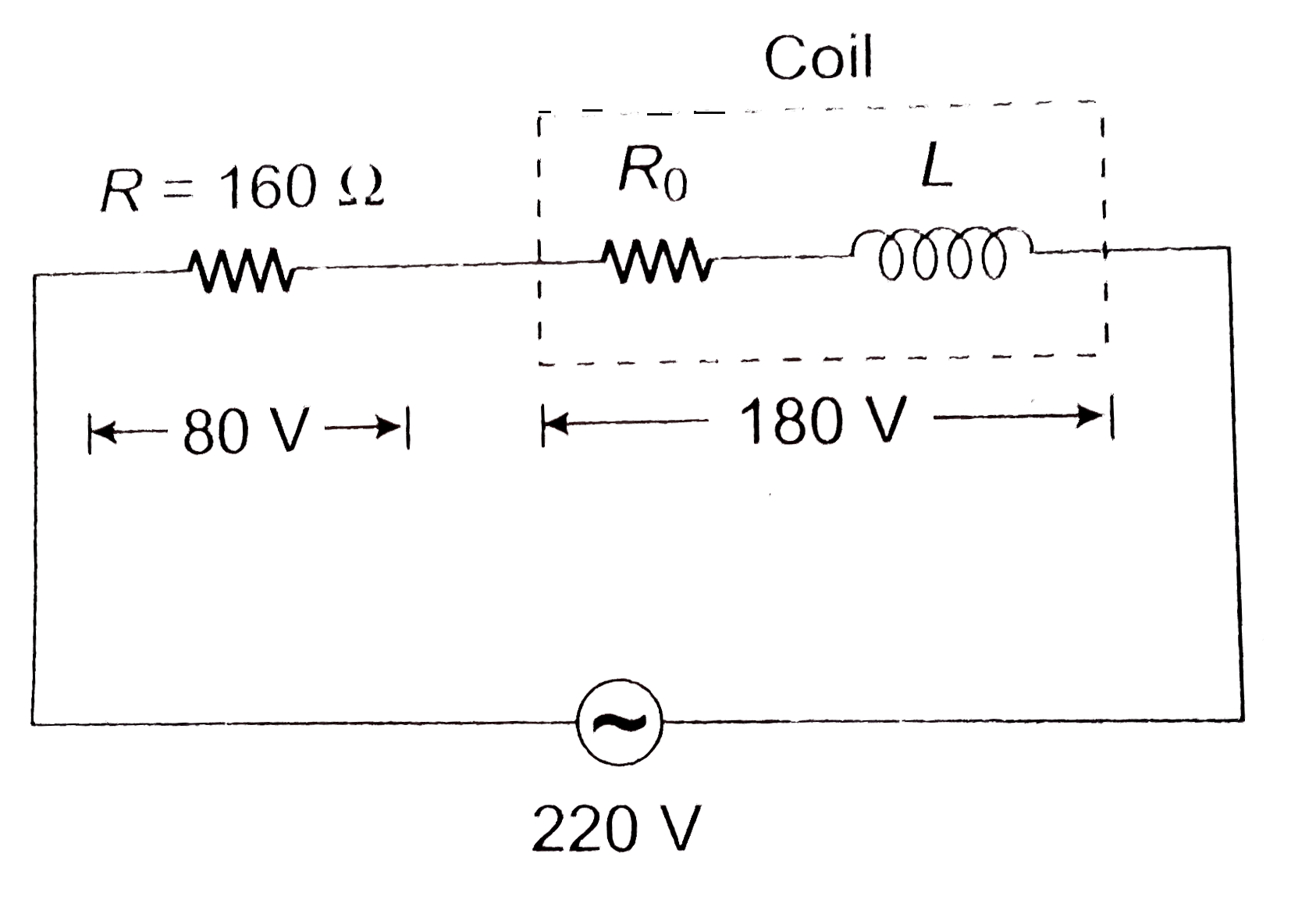 . .
|
|
| 44. |
For a certain metal, v is twice v_(0) and electrons come out with a maximum velocity of 4xx10^(6)ms^(-1). If value of v=5v_(0), then the maximum velocity of photoelectrons will be: |
|
Answer» `8xx10^(6)ms^(-1)` `(1)/(2)mv_("max")^(2)=h(5v_(0)-v_(0))` `v_("max")=8xx10^(6) ms^(-1)` |
|
| 45. |
Assertion : The information contained in our original low frequency baseband signal is to be translated into high or radio frequencies before transmission. Reason: For transmitting a signal, the antenna should have a size comparable to the wave length of the signal. |
|
Answer» |
|
| 46. |
A solid metallic sphere of radius R having charge + 3Q is surrounded by a hollow spherical shell of radius 2 R and having a charge -Q. (a) Find electric field at distance r from centre of solid sphere [R lt rlt 2R]. (b) Find potential difference between sphere and shell. (c ) Find distribution of charge if (i) inner sphere is earthed (ii) inner sphere and shell are connected by a metallic wire. |
Answer» Solution :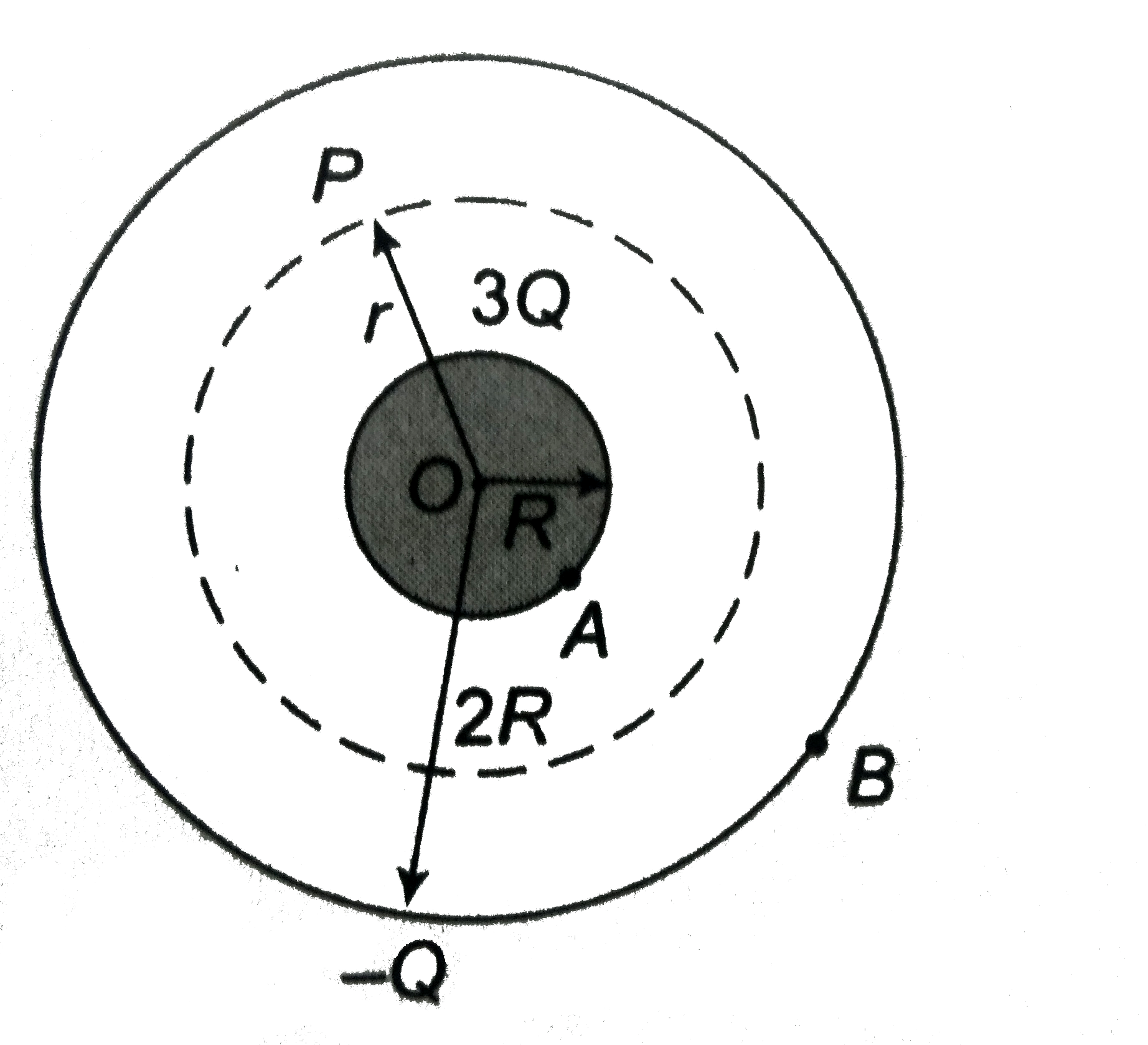 To find electeric field at `P`, assume charge inside sphere of radius `r` to be concentrated at centre `O`. `E_(P) = (1)/(4 pi in_(0)) .(3Q)/(r^(2))` (b) `V_(A) = (1)/(4 pi in_(0)) [ (3Q)/(R ) + (-Q)/(2R)]` `V_(B) = (1)/(4pi in_(0)) [ (3Q)/(2R) + (-Q)/(2R)]` `V_(A) - V_(B) = (1)/(4 pi in_(0)).(3Q)/(2R)` (c ) (i) LET charge on INNER sphere be `Q'`. `V_(P) = (1)/(4 pi in_(0)) [(Q')/(R ) + (-Q)/(2R)] = 0` `Q' = Q//2` 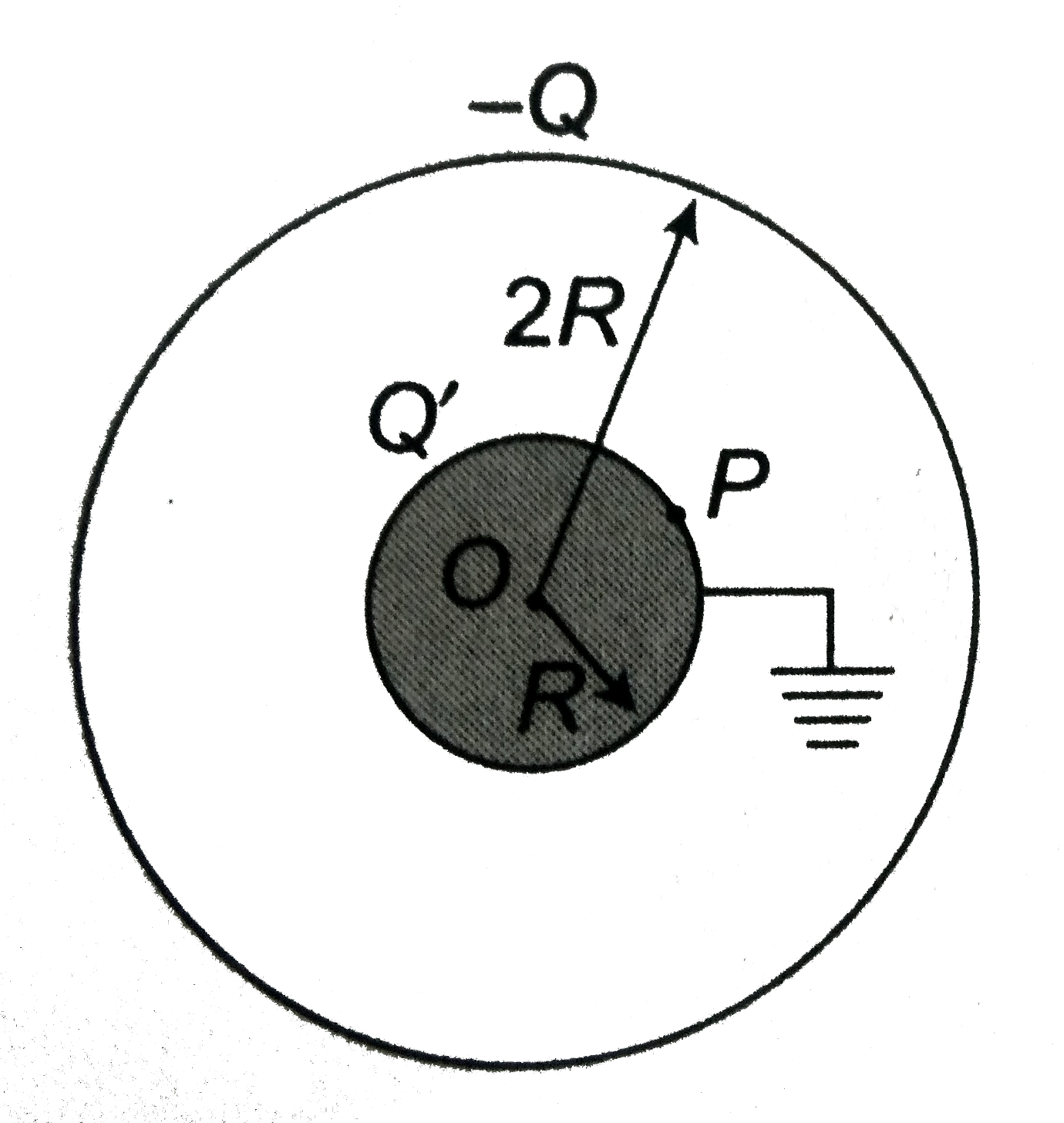 Charge distribution : 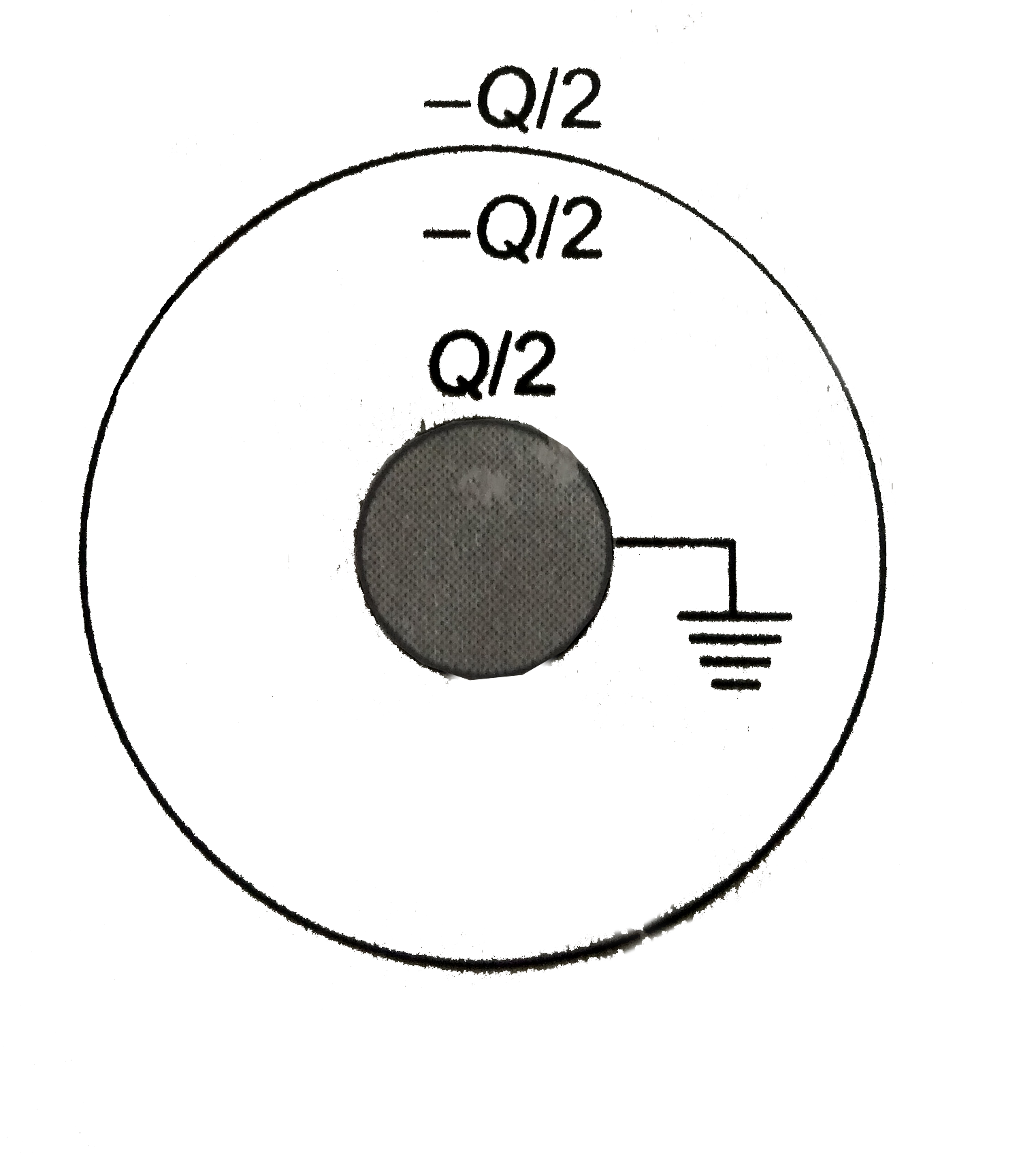 (II) When shell is connected to sphere , potential difference between shell and sphere becomes zero. 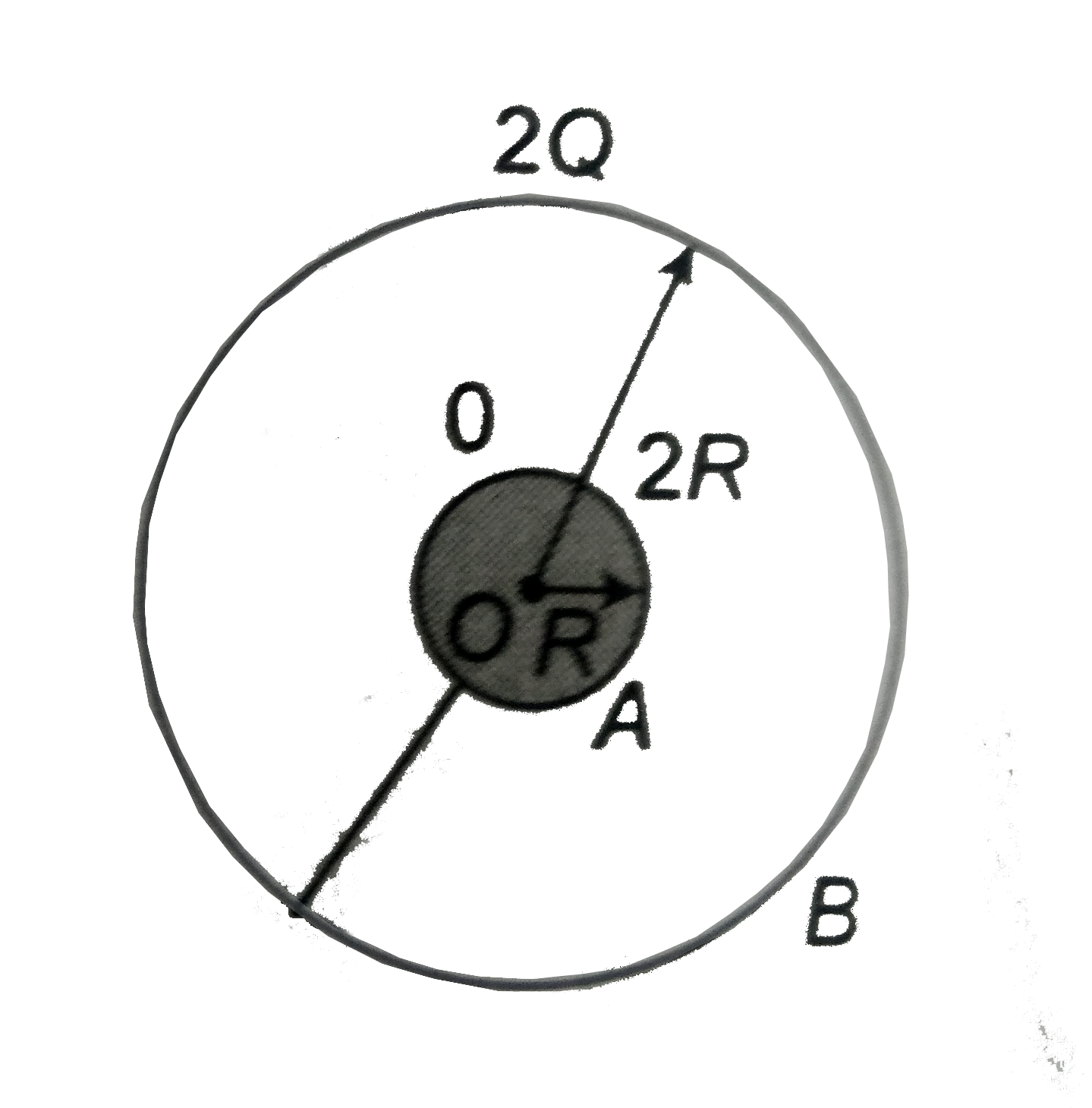 `V_(A) GT V_(B)` , charge `3Q` from sphere flows to shell , so that `V_(A) = V_(B)` Charge on sphere `= 0` Charge on shell `= 2q` |
|
| 47. |
How does mutual inductance of a pair of coils change when the number of turns in each coil is decreased? |
|
Answer» Solution :Mutual INDUCTANCE of two coils M = `mu_0n_1n_2Al` Obviously, the mutual inductance of two coils will DECREASE on DECREASING the number of TURNS in each coil. |
|
| 48. |
Two objects P and Q when placed at different positions in front of a concave mirror of focal length 20 cm, form real images of equal size. Size object P is three times size of object Q. If the distance of P is 50 cm from the mirror. Find the distance of Q from the mirror. |
|
Answer» Solution :Here, F = - 20 cm `h_p = 3 h_Q ,h_p=h_Q,u_p=-50` cm and for real image v is ALSO - ve. We know that magnification `(h.)/h=(-v)/u=f/(f-u)` `:.` For OBJECT P , we have `(h.)/(h_p)=(-20)/((-20)-(-50))=(-20)/30=(-2)/3 ""...(i)` and for object Q , we have `(h.)/(h_Q)=(h.)/(h_p/3)=(3h.)/(h_p)=(-20)/((-20)-(-u_Q))=(-20)/(u_Q-20)` `implies (h.)/h_p=(-20)/(3xx(u_Q-20))=(-20)/(3u_Q-60)""...(ii)` Comparing (i) and (ii) , we get `(-2)/3=-(20)/((3u_Q-60))` `implies2(3u_Q-60)=3xx20=60` `implies |u_Q|=30 cm` |
|
| 49. |
A small town with a demand of 800 kW of electric power at 220 V is situated 15 km away from an electric plant generating power at 440 V. The resistance of the two wire line carrying power is 0.5 Omega per km. The town gets power from the line through a 4000-220 V step-down transformer at a sub-station in the town. (a) Estimate the line power loss in the form of heat. (b) How much power must the plant supply, assuming there is negligible power loss due to leakage? (c) Characterise the step up transformer at the plant. |
|
Answer» Solution :Line resistance `=30xx0.5=15Omega`. rms current in the line `=(800xx1000W)/(4000V)=200A` (a) Line power LOSS `=(200A)^(2)xx 15Omega=600kW.` (b) Power supply by the plant `= 800 kW + 600 kW = 1400 kW.` (c ) VOLTAGE drop on the line `=200A xx 15Omega=3000V`. The step-up TRANSFORMER at the plant is `440V-7000V`. |
|
| 50. |
A person makes a quantity of iced tea by mixing 250g of hot tea (essentially wwater ) with an equal mass of ice at its melting point.Assume the mixture has negligible energy exchange with its environment. If the tea's initial temperature is T_(i) = 90^(@)C, when thermal equilibrium is reached what are (a) the mixture's temperature T_(f) and (b) the remaining mass m_(f ) of ice ? If T_(i) = 70^(@)C, when thermal equilibriumis reached what are (c ) T_(f) and (d) m_(f ) ? |
|
Answer» |
|