Saved Bookmarks
This section includes 7 InterviewSolutions, each offering curated multiple-choice questions to sharpen your Current Affairs knowledge and support exam preparation. Choose a topic below to get started.
| 1. |
The refractive indices of two lines are 1.49 and 1.51. The dispersive power of the material is |
|
Answer» 0.02 |
|
| 2. |
In the combination of the following gates, wirte the Boolen eqquation for the outputs Y in terms of inputs A and B. |
|
Answer» SOLUTION :The OUTPUTS at the 1 AND gate: A`barB` The outputs at the 2 AND gate: `barAB` The output at the OR gate: Y=A,`barB+barA.B` 
|
|
| 3. |
A motor running at a rate of 1200 rev/min can supply torque of 80 Nm. The power developed by it is what watt? |
|
Answer» 10.05 |
|
| 4. |
In Young's double slit experiment two coherent sources of intensity ratio of 64 :1, produce interference fringes. Calculate the ratio of maximum and minimum intensities. Data : I_(1) : I_(2) :: 64 : 1, (I_(max))/(I_(min))=? |
|
Answer» Solution :`(I_(1))/(I_(2))=(a_(1)^(2))/(a_(2)^(2))=(64)/(1)` `:.(a_(1))/(a_(2))=(8)/(1)` or `a_(1)=8a_(2)` `(I_(MAX))/(I_(MIN))=((a_(1)+a_(2))^(2))/((a_(1)-a_(2))^(2))=((8a_(2)+a_(2))^(2))/((8a_(2)-a_(2))^(2))` `=((9a_(2))^(2))/((7a_(2))^(2))=(81)/(49)` `:.I_(max) : I_(min) : : 81 : 49` |
|
| 5. |
The cylindrical tube of spray pump has a cross- section of 8 cm^(2) one end of which has 40fine holes each of area 10^(-8) m^(2) . IF the liquid flows inside the tube with a speed of 0.15 m min ^(-1) . The speedwith which the liquyid is ejected through the holes is |
|
Answer» `50 ms^(-1)` ` (40 xx 10^(-8)) xx v_(1) = 8 xx 10^(-4) xx (0.15/60)` ` or v_(1) = ( 8 xx 10^(-4) xx 0.15)/(40 xx 10^(-8) xx 60) = 5 m s^(-1)` |
|
| 6. |
Name the laws associated with the following equation. ointvecE.vecdt = (q)/epsilon_0 |
| Answer» SOLUTION :Faraday.s LAWS of ELECTROMAGNETIC INDUCTION. | |
| 7. |
An electron initially at rest is accelerated through a p.d. of 1V. The energy acquired by the electron is |
|
Answer» 1J |
|
| 8. |
The r.m.s. value of electric field of the light coming from sun in 720 N // C. The average energy density of e.m.f. is : |
|
Answer» `3.3 xx 10^(-3) J // m^(3)` = magnetic energy density. `:. "Total energy density"=2 xx "electric energy"` `=2((1)/(2) epsilon_(0)E^(2))` `=2 xx (1)/(2) xx 8.854 xx 10^(-12) xx 720^(2)` `= 4.58 xx 10^(-6) J // m^(3)` |
|
| 9. |
Prove that a photon in a vacuum, no matter how high its energy is, cannot transform to an electron-positron pair. |
|
Answer» Solution :Suppose that the photon PRODUCES a pair of PARTICLES with identical momenta. In this CASE the laws of conservation of energy and the momentum will be writen in the form `epsi_(ph)=2mc^(2),epsi_(ph//c)=2mvcosalpha` Hence `2mc^(2)=2mvc COSALPHA,orc=vcosalpha`, which is impossible. 
|
|
| 10. |
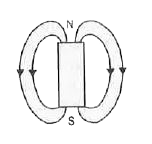
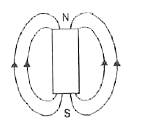
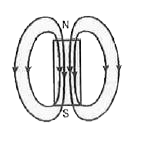
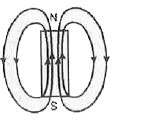
The magnetic field lines dueto a bar magnet are correctly shown in |
|
Answer»
|
|
| 11. |
When a voltameter is connected across a battery which is connected with external resistance 280 Omega to measure its emf, it reads 1.4 V. Now when this emf is measured by potentiometer, it is measured as 1.55 V. Now if maximum power is to be spent in the external resistance then its value should be made equal to ...... . |
|
Answer» 30 `Omega`  Reading obtained in voltmeter, connected across a battery (i.e. across its terminals a and b) is, V = IR `therefore 1.4 = I xx 280 ` `therefore I = 5 xx 10^(-3)` A emf of above battery as measure by potentiomete is `epsilon = 1.55 ` V. For a discharging battery, we have, `V = epsilon - Ir ` `therefore 1.4 = 1.55 - (5 xx 10^(-3)) r` `therefore (5 xx 10^(-3)) r = 0.15 ` `therefore r= (0.5 )/(0.005) = 30 Omega` Now, in order to spend maximum power in external resistance its value should be made equal to internal resistance of the battery. Hence, NEW value of external resistance should be made`30 Omega`. Verification : When `R_(1) = 280 Omega and r = 30 Omega ( " here R " gt r)` `I_(1) = (epsilon)/(R_(1) + r)= (1.55)/(280 + 30) = 0.005 A ` Power spent in `R_(1)` is `P_(1) = I_(1)^(2) R_(1) = (0.005)^(2) (280) = 0.007` W .... (1) (ii) When `R_(2)= r=30 Omega` `I_(2) = (epsilon)/(R_(2) + r ) = (1.55)/(30 + 30) = (1.55)/(60) = 0.02583` A Here , spent in `R_(2)` is `P_(2) = I_(2)^(2) R_(2) = (0.02583)^(2) (30)= 0.2 W`.... (2) (iii) When `R_(3) lt r , ` suppose `R_(3) = 20 Omega (lt 30 Omega) ` `I_(3)= (epsilon)/(R_(3) + r) = (1.55)/(20 + 30) = (1.55)/(50) =0.031 A ` Now power spent in `R_(3) ` is , `p_(3) = I_(3)^(2) R = (0.031)^(2) (20) = 0.01922` w... (3) Equation (1), (2), (3) prove that power spent in external resistance is maximum whenR = r At thistime, `1 = (epsilon)/(R + r) = (epsilon)/(2R)(because R= r) ` Notes: (i) Here maximum power spent in the circuit is `I^(2) (R + r) = I^(2) (2r) = ((epsilon)/(2r) )^(2) (2r) = (epsilon^(2))/(2r)` (ii) Maximum power that can be generated in the battery is, `P_("max") = (epsilon) (I_("max") ) = (epsilon) ((epsilon)/(r))`(when R = 0 ) `therefore P_("max") = (epsilon^(2))/(r)` |
|
| 12. |
Rank the following pairs of quantum states for an electron confined to an infinite well according to the energy differences between the states, greatest first : (a) n = 3 and, (b) n = 5 and n = 4, (c) n = 4 an n =3. |
| Answer» SOLUTION :(B), (a), (C) | |
| 13. |
At y = 1 cm, y = 3 cm y = 9 cm, y = 27 cm … and so on , an infinite number of charges equal to 5C are placed. At x = 1 cm, x = 2 cm, x = 4 cm, x = 8 cm …. And so on, an infinite number of charges equal to - 5C are placed. Find the electirc potential at origin is volts . (K = (1)/(4pi epsilon_(0))) |
| Answer» Answer :B | |
| 14. |
Figure shows a capacitor made of two circular plates each of radius 12 cm, and separated by 5.0 cm. The capacitor is being charged by an external source (not shown in the figure). The charging current is constant and equal to 0.15 A.Is Kirchhoff's first rule (junction rule) valid at each plate of the capacitor ? Explain. |
| Answer» Solution :YES, Kirchhoff.s first law is true and valid for each plate of a capacitor because WHATEVER current FLOWS towards the plate of a capacitor in the form of conduction current `i_(C )`, same amount of current flows away from it in the form of displacement current `i_(d)`. | |
| 15. |
Four identical charges Q are fixed at the four corners of a square of side a. Find the electric field at a point p located symmetrically at a distance (a)/(sqrt(2)) from the centre of th square. |
|
Answer» `(Q)/(2sqrt(2)piepsilon_(0)a^(2))` |
|
| 16. |
Figure shows a capacitor made of two circular plates each of radius 12 cm, and separated by 5.0 cm. The capacitor is being charged by an external source (not shown in the figure). The charging current is constant and equal to 0.15 A.Obtain the displacement current across the plates. |
|
Answer» Solution :According to the formula of displacement current `i_(d)=in_(0)(d Phi_(E ))/(dt)` (Where `Phi_(E )=` ELECTRIC FLUX) `= in_(0)(d)/(dt)(AE)` `=in_(0)(d)/(dt)(A XX(sigma)/(in_(0)))(because E=(sigma)/(in_(0)))` `= in_(0)xx(1)/(in_(0))(d)/(dt)(A sigma)` `= (dQ)/(dt)(because sigma =(Q)/(A)rArr Q=A sigma)` `=i_(C )` (Where `i_(C )=(dQ)/(dt)=` CONDUCTION current) = 0.15 A |
|
| 17. |
A particle moves in x - y plan according to equation x = 4t^2 + 5t + 16 and y = 5t. The acceleration of particle must be |
|
Answer» `8m/sec^2` |
|
| 18. |
A train is approaching towards a platform with a speed of 10 m s^(-1) while blowing a whistle of frequency 340 Hz. What is the frequency of whistle heard by a stationary observer on the platform ? Given speed of sound = 340 ms^(-1). |
|
Answer» 330 Hz `= 340((340)/(340-10)) = 350.3 Hz` |
|
| 19. |
Represent graphicallythe variationof resistivitywith absolutetemperaturefor copper and nichrome metals. |
Answer» SOLUTION :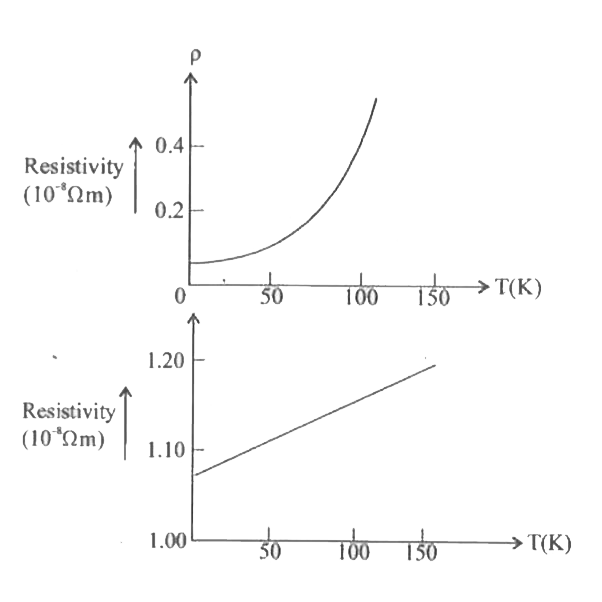
|
|
| 20. |
An aeroplane is moving north horizontally with speed of 200 m/s at a plane where the vertical component of the earth's magnetic field is 0.5xx10^(-4)T. What is the induced e.m.f. set up between the tips of the wings if they are 10 m apart? |
| Answer» ANSWER :B | |
| 21. |
Figure shows a capacitor made of two circular plates each of radius 12 cm, and separated by 5.0 cm. The capacitor is being charged by an external source (not shown in the figure). The charging current is constant and equal to 0.15 A.Calculate the capacitance and the rate of change of potential difference between the plates. |
|
Answer» Solution :Capacitance of parallel plate CAPACITOR is, `C=(in_(0)A)/(d)` `=(in_(0)(pi R^(2)))/(d)` `=((8.85xx10^(-12))(3.14)(0.12)^(2))/((0.005))` `therefore C=80xx10^(-12)F=80 pF` (picofarad) ACCORDING to formula capacitance of capacitor, `C=(Q)/(V)` `therefore Q=CV` `therefore (dQ)/(dt)=C(dV)/(dt)` `therefore I=C(dV)/(dt)` `therefore (dV)/(dt)=(I)/(C )` `therefore (dV)/(dt)=(0.15)/(80xx10^(-12))` `therefore (dV)/(dt)=1.875xx10^(9)Vs^(-1)` |
|
| 22. |
A ray of light is incident upon one face of a prism in a direction perpendicular to the other refracting face. The critical angle for glass – air interface is 30°. Find the angle of the prism (assuming it to be less than 90°) if the ray fails to emerge from the other face. |
|
Answer» |
|
| 23. |
The diagonals of a parallelogram are 2hati and 2hatj . What is the area of the parallelogram |
|
Answer» `0.5` UNIT |
|
| 24. |
A block of weight 5N is pushed against a vertical wall by a force 12 N. The coefficient of friction between the wall and the block is 0.6. The- magnitude of the force exerted by the wall on the block is |
|
Answer» 12 N |
|
| 25. |
The absorption of radio waves by the atmosphere depends on |
|
Answer» their DISTANCE from the transmitter |
|
| 26. |
Monochromatic light waves of constant phase difference phi and amplitues A_(1) and A_(2) produce an interference pattern. State an expression for the resultant amplitude at a point in the pattern.Hence deduce the conditions for (i) constructive interference with maximum intensity (ii) destructive interference with minimum intensity. Also show that the ratio of the maximum and minimum intensities(I_(max))/(I_(min))=((A_(1)+A_(2))/(A_(1)-A_(2)))^(2). |
|
Answer» Solution :Consider a two-source interference pattern produced by monochromatic light waves of angular frequency `omega`, wavelength `lambda`, amplitudes `A_(1) and A_(2)`,and a constant phase difference `phi`. LET the individualdisplacements due to the waves at a point P in the interference pattern be `y_(1)=A_(1) SIN omega t and y_(2) = A_(2) sin(omega t+phi)` Let `A_(1)+A_(2) cos phi = R cos theta and A_(2) sin phi = R sin theta ` It can be shown that, by the superposition principle, the resultant displacement at P is the algebraic sum, `y=y_(1)+y_(2)=A_(1) sin omega t +A_(2) sin (omega t +phi)` `=R sin( omega t +theta)` where the resultant amplitude is `|R|= sqrt(A_(1)^(2)+A_(2)^(2)+2A_(1)A_(2) cos phi ) "" ` ...(1) Since the intensity of a wave is proportional to the square of its amplitude, the resultant intensity at P, `I prop R^(2)` `therefore I prop A_(1)^(2) +A_(2)^(2) +2A_(1)A_(2) cos phi "" ` ...(2) that is, the intensity depends on `cos phi` Hence, P will be a point of constructive interference with MAXIMUM intensity when `cos phi` is maximum, equal to 1, i.e., when`phi =2n pi ""(n=0,1,2,3, ...) "" ` ...(3) P will be a point of destructive interference with minimum intensity when `cos phi` is minimum, equal to -1, i.e., when `phi =(2m-1)pi""(m=1,2,3,...) "" ` ...(4) Expressions (3) and (4) GIVE the conditions of constructive and destructive interference, respectively. At POINTS where R and I are maximum, `R_(max)=A_(1)+A_(2) "" ` ...(5) ` and I_(max) prop A_(1)^(2) +A_(2)^(2) +2A_(1)A_(2)` `therefore I_(max) prop (A_(1) +A_(2))^(2) "" `...(6) At points where R and I are minimum, `R_(min) =|A_(1)-A_(2)| "" `...(7) ` and I_(min) prop A_(1)^(2)+A_(1)^(2) -2A_(1)A_(2) ` `therefore I_(min) prop (A_(1) -A_(2))^(2) "" ` ...(8) `therefore` From Eqs. (6) and (8), `(I_(max))/(I_(min))=((A_(1)+A_(2))/(A_(1)+A_(2)))^(2) "" ` ...(9) |
|
| 27. |
Statement (A): Every photon striking the metal and colliding with the electron uses part of its energy to remove the electron from the metal surface, the remaining part is used to impart K.E. to the electron. Statement (B): The minimum energy needed to remove the electron from the metal surface is called work function. Statement (C): There is no time lag between incidence of photon and emission of photoelectrons. |
|
Answer» A, B are only TRUE |
|
| 28. |
Which of these rights were established as 'natural and inalienable' rights by the constitution of 1791? |
|
Answer» RIGHT to life |
|
| 29. |
The binding energies per nucleon for deuteron (._1H^2) and helium (._2He^4) are 1.1 MeV and 7.0 MeV respectively. Calculate the energy released, when two deuterons fuse to form a helium nucleus. |
|
Answer» Solution :Thefusion reaction is `2(""_(1)H^(2)) rarr ""_(2)He^(4)+Q` Q = TOTAL binding energy of the product `""_(2)He^(4)` - Total binding energy of REACTANT i.e. , two DEUTERONS. `= 4 xx7.0 - 4 xx 1.1 = 28.0 - 4.4` = 23 . 6 MEV |
|
| 30. |
The 8th century inscription of Yasovarman contains a telling description of ………………. |
|
Answer» Nalanda |
|
| 31. |
A uniform conducting wire is in the shape of a circle. The same wire has been used to make its diagonal AB. A current I enters at point P and leaves at the diagonally opposite point Q. AB makes an angle theta with the line PQ. find current (i), through AB as a function of theta. Plot a graph showing variation of i with theta(0^(@) le theta le 90^(@)) |
|
Answer» |
|
| 32. |
Statement I : Hot soup tastes better than the cold soup. Statement II : Hot soup has high value of surface tension. So it does not spread properly on the tongue. |
|
Answer» Statement-I is true, Statement-II is true and Statement-II is correct explanation for Statement-I. |
|
| 33. |
Derive equation of mobility in terms of electric current. |
|
Answer» SOLUTION :`rArr` When n number electron moves with VELOCITY `v_(d)`in conductor of cross-section A current I will be, I = nAu `d^(e)` Now, `mu = (v_(d))/(E)` `therefore v_(d) = mu `E `I = nA(mu E)e` `mu = (I)/(n AE e)` SI unit of `mu = (A)/(m^(-3) xx m^(2) xx (V)/(m) xx C)` `= (A)/(m^(-2) VC)` `= m^(2) OmegaC^(-1)` |
|
| 34. |
Four moles of hydrogen, 2 moles of helium and 1 mole of water vapour form an ideal gas mixture. What is the molr specific heat at constant pressure of mixture? |
|
Answer» `(16)/(7)R` `C_(V)` for HELIUM = `3R//2,C_(v)` for water vapour = `6R//2=3R` `therefore (C_(V))_("mix")=(4XX(5R)/(2)+2XX(3R)/(2)+1xx3R)/(4+2+1)=(16R)/(7)` `therefore C_(P)=C_(V)+R=(16R)/(7)+R=(23R)/(7)` |
|
| 35. |
Two particles, each having a mass of 5g and charge 10^(-7)C, stay in limiting equilibrium on a horizontal table with a separation of 10cm between them. Find the coefficient of friction between each particle and the table, which is same between each particle and table |
|
Answer» `MU = 0.18` |
|
| 36. |
.............introduced is used to hold patients head and guide the placements of electrodes. |
|
Answer» Monotaxic |
|
| 37. |
In the question number 96, the number of turns in the secondary is |
|
Answer» <P>20 `=(220)/(11000)xx6000=120`. |
|
| 38. |
A cell of emf epsiand internal resistance r is connected to two external resistances, R_1 and R_2 and aperfect ammeter. The current in the circuit is measured in four different situations: (i) Without any external resistance in the circuit, (ii) with resistance R_1 only (iii) with R_1 and R_2 in series combination, (iv) with R_1 and R_2 in parallel combination.The currents measured in the four cases are 0.42 A, 1.05 A, 1.4 A and 4.2 A, but not necessarily inthat order. Identify the currents corresponding to the four cases mentioned above |
|
Answer» Solution :The circuit resistance with SERIES COMBINATION of `R_1` and `R_2 GT`with resistance `R_1` or `R_2 gt`with parallel combination of `R_1` and `R_2 gt` without any EXTERNAL resistance. From this we conclude that: (i) Without any external resistance in the circuit the current should be 4.2 A. (II) With resistance `R_1` only the current should be 1.05 A. (iii) With `R_1` and `R_2` in series combination the current should be 0.42 A. (iv) With `R_1` and `R_2` in parallel combination the current should be 1.4 A. |
|
| 39. |
In case of Tangent galvanometer A) The galvanometer reduction factor depends on earth's magnetic field B) External fields have effect on T.G and therefore T.G cannot be used in mines |
|
Answer» A is TRUE, B is FALSE |
|
| 40. |
Three capacitors with capacitances of1 mu F, 2 mu F and 3 mu F are connected in series. Each capacitor gets punctured, if a potential difference just exceeding 100 volt is applied. If the group is connected across 220 volt circuit then the capacitor most likely to puncture first is |
|
Answer» capacitance `1 MU F` |
|
| 41. |
A Carnot engine, having an efficiency of eta= 1/10 as heat engine, is used as a refrigerator. If the work done on the system is 10 J, the amount of energy absorbed from the reservoir at lower temperature is |
|
Answer» 99 J |
|
| 42. |
The dotted line indicate the surface such that they lie equi-distance from the charge .q.: Write the properties of the surface. |
| Answer» SOLUTION :EQUIPOTENTIAL SURFACE. | |
| 43. |
The safety limit of temperature for germanium and silicon are : |
|
Answer» `80 ""^@C ,200""^@C` |
|
| 44. |
A stone is hung in air from a wire which is stretched over a sonometer . The bridges of the sonometer are 40 cm apart when the wire is in unison with a tuning fork of frequency 256. When the stone is completely immersed in water, the length between the bridges is 22 cm for re-establishing unison. The specific gravity of the material of the stone is : |
|
Answer» `256 XX (40)/(22)` Tension, `"" T = `Weight of stone. `therefore` In AIR `v_(1) = (1)/(2l_(1)) sqrt((W_(a))/(m))` In water `v_(2) = (1)/(2l_(2)) sqrt((W_(W))/(m))` SINCE ` v_(1) = v_(2) ` `therefore (1)/(2l_(1)) sqrt((W_(a))/(m)) = (1)/(2l_(2)) sqrt((W_(w))/(m))` `rArr "" (W_(a))/(W_(w)) = (I_(1)^(2))/(I_(2)^(2))`. Now relative density of stone = ` (w_(a))/(W_(a) - W_(w))` `therefore` Relative density = `(1)/(1 - (W_(w))/(W_(a)) ) = (1)/( 1 - (I_(2)^(2))/(I_(1)^(2)))` = `(I_(1)^(2))/(I_(1)^(2)- I_(2)^(2)) = ((40)^(2))/((40)^(2)- (22)^(2) ) `. Correct choice is c. |
|
| 45. |
A metallic loop is placed in a magnetic field. If a current is passed through it, then |
|
Answer» The ring will FEEL a force of attraction |
|
| 46. |
Four capacitors of capacitance C, 2C, 3C & 4C respectively are connected as shown in figure. Battery is deal and all the connected wires have no resistance capcitance or inductance. Initially the switch S is open. If at t=0 switch S is closed Heat generated is the switch after closing switch is |
|
Answer» `(CE^(2))/(105)` `=W_(b)=(Q_(TAKE)-Q_(take))E` Heat produced `=W_(b)-DeltaU=(CE^(2))/(105)J` 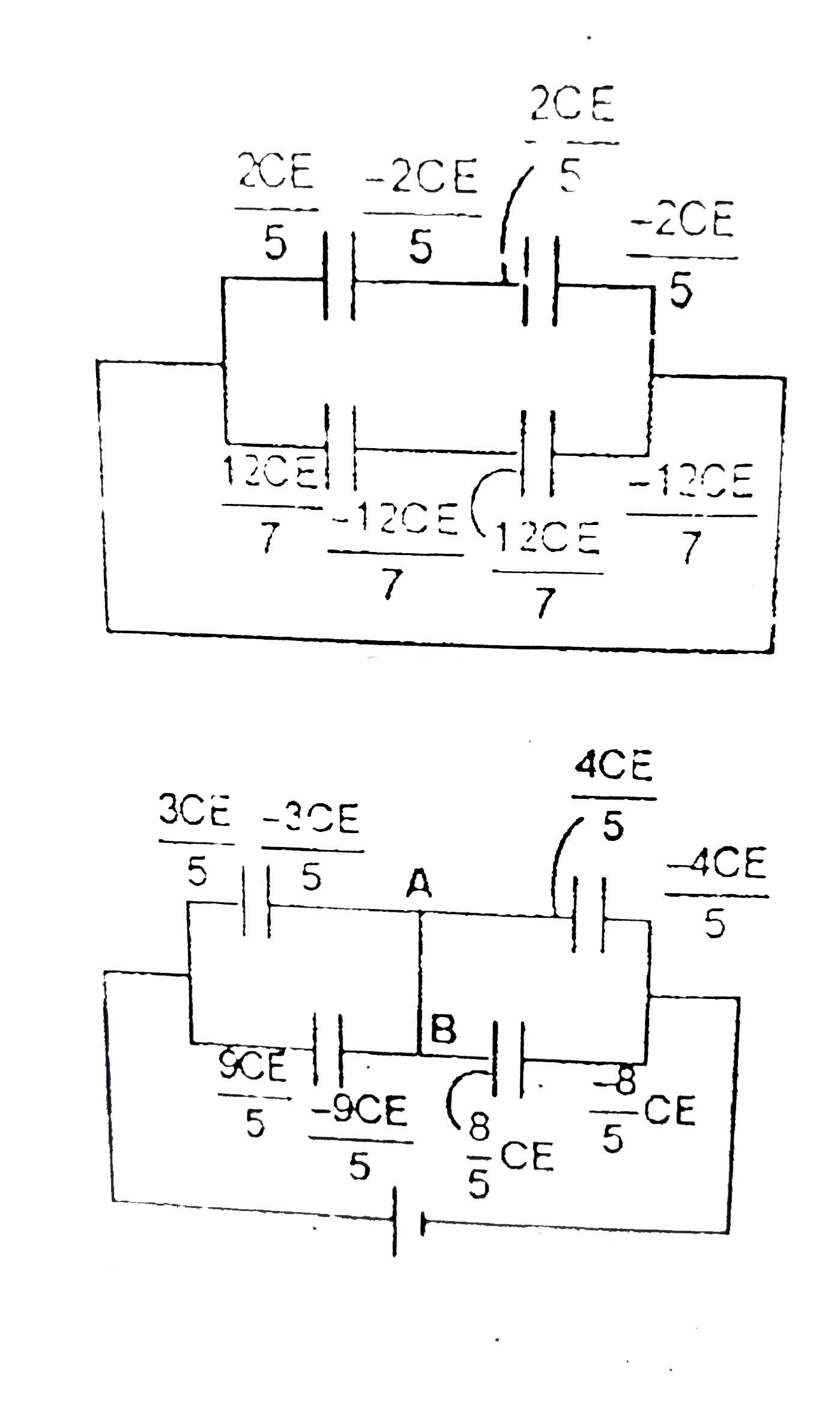
|
|
| 47. |
To reduce the ripplesin a rectifier circuit with capacitor filter. (a) R_(L) should be increased (b) Input frequency should be decreased (c) Input frequency should be increased (d) Capacitors with high capcitance should be used |
| Answer» Answer :B | |
| 48. |
A convex lens has a focal length f. It is cut inti two parts along the dotted lines as shown ii figure. The focal length of each part will be…....... . |
|
Answer» `f/2` `1/f=(n-1)(1/R_1-1/R_2)(R_1=R,R_2=-R)` `=(n-1)(1/R+1/R)=(n-1)(2/R)` `thereforef=(R)/(2(n-1))` …......(1) Now a convex lens is cut into two PARTS along perpendicular direction to the axis, the plano convex lens will prepared. The FOCALLENGTH of this lens is `f_1` then, `(1)/(f_1)=(n-1)(1/R_1-1/R_2)` `[R_1=prop(infinite),R_2=-R]` `therefore1/f_1=(n-1)1/R` `therefore f_1=(R)/(n-1)=2f` 
|
|
| 49. |
Four capacitors of capacitance C, 2C, 3C & 4C respectively are connected as shown in figure. Battery is deal and all the connected wires have no resistance capcitance or inductance. Initially the switch S is open. If at t=0 switch S is closed The work done by battery after closing, switch is |
|
Answer» `(CE^(2))/(5)` `=W_(b)=(Q_(take)-Q_(take))E` Heat PRODUCED `=W_(b)-DeltaU=(CE^(2))/(105)J` 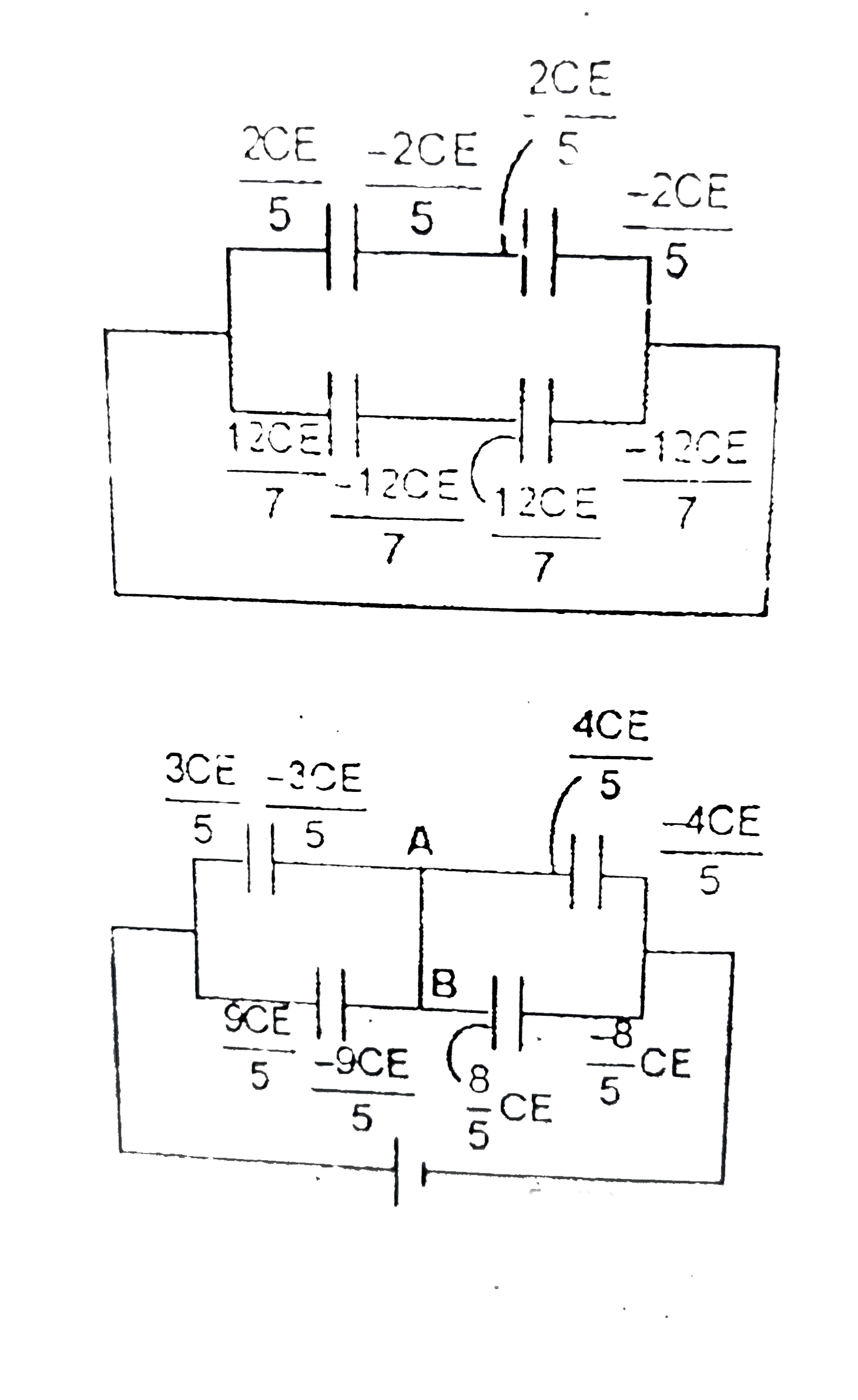
|
|
| 50. |
The figure below shows two equipotential surfaces in X-Y plane for an electric field. The scales are marked. The X-component E_x, and Y-component E_Y of the electric field in the region of the space where these equipotential lines exist, are respectively : |
|
Answer» `+100 VM^(-1),-200 Vm^(-1)` |
|