

Saved Bookmarks
This section includes 7 InterviewSolutions, each offering curated multiple-choice questions to sharpen your Current Affairs knowledge and support exam preparation. Choose a topic below to get started.
| 1. |
Both the strings, shown in figure, are made of same material and have same cross section. The pulleys are light. The wave speed of a transverse wave in the string AB is u_(1)and init is v_(2). Then v_(1)//v_(2) is |
| Answer» ANSWER :D | |
| 2. |
Find the work per cycle in Problems 17.9 and 17.10. |
|
Answer» SOLUTION :(a) `W = p_2(V_2 - V_1) - p_1(V_2 - V_1) = (p_2 - p_1)(V_2 - V_1)`. (B) `W = m/M RT_1 LN (V_2)/(V_1) - m/M RT_2 ln (V_2)/(V_1) = m/M R(T_1 - T_2) ln (V_2)/(V_1)`. |
|
| 3. |
When closed pipe has fundamental frequency 100Hz and is vibrating for its fourth harmonics then frequency of vibration will be |
|
Answer» 400Hz |
|
| 4. |
In a single slit diffraction pattern, how does the angular width of central maxima change when light of smaller visible wavelength is used ? Justify your answer. |
| Answer» SOLUTION :If `LAMDA` DECREASES, ANGULAR WIDTH decreases | |
| 5. |
A rectangular, a square, a circular and an elliptical loop, all in the x-y plane, are moving out of a uniform magnetic field with a constant velocity vcev = v_(0)hati. The magnetic field is directed along the negative z-axis direction. The induced emf, during the passage of these loops, out of the field region, will not remain constant for |
|
Answer» the RECTANGULAR, circular and elliptical loops. |
|
| 6. |
A microscope is focussed on an ink mark on th top of a table. If we place a glass slab of 3 cm thick on it, how should the microscope be moved to focus the ink spot again ? The refractive index of glass is 1.5. |
|
Answer» 2 cm upwards `therefore h_i=(1)/(1.5)xxh_0` `=(1)/(1.5)xx3` `therefore h_i=2` cm `therefore` Microscope be moved =3-2=1 cm upward |
|
| 7. |
Figure shows the motion of a particle along a straight line. Find the average velocity of the particle during the intervals (a)A to E , (b) B to E, (c ) C to E, (d) D to E , (e) C to D . |
Answer» SOLUTION :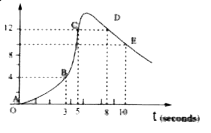 (a) As the particle moves from A to E, A is the initial point and E is the final point. The slope of the line drawn from A to E i.e., `(Deltax)/(Deltat)`gives the average velocity during that INTERVAL of time . The displacement `Deltax` is `X_E-X_A` = 10 cm -0 cm =+10 cm The time interval `Deltat_(EA)=t_E-t_A` =10 s . `therefore` During this interval average velocity `barv=(Deltax)/(Deltat)=(+10cm)/(10s)=+1cms^(-1)` (B)During the interval B to E, the displacement `Deltax=x_E-x_B`=10 cm -4 cm =6 cm and `Deltat=t_E-t_B` =10s -3 s =7s `therefore` Average velocity `barv=(Deltax)/(Deltat)=(6CM)/(7s)` `=+0.857 cms^(-1) = 0.86 cms^(-1)` (c) During the interval C to E , the displacement `Deltax=x_E-x_C` = 10 cm -12 cm =2 cm and `Deltat=t_E-t_C` =10s - 5s =5s `therefore barv=(Deltax)/(Deltat)=(-2cm)/(5s)=-0.4cms^(-1)` (d)During the interval D to E , the displacement `Deltax=x_E-x_D` = 10 cm -12 cm =-2cm and the time interval `Deltat=t_E-t_D` =10s -8s =2s `therefore barv=(Deltax)/(Deltat)=(-2cm)/(2s)=-1cms^(-1)` (e)During the interval C to D, the displacement `Deltax=x_D-x_C` = 12cm -12cm =0 and the time interval `Deltat=t_D-t_C` =8s -5s =3s `therefore` The average velocity `barv=(Deltax)/(Deltat)=(0m)/(3s)=0 MS^(-1)` (The particle has reached the same position during these 3s. The average velocity is zero because the displacement is zero). |
|
| 8. |
A Two wires of the same material have length 6cm and 10cm and radii 0.5 mm and 1.5 mm respectively. They are connected in series across a battery of 16 V. The p.d. across the shorter wire is |
| Answer» ANSWER :B | |
| 9. |
For a projectile the ratio of maximum height reached to the the square of the time of flight is ( g = 10m/s^2). |
| Answer» Answer :C | |
| 10. |
A small body is dropped into a narrow channel drilled along the Earth axis. Considering the Earth to be a homogeneous sphere and disregarding air resistance answer the following questions. (Acceleration due gravity on the surface of the Earth is g, Radius of Earth is R) The magnitude of body's acceleration, a(r) as a function of the distance r from the Earth's center is |
| Answer» Answer :D | |
| 11. |
For a transistor, the value ofalpha =0.9, then the value of betais |
|
Answer» 9 |
|
| 12. |
Which gas is the main reason for depletion of ozone layer? |
| Answer» SOLUTION :CHLOROFLUOROCARBON (CFC) or FREON. | |
| 13. |
A small body is dropped into a narrow channel drilled along the Earth axis. Considering the Earth to be a homogeneous sphere and disregarding air resistance answer the following questions. (Acceleration due gravity on the surface of the Earth is g, Radius of Earth is R) The ratio of speed of the body at the instant when it reaches the center of Earth to the escape speed on the surface of the Earth is |
| Answer» Answer :C | |
| 14. |
In the above problem if the battery is disconnected before placingthe plate, thennew energy will be - |
|
Answer» `K^(2)U_(0)` |
|
| 15. |
A small body is dropped into a narrow channel drilled along the Earth axis. Considering the Earth to be a homogeneous sphere and disregarding air resistance answer the following questions. (Acceleration due gravity on the surface of the Earth is g, Radius of Earth is R) The magnitude of body's speed as a function of r is |
|
Answer» `sqrt((2G(R^2-r^2))/R)` |
|
| 16. |
An inductor 20mH, a capacitor 100muF and a resistor 50Omega are connected in series across a source of emf, V = 10 sin 314 t. The power loss in the circuit |
|
Answer» 0.79W |
|
| 17. |
Calculate the amount of work done in turing an electric dipole of dipole moment 2 xx 10^(-8) C -m from its position of unstable eqquilibrium to its position of stable equilibrium, in a uniform electric field of 10^3 N C^(1). |
|
Answer» <P> Solution :Here `p = 2 xx 10^(-8) C-m, E= 10^(3) N C^(-1)`. In unsatable equilibriumstate `theta_1 = 180^@` and for STABLE equilibrium state `theta_2= 0^@`. THEREFORE,Work done `W = pE[cos theta_1 - cos theta_2] = 2 xx 10^(-8) xx 10^3 xx [ cos 180^@ - cos 0^@] = - 4 xx 10^(-5)J` |
|
| 18. |
Two particles A and B of mass m_(A) and m_(B) respectively and having the same charge are moving in a plane. A uniform magnetic field exists perpendicular to this plane. The speeds of the particles are v_(A) and v_(B) respectively, and the trajectories are as shown in the figure. Then |
|
Answer» `m_(A)v_(A)ltm_(B)v_(B)` |
|
| 19. |
de-Broglie wavelength of a photon is equal to ____. |
| Answer» SOLUTION :Its WAVELENGTH. | |
| 20. |
What is a cyclotron? Write down the expression for the cyclotron frequency. |
| Answer» SOLUTION :REFER TEXT, TOPIC CYCLOTRON | |
| 21. |
A doubly ionized lithium atom is hydrogen like with atomic number Z = 3. Find the wavelength of the radiation required to excite the electron in Li^(2+) from the first to the third Bohr orbit. Given the ionization energy of hydrogen atom as 13.6 eV. |
|
Answer» SOLUTION :The energy of `n^(th)` orbit of a hydrogen-like atom is given as `E_(n)=-(13.6Z^(2))/(n^(2))` Thus for `Li^(2+)` atom, as Z = 3, the electron energies of the first and third Bohr ORBITS are For n = 1, `E_(1)=-122.4eV`, for n = 3, `E_(3)=-13.6eV`. Thus the energy required to TRANSFER an electron from `E_(1)` level to `E_(3)` level is, `E=E_(3)-E_(1)=-13.6-(-122.4)=108.8eV` Therefore, the radiation NEEDED to cause this transition should have photons of this energy, hv = 108.8 eV The wavelength of this radiation is or `lambda=(hc)/(108.8eV)=114.25Å` |
|
| 22. |
Assertion: If there exists coulomb attraction between two bodies, both of them may not be charged. Reason:In coulomb attraction two bodies are oppositely charged. |
|
Answer» Both ASSERTION and Reason are true and Reason is the CORRECT explanation of Assertion |
|
| 23. |
Between two stations a train accelerates uniformly at first, then moves with constant velocity and finally retards uniformly. If the ratio of the time taken for these is 1:8:1 and the maximum speed attained be 60 km h- then what is the average speed over the whole journey ? |
|
Answer» 48 `Kmh^(-1)` `S_1=((60+0)/(2))t,S_2=60xx8t=480t` and `S_3=((60+0)/(2))t=30t` Then `v_("average")=(S_1+S_2+S_3)/(t+8t+t)` `=(30t+480t+30t)/(10t)` `=(540t)/(10t)`=54km/hour. |
|
| 24. |
An electric dipole of dipole moment oversetrightarrowP is. placed in a uniform electric field E.The maximum torque experienced by the dipole is : |
|
Answer» PE |
|
| 25. |
A neutron beam of energy of energy E scatters from atoms on a surface with a spacing d=0.1 nm.The first maximum of intensity in the reflected beam occurs at theta=30^(@) .What is the kinetic energy E of the beam in eV? |
|
Answer» Solution :Here ,if perpendicular distance between two consecutitive atomic layers is d then the path difference betweenthe rays reflected at angle `theta` is `2dsintheta` which should be equal to `nlambda` for constructive interference in the present case. Thus. `2dsintheta=nlambda` `therefore 2sin30^(@)=(1)lambda` `therefore lambda`=d=0.1nm.........(1) Here ,REFLECTION of neutron is given like a wave and so its momentum would be `p=(h)/(lambda)` and its energy would be, `E=(p^(2))/(2m)` `therefore E=(h^(2))/(2mlambda^(2))` `therefore E=((6.625xx10^(-34))^(2))/((2)(1.67xx10^(-27))(0.1xx10^(-9))^(2))` `therefore E=13.14xx10^(-68+27+20)J` `therefore E=13.14xx10^(-21)J` `therefore E=(13.14xx10^(-21))/(1.6xx10^(-19))EV` `therefore E=8.2125xx10^(-2)eV` |
|
| 26. |
Derive an expression for the electric field at a point due to an infinitely long thin charged straight wire using Gauss Law. |
|
Answer» Solution :Statement : The total electric FLUX through a closed surface in free space is equal to `1/epsilon_0` times the NET charge enclosed by the surface. i.e., `phi=q/epsilon_0`  In the above fig. AB is the infinitely long wire E is the electric field P is a point at a distance R from the wire .r. is the radius of Gaussian cylinder .l. is the length of the Gaussian cylinder Let .q. be the charge enclosed by the Gaussian cylinder . Let `.lambda.` be the linear charge density on the wire . Flux through the end faces is zero because there are no components of electric field ALONG the NORMAL to the end faces. `phi`=flux through curved surface `phi`=E x area of curved surface (`phi`=E x area) `phi=E xx 2pirl to` (1) From Gauss.s theorem `phi=q/epsilon_0 to` (2) But `lambda=q/l rArr q=lambdal` (2)`rArr phi=(lambdal)/epsilon_0 to` (3) On comparing (1) and (3) , we get `Exx2pirl=(lambdal)/epsilon_0` `E=lambda/(2piepsilon_0)` `E=1/(2piepsilon_0) lambda/r` The direction of .E. is perpendicular to the wire and directed away from the wire . |
|
| 27. |
What are permanent magnets ? Give any one practical application of permanent magnets. |
| Answer» Solution :Substance, which at ROOM TEMPERATURE, RETAIN their ferromagnetic property for a long period of time are called PERMANENT magnets. Iron, COBALT, steel and Nickel. | |
| 28. |
Why is the semiconductor damaged by a strong current? |
| Answer» Solution :Because BONDS BREAK up, crystal lattice breakdown TAKES place and crystal lattice BECOMES useless. | |
| 29. |
A straight wire of length (pi^(2)) meter is canying a current of 2A and the magnetic field due to it is measured at a point distance 1 cm from it. If the wire is to be bent into a circle and is to carry the same current as before, the ratio of the magnetic field as its centre to that obtained in the first case would be |
|
Answer» `50:1` |
|
| 30. |
A stone is catapulted at time t = 0, with an initial velocity of magnitude 18.0 m/s and at an angle of 40.0^(@) above the horizontal. What are the magnitude of the (a) horizontal and (b) vertical components of its displacement from the catapult site at t = 1.10 s? Repeat for the ( c) horizontal and (d) vertical components at t = 1.80 s, and for the (e) horizontal and (f) vertical components at t = 5.00 s. |
| Answer» SOLUTION :(a) `15.17m~~15.2m`, (b) 6.80 m, ( c) 24.8 m, (d) 4.95 m, (E) 32.6 m, (F) 0 | |
| 31. |
Three identical plates of area A are arranged as shown. A charge +Q is given to plate (2). Then, |
|
Answer» charge `+2Q//3` appears on plate `1` `(q_(1))/(C_(1))=(q_(2))/(C_(2))=(q_(1)+q_(2))/(C_(1)+C_(2))` `:. q_(1)=(C_(1)Q)/(C_(1)+C_(2)).q_(2)=(C_(2)Q)/(C_(1)+C_(2))` 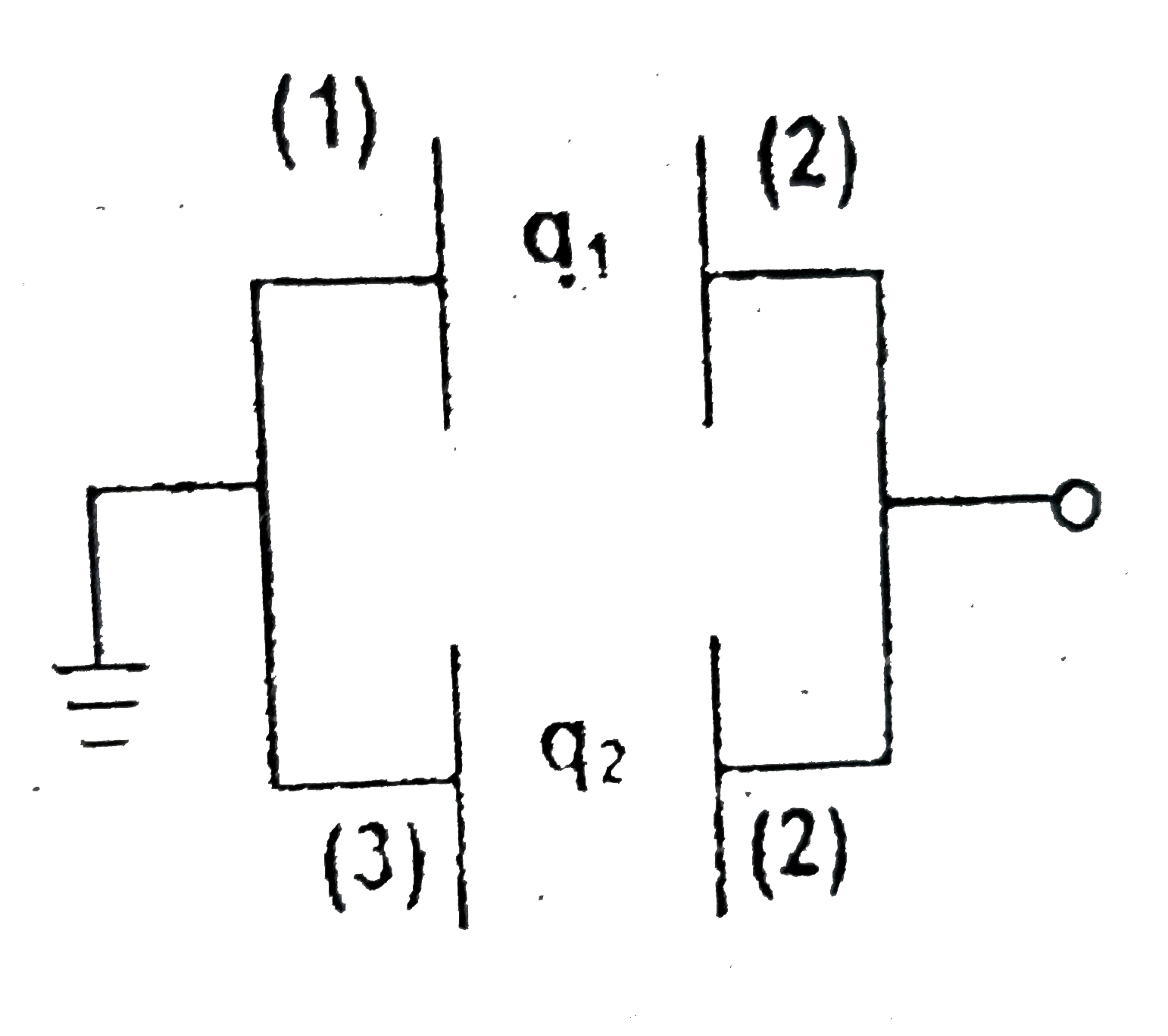
|
|
| 32. |
Two bodies of masses 6 kg and 4 kg respectively are connected to two ends of a light string passing over horizontal frictionless pulley. The acceleration in the string is : |
|
Answer» `1 ms^(-2)`  Hence CORRECT CHOICE is (b). |
|
| 33. |
An X-ray photon is found to have its wavelength doubled on being scattered through 90^(@). Find the energy of the incident photon: |
|
Answer» `8.1xx10^(-14)J` `Delta lambda=(h)/(m_(0)c)(1-cos phi)` when `theta=90^(@), Delta lambda= lambda` (wavelength is doubled) Thus `lambda=(h)/(m_(0)c)=0*024Å` Energy `hv=(hc)/(lambda)=(hc)/(h//m_(0)c)=m_(0)c^(2)` `=(9*0xx10^(-31)xxkgxx3*0xx10^(8) m//"SEC")^(2)` `=8*1xx10^(-14)J` |
|
| 34. |
Which of the following involve froth flotation processes ? (I) Extraction of silver from argentite (ii) Extraction of iron from haematite (iii) Extraction of Cu from chalcopyrite (iv) Extraction of Al from bauxite |
|
Answer» III & IV |
|
| 35. |
(a) Draw the pattern of magnetic field lines for a circular coil carrying current. (b) Two identical planes such that they have a common centre at P as shown in the figure. Find the magnitude and direction of the net magnetic field at the point P due to the loops |
|
Answer» SOLUTION :(a) MAGNETIC field LINES of a current carrying coil. POINT O LIES on the axis of both the coils. Magnetic field at O due to current carrying coil I is given by `(mu_(0))/(4pi) xx (2pi I R^(2))/((R^(2) + x^(2))^(3//2))` as shown Also `B_(2)` due to coil `2, B_(2) = (mu_(0))/(4pi) (2pi iR^(2))/((R^(2) + x^(2))^(3//2)) " as " B_(1) and B_(2)` are perpendicular each other, so net magnetic to field at O is given by `B = sqrt(B_(1)^(2) + B_(2)^(2)) = sqrt2B_(1) = sqrt2 ((mu_(0))/(4pi)) (2pi R^(2))/((R^(2) + x^(2))^(3//2))` `:. B_(1) = B_(2)` 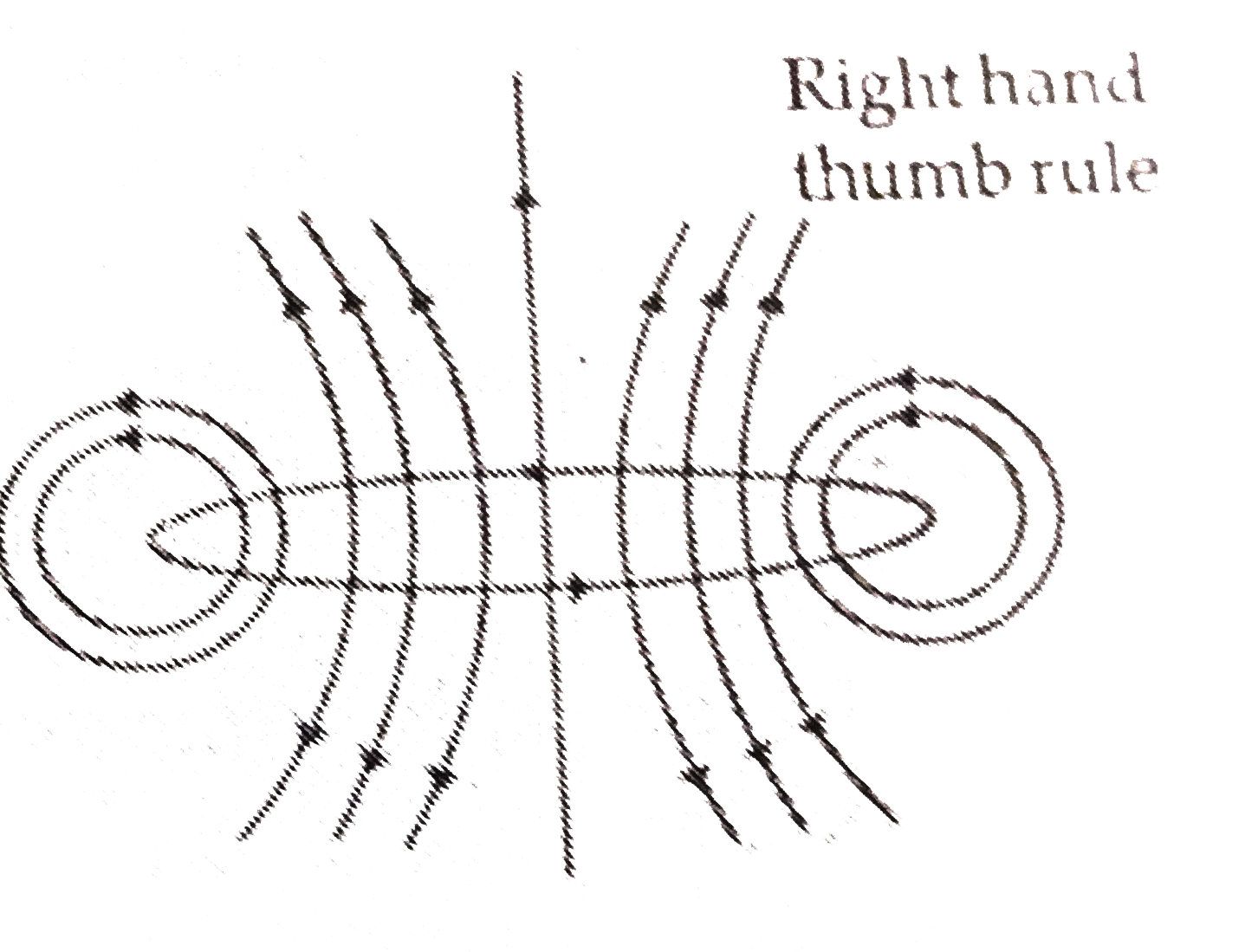 
|
|
| 36. |
Many of the diagrams given in Fig 5.7 show magnetic field lines (thick lines in the figure) wrongly. Point out what is wrong with them. Some of them may describe electrostatic field lines correctly. Point out which ones. |
|
Answer» Solution :(a) Wrong. Magnetic field lines can never emanate from a point, as shown in figure. Over any closed surface, the net flux af B must always be zero, i.e., pictorially as many field lines should seem to enter the surface as the number of lines LEAVING it. The field lines shown, in fact, represent electric field of a long positively charged wire. The correct magnetic field lines are circling the straight conductor, as described in Chapter 4. (b) Wrong. Magnetic field lines (like electric field lines) can never cross each other, because otherwise the direction of field at the point of intersection is ambiguous. There is further error in the figure. Magnetostatic field lines can never form closed loops around empty space. closed loop of static magnetic field line must ENCLOSE a region across which a current is passing. By contrast, electrostatic feld lines can never form closed loops. neither in empty space. nor when the loop encloses charges. (c) Right. Magnetic lines are completely confined within a toroid. Nothing wrong here in field lines forming closed loops, since each loop encloses a region across which a current passes. Note, for clarity of figure, only a few field lines within the toroid have been shown. Actually, the entire region enclosed by the windings contains magnetic field. (d) Wrong. Field lines due to a solenoid at its ends and outside cannot be so completely straight and confined, such a thing violates Ampere.s law. The liries sipould curve out at both ends, and meet eventually to form closed loops. (e) Right. These are held lines outside and inside a bar magnet. Note carefully the direction of field lines inside. Not all field lines emanate Ampere.s law. The lines should curve out at both ends, and meet eventually to form closed loops, (e) Right. These are field lines outside and inside a bar magnet, Note carefully the direction of field lines inside. Not all field lines eranate out of a north pole (or converge into a SOUTH pole). Around both the N-pole, and the S-pole, the net flux of the field is zero. (f) Wrong. These field lines cannot possibly represent a magnetic field. LOOK at the upper region. All the field lines seem to emanate out of the shaded plate. The net flux through a surface surrounding the shaded plate is not zero. This is impossible for a magnetic field. The given field lines, in fact, show the electrostatic field lines around a positively charged upper plate and a negattvely charged lower plate. The difference between Fig. 15.7(e) and (f)] should be carefully grasped. (g) Wrong. Magnetic field lines between two pole pieces cannot be precisely straight at the ends. Some FRINGING of lines is inevitable. Otherwise, Ampere.s law is violated. This is also true for electric field lines. |
|
| 37. |
If the source of light used in a Young's Double Slit experiment is changed from red to blue, then |
|
Answer» the fringes will become brighter |
|
| 38. |
Give two uses of convex lens. |
| Answer» Solution :Light of all WAVELENGTHS are reduced in glass. Violet light travels SLOWER than RED light. RI of violet light gt RI of red light. | |
| 39. |
Consider a coin Example 20 above. It is electrically neutral and contains equal amounts of positive and negativecharge of magnitude34.8 kC. Supposethat these equalcharges were concentrated in two point chargesseparatedby (i) 1 cm (~1//2 xx diagonal of the one paisa coin), (ii) 100 m (-lengthfo a long building), and (iii) 10^(6) m (radius fo the earth). Find the force on each such pointcharge in each of the three cases. What do youconclude from these results ? |
|
Answer» Solution :Here, `q = +- 3.48 KC = +- 3.48xx10^(4) C, r_(1) = 1 cm = 10^(-2) m, r_(2) = 100m , r_(3) = 10^(6) m, F_(1) = ?, F_(2) = ? , F_(3) = ?` According to Coulomb's law, `F_(1) = (|q|^(2))/(4pi in_(0) r_(1)^(2)) = (9XX10^(9)(3.48xx10^(4))^(2))/((10^(-2))^(2)) = 1.09xx10^(23) N`, `F_(2) = (|q|^(2))/(4pi in_(0) r_(2)^(2)) = (9xx10^(9)(3.48xx10^(4))^(2))/((100)^(2)) = 1.09xx10^(15) N`, `F_(3) = (|q|^(2))/(4pi in_(0) r_(3)^(2)) = (9xx10^(9)(3.48xx10^(4))^(2))/((10^(6))^(2)) = 1.09xx10^(7) N` We observe that when`+-` charges in ordinaryneutral matterare separated as point charges, they exert an enomous force. Hence , it is not easy to disturb electrical neutrally of MATTER. |
|
| 40. |
How Bohr modified Rutherford's model ? |
| Answer» Solution :ELECTRONS revolve around the nucleus only in certain circular orbits which do not radiate energy called stationary states. Angular MOMENTUM of the electron is integral multiple of `H/(2PI)`. | |
| 41. |
Which of the following spectral series of hydrogen atom is lying in visible range of electromagnetic wave ? |
| Answer» Solution :Balmer series | |
| 42. |
How is the radius of a nucleus related to its mass number? |
| Answer» SOLUTION :`R=R_(0)(A)^(1/3)`, where `R_(0)` is a constant having a VALUE 1.2 fm and A the mass number of NUCLEUS. | |
| 43. |
The figure below depicts a concave mirror with center mirror with center of curvature C focus F, and a horizontally drawn OFC as the optic axis. The radius of curvature is R(OC=R) and OF=R//2). A ray of light QP, parallel to the optical axis and at a perpendicular distance (wleR2) from it, is incident on the mirror at P. It is reflected to the point B on the optical axis, such that BF=k. Here k is a measure of lateral aberrotion (a) Express k in terms of {w,R}.k="___________________" (b) Sketch k vs w for w in[0,R//2] (c) Consider points P_(1)P_(2)...........P_(n) on the concave mirror which are increasingly further away from the optic centre O and approximately equidistant from each other (see figure below). Rays parallel to the optic axis are incedent at P_(1),P_(2).........P_(n) and reflected to points on the optic axis. Consider the points where these rays reflected from P_(n),P_(n-1),............P_(2) intersect the rays reflected from P_(n-1),P_(n-2),.......P_(1) respectively. Qualitatively sketch the locus of these points in figure below for a mirror (shown with solid line) with radius of curvature 2 cm. |
|
Answer» (b) 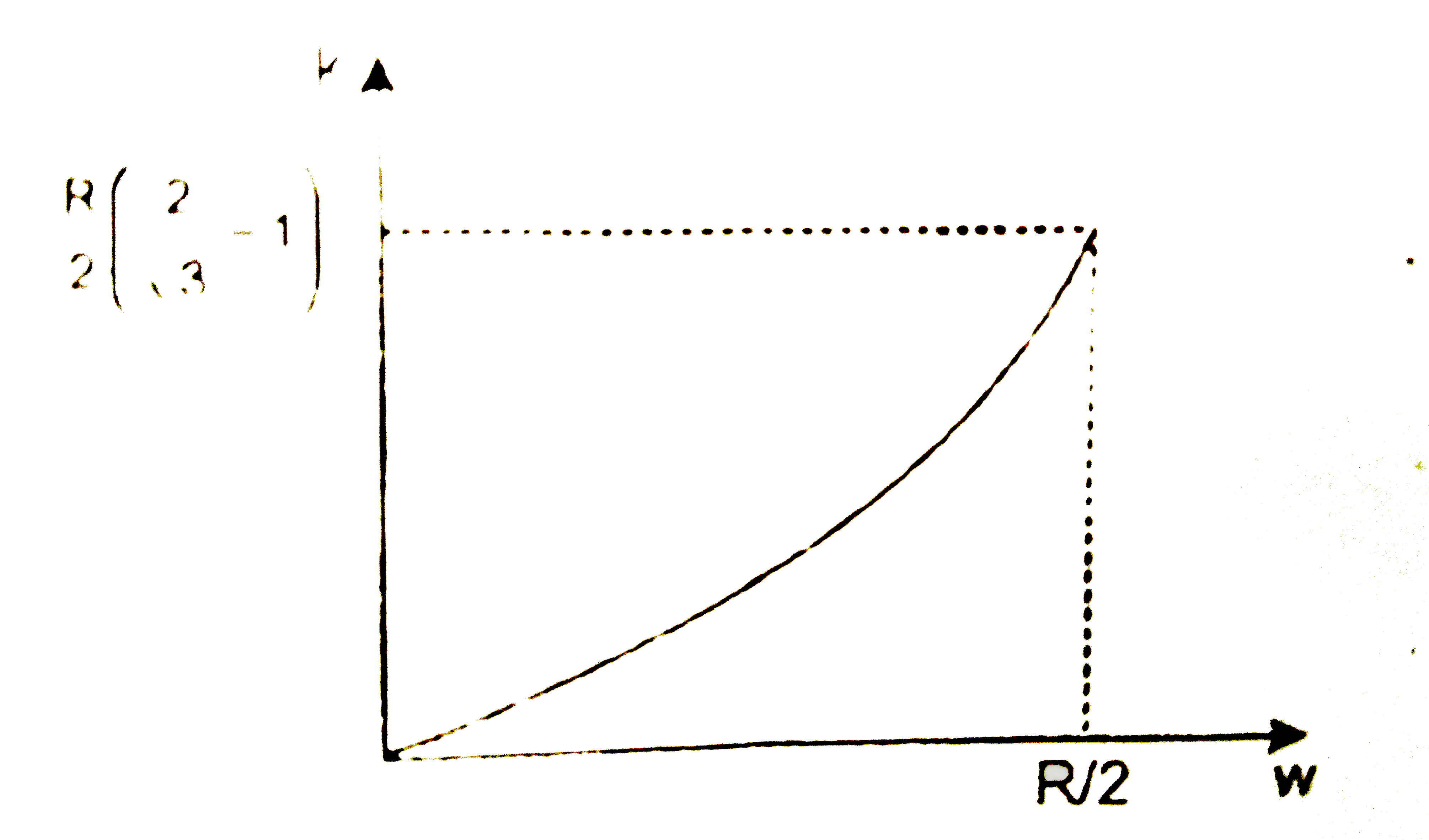 (C) 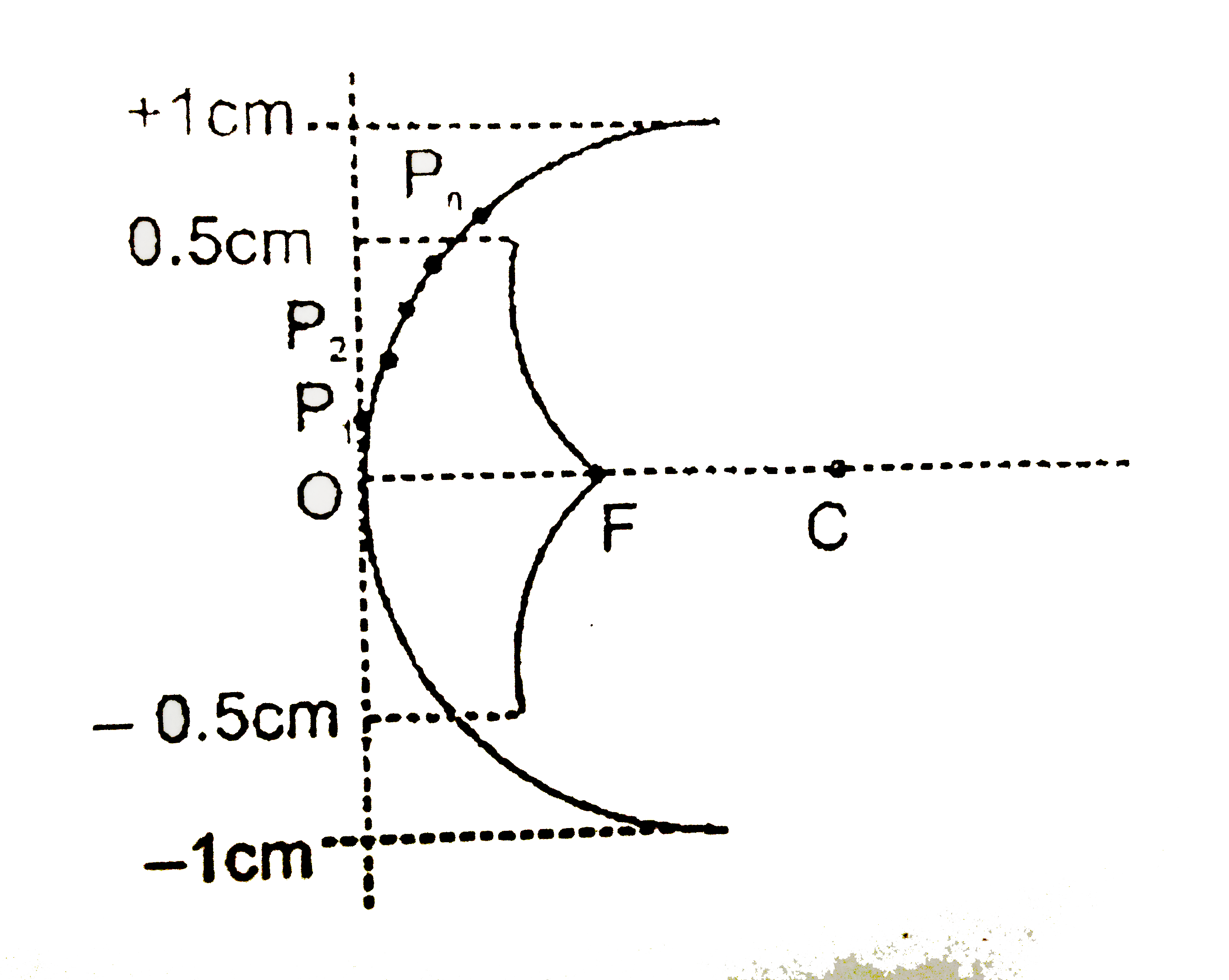
|
|
| 44. |
The particle displacement of a travelling longitudional wave is represented by xi=xi(x,t). The midpoints of a compression zone and an adjacent rarefaction zone are represented by the letter 'C' and 'R' Which of the following is true? |
|
Answer» `|delxi//delX|_(C)=|delxi//delx|_(R)` |
|
| 45. |
A number of resistors are connected as shown in the figure. The equivalent resistance between A and B is |
|
Answer» `6 Omega` `R_(eq) = 6Omega` 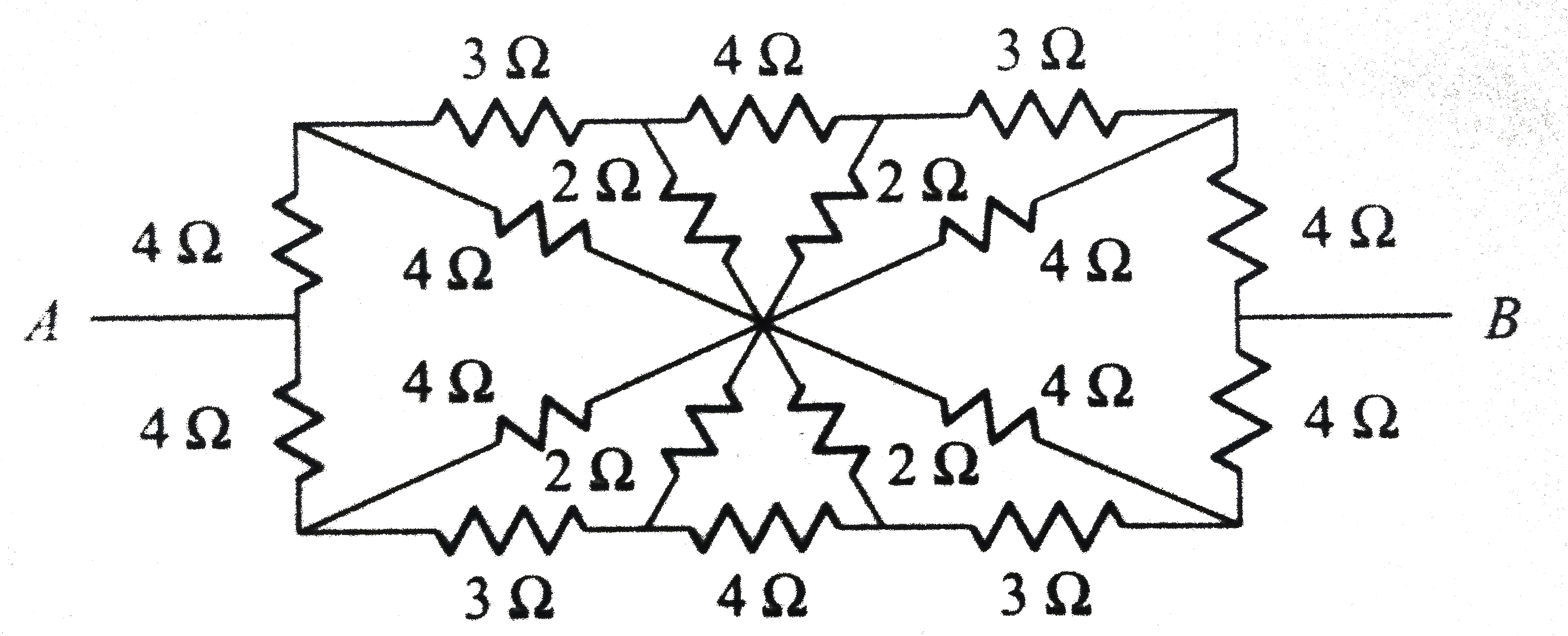
|
|
| 46. |
Steam at 100^(@)C is passed into 1 cdot 1 kg of water contained in a calorimeter of water equivalent 0 cdot 02 kg "at "15^(@)C till the temperature of the calorimeter rises to 80^(@)C. The mass of steam condensed in kilogranm is: |
|
Answer» `1 cdot 3 kg` `therefore` Heat LOST by steam `Q=mL + mcDelta T`. `=m xx540+m xx1xx(100-80)` `Q=560m" CAL….(i)"` Now heat gained by water and calorimeter. `Q_(1)=(m_(1)+m_(2)) C Delta T` `Q_(1)=(1100+20)xx1xx(80-15)=72800 cal`. Now `Q=Q_(1)` `560 m =72800` `m=(72800)/(560)=130 g = cdot 13 kg` Thus, correct choice is (c). |
|
| 47. |
Find integrals of given functions int(2x^3 - 5x + 7)dx |
|
Answer» |
|
| 48. |
A light spring balance hangs from the hook of the other light spring balance and a block of mass M kg hangs from the former one. Then the true statement about the scale reading is : |
|
Answer» both the scales read `M//2` kg each |
|
| 49. |
A ray of light in air is incident on a glass plate at polarising angle of incidence. It suffers a deviations of 22^(@) on entering glass. The angle of polarisation is |
| Answer» Answer :B | |