

Saved Bookmarks
This section includes 7 InterviewSolutions, each offering curated multiple-choice questions to sharpen your Current Affairs knowledge and support exam preparation. Choose a topic below to get started.
| 1. |
A particle of mass M at rest decays into two particles of masses m_1 and m_2 having velocities V_1 and V_2 respectively. Find the ratio of de- Broglie wavelengths of the two particles |
|
Answer» |
|
| 2. |
Derive an expression for the resistivity of a good conductor in terms of the relaxation time of electrons. |
Answer» SOLUTION : 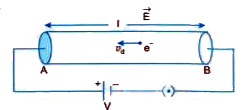 On applying a potential difference V across the ends ofa conductor of length l, the electric field `E = V/l` Force experienced by an electron`F = eE = (eV)/(l)` in a direction opposite to that of E. `therefore `ACCELERATION of electron in a direction opposite to that of E will be `a = F/m = e/m.V/l` If the average time between two successive collisions suffered by an electron be `TAU` , the drift velocity of electron will be `v_d = a tau = e/m . V/l. tau`....(i) But in terms of drift velocity magnitude of electric current is given by `I = nAev_d = nAe. e/m.V/l.tau = (nAe^2)/(m) tau. V/l` ` therefore ` RESISTANCE of conductor`R = V/l = (ml)/(nAe^2 tau)`.....(ii) and resistivity of the material of conductor `rho = (RA)/(l) = (m)/("ne"^2 tau)`....(iii) The resistivity of a material thus depends on (i) the number density of electrons, and (ii) its relaxationtime. |
|
| 3. |
A hollow sphere has charge density .sigma.Cm^(-2). Idensity incorrect statement |
|
Answer» Electric field INSIDE sphere is zero |
|
| 4. |
The resistivity of pure silicon is 3000 Omegam . The resistivity of a specimen of material when 10^(19) "atoms//m^3 of phosphorus are added ("given" mu_e=0.12 m^2//V "sec", mu_n=0.045 m^2//V-"sec") |
|
Answer» `7.5 OMEGAM` |
|
| 5. |
The radius of a disc is 1.2cm. Its area according to the idea of significant figures is |
|
Answer» `4.5216 CM^(2)` |
|
| 6. |
An electromagnetic wave in vacuum has the electric and magnetic fields vecE and vecB, which are always perpendicular to each other. The direction of polarization is given by vecX and that of wave propagation by veck . Then : |
|
Answer» `VECX |\| vecE` and `VECK |\| vecB XX vecE` |
|
| 7. |
Which law deals with the magnetic field due to a current carrying conductor ? |
| Answer» SOLUTION :BIOT SAVART | |
| 8. |
A man getting down a running train falls forward because : |
|
Answer» TRAIN exerts a FORCE on the man in the forward direction |
|
| 9. |
A coil has a self inductance of 0.01H. The current through it is allowed to change at the rate of 1A in 10^(-2)s. Calculate the emf induced. |
|
Answer» 1V |
|
| 10. |
काला हिरण, मगरमच्छ, भारतीय जंगली गधा, गेंडा, शेर-पूंछ वाला बंदर, सगांई, घड़ियाल, सोन चिड़िया, व सफेद तेंदुआ कौन से प्रकार की जातियाँ हैं? |
|
Answer» संकटग्रस्त जातियाँ |
|
| 11. |
On what conservation principles the first and the second laws of Kirchhoff are based? |
|
Answer» SOLUTION :FIRST law is a CONSEQUENCE of the law of CONSERVATION of charge. Second law is a consequence of the law of conservation of energy for electric CIRCUITS. |
|
| 12. |
A body of mass 60 kg is pushed up with just enough force to start in moving on a rough surface with mu_(s) = 0.5 and mu_(k) = 0.4 and the force continues to act afterwards. What is the acceleration of the body is |
|
Answer» `14.7 MS^(-2)` |
|
| 13. |
Obtain an expression for energy stored in an inductor connected to a source voltage. |
|
Answer» Solution :When a current grows through an inductor, the induced emf opposite its growth and as such it has to do some work . LET the current flowing through the circuit at any instant t be i. The rate of growth of current at the time `=(di)/(dt)` The induced emf set up in the inductor `E=L (di)/(dt)` The work done by the current in increasing from zero to its maximum value `I,W int_(0)^(1) dW`. But dW = Ei dt, Note : power = `("work")/("time")` i.e., dW = `L((di)/(dt))IDT= Li di`. Hence `W=int_(0)^(1)Lidi=L((i^2)/(2))_0^1 or W=1/2LI^2`. This amount of work done is stored in the form ofmagnetic energy . We note that the SELF INDUCTANCE is the electrical inertia which opposes the growth or decay of current in the circuit. |
|
| 14. |
A stone is dropeed from a height of10 cm above the top of a window 80 cm high. The time taken by the stone to cross the window is (g = 9.8 ms^(-2)) |
|
Answer» `1/7 s` |
|
| 15. |
A sphere of mass 50gm is suspended by a string in an electric field of intensity 5NC^(-1) acting vertically upward. If the tension in the string is 520 milli Dewton, the charge on the sphere is (g = 10ms^(-2)) |
|
Answer» `4 XX 10^(-3) C` |
|
| 16. |
What is the cartesian sign convention ? Applying this convention and using a neat diagram, derive an expression for finding the image distance using the mirror equation. |
Answer» Solution :According to cartesian sign convention : 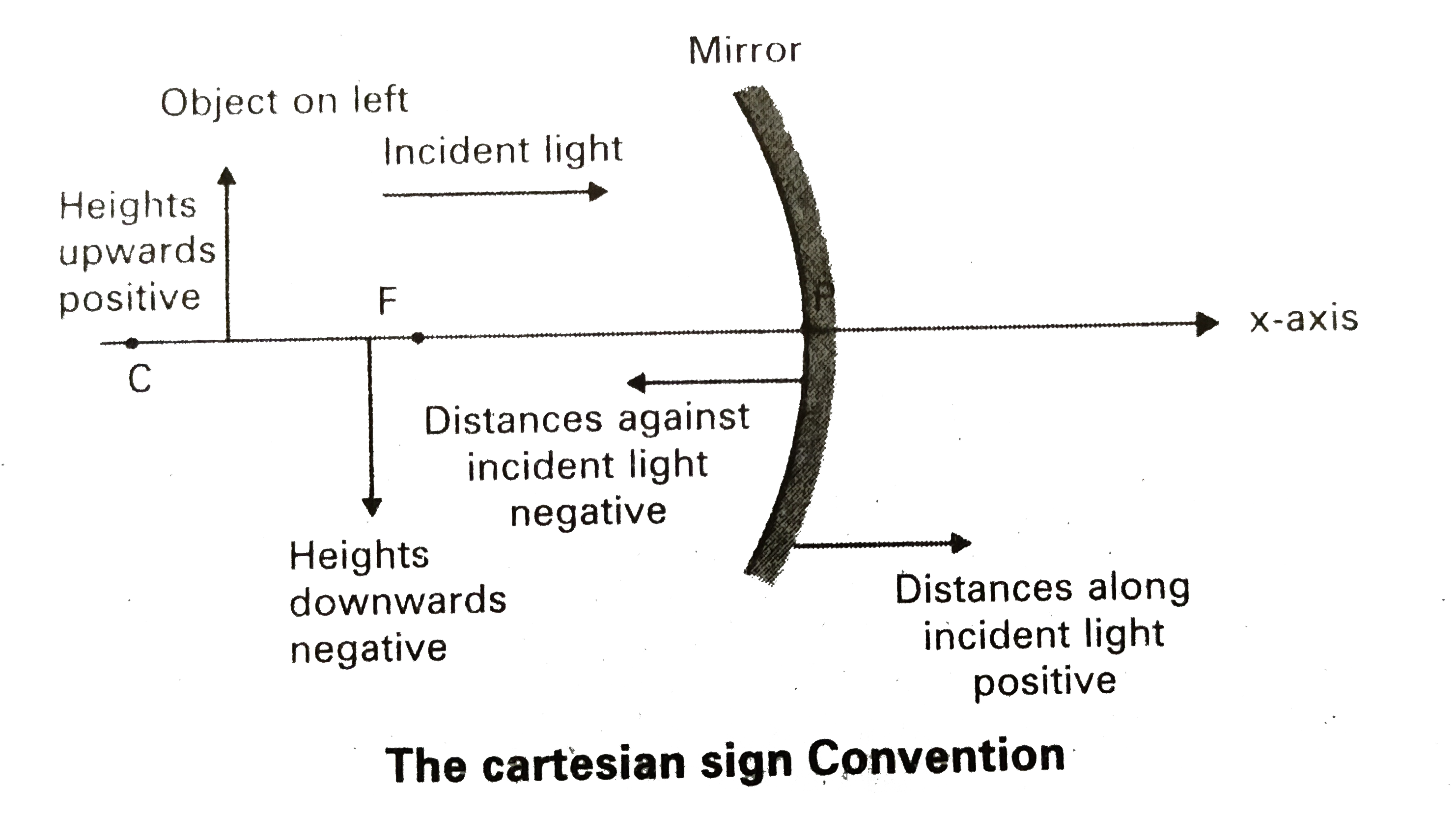 1) All distances are measured from the pole of the mirror (or) the optical centre of the lens. 2) The distances measured in the same direction as incident light are taken as positive. 3) The distances measured in the direction opposite to the incident light are taken as negative. 4) The heights measured upwards with respect to x-axis and normal to the x-axis are taken as positive. 5) The heights measured downwards are taken as negative. Image distance using mirror equation : Consider an OBJECT AB is PLACED beyond centre of curvature of a concave mirror, on its principal axis. A ray AD parallel to principal axis incident on the mirror at point D and is reflected to pass through F. Another ray AE passing through centre of curveture C is reflected along the same path. TWO rays of light intersect at point A'. Thus A'B' is real, inverted and diminished image of AB formed between C and F. `Delta^("le")"DPF and "Delta^("le")" A'B'F are similar"` `("B'A'")/("PD")=("B'F")/("FP")` `(or) ("B'A'")/("BA")=("B'F")/("FP")".....................(1)" (therefore PD = AB)` Since `angleAPB = angleA'P'B'` The right angle triangles A'B'P and ABP are similar `("B'A'")/("BA")=("B'P")/("BP")"...................................(2)"` From EQUATIONS (1) and (2), `("B'F")/("FP")=("B'P")/("BP")=("B'P - FP")/("FP")"......................(3)"` Now applying the sign convention `B'P = -v, FP = -f, BP=-u` `(-v+f)/(-f)=(-v)/(-u) rArr (v-f)/(f)=(v)/(u)` `(v)/(f)-1=(v)/(u) rArr (1)/(f)=(1)/(v)+(1)/(u)` 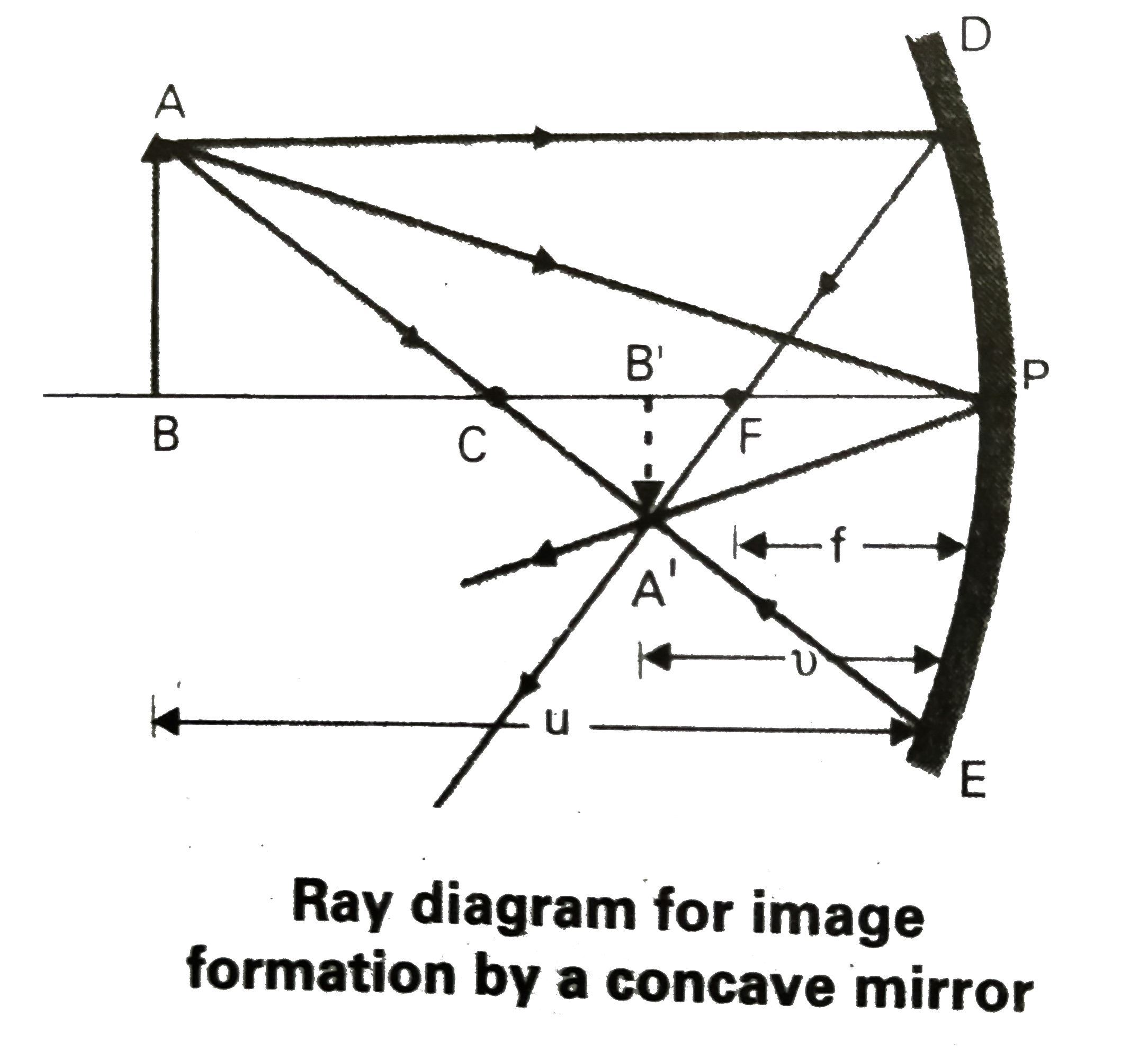
|
|
| 17. |
A beam of polarized light is sent into a systemof two polarizing sheets . Relative to the polarization diretion of that incident light the polarizing direction of the sheets are at angles thetafor the first sheet and 90^(@) for the second sheet . (a ) If 0.20 of the incident intensity is transmitted by the two sheets what is theta (b ) What percentage of the incident intensity is transmitted if the first sheet angle is reduced to 0^(@) ? |
| Answer» Solution :`THETA =32^(@) ` or `58^(@)` , (b) the transmitted INTENSITY is ZERO | |
| 19. |
Explain the three modes of propagation of electromagnetic waves through space. |
|
Answer» Solution :Propagation of electromagnetic waves: The electromagnetic wave transmitted by the transmitter travels in three different modes to reach the RECEIVER according to its frequency range:(i) Ground wave propagation (or) surface wave propagation (nearly 2 kHz to 2 MHz) (ii) Sky wave propagation (or) ionospheric propagation (nearly 3 MHz to 30 MHz) (iii) Space wave propagation (nearly 30 MHz to 400 GHz) (i) Ground wave propagation If the electromagnetic waves transmitted by the transmitter glide over the surface of the earth to reach the receiver, then the propagation is called ground wave propagation. The corresponding waves are called ground waves or surface waves. Both transmitting and receiving antennas must be close to the earth. The size of the antenna plays a major role in deciding the efficiency of the radiation of signals. During transmission, the electrical signals are attenuated over a distance. Some reasons for attenuation are as follows: 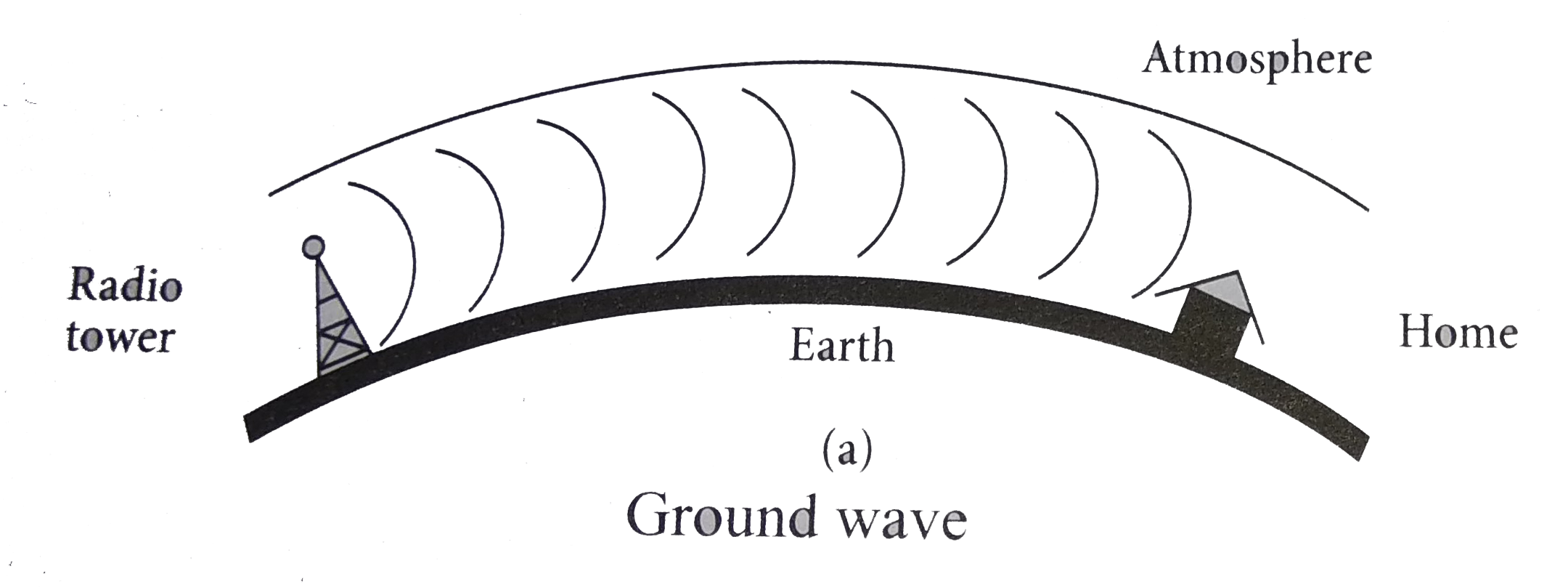 * Increasing distance: The attenuation of the signal depends on (i) power of the transmitter (ii) frequency of the transmitter, and (iii) condition of the earth surface. * Absorption of energy by the Earth: When the transmitted signal in the form of EM wave is in contact with the Earth, it induces charges in the Earth and constitutes a current. DUE to this, the earth behaves like a leaky capacitor which leads to the attenuation of the wave. * Tilting of the wave: As the wave progresses, the wavefront starts gradually tilting according to the curvature of the Earth. This increase in the tilt decreases the electric field strength of the wave. Finally, at some distance, the surface wave dies out due to energy loss. The frequency of the ground waves is mostly less than 2 MHz as high frequency waves undergo more absorption of energy at the earth.s atmosphere. The medium wave signals received during the day time use surface wave propagation. It is mainly used in local broadcasting, radio navigation, for ship-to-ship, ship-to-shore communication and mobile communication. (ii) Sky Wave Propagation: The mode of propagation in which the electromagnetic waves radiated from an antenna, directed upwards at large ANGLES gets reflected by the ionosphere back to carth is called sky wave propagation or ionospheric propagation. The corresponding waves are called sky waves. The frequency range of EM waves in this mode of propagation is 3 to 30 MHZ. EM waves of frequency more than 30 MHz can easily penetrate through the ionosphere and does not undergo reflection. It is used for short wave broadcast services. Medium and high frequencies are for long-distance radio communication. Extremely long distance communication is also possible as the radio waves can undergo multiple reflections between the earth and the ionosphere. A single reflection HELPS the radio waves to travel a distance of approximately 4000 km. 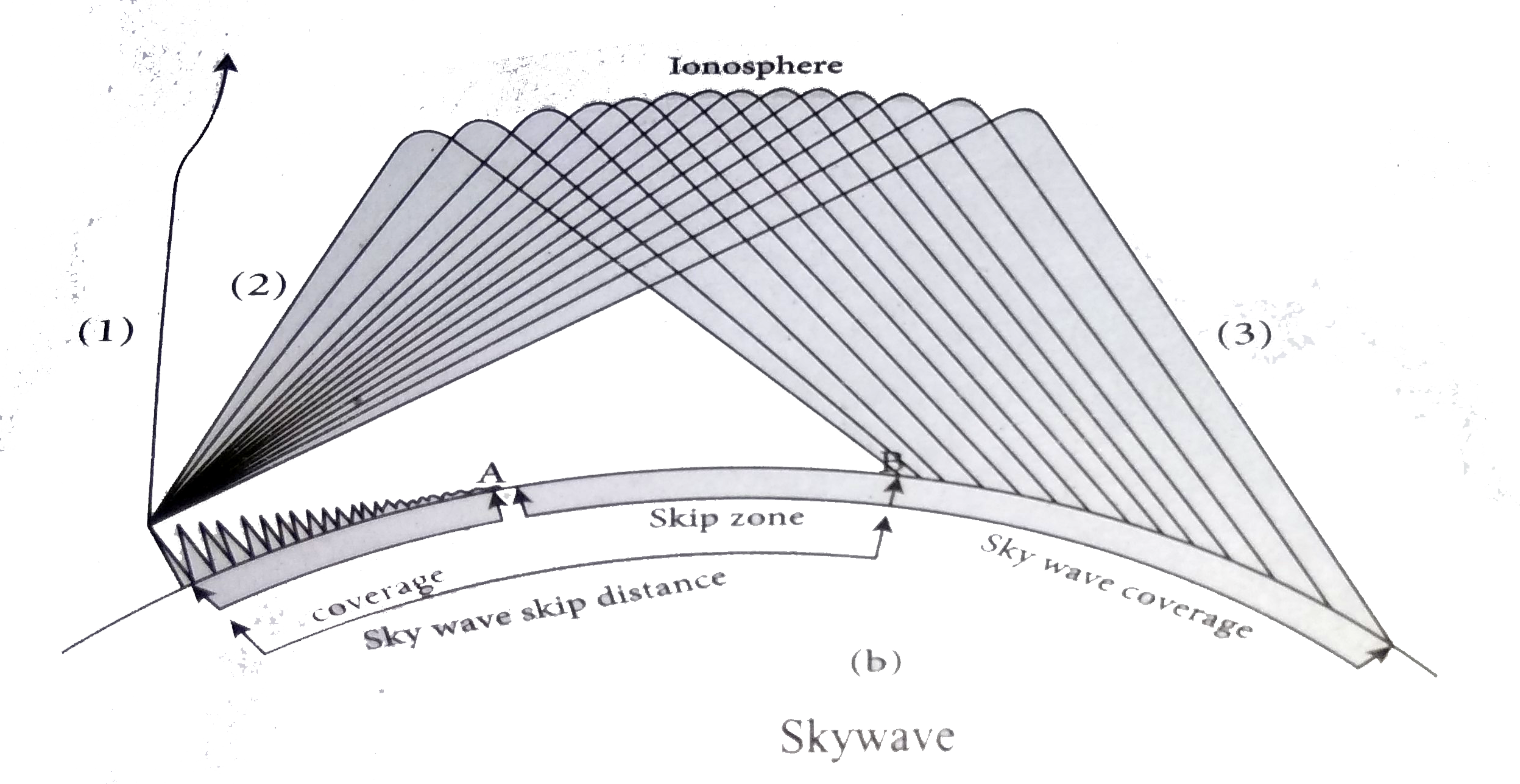 Ionosphere acts as a reflecting surface. It is at a distance of approximately 50 km and spreads up to 400 km above the Earth surface. Due to the absorption of ultraviolet rays, cosmic ray, and other high energy radiations like a, B rays from sun, the air molecules in the ionosphere get ionized. This produces charged ions and these ions provide a reflecting medium for the reflection of radio waves or communication waves back to earth within the permitted frequency range. The phenomenon of bending the radio waves back to earth is nothing but the total internal reflection. (iii) Space wave propagation:The process of sending and receiving information signal through space is called Spa wave communication. The electromagnetic waves of very high frequencies above MHz are called as space waves. These waves travel in a straight line from the transmitter to the receiver. Hence, it is used for a line of sight communication (LOS). 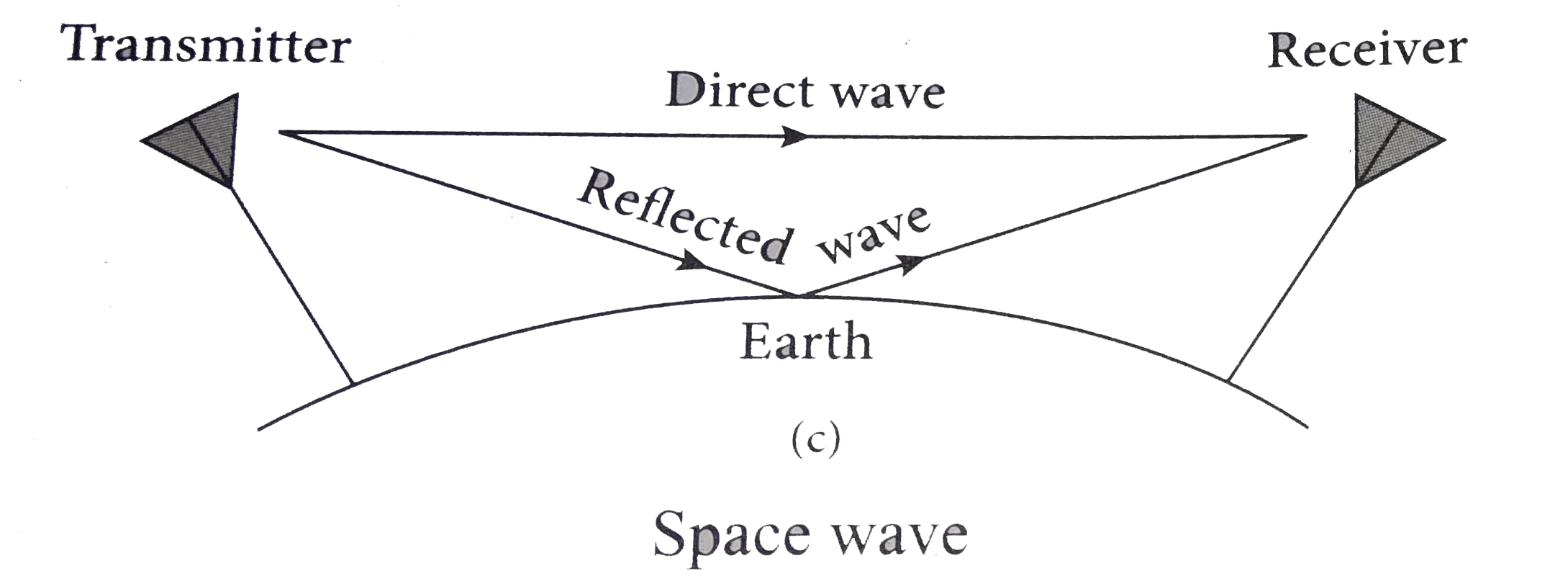 Space wave For high frequencies, the transmission TOWERS must be high enough so that the transmitted and received signals (direct waves) will not encounter the curvature of the earth and hence travel with less attenuation and loss of signal strength. Certain waves reach the receiver after getting reflected from the ground. |
|
| 20. |
A stonemust beprojectedhorizontally from a point P, whichis h meterabovethe footof a planeinclinedat an angle theta with horizontalform a point P , whichis hmeters above the foot of a planceinclinedat an anglethetawithhorizontal as shown in figure . Calculate the velocityv of the stoneso thatin may hit theincline plane perpendiculary. |
| Answer» SOLUTION :`V = SQRT(2gh)/(2+cot^(2) THETA)` | |
| 21. |
Definedispalacementcurrent . |
| Answer» SOLUTION :CURRENTIN a CAPACITORIS calleddisplacementcurrent | |
| 22. |
Assertion (A): If the distance between plates of a parallel plate capacitor is halved and the intervening space is filled with a dielectric of dielectric constant 3, the capacitance of capacitor becomes 6 times of its original capacitance. Reason (R) : The capacitance of a capacitor does not depend on the material of the metal plates. |
|
Answer» If both assertion and REASON are true and the reason is the correct explanation of the assertion. |
|
| 23. |
What is the r.m.s. value if the peak value of ac is 5 Amp ? |
|
Answer» SOLUTION :`I_0 = 5` AMP. `rArr I_rms = I_0/sqrt 2 = 5/ sqrt 2` ampere. |
|
| 24. |
The arc AB with the centre C and the infinitely longwire having linear charge density lambda are lying in the same place. The minimum amount of work to be done to move a point charge q_(0) from point A to B through a circuit path AB of radius a is equal to |
|
Answer» `(q_(0) lambda)/(4pi epsi_(0)) ln (2/3)` |
|
| 25. |
To produce beats , the generating waves must have |
|
Answer» DIFFERENT FREQUENCIES |
|
| 26. |
Two metal rods of same length have same temperature difference between their ends. Their thermal conductivities are K_(1) and K_(2) and cross-sections A_(1) and A_(2) respectively. What is the condition for the same rates of flow of heat ? |
|
Answer» `(K_(1))/(K_(2))=(A_(1))/(A_(2))` `(Q_(2))/(t)=(k_(2)A_(2)(T_(1)-T_(2)))/(d)` Now `(Q_(1))/(t)=(Q_(2))/(t)` `rArr(k_(1)A_(1)(T_(1)=T_(2)))/(d)=(k_(1)A_(2)(T_(1)-T_(2)))/(d)` `rArr""(k_(1))/(k_(2))=(A_(2))/(A_(1))` THUS CORRECT choice is (B) |
|
| 27. |
Two parallel plates have equal and opposite charge. When the space between them is evacuated, the electric field between the plates is 2xx15^5V//m. When the space is filled with dielectric the electric field becomes 1xx10^5V//m. The dielectric constant of the dielectric material: |
|
Answer» `1//2` |
|
| 28. |
Assertion: the value of temperature coefficient of resistance is positive is for metals. Reason: The temperature coefficient of resistance for insulator is also positive. |
|
Answer» If both assertion and Reason are true and the Reason is the correct explanation of the assertion. |
|
| 29. |
Assertion: The rating of a bulb is done on the basis of steady state of its filament. When a bulb is connected to a rated power supply then the filament consumesmore power than the rated power of the bulb immediately after it is switched on. Reason: When current flows through the bulb then due to heating of its filament its resistance first increases and then becomes contant when steady state temperature is attained. |
|
Answer» If both ASSERTION and REASON are correct and reason is a correct explanation of the assertion |
|
| 30. |
A slit of width a is illuminated by white light. What is the wavelength lambda of the light whose first side diffraction maximum is at 15^(@), thus coinciding with the first minimum for the red light? |
|
Answer» Solution :KEY IDEA The first side maximum for any wavelength is about halfway between the first and second MINIMA for that wavelength. Calculations: Those first and second minima can be located with Eq. 35-57 by setting m = 1 and m = 2, respectively. Thus, the first side maximum can be located approximately by setting m = 1.5. Then Eq. 35-57 BECOMES `asin theta=1.5 lambda.`. Solving for `lambda.` and substituting known data yield `lambda.=(a sin theta)/(1.5)=((2511 nm)(sin 15^(@)))/(1.5)` = 430 nm. (Answer) Light of this wavelength is violet (FAR blue, near the short- wavelength limit of the HUMAN range of visible light). From the two equations we used, can you see that the first side maximum for light of wavelength 430 nm will always coincide with the first minimum for light of wave- length 650 nm, no matter what the slit width is? However, the angle `theta` at which this overlap occurs does depend on slit width. If the slit is relatively narrow, the angle will be relatively large, and conversely. |
|
| 31. |
(A): With increase of intensity of incident light, photoelectric current also increases. (R): If the intensity of incident radiation is increased, more number of photons strike the metal surface there by liberating more photoelectrons. Then photoelectric current increases. |
|
Answer» A and R are TRUE and R is the CORRECT explanation of A. |
|
| 32. |
(a) Define the terms (i) half-life (T_(1//2) ) and (ii) average life (tau). Find out their relationships with the decay constant ( lambda). (b) A radioactive nucleus has a decay constant, lambda = 0.3465 (day)""^(-1). How long would it take the nucleus to decay to 75% of its initial amount? |
|
Answer» Solution :(a) Definition : (i) Half life : Time taken by a RADIOACTIVE nuclei to reduce to half of the initial number of radionuclei. (ii) Average life : Ratio of TOTAL life time of all radioactive nuclei to the total number of nuclei in the sample. Relation between half life and decay constant : `T_(1//2) = (0.693)/( lambda)` Relation between average life and decay constant `tau = (1)/(lambda)`. (b) `N= N_(0) e^(- lambda t)` `(3)/(4) N_(0) = N_(0) e^(-(0.3465) t) ""(because N= 75% "of" N_(0) )` `N= (3)/(4) N_(0)` `e^((0.3465)t) = (4)/(3)` `0.3465 XX t= log_(e) (4//3)` `=2.303 [ log4-log3]`. `=2.303 [0.6020-0.4771]` `=2.303 xx 0.1249` `t=(2.303 xx 0.1249) /( 0.3465)` `THEREFORE t=0.83` days or 19.92 HOURS |
|
| 34. |
If two copper wires of samelength have got different diameters Greater specific resistance. |
| Answer» SOLUTION :The SPECIFIC resistance is independent of SHAPE and size of the body but DEPENDS only on the nature of material and it.s TEMPERATURE so at same temperature, both wires have same specific resistance. | |
| 35. |
A card sheet divided into squares each of size 1 mm^(3)viewedat a distance of 9 cm through a magnifying glass (a converging lens of focal length 9 cm ) held close to the eye. a. What is the magnification produced by lenas ? How much is the area of each square in the virtual image ? b. What is the angular magnification (magnifying power ) of the lens ? c. Is the magnification in (a) equalto the magnifying power in (b)? explain. |
|
Answer» Solution :a .F = 10 CM, U = -9 cm `(1)/(v) - (1)/(u)=(1)/(f)` `(1)/(v)= (1)/(f) + (1)/(u) = (1)/(10) - (1)/(9) = - (1)/(90)therefore v = - 90 ` cm Linear magnification = `(v)/(u) = (-90)/(9) =10 ` Area of each square in the image = `(1 mm xx 10)^(2) = 100 mm^(2) = 1 cm^(2)` b. angular magnification - `(D)/(|u|) = (25)/(9) = 2.8 ` c. No. If the image is located near the least distance of distinct vision (v = D= 25 cm ) , the two QUANTITIES in (a) and (b) are equal . |
|
| 36. |
A point charge Q is located on the axis of a disc of radius R at a distance b from the plane of the disk. If one - fourthof the electric flux from the charge passes through the disk, then R = sqrt(kb). Find k. |
|
Answer» |
|
| 37. |
Let f: RrarrR be defined by f (x) = sin x and g:R rarrR bedefined byg(x)=x^2, then fog is |
|
Answer» `X^2sin x` |
|
| 38. |
In n-p-n transistor, in CE configuration a) the emitter is heavily doped than the collector b) emitter and collector can be interchanged c) the base region is very thin but is heavily doped d) the conventional current flows from base to emitter |
|
Answer» a and B are CORRECT |
|
| 39. |
An electric current is passed through a circuit containing two wires of the same material connected in parallel. If the lengths and radii of the wire are in the ratio4//3 and 2//3, then the ratio of the currents passing through the wires will be |
|
Answer» 3 |
|
| 40. |
23/2^3 5^2का दशमलव प्रसार होगा |
|
Answer» सांत |
|
| 41. |
Draw a graph showing the variation of potential energy between a pair of nucleons as a function of their separation. Indicate the regions in which the nuclear force is (i) attractive, (ii) repulsive. |
Answer» Solution :Plot of potential energy of a pair of nucleons as a function of a their separation r has been shown in Fig. 13.06. For `r gt r_(0)` the force is attractive but for `r lt r_(0)` the nuclear force is strongly repulsive. The NEGATIVE potential energy signifies that the nucleons are in a STATE of stable EQUILIBRIUM because force between them is attractive and their energy is LEAST possible. |
|
| 42. |
A standard cell of emf 1.08 V is balanced by the potential difference across 91 cm of a meter long wire supplied by a cell of emf 2 V through a series resistor of resistance 2Omega. The internal resistance of the cell is zero. Fnd the reistance per unit length of the potentiometer wire. |
|
Answer» |
|
| 43. |
Draw a graph for variation of potential V with distance r for a point charge Q. |
Answer» Solution :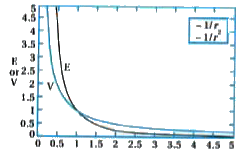 Electrostatic potential of a point CHARGE `V=(kQ)/(R)` and electric FIELD `E= (kQ)/(r^(2))` here kQ is constant `:. V PROP (1)/(r) ` and `E prop (1)/(r^(2))` Equation of electrostatic potential `V= (kQ)/(r)` shows that if Q is positive then at all POINTS electrostatic potential is positive and if Q is negative then at all points electrostatic potential is negative. |
|
| 44. |
The height of the photosphere is much less than the Sun's radius. Equating gravitational and pressure forces try to estimate the height of the photosphere assuming it to be made up entirely of atomic hydrogen. |
|
Answer» `h = RT//Mg_(o.)` |
|
| 45. |
Which of the following radioactive substance used in archeological survey? |
|
Answer» `._6C^14` |
|
| 47. |
Two particles are executing simple harmonic motion of the same amplitude A and frequency omega along the x-axis. Their mean position is separated by distance X_(0)(X_(0)gt A). If the maximum separation between them is (X_(0)+A), the phase difference between their motion is |
|
Answer» `(PI)/(3)` `x_(2)-x_(1)=2A COS (omegat+(phi)/(2))sin""(phi)/(2)` But 2A `sin""(phi)/(2)=Aimpliesphi=(pi)/(3)` Correct chice : (a). |
|
| 48. |
A person with vibrating tuning fork of frequency 338 Hz is moving towares a vertical wall with speed of 2 ms^(-1) . Velocity of sound in air is 340 ms^(-1) . The number of beats heard per second is |
|
Answer» 2 |
|
| 49. |
The elementary particle known as the positive kaon (K^(+)) is unstable in that it can decay (transform) into other particles. Although the decay occurs randomly, we find that, on average, a positive kaon has a lifetime of 0.1237 mus when stationary-that is, when the lifetime is measured in the rest frame of the kaon. If a positive kaon has a speed of 0.990c relative to a laboratory reference frame when the kaon is produced, how far can it travel in that frame duringits lifetime according to classical physics (which is a reasonable approximation for speeds much less than c) and according to special relativity (which is correct for all physically possible speeds)? |
|
Answer» Solution :KEY IDEAS 1. We have TWO (inertial) reference frames, one attached to the KAON and the other attached to the laboratory. 2. This problem also involves two events: the start of the kaon.s travel (when the kaon is produced) and the end of that travel (at the end of the kaon.s lifetime). 3. The distancetraveled by the kaon between those two eventsis related to its speed v and the time interval for the travel by `v=("distance")/("time interval")""`(36-10) With these ideas in mind, let us solve for the distance first with classical physics and then with special relativity. Classical physics: In classical physics we would find the same distance and time intervalwhether we measured them from the kaon frame or frame or from the laboratory frame. THUS, we need not be careful aboutthe frame in which the measurements are made. To find the kaon.s travel distance `d_(cp)` according to classical physics, we first rewrite Eq. 36-10 as `d_(cp)=v Deltat, ""`(36-11) where `Deltat` is the time interval between the two events in either frame. Then, substituting 0.990c for v and 0.1237 `mus` for `Deltat` in Eq. 36-11, we find `d_(cp)=(0.990c)Deltat` `=(0.990)(299 458 m//s) (0.1237 xx 10^(-6)s)` `=36.7m`. This is how far the kaon would travel if classical physics were correct at speeds close to c. Special relativity: In specialrelativity we must be very careful that both the distance and the time interval in Eq. 36-10 are measured in the same referenceframe - especially when the speed is close to c, as here. Thus, to find the actual travel distance `d_(sr)` of the kaon as measured from the laboratory frame and according to special relativity, we rewrite Eq. 36-10 as `d_(sr)=v Deltat, ""`(36-12) where `Deltat` is the time interval between the two events as measured from the laboratory frame. Before we can evaluate `d_(sr)` in Eq. 36-12, we must find `Deltat`. The 0.1237 `mus` time interval is a proper time because the two events occur at the same location in the kaon frame - namely, at the kaon itself. Therefore, let `Deltat_(0)` REPRESENT this proper time interval. Then we can use Eq. 36-9 `(Deltat=gamma Deltat_(0))` for time dilation to find the time interval `Deltat` as measured from the laboratoryframe. Using Eq. 36-8 to substitutefor `gamma` in Eq. 36-9 leads to `Deltat=(Deltat_(0))/(sqrt(1-(v//c)^(2)))=8.769xx10^(-7)s`. This is about seven times longer than the kaon.s proper lifetime. That is, the kaon.s lifetime is about seven times longer in the laboratory than in its own frame - the kaon.s lifetime is dilated. We can now evaluateEq. 36-12 for the travel distance `d_(sr)` in the laboratory frame as `d_(sr)=v Deltat=(0.990c)Deltat` `=(0.990)(299 792 458 m//s) (8.769xx 10^(-7)s)` `=260m`. This is about seven times `d_(cp)`. Experiments like the one outlined here, which verifyspecial relativity, became routinein physicslaboratoriesdecades ago. The engineering design and the construction of any scientific or medical facility that employs highspeed particlesmust take relativity into account. |
|