Saved Bookmarks
This section includes 7 InterviewSolutions, each offering curated multiple-choice questions to sharpen your Current Affairs knowledge and support exam preparation. Choose a topic below to get started.
| 1. |
The area of F.t curve is A. If one of the colliding bodies of mass m is at rest, find its speed just after the collision. |
|
Answer» Solution :The area of F-t curve gives the impulse of the FORCE F during the time. That is EQUAL to the change in momentum of the colliding bodies. SINCE one of the colliding BODY was at rest just before the collision, the change in its momentum during the impacxt is equal to momentum just after the IMPACT, that is mv. `rArr int Fdt = mv` Since `int Fdt = A` `rArr v=A//m`. 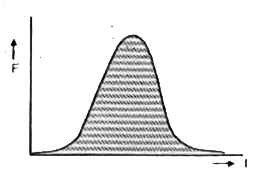
|
|
| 2. |
If the two slits in Young's double slit experiment are of unequal width, then |
|
Answer» the bright fringes will have UNEQUAL spacing. `I_(1) NE I_(2), ""therefore A neB,""I_("MIN")=(A-B)^(2)NE0` i.e., the dark fringes are not perfectly dark. |
|
| 3. |
(A):The displacement of a particle starting from rest is directly proportional to the cube of the time of travel then the particle is moving with non uniform acceleration. (R ):Acceleration veca=(d^(2)vecs)/(dt^(2)) |
|
Answer» |
|
| 4. |
Show that the square of the radius of gyration of a hollow cylinder is twice that a solid cylinder having the same radius for rotation about the respective cylinder axis. |
|
Answer» Solution :For rotation about the cylinder axis moments of INERTIA of (1) a thin HOLLOW cylinder, `I_(HC)=Mk_(HC)^2=MR^2` (2) a solid cylinder, `I_(SC)=Mk_(SC)^2=1/2MR^2` `therefore k_(HC)^2=R^2=2k_(SC)^2` |
|
| 5. |
A coil having 500 square loops each of side 10 cm is placed normal to a magnetic flux which increases at the rate of 1.0 tesla/second. The induced e.m.f. in volts is |
|
Answer» 0.1 |
|
| 6. |
Approximately a third of people with normal hearing have ears that continuously emit a low-intensity sound outward through the ear canal. A person with such spontaneous otoacoustic emission is rarely aware of the sound, except perhaps in a noise-free environment, but occasionally the emission is loud enough to be heard by someone else nearby. In one observation, the sound wave had a frequency of 1200 Hz and a pressure amplitude of 2.50 xx 10^(-3) Pa. What were (a) the displacement amplitude and (b) the intensity of the wave emitted by the ear? |
| Answer» SOLUTION :`(a) 7.99 xx 10^(-10) m ~~ 0.80 NM, (b) 7.5 n W//m^2` | |
| 7. |
A spherical planet far out in space has a mass M_(0) and diameter D_(0). A particle of mass m falling freely near the surface of this planet will experience an acceleration due to gravity which is equal to |
|
Answer» `GM_(0)//D^(2)` `G=(GM_(0))/(R^(2))=(GM_(0))/(((D_(0))/(2))^(2))=(4GM_(0))/(D_(0)^(2))`. |
|
| 8. |
Two point charges 10 muC and -10 muC are separated by a distance of 40 cm in air. Draw an equipotential surface of the system. |
Answer» Solution :An equipotential surface has been DRAWN in FIG. which is the equatorial PLANE of GIVEN DIPOLE. 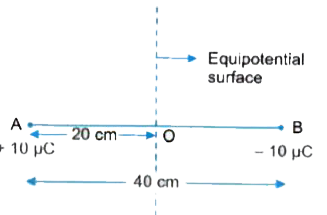
|
|
| 9. |
A man is looking at a small object placed at his near point. Without altering the position of lhis eye or the object, he puts a simple microscope of magnifying power 5x before his eyes. The angular magnification achieved is |
|
Answer» 5 |
|
| 10. |
What is the de - Broglie wavelength associated with an electron, accelerated through a potential difference of 100 Volts ? |
|
Answer» Solution :Accelerating potential `V = 100 V`. The de BROGLIE wavelength `lambda` is `lambda=h//p=(1.227)/(sqrt(V))=NM` `lambda=(1.227)/(sqrt(100))nm=0.123nm` The de Broglie wavelength ASSOCIATED with an electron in this case is of the order of X-ray WAVELENGTHS. |
|
| 11. |
Explain briefly the following terms used in communication system: Amplification. |
| Answer» SOLUTION :Amplification : In COMMUNICATION systems, the generally FEEBLE data signals need adequate amplification before it, after modulating a SUITABLE carrier wave, is transmitted from an antenna. | |
| 12. |
Direction of magnetic force on a positive charge moving in a magnetic field is given by |
|
Answer» Solution :When an electric charge q is moving with velocity `vec(v)` in the magnetic field `vec(B)`, it experiences a force, called magnetic force `vec(F_(m))`. After careful experiments. Lorentz DEDUCED the force experienced by a moving charge in the magnetic field `vec(F_(m))` `vec(F_(m)) = q (vec(v) xx vec(B)) "" `....(1) In MAGNITUDE, `F_(m) = qvB sin theta""` ....(2) In magnitude ,(1) and (2) imply 1.`vec(F_(m))` is directly proportaional to the magnetic field `vec(B)` 2.`vec(F_(m))` is directly proportaional to the velocity `vec(v)` 3.`vec(F_(m))` is directly proportaional to sine of the ANGLE between the velocity and magnetic field 4. `vec(F_(m))` is directly proportaional to the magnitude of the charge q 5. The DIRECTION of `vec(F_(m))` is always perpendicular to`vec(v)` and `vec(b)` as `vec(F_(m))` is the cross product of `vec(v) and vec(B)` 6. the direction of `vec(F_(m))` is on negative charge is opposite to the direction of `vec(F_(m))` on positive charge provided other factors are identical. 7. If velocity `vec(v) ` of the charge q ia along magnetic field `vec(B)` then, `vec(F_(m))` is zero. 
|
|
| 13. |
A cellon open circuit has e.m.f 2.0 V and in closed circuit having current of 0.05 A , the p.d is 1.5 V . Calculate internal resistance of the cell. |
|
Answer» Solution :e.m.f of CELL E= 2V Current in CIRCUIT I = 0.05 A p.d ACROSS resistance V= 1.5 V Let .R. be the internal resistance of the cell E= (Ir+V) `r= (E-V)/(I)` `=(2-1.5)/(0.05) = (0.5)/(0.05) =10 Omega` Internal resistance of the cell is `10 Omega` |
|
| 14. |
Two points are at distances a and b (a lt b)froma long string of charge per unit length l . The potential difference between the points is proportional to : |
| Answer» Answer :D | |
| 15. |
The relation between the magnetic field (B) and the magnetic potential (V)at a point is |
|
Answer» `B = -(DV)/(dx)` |
|
| 16. |
The angular frequency is: |
|
Answer» 120 rad/s f = 120 Hz A = 8.5 mm Anglular frequency `omega = 2pif = 2PI(120)` = 754 rad/s. |
|
| 17. |
Find the temperature of totally ionized hydrogen plasma of density rho = 0.10g//cm^(3) at which the thermal radiation pressure is equal to the gas kinetic pressure of the particles of plasma. Take into account that the thermal radiation pressure p = u//3, where u is the space density of radiation enegry, and at high temperatures all substances obey the equation of state of an ideal gas. |
|
Answer» Solution :For an ideal gas `p = nkT` where `n=` number density of the particles and `k = (R )/(N_(A))` is Boltzman constant. In a fully ionized hydrogen plasma, both `H` ions (protons) and electrons contribute to pressure but since the mass of electron is quite small `(=m_(P)//1836)`, only protons contribute to mass density. THUS `n = (2RHO)/(m_(H))` and `p = (2 rhoR)/(N_(A)m_(H))T` where `m_(H) = m_(p)` is the proton or hydrogen mass. equating this to thermal radiation pressure `(2rhoR)/(N_(A)m_(H)) = (u)/(3) = (M_(E))/(3) xx (4)/(3) = (4sigmaT^(4))/(3c)` Then `T^(3) = (3c rhoR)/(2sigmaN_(A)m_(H)) = (3crho R)/(sigma M)` where `M = 2N_(A)m_(H)=` molecular weight of hydrogen `= 2 xx 10^(-3) kg`. Thus `T = ((3c sigmaR)/(sigmaM))^(1//3) = 1.89 xx 10^(7)K` |
|
| 18. |
If yx^(2)/(3)="constant" when x=x_(1), then y=300, then find the y when x=(8x_(1))/(27) |
|
Answer» 450 |
|
| 19. |
Two light sources with equal luminous intensity are lying at a distance of 1.2 m from each other. Where should a screen be placed between them such that illuminance on one of its faces is four times that on another face |
|
Answer» `0.2m` |
|
| 20. |
In an n - p - n transistor , the current gain for common emitter configuration is 80 . If the emitter current be 8.1 mA , then base current is : |
|
Answer» `0.1 MUA` |
|
| 21. |
C_(p) ( without dielectric ) = 2C C_(Q) ( without dielectric ) = C k and 2 k are dielectric constant of two dielectrics . Find resultant capacity between A and B . |
| Answer» SOLUTION :`C_(AB)=([K(2C)][2KC])/((K2C+2KC))=KC` | |
| 22. |
The bulbs of two indentical thermometers are coated one with lamp black and the other with silver. Both are exposed to the sun and their seadings are recorded : |
|
Answer» both indicate sane temperature. Thus correct CHOICE is (b). |
|
| 23. |
Assertion:The back emf in a dc motor is maximum when the motor has just been switched on. Reason : When motor is switched on it has maximum speed. |
|
Answer» If both ASSERTION and REASON are t rue and the reason is the CORRECT explanation of the assertion. |
|
| 24. |
A source (s) of beta particles contains a radioactive isotope X. The emitted beta particles are passed through two parallel slits s_(1) and s_(2) to get a narrow parallel beam. This beam is made to enter a uniform magnetic field (B). The particles follow semicircular trajectories and are found to hit the screen at all points from A to B the distance AB is equal to 2a. The reaction for decay of a nucleus of X is XrarrY+._(-1)^(0)e+vecv Calculate the minimum difference in mass of a nucleus of X and Y. mass of an electron is m and charge on it its e. |
|
Answer» |
|
| 25. |
Which one of the following is a null vector ? |
|
Answer» net DISPLACEMENT of a particle moving once AROUND, a circle |
|
| 26. |
A sample of germanium is doped to the extent of 10^(14) donor atoms per cm^(3) and 7xx10^(13) acceptor atoms per cm^(3). The resistivity of pure germanium at the temperature of the sample is 60Omegacm. Find the total conduction current density due to an applied electric field of 2Vcm^(-1). The electrom and hole mobilities are given to be 3800cm^(2)V^(-1)s^(-1) and 1800cm^(2)V^(-1)s^(-1), respectivele. |
|
Answer» |
|
| 27. |
A capacitor is connected to a battery of 20 volt, so that a charge of 100muC is obtained at the plates. The capacitance of capacitor is : |
|
Answer» `1/5muF` |
|
| 28. |
The escape velocity for a body projected vertically upwards from the suface of earth is 11 km/s. If the body is projected at angle of 45^(@) with the vertical, the escape velocity will be: |
|
Answer» `11sqrt(2)km//s` `THEREFORE` Escape VELOCITY is independent of ANGLE of PROJECTION. Thus correct choice is (c ). |
|
| 29. |
(A): Fuse wire must have low resistivity and low melting point. (R): Fuse is used to protect a device connected in series to it from large currents. |
|
Answer» Both 'A' and 'R' are true and 'R' is the correct explanation of 'A' |
|
| 30. |
Calculate the binding energy per nucleon of ""_(17)^(35)Clurcleus. Given that mass of ""_(17)^(35)Cl nucleus = 34.98000 u, mass of proton = 1.007825 u, mass of neutron = 1.008665 u and I u is equivalent to 931 Mev. |
|
Answer» 6.2 MEV |
|
| 31. |
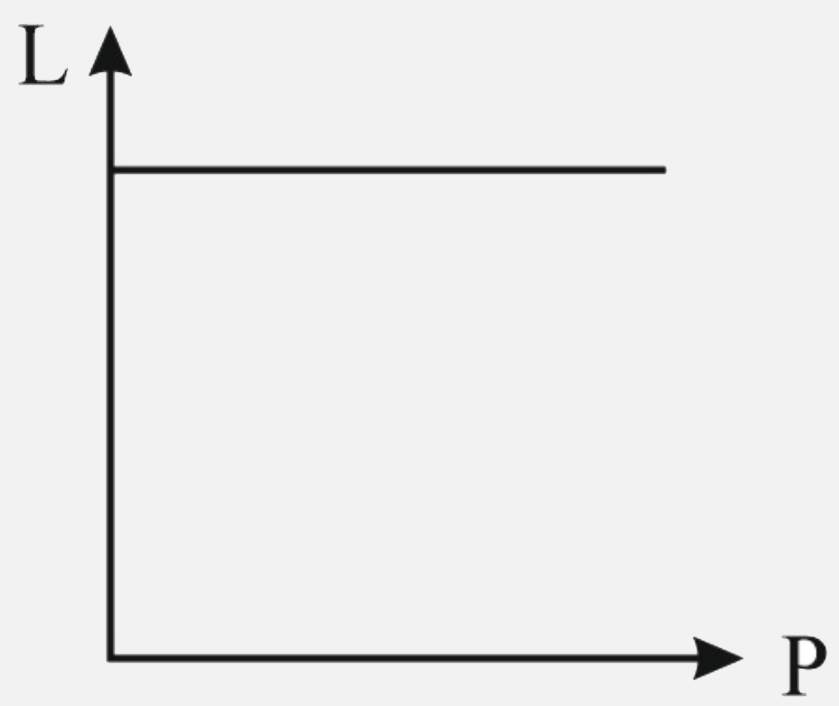
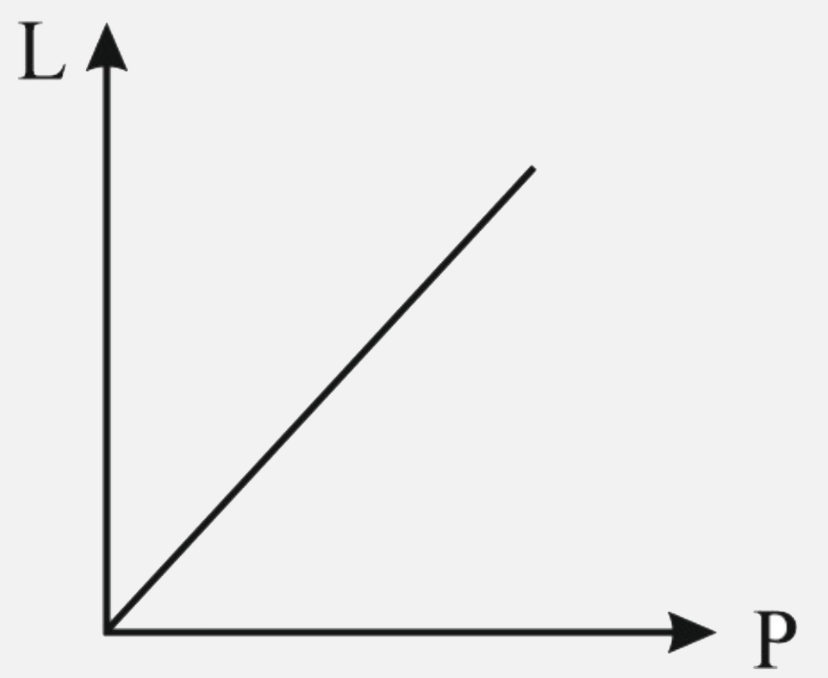
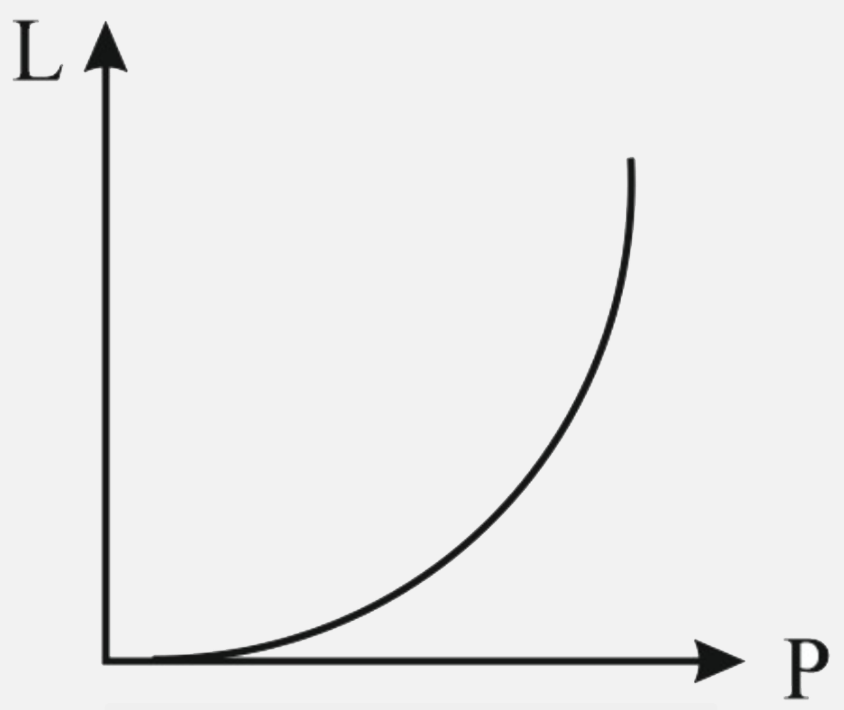
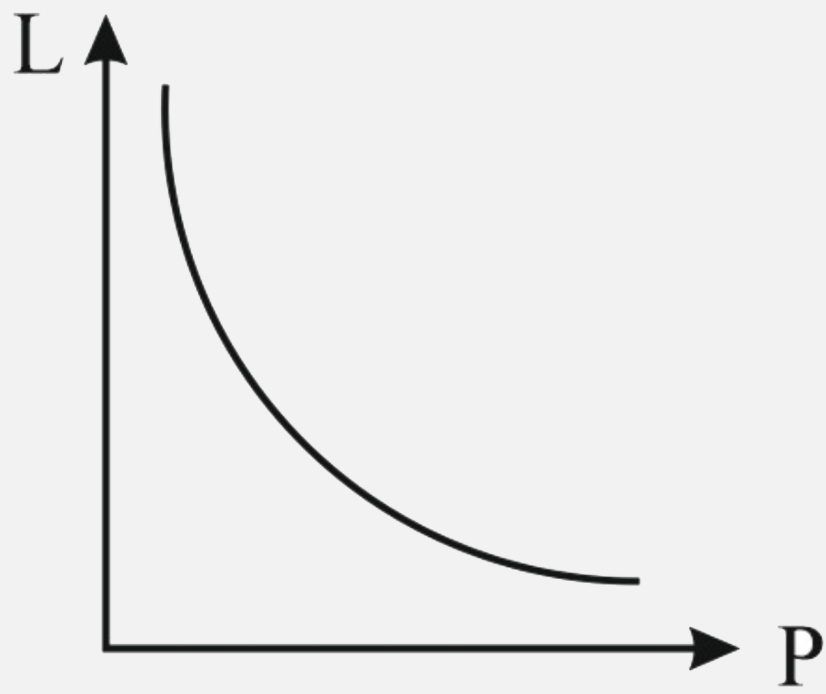
The de-Broglie wavelength L associated with an elementary particle of linear momentum p is bets represented by the graph |
|
Answer»
|
|
| 32. |
Paragraph-1 : Two discs A and B are mounted coaxially on a vertical axle. The discs have moments of inertia I and 2I respectively about the common axis. Disc A is imparted aninitial angular velocity 2omega using the entire potential energy of a spring compressed by a distance x_(1). Disc B is imparted an angular velocity omega by a spring having the same spring constant and compressed by a distance x_(2). Both the discs rotate in the clockwise direction. The loss of kinetic energyduring the above process is : |
|
Answer» `(IOMEGA^(2))/(2)` |
|
| 33. |
A potential difference V is connected across a device with resistance R, causing current I through the device. Rank the following variations according to the change in the rate at which electrical energy is converted to thermal energy due to the following greatest change first. (a) V is doubles with R unchanged. (b) i doubled with R unchanged. (c) R is doubled with V unchanged. (d) R is doubled with i unchanged. |
|
Answer» |
|
| 34. |
Paragraph-1 : Two discs A and B are mounted coaxially on a vertical axle. The discs have moments of inertia I and 2I respectively about the common axis. Disc A is imparted aninitial angular velocity 2omega using the entire potential energy of a spring compressed by a distance x_(1). Disc B is imparted an angular velocity omega by a spring having the same spring constant and compressed by a distance x_(2). Both the discs rotate in the clockwise direction. When disc B is brought in contact with disc A, they acquire a common angular velocity in time t. The average frictional torque on one disc by the other during this period is : |
|
Answer» `(2Iomega)/(3t)` |
|
| 35. |
A man moving with a velocity of 5m//s on a horizontal road observes that raindrops fall at an angle of 45^(@) with the vertical. When he moves with a velocity of 16m//s along an inclined plane, which is inclined at 30^(@) with the horizontal , he observes raindrops fallingvertically downward as shown in the figure. Find the actual velocity of the raindrops. |
|
Answer» |
|
| 36. |
Paragraph-1 : Two discs A and B are mounted coaxially on a vertical axle. The discs have moments of inertia I and 2I respectively about the common axis. Disc A is imparted aninitial angular velocity 2omega using the entire potential energy of a spring compressed by a distance x_(1). Disc B is imparted an angular velocity omega by a spring having the same spring constant and compressed by a distance x_(2). Both the discs rotate in the clockwise direction. The ratio x_(1)//x_(2) is : |
| Answer» ANSWER :C | |
| 37. |
A toaster produces more heat than a loght bulb when connected in parallel to a voltage supply.Which has greater resistance? |
| Answer» Solution :Since they are connected in parallel, voltage across both of them will be the same. Heat DEVELOPED H=`(V)^2/(R)t `Hprop/R` for the same voltage and time.As TOASTER PRODUCES more heat it has low resistance.i.e.,Light bulb has greater resistance. | |
| 38. |
The surface temperature of the sun is about 6000 K. the sun's radiation has maximum energy at a wavelength of 0.5 mu m. a certain light bulb filament emits radiations with a maximum at 2 mu m. if both the surface of the sun and the filament have the same emissive characteristics, then the temperature of the filament will be |
|
Answer» 1500 K |
|
| 39. |
An energetic a-particle experiences head-on collision with nucleus having Z = 85. If distance of closest approach is 1.85xx10^(-14)m then calculate energy of a particle. |
|
Answer» 23.13 MEV Kinetic energy of a particle = P.E. at `r_(0)` DISTANCE `=(kxxZexx2e)/(r_(0)xxe)toeV` `=(9xx10^(9)xx85kxx2xxe^(2))/(1.85xx10^(-14)xxe)` `=(9xx10^(9)xx170xx1.6xx10^(-19))/(1.85xx10^(-14))` `=1323.24xx10^(4)eV` `=13.23xx10^(6)eV` `=13.23MeV` |
|
| 40. |
What happens when a block of metal is kept in a varying magnetic field ? |
| Answer» Solution :EDDY currents START flowing through the body of METAL BLOCK. | |
| 41. |
Dimension of (1)/mu_0epsilon_0 where symbols have their usual meanings are: |
|
Answer» `[L^(-1)T]` |
|
| 42. |
Is finite rotation a vector ? |
| Answer» Solution :The FINITE ROTATION about an AXIS is not a VECTOR because it.s addition to another finite roatation about a different axis does not obey commutative LAW. | |
| 43. |
A rectangular coil of dimensions 0.1 mxx0.5 m consisting of 2000 turns rotates about and axis parallel to its long side, making 2100 revolutions per minute in a field of 0.1 T. What is the maximum emf indcuced in the coil? Also find the instantaneous emf, when the coil is 60^(@) to the field. |
|
Answer» |
|
| 44. |
For a beam of light emerging from glass into air, for which visible spectral colour the critical angle of glass will be minimum? |
| Answer» Solution :The wavelength of VIOLET RAYS is the least AMONG all the visible SPECTRAL colours. If wavelength decreases, refractive index increases. Again when refractive index increases, critical angle decreases. Therefore, during refraction from GLASS to air the critical angle will be minimum for the violet ray. | |
| 45. |
State De Morgan's first and secondtheorems. |
|
Answer» Solution :The first THEOREM states that the COMPLEMENT of the sum of TWO LOGICAL inputs is equal to the product of its complements. `vec(A+B)=vecA.vecB` De Morgan.s Second .Theorem: The second theorem states that the complement of the product of two inputs is equal to the of its complements `vec(A.B)=vecA+vecB` |
|
| 46. |
A rectangular coil of dimensions 4 cm x 5 cm with number of turns 20 is placed with its plane perpendicular to a uniform magnetic field of 5 T. If it is moved with a speed of 2 m/s in the field parallel to its length, the e.m.f induced is |
|
Answer» 0.4V |
|
| 47. |
(a) A rectangular coil rotates in a uniform magnetic field. Obtain an expression for induced emf and current at any instant. Also find their peak values. Show the variation of induced emf versus angle of rotation (omegat) on a graph. (b) An iron bar falling through the hollow region of a thick cylindrical shell made of copper experiences a retarding force. What can you conclude about the nature of the iron bar? Explain. |
| Answer» SOLUTION :(B) The bar is MAGNETIC in nature. It experiences RETARDATION in accordance with Lenz.s law. | |
| 48. |
Suppose the fractional efficiency of a cesium surface (with work function 1.80 eV) is 1.0 xx 10^(-16), that is, on average one electron is ejected for every 10^(16) photons that reach the surface. What would be the current of electrons ejected from such a surface if it were illuminated with 600 nm light from a 3.00 mW laser and all the ejected electrons took part in the charge flow? |
| Answer» SOLUTION :`1.45xx10^(-19)A` | |
| 49. |
Thermoelectricity refers to a phenomenon that occur at the junctions of dissimilar conductors or within a single conductor, when a temperature difference exists between the junctions or across a conductor. There are three thermogalvanic effects, namely Seebeck effect, Peltier effect and Thomson effect. They involve conversion of thermal energy into electrical energy or vica versa. They are all reversible in contrast with the Joule effect which is irrevesible. Seebeck effect is the superposition of Peltier effect and Thomson effect. In a thermocouple, if the two junctions are maintained at a potential difference, a temperature difference is established, i.e. heat is generated at one junction and absorbed at the other junction. This is called Peltier effect and its converse is the Seebeck effect. The relationship between the. thermo-emf across the junction and the temperature difference is parabolic. Equation between Seebeck emf and temperature difference (0) across the function may be written as |
|
Answer» `EPSILON proptheta` |
|
| 50. |
As an electron makes a transition from an excited state to the ground state of a hydrogen-like atom ion. The wrong option(s) is (are) |
|
Answer» lt KINETIC energy increases but POTENTIAL energy and total deceases |
|