

Saved Bookmarks
This section includes 7 InterviewSolutions, each offering curated multiple-choice questions to sharpen your Current Affairs knowledge and support exam preparation. Choose a topic below to get started.
| 1. |
Current passing through two parallel wires A and B are I_(1)andI_(2) respectively, If both the currents flow in the same direction, magnetic field near the midpoint of wire is 10 T. If direction of current I_(2) is reversed magnetic field becomes 30T. I_(1)/I_(2)= _____ |
|
Answer» 1 
|
|
| 2. |
Explain the principle of a device that can build up high voltages of the order of a few million volts. Draw a schematic diagram and explain the working of this device. Is there any restriction on the upper limit of the high voltages set up in this machine ? Explain. |
| Answer» SOLUTION :Out of SYLLABUS. | |
| 3. |
Thermoelectricity refers to a phenomenon that occur at the junctions of dissimilar conductors or within a single conductor, when a temperature difference exists between the junctions or across a conductor. There are three thermogalvanic effects, namely Seebeck effect, Peltier effect and Thomson effect. They involve conversion of thermal energy into electrical energy or vica versa. They are all reversible in contrast with the Joule effect which is irrevesible. Seebeck effect is the superposition of Peltier effect and Thomson effect. In a thermocouple, if the two junctions are maintained at a potential difference, a temperature difference is established, i.e. heat is generated at one junction and absorbed at the other junction. This is called Peltier effect and its converse is the Seebeck effect. The relationship between the. thermo-emf across the junction and the temperature difference is parabolic. Which heat is produced throughout the conducting wire |
|
Answer» Peltier HEAT |
|
| 4. |
The capacitance of a parallel plate capacitor formed by the circular plates of diameter 4.0 cm is equal to the capacitance or a sphere of diameter 200 cm. Find the distance between two plates. |
|
Answer» `2xx10^(-4)` m `:. C_(1)= 4pi epsilon_(0)` R The capacitance of a parallel plate capacitor `C_(2)=(epsilon_(0)A)/(d)` but `C_(1)=C_(2)` `:. 4 PI in_(0)R = (epsilon_(0)pir^(2))/(d)` `:. D=(r^(2))/(4R)` but `r= 2.0 cm =2xx10^(-2)` m R = `(200)/(2) = 100 cm = 1 m` `:. d = (4xx10^(-4))/(4xx1)` `:. d = 1 xx10^(-4)` m |
|
| 5. |
The figure shows the interference pattern obtained in a double-slit experiment using light of wavelength 600 nm. Which fringe is 300 nm closer to one slit than to the other? |
|
Answer» A |
|
| 6. |
The magnetic moment vectors mu_s and mu_i associated with the intrinsic spin angular momentum S and orbital angular momentum l, respectively, of an electron are predicted by quantum theory (and verified experimentally to a high accuracy ) to the given by |
|
Answer» Solution :`mu_i` is in accordance with classical theory. It follows from the definitions of `mu_f and l` `mu_i=IA=(e/T)pir^2""l=mvr=m(2pir^2)/T` where r is the radius of the circular orbit which the ELECTRON of MASS m and CHARGE (-e) completes in time T. Clearly , `mu_i/l=e/(2m)` Since charge of electron is negative (=-e) , it is easily seen the `1//4` and l are antiparallel, Therefore , `mu_i=-(e/(2m))` INote `mu_s/S` in contrast to `mu_l/l` is `e/m` . i.e, twice the classically EXPECTED value . This latter result (VERIFIED experimentally ) is an outstanding consequence of modern theory (verified experimentally ) is an outstanding consequence of modern quantum theory and cannot be obtained classically . |
|
| 7. |
The figure shows the interference pattern obtained in a double-slit experiment using light of wavelength 600 nm. Which fringe results from a phase difference of 4pi? |
|
Answer» A |
|
| 8. |
What is meant by forbidden energy gap ? |
| Answer» SOLUTION :The band separating the VALENCE band and the CONDUCTION band is CALLED forbidden gap. | |
| 9. |
Two bodies begin a free fall from the same height at a time interval of Ns. If vertical separation between the two bodies is 1 after second from the start of the first body, then is equal to : |
|
Answer» `sqrt(nN)` `S_1-S_2=(1)/(2)g[n^(2)-(n-N)^(2)]` `1=(g)/(2)(2N-N)(N)` `2n(2)/(gN)+N` and `n=(1)/(gN)+(N)/(2)` |
|
| 10. |
Find the current flowing through a copper wire of length 15 cm ,with area of cross section 10^(-2) cm ^2 , when it is connected to a power supply of 2V. Given : Electron density of copper is 8.8xx10^(22) cm^(-3) and electron mobility is 4xx10^(-6) m^(-2) V^(-1)s^(-1). |
|
Answer» |
|
| 11. |
Some steem balls are fixed at the bottom of a silica bulb of negligible exapnsivity. The bulb holds 340 gm of mercury at 0^(@)C when filled, in the absence of the steel balls and 255 gm of mercyr, when the steel balls are inside. On heating the bulb and its contents (steel balls and mercury) to 100^(@)C, 4.5 gm ofmercury overflows. Find the coefficient of linear expansion of steel. gamma_(Hg)=180xx10^(-6).^(@)C^(-1) |
|
Answer» |
|
| 12. |
If the rate of emission of energy from a star is 2.7 xx10^36 J/ S. The rate of loss of mass in the star will be |
|
Answer» `3xx10^18` kg/s |
|
| 13. |
Mahesh served Gafur's family for how long? |
|
Answer» 10 years |
|
| 14. |
Using the Schrodinger equation, demonstrate that at the point where the potential energy U(x) of a particle has a infinte discountinuity, the wave function renains smooth, I.e., its first derivaltive with respect to the coordinate is continuous. |
|
Answer» Solution :We can for definiteness assume that the discontinuity occurs at the point `x=0`. Now the schordinger EQUATION is `( ħ^(2))/(2m)(d^(2)Psi)/(dx^(2))+U(x)Psi(x)=EPsi(x)` We intergate this equation around `x=0`i.e., from `x=-epsilon_(1) to x=epsilon_(2)` where `epsilon_(1),epsilon_(2)` are small positives numbers. Then `( ħ^(2))/(2m)int_(-epsilon_(1))^(+epsilon_(2))(d^(2)Psi)/(dx^(2))dx=int_(-epsilon_(1))^(+epsilon_(2))(E-U(x)Psi(x)dx)` ltbrltgtor `((dPsi)/(dx))_(+epsilon_(2))=((d Psi)/(dx))_(-epsilon_(1))=-(2m)/ (ħ^(2)) int_(-epsilon_(1))^(epsilon_(2))(E-U(x))_(dx)Psi(x)` SInce the potential and the energy `E` are finite and `Psi(x)` is bounded by ASSUMPTION, the intergaral on the right exists and `rarr0asepsilon_(1),epsilon_(2)rarr0` THUS `((d Psi)/(dx))_(epsilon_(2))=((dPsi)/(dx))_(-e_(1)) as epsilon_(1),epsilon_(2)rarr0` So `((dPsi)/(dx))` is continuous at `x=0` (the point where `U(x)` has a infinite jump discontuinuityI `((d Psi)/(dx))_(epsilon_(2))=((dPsi)/(dx))_(-e_(1)) as epsilon_(1),epsilon_(2)rarr0` So `((dPsi)/(dx))` is continuous at `x=0` (the point where `U(x)` has a infinite jump discontuinuity. |
|
| 15. |
The maximum range of projectile is2/√3 times actual range. What isthe angle of projection for the actual range ? |
| Answer» | |
| 16. |
A nucleus X_1 has a half life of 24 days How long of sample of X_1 will take to change 80% of its to X_2 ? |
|
Answer» |
|
| 17. |
A particle is to be placed, in turn, outside four objects each of mass m:(1) a large uniform solid sphere, (2) a large uniform spherical shell,(3) a small uniform solid sphere, and (4) a small uniform shell. In each situation,the distance between the particle and the center of the object is d. Rank the objects according tothe magnitude of the gravitational force they exert on the particle, greatest first. |
| Answer» SOLUTION :All TIE | |
| 18. |
Consider two different hydrogen atoms. The electron in each atom is in an excited state. Is it possible for the electrons to have different energies but the same orbital angular momentum according to the Bohr model ?s |
|
Answer» Solution :No, it can not be like that because total energy of ELECTRON in the `n^(th)` energy level of H-atom is `E_(n)=-(13.6)/(n^(2))EV` `rArr` If values of `E_(n)` are DIFFERENT then values of n will also be different. Now, `l_(n)=(NH)/(2pi) rArr ` If values of n are different then values of angular momentum `l_(n)` would also be different. |
|
| 19. |
(a) In the adjoining figure find the normal force exerted by the inclined plane on the block B. The contact surface of the block A and B are rough and all other surfaces are frictionless . There is no slipping between the blocks A and B. ( b ) Find the force of friction acting on the block A. |
|
Answer» |
|
| 20. |
Zener diodes are used as: |
|
Answer» Reference voltate ELEMENTS |
|
| 21. |
What is space wave communication? |
| Answer» SOLUTION :When radiowaves from the transmitting antenna reach the receiving antenna either directly or after reflection from the GROUND (TROPOSPHERE), the wave PROPAGATION is called space wave propagation. | |
| 22. |
The ratio of minimum wavelengths of Lyman and Balmer series will be |
|
Answer» 1.25 `lambda_("LYMAN")/lambda_("BALMER")=(1/2)^(2)` `lambda_(L)/(lambda_(B))=1/4 =0.25` |
|
| 23. |
Two particles A and B are connected by a rigid rod AB. The rod slides along perpendicular rails as shown. The velocity of A to the left is 10 ms^(-1) What is the velocity of B when anglealpha=60^(@)? |
|
Answer» 9.8 m`s^(-1)` Speed of `B =dy//dt` Now `x^(2)+y^(2)=(AB)^(2)` Diff. w.r.t. t 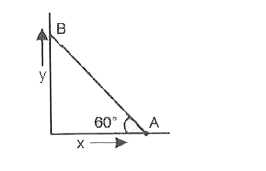 `2x(dx)/(dt)+2ydy//dt=0` or`(dy)/(dt) =- (x)/(y)(dx)/(dt)= - cot 60^(@)xx10 = - 5.8 ms^(-1)` |
|
| 24. |
In Young's interfernce experiment has a set up as shown in figure, consider that a source of monochromatic light of wavelength 5000Å is placed at S.S_(1) and S_(2) are equidistant from S and have equal widths. A wvefront, eit light waves, which superimpose to result in an interference pattern on the screen kept at position (1). this is an experiment where coherent sources are obtained by division of wavefront. O is a point on the screen equidistant from S_(1) and S_(2). P is a point on the screen 1 mm from O at which path difference between waves from S_(1) and S_(2) is 11250Å. Position of amy point on the screen can be expressed by theta. The path difference is zero at O and a central bright fringe of intensity I_(0) is obtained at O. Q is another point 2 mm from O. If the screen is now shifted to a new position (2) [not shown in figure] so that D changes, the fringe width is found to be 50% more than its earlier value and the angular fringe width is (1)/(90) radian. Answer the following question [assume D to be large and theta very small so taht sinapproxtantheta approxtheta] Q. Fringe width when screen is at position (1) will be |
|
Answer» `(4)/(9)mm` |
|
| 25. |
A ring of radius R =8m is made of a highly dense-material Mass of the ring is m_(R) = 2.7 xx 10^(9)kg distributed uniformly over its circumference. A particle of mass (dense) m_(p) = 3 xx 10^(8)kg is palced on the axis of the ring speed (in cm/sec) of the particle at the instant when it passes through centre of ring . |
|
Answer» |
|
| 26. |
In the following questions a statement of assertion (A) is followed by a statement of reason ( R). A: Unifrom circular motion is accelerated motion stil speed remains unchanged . R: Instantaneous velocity is always normal to instantaneous acceleration in uniform circular motion. |
|
Answer» If both ASSERTION & Reason are true and the reason is the correct explanation of the assertion then mark (1) . |
|
| 27. |
In Young's interfernce experiment has a set up as shown in figure, consider that a source of monochromatic light of wavelength 5000Å is placed at S.S_(1) and S_(2) are equidistant from S and have equal widths. A wvefront, eit light waves, which superimpose to result in an interference pattern on the screen kept at position (1). this is an experiment where coherent sources are obtained by division of wavefront. O is a point on the screen equidistant from S_(1) and S_(2). P is a point on the screen 1 mm from O at which path difference between waves from S_(1) and S_(2) is 11250Å. Position of amy point on the screen can be expressed by theta. The path difference is zero at O and a central bright fringe of intensity I_(0) is obtained at O. Q is another point 2 mm from O. If the screen is now shifted to a new position (2) [not shown in figure] so that D changes, the fringe width is found to be 50% more than its earlier value and the angular fringe width is (1)/(90) radian. Answer the following question [assume D to be large and theta very small so taht sinapproxtantheta approxtheta] Q. Intensity at P when the screen is at positio (1), is |
|
Answer» `2I_(0)` |
|
| 28. |
When a U-235 nucleus absorbs a neutron and underfoes nuclear fission, about 200 MeV of energy is released. But in what form? Intereting most of this energy initially appears in the form of |
|
Answer» `GAMMA` rays |
|
| 29. |
A thermos bottle containing coffee is vigorously shaken. Consider coffee as a system:Has heat been added to it ? |
| Answer» SOLUTION :No, because the THERMOS BOTTLE isinsulated from SURROUNDINGS | |
| 30. |
In Young's interfernce experiment has a set up as shown in figure, consider that a source of monochromatic light of wavelength 5000Å is placed at S.S_(1) and S_(2) are equidistant from S and have equal widths. A wvefront, eit light waves, which superimpose to result in an interference pattern on the screen kept at position (1). this is an experiment where coherent sources are obtained by division of wavefront. O is a point on the screen equidistant from S_(1) and S_(2). P is a point on the screen 1 mm from O at which path difference between waves from S_(1) and S_(2) is 11250Å. Position of amy point on the screen can be expressed by theta. The path difference is zero at O and a central bright fringe of intensity I_(0) is obtained at O. Q is another point 2 mm from O. If the screen is now shifted to a new position (2) [not shown in figure] so that D changes, the fringe width is found to be 50% more than its earlier value and the angular fringe width is (1)/(90) radian. Answer the following question [assume D to be large and theta very small so taht sinapproxtantheta approxtheta] Q. When the screen is at position (1), phase difference of waves from S_(1) and S_(2) at point P is effectively. |
|
Answer» `90^(@)` |
|
| 31. |
Light of two different frequencies, whose photons have energies 2eV and 5eV respectively, successively illuminates a metal of work function 1.0 eV. The ratio of maximum kinetic energy of the emitted photoelectrons will be |
|
Answer» `2:5` `(K_(1))/(K_(2))=(E_(1)-phi_(0))/(E_(2)-phi_(0))=((2-1)eV)/((5-1)eV)1:4`. |
|
| 32. |
In Young's interfernce experiment has a set up as shown in figure, consider that a source of monochromatic light of wavelength 5000Å is placed at S.S_(1) and S_(2) are equidistant from S and have equal widths. A wvefront, eit light waves, which superimpose to result in an interference pattern on the screen kept at position (1). this is an experiment where coherent sources are obtained by division of wavefront. O is a point on the screen equidistant from S_(1) and S_(2). P is a point on the screen 1 mm from O at which path difference between waves from S_(1) and S_(2) is 11250Å. Position of amy point on the screen can be expressed by theta. The path difference is zero at O and a central bright fringe of intensity I_(0) is obtained at O. Q is another point 2 mm from O. If the screen is now shifted to a new position (2) [not shown in figure] so that D changes, the fringe width is found to be 50% more than its earlier value and the angular fringe width is (1)/(90) radian. Answer the following question [assume D to be large and theta very small so taht sinapproxtantheta approxtheta] Q. When the screen is at position (2), its distance from the double slits is nearly |
|
Answer» 30 cm |
|
| 33. |
Which of the following units denote the dimensions of (ML^(2))/(Q^(2)) where Q is the electric charge ? |
|
Answer» `Wb//m^(2)` which is the DIMENSIONAL formula for Inductance which is expressed in henry. Hence correct choice is `(B)`. |
|
| 34. |
In Young's interfernce experiment has a set up as shown in figure, consider that a source of monochromatic light of wavelength 5000Å is placed at S.S_(1) and S_(2) are equidistant from S and have equal widths. A wvefront, eit light waves, which superimpose to result in an interference pattern on the screen kept at position (1). this is an experiment where coherent sources are obtained by division of wavefront. O is a point on the screen equidistant from S_(1) and S_(2). P is a point on the screen 1 mm from O at which path difference between waves from S_(1) and S_(2) is 11250Å. Position of amy point on the screen can be expressed by theta. The path difference is zero at O and a central bright fringe of intensity I_(0) is obtained at O. Q is another point 2 mm from O. If the screen is now shifted to a new position (2) [not shown in figure] so that D changes, the fringe width is found to be 50% more than its earlier value and the angular fringe width is (1)/(90) radian. Answer the following question [assume D to be large and theta very small so taht sinapproxtantheta approxtheta] Q. Distance d between S_(1) and S_(2) is |
|
Answer» 0.2 MM |
|
| 35. |
Which of the following represents (a) a progressive wave and (b) a stationary wave ? (a)y = 2 cos 5 x sin 9t,(b)y = 2sqrt(x -vt), (c) y = sin(5x - 0.5t) + 4 cos(5x - 0.5 t) (d) y=cos x sint + cos 2x * sin 2t. If progressive , and its velocity . |
|
Answer» |
|
| 36. |
The shape of the wavefront originating from a tubelight is |
|
Answer» Plain |
|
| 37. |
In Young's interfernce experiment has a set up as shown in figure, consider that a source of monochromatic light of wavelength 5000Å is placed at S.S_(1) and S_(2) are equidistant from S and have equal widths. A wvefront, eit light waves, which superimpose to result in an interference pattern on the screen kept at position (1). this is an experiment where coherent sources are obtained by division of wavefront. O is a point on the screen equidistant from S_(1) and S_(2). P is a point on the screen 1 mm from O at which path difference between waves from S_(1) and S_(2) is 11250Å. Position of amy point on the screen can be expressed by theta. The path difference is zero at O and a central bright fringe of intensity I_(0) is obtained at O. Q is another point 2 mm from O. If the screen is now shifted to a new position (2) [not shown in figure] so that D changes, the fringe width is found to be 50% more than its earlier value and the angular fringe width is (1)/(90) radian. Answer the following question [assume D to be large and theta very small so taht sinapproxtantheta approxtheta] Q. Intensity at point Q when screen is at position (1) is |
|
Answer» 0.5 `I_(0)` |
|
| 38. |
The moment of inertia of a solid sphere of density p and radius R about its diameter is |
|
Answer» `(176piR^(3))/105` Mass = Volume `XX` Density. `I=2/5(4/3piR^(3).p).R^(2)=8/15pipR^(5)=8/15xx22/7pR^(5)=176/105pR^(5)` |
|
| 39. |
In Young's interfernce experiment has a set up as shown in figure, consider that a source of monochromatic light of wavelength 5000Å is placed at S.S_(1) and S_(2) are equidistant from S and have equal widths. A wvefront, eit light waves, which superimpose to result in an interference pattern on the screen kept at position (1). this is an experiment where coherent sources are obtained by division of wavefront. O is a point on the screen equidistant from S_(1) and S_(2). P is a point on the screen 1 mm from O at which path difference between waves from S_(1) and S_(2) is 11250Å. Position of amy point on the screen can be expressed by theta. The path difference is zero at O and a central bright fringe of intensity I_(0) is obtained at O. Q is another point 2 mm from O. If the screen is now shifted to a new position (2) [not shown in figure] so that D changes, the fringe width is found to be 50% more than its earlier value and the angular fringe width is (1)/(90) radian. Answer the following question [assume D to be large and theta very small so taht sinapproxtantheta approxtheta] Q. Angular position of a bright fringe of order 5 when the screen is at position (1), will be nearly |
| Answer» Answer :B | |
| 40. |
Same mass of copper is drawn into 2 wires of Imm thick and 3mm thick. Two wires are connected in series and current is passed. Heat produced in the wires is the ratio of |
|
Answer» `3:1` |
|
| 41. |
Assertion (A) : Electric charges is quantised. Reason ® : charges less than n C is not possible in nature. |
|
Answer» |
|
| 42. |
A screw gauge gives the following reading when used to measure the diameter of a wire. main scale reading Omm Circular scale reading: 52 divisions Given that I mm on main scale corresponds to 100 divisions of the circular scale. The diameter of wire from the above data is |
|
Answer» 0.52 CM |
|
| 43. |
The ratio of the magnetic induction at an axialpoint and an equatorial point at the same distance from the centre of the dipole is : |
|
Answer» ` 1 : 1` |
|
| 44. |
If a change in current of 0.01 A in one coil produces a change in magnetic flux of 2xx10^(-2) weber in the other coil, then the mutual inductance of the two coils in henry is |
|
Answer» 0 |
|
| 45. |
In the nuclear fusion reaction ""_(1)^(2)H+""_(1)^(3)H to ""_(2)^(4)He+n given that the repulsive potential energy between two nuclei is -7.7 xx 10^(-14)J, the temp. at which gases must be heated to initiate the reaction is nearly : (k=1.38 xx 10^(-23)) |
|
Answer» `10^(7)K` `T=2/3. (7.7 XX 10^(-14))/(k) =2/3 xx (7.7 xx 10^(-14))/(1.38 xx 10^(-23))=10^(9)K` |
|
| 46. |
Assertion :If two end of a solenoid are bent and together to form a closed ring shape, it is called as toroid Reason : Magnetic field due to a long current carrying solenoid is m B = (mu NI)/L = mu n I ("where, n " = N/L) |
|
Answer» Assertion and Reason are correct and Reason is the correct EXPLANATION of Assertion . |
|
| 47. |
A resistorand a capacitorare connected in seriesto a 50 Hz acsource . Thevoltage(rms ) acroossthe resistorand capacitorare 151 Vand 160.3 VrespectivelyCalculatethe rmsvoltageof thesource.Alsofindthe capactivereactanceadnimpedanceof thecircuit, if thecircuitis 0.755 A . |
|
Answer» SOLUTION :`V_R =151 V ,V_C=160.3V` `V_(rms) = sqrt(V_(R)^(2) +V_(C)^(2))` `= sqrt((151)^2 +(160 .3)^2)` ` V_(rms) = 220V ` Capacitivereactance : `V_C =I X_C` `X_C= (V_C)/(I ) = (160.3)/(0.755 )` ` X_C = 212.31 OMEGA ` impedance : ` Z=(V_(rms))/(I )= (220 )/(0.755)` `Z = 291.39Omega ` |
|
| 48. |
The velocity of a particle executing a simple harmonic motion is 13ms^(-1)when its distance from the equilibrium position (Q) is 3 m and its velocity is 12 ms^(-1)when it is 5 m away from Q. The frequency of the simple harmonic motion is |
|
Answer» `(5pi)/8` the VELOCITY, `v = omegasqrt(A^(2)-x^(2))` When the velocity at 3 m is 13 `ms^(-1)`, then `13^(2) = OMEGA^(2)(A^(2)-3^(2))`……(i) When the velocity at 5m is `12 ms^(-1)`, then `12^(2) = omega^(2) (A^(2)-5^(2))`........(ii) From eqns. (i) and (ii), `omega =5/4 rad s^(-1)` `u =N/(2L) = 5/(8pi)` |
|
| 49. |
The drift velocity of free electrons in metals is of the order of_______. |
| Answer» SOLUTION :`10^(-4) m s^(-1)` | |