Saved Bookmarks
This section includes 7 InterviewSolutions, each offering curated multiple-choice questions to sharpen your Current Affairs knowledge and support exam preparation. Choose a topic below to get started.
| 1. |
Two bar magnets are quickly moved towards a metallic loop connected across a capacitor .C. as shown in the figure. Predict the polarity of the capacitor. |
|
Answer» Solution :Upper PLATE is positive and LOWER plate is negative. ALTERNATIVELY, Upper plate is negative and lower plate is positive. ( because axis is not GIVEN. ) |
|
| 2. |
A light with an electric field E = 165 [sin (22 xx 10^(15)t) + sin(pi lt 10^(14)t) Vm^(-1) where t is in seconds, falls on a metal of work function 2 eV. The maximum kinetic energy of the photoelectron is (h=4.14 xx 10^(15)eV.S) |
|
Answer» 1.8eV `E_(k)=hv-W, " where work FUNCTION W=2eV"` `E_(k)=4.41 XX 10^(-15) 10^(15)-2=2.14eV` |
|
| 3. |
The center of our Milky Way galaxy is about 23 000 ly away. (a) To eight significant figures, at what constant speed parameter would you need to travel exactly 23 000 ly (measured in the Galaxy frame) in exactly 40 y (measured in your frame)? (b) Measured in your frame and in lightyears, what length of the Galaxy would pass by you during the trip? |
|
Answer» |
|
| 4. |
A coil having resistance 15 and inductance 10 H is connected across a 90 Volt supply. Determine the value of current after 2sec . What is the energy stored in the magnetic field at that instant |
|
Answer» Solution :Given that `R=15 Omega`, L = 10H, E = 90 Volt Peak value of current `I_(0)=(E)/(R)=(90)/(15)A=6A` Also, `tau_(L) =(L)/(R)=(10)/(15)= 0.67` sec Now, `I=I_(0)(1-e^((-Rt)/(L)))` After 2 sec , I =`6[1 - e^(-2//0.67)] = 6[1-0.05] = 5.7A` ENERGY stored in the MAGNETIC field `U=(1)/(2))LI^(2)=(1)/(2) xx10xx(5.7)^(2)J = 162.45` J. |
|
| 5. |
Proceeding from Mosely's law find: (a) the wavelength of the k_(alpha) line in aluminum and cobalt: (b)the difference in binding energies of K and L electrons in Vanadium. |
|
Answer» Solution :(a) From Moselety's law `omega_(k alpha)=(3)/(4)R(Ƶ-sigma)^(2)` or `lambda k_(alpha)=(2 pi Ƶc)/(omegak_(alpha))=(8pi c)/(3R)(1)/((Ƶ-sigma)^(2))` We shall take `sigma=1`. For Aluminum `(Ƶ=13)` `lambdak_(alpha)(AL)=843.2 p m` and for cobalt `(Ƶ=27)` `lambdak_(alpha)(Co)=179.6p m` (b) This difference is nearly equal to the energy of the `k_(alpha)` LINE which by Moseley's law is equal to `(Ƶ=23` for VANADIUM) `DeltaE=ħ onegak_(alpha)=(3)/(4)xx13.62xx22xx22=4.94 KEV` |
|
| 6. |
Two circular coils of radii a and 2a having a common centre, carry identical current I but in opposite directions. Number of turns of the second conductor is 8. show that magnetic field intensity at the centre is 3 times that due to the smaller one. Also find out the change in the previous when current flow in the same direction through both the coils. |
|
Answer» Solution :Mangneticfield intensity at the centre O due to the smaller loop is, `B_(1)=(mu_(0)i)/(2a)` (upwards) SIMILARLY magnetic FIELD intensity at the centredue to the bigger loop, `B_(2)=8xx(mu_(0)i)/(2(2a))=(2mu_(0)i)/(a)` (upwards) 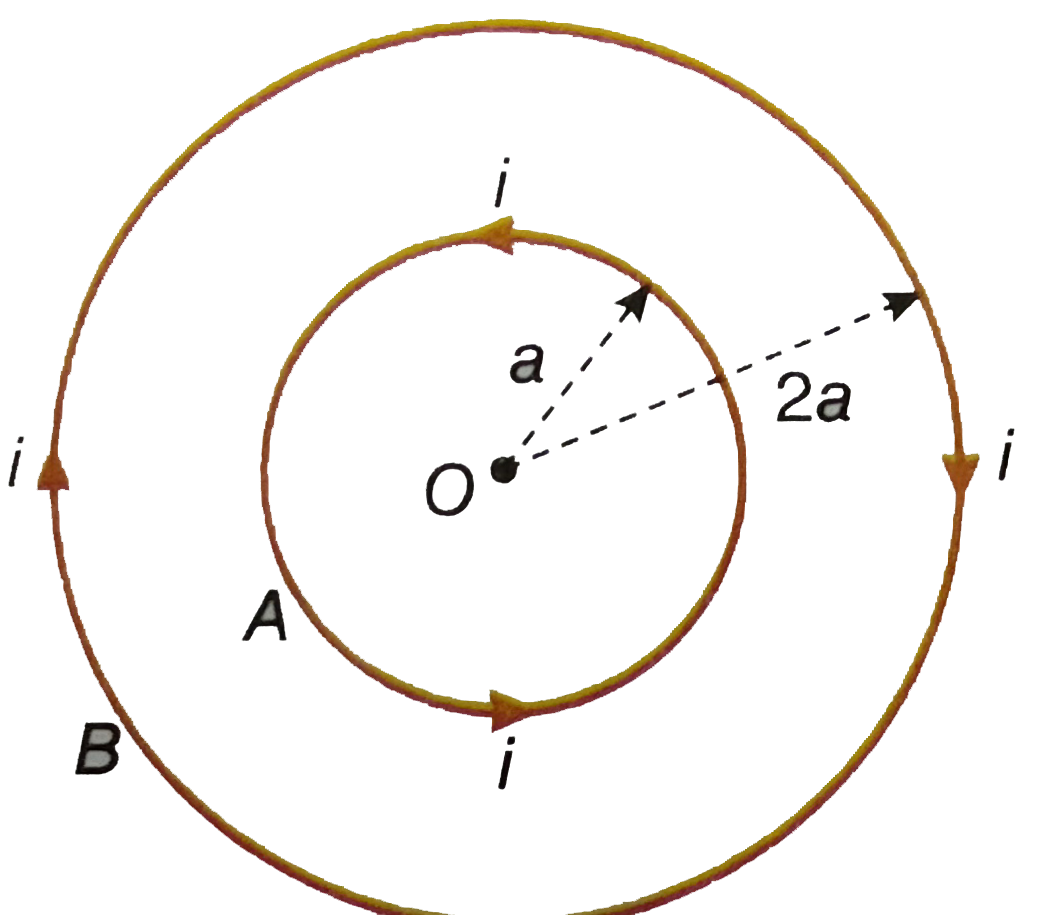 `:.` Net magnetic field at O `B=B_(2)-B_(1)` `=(mu_(o)i)/(a)(2-(1)/(2))` `=(3mu_(0)i)/(2a)=3B_(1)[ :. B_(1)=(mu_(0)i)/(2a)]` Hence resultant field is 3 times that due to the smaller lopp. Now if the direction of the CURRENT is same for both the LOOPS, the resultant field will be, `B=B_(1)+B_(2)=(mu_(0)i)/(2a)+(2mu_(0)i)/(a)=5(mu_(0)i)/(2a)=5B_(1)` Hence the resultant field will be 5 times that due to the smaller loop is current flows in the same direction. |
|
| 7. |
A particle starts its motion from rest under the action of a constant force. If the distance covered in first 10 seconds is S_1 and that covered in the first 20 seconds is S_2 then |
|
Answer» `S_2 = 3S_1` |
|
| 8. |
Kamla peddles a stationary bicycle. The pedals of the bicycle are attached to a 100 turn coil of area 0.10 m^2. The coil rotates at half a revolution per second and it is placed in a uniform magnetic field of 0.01 T perpendicular to the axis of rotation of the coil. What is the maximum voltage generated in the coil ? |
|
Answer» SOLUTION :For A.C. dynamo or A.C. generator, maximum VOLTAGE generated is GIVEN by, `epsilon_0=NAB OMEGA` `=NAB(2pif)` `=(100)(0.1)(0.01)(2xx3.14xx0.5)` `therefore epsilon_0`=0.314 V |
|
| 9. |
Is there any importance for the curie point ? Explain . |
| Answer» Solution :When temperature rises , the SUSCEPTIBILITY of ferro magnetic SUBSTANCES decreases . At a certain temperature its FERROMAGNETIC property completely loses and becomes paramagnetic in nature . The temperature atwhich the transition from ferro to para takes place is called Curie point or Curie temperature e.g. For IRON, Curie temp is about 1000K , for Cobalt - about 1400 K and for Nickel about 631 K. | |
| 10. |
(A): The path followed by one projectile as observed by another projectile is a straight line in uniform gravitation field. (R): The relative velocity between two projectiles at a given place doesn't change with time. Because their relative acceleration is zero. |
|
Answer» Both (A) and (R) are TRUE and (R) is the CORRECT EXPLANATION of (A) |
|
| 11. |
Explain drift of electron and drift velocity. Derive equation of current in term of cross-section of conductor. |
|
Answer» Solution : `rArr` In conductor free electron collide with ions and direction of their motion is continuously changing. Let there be N electron in conductor (i = 1, 2, 3, ... , N). At given time velocity of ith electron be `v_(l)`then its AVEREGE speed `((1)/(N) sum_(i=1)^(N) v_(i) = 0 )`will be zero. `rArr ` When electric field is present then electron will be accelerated. `rArr` Acceleration of electron , `vec(a) = ("force " )/("MASS") = (- e vec(E))/(m)` which is for very short duration. `rArr `Charge of electron is ( - e) and mass be m. `rArr` Let last collision of `i^(th)` electron at time t. after this collision let `t_(i)` time is ELAPSED and after this velocity at time t be `vec(v_(t))` then, `vec(v_(t)) = vec(v_(i))` +at `THEREFORE vec(v_(t)) = 0 - (e vec(E))/(m) t "" [ because v_(i) = 0 ] `  `rArr` At time t average velocity of electron wi1l be average velocity of `v_(i)`velocity of all electron and it will be zero because `v_(i)`is zero for all electron. `rArr` Collision among electron not at definite interval hence direction of velocity of electron will be changing. `rArr` Let average time interval between two successive collision be `tau`which is called relaxation time `rArr` Average velocity of N electron gives drift velocity `vec(v_(d))` `therefore vec(v_(d)) = 0 - (e vec(E))/(m) . (t)_("average")` `therefore v_(d) = - (e vec(E))/(m) . tau` Which is called drift velocity of electron. |
|
| 12. |
The resultant resistance of two resistance in series is 50 Omega and it is 12Omega , when they are in parallel. The individual resistances are |
|
Answer» `20 OMEGA and 15 Omega` |
|
| 13. |
The condider alpha of a transistor is 0.9 .What would be the change in the collector currnt corresponding to a change of 4 mA in the base current in a common emitter arrangement> |
|
Answer» Solution :The current gain `alpha` in common base ARRANGEMENT is related to the current gain `BETA` in common emitter arrangement by the relation, `beta=(alpha)/(1-alpha)` Given ,`alpha` =0.9 `therefore beta=(0.9)/(1-0.9)=9` But `beta=((deltaI_(C))/(deltaI_(B)))_(V_(CE))` Hence change in COLLECTOR current `deltaI_(C)=betadeltaI_(B)=9xx4mA=36 mA` |
|
| 14. |
A given conductor has got different areas of cross section. From the formula for drift speed can we say the current i will be different at different cross sections? |
| Answer» SOLUTION :No. CURRENT will be the same at all CROSS SECTIONS. | |
| 15. |
In the following question a statement of assertion (A) is followed by a statement of reason (R ) A : Water hasa much greater dielectric constant than any other ordinary subtance. R : Water has permanent dipole moment . |
|
Answer» If both Assertion & Reason are TRUE and the reason is the CORRECT explanation of the assertion , then mark (1). |
|
| 17. |
First overtone frequency of a closed organ pipe is equal to the first overtone frequency of an open organ pipe. Further nth harmonic of closed organ pipe is also equal to the nth harmonic of open pipe, where n and m are: |
|
Answer» 5,4 |
|
| 18. |
Two coaxial discs, having moment of inertia I_(1) and I_(1)/2, are rotating with respective angular velocities. omega_(1) and omega_(1)/2, about their common axis. They are brought in contact with each other thereafter they rotate with a constant angular velocity. If E_(f) and E_(i) are the final and initial total energies, then (E_(f) - E_(i)) is: |
|
Answer» `-(I_(1)omega_(1)^(2))/(24)` Li = LF `rArr I_(1)omega_(1) + I_(1) /2 XX omega_(1)/2 =(I_(1) + I_(1)/2) omega_(f) rArr omega_(f)=(5/4 I_(1)omega_(1))/(3/2 I_(1)) = 5/6 omega_(1)` `therefore E_(f) - E_(i) = 1/2 (I_(1) + I_(1)/2) omega_(f)^(2) -[1/2 I_(1)omega_(1)^(2) +1/2(I_(1)/2)(omega_(1)/2)^(2)] =1/2 xx (3I_(1))/2 (5/6 omega_(1))^(2) -9/16 I_(1)omega_(1)^(2) = (I_(1)omega_(1)^(2))/24` |
|
| 19. |
A charged capacitor and an inductor are connected in series at time t= 0. In terms of the period T of the resulting oscillations. determine how much later the following reach their maximum value: (a) the charge on the capacitor, (b) the voltage across the capacitor, with its original polarity: (c) the energy stored in the electric field, and (d) the current. |
|
Answer» |
|
| 20. |
A galvanometer coil has a resistance of 50 Omega and the meter shows full scale deflection for a current of 5 mA . This galvanometer is converted into voltmeter of range 0-20V by connecting |
|
Answer» `3950Omega` in SERIES with GALVANOMETER `R=(V)/(I_(g))-G=(20)/(0.005)-50=4000-50=3950Omega` in series with galvanometer |
|
| 21. |
The current gain of a transistor in common base and common-emitter configurations called alpha and beta are related as |
|
Answer» `ALPHA=(BETA)/(1+beta)` |
|
| 22. |
The given figure shows five particles are shot from left into a region that contains a uniform electric field. The numbered lines shows the paths taken by the five particles. A negatively charged particle with a charge -3Q follows path 2 while it moves through this field. Do not consider any effects due to gravity. Which path would be followed by a charge + 6Q ? |
|
Answer» PATH 1 |
|
| 23. |
Answer the question regarding earth's magnetism: The earth's field, it is claimed, roughly approximates the field due to a dipole of magnetic moment 8 xx 10^(22) JT^(-1) located at its centre. Check the order of magnitude of this number in some way. |
| Answer» Solution :(E) Using FORMULA `B_(e) = (mu_(0)) /(4pi ) ((m)/( r^3) )` and placing the values `m= 8 xx 10^(22) J//T` (or `Am^(2)), r=R_(e)=6.4 xx 10^(6)` m when we find out value of `B_(e)`, it comes out to be 0.3052 G (Gauss) which is quite close to experimentally measured value. This means that magnetic field of bar magnet with magnetic dipole MOMENT `8 xx 10^(22) J//T`. | |
| 24. |
The given figure shows five particles are shot from left into a region that contains a uniform electric field. The numbered lines shows the paths taken by the five particles. A negatively charged particle with a charge -3Q follows path 2 while it moves through this field. Do not consider any effects due to gravity. In Which direction does the electric field point ? |
|
Answer» TOWARD the TOP of the page |
|
| 25. |
Maximum velocity of the photoelectron emitted by a metal is 1.8 xx 10^(6) ms^(-1). Take the value of specific charge of the electron is 1.8 xx 10^(11) C kg^(-1). Thenthe stopping potential in volt is |
|
Answer» 1 We have `eV_(0)=(1)/(2) mv^(2)` `V_(0)(e)/(m)=(v^(2))/(2)` `RARR V_(0)xx1.8xx10^(11)=(1.8xx1.8xx(10^(6))^(2))/(1)` `V_(0)=9V`. |
|
| 26. |
The given figure shows five particles are shot from left into a region that contains a uniform electric field. The numbered lines shows the paths taken by the five particles. A negatively charged particle with a charge -3Q follows path 2 while it moves through this field. Do not consider any effects due to gravity. Which path would be followed by a helium atom (an electrically neutral particle) ? |
|
Answer» PATH 1 |
|
| 27. |
A circular disc rolls on a horizontal floor without slipping and the centre of the disc moves with a unifonn velocity v. Which of the following values the velocity at a point on the rim of the disc can have? |
|
Answer» v So, velocity at the POINT of contact, `v_(g) = v - omegaR = 0` Velocity at the top, `v_(l) = v + omegaR = 2v`  Velocity at a point on the rim of DISC,vr =v is POSSIBLE if v and `omegaR` are at 120°. Velocity at a point on the rim of disc, v R = -v is not possible because `-1 lecostheta le1`. |
|
| 28. |
Modern communication systems use : |
|
Answer» ANALOG circuits |
|
| 29. |
Internal resistance of an electric cell is 1 Omega. Error is incurred during the measurement of its emf with the help a voltmeter.What is the resistance of the voltmeter? |
|
Answer» |
|
| 30. |
Explain the Rutherfordlimitation. |
|
Answer» Solution : As the planets revolves around the Sun, Rutherford suggested in the proposed atomic model, that nucleus at the centre and the electrons orbiting it around the nucleus. Thus the basic difference between the two is that the planets in the system of Sun are captured by gravitational force while the nucleus electron intersects according Coulomb law in a atom. The limitation of the Rutherford atomic model: According to classical physics, there is no constraint on the radius of the orbit of electron. Electron moving in a circular orbit performs an acceleration motion. According to classical electromagnetic theory an accelerated charge radiates energy in the form of electromagnetic radiation hence its energy goes on decreasing. Hence, its orbit would not be circular, it will be spiral terminating at its nucleus which is shown in the figure.  Thus, such an atom cannot be stable. Further, according to the classical electromagnetic theory, the frequency of the electromagnetic wave emitted by the revolving electrons is equal to the frequency of revolution. As the electrons spiral inwards, their angular velocities and hence their FREQUENCIES would change continuously and so will the frequency of the light emitted. Thus, they would emit a continuous spectrum in contradiction to the line spectrum actually observed. Hence, Rutherford.s atomic model states that classical IDEAS are not SUFFICIENT to explain the atomic structure. Because, this model fails to understand the STABILITY of atom. |
|
| 31. |
Above Curie temperature, a |
|
Answer» FERROMAGNETIC MATERIAL becomes diamagnetic. |
|
| 32. |
A: A magnetic dipole experiences maximum torque when it is placed normal to the magnetic field. R: The minimum potential energy of magnetic dipole is zero. |
|
Answer» If both Assertion & Reason are true and the reason is the correct explanation of the assertion then MARK (1) |
|
| 33. |
You may observe that the fish inside the equarium appears to be raised. a. What is the reason for this phenomenon ? c.What happens to the height of the object , (that vertically stands in the aquarium ) when it is observed by the fish ? i. Becomes taller ii. becomes smaller iii. The height does not change Justify your answer . |
|
Answer» SOLUTION :a.Refraction of LIGHT C. BECOMES TALLER. |
|
| 34. |
A man stands in the centre of a Zhukovskii turntable (a rotating platform with frictionless bearings) and rotates with it at 30 r.p.m. The moment of inertia of the man's body with respect to the axis of rotation is about 1.2 kg.m^2 . The man holds in his outstretched hands two weights of mass 3 kg each. The distance between the weights is 160 cm. What will be the change in the speed of rotation of the system, if the man lets his hands fall so that the distance between the weights becomes 40 cm? The moment of inertia of the turntable is 0.6 kg. m^2the change in the moment of inertia of the man's hands and the friction are to be neglected, |
|
Answer» `(I_(man)+I_(b)+2mr_1^2)omega_1=(I_(man)+I_b+2mr_2^2)omega_2` |
|
| 35. |
n-type semiconductor is obtained on doping intrinsic germanium by ……. |
|
Answer» phosphorus Phosphorus is pentavalent IMPURITIES, one ELECTRON from impurities is donate to PURE germanium and it formed n-type of SEMICONDUCTOR. |
|
| 36. |
The optical path of a monochromatic light is same if, it goes thoruhg 4.0cm of glass or 4.5cm of water. If the refractive inded of glass is 1.53, the refractive index of the water is |
|
Answer» `1.30` `n_(G).x_(g)=n_(w).x_(w)impliesn_(w)=n_(g)=(x_(g))/(x_(w))=1.53xx4.0/4.5=1.36` |
|
| 37. |
Pick out the correct staternent from the following. |
|
Answer» Energy released per unit mass of the reactant is less in case of fusion reaction |
|
| 38. |
The value of G on the mars is different than earth,Is it true? |
|
Answer» |
|
| 39. |
In a modified YDSE, monochromaticuniform and parallel beam of light of wavelength 6000 A^(0) and intensity (10/pi) W//m^(2) is incident normally on twocircular aperturesA and Bof radii1 mm and 2 mm respectively. Findthe ratio of the intensity of the two sources [(I_(B))/(I_(A))] |
|
Answer» |
|
| 41. |
Show that when a light beam is incident on a refractive surface at the polarising angle, the reflected and refracted beams are mutually perpendicular to each other. |
|
Answer» Solution :When a light beam travelling in air is INCIDENT on the surface of a refractive medium of refractive index at the polarising angle `i_(p)`, then according to Brewster.s law `tani_(p)=(sini_(p))/(cosi_(p))=n` If the refracted beam subtends an angle of refraction r in given medium, then according to Snell.s law `(sini_(p))/(sinr)=n` Comparing (i) and (ii), we have `cosi_(p)=sinrimplies sin(90-i_(p))=sinrimplies90-i_(p)=r or r+i_(p)=90^(@)` Then, angle between REFLECTED and refracted (TRANSMITTED) rays `angle RAT=180^(@)-(r+i_(p))=180^(@)-90^(@)=90^(@)` i.e., the reflected and refracted rays are MUTUALLY perpendicular. |
|
| 42. |
A slab of material of dielectric constant K has the same area as that of the plates of a parallel plate capacitor but has the thickness d/2, where d is the separation between the plates. Find out the expression for its capacitance when the slab is inserted between the plates of the capacitor. |
|
Answer» Solution :We KNOW that capacitance of a parallel PLATE capacitor is given as `C = (epsi_0A)/d` where A is AREA of eachplate and d is the DISTANCE between them. If a dielectric SLAB of dielectric constant K and area A but of thickness t (t In present case t = d/2. Hence capacitance of the capacitor will be `C = (epsi_0A)/(d - d/2((K-1)/K))=(2 epsi_0A)/(2d-d((K-1)/K)) =(2epsi_0A)/(d(1 +1/K))` |
|
| 43. |
In an ideal transformer the number turns of primary and secondary coil is given as 100 and 200 respectively. If the peak value of the primary voltage is 50V, then the r.m.s value of secondary voltage is nearest to |
|
Answer» 100V |
|
| 44. |
A radioactive nucleus undergoes a series of decays according to the sequence AoversetbetatoA_1 oversetalphatoA_2oversetalphatoA_3. If the mass number and atomic number of A_3 are 172 and 69 respectively, what is the mass number and atomic number of A ? |
|
Answer» 180,72 |
|
| 45. |
A proton collides with a stationary deuteron to form a .^3He nucleus. For this reaction to take place , the proton must have a minimum kinetic energy K_0 . If instead , a deuteron collides with a stationary proton to make a .^3He nucleus , then it must have minimum kinetic energy equal to |
|
Answer» `2K_0` |
|
| 46. |
State briefly the underlying principle of a transistor oscillator. Draw a circuitdiagram showinghow thefeedback is accomplished byinductive coupling. Explain the oscillator action. |
|
Answer» Solution :Transistor as an oscillator: In an oscillator, the output at a desired frequency is obtained without applying any external input voltage. The common emitter npn transistor as an oscillator is shown in the following figure. A variable capacitor C of suitable range is connected in parallelto coil L to give the variation in frequency. Oscillator action : As in an amplifier, the base-emitter junction is forward biased while the base-collector junction is reverse biased. When the switch S is PUT on, a surge of collector current FLOWS in the coil `T_(2)`. The inductive coupling between coil `T_(2)` and `T_(1)` cause a current to flow in the emitter circuit i.e. feedback from input to output. As a result of positive feedback, the collector current REACHES at MAXIMUM. When there will be no further feedbackfrom `T_(2) ` to `T_(1)`, the emitter current begins to fall and collector current decreases. Therefore, the transistor has reverted back to its original state. The whole PROCESS now repeats itselt. 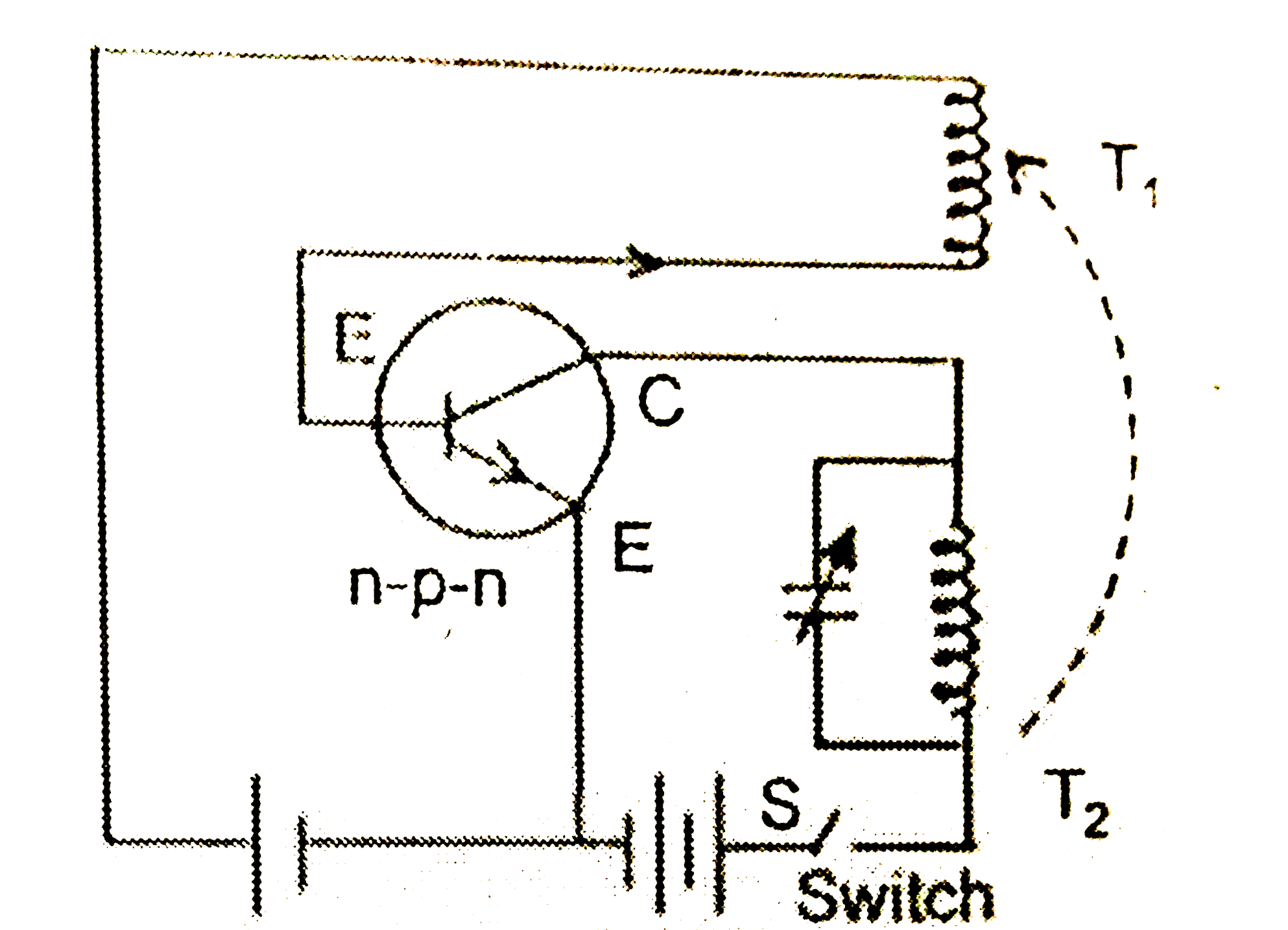
|
|
| 47. |
A diffraction grating 2.0 cm wide has 6000 rulings.At what angles will max. Intensity occur? |
|
Answer» `0^(@), PM3^(@), pm9^(@), pm16^(@)`.... `lambda = 5890 xx 10^(-8)` cm Then `sin theta = (n lambda)/(a + b) = 0.1767 n` Here `n= pm (0, 1, 2...)` `therefore theta = sin^(-1) (0.1767), sin^(-1)(2 xx 0.1767)`... `therefore theta = 0^(@), pm 10^(@), pm 32^(@), pm 45^(@)`... |
|
| 48. |
The product of the reaction is - |
|
Answer»
`to` HYDRATION ACCORDING toAMK ADDITION TAKES place |
|
| 49. |
इनमे कौन विद्युत-क्षेत्र की तीव्रता का मात्रक है ? |
|
Answer» कूलॉम (C ) |
|
| 50. |
(A) : Optical and radiotelescopes are built on the ground but x-ray astronomy is possible only from satelltes orbiting the earth. (R) : Atmosphere absorb X-rays, while visible and radiowaves can penetrate it. |
|
Answer» Both 'A' and 'R' are TRUE and 'R' is the CORRECT EXPLANATION of 'A'. |
|