

Saved Bookmarks
This section includes 7 InterviewSolutions, each offering curated multiple-choice questions to sharpen your Current Affairs knowledge and support exam preparation. Choose a topic below to get started.
| 1. |
In the circuit shown in figure, each capacitor has a capacitance C and cell voltage is E. If switch S is closed, then calculate the work done by battery after closing the switch. |
|
Answer» |
|
| 2. |
A magnetic needle is suspended by a thread at its centre and it shows a dip of 60^(@) When a weight of 20 mg is placed at its front end, the dip is reduced to 30^(@) . If the vertical component of the earth's firld is 4xx10^(-5) testa, find the pole strength of the needle . |
|
Answer» |
|
| 3. |
What is meant by potential at a point? |
| Answer» Solution :POTENTIAL at a POINT is the WORKDONE required BRING a unit charge from infinity to that point without ACCELERATION. | |
| 4. |
Upon which principle Kirchoff's laws are based ? |
| Answer» Solution :The CURRENT law is based on the principle of conservation of CHARGE and voltage lawon conservation of ENERG. | |
| 5. |
The voltage cument values obtained from a transformer constructed by a student is shown in the following table. ( ## EXP_SPS_PHY_XII_C07_E05_001_Q01 .png" width="80%">: Identify the transformer as step up or step down. |
| Answer» SOLUTION :STEP down TRANSFORMER | |
| 6. |
For a parallel beam of monochromatic light of wavelength lambda, diffraction is produced by a single slit whose width a is of the order of the wavelength of the light. If D is the distance of the screen from the slit, the width of the central maxima will be |
|
Answer» `(lambdaD)/d` |
|
| 7. |
What is a prism ? |
| Answer» SOLUTION :Prism is a BOOK of glass having three vertical faces and TWO HORIZONTAL faces. | |
| 8. |
In the electric network shown in the Fig., use Kirchhoff's rules to calculate the power consumed by the resistanceR = 4 Omega |
|
Answer» <P> Solution :Applying Kirchhoff.s second rule for loop ABCDA, we have`-12 +I_1 xx 2 + (I_1+ I_2) xx 4 = 0` `rArr 6I_1 + 4I_2 = 12 `....(i) Again for loop ADFEA, we have ` - (I_1 + I_2) xx 4 + 6 = 0` ` rArr 4I_1 + 4I_2 = 6`...(ii) From (i) and (ii), we get`I_1 = 3A , I_2 = - 1.5 A` Hence current flowing through the RESISTANCE `R=4Omega` will be`I_1 + I_2 = 3 - 1.5 = 1.5 A` ` THEREFORE ` Power CONSUMED by the resistor`P = I^2 R = (1.5)^2 xx 4= 9W` |
|
| 9. |
Obtain the expression for capacitance for capacitance for a parallel plate capacitor . |
|
Answer» Solution :Capacitance of a parallel plate capacitor : Consider a capacitor with two parallel plates each of cross - sectional area A and separated by a distance d . The electric FIELD between two INFINITE parallel plates is uniform and is given by `E = (sigma)/(epsilon_(0))` where `sigma ` is the surface charge density on the plates `sigma = (Q)/(A)` . If the separation distance d is very much smaller than the size of the plate `(d^(2) ltltA )` then the above result is USED even for finite -sized parallel plate capacitor . The electric field between the plates is `E= (Q)/(Aepsilon_(0))` Since the electric field is uniform the electric potential between the plates having separation d is given by `V = (Ed)= (Qd)/(Aepsilon_(0))` Therefore the capacitance of the capacitor is given by `C= (Q)/(V) = (Q)/((Qd)/(Aepsilon_(0)))= (epsilon_(0)A)/(d)` 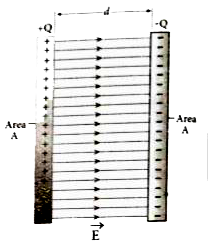 From equation (3) it is evident that capacitance is DIRECTLY proportional to the area of cross section and is inversely proportional to the distance between the plates . This can be understood from the following . (i) If the area of cross - section of the capacitor plates is increased more charges can be distributed for the same potential difference . As a result the capacitance is increased. If the distance d between the two plates is reduced the potential difference between the plates (V= Ed) decreases with E constant . |
|
| 10. |
Under certain circumstances, a nucleus can decay by emitting a particle more massive than an alpha - particle. Consider the following decay processes : ._(88)^(223)Ra to ._(82)^(209)Pb + ._(6)^(14)C ._(88)^(223)Ra to ._(86)^(219)Pb+ ._(2)^(4)He. Calculate the Q - value for these decays and determine that both are energetically allowed. |
|
Answer» Solution :i) For the decay process `._(88)Ra^(223)to ._(82)Pb^(209)+ ._(6)C^(14)+Q` mass defect, `Delta M` = mass of `Ra^(223)` - (mass of `Pb^(209)` + mass of `C^(14)`) `= 223.01850 - (208.98107+14.00324)` = 0.03419 U `Q = 0.03419 XX 931 MeV = 31.83 MeV` ii) For the decay process `._(88)Ra^(223)to ._(86)Rn^(219)+ ._(2)He^(4)+Q` mass defect, `Delta M` = mass of `Ra^(223)` - (mass of `Rn^(219)+` mass of `He^(4)`) `= 223.01850 - (219.00948 + 4.00260)` `= 0.00642 u` `therefore Q = 0.00642xx931 MeV = 5.98 MeV` As Q values are positive in both the cases, therefore both the decays are energetically possible. |
|
| 11. |
Figure shows a long straight wire of a circular cross-section (radius a) carrying steady current I. The current I is uniformly distributed across this cross-section. Calculate the magnetic field in the region r < a and r > a. |
|
Answer» Solution : (a) Consider the case R > a. The Amperian loop, labelled 2, is a circle concentric with the cross-section. For this loop, `L = 2pi r ` `I_e`=Current enclosed by the loop = I The result is the familiar expression for a long straight wire `B(2pi r) = mu_0 I` `B = (mu_0 I)/(2pi r)` `B prop 1/r(r gt a)` (b) Consider the case r < a. The Amperian loop is a circle labelled 1. For this loop, taking the radius of the circle to be r, `L = 2pi r ` Now the current enclosed Ie is not I, but is less than this VALUE. Since the current DISTRIBUTION is uniform, the current enclosed is, `I_e = I ( (pi r^2)/(pi a^2)) = (Ir^2)/(a^2)` Using ampere law `B (2pi r) = mu_0 (Ir^2)/(a^2)` `B = ((mu_0 I)/(2a^2)) r` `B prop r ""(r lt a)` 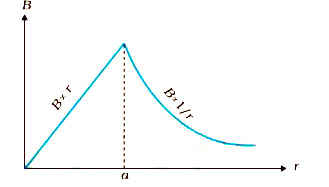 Figure shows a plot of the magnitude of B with distance r from the centre of the wire. The direction of the field is tangential to the respective circular loop (1 or 2) and given by the right-hand rule described earlier in this section. This EXAMPLE possesses the required symmetry so that Ampere’s law can be applied readily. |
|
| 12. |
Why are neutrons very effective as bombarding particles? |
| Answer» Solution :As NEUTRONS do not have any charge, they are not repelled by nucleus. Hence are more effective BOMBARDMENT particles compared to charged particles. | |
| 13. |
(a) Define the term magnetic susceptibility and write its relation in termsof relative magnetic permeability .(b) Two magnetic materials A and B have relative magnetic permeabilities of 0.96 and 500 . Identify the magnetic materials A and B . |
|
Answer» Solution :(a) Magnetic SUSCEPTIBILITY : It is defined as the RATIO of the magnetisation M to the magnetising field intensity H. It is denoted by `X_(m)`. `X_(m)=(M)/(H)` Magnitic susceptibility in terms of magnetic permeability. `X_(m)=mu_(r)-1` (b) A is a diamagnetic material , B is a ferromagnetic material. |
|
| 14. |
Water in a lake starts freezing if temperature of surrounding is -20^@C. The graph between thickness of ice y and time is plotted. Which of the following graph correctly represents this situation? |
|
Answer»
|
|
| 15. |
A monkey is descending from the branch of a tree with a constant acceleration. If the breaking strength of the branch is 75% of the weight of the monkey, the minimum acceleration with which hte monkey can slide down without breaking the branch is : |
| Answer» ANSWER :B | |
| 16. |
Which of the following gaseous molecule is non-linear ? |
|
Answer» `XeF_(2)` 
|
|
| 17. |
If 13.6 eV energy is required to ionise the hydrogen atom, then energy required to removean electron from n=3 is : |
|
Answer» 9 eV |
|
| 18. |
In the above problem, find the ratio of frequencies of wave: |
|
Answer» `M/(M+m)` |
|
| 19. |
Distinguish between electric potential and electric potential energy. |
Answer» SOLUTION :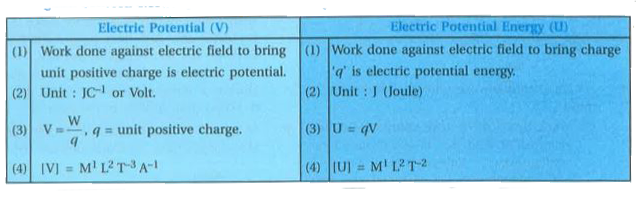
|
|
| 21. |
A ray of light travelling in air isinciden at angle of inciden 30^@ on one surface of slab in which refractive index varies with y. The light travels along the curve y =4x^(2) ( y and x are in meter) in the slab. Find out the refractive index of the slab at y=1//2m in the slab. |
|
Answer» Solution :LET R.I. at `y=y` is `mu` and corresponding angle of refraction is `theta` `musintheta=1sin30^@` (i) and `TAN((pi)/(2)-theta)=(dy)/(dx)rArrcottheta=8xrArr COTTHETA=(8y^(1//2))/(2)` `cot theta=4 y^(1//2)` At `y=1//2mrArrcottheta=(4)/(sqrt(2))=2sqrt(2)` or `sintheta=(1)/(2)` From (i), `muxx(1)/(3)=(1)/(2)rArrmu=(3)/(2)` 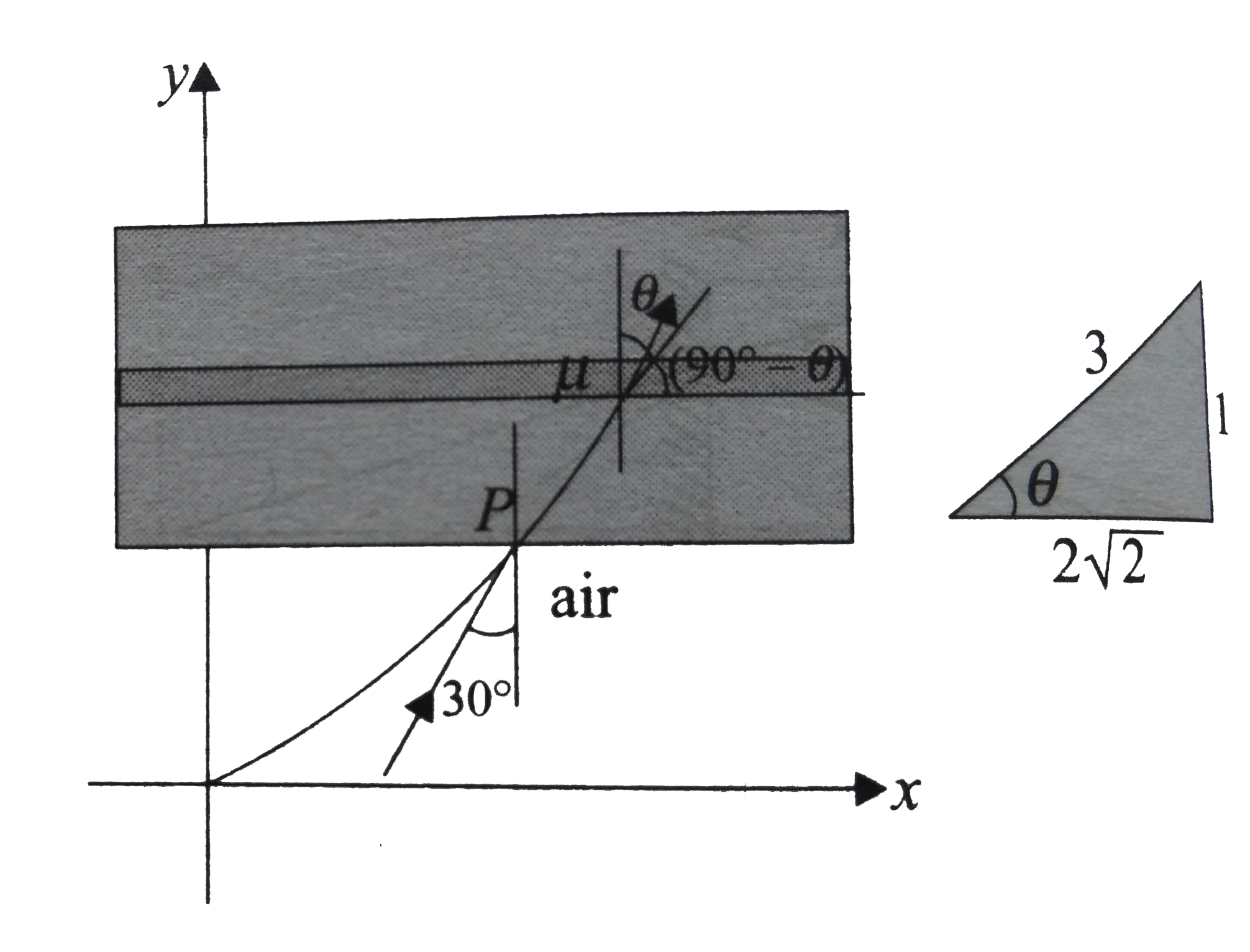
|
|
| 22. |
Angular width of a central max is 30^(@) when the slits is illuminated by light of wavelength 6000 Å.Then width of the slit will be approx: |
|
Answer» `12 xx 10^(-6) m` `therefore sin 30^(@) = (LAMBDA)/(a)` `therefore a = (lambda)/(sin 30^(@)) = 12000 xx 10^(-10)` m `= 12 xx 10^(-7)`m. |
|
| 23. |
A light ray travelling parallel to the principal axis of a convex lens of focal length 12 cm strikes the lens at a height of 5 mm from the principal axis. What is the angle of deviation produced? |
|
Answer» `4^(@)` |
|
| 24. |
State Coulomb's law in electrostatics. Write the law in vector form. Derive the definition of coulomb. |
|
Answer» Solution :Coulomb.s law. It states that two stationary electric point charges attract or repel each other with a force which is directly proportional to the product of MAGNITUDE of the charges and inversely proportional to the square of the distance between them. COulomb.s law in VECTOR form Let `q_(1) and q_(2)` charges be separated by a distance r. 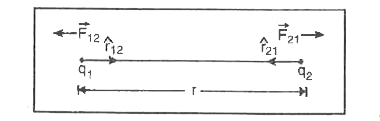 let `hatr_(12)`=unit vector pointing from `q_(1) ` to `q_(2)` `hatr_(21)=` unit vector pointing from `q_(1)" to "q_(1)` `vecF_(21)`=force exerted on `q_(2)" by " q_(2)` Then `vecF_(12)=(1)/(4piepsi_(0))(q_(1)q_(2))/(r^(2))hatr_(21)`. . . (i) and `vecF_(21)=(1)/(4piepsi_(0))(q_(1)q_(2))/(r^(2))hatr_(12)` or `vecF_(21)=-(1)/(4piepsi_(0))(q_(1)q_(2))/(r^(2))hatr_(21)`. . . (ii) Adding (i),(ii) we get `vecF_(12)+vecF_(21)=0` or `vecF_(12)=-vecF_(21)` DEFINITION of one coulomb IN vaccum, `F=9xx10^(9)(q_(1)q_(2))/(r^(2))` If `q_(1)=q_(2)=q(say),r=1m,F=9xx10^(9)N` Then, `9xx10^(9)=9xx10^(9)*(q*q)/(1)` or `q=pm1C` `therefore` One coulomb is charge which when placed before an equal and similar charge in VACUUM at 1m, repels with a force of `9xx10^(9)N`. |
|
| 25. |
(A): The coil of a heater is cut into two equal halves and only one of them is used into heater. The heater will now require half the time to produce the same amount of heat. (R): The heat produced is inversily proportio nal to square of current. |
|
Answer» Both 'A' and 'R' are TRUE and 'R' is the correct explanation of 'A' |
|
| 26. |
A closed coil having 50 turns is rotated in a uniform magnetic field B=2xx10 T about a diameter which is perpendicular to the field.The angular velocity of rotation is 300 revolutions per minute.The area of the coil is 100 cm^(2) and its resistance is 4 Omega.Find (a) the averatage emf developed in half a turn from a position where the coil is perpendicular to the magnetic field (b)the average emf in a full turn (c )the net charge flown in part (a) and (d) the emf induced as a function of time if it is zero at t=0 and is increasing in positive direction (e)the maximum emf induced. (f)the average of the squares of emf induced over a long period |
|
Answer» |
|
| 27. |
In a series resonance of an L,C,R circuit, the angular frequency of the resonating circuit is given by: |
|
Answer» `L/(2pisqrtLC)` |
|
| 28. |
A block of mass 4 kg is kept over a rough horizontal surface. The coefficient of friction between the block and the surface is 0.1 At, t=0, (3hati)(m/s) velocity is imported to the block simultaneously (-2hati)N force starts acting on it. Its displacement in first 5s is |
|
Answer» `8hati` |
|
| 29. |
A wavelength of a monochromatic light in vacuum is lambda . It travels from vacuum to a medium of absolute refractive index mu. The ratio of wavelength of the incident and refracted wave is |
|
Answer» SOLUTION :`mu=c/v=(lambda_0f)/(lambdaf)` `(mu)/(1)=(lambda_0)/(LAMBDA)` `THEREFORE lambda_0 : lambda=mu : 1` |
|
| 30. |
रासायनिक समीकरणों को निम्नलिखित में से किस नियम के सन्तुलित किया जाता है? |
|
Answer» गुणित अनुपात का नियम |
|
| 31. |
What is a capacitor ? |
| Answer» SOLUTION :A CAPACITOR is a device used to STORE the electric CHARGES. | |
| 32. |
A uniform solid right circular cone has its base cut out in conical shape shown in figure such that the hollow portion is a right circular cone on the same base. Find what should be the height of the hollow portion so that the centre of mass of the remaining portion may coincide with the vertex of the hollow portion. |
|
Answer» `h/3` `M = rho 1/3 pi r^2 h_1, Y_(1_(CM)) = (h_1)/(4) "[For removed PART)"` `Y_(CM) = h_1 = (M_Y - M_1 Y_1)/(M - M_1)` `=(rho 1/3 pir^2((h^2)/4 - (h_1^2)/(4)))/(rho1/3 pi r^2 (h - h_1)) implies h_1 = (h_1 + h)/(4) implies h_1 = h/3` 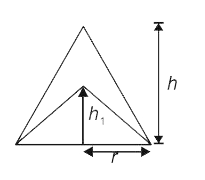
|
|
| 33. |
A ray of light is incident on the plane mirror at rest. The mirr starts turning at a uniform angular acceleration of pi rad s^(-2) . The reflected ray at the end of 1/4s must have turned through |
| Answer» ANSWER :D | |
| 34. |
Describe the biprism experiment to find the wavelength of the monochromatic light. Draw the necessary ray diagram. The width of plane incident wavefront is found to be doubled on refraction in denser medium. If it makes an angle of 65^(@) with the normal, calculate the refractive index for the denser medium. |
|
Answer» Solution :Biprism experiment to find the wavelength of the monochromatic light : To find the wavelength of the monochromatic light through Biprism experiment, an optical bench is used. The length of optical bench is about one and half meter long and scale is marked along its length. Four adjustable stands carrying the slit(S), biprism (B), lens (L) and the micrometer eyepiece (E) are mounted on optical bench. The slit and the biprism can be rotated about horizontal axis. The slit, biprism and eyepiece are required to be SET at same height by keeping their centres in same line.The slit is made narrow and is illuminated by monochromatic light (viz. sodium vapour lamp). The slit is kept VERTICAL and the stand carrying slit is kept close to the stand carrying biprism. Now, rotate the biprism such that its refracting edge becomes parallel to slit and the interference pattern consisting of alternate bright and dark bands appears in the field view of the eyepiece. After this the wavelength of light can easily be determined by using equation, `X=(lambda D)/(d)` `orlambda=(Xd)/(D)` 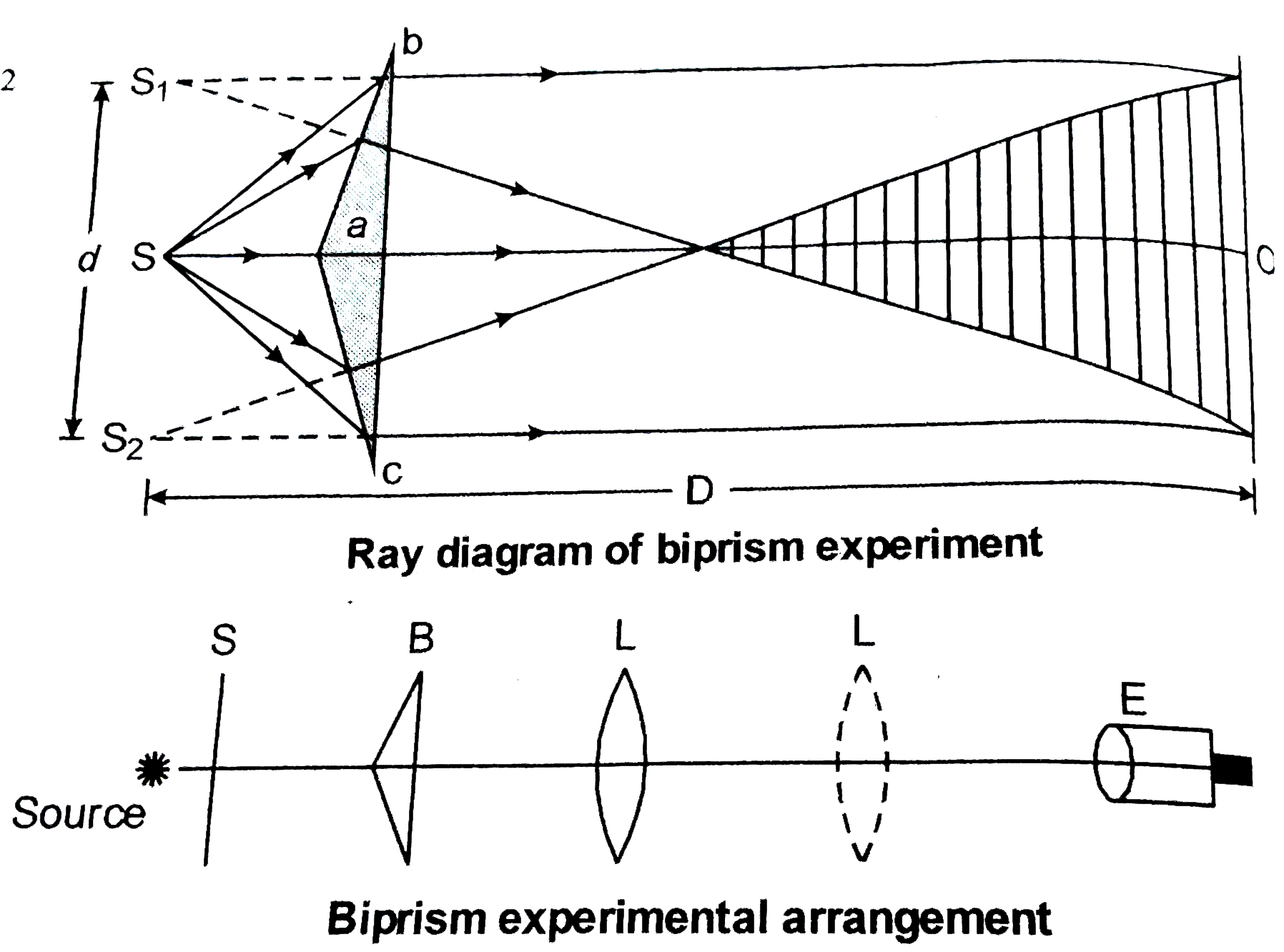 B = Biprism S = Slit L = CONVEX lens E = Eyepiece Numerical : Given: `angle i = 65^(@)` From figure,`cos i=(AB)/(AD) and cos R=(CD)/(AD)` 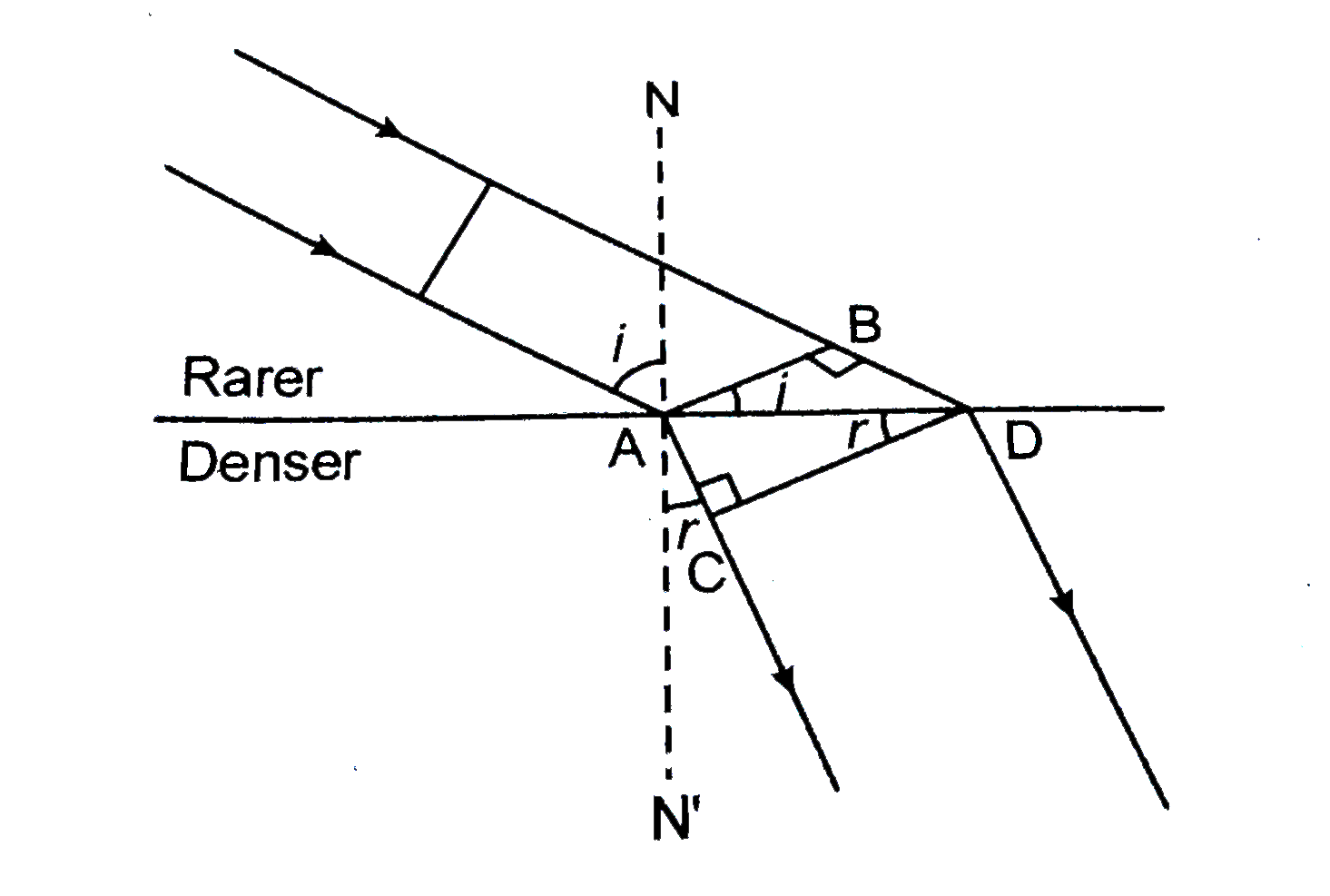 `THEREFORE (cos r)/(cos i) =(CD)/(AB)=2`(given) `therefore cos r=2xx cos i` `cos r=2xx cos 65^(@)` `=2xx0.423` `=0.8425` `therefore r=cos^(-1)(0.845)` `=32.328^(@)` Now, `""_(r)mu_(d)=(sin i)/(sin r)` `=(sin65^(@))/(sin32.328^(@))` `=(0.906)/(0.535)` `" "_(r)mu_(d)=1.693` `therefore`Refractive index for the denser medium is 1.693. |
|
| 35. |
Douglas went down towards the bottom |
|
Answer» only once |
|
| 36. |
A low voltage supply, from which one needs high currents must have very low internalresistance. Why |
| Answer» SOLUTION :The maximum current which can be drawn from a supply is I =`epsi/R`. HENCE, for obtaining highercurrent from a low voltage supply the internal RESISTANCE .r. should be as small as POSSIBLE. | |
| 37. |
A car is moving with a speed of 30 ms^(-1) on a circular path of radius 500 m. If its speed is increasing at the rate of 2 ms, the net acceleration of the car is |
|
Answer» `3.6 MS^(-2)` |
|
| 38. |
A : All physically correct equations are dimensionally correct. R : All dimensionally correct equations are physically correct. |
|
Answer» If both Assertion & Reason are true and the reason is the correct explanation of the assertion, then mark (1). |
|
| 39. |
A parallel plate capacitor is charged to 50muC at 150V. It is then connected to another capacitor of capacity four times of first capacitor. Calculate the energy loss. |
|
Answer» |
|
| 40. |
मान लीजिए A=R-{3} B=R-{1}एक फलनf:A->Bमेf(x)=(x-2)/(x-3) AAXvarepsilonA द्वारा परिभषितहै । तब f होगा - |
|
Answer» एकैकी |
|
| 41. |
An endoscope is employed by a physician to view the internal parts of a body organ. It is based on the principle of |
|
Answer» refraction |
|
| 42. |
In a hydrogen atom, an electron is revolving with an angular frequency 6.28 rad/s around the nucleus. Then the equivalent electric current is ..... ..10^(-19) |
|
Answer» 0.16 |
|
| 43. |
The ratio(("1 kilowatt hour")/("1 electron volt")) equals to |
|
Answer» `2.25xx10^25 `JOULES |
|
| 44. |
The diffraction pattern becomes invisible when the slit is very wide. Give reason. |
| Answer» SOLUTION :Slit width or size should be of the ORDER wavelength of light to observe diffraction of light. HENCE diffraction PATTERN is invisible if the slit is very wide. | |
| 45. |
In a wave motion y = a sin(kx - omega t), y cen represent |
|
Answer» ELECTRIC field |
|
| 46. |
When electric field intensityat any point in the electric field is directed towards or away from the same fixed point, then the field is |
|
Answer» CIRCULAR ELECTRIC field |
|
| 47. |
जल तथा हाइड्रोजन पराक्साइड निम्नलिखित में से किस नियम को दर्शाते है? |
|
Answer» स्थिर अनुपात के नियम को |
|
| 48. |
Eddy currents are produced, when____ |
|
Answer» by heating the metal |
|
| 49. |
Two conducting plates M and N, each having large surface area A (on one side), are placed parallel to each other in figure. The plate M is given charge Q_1 and N, charge Q_2(ltQ_1). Then |
|
Answer» ELECTRIC field at point A is `(Q_1-Q_2)//2Aepsilon_0` TOWARD RIGHT. Electric field LINES will be from `M` to `N`, so potential of `N` will be less than that of `M`. |
|


