

Saved Bookmarks
This section includes 7 InterviewSolutions, each offering curated multiple-choice questions to sharpen your Current Affairs knowledge and support exam preparation. Choose a topic below to get started.
| 1. |
The half life of radon is 3.8 days. After how long there will be only one twentieth of radon sample left over? |
|
Answer» Solution :Data supplied, `N = (N_0)/(20), "" N/(N_0) = 1/(2^n) , "" T_(1//2) = 3.8` DAYS i.e, `1/20 = 1/(2^n) , "" 20 = 2^n` `log 20 = n log 2` `n = (log 20)/(log 2) = 4.322` `t_1 = nT_(1//2) = 3.8 xx 4.322= 16.42` days. |
|
| 2. |
The following energy states are shown for a atom such as hydrogen. The radius of first orbit of Bohr is ...... |
|
Answer» `0.265Å` Here for H, n=1 and `E_(1)=-54.4eV` `:.-54.4=-(13.6Z^(2))/(1^(2))` `:.(54.4)/(13.6)=Z^(2)` `:.4=Z^(2)` `:.Z=2` Radius of Bohr ORBIT `r_(1)=(0.53(1)^(2))/(2)[:.n=1]` `=(0.53)/(2)=0.265Å` |
|
| 3. |
A tuning fork and an organ pipe at temperature 88^@Cproduce 5 beats per second. When the temperature of the air column is decreased to 51^@Cthe two produce 1 beat per sec. What is the frequency of the tuning fork? |
|
Answer» F’=81Hz |
|
| 4. |
A beam of unpolarised light of intensity is passed through a polaroid A and then through another polaroid B which is oriented so that its principal plane makes an angle of 45^(@) relative to that of A. The intensity of the emergent light |
|
Answer» `(I_(0))/(8)` `I_(1)=I_(0) cos^(2) theta` `I_(1)=(I_(0))/(2)` The intensity of emergent light from polaroid `I_(2)=I_(1) cos^(2) theta` `=(I_(0))/(2)cos^(2)45^(@)` `=(I_(0))/(2)xx(1)/(2)=(I_(0))/(4)` |
|
| 5. |
The voltage of ac mains is represented by E=200sqrt2sin 100pi t volts, where t is in seconds. The frequency of ac is |
| Answer» ANSWER :C | |
| 6. |
Number of ejected photoelectron increases with increase |
|
Answer» in INTENSITY of light |
|
| 7. |
What is peak value of 220V a.c ? |
| Answer» Solution :`E_(0) = sqrt(2)E_(V) = sqrt(2) XX 220 "VOLT" = 311 "volt"` | |
| 8. |
Energy of ground state of hydrogen atom is -13.6eV.What is its ionisation potential? |
|
Answer» SOLUTION :Ioniasation energyU=13.6ev=`13.6xx1.6xx10^(-19)J` IONISATION POTENTIAL= U/e=`(13.6xx1.6xx10^(-19)) /(1.6xx10^(-19)`=13.6ev |
|
| 9. |
A pipe of length 85 cm is closed from one end. Find the number of possible natural oscillations of air column is the pipe whose frequencies lie below 1250 Hz. The velocity of sound in air is 340 m/s. |
|
Answer» 4 `(lambda)/(4)= 0.85 ` `lambda = 4 xx0.85 ` f = v/`lambda= (340)/(4 xx 0.85) = 100` Hz. `THEREFORE` Possible frequency = 100 Hz, 300 Hz, 500 Hz, 700Hz, 900 Hz, 1100 Hz below 1250 Hz. thus number of possible NATURAL oscillations whose frequency is below 1250 is 6. So, CORRECT choice is d. 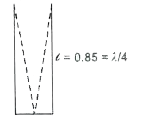
|
|
| 10. |
A torque of magnitude 400 Nm acting on a body of mass 40kg produces an angular acceleration of 20 rad/s^2 . calculate thr radius of gyration of the body. |
|
Answer» 0.5 m |
|
| 11. |
When a biconvex lens of glass having refractive index 1.47 is dipped in a liquid, it acts as a plane sheet of glass. This implies that the liquid must have refractive index, |
|
Answer» LESS than one |
|
| 12. |
A bar of mass m and length I moves on two frictionless parallel rails in the presence of a uniform magnetic field directed into the plane of the paper. The bar is given an initial velocity v to the right and released. Find the velocity of bar, induced emf across the bar and the current in the circuit as a function of time. |
|
Answer» Solution : The INDUCED current is in the counter clockwise direction and the magnetic force on the bar is given by `F_B = il B`. The negative sign indicates that the force is towards the left and retards MOTION. F = ma ` - ilB = m (dv)/(dt)` Because the force depends on current and the current depends on the speed, the force is not constant and the acceleration of the bar is not constant. The induced current is given by i =`(Blv)/(R )` ` -ilB = m. (dv)/(dt)` `- ((Blv)/(R )) lB = m.(dv)/(dt) rArr (dv)/(v) = - (B^2 l^2)/(mR) dt` `int_(v_i)^(v) = - (B^2 l^2)/(mR) int_0^t dt ` `ln ((v)/(v_i)) = - (B^2 l^2)/(mR) t = (-t)/(T)` where `T = (mR)/(B^2 l^2) rAr v = v_i e^(-1/T) ` The speed of the bar therefore decreases exponentially with time under the action of magnetic RETARDING force. `emf = iR = Blv_i e^( - t/T)` current `i = (Blv)/( R) = (BL)/(R ) v_i e^(-t/T)` |
|
| 13. |
A drop of water in volume 0.05cc is pressed between two glass plates so that is spreads for an area of 40.89cmsquare. If the surface tension of water is 70 dyne/cm, What is the normal force required to separate the two given glass plates? |
|
Answer» SOLUTION :PA = F = 2TA/d = `(2 xx 70 xx 40)/ (0.05/40)` ` = 4.5 xx 10^6` dyne |
|
| 14. |
What is dispersion? |
| Answer» Solution :The PHENOMENON of spliting of while LIGHT into its compoentcolours on passing through a refracting MEDIUM is called DISPERSION. | |
| 15. |
What is chromatic absorption ? |
| Answer» SOLUTION :The prismatic ACTION of a LENS is called CHROMATIC ABERRATION. | |
| 16. |
What can cause an electron to held in an atom? |
|
Answer» Coulomb FORCES |
|
| 17. |
The spectral composition of solar radiation is much the same as that of a black whose maximum emission corresponds to the wavelength 0.48mu m. Find the mass lost by the sun every second due to radiation. Evaluate the time interval during which the mass of the sun diminishes y 1 per cent. |
|
Answer» Solution :The black body temperature of the sum may be taken as `T_(Theta) = (0.29)/(0.48 xx 10^(-4)) = 6042K` Thus the radiosity is `M_(e Theta) = 5.67 xx 10^(-8) (6042)^(4) = 0.7555 xx 10^(8)W//m^(2)` ENERGY LOST by SUN is `4pi(6.95)^(2) xx 10^(16) xx 0.7555 xx 10^(8) =4.5855 xx 10^(26)watt` This corresponds to a mass loss of `(4.5855 xx 10^(26))/(9xx 10^(16))kg//SEC = 5.1 xx 10^(9) kg//sec` The sun loses `1%` of its mass in `(1.97 xx 10^(30) xx 10^(-2))/(5.1 xx 10^(9)) sec = 1.22 xx 10^(11)` years. |
|
| 18. |
In circuit in the following figure the value of Y is |
|
Answer» `0` Thus `A=1` and `B=1` become inputs of `NAND` gate giving FINAL OUTPUTS as zero. Choice (a) is correct. 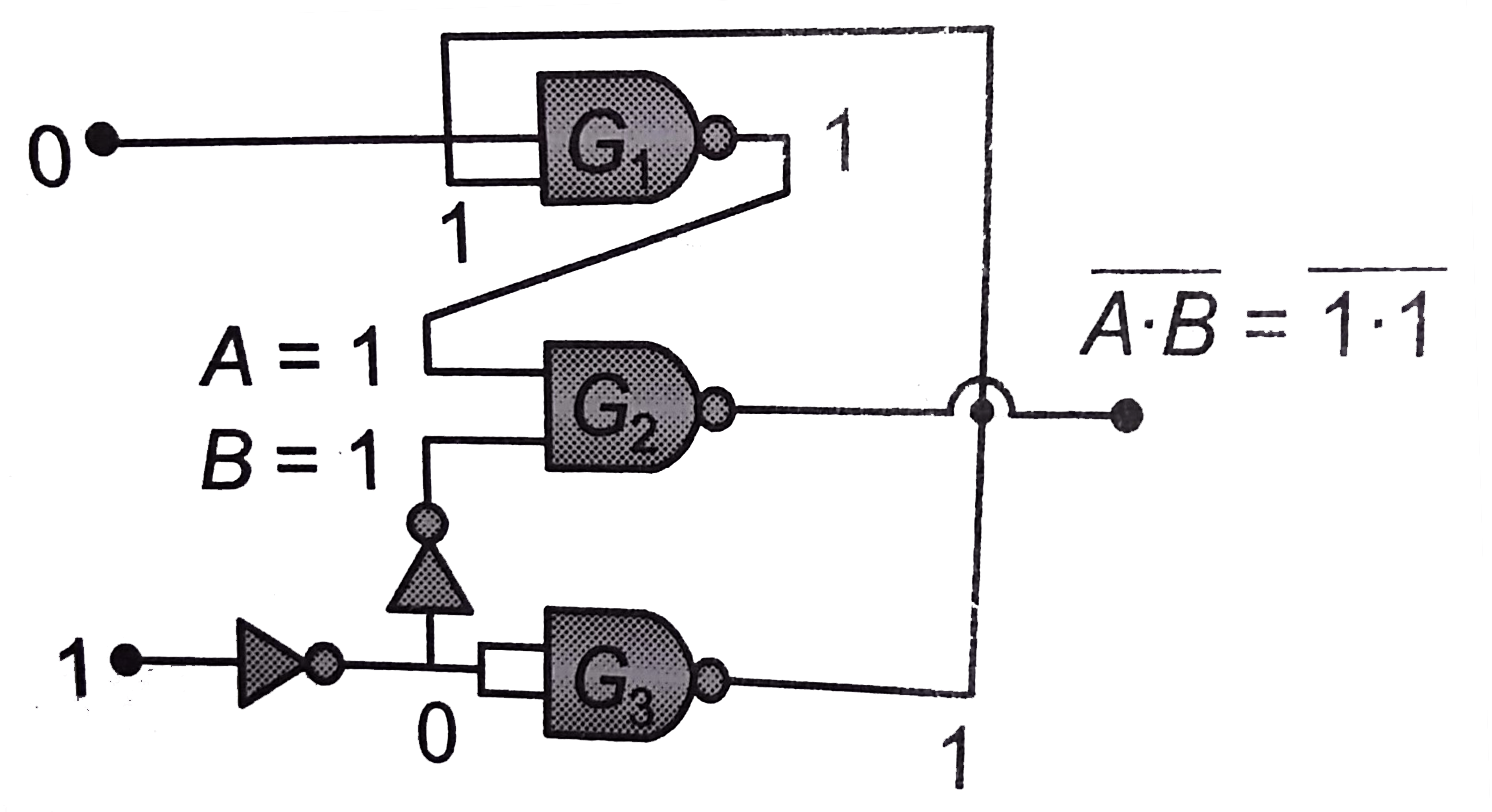
|
|
| 19. |
The variation of velocity of a particle moving along a straight line is shown in the figure. The distance travelled by the particle in 4s is |
|
Answer» 55 m |
|
| 20. |
Unpolarized light of intensity l_0 is incident on a set of 3 polaroids as shown. The pass axis of each polaroid is perpendicular to direction of propagation. One of the polaroid is rotated about the commondirection of propagation of light. |
|
Answer» If A is ROTATED, the FINAL intensity will change |
|
| 21. |
The refractive index of glass is 3/2 . What is the polarising angle of glass |
| Answer» Answer :A | |
| 22. |
A point source of light of power P_(0) is placed at a distance of 4 m from the centre of a thin hemispherical shell as shown in the figure, The shell has a radius of 3 m and it behaves like a perfect black body. If the temperature of the hemisphere is related to the power of the sourcec as T^(4)=(p_(0))/(n pi sigma) where sigma is the stefan's constant, then find the value of (n)/(10). |
|
Answer» |
|
| 23. |
Answer the following questions a. Explain qualitatively on the basis of domain picture the irreversibility in the magnetisation curve of a ferromagnet. b. The hysteresis loop of soft iron piece has a much smaller area than that of a carbon steel piece. If the material is to go through repeated cycles of magnetisation , which piece will dissipate greater heat energy ? c. 'A system displaying a hysteresis loop such as a ferromagnet , is a device for storing memory ? ' Explain the meaning of this statement. d. What kind of ferromagnetic material is used for coating magnetic tapes in a cassette player , or forbuilding ' memorystores ' in a modern computer ? e. A certain region of space is to be shielded from magnetic fields . Suggest a method. |
|
Answer» Solution :a. A ferromagnetic material has many small DOMAINS of magnetic field . But the magnetic moments of these domains are distributed in random so that there is no magnetism in the unmagnetised state. Under the increasing external magnetic field, the domains merge and magnetism increases until saturation is produced . On reducing the magnetising dield, the merged domains do not SPLIT at the rate they merged and hence the retentively . The domains are not completely randomised even if the external field is brought to zero. This shows te IRREVERSIBILITY in the magnetsation curve of the ferromagnetic material. b. Carbon steel piece, because heat lost cycle is proportional to the are of hysteresis loop. c. Magnetisation of ferromagnegnet is not a single - valued function of the magnetising field . Its value for a particular field depends field both on the field and also on history of magnetisation (i.e., how many cycles of magnetisation it has gone through etc.) In other words , the value of magnetisation ISA record or memory of its cycles , of magnetisation, If information bits can be made to correspond to these cycles, the system displaying such a hysteresis loop can act as a device for storing information. d. Ceramics (specially treated barium iron oxides) also called ferrites. e. Surround the region by soft iron ringsMagnetic field lines will be drawn into the ringsand the enclosed space will be FREE of magnetic field . But this shielding is only approximate , unlike the perfect electric shielding of a cavity in a conductor placed in an external electric field. |
|
| 24. |
A charge +1xx10^(-5)C is uniformly distributed over a thin wire ring of radius 1 m. A particle of mass 0.9 g and carrying charge -1xx10^(-6)C is placed on the axis of the ring at a distance of 1 cm from the centre of the ring. Prove that the motion of this negatively charged particle is simple harmonic. Calculate the time period of the oscillation. |
|
Answer» |
|
| 25. |
In a football match a ball is kicked by a player with a force of 25N for 0.2 sec and then by another player with a force of 70 N for 0.1 sec in the same direction. If the foot ball gains a velocity of 24 m/s after the two kicks, the mass of the foot ball is nearly |
| Answer» ANSWER :D | |
| 26. |
A convergent beam of light is incident on a convex mirror so as to converge to a distance 12 cm from the pole of the mirror. An inverted image of the same size is formed coincident with the virtual object. What is the focal length of the mirror ? |
| Answer» Answer :C | |
| 27. |
which of these nuclear reaction is possible? |
|
Answer» `""_(11)^(23)NA+""_(1)^(1)Hto""_(19)^(20)Ne+""_(2)^(4)He` |
|
| 28. |
On applying an electric field of 15xx 10^(-6) vm^(-1)across a conductor , current density through it is 3.0 Am^(-2). The resistivity of the conductor is ....... |
|
Answer» `45 XX 10^(-6) Omega m` `J = sigma ErArr (E)/(RHO)` `THEREFORE rho= (E)/(J) = (15 xx 10^(-6))/(3) = 5 xx 10^(-6) Omega`m |
|
| 29. |
स्टैचू ऑफ यूनिटी किस नदी पर अवस्थित है? |
|
Answer» तापी |
|
| 30. |
(A): When a stretched string vibrates in two segments, then all the vibrating particles in first half of the string are in out of phase to that of in the remaining of the string (R): In a stationary wave the phase difference between the vibrating particles in two consecutive loops is trad. |
|
Answer» Both 'A' and 'R' are true and 'R' is the correct, EXPLANATION of 'A'. |
|
| 31. |
The current through a P-N junction diode is 55mA at a forward bias voltage of 3.0 V. If the temperature is 27^@ C, find the static resistance of the diode. |
| Answer» SOLUTION :The STATIC resistance `R_(dc ) =(V )/(I ) = (3) /( 55 xx 10^(-3)) = 54.5 Omega ` | |
| 32. |
Two ice skaters A and B approach each other at right angles. A has mass 30 kg and velocity 1 m/s and B has a mass of 20 kg and velocity 2 m//s. They meet and stick together. The final velocity of couple is : |
|
Answer» Solution :Let v = COMPOSITE velocity after collision, `theta` = angle with the direction of 30 KG mass Thenfrom momentum conservation, `50V cos theta=30xx1` `50v sin theta =20xx2` From EQUATIONS (1) and (2), `sqrt((50)^(2)+v^(2))=sqrt(900+1600)` `50v=50` `v=1m//s` 
|
|
| 33. |
A tunning fork A produces five beats per second with another tuning forkB frequency 256cps. On filing the fork A, only two beats are heard per second. Frequency of fork A before filing is |
|
Answer» 256 |
|
| 34. |
Are the paths of electrons straight lines between successive collisions (with the positiveions of the metal) in the (i) absence of electric field, (ii) presence of electric field ? |
| Answer» SOLUTION :In the absence of electric field, the paths are STRAIGHT lines. But in the PRESENCE of electric field,the paths are, in general, CURVED. | |
| 35. |
Two photons of energy 4 eV and 4.5 eV are incident on two metals A and B respectively.The maximum kinetic energy for an ejected electron is T_(A) for A and T_(B)=T_(A)-1.5 eV for the metal B.The relation between the de-Broglie wavelengths of the ejected electron of A and B are lambda_(B)=2lambda_(B) .The work function of the metal B is |
|
Answer» 1.5 eV `lambda=(h)/(p)=(h)/(SQRT(2m_(e)K))[because p=sqrt(2m_(e)K)]` `therefore lambda prop (1)/(sqrt(K))` [`because` h,2 and `m_(e)` are same] `(lambda_(A))/(lambda_(B))=sqrt((K_(B))/(K_(A)))=sqrt((T_(B))/(T_(A)))` `therefore (1)/(2)=sqrt((T_(A)-1.5)/(T_(A)))` `therefore (1)/(4)=(T_(A)-1.5)/(T_(A))=1-(1.5)/(T_(A))` (By taking SQUARE) `therefore (1.5)/(T_(A))=1-(1)/(4)=(3)/(4)` `therefore T_(A)=(1.5xx4)/(3)` `therefore T_(A)=2EV` Now `T_(B)=(T_(A)-1.5)eV` `therefore phi_(B)=hf-T_(B)=(4.5-0.5)eV` `therefore phi_(B)=4.0 eV` |
|
| 36. |
A satellite of mass m is revolving round the earth at a height R above surface of earth. If g is gravitational intensity at earth's surface and R is radius of the earth, the K.E. of satellite is : |
|
Answer» `"mg" (R )/(4)` `therefore (mv^(2))/(2R)=(GMM)/((2R)^(2)) rArr (1)/(2)mv^(2)=(GMm)/(4R)=(mgR)/(4)` or `K.E.=-(1)/(2) (GP.E.)= -(1)/(2)` `((-GMm)/(2R))=(GMm)/(4R)=(mgR)/(4)` Thus CORRECT choice is (a). |
|
| 37. |
A man is travelling at 10.8 kmph in a topless car on a rainy day. He holds an umbrella at an angle of 37° with the vertical so that he does not wet. If rain drops falls vertically downwards, what is the rain velocity ? |
| Answer» Answer :D | |
| 38. |
A body floats with one third of its volume outside water and 3/4 of its volume outside another liquid. The density of other liquid is : |
|
Answer» 9/4g/cc `thereforeVp_(s)g=(2V)/3p_(w)grArrp_(s)=2/3p_(w)` Similarly in liquid, `Vp_(s)g=1/4.Vp_(l)grArrp_(l)=4p_(s)` or `p_(l)-4. 2/3p_(w)-8/3p_(w)` `pl=8/3xx1gcm^(-3)` So the correct choice is (c). |
|
| 39. |
Match the column -I with column -II |
|
Answer» a-s b-tc-q d-p |
|
| 40. |
क्लोरोफिल किस कोशिकांग में पाया जाता है ? |
|
Answer» माइटोकॉन्ड्रिया |
|
| 41. |
In the situation as shown in Figure, (cos53^(@)=(3)/(5)) |
|
Answer» velocity of image wrt mirror is `-22hat(i)-24hat(j)` `vecv_(m)=` velocity of mirror`=-2hat(i)ms^(-1)` `m+(F)/(f-u)=(-20)/(-20-(-30))=-2` For velocity component parallel to OPTICAL AXIS, `(vecv_(I//m))_(||)=-m^(2)(vecv_(O//m))_(||)` `(vecv_(I//m))_(||)=-(-2)^(2)11hat(i)=-44hat(i)ms^(-1)` For velocity component perpendicular to optical axis `(vecv_(I//m))_(_|_)=m(vecv_(o//m))_(_|_)=-(-2)12hat(j)=-24hat(j)ms^(-1)` `(vecv_(I//m))=` velocity of image with respet to mirror `vecv_(I//m)=(vecv_(I//m))_(||)+(vecv_(I//m))_(_|_)=(-44hat(i)-24hat(j))ms^(-1)` ALSO, `vecv_(I//m)=vecv_(I)-vecv_(m)` or `vecv_(I)=vecv_(I//m)+vecv_(m)=(-44hat(i)-24hat(j))-2hat(i)=(-46hat(i)-24hat(j))ms^(-1)` 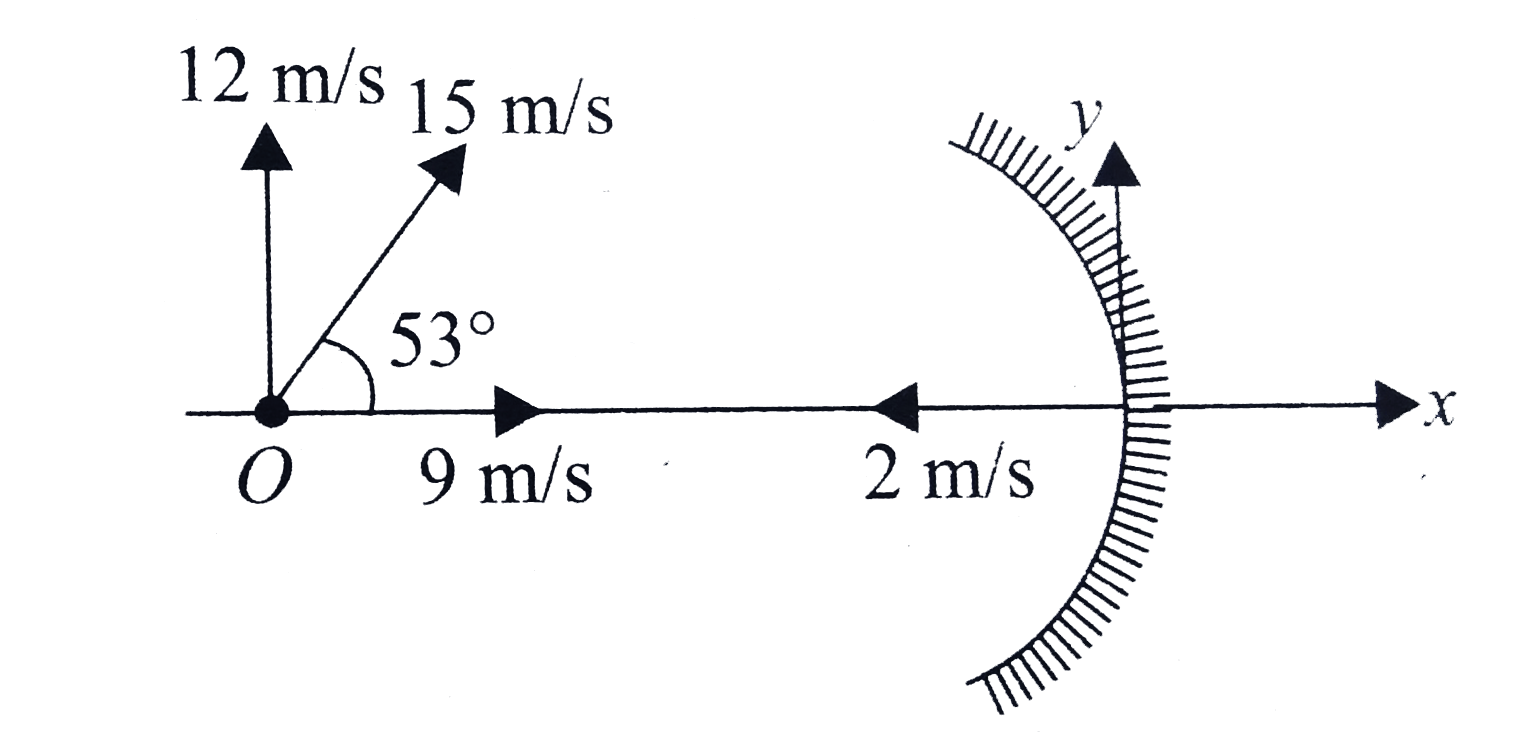
|
|
| 42. |
(a) Show that the values of a at which intensity maxima for single-slit diffraction occur can be found exactly by differentiating Eq. 35-56 with respect to alpha and equating the result to zero, obtaining the condition tan alpha= alpha. To find values of a satisfying this relation, plot the curve y = tan alpha and the straight line y = alpha and then find their intersections, or use a calculator to find an appropriate value of alpha by trial and error. Next, from alpha = (m + 1 // 2)pi, determine the values of m associated with the maxima in the single-slit pattern. (These m values are not integers because secondary maxima do not lie exactly halfway between minima.) What are the (b) smallest alpha and (c) associated m, the (d) second smallest alpha and (e) associated m, and the (f) third smallest alpha and (g) associated m? |
| Answer» Solution :(b) 0, (C) -0.500, (d) 4.493 RAD, (E) 0.930, (F) 7.725 rad, (G) 1.96 | |
| 43. |
In Young's double slit experiment, the intensity of the maxima is I. If the width of each slit is doubled the intensity of the maxima will be: |
|
Answer» `(I)/(2)` |
|
| 44. |
A 2m long wire of resistance 4 ohm and diameter 0.64 mm is coated wilth plastic insulation of thickness 0.06 mm. When a current of 5A flows through the wrie, find the temperature difference across the insultion insteady state. If K=0.16xx10^(-2) cal/cm ""^(@)C sec. |
|
Answer» Solution :Consider a concenric CYLINDRICAL shell of radius r and thickness dr as shown in figure. The radial rate of flow of heat through this shell in STEADY STATE will be `H=(dQ)/(dt)=-KA(d theta)/(dr)` Negative sign isused as with Increase in r `theta` decreases Now as for cylindrical shell `A=2 pi rL` `H=-2piLK(d theta)/(dr)` or `int_(a)^(b)(dr)/r=-(-2piK)/Hint_(theta_(1))^(theta_(2))d theta` Which on integration and simplification gives `H=(dQ)/(dt)=-(-2piLK(theta_(1)-theta_(2)))/("In"(b//a))`..........(1)  Here `H=(I^(2)R)/4.2=((5)^(2)xx4)/4.2=24("CAL")/("sec"),L=2m=200cm` `r_(1)=(0.64//2)mm=0.032cm` and `r_(2)=r_(1)+d=0.032+0.006=0.038cm` `(theta_(1)-theta_(2))=(24xx"In"(38//32))/(2xx3.14xx200xx0.16xx10^(-2))` `implies(theta_(1)-theta_(2))=(55xx[1.57-1.50])/2=2^(@)C` |
|
| 45. |
A non-zero current passes through the galvanometer G shown in the circuit when the key 'K' is closed and its value does not change when the key is opened. Then which of the following statements (s) is/are true? |
|
Answer» The GALVANOMETER resistance is infinite. ` therefore(200)/(300) = (100)/( G)impliesG= 150 Omega `  ` R_(eq)= ( 500 xx 250) /( 750)= (500)/(3) Omega ` Nowcurrentthroughgalvanometer `I^-= (10)/( 250)=(1)/(25)= 0.04A = 40m A ` Afterkeyis closedwheatstonebridgeconditionis appliedand SINCE`200 Omega`and `300Omega `are inseriesthereforecurrentthroughbothwill bethe same . |
|
| 46. |
When a beam of light is used determine the position of an object, the maximum accuracy is achieved if the light is ..... |
|
Answer» POLARISED |
|
| 47. |
26.65 gm of compound having formula [Cr(H_2O)_5Cl)]Cl_2.H_2Ois mixed with 498.2gm water. If complex is 75% ionised in water, then find elevation in boiling point in Kelvin for abovesolution (k_b water = 0.50 k kg mol^(-1)) (At. wt. Cr : 52, Cl : 35.5, O : 16) |
|
Answer» TOTAL WATER =498.2+18=500 GM `DeltaT_b=im k_b=(1+2xx3/4)0.1/0.5xx0.5` =0.25 |
|
| 48. |
The centre of mass of a right circular cone of height h, radiusr and constant density rho is at |
|
Answer» `(0,0, h/4)` |
|
| 49. |
(a) The rest mass energy of an electron is m_(0)c^(2)=0.51MeV. Can a photon of this energy create an electron in free space? (A) A single photon of energy 2m_(0)c^(2) or greater has enough energy to form an electron (e^(-)). Positron (e^(+)) pair. But prove that this process cannot occur in free space. (c) The pair production is possibel in presence of a third particle. Assume that a photon having frequency v collides with a nucleus of rest mass M_(0) (at rest) and creates an e^(-),e^(+) pair at rest. Calculate the mass M_(0) of the nucleus. Neglect relativistic effect in all questions. |
|
Answer» |
|
| 50. |
A 500kg rocket has to be fired vertically. Exhaust velocity of the gases is 1.96 km/s. Minimum mass of the fuel to be released in kg per second is |
|
Answer» 250 |
|