Saved Bookmarks
This section includes 7 InterviewSolutions, each offering curated multiple-choice questions to sharpen your Current Affairs knowledge and support exam preparation. Choose a topic below to get started.
| 1. |
In the following series of resonant frequenies, one frequency (lower than 400 Hz) is missing. 150, 225, 300,375Hz, (a) What is the missing frequency? (b) What is the frequency of the seventh harmonic? |
|
Answer» |
|
| 2. |
Light is incident at an angle i on one planer end of a transparent cylinderical rod of refractive index mu. Find the least value of mu so that the light entering the rod does not emerge from the curved surface of the rod irrespective of the value of i. |
Answer»  `A ge `2theta_(C)` or `sintheta_(C) LT sin ((A)/(2))` or `(1)(mu) le sin 45^(@)` or `(1)/(mu) le (1)/(sqrt(2))` `:. mu ge sqrt(2)` |
|
| 3. |
Four rods of equal lengths AB, BC, CD and DA have mass m, 2m, 3m and 4m respectively are place in x-y plane (see figure) given AB=BC=CD=DA=4 meters. The centre of mass of the system will satisfy (x and y are in meters) |
|
Answer» `xgt2, ygt2` |
|
| 4. |
Consider a rocket that is in deep space and at rest relative to an inertial reference frame. The rocket's engine is to be fired for a certain interval. What must be the rocket's mass ratio (ratio of initial to final mass) over that interval if the rocket's original speed relative to the inertial frame is to be equal to (a) the exhaust speed (speed of the exhaust products relative to the rocket) and (b) 2.0 times the exhaust speed? |
|
Answer» |
|
| 5. |
The wave function for a travelling wave on a string is given as y(x, y) = (0.350m) sin (10pit -3pix+ (pi)/(4)) (a) What are the speed and direction of travel of the wave? (b) What is the vertical displacement of the string at t = 0, x = 0.1 m ? (c) What are wavelength and frequency of the wave ? |
|
Answer» Solution :(a) 3.33 `hati m//s` (B) ` - 5.48 cm` (c ) `0.67` , , 5HZ |
|
| 6. |
A glass rod rubbed with silk acquires a charge +1.6 xx 10^(-12)C . What is the charges on the silk? |
|
Answer» |
|
| 7. |
A condenser of capacity 1 mu Fand a resistance 0.5 mega-ohm are connected in series with a DC supply of 2 V. The time constant of circuit is |
|
Answer» 2s |
|
| 8. |
A charged ball with mass m and charge q is dropped from a height h over a non-conducting smooth horizontal plane. There exists a uniform electric field E_0 in vertically downward direction and the coefficient of restitution between the ball and the plane is e. Find the maximum height attained by the ball after n^(th) collision. |
|
Answer» |
|
| 9. |
A car starts from rest and moves with constant acceleration. The ratio of distance covered by the car in nth second with that covered in n seconds is: |
| Answer» Solution :Here `(S_n)/(s)=((a)/(2)(2n-1))/((1)/(2)an^(2))=(2n-1)/(n^(2))` | |
| 10. |
The following figure shows three circuits with identical batteries, inductors, and resistors. |
|
Answer» |
|
| 11. |
Ampere's circuital law is true for _______ . |
|
Answer» symmetric electric fields |
|
| 12. |
On an inclined plane making an angle theta with the horizontal plane, a solid cylinder of mass m_(1) is connected to a block of mass m_(2) by means of a light chord which is parallel to incline plane . The coefficient of friction between block and incline and between cylinder and incline is equal to mu . the system is held at rest & then released . If cylinder & block move together and cylinder perform pure rolling & tension in string is non zero thenMinimum value of mu for whichcylinder will not slip ? |
|
Answer» `((m_(1)+m_(2))TANTHETA)/(m_(1)+2m_2)` |
|
| 13. |
An uncharged capacity ER C=100muF with a resistor is connected with AC source as shown in the figure If R= is 50Omega and switch S is closed at t=0 maximum value of (v_(A)-V_9B) is k volt. Calculate K |
|
Answer» |
|
| 14. |
Consider the circuit consisting of two capacitors having capacitances 3 mu F and 6 mu F and an ideal battery of emf e = 4 volts as shown. The switch S is open for a long time and then closed. After the switch is closed. The work done by the battery is : |
|
Answer» 16 m J `= (3 XX 6)/(3+6) xx 4 = 8 mC` final charge on 6mF capacitor `= 6 xx 6 = 25 mC` charge PASSING through cell (in direction aided by cell) `= q_(f) -q_(i) = Dq = 24 - 8 = 16 mC` work done by cell = Dqe `= 16 xx 4 = 64 mJ` |
|
| 15. |
Rain is falling vertically with a speed of 20 ms^(-1) . A person is running in the rain with a velocity of 5 ms^(-1) and a wind is also blowing with a speed of 15 ms^(-1) (both from the west). The angle with the vertical at which the person should hold his umbrella so that he may not get drenched is: |
|
Answer» SOLUTION :`vec(V_("Rain"))=vec(V_(R))=20(-HATK)` `vec(V_("Man"))=vec(V_(M))=5hati` `vec(V_("wind"))=vec(V_(W))=15 hati` Resultant velocity of rain and wind `vec(V_(RM))=-20 hatk+15hati` Now Velocity of Rain relative to man = `vec(V_(RM))-vec(V_(M))` `=(-20 hatK+15 hati)-(5hati)` `=-20 hatK+10 hati` `Tan alpha=(1)/(2) RARR alpha="Tan"^(-1) (1)/(2)` 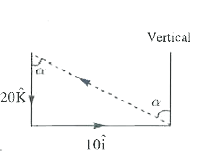
|
|
| 16. |
J = sigma E represents........ . |
|
Answer» Coulomb's law J = `sigma` E `therefore (I)/(A)= (N)/(C) xx (1)/(Rm) [ "Unit of " sigma = (1)/(Omega m) , " Unit of " ` `E= (N)/(C) and " Unit of " J = (A)/(m^(2)) ]` `therefore (I)/(m^(2)) = (N)/(CRm)` `therefore I = (NM)/(CR) = (V)/(R) . ` Which is Ohm.s law. `""[ because (Nm)/(C) = " VOLTAGE" ] ` |
|
| 17. |
The total energy of body executing S.H.M. with amplitude ® is proportional to |
|
Answer» `r/2` |
|
| 18. |
Consider A, D and C to be the co-centric shells of metal . Their radii are a ,b and c respectively (a < b < c). Their surface charge densities are sigma, -sigma and sigma respectively. Calculate the electric potential on the surface of shell A. |
|
Answer» `(sigma)/(epsilon_(0))[(a^(2)-B^(2))/(a)+c]` 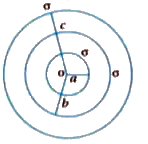 Potential ins.ide the shell and on SURFACE is same `V = (KQ)/(R)` where R is radius of shell and potential at `r gt R` distance `V= (kq)/(R)` `Vb = (kq_(a))/(b) + (kq_(b))/(b) +(kq_(c))/(b)` but ` Q = 4p pi^(2) sigma` `:. Vb = (4pia^(2)sigma)/(4pi in_(0)xxb)+(4pi b^(2)(-sigma))/(4 pi in_(0)xxb) +(4pi in^(2)(sigma))/(4pi in_(0)xxc)` `= (a^(2)sigma)/(in_(0)b)-(b^(2)sigma)/(in_(0)b)+(c^(2)sigma)/(in_(0)c)` `= (sigma)/(in_(0))[(a^(2)-b^(2))/(b)+c]` |
|
| 19. |
A string of length I is stretched by II 30 and transverse waves in the string are found to travel at a -speed v_0. Speed of transverse waves when the string is stretched by II15 will be : |
|
Answer» `v_(0)/2` |
|
| 20. |
The frequency which is not part of AM broadcast |
| Answer» Answer :A | |
| 21. |
Two identical circular coils A and B are placed parallel to each other with their centres on the same axis. The coil B carries current in the clockwise direction as seen from A. What would be the directions of the induced current in A as seen from B when the current in B is increased |
| Answer» Solution :If the CURRENT in COIL B is increased, a current will be induced in coil A and according to Lenz's law, its direction will be such that, it will oppose the increase of current in coil B. HENCE the direction of induced current in coil A will be OPPOSITE to the direction of current in coil B. So, when looked from coil B, the current in coil A will be clockwise. | |
| 22. |
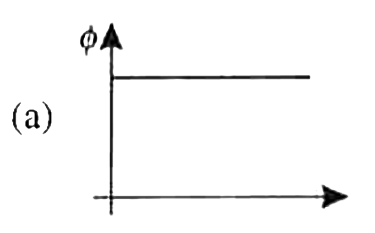
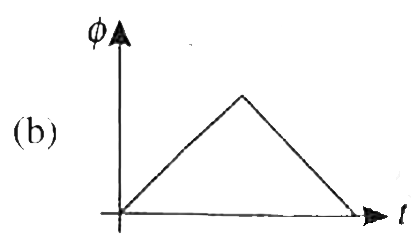
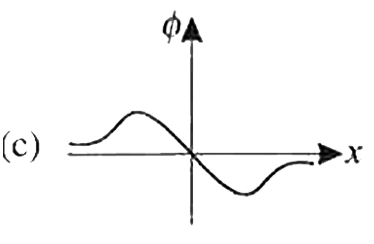
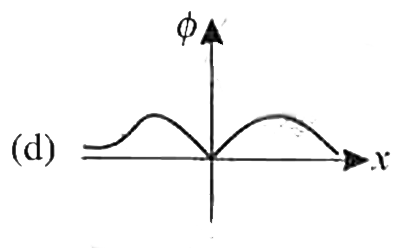
A ring of radius R is placed in the plane its centre at origin and its axis along the x-axisand having uniformly distributed positive charge. A ring of radius r(ltltR) and coaxial with the larger ring is moving along the axis with constant velocity , then the variation of electrical flux (phi) passing through the smaller ring with position will be best represent by : |
|
Answer»
|
|
| 23. |
A ray of light from a denser medium strikes a rarer medium. The reflected and refracted rays make an angle of 90^(@) with each other. The angle of reflection and refraction are r and r^(1). The critical angle would be |
|
Answer» `SIN^(-1)(tan r)` |
|
| 24. |
Two identical circular coils A and B are placed parallel to each other with their centres on the same axis. The coil B carries current in the clockwise direction as seen from A. What would be the directions of the induced current in A as seen from B when the coil B is moved towards A, keeping the current in B constant? |
| Answer» Solution :Keeping the current steady in coil B, if it is moved towards coil A, the number of magnetic LINES of force linked with coil A will increase and current OPPOSITE to that in coil B will be induced in coil A. HENCE, in this case ALSO, if looked from coil B, the current in coil A will be clockwise. | |
| 25. |
Two balls are projected simultaneously in same vertical plane from the same point with velocities V_1 and V_2 with angles theta_1 and theta_2 respectively with the horizontal. If V_1 Cos theta = V_2 Cos theta_2, the path of one ball as seen from the position of another ball is |
|
Answer» parabola |
|
| 26. |
Two waves of wavelength 2m and 2.02 m respectively, moving with the same velocity, superpose to produce 2 beats per sec. Hie velocity of the wave is : |
|
Answer» 400.0 m/s |
|
| 27. |
Whatis theconclusionof Davisson- Germerexperimentof thenatureof electron ? |
| Answer» SOLUTION :DAVISSON- Germerexperimentprovesthe wavenatureof ELECTRONIN MOTION . | |
| 29. |
The difference in the variation of resistance with temperature in a metal and a semiconductor arises essentially due to thedifferencein the………. |
|
Answer» crystal STRUCTURE. As the temperature of metal increases, the number of charge carriers does change, but as the temperature of SEMICONDUCTOR increases, the number of charge carriers increases, so the change in the resistance is different. |
|
| 30. |
An ac generator with emf E = E_m sin omega_d t, where E_m = 25.0 V and omega_d=377 rad/s, is connected to a 4.15 muF capacitor. (a) What is the maximum value of the current? (b) When the current is a maximum, what is the emf of the generator? (c) When the emf of the generator is -12.5 V and increasing in magnitude, what is the current? |
|
Answer» |
|
| 31. |
A dip needle free to movein a vertical plane perpendicular to the magnetic will remain: |
|
Answer» horizontal |
|
| 32. |
There were 100 droplets of mercury of 1 mm diameter on a glass plate. Subsequently they merged into one big drop. How will the energy of the surface layer change? The process is isothermal. |
|
Answer» Solution : The total surface AREA of all the droplets is `S_(0)=400 PI r^(2)=` `100 pid^(2)` their total volume is `V_(0)= 100pi a^(3)//6`. After the droplets merge, the volume remains unchanged, but the surface area decreases: `V=pi D^(3)//6=V_(0),S=piD^(2)`.From the condition of equality of the volumes, find the diameter of the large drop: `(100 pi d^(3))/(6)=(piD^(3))/(6)`, where `D=d^(3)sqrt(100)` The surface area of the large drop is `s=pid^(2)""^(3) sqrt(10^(4))`. The decrease in the surface layer energy corresponding to the decrease in the surface area of `DeltaS=S_(theta)-S= pid^(2)(10^(2)-10^(4//3))` is `Delta_("SUR")=alpha DeltaS~~ SIGMA DeltaS=pi sigma d^(2)(10^(2)-10^(4//3))` |
|
| 33. |
What were the three revolutionaries singing? |
| Answer» Answer :D | |
| 34. |
Eddy currents are produced, when |
|
Answer» a metal is kept in a varying magnetic field. |
|
| 35. |
The synthetic material used for the preparation of polaroids prosses the propery of |
|
Answer» ANOMALOUS THERMAL expansion |
|
| 36. |
Which of the following statemnets is not true ? |
|
Answer» COEFFICIENT of friction MAY be greater than unity. |
|
| 37. |
When an alternating voltage of 220 V is applied across a device X, a current of 0.25 A flows which lags behind the voltage in phase by pi/2 rad. If the same voltage is applied across another device Y, the same current flows but now it is in phase with the applied voltage. (a) Name the devices X and Y. (b) Calculate the current flowing in the circuit when the same voltage is applied across the series combination of X and Y. |
|
Answer» SOLUTION :(a) As in device X the current I lags behind voltage V by `pi/2`the device X is an inductor L. In device Y the current I and voltage V are in phase, the device Y is a resistor. (b) `X_(L) = R = (220 V)/(0.25 A) = 880 Omega` When L and R both are connected in series, the total impedance, `Z = sqrt(R^(2) + X_(L)^(2))` `therefore` Current `I = V/Z = V/sqrt(R^(2)+ X_(L)^(2)) = 220/sqrt((800)^(2) + (880)^(2)) = 220/(800sqrt(2)) = 1/(4sqrt(2))A = 0.18 A` |
|
| 38. |
Draw ray diagrams to show how specially designed prism make use of total internal reflection to obtain inverted image of the object by deviating rays (i) through 90°, and (ii) through 180°. |
Answer» Solution : Ray DIAGRAMS are given in FIG. 9.37(i) and (ii) RESPECTIVELY. 
|
|
| 39. |
Define current gain at a constant V_("CE") and V_("BE"). |
|
Answer» Solution :i. The ratio `((I_(C ))/(I_(B)))_(V_("CE"))` is called DC GAIN `(beta_("dc"))` and `((Delta I_(C ))/(Delta I_(B)))_(V_("CE"))`is called AC signal CURRENT gain `(beta_("ac"))` or current amplification FACTOR. ii. The ratio `((I_(C ))/(I_(E)))_(V_("CE"))`is called DC gain `(alpha_("dc"))` and `((Delta I_(C ))/(Delta I_(B)))_(V_("BE")) = alpha_("ac") ` is called ac gain. |
|
| 40. |
What do you observe when a soap bubble or thin layer of oil on water is illuminated by white light?Why? |
| Answer» Solution :Coloured FRINGES are observed.This is due to interference of light waves REFLECTED from the upper and lower LAYER SURFACE of thin flim. | |
| 41. |
The magnetic field (dB) due to a small element. (dl) at a distance (vecr) and element carrying current I is |
|
Answer» `dvecB=(mu_(0))/(4PI)i((dveclxxvecr)/r)` |
|
| 42. |
Two points charges are kept in air with a separation between them. The force between them is F_(1), if half of the space between the charges is filled with a dielectric constant 4 and the force between them is F_(2)." If "(1)/(3)rd of the space between the charges is filled with dielectric of dielectric constant 9. Then (F_(1))/(F_(2)) is |
|
Answer» `(27)/(64)` `F=(q_(1)q_(2))/(4pi epsi_(0)[r-t+tsqrt(K)]^(2))` where, K = dielectric constant of medium In first case, t=r/2 and k=4 `F=(q_(1)q_(2))/(4pi epsi[r-r//2+(r)/(2)sqrt(4)]^(2))=(q_(1)q_(2))/(4pi epsi_(0)""(9)/(4)r^(2))=(q_(1)q_(2))/(9pi epsi_(0)r^(2))` In second case, t =r/3 and K=9 `therefore F_(2) =q_(1)q_(2)//4pi epsi_(0)[r-(r)/(3) +(r)/(3)sqrt(3)]^(2)=(q_(1)q_(2))/(4pi epsi_(0)((25)/(9))r^(2))` `therefore (F_(1))/(F_(2))=(q_(1)q_(2))/(9pi epsi_(0)r^(2))xx(4pi epsi_(0)((25)/(9))r^(2))/(q_(1)q_(2))=(100)/(81)` |
|
| 43. |
How did Evelyn hear music? |
|
Answer» through drums |
|
| 44. |
What is the force between two small charged spheres having charges of 2 xx 10^(-7)C and 3 xx 10^(-7)C placed 30 cm apart in air ? |
|
Answer» Solution :`F = k(q_(1)q_(2))/(r^(2))` `F = (9 XX 10^(9))(2 xx 10^(-7))(3 xx 10^(-7))/(0.3)^(2)` `F = 6 xx 10^(-3)` N Here, two given charges are like charges and so above FORCE is repulsive. |
|
| 45. |
Give three characteristics of photon. |
|
Answer» Solution :1. Radiation consists of packets of energy called PHOTONS(or quanta). 2. The rest mass of the photons is ZERO. 3. The photons are electrically neutral. 4. The photons travel with the speed of light. 5. The energy of each PHOTON is given by E = HV where h=plank.s constant and v= frequency of photon. 6. The energy of the photon is DIRECTLY proportional to the frequency of the photon. 7. Momentum of the photon is given by, `p=mc " or " p=h//lamda` |
|
| 46. |
A man in an open car moving with high speed, throws a ball his full capacity along the direction of the motion of the car . Now the same man throws the same ball when the car is not moving. In which case the ball possesses more kinetic energy in (a) ground frame (b) car frame. |
|
Answer» Solution :(a) `KE=1/2m(c)+v_(p)^(2)` (B) `KE=1/2m(v_(p))^(2)`, Where `v_(c)=v_("car"),v_(p)=v_("particle")`, In the ground frame the BALL possess more Kinetic ENERGY In second case, since the car is stationaryKE is same in both FRAMES. |
|
| 47. |
One requires lleV of energy to dissociate a carbon monoxide molecule into carbon and oxygen atoms.The minimum frquency of the appropriate electromagnetic radiation to achieve the dissociation lies in |
|
Answer» VISIBLE region |
|
| 48. |
Two charges +qand -q are fixed closely on x-axis as shown. Consider a region in y-z plane a^(2)lty^(2)+z^(2)leb^(2) . Choose the correct statement(s). (a gt gt gt d). |
|
Answer» Electric FIELD anywhere in the GIVEN region is directed towards + ve x-axis |
|
| 49. |
In a Young.s double slit experiment ,green light is incident on the two slits . The interference pattern is observed on a screen , Whichof the followingchangeswouldcausethe observed fringesto bemore closelyspaced ? |
|
Answer» Reducing the separation between the slits |
|
| 50. |
Find the speed at which the mass of an electron is double of its rest mass. |
|
Answer» Solution :The mass of an elctron at SPEED v is `= m_0 = (sqrt 1 -v ^(2) /C ^(2) )` Where m_0 is its rest mass. If `m= 2 m^(0)` `2 =1/ ( sqrt 1 -v ^(2) /c ^(2) ) ` or, ` 1 - v^(2) / v^(2) = 1 / 4 ` or, v = (sqrt 3) / 2 c = 2.598 XX 10^(8) m s^(-1)` |
|