

Saved Bookmarks
This section includes 7 InterviewSolutions, each offering curated multiple-choice questions to sharpen your Current Affairs knowledge and support exam preparation. Choose a topic below to get started.
| 1. |
A square loop of side 12 cm with its sides parallel to X and Y axes is moved with a velocity of 8cms^(-1) in the possitive x-direction in an environment containing a magnetic field in the positive z- direction. The field is neither uniform in space nor constant in time. It has a gradient of 10^(-3)Tcm^(-1) along the negative x-direction (that is it increases by 10^(-3)T as one moves in the negative x-direction), and it is decreasing in time at the rate of 10^(-3)Ts^(-1). Determine the direction and magnitude of the induced current in the loop of its resistance is 4.50mOmega. |
|
Answer» Solution :RATE of change of FLUX due to time variation in `B=144xx10^(-4)m^(2)xx10^(-3)TS^(-1)` `=1.44xx10^(-5)Wb//s` Rate of change of flux due to motion of the loop in nonuniform `B=144xx10^(-4)m^(2)xx10^(-3)Tcm^(-1)xx8cm//s=11.52xx10^(-5)Wb//s` Net change in flux = `varepsilon=(1.44+11.52)xx10^(-5)=12.96xx10^(-5)V` Current `I=(12.96xx10^(-5))/(4.5xx10^(-3))=2.88xx10^(-2)A` Direction of induced current is such that it INCREASES the magnetic flux LINKED with the loop in the positive direction. |
|
| 2. |
In 1980, over San Francisco Bay, a large yo-yo was released from a crane. The 116 kg yo-yo consisted of two uniform disks of radius 32 cm connected by an axle of radius 3.2 cm. What was the magnitude of the acceleration of the yo-yo during (a) its fall and (b) its rise? (c) What was the tension in the cord on which it rolled? (d) Was that tension near the cord's limit of 52 kN? Suppose you build a scaled-up version of the yo-yo (same shape and mate rials but larger). (e) Will the magnitude of your yo-yo's acceleration as it falls be greater than, less than, or the same as that of the San Francisco yo-yo? (f) How about the tension in the cord? |
| Answer» Solution :(a) `0.19 m//s^(2)`, (b) Our result in part (a) applies to both the descending and the RISING yo-yo motions, (c) `1.1 xx 10^(3)`m, (d) Our result in part (c) INDICATES that the tension is well below the ultimate LIMIT for the cord, (e) As we saw in our acceleration computation, all that mattered was the RATIO `R//R_(0)` (and, of course, g). So, if it is a scaled-up version, then such ratios are unchanged, and we obtain the same result, (f) Since the tension also depends on mass, then the larger yo-yo will INVOLVE a larger cord tension. | |
| 3. |
The velocity of light in air is 3xx10^8 m//s. Its velocity in glass of refractive index 1.5 in m/s will be: |
|
Answer» `6xx10^8` |
|
| 4. |
A parallel beam of light of wavelength 500nm falls on a narrow slit and the resulting diffraction pattern is observed on screen 1m away. It is observed that the first minimum is at a distance of 2.5 mm from the centre of the screen. Find the width of the slit. |
|
Answer» SOLUTION :`theta=(y)/(D), theta= (2.5xx10^(-3))/(1)` radian. Now, `d sin theta = N lambda` Since `theta` is very small, therefore `sin theta = theta`. or `d= (n lambda)/(theta)=(1xx500xx10^(-9))/(2.5xx10^(-3))m = 2xx 10^(-4)m= 0.2 mm`. |
|
| 5. |
A cube of edge a has its edges parallel to X, Y and Z -axis of rectangular coordinate system. A uniform electric held E is parallel to Y-axis. The rate at which energy flows through each face of the cube is |
|
Answer» `(a^(2)EB)/(2mu_(0))` PARALLEL to X-Y plane and ZERO in others |
|
| 6. |
A slab consists of two parallel layers of two different materials of same thickness having thermal conductivities k_(1) & k_(2). The equivalent conductivity of the combination is : |
|
Answer» `k_(1)+k_(2)` |
|
| 7. |
What is the ratio of Bohr magneton to the nuclear magneton? |
|
Answer» `(m_(p))/(m_(E))` NUCLEAR magneton, `mu_(N) = (eh)/(2m_(p))``therefore (mu_(B))/(mu_(N)) = (m_(p))/(m_(e))` |
|
| 8. |
The magnetic field I nan reigion is given by B=B_(0) (X)/(a)K. A Squrae edges along the x and y axis. The loop is moved with a constant velocity . The emf induced in the loop is |
|
Answer» `B_(0)v_(0)d` |
|
| 9. |
How can the resistances of 2Omega, 3 Omega " and " 6 Omega be connected to give an effective resistance of 4 Omega ? |
|
Answer» |
|
| 10. |
Two blocks of mass m and 2m are connected to a spring and wrapped around a smooth pulley as shown in the figure. Blocksare released together with spring in natural length. Calculate the maximum elongation (in meter) of the spring. Given (mg)/(K)=3 meter. |
|
Answer» Solution :`a_(CM)=(g)/(3)` `THEREFORE(4mg)/(3)x=(1)/(2)KX^(2)`  `RARR x=(8mg)/(3k)=8M` |
|
| 12. |
A 12pF capacitor is connected to a 50V battery. How much electrostatic energy stored in the capacitor? |
|
Answer» Solution :`C=12pF, V=50V` `E=1/2 CV^(2)=1/2 XX 12 xx 10^(-12) xx 50 xx 50` `=150 xx 10^(-10) =1.5 xx 10^(-10) xx 10^(-8)J` |
|
| 13. |
Under what condition will the current through a series LCR circuit be in phase with voltage? |
| Answer» SOLUTION :Current through a series LCR circuit will be in phase with voltage, when inductive reactance `(X_(L))` = capacitive reactance `(X_(c))`. The circuit in this case is SAID to be under resonance. `Z=Z_(MIN)=R,I=I_(max)`. | |
| 14. |
Current in a coil increases from 0 to 1 ampere in 0.1 second. If self inductance of the coil is 5 millihenry, magnitude of induced emf is |
| Answer» Answer :D | |
| 15. |
In the circuit given in the figure, both batteries are ideal . Emf E_1 of battery 1 has a fixed value, but emf E_2 of battery 2 can be varied between 1.0V and 10.0 V . The graph gives the currents through the two batteriesas a function of E_2 but are not marked as which plot corresponds to which battery. But for both plots, current is assumed to be negative when the direction of the current through the battery is opposite to the direction of that battery's emf (direction of emf is from negative to positive.) , The resistance R_1 has value |
|
Answer» `10 OMEGA` As `0.1 R_1 + 0.1R_2 - E_1 =0` `0.1 R_2 - 4V = 0` `R_2 = 40Omega` 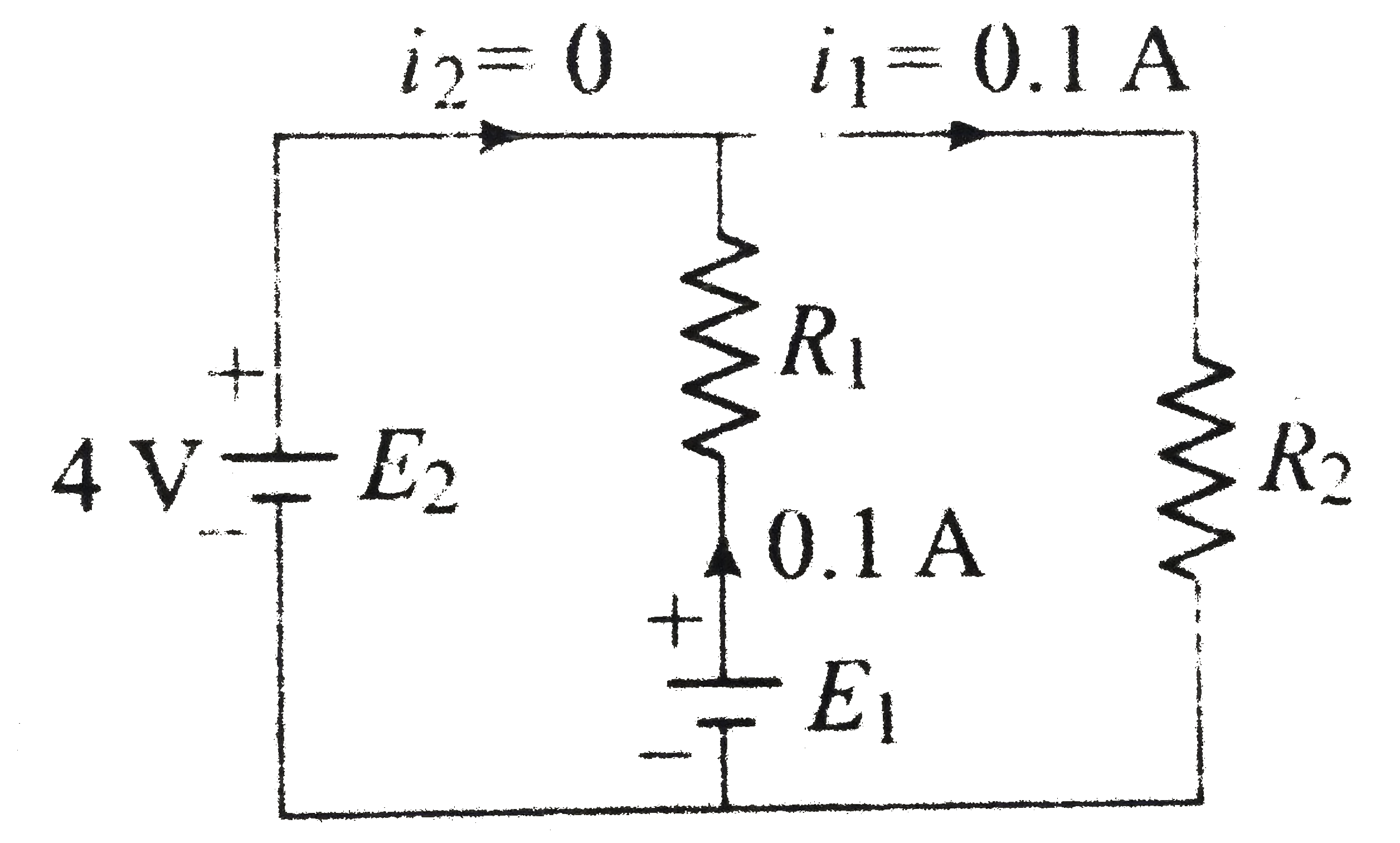 (ii) Now `i_2 = 0.3A, i_1 = 0.1 A, E_2 = 8A`. Now `0.1R_1 + E_1 - 8 =0 ` `0.1 + 4 -E_1 = 0` `0.2 R_1 - 4 = 0` or `R_1 = 4/0.2 = 20 Omega` `0.2 E_1 = 2+4 = 6V`. 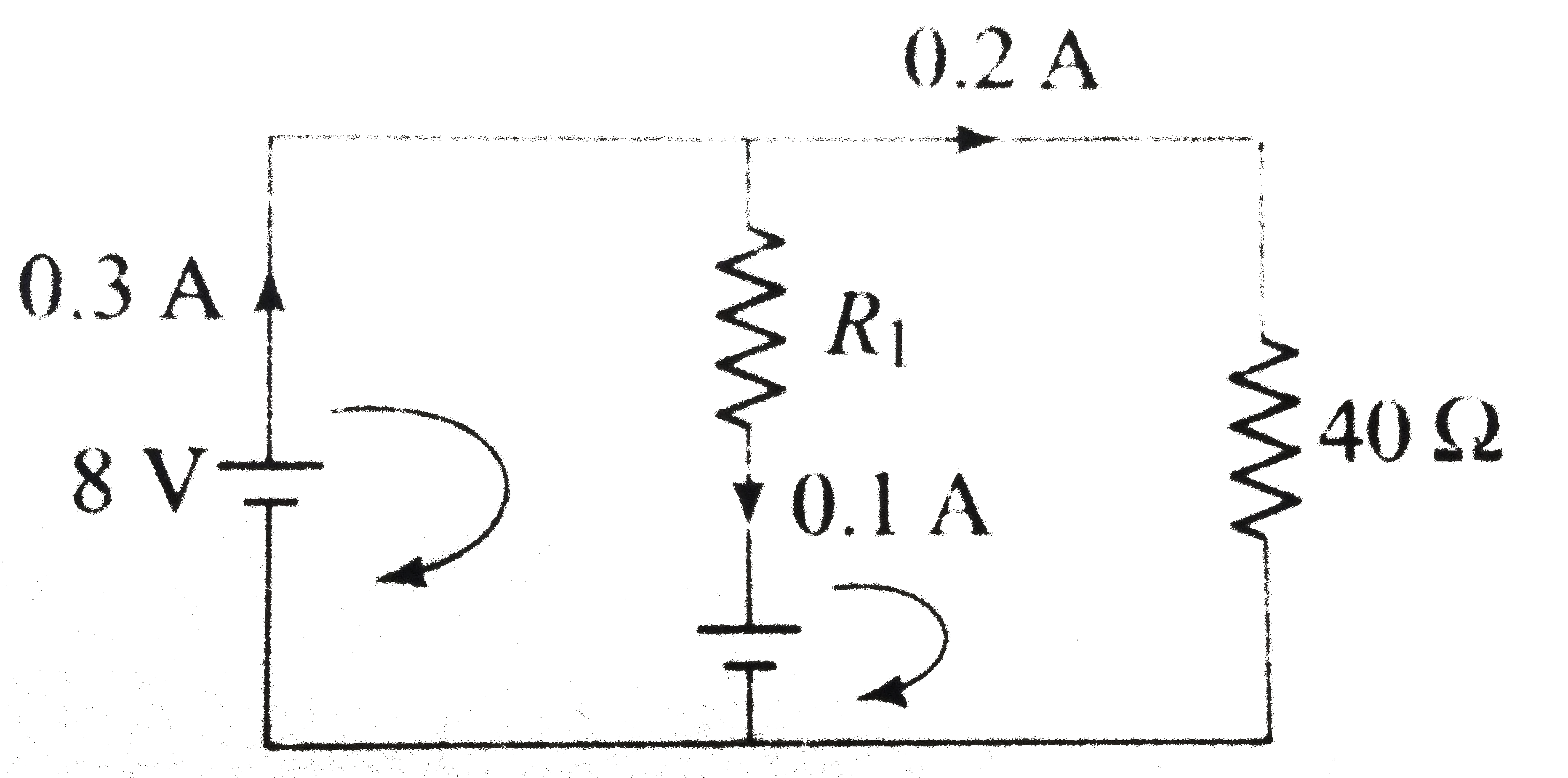
|
|
| 16. |
Resistores are sometimes joinned together and they have several applications in electronics. Draw a series combination of three resistore R_1,R_2 and R_3. |
Answer» SOLUTION :
|
|
| 17. |
Two copper spheres of radii, one hollow and the other solid are charged to the same potential. a. Which of the two will hold was charge? b. Can a metal sphere a radius 1 cm hold a charge of 1 C? c. What is your justification? |
|
Answer» Solution :a. Both will HOLD the same charge b. No. C. The CAPACITY is small |
|
| 18. |
The electric field in a certain region is acting radially outward and is given by E = Ar. A charge contained in a shepere of radius 'a' centred at the origin of the field, will be given by : |
|
Answer» `Aepsilon_(0)a^(2)` since electric FIELD is RADIAL. It is always perpendicular to the surface. So, `phi =Ar.(4pir^(2))` `phi = A(a)(4pir^(2))` `phi =A4pia^(3)` (as r=a) Now according to gauss law `phi = (q_(in))/epsilon_(0) RARR q_(in) =phi.epsilon_(0)` So,= `q_(in) =Apia^(3)epsilon_(0)` |
|
| 19. |
A paratrooper whose chute fails to open lands in snow, he is hurt slightly .Had he landed on bare ground , the stopping time would have been 10 times shorter and the collision lethal . Does the presence of the snow increase , decrease , or leave unchanged the values of (a) the paratrooper's change in momentum, (b) The impulse stopping the paratrooper, and (c ) the force stopping the paratrooper ? |
|
Answer» |
|
| 20. |
Which is the correct relation between interatomic force -constant k , Young 's modulus y and interatomic distance ro is |
|
Answer» Y = `kxxr_(0)` |
|
| 21. |
The acceleration of a particle moving along x-axis is a = –200 x + 50. It is released from x = 2. Here 'a'and 'x' are in S.I. units. The motion of particle will be :- |
|
Answer» Periodic, oscillatory but not SHM `a==200[X-(50)/(200)]` `a=-200 X'` When `X'=x-(50)/(200)` This function is a SHM, periodic & oscillatory also. |
|
| 22. |
A sound wave of frequency 1020 Hz and travelling at 340 m//s is reflected from the closed end of a tube. The node adjacent to the closed end is at ......... from the closed end. |
|
Answer» `(1)/(3) m` |
|
| 23. |
Mention the application of a oscillators. |
|
Answer» SOLUTION :Applications of oscillators to generate a periodic sinusoidal or non sinusoidal wave forms. • to generate RF carriers. • to generate audio tones • to generate clock SIGNAL in DIGITAL circuits. • as sweep circuits in TV sets and CRO. |
|
| 24. |
A stiff wire.is bent into a circular loop of diameter D. It is cfampei at two points opposite to each other.A transverse wae is sentaround the loop by means ol a small vibrator which acts close to one clamp. The resonance frequency (fundamental, mode) of the loop in terms of wave speed V and diameter D is |
|
Answer» `V/D` |
|
| 25. |
Which of the following are not fundamental particles i) Electron ii) Photon iii) alpha- Particle iv) Deuteron |
|
Answer» Only i & II are TRUE |
|
| 26. |
in theabovegivencompound how manyfunctionalgroup reducedby LAH (lithium aluminiumhydride)andSBH (sodiumBorohydride) respectively ? |
|
Answer» 4,4 |
|
| 27. |
What are light emitting diodes (LED) ? |
|
Answer» SOLUTION :Light emitting DIODES (LED) are specially made p-n junction diode (gallium arsenide phosphide-GaAsP) in which when current is made to flow in the FORWARD direction, visible light is emitted from the region of the depletion layer. When `p-n` junction is forward biased, the potential barrier gets lowered, the conduction band electrons from n-region cross the barrier and ENTERS the p-region . Also some holes may cross the junction from p region to n-region. A conduction band electron in the p-region may fall into a hole, even before it crosses the junction . In either case, recombination takes place around the junction. Each recombination radiates energy in a visible form. Such light emitting diodes are called LED for short. |
|
| 28. |
The work function of caesium metal is 2.14 eV.When light of frequency 6xx10^(14) Hz is incident on the metal surface ,photoemission of electrons occurs.What is the (a)Maximum kinetic energy of the emitted electrons. (b)Stopping potential ,and (c )Maximum speed of the emitted photoelectrons? |
|
Answer» Solution :Work function `phi_(0)`=2.14 eV Frequency of light `v_(0)=6xx10^(14)Hz` `h=6.63xx10^(-34)` JS, l eV=`1.6xx10^(-19)J` (a) Photoelectric equation , `K_(max)=hv-phi_(0)` `=((6.63xx10^(-34)xx6xx10^(14))/(1.6xx10^(-19))-2.14)eV` =(2.48625-2.14) eV (B) `K_(max)=eV_(0)` `therefore V_(0)=(K_(max))/(e)=(0.34eV)/(e) therefore V_(0)=0.34 V` (c )`K_(max)=0.34eV` `therefore (1)/(2) mv_(max)^(2)=0.34xx1.6xx10^(-19)` `therefore V_(max)^(2)=(2xx0.346xx1.6xx10^(-19))/(m)` `=(2xx0.34xx1.6xx10^(-19))/(9.1xx10^(-31))` `therefore v_(max)=sqrt((0.692xx1.6xx10^(-19))/(9.1xx10^(-31)))` `therefore v_(max)=sqrt(0.12167xx10^(12))` `=0.345775xx10^(6)~~345.8xx10^(3)m//s` `therefore v_(max)=345.8 km//s` Note:Textbook answer is DIFFERENT. |
|
| 29. |
How much(in per cent)has a filament diameter decreaseddue to evaporation if themaintancesof the previoustemperature due to evaporation if the maintenance of the previoustemperatur requiredan increasesof the voltageby eta = 1.0 % ? The amount of heattransfereedfromt thefilamentinto surrounding spaceis assumedto be propotional to the filamentsurface area. |
|
Answer» Solution :If the WIRE diameter decreases by `sigma` then BYTHE information given `P` = Power input `= (V^(2))/(R)` = beat lostg throgh the SURFACE, `H`. Now, `H prop (1 - sigma)` LIKE the surfacearea and `R prop (1 - sigma)^(2)` So, `(V^(2))/(R_(0))(1 - sigma)^(2) = A (1 - sigma)` or, `V^(2) (1 - sigma)` = constant But `V prop 1 + eta` so `(1 + eta)^(2) (1 - sigma)` = constant = 1 Thus `sigma = 2 eta = 2%` |
|
| 30. |
If ac supply is used and an iron core is introduced in a coil connected in series with the bulb, then what happens to the intensity of the bulb? |
|
Answer» SOLUTION :Intensity of the lamp decreases. Note : `X_(L)propLandLpropmu_(r)`. Hence the reactance of the coil INCREASES and voltage ACROSS the coil increases. |
|
| 31. |
The electric field vector of an electromagnetic wave is E=E_(0)sin [2pi ((x)/(lambda)-(t)/(T))]hat(j)a. Write the magnetic field vector of this wave.b.What is the direction of propagation ?c.With what velocity the wave propagates ? |
|
Answer» Solution :a. `bar(B)=B_(0)sin[2pi((x)/(lambda)-(t)/(T))]hat(k)` b.X - DIRECTION (or along `hat(i)`) C. `c = upsilon lambda "" c=(1)/(SQRT(mu_(0)epsilon_(0)))` or `c=(1)/(sqrt(mu EPSILON))`(in a medium) |
|
| 32. |
In a sample of radioactive material, what percentage of the initial number of active nuclei will decay during one mean life? |
| Answer» ANSWER :C | |
| 33. |
Magnetic induction at a point due to a small element of current carrying conductor is |
|
Answer» INVERSELY PROPORTIONAL to the square of the distance of the POINT from the conductor |
|
| 34. |
Obtain the expression of torque acting on electric dipole in uniform external electric field. |
|
Answer» Solution :Consider a PERMANENT dipole of dipole moment `vecP`in a uniform external FIELD `vecE` as shown in figure. There is a force `-qvecE` on `-q` and a force `-qvecE` on - q. The net force on the dipole is zero, since `vecE`is uniform. However, the charge are separated, so the forces ACT at different points, resulting in a torque on the dipole. When the net force is zero, the torque (couple) is independent of the origin. Magnitude of torque =(Magnitude of each force) x (Perpendicular distance between the two forces) `=qE xx 2a SIN theta` `=2qaEsin theta` Its direction is NORMAL to the plane of the paper, coming out of it. `vectau = vecp xx vecE` `therefore tau = pEsin theta` This torque will tend to align the dipole with the field `vecE` . When `vecp`is aligned with `vecE`the torque is zero. |
|
| 35. |
Which lens produces a diminished image for all possible position of an object ? |
| Answer» SOLUTION :CONCAVE LENS | |
| 36. |
In a region the electric potential is given by V = 2x + 2y -3z. Obtain the expression for electric field |
|
Answer» |
|
| 37. |
The input resistance of a silicon transisitor is 100Omega. Base current is changed by 50muA which result in a change in collector current by 5 mA. This transisitor is used as a common emitter amplifier with a load resistance of 4kOmega.The voltage gain of the amplifier is |
|
Answer» 1000 |
|
| 38. |
A rod of length Land cross -section area A lies along the x - axis between x = 0 and x = l. The material obeys Ohm.s law and its resistivity varies along the rod according to rho(x)=rho_(0)e^(-x//L). Find the total resistance of the rod. The end of the rod at x = 0is at a potential V_(0) and it is zero at x = L. |
|
Answer» `(rho_(0)L)/(A)((1)/(e))` |
|
| 39. |
A 2cm high object is placed on the principal axis of a concave mirror at a distance of 12 cm from the pole. If the image isinverted, real and 5 cm high. The location of the image and the focal length of the mirror is |
| Answer» Answer :A | |
| 40. |
What are energy bands ? Explain the formation of energy bands in case of silicon crystal. |
|
Answer» Solution :Energy bands in Solids. Solids display a large range of electrical resistivity. Whereas some solids are good conductors of electricity, others are insulators (bad condutors) and still others, called semiconductors have properties in between conductors and insulators. The significant feature of atomic structure is that there EXIST discrete energy levels or shells in an atom called K,L,M......, shells. An electron revolving round the nucleus can occupy ONE of these shells to have a definite value of energy associated with it. Consider now a single valence electron in an atom like that in lithium or sodium atom. When ANOTHER identical atom is brought close to it as in a crystal, the electron energy level gets modified because now it is under the electrostatic influence of two atomic cores (consisting of two nuclei plus the inner orbital electrons) instead of only one. Each of the two valence electrons may now occupy a different energy state, one a little higher, `E_(1)` and the other a little lower, `E_(2)` than that of the isolated atom, `E`. The magnitudes `(E_(1)-E)` and `(E-E_(2))` increase as the atoms are brought closer together. Now in a solid there are about `10^(23)` atoms per cubic centimetre and same, therefore, is the number of single valence electrons. Thus there is an enormously large number of energy levels which the electron may occupy with certain upper and lower limits (a certain energy range) depending upon the nature of the element. The enormous number of energy states constitutes an energy band in which there is a continuous distribution of energy within a certain energy range.  Consider lithiun atom. Its electronic configuration is `1s^(2)`, `2s^(1)`. Thus it has two electrons in the `s` state in K shell and they have opposite spins (fig. a). The third (valence) electron is in the state in L shell. In an isolated atom, each of the electrons in the K shell and the electrons in the L shell are associated with a definite amount of energy characteristic of lithium, irrespective of the atom to which these electrons belong. Let us consider a lithium crystal consisting of n atoms, say. These N atoms do no have corresponding electrons in identical energy states. There are evidently N energy states corresponding to each shell and they are so numerous and close to each other that they form energy bands as explained above. Any energy state in an energy band may be occupied by two electrons (and not more than two) with opposite spins. Hence, N energy states are completely filled when they accummodate a maximum number of `2N` electrons. In fig. (a) which shows the energy levels for isolated lithium atom, there are two K shell electrons in the same energy level and one L shell electron in a higher level. Fig (b) which shows the energy bands for a lithium crystals, there are `2N` electrons in K shell filling N energy states in one band and N electrons in L shell in the higher energy band. Since the second band accommodates half the maximum number it can do, it is only half filled. In fig. (a), there is also shown an unoccupied level. It refers to the level which the electrons could enter on being excited. Fig (b) shows the corresponding unoccupied energy band. A solid can be classified as conductor , an INSULATOR or a semiconductor on the basis of its energy band structure. Distinction between insulators, semiconductors and conductors Insulators. As show in energy band fig. (c), the valence band in this CASE is completely filled and conduction band is completely empty and the two bands are separated by a wide energy gap `E_(g)` (known as forbidden band). Since forbidden band is quite wide, an applied electric  field cannot give enough energy to an electron in the valence band to enable it to enter the conduction band. Thus, materials with large energy gap between valence and conduction bands behave as insulators. The example of insulators are wood, glass, mica, diamond etc. The resistivity of insulators is greater than `10^(4)` ohm-m . For diamond, the energy gap is `5.4eV`. Semiconductors. In this case, energy gap is smaller than insulator and it is nearly `1eV` (Fig.d). At ordinary temperature say `300K`, some electrons in the valence band may have enough thermal energy to surmount the valence band and enter the conduction band. The gap or valency caused in the valence band due to the shift of an electron to the conduction band is called a hole. Thus in such solids both holes and electrons contributes to the conduction process and such solids are called semiconductors. Their resistivity varies from `10^(-8)` and `10^(-4)Omegam`. Energy gap `E_(g)` for `Si` is `1.12eV` for `Ge`it is `0.75eV`. Conductors have resistivity less than `10^(-8)Omegam`. In such substances the valence bond and conduction band overlap each other so that electrons from the valence band can easily pass into conduction band as shown in fig. (e). Electrons in overlaping region are conduction electrons. |
|
| 41. |
You are given an equilateral glass prism of refractive index 'n'. A light rays is incident on one of its faces at an angle 'i_(1)' . a.What happens when you increase 'i_(l)' gradually ? b.What happens if 'i_(l)' is increased beyond a certain value ? c.Give the graphical representation of variation |
|
Answer» Solution :a. As `.i_(1).` increases gradually, the angle of DEVIATION .d. DECREASES. b. For a particaular value of `.i_(1).` , the angle .d. reaches a minimum value. If again we INCREASE `.i_(1).`, then .d. also increases. C. 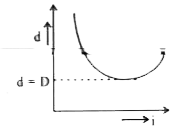
|
|
| 42. |
एक कण 25 m भुजा वाले वर्ग की भुजाओं AB, BC, CD के अनुदिश 15m/s के वेग से गति कर रहा है। इसका औसत वेग हैं। |
|
Answer» 15 m/s |
|
| 43. |
Three condensers have capacities in the ratio 1:2:3 Difference between their equivalent capacities in parallel and series is60/11muF. The individual capacities are : |
|
Answer» `1muF,2muF,3muF` |
|
| 44. |
(A): A p-n junction diode is non ohmicconductor (R): the V-I graph for a diode is not a straight line passing through origin |
|
Answer» Both 'A' and 'R' are TRUE and 'R' is the correct EXPLANATION of 'A' |
|
| 45. |
Equation of stationary wave is ,y=4sin(pix/3)cos40pit. The separation between two consecutives nodes is |
|
Answer» 12m |
|
| 46. |
Which statement about a system of point charges that are fixed in space is necessarily true? Assuming electrostatic potential energy at infinity to be zero. |
|
Answer» If the electrostatic potential energy of the system is negative, net positive work by an EXTERNAL agent is REQUIRED to take the charges in the system back to infinity. |
|
| 47. |
The escape velocity for a planet is v_(e). A particle is projected from its surface with a speed v. For this particle to move as a satellite around the planet, |
|
Answer» `(v_(E))/(2) lt v lt v_(e)` |
|
| 48. |
Obtain the expression of electric field by a plane of infinite size and with uniform charge distribution. |
Answer» Solution :Let a be the uniform surface charge density of an infinite plane sheet. 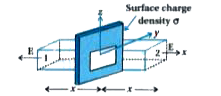 Take the x-axis normal to the given plane. By symmetry, the electric field will not depend on y and z COORDINATES and its direction at every point must be parallel to the x-direction. We can take the GAUSSIAN surface to be a rectangular parallel piped of cross sectional area A, as shown. Only the two FACES 1 and 2 will contribute to the flux, electric field lines are parallel to the other faces and they do not contribute to the total flux. The unit vector normal to surface 1 is in -x-direction while the unit vector normal to surface 2 is in the + x-direction. Therefore, flux `VECE. DeltavecS`through both the surfaces are equal and add up. Therefore the net flux through the Gaussian surface is 2 EA.The charge enclosed by the closed surface is `sigmaA`. Therefore by Gauss.s law, `2EA = (sigmaA)/epsilon_(0)` `therefore E = sigma/(2epsilon_(0))` `therefore vecE =sigma/(2epsilon_(0)).hatn`...........(1) where `hatn` is a unit vector normal to the plan and going away from it. E is directed away from the plate if `sigma`is positive and toward the plate if `sigma`is negative. For a finite large planar sheet equation (1) i approximately true in the middle regions of th planar sheet, away from the ends. |
|
| 49. |
Four point charges q, q, -q and -qare held fixed at the corners of a square ABCD with diagonals of length 2l. Determine the field intensity at a point distant x from the plane of the square on its axis. |
|
Answer» |
|
| 50. |
A particle is acted upon by a force of constant magnitude which is always perpendicular to the velocity of the particle, the motion of the particle takes place in a plane. It follows that : |
|
Answer» its VELOCITY is CONSTANT |
|