

Saved Bookmarks
This section includes 7 InterviewSolutions, each offering curated multiple-choice questions to sharpen your Current Affairs knowledge and support exam preparation. Choose a topic below to get started.
| 1. |
Three forces start acting simultaneously on a particle , moving with velocity, vec(v) . These forces are represented in magnitude and direction by the three sides of a triangle ABC (as shown). The particle will now move with velocity |
|
Answer» `vec(v)`, remaining unchanged |
|
| 2. |
A radio active isotope has a half - life of 'T' years. How long will it take the activity to reduce to (a) 3.125%(b) 1% of the original value. |
| Answer» SOLUTION :(a) 5 T YEARS (B) 6.65 T years | |
| 3. |
How does amount of scattering depend on the wavelength of light used ? |
| Answer» SOLUTION :AMOUNT of SCATTERING `PROP 1/lambda^(4)` | |
| 4. |
Two slabs A and B, each though similar, in all other respects, have different materials. They are placed one above the other in perfect contact and a steady differenceof temperatureof 36^(@)C is maintained across the combination. If the thermal conductivity of A is twice that of B, what is the temperature of interface? |
|
Answer» `16^(@)C` |
|
| 5. |
The equation of plane progressive wave motion is y=a sin (2pi)/lamda (vt-x). Velocity of the particle is |
|
Answer» `y(DV)/(DX)` |
|
| 6. |
A proton accelerated by potential difference 100 V have de-Broglie wavelength of lambda_(0) alpha-particle is accelerated by same potential different.Its de-Broglie wavelength will be …… |
|
Answer» `2sqrt(2)lambda_(0)` `THEREFORE m^(2)v^(2)=p^(2)=2meV` Now `LAMBDA=(h)/(p)` `therefore lambda=(h)/(sqrt(2meV))` `therefore m^(2)v^(2)=p^(2)=2meV` Now `lambda=(h)/(p)` `therefore lambda=(h)/(sqrt(2meV))` `therefore lambda prop (1)/(sqrt(me))` `therefore (lambda_(alpha))/(lambda_(p))=sqrt((m_(p))/(m_(alpha)e_(alpha)))` Now `m_(alpha)=4m_(p),e_(alpha)=2e_(p)`, `therefore (lambda_(a))/(lambda_(p))=sqrt((m_(p)e_(p))/(4m_(p)xx2e_(p)))=(1)/(sqrt(8))` `therefore (lambda_(alpha))/(lambda_(p))=(1)/(2sqrt(2))` `therefore (lambda_(alpha))/(lambda_(0))=(1)/(2sqrt(2)) therefore lambda_(alpha)=(lambda_(0))/(2sqrt(2))` |
|
| 7. |
Kailash Satyarthi won Nobel Prize for |
|
Answer» Against the SUPPRESSION of chIldren |
|
| 8. |
A particle is subjected simultaneously to two SHMs, one along the x - axis and the other along the y - axis. The two vibrations are in phase and have unequal amplitudes. The particle will execute |
|
Answer» STRAIGHT LINE motion |
|
| 9. |
A device which converts mechanical energy into electric energy is called as |
|
Answer» Dynamo |
|
| 10. |
(ii) If instead of this, the plates of oppositepolarity were joined together, then amount of charge that flows is : |
|
Answer» `6XX10^(-4)C` |
|
| 11. |
Assertion (A) : If an electron, coming vertically from outer space, enters the earth's magnetic field, it is deflected towards west. Reason (R) : Electron has negative charge. |
|
Answer» If both ASSERTION and reason are true and the reason is the CORRECT explanation of the assertion. |
|
| 12. |
what is frequency of red light when wavelength of light is 7500 A^@. |
| Answer» SOLUTION :`v=C/lamda`=`(3xx10^8)`/`(7500xx10^-10) =`4xx10^4Hz` | |
| 13. |
An equilateral triangle ofside length 1 is formed from a piece of wire of uniform resistance. The current I is as shown in figure. Find the magnitude of the magnetic field at its center O. |
Answer» Solution : The magnetic FIELD induction at O due to current through PR is `B_(1) = (mu_0)/(4pi) (2I//3)/(r) [ sin 60^@ + sin 60^@]` `= (mu_0)/(4pi)(2I)/(3R)ODOT` (directed outward) The megantic field induction at O due to current through PQR is `B_(2) = 2xx(mu_0(I//3))/(4pir)[sin 60^@ + sin 60^2]` `= (mu_(0)2I)/(2pi3r)OX` (directed inward) `therefore` Resultant magnetic induction at O `rArr B_1 - B_2 = 0` |
|
| 14. |
Isotones are the nuclides which contain ............... . |
| Answer» SOLUTION :EQUAL NUMBER of NEUTRONS | |
| 15. |
Binding energy of deuterium is 2.23MeV. Mass defect in amu is |
|
Answer» 0.0012 |
|
| 16. |
If the K.E. of free electron doubles, its de-Broglie wavelength changes by the factor |
|
Answer» `(1)/(2)` When kinetic energy is doubled, `lambda. = (h)/(sqrt(2m XX 2K)) = (1)/(sqrt(2)) lambda` |
|
| 17. |
The virtual current of 4 A and 50 Hz flows in an AC circuit contaning a coil. The power consumed in the coil is 240 W. If the virtual voltage across the coil is 100 V, then its resistance will be |
|
Answer» `(1)/(3PI)Omega` |
|
| 18. |
From the condition of the foregoing problem find: (a) normalized eigenfunctions of the particle in the states for which Psi(r ) depends only on r , (b) the most probable value r_(pr) for the ground state of the particle and probability of the particle to be in in the region r lt r_(pr) |
|
Answer» SOLUTION :(a) The nomalized wave functions are obtained from the normalization `1=int|Psi|^(2)dV=int|Psi|^(2) 4pir^(2)dr` `=int_(0)^(ro)A^(2)4pichi^(2)dr=4piA^(2)int_(0)^(ro)"sin"^(2)(npi r)/(r_(o))dr` `=4piA^(2)(r_(0))/(npi)int_(0)^(bar(npi))sin^(2)xdr=4piA^(2)(r_(0))/(npi).(npi)/(2)=r_(0).2piA^(2)` Hence `A=(1)/(sqrt(2pir_(0)))` and`Psi=(1)/(sqrt(2pi.r_(0)))("sin"(npir)/(r_(0)))/(r)` (b) The radial probability distribution function is `P_(n)(r )=4pir^(2)(Psi)^(2)=(2)/(r_(0)) "sin"^(2)(npir)/(r_(0))` For the ground state `n=1` so `P_(1)(r )=(2)/(r_(0))"sin"^(2)(PI r)/(r_(0))"sin"^(2)(pi r)/(r_(0))` By inspection this is maximum for `r=(r_(0))/(2)`. Thus `r_(pr)=(r_(0))/(2)` The probability for the particle to be found in the region `r lt r_(pr)` is clearly `50%` as one can immediately see from a graph of `sin^(2)x`. |
|
| 19. |
Which of the following four alternatives is not correct? We need modulation |
|
Answer» to increase the selectivity |
|
| 20. |
Who established the fact of animal electricity ? |
|
Answer» Van DE Graaff |
|
| 21. |
A thin wire of radius ..r.. carries a charge q. Find the magnitude of the electric field strength on the axis of the ring as a function of distance L from the centre. Find the same for L gt gt r Find maximum field strength and the corresponding distance L. |
|
Answer» Solution :DUE to a ring electric field strength at a distance ..L.. from its centre on it can be given as `E= (QL)/(4pi epsi_(0)(L^(2) + r^(2))^(3//2)) rarr (1)` For `L gt gt t` we have `E= (1)/(4pi in_(0))(Q)/(L^(2))` Thus the ring behaves like a POINT charge. For `E_("Max") , (dE)/(dL) = 0`. From equation (1) we get `(dE)/(dL) = (q)/(4pi epsi_(0)) [((r^(2) + L^(2))^(3//2)- (3)/(2) (r^(2) + L^(2))^(1//2)2L)/((r^(2) + L^(2))^(3))]=` `(r^(2) + L^(2))^(3//2) = (3)/(2) (r^(2) + L^(2))^(1//2) xx 2L` On solving we get `L = (r )/(sqrt2) rarr (2)` Substituting the value of "L.. in equation (1) we get `E= (1)/(4pi in_(0)) xx (q (r//sqrt2))/((r^(2) + r^(2)//2)^(3//2)) = (q)/(6 sqrt3 pi in_(0)r^(2))` |
|
| 22. |
When light of wavelenght lambda is incident on an equilateral prism kept in its minimum deviation position, it is found that the angle of deviation equals the angle of the prism itself. The refractive index of the material of the prism for the wavelenght lambda is, then |
|
Answer» `SQRT(3)` |
|
| 23. |
Find the total heat produced in the loop of the previous problem during the interval 0 to 5 s |
|
Answer» |
|
| 24. |
Write the difference between isotope and isobars. |
|
Answer» SOLUTION :Correct definition of isotopes. Correct definition of isobars. Detailed Answer: Isotopes of an element are the ATOMS of the element which have the same atomic number but different atomic weights. Isobars are the atoms of different ELEMENTS which have the same MASS number but different atomic number. |
|
| 25. |
The air column in a pipe closed at one end is made to vibrate in Us third over tone by tuning fork of frequency 220Hz. The speed of sound in air is 330m/sec. End correction may be neglectd. Let P_0 denote the mean pressure at any point in the pipe and DeltaP_(0)the maximum amplitude of pressure vibration: What is the amplitude of pftessure variation at the middle of the column |
|
Answer» `(DeltaP_(0))/sqrt(2)` |
|
| 26. |
The air column in a pipe closed at one end is made to vibrate in Us third over tone by tuning fork of frequency 220Hz. The speed of sound in air is 330m/sec. End correction may be neglectd. Let P_0 denote the mean pressure at any point in the pipe and DeltaP_(0)the maximum amplitude of pressure vibration: Find the length of the air column |
|
Answer» 3.2 m |
|
| 27. |
An ideal gas at initial temperature T_0and initial volume V_0is expanded adiabatically to a volume 2V_0The gas is then expanded isothermally to a volume 5V_0 , and there after compressed adiabatically so that the temperature of the gas becomes again T_0. Ifthe final volume of the gas is alpha V_0then the value of constant alphais |
|
Answer» 2.5 ` T_1V_1^(gamma - 1) = T_2V_2^(gamma - 1) rArr T_2/T_1 = (V_1/V_2)^(gamma - 1)` Here ` T_1 = T_0` ` T_2/T_0 ( (V_0)/(2V_0) )^(gamma - 1)` ` T_2 = ( 1/2)^(gamma - 1) T_0 "" [ because V_1 = V_0 , V_2 = 2V_0 ]` Again, GAS is expanded isothermally, therefore `P_1 V'_1 = P_2 V'_2` here ` [ V'_1 = V_2 = 2V_0 , V'_2 = 5V_0 ]` ` P_1/P_2 = (V'_2)/(V'_1) = (5V_0)/(2V_0)` `P_1/P_2 = (V'_2)/(V'_1) = 5/2 "" .....(i) ` Finally gas compressed again ADIABATICALLY, therefore, by adiabatic relation, ` TV^(gamma -1)` = constant ` T_2 (V_2)^(gamma - 1) = T_3 (V_3)^(gamma - 1) rArr( (V_3)/(V'_2) )^(gamma -1) =T_2/T_3 "" [ therefore T_3 = T_0 ]` ` ( (V_3)/(V'_2) )^(gamma - 1) = ( (1/2)^(gamma-1) T_0 )/(T_0) rArr (V'_2)/(2) = (5 V_0)/(2) = 2.5 V_0` Hence, the value of constant is 2.5 |
|
| 28. |
The air column in a pipe closed at one end is made to vibrate in Us third over tone by tuning fork of frequency 220Hz. The speed of sound in air is 330m/sec. End correction may be neglectd. Let P_0 denote the mean pressure at any point in the pipe and DeltaP_(0)the maximum amplitude of pressure vibration: What is the maximum pressure at the open end of the pipe ? |
|
Answer» <P>`P_(0)` |
|
| 29. |
Suppose the rest length of the box in figureis 30 light seconds. The train T_1 travels at a speed of 0.8c. Find the time elapsed between opening of D_1 and D_2 in the frame of T_1. |
|
Answer» Solution :The BOX MOVES in the frame of `T_1` with a speed of 0.8c so that `gamma = 1 / (sqrt 1 - (0.8)^(2)) = 1 / 0.6` In this frame, `D_2` OPENS after `D_1`. Thetime elapsed between the openings of the doors is ` Lv / C^2 gamma = (30 light seconds ) xx (0.8 c) / C^(2) xx 0.6 ` ` (30 s ) C xx (0.8 c) / C^2 xx 0.6 = 40s`. |
|
| 30. |
A stationary particle explodes into two particles of masses m_1 and m_2 which move in opposite directions with velocities v_1 and v_2.The ratio of their K.E E_1//E_2 is: |
|
Answer» `(m_1v_2)/(m_2u_1)` |
|
| 31. |
In a metre bridge the null point is found at a distance of 60.0 cm from A. If now a resistance of 5Omega is connected in series with S, the null point occurs at 50 cm. Determine the values of R and S. |
|
Answer» Solution :Initially the null point is formed at a distance of 60 cm from the end A, hence `R/S = (60 cm)/((100 - 60) cm) = 60/40 = 3/2 ` ` RARR R = 3/2 S` When a resistance of 5`Omega` is CONNECTED in SERIES with S the effective resistance becomes (S+5) `Omega` . As now null point occurs at 50 cm, hence ` (R )/((S + 5)) = (50 cm)/((100 - 50)cm) = 50/50 = 1` `rArr R = S + 5` ` rArr S = 10 Omega ` and `R = 15 Omega ` |
|
| 32. |
An element vec(Delta) = Delta x hati is placed at the origin as shown (fig.) and carries a current I = 2 A . Find out the magnetic field at a point p on the y-axis at a distance of 1.0 m due to the element Delta x = 1 cm. Give the direction of the field produced. |
|
Answer» SOLUTION :Here `DL = Delta x = 1 CM = 10^(-2) m, I = 2 A and r = 1.0 m` MOREOVER `theta = 90^@` `:.` Magnetic field `DeltaB = (mu_0)/(4pi) cdot (I dl sin theta)/(r^2) = (10^(-7) xx 2 xx 10^(-2) xx sin 90^@)/((1.0)^(2))` `= 2 xx 10^(-9) T` The direction of magnetic field is +z- axis. 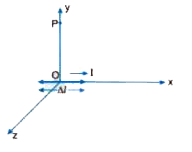
|
|
| 33. |
Five particles undergo damped harmonic motion. Value for the spring constant k, the damping constantb, ad the mass m are given below. Which leads to the smallest rate of loss of mechanical energy? |
|
Answer» k=100N/m, m=50g, B= 8G m/s |
|
| 34. |
In the figure given below there is one parallel plate capacitor with two types of dielectric materials in between the plates. Calculate net capacitance of the given system. |
Answer» Solution :We can see that THICKNESS of each dielectric material between the plates is continuously changing as we move from one end to the other and we need to apply math of intergration to GET the capacitance of the system. 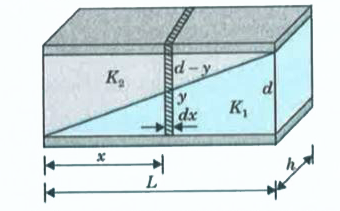 WIDTH="80%"> WIDTH="80%"> Let us select a segment of width dx at a distance x from the left end of the capacitor as shown in the figure. Let y represent thickness of dielectric material with dielectric constant `K_(1)` for this capacitor segment and d-y the thickness of dielectric material with dielectric constant `K_(2)`. We can easily understand that capacitor segment can be further divided in two segments `dC_(1)` and `dC_(2)` connected is series with each other to represent the complete capacitor segmentas shown in the figure. 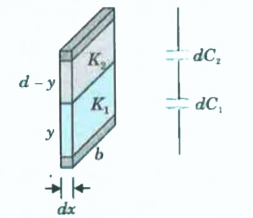 Let dC be the capacitance of selected capacitor segment then we can write the following: `(1)/(dC)=(1)/(dC_(1))+(1)/(dC_(2))"" ...(i)` further we can write: `dC_(1)=(K_(1)epsilon_(0)(bdx))/(y) & dC_(2)=(K_(2)epsilon_(0)(bdx))/(d-y)""...(ii)` Substituting the valuco of `dC_(1) and dC_(2)` from equation (ii) in equation (i) we get the following: `(1)/(dC)=(y)/(K_(1)epsilon_(0)(bdx))+(d-y)/(K_(2)epsilon_(0)(bdx))` `rArr (1)/(dC)=(K_(2)y+K_(1)(d-y))/(K_(1)K_(2)epsilon_(0)(bdx)) =(K_(1)d+(K_(2)-K_(1))y)/(K_(1)K_(2)epsilon_(0)(bdx))` `rArr dC=(K_(1)K_(2)epsilon_(0) (bdx))/(K_(1)d+(K_(2)-K_(1))y) "" ...(iii)` All capacitor segments are supposed to beconnected in parallel to each other so we can integrate dC in equation (iii) to get the overall capacitance of this system. But before we can actually integrate equation (iii), we first need to decide on the variable of integration. Is it x or y? Both are related to each otherbut using GEOMETRY we can wirte the following equation: `(d)/(L)=(y)/(x) rArr dx=(L)/(d)dy ""...(iv)` We can substitue dx in terms of dy from equation (iv) into equation (iii) to get the following equation. `dC=(K_(1)K_(2)epsilon_(0)bL)/(d)((dy)/(K_(1)d+(K_(2)-K_(1))y))"" ...(v)` We can understand that variable y changes from zero to d as x changes from 0 to L. Now using suitable LIMITS of integration we can integrate equation (v) to get the net capacitance of this system. `C=(K_(1)K_(2)epsilon_(0)bL)/(d) int_(y=0)^(y=d) (dy)/(K_(1)d+(K_(2)-K_(1))y)` `rArr C=(K_(1)K_(2)epsilon_(0)bL)/(d)[(1)/(K_(2)-K_(1))"ln" {K_(1)d+(K_(2)+K_(1))y}]_(0)^(d)` `rArr C=(K_(1)K_(2) epsilon_(0)bL)/(d(K_(2)-K_(1))"ln"(K_(2))/(K_(1))` |
|
| 35. |
In the circuit shown, the energy stored in 1muF capacitor is |
|
Answer» `40 mu J` |
|
| 36. |
State Boyle's law. Derive it on the basis of the kinetic theory of an ideal gas. |
|
Answer» Solution :For a circulary symmetric rigid body, starting from rest and rolling down an INCLINED plane without slipping, its speed after a VERTICAL displacement h is `v=sqrt((2gh)/(1+(I//MR^(2))))""`….(1) where M, R and I are respectively the mass, radius and moment of inertia of the body. (i) For a ring (or a thin-walled hollow CYLINDER), `I=MR^(2)""`...(2) `:. (I)/(MR^(2))=1` `:. v=sqrt((2gh)/(1+(I)/(MR^(2))))""`....(3) (ii) For a solid cylinder (or a disc), `I=(1)/(2)MR^(2)""`....(4) `:. (I)/(MR^(2))=(1)/(2)` `:. v=sqrt((2gh)/(1+(I)/(MR^(2))))=sqrt((2gh)/(1+(1)/(2)))=sqrt((3)/(4)gh)""`......(5) (iii) For a solid SPHERE, `I=(2)/(5)MR^(2)""`....(6) `:. (I)/(MR^(2))=(2)/(5)` `:. v=sqrt((2gh)/(1+(I)/(MR^(2))))=sqrt((2gh)/(1+(2)/(5)))=sqrt((10)/(7)gh)""`......(7) |
|
| 37. |
Two balls have the same size but one is denser than the other. Assume the air resistance to be same on each, show that when they are released simultaneously from the same height, the heavier ball will reach the ground first. |
| Answer» Solution :The retarding force F and g will be same for both balls. Retarding acceleration `=F//mass` . In case of denser BALL the retarding acceleration will be less. THUS, the NET DOWNWARD acceleration equal to `(g = F//mass)` will be greater and so it will REACH the ground first. | |
| 38. |
What is the magnification in this case? |
|
Answer» Solution :VAUE of magnification , `m = (|V|)/(|U|)= (25)/(50//7) = 7/2` `thereforem = 3.5` |
|
| 39. |
The hysteresis loop of a soft iron piece has a much smaller area than that of a carbon steel piece . If the material is to go through repeated cycles of magnetisation , which piece will dissipate greater heat energy ? |
| Answer» Solution :Heat DISSIPATED per secondis DIRECTLY proportional to the AREA of the hysteresis loop of the material . Hence carbon steel will dissipate more energy than SOFT IRON . | |
| 40. |
In a common base configuration I_c=1muA,alpha=0.95, the value of base current is |
|
Answer» `1.95mA` |
|
| 41. |
Weightlessness in a satellite is due to the |
|
Answer» Zero gravity of earth |
|
| 42. |
A simple pendulum oscillates in a verticle plane. When it passes through the mean position,the tension in the string is 3 times the weight of the pendulum bob. What is the maximum angular displacement of the pendulum of the string with respect to the vertical ? |
|
Answer» `30^(@)` `:.""mg+(mv^(2))/(l)=3mg""implies""v=sqrt(2GL)` `:.` Velocity will be ZERO when it is at vertical height l i.e., whenthe string makes an angle of `90^(@)`withvertical. `:.` CORRECT choice is (d). |
|
| 43. |
Differentiate each function by applying the basic rules of differentiation (2x)/(7x-1) |
| Answer» | |
| 44. |
The maximum intensity in the interference pattern of two equal and parallel slits is I. If one of the slits is closed the intensity at the same point is 1_(0). Then ______. |
|
Answer» `1=1_(0)` when one slit is CLOSED, INTENSITY at the same point is `I'=a^(2)=I_(0)` `:.""I=4I_(0)` |
|
| 45. |
The potential barrier of 0.5 V exist across a p-n junction. If the dpletion region is 5.0xx10^(-7)m wide, then the intensity of electric field in this region is …………. |
|
Answer» `1.0xx10^(9)V//m` `E=(V)/(d)=(0.5)/(5.0xx10^(-7))=0.1xx10^(7)=1.0xx10^(6)(V)/(m)` |
|
| 46. |
Resistance of conductor increases with increase in temperature because .... |
|
Answer» electron density increases In R= `(RHO l)/(A) , (l)/(A) ` is same `therefore R PROP rho ` `therefore rho= (m)/("ne"^(2) tau)` `therefore R = (m)/("ne"^(2) tau)` `therefore R prop (1)/(tau)` (other terms are CONSTANT ) `therefore "Where " tau ` decreases, R increases, |
|
| 47. |
At breakdown voltage the reverse current of p-n junction can be ranked mA ……. . |
|
Answer» by increasing BREAKDOWN VOLTAGE |
|
| 48. |
The susceptibilityof a magnetic material is 0.9853Identify the type of magnetic material .Draw the modification of the field pattern on keeping a piece of this material in a uniform magnetic field. |
|
Answer» SOLUTION :The MATERIAL is paramagnetic . The field pattern gets MODIFIED as SHOWN in the figure below. |
|
| 49. |
In specific resistance measurement of a wire using a meter bridge, the key k in the main circuit is kept open when we are not taking readings. The reason is |
|
Answer» the emf of CELL will decrease. |
|
| 50. |
What is the resistance to be connected in series with a condenser of a capacity 5muF so that the phase difference between the current and the applied voltage is 45^(@) when the angular frequency of the applied voltage is 400 rads^(-1) |
|
Answer» `250Omega` |
|