Saved Bookmarks
This section includes InterviewSolutions, each offering curated multiple-choice questions to sharpen your knowledge and support exam preparation. Choose a topic below to get started.
| 7501. |
ln a n-type semiconductor ____ .are minority carriers and ___ are majority charge carriers. |
| Answer» SOLUTION :HOLES, ELECTRONS | |
| 7502. |
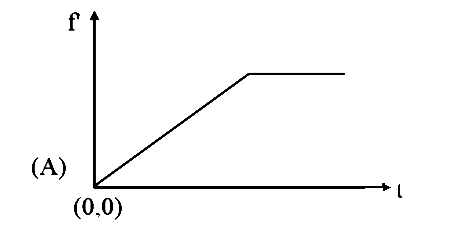
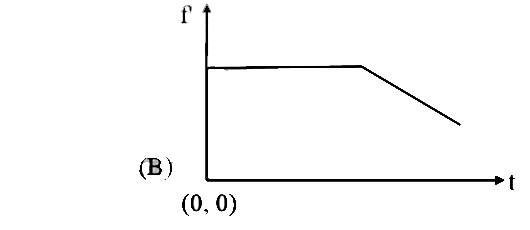
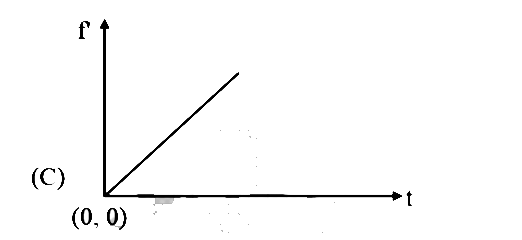
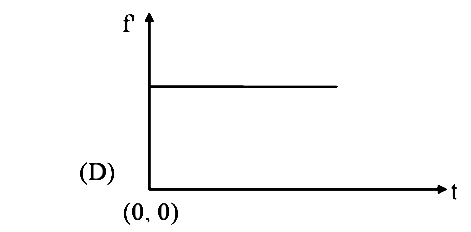
A block of mass M rests on a rough horizontal table. A steadily increasing horizontal force is applied such that the block starts to slide on the table without toppling. The force is contained even after sliding has started. Assume the coefficients of static end kinetic friction between the table and block to be equal. The correct representation of the variation of the frictional force , f_(1) exerted by the table on the block with time t is given by - |
|
Answer»
|
|
| 7503. |
A proton of mass m and accelerated by a potential difference Vgets into a uniform electric field of a parallel plate capacitor parallel to plates of length 1 at mid-point of its separation between plates. The field strength in it varies with time as E = at, where a is a positive constant. Find the angle of deviation of the proton as it comes out of the capacitor. (Assume that it does not collide with any of the plates.) |
|
Answer» `a_y=(qE)/m=(qat)/m=(dv_y)/(DT)` 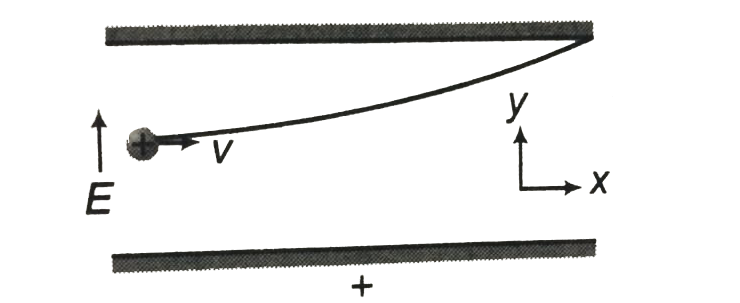 INTEGRATING both sides we get `v_y=(qat^2)/(2M)` `or v_y=((qa)/(2m))l^2(m/(2qV))=(al^2)/(4V)` Now, ANGLE of deviation `theta=tan^-1(v_y/v_x)=tan^-1((al^2)/(4V)/sqrt((2qV)/m))` `=tan^-1((al^2)/(4V) sqrt(m/(2EV)))` |
|
| 7504. |
What are most important characteristic of a photon . |
| Answer» Solution :It.s REST MASS is zero and it MOVES with velocity of light and are electrically NEUTRAL. | |
| 7505. |
Identify the following electro magnetic radiations as per the frequencies given . Write one application of 10^20Hz |
| Answer» SOLUTION :x-rays in the STUDY of CRYSTAL STRCTURE. | |
| 7506. |
Identify the following electro magnetic radiations as per the frequencies given Write one application of 10^11Hz |
| Answer» SOLUTION :MICROWAVES in MICROWAVE wovens. | |
| 7507. |
The cell is said to be in open circuit condition |
|
Answer» When current passing through it is maximum |
|
| 7508. |
How does an ammeter differ from a galvanometer. |
| Answer» SOLUTION :An ammeter is a GALVANOMETER in which very small SUITABLE RESISTANCE is connected in series to it. | |
| 7509. |
If the intensity of unpolarized light after passing through a polarize (P) and an analyser (A) reduces to one eighth of its original value, then the angle between the principal planes of P and A is : |
|
Answer» `30^(@)` `therefore I.= 1/2 cos^(2) a` GIVEN , `I. = 1/8 I` `therefore 1/8 I = 1/2 I cos^(2)a` or `cos^(2)a = 1/4` or `cos a = 1/sqrt2` THUS`a = 45^(@)` 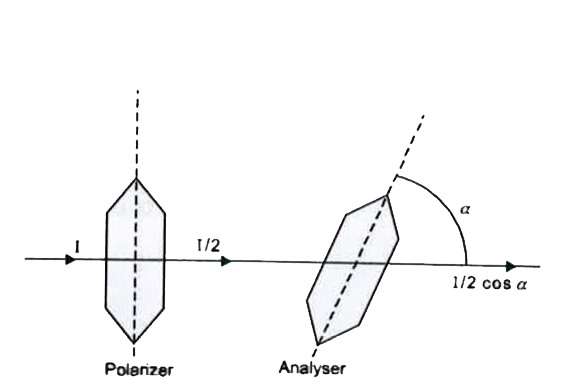
|
|
| 7510. |
vec(B), vec(H) and vec(I) are related according to the equation |
|
Answer» ` vec(B) = mu_(0) (vec(H) xx vec(I))` |
|
| 7511. |
When a Daniel cell is connected in the secondary circuit of a potentiometer, the balancing length is found to be 540 cm. If the balancing length becomes 500 cm. When the cell is short-circuited with 1Omega, the internal resistance of the cell is |
|
Answer» |
|
| 7512. |
How is the working of a telescope different from that of a microscope ? The focal lengths of the objective and eyepiece of a microscope are 1.25 cm and 5 cm respectively. Find the position of the object relative to the objective in order to obtain an angular magnificationof 30 in normal adjustment. |
|
Answer» Solution :A TELESCOPE produces images of far objects nearer to our eye. Therefore, objects, which are not resolved at far DISTANCE, can be resolved by looking at them through a telescope. On the other hand, a microscope magnifies objects (which are near to us) and produces their larger image. In nutshell, thus, a telescope resolves whereas a microscope magnifies. As per question `f_(0)= 1.25 cm,f_e = 5 cm` and `m = 30`The compound microscope is being used in normal adjustment i.e., final image is being formed at `infty` `therefore` Magnification or eyepiece `|m_(e)| =D/f_(e) =(25 cm)/(5 cm) =5` As `|m| =|m_(0)| xx |m_(e)| = 30/5=6` `rArr |v_(0)/u_(0)| =6`. But as the image formed by objective lens is real and inverted one, hence as per sign convention `u_0`is negative and magnification is ALSO negative i.e., , `m=-6` or `v_(0)=-6u_(0)` Thus from lens formula `1/V-(0)-1/u_(0) = 1/f_(0)`, we have `1/(-6u_(0)) -1/(-u_(0)) =1/1.25 rArr 5/(6u) = 1/(1.25) rArr u=1.5 cm` |
|
| 7513. |
How would the angular separation of interference bands in Young's double slit experment change when the distance of separation between the slits and the screen is doubled? |
|
Answer» SOLUTION :`beta_(1)=(D_(1)lamda)/(d_(1)),beta_(2)=(D_(2)lamda)/(d_(2))` `D_(1)=D,D_(2)=2D` `d_(1)=d,d_(2)=2d` `:.beta_(2)=(2Dxxlamda)/(2d)=(D lamda)/d=beta_(1)""` i.e. `beta_(1)=beta_(2)` |
|
| 7514. |
Derive an expression for torque oversetto tauexperienced by an electric dipole of dipole moment oversetto p kept in uniform electricoversetto E. What will happen if the field were not uniform? |
|
Answer» Solution :Consider an electric DIPOLE AB placed in a uniform electric field `oversetto E ` oriented at an angle ` theta ` with the field. As shown in forces qE and qE act on the two charges in mutually opposite directions. Consquently, NET translational force on dipole is zero and there is no translatory MOTION of dipole. However, as the two forces act at two different points non-linearly. they constitute a couple whose torque is given by: torque ` "" torque =(qE) . `Normal distance between the forces `""=qE 2 a sin theta =qE sin theta ` The torque has tendency to align the dipole ALONG the direction of electric field. In vector notation, we can write that , ` "" oversetto tau =oversetto p xx oversetto E ` If the electric field were not uniform then the dipole will experience a net translatory forces as well as a torque. 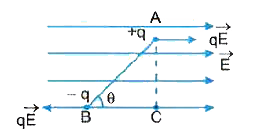
|
|
| 7515. |
Obtain an expression for quality factor of series RLC circuit connected to ac source. |
|
Answer» Solution :We know that for MAXIMUM current `i_(m)=(v_(m))/(sqrt(R^(2)+(omega_(L)-(1)/(omega_(C)))^(2)))""...(1)` From the current FREQUENCY curve, the band width `omega_(1)-omega_(2)=2Deltaomega`. The quantity `((omega_(0))/(2Deltaomega))` is regarded as a measure of the sharpness of resonance. Hence, `omega_(1)=omega_(o)+Deltaomegaandomega_(2)=omega_(0)-Deltaomega` i.e., `i_(rms)=(i_(m))/(sqrt(2))=(v_(m))/(sqrt(2))=(v_(m))/(sqrt(R^(2)+(omega_(1)L-(1)/(omega_(1)C))^(2)))""...(2)` we note that `omega_(1)andomega_(2)` are obtained by drawing perpendicular to the frequency axis corresponding to the `(1)/(sqrt(2))i_(m)` Equation (2) may be simplified as `Rsqrt(2)=sqrt(R^(2)+(Comega_(1)L=(1)/(omega_(2)C))^(2))`. Squaring both side, `2R^(2)=R^(2)+(omega_(1)L-(1)/(omega_(1)C))^(2)` or `R=omega_(1)L-(1)/(omega_(1)C)` i.e., `R=(omega_(o)+Deltaomega)L-(1)/((omega_(0)+Deltaomega)C)` i.e., `R=omega_(0)L(1+(Deltaomega)/(omega_(0)))-(1)/(omega_(0)C(1+(Deltaomega)/(omega_(0))))` but `omega_(0)^(2)=(1)/(LC)oromega_(0)L=(1)/(omega_(0)C)` Hence, `R=omega_(0)L(1+(Deltaomega)/(omega_(0)))-omega_(0)L(1-(Deltaomega)/(omega_(0)))` Simplifying we get, `((omega_(0)L)/(R))=((1)/(2Deltaomega))omega_(0)` The ratio `(omega_(0)L)/(R)` is called the QUALITY factor 'Q' of the circuit. `Q=(omega_(0)L)/(R)` i.e., `Q=(1)/(R)sqrt((L)/(C))=(1)/(omega_(0)RC)` |
|
| 7516. |
Two identical cells, each of emf epsi , having negligible internal resistance, are connected in parallel with each other across an external resistance R. What is the current through this resistance ? |
|
Answer» Solution : EMF of parallel combination of cells = `epsi`and INTERNAL resistance r=0 ` therefore ` Current FLOWING through the EXTERNAL R, resistance `I = epsi/R` |
|
| 7517. |
धुआंधार जलप्रपात किस नदी पर स्थित है? |
|
Answer» नर्मदा |
|
| 7518. |
In the bhysteresis cycle the value of H needed to makle the intensity of magnetisationzero is called |
| Answer» Answer :B | |
| 7519. |
नर्मदा नदी का उद्गम कहां से है? |
|
Answer» सतपुड़ा |
|
| 7520. |
Wave theory cannot explain the phenomena of (A)Polarization (B) Diffraction (C ) Compton effect (D) Photoelectric effect Which of the following is correct? |
|
Answer» A and B |
|
| 7521. |
A travelling harmonic wave on a stringis described by y ( x,t ) = 7.5 sin ( 0.0050x +12 t +pi //4) (a) What are the displacement and velocity of oscillation of a point at x=1cm, and t =1s ? Is this velocity equal to the velocity of wavepropagation ? (b) Locate the points of the string whcih have the same transverse displacements and velocityas the x=1 cmpoint at t=2s, 5s and 11s. |
|
Answer» Solution :(a) The travelling harmonicwave is y ( x,t) `= 7.5 ( 0.005x+ 12t +( pi)/(5))` At x = 1 cm,t =1 sec `y ( 1,1) = 7.5 sin ( 0.005 xx 1 +12 xx 1 + (pi)/(4))` `= 7.5 sin ( 12.005 +( pi)/(4))` ...(1) Now, `theta =( 12.005+ (pi)/(4))` radian `=( 180)/( pi) (12.005+ (pi)/(4)) ` degree `= ( 12.005 xx 180)/( (22)/(7))+ 45 =732.55^(@)` From (1), `y(1,1) = 7.5 sin ( 732.55^(@))` `= 7.5 sin( 720 +12.55^(@))` `= 7.5 sin 12.55^(@) = 7.5 xx 0.2173 =1.63 cm ` velocity of oscillation, `v= ( dy)/(dt)(1,1)` `= (d)/(dt) [ 7.5 sin ( 0.05x+ 12t + ( pi)/(4))]` `= 7.5 xx12 cos ( 0.005x + 12t + (pi)/(4))` At x = 1cm ,t = 1 sec `v = 7.5 xx 12 cos ( 0.005 + 12 + ( pi)/(4))` ` = 90 cos ( 732.55^(@))` `= 90 cos ( 720 + 12.55^(@))` `= 90cos ( 12.55^(@))` `=90 xx 0.9765` `= 87.89 cm//s ` Comparing thegiven equation with the standard form `y ( x,t) = r sin [ ( 2pi)/( lambda) ( vt+x) + phi_(0)]` We get `r= 7.5 `cm`, ( 2piv)/(lambda)=12 ` ( or ) ` 2pi V =12 `. `V =( 6)/( pi ) ` `2 ( pi)/( lambda) = 0.005 ` `:. lambda =( 2pi)/( 0.005) =( 2 xx 3.14 )/( 0.005) = 1256m` Velocity of WAVE propagation, `v = V lambda ` `=( 6)/( pi )xx 12.56 ` `= 24 m //s `. We find thatvelocityat x = 1cm t = 1secis not equal to velocity of wave propagation. (B) Now, all pointswhich are at a distance of `+-lambda, +- 2 lambda, +- 3 lambda ` from x =1 cmwill have same transverse displacement and velocity. As `lambda= 12.56` m, therefore, all POINTS at distances `+- 12.6m , +- 25.2 m` displacement and velocity. As `lambda = 12.56 m`,therefore all points at distance `+-12.6m,+- 25.2m , +- 37m` from x = 11M will havesame displacement & velocityat x= 1cm point at t = 25.55 & 115s. |
|
| 7522. |
(a) Given n resistores each of resistance R. how will you combine them to get the (i) maximum (ii) minimum effective resistance? (b) Given the resistances of 1 Omega, 2 Omega, 3 Omega. how will be combine them to get an equivalent resistance of (i) (11//3) Omega (ii) (11//5) Omega, (iii) 6 Omega, (iv) (6//11) Omega ? (c ) Determine the equivalent resistance of networks shown in |
|
Answer» Solution :When given resistances are all connected in series, equivalent RESISTANCE is maximum. here, `R_(MAX) =R_(S)= nR ` When given resistances are all connected in parallel, equivalent resistance is MINIMUM. Here, `R_(MIN) = R_(p)= (R)/(N) ` Required ratio = `(R_(max))/(R_(min)) = (nR)/((R)/(n)) = n^(2)` |
|
| 7523. |
When resistance is connected with AC source the emf. |
|
Answer» LEADS CURRENT by `pi//2` |
|
| 7524. |
Why can should waves be diffracted more easily than light waves? |
| Answer» Solution :DIFFRACTION effect is more PRONOUNCED when the size of the OBSTACLE is comparable with the wavelength of the waves. Sound waves have larger wavelength. So they diffracted even around buildings. LIGHT waves being shorter in wavelength cannot do the same. | |
| 7525. |
In the circuit shown in fig, the resonant frequency is |
|
Answer» `75 (KC)/(s)` |
|
| 7526. |
A small candle 2.5 cm in size is placed at 27 cm in front of a concave mirror of radius of corvature 36 cm. At what distance from the mirror should a screen be placed in order to obtain a sharp image? Describe the nature and size of the image. If the candle is moved closer to the mirror, how would the screen have to be moved ? |
|
Answer» Solution : u = - 27 cm, f = - 18 cm `(1)/(V) + (1)/(u) = (1)/(f), "" (1)/(-27)+ (1)/(v) = (1)/(-18) "" therefore v = (-18 xx 27)/(27 - 18) = - 54` cm `m = (h_(i))/(h_(0)) = (-v)/(u), (h_(i))/(2.5) = (-(-54))/((-27)) = - 2` `h_(i) = - 5 ` cm `"" therefore` The IMAGE is real, inverted and magnified. |
|
| 7527. |
The force between two charges 4C and -2C which are separated by a distance of 3km is |
| Answer» Answer :C | |
| 7528. |
Selectthe correct statement about the reflection and refraction of a wave at the interface between the medium 1 and 2 the |
|
Answer» Reflected WAVE has a PHASECHANGE of ` PI` |
|
| 7529. |
For what distance is ray optics a good approximation when the aperture is 3 mm wide and the wavelength is 500 nm ? |
|
Answer» Solution :For distance `Z lt= Z_F`ray optics is the good APPROPRIATE Fresnel distance `Z_F = (a^2)/(LAMDA) = ((3 xx 10^(-3))^2)/(5 xx 10^(-7)) = 18M` |
|
| 7530. |
A charged belt, 50 cm wide, travels at 30 m/s between a source of charge (electrons) and a sphere. The belt carries charge into the sphere at a rate corresponding to 76 A. (a) Compute the surface charge density on the belt. (b) What is the number density (number per unit area) of the electrons on the belt? |
|
Answer» |
|
| 7531. |
When we close one slit in the Young's double slit experiment, then |
|
Answer» a. the BANDWIDTH is increased |
|
| 7532. |
Two independent monochromatic sources cannot act as coherent sources, why? |
| Answer» Solution :TWO independent source of LIGHT cannot be coherent. This is becauselight is EMITTED by individual atoms. When they RETURN to ground state. Even the smallest source of light contains billions of atoms which obviously cannot emit light waves in the same phase. | |
| 7533. |
A wire of density 'rho' and Yaung's modulus 'Y' is stretched between two rigid supports separated by a distance 'L' under tension 'T'. Derive an expression for its frequency if fundamental mode. Hence show that n=(1)/(2L)sqrt((Yl)/(rhoL)), where symbolshave their usual meanings. When the length of a simple pendulum is decreased by 20 cm, the period changes by 10%. Find the original length of the pendulum. |
|
Answer» Solution :Consider a wire stretched between TWO rigid supports ata distance L apart. Let T = the TENSION in the wire r = the radius of cross section of the wire. Y, `rho` = young's modulus and mass denisty of the material of the wire. M, m = the mass and linear density of the wire Then, `M=(pir^(2)L)rho" and "m=(M)/(L)=pir^(2)rho""...(i)` `because` The stress in the wire `=(T)/(pir^(2))` `:.""(T)/(m)=(T)/(pir^(2)rho)=("Stress")/(rho)""...(ii)` The fundamental frequency of vibration of the wire, `n=(1)/(2L)sqrt((T)/(m))` `=(1)/(2L)sqrt(("Stress")/(rho))""["Using"(ii)]...(iii)` If `DeltaL=l` is the elastic extension of the wire under tension T, Strain =l/L Since `""Y=("Stress")/("Strain")` `implies"""Stress"=Yxx"strain"=Y(l)/(L)""...(iv)` `:.""n=(1)/(2L)sqrt((Yl)/(rhoL))""...(v)` which is the required expression. Numerical : Given : Length decreasedby 20 CM and PERIOD changes by `10%`. Let, original length = l andnew time period will decreased by `10%` `T'=T-(10)/(100)xxT` `:.""T'=T-(T)/(10)=(9T)/(10)` `because""T=2pisqrt((l)/(g))""...(i)` `implies""(9T)/(10)=2pisqrt((l-20)/(g))""...(ii)` On dividing equation (i) by (ii) `implies""(T)/((9T)/(10))=(2pisqrt((l)/(g)))/(2pisqrt((l-20)/(g)))` `implies""(10)/(9)=sqrt((l)/(l-20))` `implies""((10)/(9))^(2)=(l)/(l-20)` `implies""(100)/(81)=(l)/(l-20)` `implies""100(l-20)=81l` `implies""100l-81l=2000` `implies""19l=2000` `implies""l=(2000)/(19)" cm"` `=(20)/(9)" m"` `:.""l=1.05m` |
|
| 7534. |
The magnetic field B within the solenoid having n turns per unit length and carrying a current I is given by |
|
Answer» `mu_0 N I` |
|
| 7535. |
An infinite ladder network consisting of all equal resistances, r = (10)/(2.732) Omega is placed side by side to a capacitor system as shown in fig. Initially, all the switches are keptopen and all the three capacitors are given equal charges of 30 muCeach. The capacitances are C_(1) = 3 mu F, C_(2) = 6 mu F and C_(3) = 6 mu F. Polarity of charges on the capacitor plates is shown in the fig. Now all the three switches are closed simultaneously. (a) find the magnitude of rate of change of charge on the plates of the capacitors immediately after the switches are closed. (b) Calculate heat generated in the circuit by the time steady sate condition is established. |
|
Answer» (B) `75 MUJ` |
|
| 7536. |
A standard unit should be (a) consistent(b) reproducible (c) Invariable(d) easily available for usage |
|
Answer» Only a& B are true |
|
| 7537. |
Linear charge densities of two parallel wires of infinite length is lambda_(1) and lambda_(2) . Distance between two wires is R. Force acting on any one wire per unit length is ...... |
|
Answer» `k(lambda_(1)lambda_(2))/R` 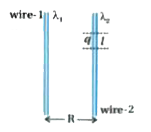 `E_(1) = (2klambda_(1))/R` Charge on wire-2, of length I, `q=lambda_(2)l` `therefore` FORCE acting on wire-2 of length l, `F = EQ = (2klambda_(1))/R xx lambda_(2)l` `therefore` Force acting per unit length, `F/l = (2klambda_(1)lambda_(2))/R` |
|
| 7538. |
If the force on a rocket moving moving with a velocity of 300 m/s is 345 N, then the rate of combustion of the fuel is |
|
Answer» 0.55kg/s |
|
| 7540. |
A solenoid of 50 cm length and 8 cm diameter is wouldwith 500 turns of wire . Anothercoil of 20 insulated wire is colsely woundover it at its middle region . Calculate the coefficient of mutual induction[Hint : Use the formula M=(mu_(0)mu_(r)N_(1)N_(2)S)/(l)henry] |
|
Answer» |
|
| 7541. |
STATEMENT-1: Lenz's law is based on the principle of conservation of energy. Because STATEMENT-2: The magnitude of the induced emf is directly proportional to the rate of change of the magnetic flux. |
|
Answer» Statement-1 is TRUE , Statement-2 is True , Statement-2 is a CORRECT EXPLANATION for Statement-1. |
|
| 7542. |
Monochromatic light of wavelength 632.8nm is produced by a helium-neon laser. The power emitted is 9.42 mW. (a) Find the energy and momentum of each photon in the light beam. (b) How many photons per second, on the average, arrive at a target irradiated by this beam ? (Asume the beam to have uniform cross-section which is less than the target area), and (c) How fast does a hydrogen atom have to travel in order to have the same momentum a that of the photon ? |
|
Answer» SOLUTION :Here `LAMDA=632.8nm=6.328xx10^(-7)m` and power emitted=`9.42mW=9.42xx10^(-3)W=9.42xx10^(-3)Js^(-1)` (a) Energy of each photon `E=(hc)/(lamda)=(6.63xx10^(-34)xx3xx10^(8))/(6.328xx10^(-7))=3.14xx10^(-19)J` and momentum of each photon `p=(E)/(c)=(3.14xx10^(-19))/(3xx10^(8))=1.05xx10^(-27)kg" "ms^(-1)` (B) Number of photons arriving per second at the target `n=(Power)/("Energy of one photon")=(9.42xx10^(-3))/(3.14xx10^(-19))=3xx10^(16)" photons "s^(-1)`. (c) We know that the mass of a hydrogen atom `m_(H)=1.67xx10^(-27)kg.` if velocity of hydrogen atom be V, then momentum of hydrogen atom `m_(H)v=`momentum of a photon=`1.05xx10^(-27)" ms"^(1)` `impliesv=(1.05xx10^(-27))/(m_(H))=(1.05xx10^(-27))/(1.67xx10^(-27))=0.63ms^(-1)`. |
|
| 7543. |
Twelve cells each having the same emf are connected in series and are kept ina closed box. Some of the cells are wrongly connected. This battery of cells is connected in series with an ammeter and two cells identical with the others. The current is 3A when the cells and the battery aid each other and is 2A when the cells and the battery oppose each other. How many cells in the batter are wrongly connected? |
|
Answer» 1 |
|
| 7544. |
If vec(E ) and vec(B) represent electric and magnetic field vectors of the electromagnetic wave, the direction of propagation of electromagnetic wave is along |
|
Answer» `vec(E )` 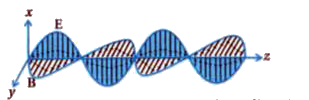 Here electromagnetic WAVE is in z - direction. Which is given by cross product of `vec(E )` and `vec(B)`. |
|
| 7545. |
Magnifying power of compound microscope is given by what |
| Answer» SOLUTION :`beta/alpha` | |
| 7546. |
A parallel beam of white light is incident normally on a diffraction grating having 6000 lines per cm. Calculate the angular separation of red and viotet lights to be 7 xx 10^(-7) m and 4 xx 10^(-4) m respectively. |
|
Answer» |
|
| 7547. |
Value of dip angle at magnetic equator is and at magnetic poles of earth its value is ________ . |
| Answer» SOLUTION :`0^@ , 90^@` | |
| 7548. |
Using the relation vec(B) = mu_(0) (vec(H)+ vec(M)), show that X_(m) = mu_(r) - 1. |
|
Answer» Solution :`vec(B) = mu_(0) (vec(H) + vec(M))` But from EQUATION `x_(m) = |(vec(M))/(vec(H))|`, in vector form `vec(M) = X_(m) vec(H)` HENCE, `vec(B) = mu_(0) (X_(m) + 1)vec(H) rArr vec(B) = mu vec(H)` Where, `mu = mu_(0) (X_(m) + 1) rArrX_(m) + 1 = (mu)/(mu_(0)) = mu_(r) ` `rArr X_(m) = mu_(r) - 1` |
|
| 7549. |
Two solids P and Q float in water. It is observed that P floats with half of its volume immersed and Q floats with (2^(rd))/3 of its volume immersed. The ratio of densities of P andQ is: |
|
Answer» `4//3` wt. of body = wt of water displaced for body P. `v_(p)p_(p).G=(V_(P))/2p_(w).grArrp_(P)=(p_(w))/2` For body Q. `V_(Q)p_(Q).g=2/3V_(Q).p_(w)grArrp_(Q)=2/3p_(w)` `therefore(p_(P))/(p_(Q))=((p_(w))/2)(2/3p_(w))=3/4` So CORRECT choice is (B). |
|
| 7550. |
The relation between I_(p) and V_(p) for a triode is I_(p)=(0.124 V_(p)-7.5)mA Keeping the grid potential constant at 1 V , the value of r_(p) will be |
| Answer» Answer :D | |