

Saved Bookmarks
This section includes InterviewSolutions, each offering curated multiple-choice questions to sharpen your knowledge and support exam preparation. Choose a topic below to get started.
| 40901. |
What are beta rays ? What is the main feature of beta ray energy spectrum? |
|
Answer» Main features of beta ray energy spectrum 1. `beta`-particle emitted by aradioactive substancehas a CONTINUOUS energy range, extending from zero to a cetain maximum. The upper energy level is called the end point energy and is the characteristic of nature of `beta`-emitter. The given figure shows the spectrum of the `beta`-particles emitted with end point shows the energy 1.17 M eV. 2. Every `beta`-particle energy distribution curve has a well defined maximum whose height and position depend upon the nature of `beta`-emitter. 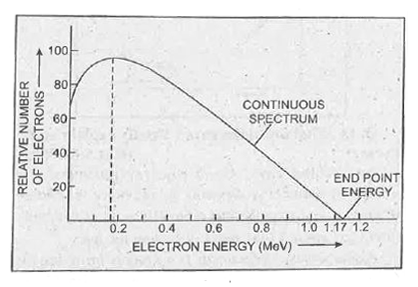
|
|
| 40902. |
Long distance transmission of a.c. is done at _____ voltage and _____ current in order to avoid loss of energy |
| Answer» SOLUTION :HIGH, LOW | |
| 40903. |
Light of wavelength 6000 Å falls normally on a narrow circular aperture of radius 9xx10^(-4) m . At what distance along the axis will the first maximum be observed ? |
| Answer» SOLUTION :1.35 m | |
| 40904. |
Give characteristics of electric field lines. |
|
Answer» Solution :(i) A TANGENT at any point on electric field line gives direction of electric field at that point. (ii) Two electric field lines never intersect each other. If they do so, then there will be two tangents at the point of intersection and hence two directions of electric field at the same point, which is not possible. Hence, two field lines can never cross each other. (III) The distribution of electric field lines in any REGION of field gives intensity of field in that region. (iv) Field lines of uniform electric field are equidistant and parallel to each other. (v) Field lines of stationary electric charge do not form CLOSED loops. In practice, number of field lines passing through any region of field is controlled such that, number of field lines passing through unit AREA which is normal to field line at that point is proportional to the intensity of the given field. |
|
| 40905. |
In forward biased condition, the p-n junction diode behaves as |
|
Answer» HIGH resistance connection |
|
| 40906. |
A 6 Vcell with 0.5Omega internal resistance , a 10 v cell with 1Omega internal resistance and a 12Omega external resistance are connectedin parallel . The current (in amper) through the 10 V cell is |
|
Answer» 0.6 |
|
| 40907. |
(A) : An exact number has infinite number of significant digits. (R): Anumber, which is not a measured value has infinite number of significant digits. |
|
Answer» Both (A) and (R) are true and (R) is the CORRECT explanation of (A) |
|
| 40908. |
The thermoelectric emf varepsilon of a copper constantan thermocouple and the temperature theta of the hot junction (with cold junction at 0^(@)C) are found to satisfy approximately the following relation. varepsilon=atheta+btheta^(2) where varepsilon is in muV,theta in .^(@)C and alpha =41 mu V^(@)C^(-1), b=0.041 mu V^(@)C^(-2) What is the temperture of the hot junction when the thermoelectric emf is measured to be 5.5 mV? |
| Answer» | |
| 40909. |
Force experienced by a magnetic pole, when kept in a uniform magnetic field of4xx10^(-5)T,Is the same as theforceexperienced by that pole. Determine the pole _ strength of theunknown pole. |
|
Answer» |
|
| 40910. |
The initial and final temperatures are recorded by using a thermometer as (30.4 pm 0.2)^(0)C and (50.6 pm 0.3)^0 C . The rise in temperature is |
|
Answer» `20.2^0 C` |
|
| 40911. |
An image of the sun is formed on the metal surface of the photoelectric cell and it produces of current. The lens formingthe image is then replaced by another of the same diameter but only half in focal length. a. What will be the effect on the photoelectriccurrent? b. Is photoelectric emission possible at all frequencies ? c. If not give your explanation. |
|
Answer» SOLUTION :a. No CHANGE b. No. Only at or above threshold frequency c. The energy of the incident photon should be ATLEAST equal to or greater than the work function of the metal. |
|
| 40912. |
A battery of emf 10V and internal 2Omega is connected to a reststor.If the current in the is 0.5 A, what is the resistance of the resistor? |
|
Answer» `13Omega` |
|
| 40913. |
In the above problem, the frequnecy of oscillations of the cage will be- |
|
Answer» `1/2PI[K/m]^(1//2)` |
|
| 40914. |
Explain that microwaves are better carriers of signal than radio waves. |
| Answer» Solution :MICROWAVES are electromagnetic waves having wavelength of the order of a few millimetres. Due to such smaller wavelength, they can be transmitted as BEAM signals in a particular diretion because they do not spread or bend around the corners of the obstacle coming in their WAY, so microwaves are better CARRIERS of signal than radiowaves. | |
| 40915. |
Show that the force on each plate of a parallel platecapacitor has a magnitudeequalto (1)/(2) QE, where Q is the chargeon the capacitorand E si the magnitudeof electricfield between the plates. Explain the orginof factor (1)/(2). |
|
Answer» Solution :If F is the force on each plate of a parallel plate capacitor, then WORK donein INCREASINGTHE separation betweenthe plates by `Delta x = F. Delta x`. This must be the increase in potential energyof the capacitor. Now, increase in volume of capacitor `=A. Delta x` If u = energy density = energy stored/ volume, then increase in pot, energy`= u.A Delta x :. F Delta x = u. A Delta x` `F = u.A = ((1)/(2) in_(0) E^(2)) A = (1)/(2) (in_(0) AE)E , F = (1)/(2) (in_(0) A(V)/(d))E (( :. C = (in_(0) A)/(d))` `F = (1)/(2) (CV) E = (1)/(2) QE` This origin of factor `1//2` in force can be explained by the FACT that inside the conductor, field is zero and outside the conductor, the field is E. Thereforethe averagevalue of the field `(i.e. E//2)` constribuites to the force. |
|
| 40916. |
When series resistance is increased, range of voltmeter _______ |
|
Answer» decreases `R_(S)=G(n-1)` `thereforeR_(S)=G_(n)-G` `thereforen=(R_(S)+G)/G` `rArr` if `R_(S)` is INCREASED then n increases. `rArr` New voltage capacity `V=nV_(G)=nI_(G)` will INCREASE. `rArr` Range will increase. |
|
| 40917. |
The angular resolution of a 10 cm diameter telescope at a wavelength of 5000 Å is of the order of ..... |
|
Answer» `10^(6)` rad `=(1.22 LAMBDA)/(d)` `=(1.22xx5xx10^(-7))/(10^(-1))` `=6.1xx10^(-6)` `=10^(-6)` rad |
|
| 40918. |
The process of superimposing signal frequency (i.e. audiowave) on the carrier wave is known as |
|
Answer» TRANSMISSION |
|
| 40919. |
Self inductance of straight conducting wire is ______ |
|
Answer» zero Thus `L=phi/I, phi=0` so, L=0 |
|
| 40920. |
This question concerna a symmetrical lens shown, along with its two focal points. It is made of plastice with n=1.2 and has focal length f. Four different regions are shown: Here, A. -oox lt -fB.-f lt x lt 0 C. 0 lt x lt fD. f lt x lt oo Q. If incident rays are converging, then in which region does the image appear? |
|
Answer» A `(1)/(F)=(1)/(f_(1))+(1)/(f_(2))=(1)/(f)-(1)/(3F) or F=(3f)/(2)` |
|
| 40921. |
A parallel beam of fast moving electrons is incident normally on a narrow slit. A fluorescent screen is placed at a large distance from the slit. If the speed of the electron is increased which of the following statements is correct? |
|
Answer» The angular width of the central maximum will decrease `LAMBDA=(h)/(mv)` `:. Lambda PROP (1)/(v)` h and m is constant As speed is increased so wavelength will decreases and diffraction depend on `sin theta prop lambda`, as decrease SINE also decreases, so `theta` decreases. As a result angular width decreases. |
|
| 40922. |
This question concerna a symmetrical lens shown, along with its two focal points. It is made of plastice with n=1.2 and has focal length f. Four different regions are shown: Here, A. -oox lt -fB.-f lt x lt 0 C. 0 lt x lt fD. f lt x lt oo Q. If an object is placed somewhere region (A),in which region does the image appear ? |
|
Answer» A `(1)/(F)=(1)/(f_(1))+(1)/(f_(2))=(1)/(f)-(1)/(3f) or F=(3f)/(2)` |
|
| 40923. |
In the phenomenon of diffraction of light, when blue light is used in the experiment insteadof red light , then |
|
Answer» FRINGES will BECOME narrower |
|
| 40924. |
A monochromtic light of frequency 6xx10^14 Hz is produced by a laser. The power emitted is 2xx10^-3 W. The number of photons emitted per second is |
|
Answer» `2xx10^15` |
|
| 40925. |
A car of mass 400 kg and travelling at 72 km-h^(-1) crashes into a truck of mass 4000 kg and travelling at 9 km-h^(-1), in the same direction. The car bounces back at a speed of 18 km-h^(-1). The speed of the truck after the impact is |
|
Answer» `9 km-h^(-1)` `m_(2) = 4000 kg, u_(2) = 9 kmh^(-1) = 9 x 5/18= 2.5 ms^(-1)` `V_(1) = 18 kmh^(-1) = 18xx5/18= 5 ms^(-1)` From Law of Conservation of momentum `m_(1)u_(1)=m_(2)u_(2)= m_(1)V_(1)=m_(2)V_(2)` `IMPLIES 400xx20+4000xx2.5=400xx(-5)+4000xxV_(2)` `v_(2)=20,000/4000` `v_(2) = 5 ms^(-1)= 5xx18/5-= 18 kmh^(-1)` |
|
| 40926. |
Three positive point charges q_1,q_2,and q_3 form an isolated system. Suppose the charges have generated a property due to which like charges also attract. The charges are moving along a circle with same speed maintaining angles as shown in the figure. The charge q_1 experiences a force f_1 due to other two charges. Similarly, q_2 experiences a force f_2 and q_3, a force f_3. The ratio of f_1:f_2:f_3 is |
|
Answer» `1:1:1` 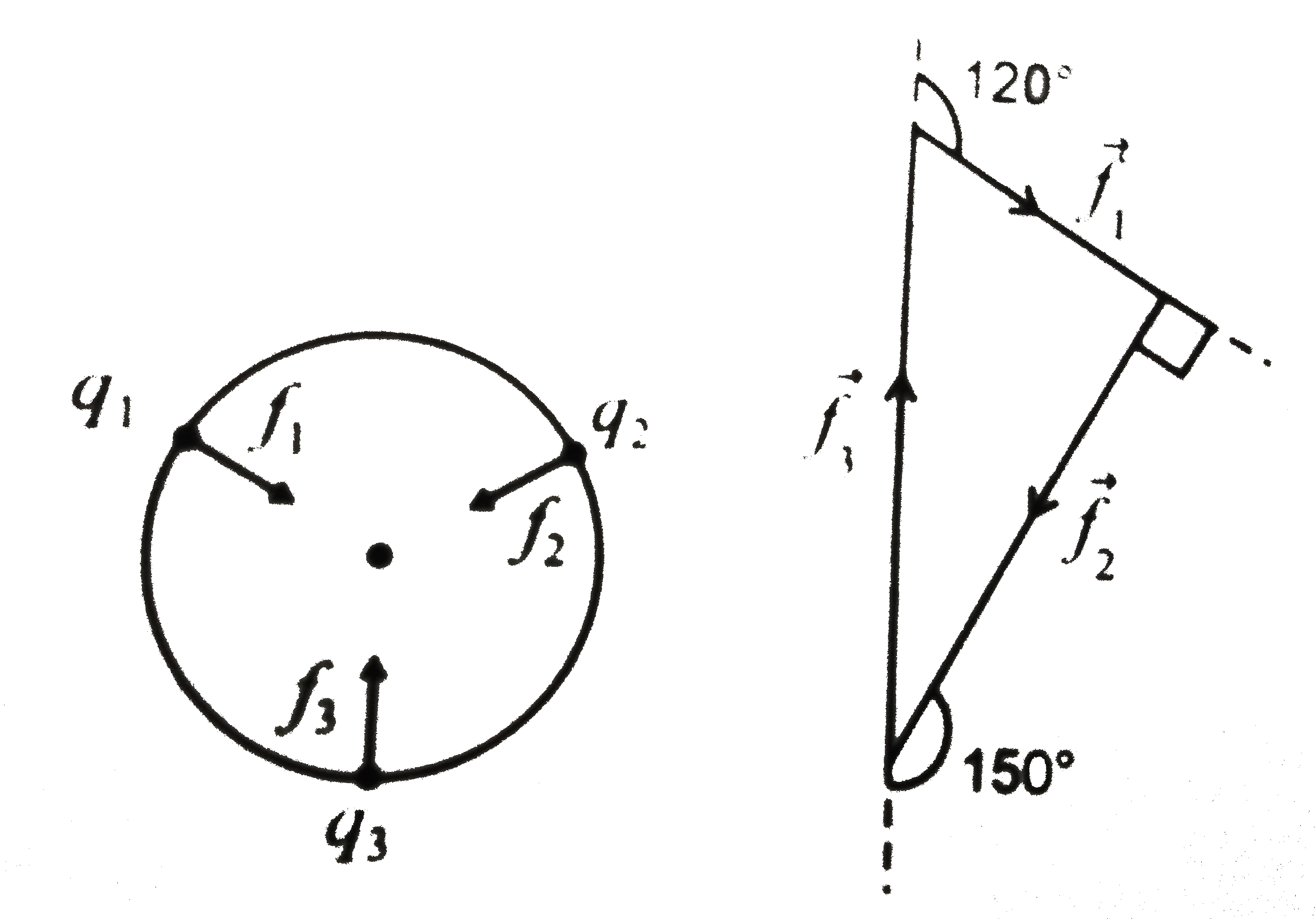 Applying sinc rule, we have `(f_(1))/(SIN30)=(f_(2))/(sin60)=(f_(3))/(sin90)` or `2f_(1)=(2f_(2))/(sqrt(3))=K` (suppose) `f_(1)=(K)/(2),f_(2)=(sqrt(3))/(2)K,f_(3)=K` So `f_(1):f_(2):f_(3)=(1)/(2):(sqrt(3))/(2):1=1:sqrt(3):2` |
|
| 40927. |
How the spark discharge helped hertz in his experiment ? |
| Answer» SOLUTION :For PRODUCTION of ELECTROMAGNETIC WAVES. | |
| 40928. |
A steady current flows in a metallic conductor of non-uniform cross-section. Which of these quantities is constant along the conductor : current, current density, electric field, drift speed? |
| Answer» Solution :Only CURRENT (because it is GIVEN to be steady). The rest depends on the area of cross-section INVERSELY. | |
| 40929. |
Bangle industry flourishes in the town of |
|
Answer» Ferozepur |
|
| 40930. |
A transparent glass plate of thikness 0.5 mmand refrective index 1.5is placedinfrontof one of the slitsin a double slit expremint . If the wavelengthof light usedis 6000 A^(0) the ratioof maximum to minimum intensity in the interference patternis 25/4 . Then the ratio of light intensity transmitted to incident on thin transparent glass plate is |
|
Answer» `9:7` |
|
| 40931. |
Two capillary tubes of diffemt diameters are dipped in water. The rise of water is : |
|
Answer» the same in both tubes `h=(2Tcostheta)/(rpg)` `thereforehprop1/r` So rise of water will be greater in a tube of smaller diameter. So correct choice is (c). |
|
| 40932. |
Calculate the speed of light in a medium whose critical angle is 30°. |
|
Answer» Solution :Here, `i_( c) = 30^(@)` `therefore` REFRACTIVE index of medium `n=1/(SIN i_( c)) =1/(sin 30^(@)) =1/(1/2) = 2.0` `therefore`Speed of light in the given medium `v=c/n = (3 xx 10^(8))/2 = 1.5 xx 10^(8) ms^(-1)` |
|
| 40933. |
A block of mass 10 kg kept on a rough horizontal surface can be maintained in uniform motion in a straight line when the force of 50 N is applied to the body in the direction of it’s motion. Find the coefficient of kinetic friction between the surfaces.; |
|
Answer» 0.49 |
|
| 40934. |
A point charge .q. is placed at origin. bar(E )_(A), bar(E )_(B) and bar(E )_(C ) be the electric field at three points A(1, 2, 3), B(1, 1, -1) and C(2, 2, 2) due to charge q. Then give the possible relations between the above field strengths. |
|
Answer» SOLUTION :`bar(E )_(A)` is along `bar(OA) and bar(E )_(B)` is along `bar(OB)`. `bar(OA) = i + 2j + 3K and bar(OB) =I + j - k` since `bar(OA).bar(OB) = 0`, `bar(E )_(A) bot bar(E )_(B)` further `|bar(E )| prop (1)/(r^(2))` `THEREFORE |bar(OC)| =2 |bar(OB)| therefore |bar(E )_(B)|=4 |bar(E )_(C)|` |
|
| 40935. |
A monochromaticradiation of wavelength 975 Å excites the hydrogen atom from its groundstate to a higher state . How manydifferent spectral lines are possivle in the resultingspectrum ? Whichtransition correspondsto thelongestwavelenghtamongst them ? |
| Answer» SOLUTION :6,N= 4 to n = 3 | |
| 40936. |
The wavelength of red light in air is 7890 Å . What is the wavelength in glass (mu = 1.5) ? |
|
Answer» |
|
| 40937. |
The intrinsic conductivity of germanium at 27^(@)C is 2.13ohm^(-1)*m^(-1), the mobilities of electrons and holes are 0.38 and 0.18m^(2)//(V*s), respectively. Compute the carrier densities and the Hall coefficient. |
|
Answer» To find the Hall coefficient, note that the Hall potential DIFFERENCE of the electron and the hole components are of opposite signs We have `R_(H)=R_(H)^((-))-R_(H)^((+))=(b_(-)-b_(+))/gamma`. |
|
| 40938. |
Any radiation in the ultra violet region of Hydrogen spectrum is able to eject photo-electrons from a metal. Then the maximum value of threshold wave length is lambda= (1)/(R) = 911 Å then the frequency of the metal is, nearly |
|
Answer» `3.3xx10^(15)` HZ |
|
| 40939. |
Agrass hopper can jump maximum distance of 1.6m. It spends negligible time on the ground. How far can it go in 10 seconds? |
|
Answer» Solution :`(u^(2))/(g)=1.6 u^(2)=16 RARR u= 4 m//s` `4 COS theta=4xx(1)/(sqrt(2))=2 sqrt(2) m//s` `S= 4 cos theta t=2 sqrt(2)xx10 "" S=20 sqrt(2) m` |
|
| 40940. |
A ray of light incident on a glass slab making an angle 30^@ with the surface. The angle of deviatio during its passage through the glass slab of R.I. 1.6 is |
|
Answer» `27^2` |
|
| 40941. |
If the equivalent capacity between A and B in the circuit is 12mF, the capacity C is |
| Answer» ANSWER :A | |
| 40942. |
Describe the use of a potentiometer to compare the emf's of two cells by the sum difference method. |
|
Answer» SOLUTION :A BETTERY of stable emf E is used to set up a potential gradient `V//L` along the potentiometer WIRE, where `V equiv p.d` across total length L of the wire. The positive terminal of cell 1 of emf `E_(1)` is connected to the higher potential terminal A of the potentiometer, the negative terminal is connected to the galvanometer through the reversing key. the other terminal of the galvanometer is connected to a pencil jockey. Cell 2 of emf `E_(2)` is connected across the remaining TWO opposite terminals of the reversing key. `E_(1)` should be greater than `E_(2)`, and `E` should be greater than `E_(1)+E_(2)`. Inserting two plugs in the reversing key in positions `1-1`, the two cells assist each other so that the net emf is `E_(1)+E_(2)`. the jockey is tapped along the wire to locate the null point D. If the null point is a distance `l_(1)` from A, `E_(1)+E_(2)=l_(1) (V//L)` 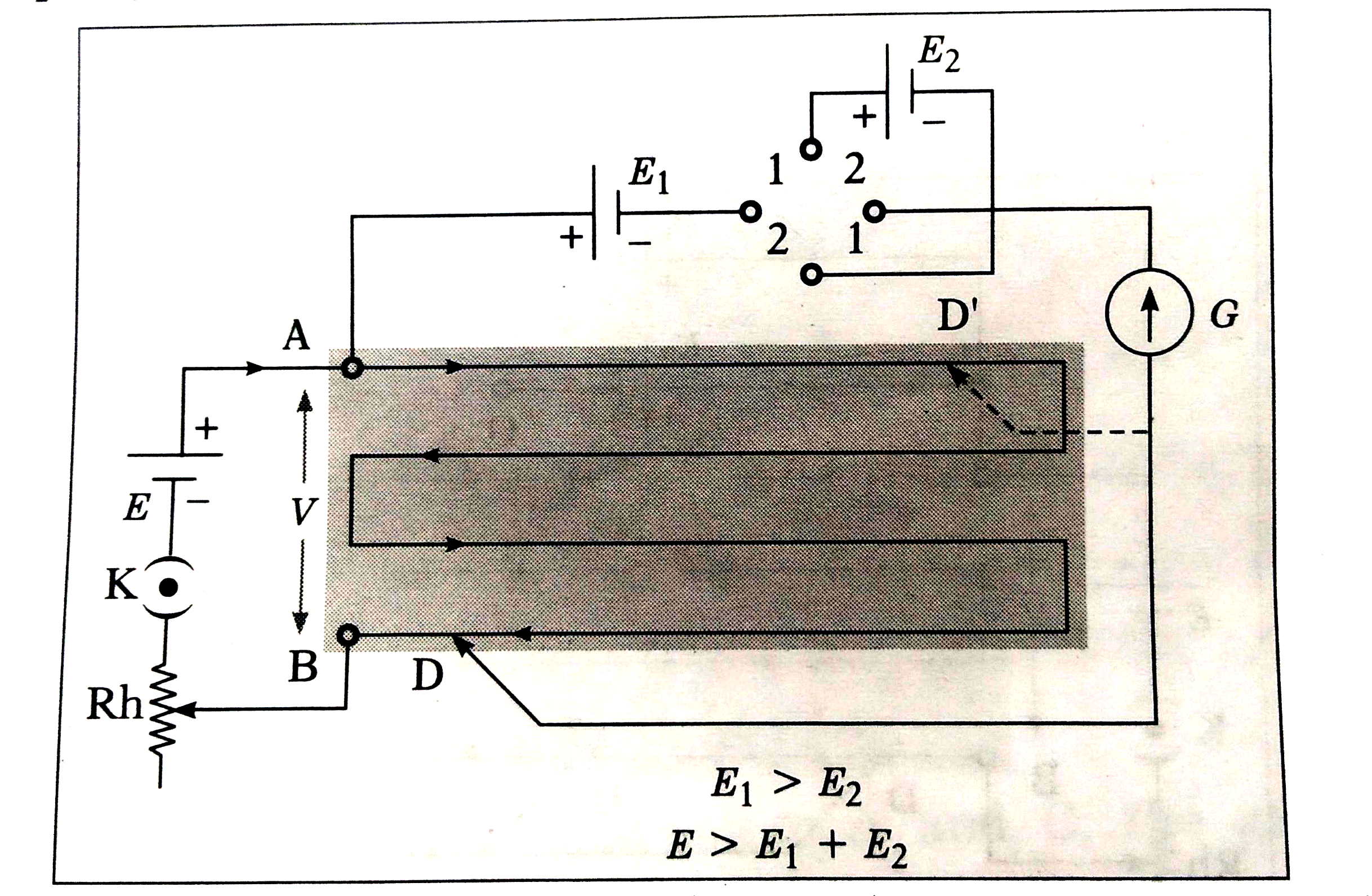 For the same potential gradient, the plugs are now inserted into position `2-2`. The emf `E_(2)` then opposes `E_(1)` and the net emf is `E_(1)-E_(2)`. The new null point D' is, say, a distance `l_(2)` from A and `E_(1)-E_(2)=l_(2) (V//L)` `:. (E_(1)+E_(2))/(E_(1)-E_(2))=l_(1)/l_(2)` or `E_(1)/E_(2)=(l_(1)+l_(2))/(l_(1)-l_(2))` The experiment is repeated for different potential gradients. |
|
| 40943. |
An 80 kg stuntman jumps out of a window that's 45m above the ground Q. What if he had instead landed on the ground (impact time=10 ms)? |
|
Answer» Solution :In this case `overline(F)=(Deltafi-p)/(Deltat)=(0-mv)/(Deltat)=(-(80kg)/(30m//s))/(10xx10^(-3)s)=-240,000N implies overline(F)=-240,000N` This force is equivalent to about 27 tons(!), more than ENOUGH force to break bones and cause fatal brain damage. notice how crucial the impact time is: Increasing the slowing-down time reduces the acceleration and the force, IDEALLY enough to prevent injury. this is the purpose of safety devices such as AIR BAGS in CARS. |
|
| 40944. |
The heat generated by radioactivity within the earth is conducted outward through the oceans. Assuming the average temperature gradient within the solid earth beneath the ocean to be 0.07 ^(@)C^(-1) and the average thermal conductivity 0.2 cal m^(-1) s^(-1) ^(@)C^(-1), determine the rate of heat transfer per square metre. Radius of the earth = 6400 km.- further, determine the quantity of heat transferred through the earth's surface each day |
|
Answer» |
|
| 40945. |
A lens is made with 2 convex faces of same radii of curvature. The refractive index of the lens material is 1.54. What will be the radii of the two convex faces in order to give the lens a focal length of 30 cm ? |
|
Answer» |
|
| 40946. |
A double slit experiment produces interference fringes for sodium light (lambda = 5890 Å) that are 0.20^(@) apart What will be angular fringe separation if the entire arrangement is immersed in water (mu = 4/3)? |
|
Answer» `1.25^(@)` `THEREFORE theta D = (lambda_(0)D))/(d)` or `theta = (lambda_(0))/(d)` Now `MU = (lambda_(0))/(lambda)` `thereforetheta. = (lambda)/(d) ("In water") & (theta.)/(theta) = (lambda)/(d) xx (d)/(lambda_(0)) = (lambda)/(lambda_(0))` But `(lambda)/(lambda_(0)) = (1)/(mu)` `therefore theta.= (theta)/(mu) = 0.15^(@)`. |
|
| 40947. |
Two dielectric slabs of dielectric constants K_1 and K_2 are filled in between the two plates, each of area A, of the parallel plate capacitor as shown in the figure. Find the net capacitance of the capacitor. |
|
Answer» SOLUTION :The arrangement is EQUIVALENT to two capacitors JOINED in parallelwhere area of plates of either capacitor is `A/2`. THUS, `C_1 =(K_1 epsi_0 (A/2))/d = (K_1 epsi_0A)/(2d)` and `C_2 =(K_2epsi_0(A/2))/(d) =(K_2 epsi_0A)/(2d)` `:.` NET capacitance of the capacitor `C = C_1 + C_2= (K_1 epsi_0 A)/(2d) + (K_2 epsi_0A)/(2d) = (epsi_0A)/d ((K_1 + K_2)/2)`. |
|
| 40948. |
An object of specific gravity rho is hung from a thin steel wire. The fundamental frequency for transverse standing waves in the wire is 300 Hz. The object is. immersed in water so that one half of its volume is submerged. The new fundamental frequency in Hz is (Take density of water = 1 g "cm"^(-3) ) |
|
Answer» `300((2rho-1)/(2rho))^(1//2)` Upthrust of water on object= `V/2 sigmag`. `THEREFORE` Tension T.=`V rho g-(Vsigmag)/2` or `T.=Vg((2rho-sigma)/2)` `therefore upsilon=1/(2l)sqrt(T/mu)`, where T=`Vrhog` `upsilon.=1/(2l)sqrt((T.)/mu)therefore (upsilon.)/upsilon=sqrt((T.)/T)` `(upsilon.)/upsilon=sqrt((Vg(2rho-1))/2xx1/(Vgrho))` `upsilon.=upsilonsqrt((2rho-1)/(2rho))` or `upsilon.=300[(2rho-1)/(2rho)]^(1//2)` |
|
| 40949. |
How relative permittivity and susceptibility of a substance is connected. |
|
Answer» SOLUTION :`mu_r = 1 + CHI` where `mu_r ` = PERMEABILITY and `chi`-SUSCEPTIBILITY. |
|
| 40950. |
hysteresis loop is narrow Explain the significance of each propety. |
| Answer» SOLUTION :To reduc HYSTERESIS LOOS | |