

Saved Bookmarks
This section includes 7 InterviewSolutions, each offering curated multiple-choice questions to sharpen your Current Affairs knowledge and support exam preparation. Choose a topic below to get started.
| 1. |
Dilute aqueous KMnO_4at room temperature reacts with R-CH=CH-R to give |
|
Answer» `R - CHO` |
|
| 2. |
Dil, cold, alkaline KMnO_(4) is baeyers reagent. It acts as oxidizing agent Q. HC=CH"Baeyer's reagent"gtB("major") B is |
|
Answer» `HCHO` |
|
| 3. |
Dihydrogen, under certain reaction conditions, combines with almost all elements, except noble gases, to form binary compounds, called hydrides. If 'E' is the symbol of an element, then hydride can be expressed as EH_x (e.g.HgH_2)or E H_x (e.g. B_2H_6) . The hydrides are classified into three categories : ionic, covalent and metalicIn which of the following pair, both the hydrides are not of the same type |
|
Answer» `LaH_3, TiH_2` |
|
| 4. |
Dihydrogen, under certain reaction conditions, combines with almost all elements, except noble gases, to form binary compounds, called hydrides. If 'E' is the symbol of an element, then hydride can be expressed as EH_x (e.g.HgH_2)or E H_x (e.g. B_2H_6) . The hydrides are classified into three categories : ionic, covalent and metalicAmong CaH_2, NH_3, NaH and B_2H_6 , which are covalent hybrides ? |
|
Answer» `NH_3` and `B_2H_6` |
|
| 5. |
Dihydrogen, under certain reaction conditions, combines with almost all elements, except noble gases, to form binary compounds, called hydrides. If 'E' is the symbol of an element, then hydride can be expressed as EH_x (e.g.HgH_2)or E H_x (e.g. B_2H_6) . The hydrides are classified into three categories : ionic, covalent and metalicWhich of the following is not an example of Ionic hydrides |
| Answer» ANSWER :D | |
| 6. |
Dihydrogen reacts with dioxygen (O_(2)) to form water. Write the name and formula of the product when the isotope of hydrogen which has one proton and one neutron in its nucleus is treated with oxygen. Will the reactivity of both the isotopes be the same towards oxygen ? Justify your answer. |
|
Answer» Solution :The isotope of hydrogen which contains one proton and one neutron is deuterium (D). Thus, when dideuterium reacts with dioxygen , deuterium OXIDE , i.e., heavy water is produced. `underset("Diheuterium")(2D_(2)(g))+undeset("Dioxygen")(O_(2)(g)) overset("Heat")to underset("Deuterium oxide")(2D_(2)O)` The reactivity of `H_(2)` and `D_(2)` TOWARDS OXYGEN will be different. Since the D-D bond is stronger than H-H bond, therefore, `H_(2)` is more reactive than `D_(2)` towards reaction with oxygen. |
|
| 7. |
Dihydrogen reacts with dioxygen (O_2) to form water. Write the name and formula of the product when the isotope of hydrogen which has one proton and one neutron in its nucleus is treated with oxygen. Will the reactivity of both the isotopes be the same towards oxygen ? Justify your answer. |
|
Answer» Solution :The isotope of hydrogen which contains on proton and one neutron is deuterium. Thus, when dideuterium reacts with dioxygen, deuterium oxide. i.e. heavy water is obtained. `underset"Dideuterium"(2D_(2(g)))+ underset"Dioxygen"(O_(2(g))) overset"HEAT"to underset"Deuterium oxide"(2D_2O)` The reactivity of `H_2` and `D_2` TOWARDS OXYGEN will be different since the D-D bond is stronger than H-H bond therefore, `H_2` is more reactive then `D_2` towards reaction with oxygen. |
|
| 8. |
Dihydrogen reacts with dioxygen (O_(2)) to form water. Write the name and formula ofthe product when the isotope ofhydrogen which has one proton and one neutron in its nucleus is treated with oxygen. Will the reactivity of boththe isotopes be the same towards oxygen ? Justify your answer. |
|
Answer» The isotope of hydrogen which has one proton and one neutron inits NUCLEUS is Deuterium . `2D_(2)+O_(2)to2D_(2)O` The product is heavy water (Deuterium oxide).`H_(2)O and D_(2)O`has same chemical properties but the reaction VELOCITY of `D_(2)O`is slightly LESS due to the difference in the mass number of theisotopes known as isotopic EFFECT. Deuterium is heavier than protium so reacts SLOWLY. |
|
| 10. |
Dihydrogen is considered as fuel Explain. |
|
Answer» Solution :Dihydrogen is considered as another alternative source Advantages of using dihydrogenas FUEL are 1. It is abundantly available in the combined states as WATER. 2. Dihydrogen as fuel provides pollution free atmosphere. 3. The energy released in automobile engine by buring hydrogen is about `50%` more than the energy released in automobile engine by buring gasoline. 4. Heat of combustion per gram of hydrogen is twice than that of JET fuel. 5. Hydrogen - oxygen fuel cells are used in powering motor vehicles. 6. Hydrogen is an excellent reducing agent and can replace coal in may industrial processes involving reduction. 7. Time REQUIRED for REGENERATION of hydrogen is much shorter. |
|
| 11. |
Dihydrogen gas used in Haber's process is produced by reacting methane from natural gas with high temperature steam. The first stage of two stage reaction involves the formation of CO and H_2. In second stage, CO formed in first stage is reacted with more steam in water gas shift reaction, CO_((g)) + H_2O_((g)) hArr CO_(2(g)) + H_(2(g)) If a reaction vessel at 400^@C is charged with an equimolar mixture of CO and steam such that p_(CO) = P_(H_2O) = 4.0 bar, what will be the partial pressure of H_2 at equilibrium ? K_p = 10.1 at 400^@C. |
|
Answer» Solution :Suppose in reaction , x bar of CO react with x bar of `H_2O` and So, x bar of `CO_2` and `H_2` is create. (PARTIAL PRESSURE (x) bar `prop` CONCENTRATION MOL `L^(-1)`) `{:("Equilibrium reaction :",CO_((G))+,H_2O_((g)) hArr , CO_(2(g)) + , H_(2(g))),("Initial partial pressure bar :",4.0,4.0,0,0),("Change in pressure bar",-x,-x,+x,+x),("Partial pressure at equilibrium :",(4-x),(4-x),x,x):}` In this gas reaction `K_p` is as under. `K_p=((p_(CO_2))(p_(H_2)))/((p_(CO))(p_(H_2O)))` `10.1 =((x)(x))/((4-x)(4-x))` `therefore 10.1 = x^2/(4-x)^2` (take square root both sides) `therefore 3.178-x/(4-x)` `therefore` 12.712-3.178x =x `therefore` 12.712=4.178x `therefore x=12.712/4.178`=3.0426 `approx` 3.04 bar `therefore p_(H_2) = p_(CO_2)`= x = 3.04 bar `therefore p_(H_2) = p_(CO_2)`=x=3.04 bar `p_(CO)= p_(H_2O)` = (4-x)=(4-3.04)=0.96 bar |
|
| 12. |
Dihydrogen gas. used in Haber's process is produced by reacting methane from natural gas with high temperature stam. The first stage of two stage reaction involves the formation of CO and H. In second stage, CO formed in first stage is reacted with more steam in water gas shift reaction. CO(g)+H_(2)O(g) hArr CO_(2)+H_(2)(g) If a rection vessel at 400^(@) is charged with an equimolar mixture of CO and steam so that P_(CO) = P_(H_2O) =4.0 bar , what will be the partial pressure of H_2 at equilibrium ? K_(p) =0.1 at400^(@) |
|
Answer» <P> Solution :Let the partial pressure HY drogen`(H_2)` at equilibrium point =p bar`CO(g)+H_(2)O(g) hArr CO_(2)(g) + H_(2)(g)` `{:("Initial pressure ", "4.0 bar","4.0 bar","0", "0"),("EQM. Presure ","(4-p) bar","(4-p) bar ","P bar ","P bar "):}` `K_(p) = (P_(CO_2) xx P_(H_2))/(P_(CO) xx P_(H_2O)) or 0.1 = (("p bar ") xx ("p bar"))/((4-p) "bar"xx (4-p)"bar")` `p=0.316p = 1.264 or p = (1.264)/(1.316) = 0.96 " bar"` |
|
| 13. |
Dihydrogen isa strong reducing agent. Can you thick of a reaction in which it acts as an oxidising agent ? |
|
Answer» SOLUTION :`H_(2)` acts as an oxidising agent when it reacts with HIGHLY electropositive alkali metals. For example `2Na(s) + H_(2)(G) to underset("Sod. HYDRIDE")(2Na^(+)H^(-))` Here, NA has been oxidised to `Na^(+)` while `H_(2)` has been reduced to hydride `(H^(-))` ion. |
|
| 14. |
Dihydrogen gas is obtained frjom natural gas by partial oxidation with steam as per the endothermic reaction : CH_(4) (g) + H_(2) O (g) hArr CO (g) + 3 H_(2) (g) (a) Write an expression for k_(p) for the above reaction. (b) How will the value of K_(p) and composition of the equilibrium mixture be affected by (i) increasing the pressure (ii) using a catalyst ? |
|
Answer» <P> SOLUTION :(a) ` K_(p) = (p_(CO)xx p_(H_(2))^(3))/(p_(CH_(4)) xx p_(H_(2)O`(b) (i) By Le Chatelie's principle , equilibrium will shifts in the backward direction (as ` n_(r) lt n_(p))`(II) As the given reaction is endothermic , by Le Chatelier's principle , equilibrium will shift in the forward direction. (III) Equilibrium composition will not be disturbed but equilibrium will be attained quickly . |
|
| 15. |
Dihydrogen gas may be cured by heating caustio soda on |
| Answer» SOLUTION :`Zn + 2NAOH to Na_2 ZnO_2 + H_2` | |
| 16. |
Dihydrogen gas is obtained from natural gas by partial oxidation with steam as per following endothermic reaction : CH_(4(g)) + H_2O_((g)) hArr CO_((g)) + 3H_(2(g)) (a) Write as expression for K_pfor the above reaction. (b) How will the values of K_p and composition of equilibrium mixture be affected by (i) increasing the pressure (ii) increasing the temperature (iii) using a catalyst ? |
|
Answer» Solution :(a)`K_p` for reaction : `K_p = ((p_(CO))(p_(H_2))^3)/((p_(CH_4))(p_(H_2O)))` (b) (i) According to Le-Chatelier.s principle with increases in pressure equilibrium will shift to the LEFT to produce less number of moles. (ii) Since the reaction is exothermic, with increases in TEMPERATURE equilibrium will shift to the BACKWARD direction (endothermic reaction). (iii) Equilibrium will not be disturbed by using a catalyst. However equilibrium will be attained quickly. |
|
| 17. |
Dihydrogen gas is obtained from natural gas by partial oxidation with steam as per following endothermic reaction: CH_(4)(g) +H_(2)O(g) hArr CO(g) hArr CO(g) + 3H_(2)(g) (a) Write an expression for K_p for the above reaction. (b) How will the values of K_p and composition of equilibrium mixture bge affected by (i) increasing the pressure (ii) increasing the temperature (iii) using a catalyst ? |
|
Answer» Solution :(a) `K_(P)=([P_(co)][p_(H_2)]^3)/([p_(CH_4)][P_(H_2O)])` (b) (i) VALUE of `K_p` will not CHANGE , EQUILIBRIUM will shif in BACKWARD direction. (ii) value of `K_p` will increase and reaction will proceed in forward direction. (iii) no effect. |
|
| 18. |
Dihydrogen ga used in Haber's process is produced by reacting methane from natural gas with high temperature steam. The first stage of two stage reaction involves the formation of CO and H_(2) In second stage, CO formed in first stage is reacted with more steam in water gas shift reaction, CO(g) + H_(2)O (g) hArr CO_(2) (g) + H_(2) (g)." If a reaction vessel at " 400^(@)Cis charged with an equimolar mixture of CO and steam such that p_(CO)=p_(H_(2))O=4*0 " bar ",What will be the partial pressure of H_(2) " at equilibrium ? " K_(p) = 0*1 " at" 400^(@)C. |
|
Answer» Solution :`{:(,CO(g) ,+,H_(2)O (g),hArr,CO_(2)(g),+,H_(2)(g)),("INTIAL pressure",4*0 "bar",,4*0 "bar",,,,),("At eqm.",(4-p),,(4-p),,p,,p):}` ` K_(p) = (p^(2))/(4-p)^(2) = 0*1 ("Given"):. p/(4-p) = sqrt (0*1) = 0*316 ` ` p= 1*264 -0*316 p or 1* 316 p =1* 264 or p = 9*96 "bar". " Hence, " (p_(H_(2))) _(eqm.) = 0*96 "bar" ` |
|
| 19. |
Dihydrogen gas is obtained by using, which reactant ? |
|
Answer» `Cl_2+ NaOH_((aq))` |
|
| 20. |
Dihydrogen can be prepared on commercial scale by different methods. In its preparation by the action of steam on hydrocarbons, a mixture of CO and H_(2) gas is formed . It is known as ………….. . |
|
Answer» WATER GAS |
|
| 21. |
Dihydrogen form three types of hydrides. (i)___ hydrides are formed by alkali metals and alkaline earth metals. (ii)___ hydrides are formed by non-metals and (iii)___ hydrides are formed by d abd f-block elements at elevated temperature. Complex metal hydrides such as (iv)___ and (v)___ are powerful reducing agents. |
|
Answer» |
|
| 22. |
Dihydrogen can be prepared on commercial scale by different methods. In its preparation by the action of steam on hydrocarbons, a mixture of CO and H_2 gas is formed. It is known as ....... |
|
Answer» water GAS `CnH_(2n+2) + nH_2O underset"[Ni]"overset"1270 K"to nCO_2 + (2n+1)H_2` `CH_(4(g))^(+) + H_2O_((g))underset"[Ni]"overset"1270 K" to CO_((g)) + 3H_2` The mixture of CO and `H_2` is known as water gas and it is useful in synthesis of methanol and other hydrocarbons. So it is called synthetic gas. |
|
| 23. |
Dihydrogen and alkli metals resemble in which of the following properties ? |
|
Answer» Both are POWERFUL oxidising agents |
|
| 24. |
Dihydrate of alumia is called |
|
Answer» Diaspore |
|
| 26. |
Dihedral angle in gaseous hydrogen peroxide molecule is |
|
Answer» `111.5^(0)` |
|
| 27. |
Difine orbitals/What are the n and l values for 3p_x and (4d_x^(2)-y^(2)) electron? |
|
Answer» SOLUTION :(i)orbitas is a THREE dimensinoal SPACE which the probability of finding the electron is maximum. (ii)For`3p_x` electronn value=3 l value=1 (iii) For `4d_(X^(2)-y^(2))` electron N value =4 l value =2 |
|
| 28. |
Diffusion of He gas is |
|
Answer» 4 TIMES faster than `CO_(2)` 4=`sqrt((M_(2))/(4))rArr16=(M_(2))/(4)` `M_(2)=64` |
|
| 29. |
Differentiate the terms hydrolysis and hydration. |
|
Answer» Solution :Chemical reaction of a salt with water is called hydrolysis. `PCl_(3)+3H_(2)OtoH_(3)PO_(3)+3HCl` HYDRATION is ADDITION of water through a physical process. `CuSO_(4)+5H_(2)OtoCuSO_(4).5H_(2)O` |
|
| 30. |
Differentiate the carbocation and carbanion |
| Answer» Solution :`{:("Carbocation", " Carbanion"),("(i) In a carbocation carbon bearing POSITIVE charge", "In a carbanion carbon bearing negative charge"),("(II) Carbon bearing positive charge has" sp^(2) " HYBRIDIZATION" , "Carbon bearing negative charge has " sp^(3) " hybridization ") ,("(iii)It hasa PLANAR structure " , "It has pyramidal structure" ),("(iv)Example" CH_(3)^(+) (CH_(3))_(2)overset(circ)CH (CH_(3))_(3)C^(+)"etc","Example" CH_(3)-overset(circ)(C)H_(2)CH_(3)-CHO(CH_(3))_(2)overset(circ)(C)H"etc"):}` | |
| 31. |
Differentiate the following: |
Answer» Solution :(i) BOD and COD (ii) VIABLE and non-viable PARTICULATE POLLUTANTS  (ii) Viable and non-viable particulate polluttants 
|
|
| 32. |
Differentiate between the principle of estimation of nitrogen in an organic compound by (l):Dumas method (ii) Kjeldahl's method |
| Answer» Solution :Dumas method: The organic compound is heated strongly with excess of CuO (Cupic OXIDE) in an atmosphere of `CO_(2)` where free nitrogen, `Co_(2)` and `H_(2)O` are obtained. , (ii) Kjeldahl.s method: A known mass of the organic compound is heated strongly with conc. `H_(2)SO_(4)` a little AMOUNT of POTASSIUM SULPHATE and a little amount of mercury (as CATALYST). As a result of reaction, the nitrogen present in the organic compound is converted to ammonium sulphate | |
| 33. |
Differentiate between the principle of estimation of nitrogen in an organic compound by (i) Dumas method (ii) Kjeldahl's method. |
|
Answer» Solution :(i) In Dumas method, a known mass of the ORGANIC compound is heated with excess of CUO in an atmosphere of `CO_(2)`, when nitrogen of the organic compound is converted into `N_(2)` gas. The volume of `N_(2)` thus obtained is converted into NTP and the percentage of nitrogen determined by applying the equation. `%N = (28)/(22400) xx ("Vol. of " N_(2) " at NTP")/("Mass of the substance taken")` (ii) In Kjeldahl's method, a known mass of the organic substance is digested (heated) with conc. `H_(2)SO_(4)` in PRESENCE of `K_(2)SO_(4)` (raises the b.p. of `H_(2)SO_(4)`) and little `CuSO_(4)` or Hg (catalyst) in a long necked flask called Kjeldahl's flask when nitrogen in the organic compound is quantitatively converted into `(NH_(4))_(2)SO_(4). (NH_(4))_(2)SO_(4)` thus obtained is boiled with excess of NaOH solution to LIBERATE `NH_(3)` gas which is absorbed in a known excess of a standard acid such as `H_(2)SO_(4)` or HCl. The volume of acid unused is formed by titration against a standard alkali solution. From the volume of the acid used, the percentage of nitrogen is determined by applying the equation, `%N = (1.4 xx "Molarity of the acid" xx "Basicity of the acid" xx "Vol. of the acid used")/("Mass of the substance taken")` |
|
| 34. |
Differentiate between the principle of estimation of nitrogen in an organic compound by (i) Dumas method and (ii) Kjeldahl's method |
|
Answer» Solution :(i) In Dumas method, a KNOWN mass of the organic COMPOUND is heated with EXCESS of CuO is an atmosphere of `CO_(2)`, when nitrogen of the organic compound is concerted in to `N_(2)` gas. On the base of volume of `N_(2)`, the % of N calculated. (ii) In Kjeldahl.s method, a known mass of the organic substance is heated with concentrate `H_(2)SO_(4)` in presence of `K_(2)SO_(4)` and little `CuSO_(4)` or Hg catalyst when nitrogen is concerted into ammonium sulphate and then it is boiled with excess of NaOH solution and to LIBERATE `NH_(3)`, the % of N is calculated |
|
| 35. |
Differentiate between the principle of estimation of nitrogen in an organic compound by (i) Duma's method (ii) Kjeldahl's method. |
| Answer» Solution :In DUMA's method, nitrogen evolved from the organic compound is measured and then estimated. In KJELDAHL's method, nitrogen present in the organic compound is converted into ammonia which then is estimated volumetrically. For DETAILS, consult SECTION 12.49. | |
| 36. |
Differentiate between the principle of estimation of nitrogen in an organic compound by (i) Dumas method (ii) Kjeldahl's method. |
|
Answer» Solution :(i) Dumas method: The organic compound is heated strongly with excess of CuO (Cupic Oxide) in an atmosphere of `CO_(2)`, where free NITROGEN, `CO_(2)` and `H_(2)O` are OBTAINED. (ii) Kjeldahl.s method: A known mass of the organic compound is heated strongly with conc. `H_(2)SO_(4)` , a little AMOUNT of potassium sulphate and a little amount of mercury (as catalyst). As a result of reaction, the nitrogen present in the organic compound is CONVERTED to ammonium sulphate. |
|
| 37. |
Distinguish between ideal and non-ideal solution. |
Answer» SOLUTION :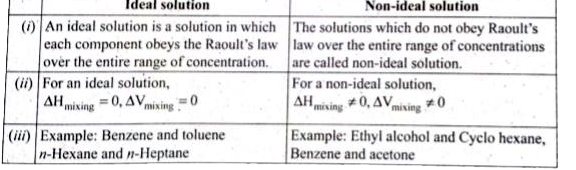
|
|
| 38. |
Differentiate between chiral and achiral molecules. |
|
Answer» Solution :A chiral MOLECULE is one that is not superimposable on its mirror IMAGE. These molecules CONTAIN one asymmetric or chiral CARBON atom. For EXAMPLE, butan-2-ol. An achiral molecule, on the other hand, is one which is superimposable on its mirror image. For example, propan-2-ol. |
|
| 39. |
Differentiate between a. quicklime b. limewater c. slaked lime |
Answer» Solution :POINTS of DIFFERENCE between quiklime, limewater and SLAKED LIME are as follows: 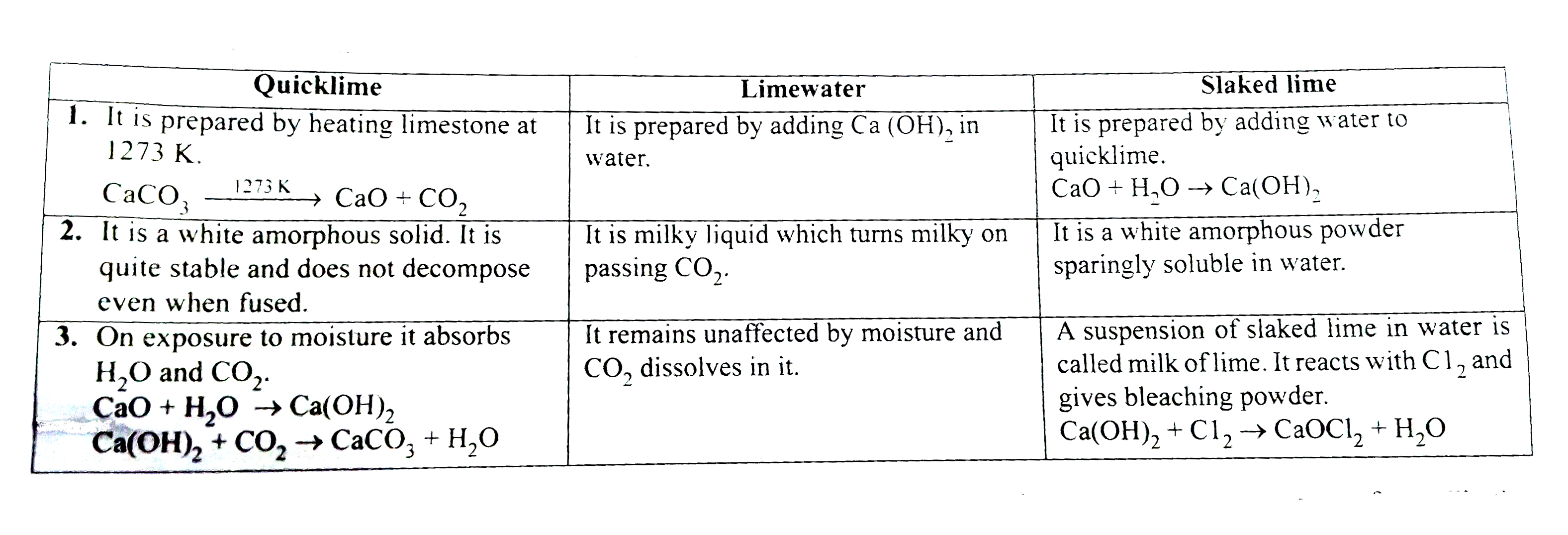
|
|
| 40. |
Differentiate atomic orbitals and hybrid orbitals. |
Answer» SOLUTION :
|
|
| 41. |
Differentiate an element and an atom |
|
Answer» Solution :An atom is the ultimate smallest ELECTRICALLY NEUTRAL, being made up of fundamental particles such as proton, neutron and electron. . An element CONSISTS of only one type of ATOMS. Elements are further divided into metals, non-metals, and metalloids |
|
| 42. |
Different water samples A, B, C and D have 150 ppm each of CaCl_2, MgSO_4, CaSO_4, and MgCl_2 respectively. The order of degree of hardness of these samples is |
|
Answer» `D GT A gt B gt C` |
|
| 43. |
Different values of 'm' for a given 'I' value represent different _______ of orbitals in space. |
|
Answer» orientation |
|
| 44. |
Different value of R and its units. |
Answer» SOLUTION :
|
|
| 45. |
different structures generated due to rotation about CC axis of a organic molecule are explain of. |
|
Answer» GEOMETRICAL isomerism |
|
| 46. |
Different samples of water containing each 100 ppm of CaCl_(2),MgSO_(4),CaS_(4) and MgCl_(2) among them which will have greater hardness/ |
|
Answer» `CaCl_2` |
|
| 47. |
Different possible thermal decomposition pathways for peroxyesters are shown below. Match each pathway from List-I with an appropriate structure from List II and select the correct answer using the code given below the lists. |
|
Answer» <P>`{:(P,Q,R,S),(1,3,4,2):}` |
|
| 48. |
Different conformations of the same molecule are called |
|
Answer» Isomers |
|
| 49. |
different arrangement of constituent particle in different directions. |
|
Answer» |
|