

Saved Bookmarks
This section includes 7 InterviewSolutions, each offering curated multiple-choice questions to sharpen your Current Affairs knowledge and support exam preparation. Choose a topic below to get started.
| 1. |
Explain Heat Capacity. |
|
Answer» Solution :The quantity of heat required for increase in TRANSFER by 1 °C of any substance is called heat capacity (C) of that substance. `q= C. Delta T` where, `C=` Heat capacity We can measure the heat supplied by monitoring the temperature rise, PROVIDED we know the heat capacity. When C is large, a GIVEN amount of heat results in only a small temperature rise. Water has a large heat capacity i.e., a lot of energy is needed to raise its temperature. C is directly proportional to amount of substance. Molar Heat Capacity : Molar heat capacity of a substance, is the heat capacity for one mole of the substance and is the quantity of heat needed to raise the temperature of one mole by one degree celsius. Molar Heat Capacity `C_(m) = ((C)/( n))` Specific Heat Capacity : The specific heat capacity is the quantity of heat required to raise the temperature of one unit mass of a substance by one degree celsius. `q=c xx m xx Delta T = C Delta T` ( m = mass of substance) |
|
| 2. |
Explain Hard and Soft water |
|
Answer» Solution :Rain water is ALMOST pure, Being a good solvent, when it flows on the surface of the earth, it dissolves many salts. Presence of calcium and magnesium salts in the form of hydrogencarbonate, chloride andsulphate in water makes water .hard.. Hard water does not give LATHER with soap. Water free from soluble salts of calcium and magnesium is CALLED Soft water. It gives latherwith soap easily. Hard water forms scum/precipitate with soap. Soap containing sodium stearate `(C_17 H_35 COONa)`. Reacts with hard water to precipitate out Ca/Mg stearate. `2C_17H_35COONa_((AQ)) + M_((aq))^(2+) to (C_17H_35COO)_2M darr + 2Na_((aq))^(+)`, M is Ca/Mg It is, therefore, unsuitable for laundry. It is harmful for boilers as well, because of deposition of salts in the form of scale. This reduces the EFFICIENCY of the boiler. The hardness of water is of two types: (i) temporary hardness, and (ii) permanent hardness. |
|
| 3. |
Explain halogenation of benzene with example of chlorination. |
|
Answer» Solution :(a) Chlorination and bromination of benzene gives chlorobenzene and bromobenzene respectively. Reactant of chlorination : Chlorobenzene Catalyst of chlorination: Anhydrous `FeCl_(3)` or `AlCl_(3)` Electrophiles : Cl + (Chloronium ion) Mechanism of reaction : electrophilic substitution reaction of aromatic ring.  (b) Mechanism of chlorination reaction of benzene : Reaction occurs in two steps. (i) Occurring of electrophilic reactant `Cl^(o+)` : Catalyst anhydrous `AlCl_(3)` or anhydrous `FeCl_(3)` react with `Cl_(3)` molecule and produce electrophilic chloronium ions `(Cl^(o+))`.  (ii) Carbocation OR Arenium ion OR Formation of `sigma`-COMPLEX OR Electrophilic substitution reaction : Step-1 : Electrophilic `Cl^(+)`, destroy `pi` electron CLOUD of benzene and attached one carbon. And form INTERMEDIATE sigma complex.  In ` sigma`-complex on carbon is `sp^(3)`. So `sigma`- complex is not aromatic. THOUGH intermediate resonance of `sigma`-complex is stable. It has (A), (B), (C) resonance structureand hybrid structure (D). The carbon of `sigma`-complex possess positive charge, it is carbocation.  Step-2 : In this step `pi`-bond is formed. `FeCl_(4)^(-)//AlCl_(4)^(-)` accept `H^(+)` from the `sigma`-complex. This step has bond formation so it is FAST step.  In step-I electrophilic group is added. So mechanism of this reaction is electrophilic in nature. And product obtained by substitution of H from the benzene by Cl group is electrophilic type. |
|
| 4. |
Explain Groupwise electronic configuration. |
|
Answer» Solution :Elements in the same vertical column or group have SIMILAR valence shell ELECTRONIC configurations, the same number of electrons in the outer ORBITALS and similar properties. e.g. The group 1 elements (alkali metals `ns^(1)` have his valence shell electronic configuration as shown below :  Thsu it can be see that the properties of an element have periodic dependence upon its ATOMIC number and not on relative atomic MASS . |
|
| 5. |
Explain graphite. |
|
Answer» SOLUTION :Graphite has layered structure. Layers are held by van der Waals forces and distance between two layers is 340 PM. Each layer is composed of planar hexagonal rings of carbon ATOMS. C-C bond length within the layer is 141.5 pm. Each carbon atom in hexagonal ring UNDERGOES `sp^2` hybridisation and makes three sigma bonds with three neighbouring carbon atoms Fourth electron forms a `pi`-bond. The electrons are delocalized over the whole sheet. Electrons are mobile and therefore, graphite conducts electricity along the sheet. Graphite cleaves easily between the layers and therefore, it is very soft and slippery. For this reason graphite is used as a dry lubricant in machines running at high TEMPERATURE, where oil cannot be used as a lubricant. 
|
|
| 6. |
Explain, giving reasons, which of the following sets of quantum numbers are not possible. (a) n=0, l=0, m_(1)=0, m_(s)= +1//2 (b) n=1, l=0, m_(l)=0, m_(s)=-1//2 (c) n=1, l=1, m_(l)=-0, m_(s)=+1//2 (d) n=2, l=1, m_(l)=0, m_(s)=-1//2 (e) n=3, l=3, m_(l)=-3, m_(s)=+1//2(f) n=3, l=1, m_(l)=0, m_(s)=+1//2 |
|
Answer» Solution :(a) Not possible because `n ne 0` (b) Possible (c) Not possible because when `n=1, L ne 1` (d) Possible (E) Not possible because when `n=3, l ne 3`. (F) Possible. |
|
| 7. |
Explain graphical representation of Charle's law on effect of volume v/s |
| Answer» Solution :The equation `V=K_(2)T` is similar to `y=mX`.Hence a graph of volume along y-axis and temperature in kelvin scal along X-axis be a striaght be a stright LINE PASSING through ORIGIN. Its slope represents `K_(2)`. | |
| 8. |
Explain graphical representation of Boyle's law on effect of pressure v/s volume. |
| Answer» Solution :Boyls.s law can also be represented graphically by plotting PRESSURE along y-axis and VOLUME along x-axis. It is to be noted that v decreases as P increases. HOWEVER, the product `PxxV` always remains unchanged at a given temperature. Since temperatureis KEPT constant, these graphs of P versus V are called isotherms. | |
| 9. |
Explain giving reasons whether BH_(4)^(-) and H_(3)O^(+) will have same or differnent geometry . |
|
Answer» SOLUTION :Central atom in both the IONS is SURROUNDED by same number of paris of VALENCE electrons ,i.e., 4 Hence , they have the same geometry, viz., tetrahedral. |
|
| 10. |
Explaingivingreasonswhich of the followingsetsof quantumnumberare notpossible (a )n=0, l=0m_(l)= 0, m_(s ) =+ (1)/(2) ( b)n=1 , l = 0 m_(l)= 0, m_(s )= - (1)/(2) ( c)n=1 , l = 1, m_(l ) = 0, m_(s ) = + (1)/(2) (d ) n= 2, l = 1, m_(l ) = 0,m_(s )= (1) /(2) ( e) n=3, l = 3,m_(l)= 3, m_(s )= + (1)/(2) (f ) n=3,l = 1,m_(l) = 0, m_(s) l =+ (1)/(2) |
|
Answer» Solution :thefollowingsets of quantumnumbersare notpossible ( a)n=0is notpossibleas the VALUE ofremain1,2,3,…n (c ) ifn=1 than l= 1 is not possibleas the VALUEOF l always(n-1)to 0 (zero ) (e )n=3 = l isnotpossibleas thevalueof 1remainsbetween(n-1)to 0 (zero ) . so the (NOTE : B,df are possible |
|
| 11. |
Explain giving reasons "The presence of CO reduces the amount of haemoglobin available in the blood for carrying oxygen to the body cells." |
|
Answer» Solution :CO combines with haemoglobin of the red blood corpuscles (RBC) about 200 times more easily than oxygen to FORM CARBOXYHEMOGLOBIN reversibly as follows: `Hb+CO hArr HbCO` Thus, it is not able to combine with oxygen to form oxyhemoglobin and transport of oxygen to different body CELLS cannot take PLACE |
|
| 12. |
Explain Gibb's energy change and equilibrium. |
Answer» Solution :In a reversible reaction `A + B hArr C + D`, the same EQUILIBRIUM can be attained from either DIRECTION. If A and B are mixed, Gibb's free energy of the system decreases. This continues until the equilibrium STATE is reached. At this state, the Gibb's free energy is minimum. It does not change further. If C and D are mixed, the GIbb's free energy decreases. THis also LEADS to the same state of equilibrium.  `Delta G = 0` at equilibrium. This is the state of minimum Gibb's energy. |
|
| 13. |
Explain : Gay Lussac.s Law. |
|
Answer» Solution :Pressure in well inflated tyres of automobiles is almost constant, but on a hot summer day tyre may burst if pressure is not adjusted properly. During winters on a COLD morning one may find the pressure in the tyres of a vechicle decreased considerably. Law :At constant volume, pressure of a fixed amount of a gas varies directly with the temperature. The rule as mathematically : `p prop T` (at constant V) ....(Eq. - i) and `p=K_(3)T` (at constant V) ....(Eq. -ii) So, `(p)/(T)=K_(3)=` constant.....(Eq.-iii) Law : ..At constant volume ratio of pressure and ABSOLUTE temperature of gas is constant... Formula of changes of temperature and pressure at constant volume : Suppose, at constant volume initial pressure is `p_(1)` and initial temperature `T_(1)` and final pressure is `p_(2)` and final temperature is `T_(2)`. According to GAY Lussac.s Law, `(p_(1))/(T_(1))=k_(3)=(p_(2))/(T_(2))` Thus, `(p_(1))/(T_(1))=(p_(2))/(T_(2)) ""`....(Eq. -iv) and `(p_(1))/(p_(2))=(T_(1))/(T_(2)) ""` ....(Eq. -v) and `p_(1)T_(2)=p_(2)T_(2) ""`.....(Eq. - vi) Isocore Graph : Pressure vs temperature (Kelvin) graph at constant molar volume is shown in Fig.  The graph is a strait line with positive slope. Each line of DIFFERENT volume `(V_(1),V_(2),V_(3),V_(4))` are isochore. All the isohores expanded to low temperature are gathered at origin point. `therefore` At zero K temperature, pressureis zero therefore at zero K temperature there is no gaseous state. We can get Gay Lussac.s law by using Boyle.s and Charle.s law. |
|
| 14. |
Explain Gay Lussac Law. |
|
Answer» Solution : ..At constant volume FIXED amount of any gas is directly PROPORTIONAL to its absolute temperature... `p PROP T` (constant n, V) |
|
| 15. |
Explain Gay Lussac's law. |
|
Answer» Solution :In states that .. pressure of a fixed mass of a GAS at constant volume is directly proportional to the temperature of kelvin SCAL...MATHEMATICALLY. `P prop T` (At constant) `P=K_(3) T or (P)/(T)=k_(3)a` constant, if volume is constant. The equation `P=K_(3)T` 1 g of the type y=mx. Hence a graph of pressure along y-axis and temperature (kelvin) along x-axis is a straight LINE passing through the origin. its slope represents `K_(3)`. the law can also can be written as `(P_(1))/(T_(1))=(P_(2))/(T_(2))`, if volume is constant. |
|
| 16. |
Explain Gattermann reaction. |
Answer» Solution :Gattermann reaction . The reaction in which BENZENE DIAZONIUM CHLORIDE react with copper in the presence of HCl , chlorobenzene is formed , called Gattermann reaction . 
|
|
| 17. |
Explain fullerenes. |
|
Answer» Solution :Fullerenes are made by the heating of graphite in an electric arc in the presence of inert gases such as helium or argon. The sooty material formed by condensation of vapourised `C^n` small molecules consists of mainly `C_60` with smaller quantity of `C_70` and TRACES of fullerenes consisting of even number of carbon atoms upto 350 or above. Fullerenes are the only pure FORM of carbon because they have smooth structure without having .dangling. bonds. Fullerenes are cage like molecules. `C_60` molecule has a shape like soccer ball and called Buckminsterfullerene.  It contains twenty six-membered rings and twelve five-membered rings. A six-membered ring is fused with six or five membered rings but a five membered ring can only fused with six membered rings. All the carbon atoms are equal and they undergo `sp^2` hybridisation. Each carbon atom forms three sigma bonds with other three carbon atoms. The remaining electron at each carbon is delocalised in molecular orbitals, which in turn GIVE aromatic CHARACTER to molecule. This ball shaped molecule has 60 vertices and each one is occupied by one carbon atom and it also contains both single and double bonds with C-C distances of 143.5 pm and 138.3 pm respectively. Spherical fullerenes are also called bucky balls in short It is very important to know that graphite is thermodynamically most stable allotrope of carbon and therefore, `Delta_fH^ɵ` of graphite is taken as zero. `DeltafH^ɵ` values of diamond and fullerene, `C_60` are 1.90 and 38.1 kJ `"mol"^(-1)` respectively. Other forms of elemental carbon like carbon black, COKE and charcoal are all impure forms of graphite or fullerenes. Carbon black is obtained by burning hydro carbons in a limited supply of air. Charcoal and coke are obtained by heating wood or coal respectively. |
|
| 18. |
Explain Friedel -Craft's acylation with an example. |
Answer» Solution :FRIEDEL Craft.s ACYLATION : Reaction between benzene and acetyl chloride in presence o anhydrous `AlCl_(3)`, is CALLED riedel -craft.s acylation. 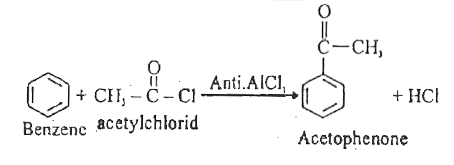
|
|
| 19. |
Explain free expansion. |
|
Answer» <P> Solution :EXPANSION of a gas in vacuum `(p_(ex) = 0)` is called free expansion. No work is done during free expansion of an ideal gas whether the process is reversible or irreversible.Now, we can write equation-(i) in number of ways depending on the type of processes. Let us substitute `W=- p_(ex) Delta V` in equation-(i), and we get `Delta U= q-p_(ex) Delta U "where",(w=p_(ex) Delta V)` If a process is CARRIED out at constant volume `(Delta V= 0)`, then `Delta U= q_(V)` The subscript V in `q_(V)` denotes that heat is supplied at constant volume. |
|
| 20. |
Explain formation of London forces. |
|
Answer» Solution :Atoms and nonpolar MOLECULES are electrically symmetrical and have no dipole moment because their electronic CHARGE cloud is symmetrically distributed. But a dipole may develop momentarily even in such atoms and molecules. Suppose we have two atoms .A. and .B. in the close vicinity of each other.  It may so happen that momentarily electronic charge distribution in one of the atoms .A., becomes unsymmetrical i.e., the charge cloud is more on one side than the other.  This results in the development of instantaneous dipole on the atom .A. for a very SHORT time. This instantaneous or transient dipole distorts the ELECTRON density of the other atom .B., which is close to it and as a consequence a dipole is induced in the atom .B.. The temporary dipoles of atom .A. and .B. attract each other. Similarly temporary dipoles are induced in molecules also. |
|
| 21. |
Explain force polishing of glass ? |
| Answer» Solution :On heating, the glass MELTS and the surface of the LIQUID TENDS to TAKE the rounded shape at the edges which makes the edges which makes the edges smooth. This is called fire POLISHING of glass. | |
| 22. |
Explain following terms : (i) u_(mp)(ii) u_(av)(iii)u^(2) (iv)u_(rms) |
|
Answer» Solution :(i) Most probable speed `(u_(mp))` : At fixed temperature, MAXIMUM number of molecule of gas. `u_(mp)=sqrt((2RT)/(M))=0.816xx u_(rms) ""`…..(EQ. -i) (ii) AVERAGE speed `(u_(av))` : Different velocity average at molecules of gas is known as average speed. `u_(av)=(u_(1)+u_(2)+u_(3)+.....u_(n))/(n)` where, `u_(1), u_(2), u_(3)` .... = speed of different molecule and n = number of molecules of gas. `u_(av)=sqrt((8RT)/(M))` (iii) Square of average speed of molecules `(u^(2))` :Square of average speed of molecule is kinetic energy of molecules of gas. `bar(u)^(2)=(u_(1)^(2)+u_(2)^(2)+.......u_(n)^(2))/(n) ""` ....(Eq. -ii) `u^(2)=(3RT)/(M) ""`......(Eq. - iii) `(u_(rms))` : 1 root `(bar(u)^(2))` average speed square speed is known as `(u_(rms))`. `u_(rms)=sqrt(bar(u)^(2))=sqrt((u_(1)^(2)+u_(2)^(2)+u_(3)^(2)+......)/(n)) ""`......(Eq. - IV) |
|
| 23. |
Explain-Finkelstein reaction. |
| Answer» Solution :Chloro (or) bromoalkane on heating with sodium iodide in dry acetone GIVES iodo alkane.This reaction is called Finkelstein reaction.<BR> `underset("Bromoethane")(CH_(3)- CH_(2)) Br + Nal to Cunderset("Iodoethane")(H_(3) - CH_(2) I) + NABR` | |
| 24. |
Explain following terms :(i) Isotherm (ii) Isochore (iii) Isobar |
|
Answer» SOLUTION :(i) Isotherm : At CONSTANT temperature the graph of gas plotted between VOLUME and PRESSURE is e.g. : Boyle.s Law (ii) Isochore : At constant volume the graph of has plotted between temperature and pressure is KNOWN as Isochore. e.g. : Gay Lussac.s Law (iii) Isobar : At constant pressure the graph of gas plotted between volume and temperature is known as isobar. e.g. : Charle.s Law |
|
| 25. |
Explain factors affecting equilibria. |
|
Answer» SOLUTION :Factors affecting equilibrium are: A chemical reaction at equilibrium will maintain its equilibrium concentrations indefinitely unless it is disturbed. Such disturbances (also called constraints or stresses) include a change in TEMPERATURE, a change in concentration of a reactant or product, and a change in pressure within the reacting mixture. The effect of temperature and pressure on the position of equilibrium of a reversible reaction can be calculated quantitatively. However, the effect of concentration, temperature and pressure can be predicted qualitatively with the help of a generalisation proposed by Le-Chatelier, a French chemist in 1884. This PRINCIPLE is based fundametanlly on the SECOND LAW of thermodynamics. |
|
| 26. |
Explain factors affect the boiling point. |
|
Answer» Solution :Boiling point : The temperature at which vapour PRESSURE is equal to 1 atmosphere, that temperature is called boiling point of liquid. Liquid of boiling point effect the following FACTORS. Nature of liquid : Each liquid has definite boiling point. If the intermolecular attraction FORCE in liquid is LESS them boiling point is less hence, the vapour pressure is more. Such liquid are more volatile and their boiling point is less. e.g., Boiling point of water is `(100^@C)`, Ethanol `(78^@C)` and Ether `(34^@C)`. Pressure : At boiling point liquid and its vapour is in equilibrium at 1 atmosphere pressure. If atmospheric pressure is less, so boiling point also less. Hence boiling point depends on height. e.g.-1 : On mountain atmosphere pressure is less, so water BOILS at law temperature it means boiling point of water is less. e.g.-2: In Pressure cooker, pressure is more so boiling point of water is more. |
|
| 27. |
Explain f-block elements of period in detail. |
|
Answer» Solution :The two rows of elements at the bottom of the Periodic Table, called the Lanthanoids, Ce (Z = 58) - Lu (Z = 71) and Actinoids, Th (Z = 90) - Lr (Z = 103) are characterised by the outer electronic configuration `(n -2) f^(1-14) (n -1) d^(0-1) ns^(2)`. The LAST electron added to each element is filled in f-orbital. These two series of elements are hence called the Inner-Transition Elements - BLOCK Elements). They are all metals. Within each series, the properties of the elements are quite similar. The chemistry of the early actinoids is more COMPLICATED than the corresponding lanthanolds, due to the large number of oxidation states possible for these actinoid elements. Actinoid elements are radioactive. Many of the actinoid elements have been made only in nanogram QUANTITIES or even less by nuclear reactions and their chemistry is not fully studied. The elements after URANIUM are called Transuranium Elements. |
|
| 28. |
Explain extensive property and intensive property. |
|
Answer» Solution :Extensive property : An extensive property is a property WHOSE VALUE depends on the QUANTITY or size of matter present in the system. e.g., mass, volume, internal energy, enthalpy, heat capacity, etc. Intensive property : Intensive property is those properties which do not DEPEND on the quantity or size of matter present e.g., temperature, density, pressure etc. A molar property, `chi_(m)`, is the value of an extensive property `chi` of the system for 1 mol of the substance. If n is the amount of matter, `chi_(m) = (chi)/( n)` is independent of the amount of matter. Other examples are molar volume, `V_(m)` and molar heat capacity, `C_(m)`. Take a gas enclosed in a container of volume V and at temperature T [Fig. (a)). Let us make a PARTITION such that volume is halved, each part [Fig. 6.6 (b)]  Now has one of the original volume `{:(V),(2):}`, but the temperature will still remain the same. Therefore, it is clear that volume V is an extensive property and temperature T is an intensive property. |
|
| 29. |
Explain equilibrium of gases in liquids. |
|
Answer» Solution :There is saturated solution with high pressure of `CO_2` gas in closed soda WATER bottle. There is an equilibrium between the atoms of `CO_2` dissolves in water and of gaseous state. `CO_(2"(gas)") hArr CO_(2"(in solution)")`….(i) (Fix pressure and temperature) Henry.s law : Due to dissoluble gas is due to Henry.s Law which states that "the mass of a gas dissolved in a given mass of a solvent at any temperature is proportional to the pressure of the gas above the solvent." mass `prop` pressure This AMOUNT decreases with increase of temperature. And if pressure decreases so, solubility decreases. In SHORT, solubility of gas `prop`pressure of gas. .(constant T and p) The soda water bottle is sealed under pressure of `CO_2` gas when its solubility in water is high. As soon as the bottle is opened, some of the dissolved `CO_2` gas escapes to reach a new equilibrium condition required for the lower pressure, namely its partial pressure in the atmosphere. This is how the soda water in bottle when left open to the air for some time, TURNS .flat. |
|
| 30. |
Explain equilibrium involving dissolution of solid in liquid. |
|
Answer» Solution :A limited AMOUNT of salt or sugar dissolve in a given amount of water at room temperature. A thick sugar syrup solution by dissolving sugar at a higher temperature, sugar crystals separate out if cool the syrup to the room temperature. "The solution contain sugar crystal in water is called saturated solution." OR "The saturated solution when no more of solute can be dissolved in it at a given temperature." In a saturated solution, a DYNAMIC equilibrium exits between the solute molecules in the solid state and in the solution. e.g.: `"Sugar"_"(solution)" hArr "Sugar"_"(solid)"` and (The rate of dissolution of sugar ) = (Rate of crystallisation of sugar) In forward reaction, the dissolution of solid in to solution and in reverse reaction the crystallisation OCCURS. Dynamic equilibrium : Saturated solution is a dynamic equilibrium and the rate is same of dissolution of sugar and crystallisation of sugar in solution. Equality of the two rates and dynamic nature of equilibrium has been confirmed with the help of radioactive sugar. If we drop some radioactive sugar into saturated solution of non-radioactive sugar, then after some time radioactivity is observed both in the solution and in the solid sugar. Initially there were no radioactive sugar molecules in the solution but due to dynamic nature of equilibrium, there is exchange between the radioactive and non-radioactive sugar molecules between the two phases. The ratio of the radioactive to nonradioactive molecules in the solution increases TILL it attains a constant value. non-radioactive sugar (solution)`hArr` non-radioactive sugar (solid) and after added (Radioactive sugar) `["(non-radioactive sugar)"+"(radioactive sugar)"]_"solution" hArr ["(non-radioactive sugar)"+"(radioactive sugar)"]_"solid"`...(i) The solubility of solid (sugar) in saturated solution depends upon the temperature. Saturated solution is in open VESSEL but system is closed because it is equilibrium between the molecules of solid and solid in solution. |
|
| 31. |
Explain equilibrium in soda water and explain it by Henry's law. |
|
Answer» SOLUTION :There is saturated solution with high pressure of `CO_2` gas in closed soda water bottle. There is an equilibrium between the atoms of `CO_2` dissolves in water and of GASEOUS STATE. `CO_(2"(gas)") hArr CO_(2"(in solution)")`….(i) (Fix pressure and temperature) Henry.s law : Due to dissoluble gas is due to Henry.s Law which states that "the mass of a gas dissolved in a given mass of a solvent at any temperature is proportional to the pressure of the gas above the solvent." mass `prop` pressure This amount decreases with increase of temperature. And if pressure decreases so, solubility decreases. In short, solubility of gas `prop`pressure of gas. .(constant T and p) The soda water bottle is sealed under pressure of `CO_2` gas when its solubility in water is high. As soon as the bottle is opened, some of the dissolved `CO_2` gas ESCAPES to reach a new equilibrium condition required for the lower pressure, namely its partial pressure in the atmosphere. This is how the soda water in bottle when left open to the air for some time, TURNS .flat. |
|
| 32. |
Explain equilibrium in saturated solution and its dynamic nature. |
|
Answer» Solution :A limited amount of salt or sugar dissolve in a given amount of water at room temperature. A thick sugar syrup solution by DISSOLVING sugar at a higher temperature, sugar crystals separate out if cool the syrup to the room temperature. "The solution contain sugar crystal in water is called saturated solution." OR "The saturated solution when no more of solute can be dissolved in it at a given temperature." In a saturated solution, a dynamic equilibrium exits between the solute molecules in the solid state and in the solution. e.g.: `"Sugar"_"(solution)" hArr "Sugar"_"(solid)"` and (The rate of dissolution of sugar ) = (Rate of CRYSTALLISATION of sugar) In forward reaction, the dissolution of solid in to solution and in reverse reaction the crystallisation occurs. Dynamic equilibrium : Saturated solution is a dynamic equilibrium and the rate is same of dissolution of sugar and crystallisation of sugar in solution. Equality of the two rates and dynamic nature of equilibrium has been confirmed with the help of RADIOACTIVE sugar. If we drop some radioactive sugar into saturated solution of non-radioactive sugar, then after some time radioactivity is observed both in the solution and in the solid sugar. Initially there were no radioactive sugar molecules in the solution but due to dynamic nature of equilibrium, there is exchange between the radioactive and non-radioactive sugar molecules between the two phases. The ratio of the radioactive to nonradioactive molecules in the solution increases till it attains a constant value. non-radioactive sugar (solution)`hArr` non-radioactive sugar (solid) and after added (Radioactive sugar) `["(non-radioactive sugar)"+"(radioactive sugar)"]_"solution" hArr ["(non-radioactive sugar)"+"(radioactive sugar)"]_"solid"`...(i) The SOLUBILITY of solid (sugar) in saturated solution depends upon the temperature. Saturated solution is in open VESSEL but system is closed because it is equilibrium between the molecules of solid and solid in solution. |
|
| 33. |
Explain equilibrium constant (or) equilibrium law. |
|
Answer» Solution :At any time, rate of the FORWARD reaction is given by the equation `V_(1)=K_(1)[A][B]_(1)` where `k_(1)` is the rate constant of the forward reaction. Similarly, rate of the backward reaction is given by the equation `v_(2)=k_(2)[C][D]` where `k_(2)` is the rate constant of the backward reaction. At equilibrium, The rate of the forward reaction - the rate of the backward reaction, i.e., `v_(1)=v_(2)` `k_(1)[A][B]=k_(2)[C][D]` `k_(1)/k_(2)=K_(c)=([C][D])/([A][B])` where, `K_(c)` is a constant called equilibrium constant. `K_(c)=k_(1)/k_(2)andK_(c)=([C][D])/([A][B])` at equilibrium This equation is called equilibrium equation. i.e., in general, for a reaction, `aA+bBhArrcC+dD`, the equilibrium equation is `K_(c)=([C]^(c)[D]^(d))/([A]^(a)[B]^(b))` at equilibrium. `K_(c)` is also known as 'equilibrium constant in TERMS of molar concentration'. Equilibrium constant is the ratio of the rate constant of the forward reaction to the rate constant of the backward reaction. Equilibrium constant is the ratio of product of molar concentrations of the products to that of the reactants at equilibrium, the concentrations being raised to the power of the respective number of moles of the species as represented in the balanced CHEMICAL equation. This statement is called "The Law of Chemical Equilibrium" or "Equilibrium Law". |
|
| 34. |
Explain : Enthalpy : state function.ORDelta H= q_(p) Or Prove : "The change in enthalpy of the system in which chemical reaction occurs is equal to value of heat gain by system." |
|
Answer» SOLUTION :`Delta U= q+w` we may WRITE as `Delta U = q_(p) - pDelta V` at constant pressure, where `q_(p)=` heat absorbed by system `pDelta V=` expansion work done by system When heat is absorbed at constant pressure by system, internal energy turns form `U_(1)` to `U_(2)` and volume turns `V_(1)` to` V_(2)`. `therefore Delta U= U_(2) - U_(1)` `Delta V= V_(2) - V_(1)` Put this value in above equation. `therefore U_(2) - U_(1) = q_(p) - p (V_(2) - V_(1) )` `q_(p) = (U_(2) - U_(1) ) + P (V_(2) - V_(1) )` `q_p = (U_(2) + pV_(2)) - (U_(1) + pV_(1) ) ""...(i)` here, `U+pV` is a state function. It is mentioned as H `H= U+ pV""...(ii)` `therefore q_(p) = H_(2) - H_(1) = Delta H` H is a state function, because, U, p, V are state functions, for fixed change at constant pressure, `Delta H = Delta U + pDelta V ""...(iii)` `Delta H` is positive for endothermic reactions which ABSORB heat from the surroundings and `Delta H` is NEGATIVE for exothermic reactions which evolve heat during the reaction. |
|
| 35. |
Explain entropy and spontaneity of reactions. OR Explain entropy and spontaneity. |
|
Answer» SOLUTION :`1/2N_(2(g)) + (3)/(2) H_(2(g)) = NH_(3(g)), Delta_(r) H^( Theta ) = -46.1` kj/mol `(1)/(2) H_(2(g)) + (1)/(2) CI_(2(g)) = HCI_((g)) , Delta_(r) H^( Theta )= -92.32` kj/mol `H_(2(g)) + (1)/(2) O_(2(g)) = H_(2) O_((g)) , Delta_(r) H^( Theta ) = -285.8` kj/mol The decrease in ENTHALPY is passing from reactants to products may be shown for any exothermic reaction on an enthalpy diagram as shown in FIG. (a).  Figure-(a) Enthalpy diagram for exothermic reactions Thus, the postulate that driving force for a chemical reaction may be DUE to decrease in energy sounds .reasonable. as the basis of evidence so far ! Endothermic reaction : `(1)/(2) N_(2(g)) + O_(2(g)) to NO_(2(g)) , Delta_(r) H^( Theta ) = + 33.2` kj/mol `C_((s)) + 2S_((l)) + CS_(2(l)) ,Delta_(r) H^( Theta ) = + 128.5` kj/mol These reactions though endothermic, are spontaneous. The increase in enthalpy may be represented on an enthalpy diagram as shown in Fig.-(b).  Figure-(b) : Enthalpy diagram for endothermic reactions Therefore, it becomes obvious that while decrease in enthalpy may be a contributory factor for spontaneity, but it is not true for all cases. |
|
| 36. |
Explain Enthalpy of Solution (Delta_("sol") H^( Theta ) ). |
|
Answer» Solution :Enthalpy of solution of a substance is the enthalpy change when one mole of it dissolves in a specified amount of SOLVENT. The enthalpy of solution at infinite dilution is the enthalpy change observed on dissolving the substance in an infinite amount of solvent when the interactions between the ions are negligible. When an ionic compound dissolves in a solvent, the ions leave their ordered positions on the crystal lattice. These are now more free in solution. But salvation of these ions also occurs at the same time. This is shown diagrammatically, for an ionic compound, `AB_((s))`·  `Delta_("SOL")H^( Theta ) = Delta_("lattice")H^( Theta ) + Delta_("HYD") H^( Theta )` For most of the ionic COMPOUNDS, `Delta_("sol")H^( Theta )` is positive and the dissociation process is endothermic. |
|
| 37. |
Explain Enthalpy of atomization (Delta_(a) H^( Theta )). |
|
Answer» Solution :To break one mole of bonds completely to OBTAIN atoms in the gas phase is CALLED enthalpy of atomization." `H_(2(g)) to 2H_((g)), Delta_(a) H^( THETA ) = 435.0 "kj/mol"` During this process H atoms are formed by breaking H-H bonds in dihydrogen. The enthalpy change in this process is known as enthalpy of atomization `Delta_(a) H^( Theta) `. The enthalpy of atomization is also the bond dissociation enthalpy. e.g., `CH_(4(g)) to C_((g)) + 4H_((g)) ,Delta_(a) H^( Theta ) = 1665 "kj/mol"` `Na_((s)) to Na_((g)) , Delta_(a) H^( Theta ) = 108.4 "kj/mol"` In this case, the enthalpy of atomization is same as the enthalpy of sublimation. |
|
| 38. |
Explain enthalpy changes during phase transformations. |
|
Answer» Solution :Standard enthalpy of fusion `(Delta_("fus") H^(Theta) )` (molar enthalpy of fusion) : The enthalpy change that accompanies melting of one mole of a solid substance in standard state is called standard enthalpy of fusion or molar enthalpy of fusion, `Delta_("fus") H^(Theta)` `H_(2) O_((s) ) to H_(2) O_((l)) , Delta_("fus")H^(Theta) = 6.00 "kj mol"^(-1)` Melting of a solid is endothermic, so all enthalpies of fusion are positive. Water requires heat for evaporation at constant temperature of its boiling point `T_(B)` and at constant pressure. Standard enthalpy of vaporization or molar enthalpy of vaporization `(Delta_("vap") H^( Theta) ) :` Amount of heat required to VAPORIZE one mole of a liquid at constant temperature and under standard pressure (1 bar) is called its standard enthalpy of vaporization or molar enthalpy of vaporization `Delta_("vap")H^( Theta)` `H_(2) O_((l)) to H_(2) O_((g)), Delta_("vap")H^(Theta) = +40.79 "kj mol"^(-1)` Standard enthalpy of sublimation `(Delta_("SUB") H^(Theta) ):` Standard enthalpy of sublimation is the change in enthalpy when one mole of a solid substance sublimes at a constant temperature and under standard pressure (1 bar). Sublimation is direct conversion of a solid into its vapour. `CO_(2(s)) to (CO_(2 (g)) Delta_("sub") H^( Theta)= 25.2 "kj mol"^(-1)` Solid `CO_(2)` or .dry ice. sublimes at 195 K with `Delta_("sub")H^( Theta) = 25.2 kj mol^(-1)`. Naphthalene sublimes slowly and for this `Delta_("sub") H^( Theta) = 73.0 "kj mol"^(-1)` The magnitude of the enthalpy change depends on the strength of the intermolecular interactions in the substance undergoing the phase transformations. The strong hydrogen bonds between water molecules hold them tightly in liquid phase. For an organic liquid, such as acetone, the intermolecular dipole-dipole interactions are significantly weaker. Thus, it requires less heat to vaporize 1 mol of acetone than it does to vaporize 1 mol of water. Standard Enthalpy CHANGES of Fusion and Vaporisation 
|
|
| 39. |
Explain :energyphoton energyof electron andno ofphotons inphotoelectriceffect. |
|
Answer» SOLUTION :Einstein (1905)wasableto explainthe photoelectriceffect usingplankquantum theoryof electromagneticradiation . Shiminga beamof lighton toa metalsurfacecanthereforebe viewedas shooting a BEAM ofparticlethe photons.Whena photon ofsufficientenergystrikesan ELECTRONIN theatomof the metalittransfers it ENERGY instantaneouslyto theelectronduringthe collisionand theelectronis ejectedwithout any TIMELAG ordelay A moreintensebeamof lightconsistsof largernumberof photonsconsequently the numberof electronsejectedis alsolarger. |
|
| 40. |
Explain energy level diagram for molecular orbital form by 1s orbitals. OR Explain formation of H_(2) and energy level diagram of H_(2) molecule. |
|
Answer» Solution :1s atomic orbitals on two atoms (e.g. hydrogen form two molecular orbitals designated as `sigma`1s and `sigma^(**)` 1s is. `sigma` 1sis bonding molecular orbital (BMO) and `sigma`1 s is Antibonding molecular orbital (ABMO). Energy of `sigma` 1s is `LT` Energy of atomic orbital is 1s `lt sigma^(**)` 1s. (energy of `sigma` 1s + energy of `sigma^(**)` 1s) = (Edition of energy of two 1s ) The energy diagram of 1s, `sigma` 1s and `sigma^(**)` 1s is as under. Where , MO = molecular orbitals, `sigma` 1s = BMO  AO = Atomic orbitals, `sigma`1s = ABMO Note (i) Remember that in both 1s the electron spin SHOWN by `UARR and darr` (opposite). (ii) Only BMO is filled `(uarr darr)` and ABMO is empty. so, electron FIRST filled in less energy containing MO. Two MO, `sigma`1s and `sigma^(**)`1s are formed by overlapping of two 1s. Its figure is as under. 
|
|
| 41. |
Explainemissionandabsorptionspectrum |
Answer» SOLUTION :Absorptionspectra: TheelectromagneticradiationWhenappliedan objectitinteract withobject  `E_(1) =` lowerenergystate `E_(2)` = higherenergystate `DELTAE = (E_(2)- E_(1))` = Absorbed energyin emission Atomsmoleculesor ionsthat have absorbedradiationare saidto beexcited Whenelectrongoingto higherenergy levelspecificradiationwithspecificenergyisspectrum iscalledabsorptionspectra Anabsorptionspectrumis likephotograhicnegativeof anemissionspectrum Emissionspectra : Theatom inexisted star isnotstableso byrelasing energyit gainmorestablestate` (E_(1)` Atthat timeemitsradiation. Soit iscalledemissionspectrum Spectroscopy : The study ofemissionorabsorptionphaseemissionorabsorptionspectraof atom is not continous . |
|
| 42. |
Explain electronic configuration of period in periodic table. |
|
Answer» Solution :Order of period of element indicates value of principle QUANTUM number (n). When periodic order increases value of energy increases in = 1, n = 2..... etc.). Number of elements of any period are double than number of atomic ORBITALS.  The 4f and 5f - inner transition SERIES of elements are placed separately in the Table to maintain its structure and to preserve the principle of CLASSIFICATION by keeping elements with similar properties in a single COLUMN. |
|
| 43. |
Explain electronegativity of group 14 elements . |
|
Answer» Solution :Ge , Sn and Pb prefer to exhibit + 2 state because of INERT pair effect i.e., `NS^(2)` electrons remain inert and do not involve in bonding . The inert pair effect increases down the group in the order `Ge lt Sn lt Pb`. Carbon is highly electronegative with ELECTRONEGATIVITY 2.5 Si, Ge, Sn and Pb less electronegative . Hence they do not exhibit NEGATIVE oxidation states. |
|
| 44. |
Explain electronegativity of group 13 elements. |
| Answer» Solution :Group 13 elements are more ELECTRONEGATIVE than the elements of group 1 and 2 . The electronegativity first decreases from BORON to aluminium and then increases MARGINALLY down the group because atomic size increase . After aluminium due to the imperfect shielding effect of the d and f electrons the force of attraction of the nucleus TOWARDS electrons increases hence electronegativity increases . | |
| 45. |
Explain electron movement in organic reactions. |
|
Answer» Solution :All organic reactions can be understood by following the electron movements. (i) LONE OAIR becomes a bonding pair. (ii) Bonding pair becomes a lone pair. (iii) A bond breaks and becomes another bond. The electron MOVEMENT depends on the nature of the substrate, reagent and the prevailing conditions. TYPE 1. A lone pair to a bonding pair  Type 2. A bonding pair to a lone pair  Type 3. A bonding pair to an another bonding pair. 
|
|
| 46. |
Explain electron movement in organic reaction |
Answer» Solution :The MOVEMENT of electron in organic reactions can be shown by curved-arrow notation. It SHOWS how changes in bonding occur due to electronic redistribution during the reaction. To show the change in position of a pair of electrons, curved arrow starts from the point from where an electron pair is shifted and it ends at a location to which the pair of electron may move. Presentation of shifting of electron pair is GIVEN below:  From `pi` bond to adjacent bond positions.  From `pi` bond to adjacent atom  From atom to adjacent bond positions. Movement of single electron: Movement of single electron is indicated by a single barbed .fish hooks. (i.e. HALF headed curved arrow). For example: (i) Transfer of electron in ethanol from hydroxide ion is as follow.  (ii) In dissociation of chloromethane, the movement of electron using curved arrows can be depicted as FOLLOWS: 
|
|
| 47. |
Explain electron displacement effect in covalent bonds |
|
Answer» Solution :The electron displacement in an ORGANIC molecule may take place either in the ground STATE under the influence of an atom or a substituent group or in the presence of an appropriate attacking reagent. (i) The electron displacements DUE to the influence of an atom or a substituent group present in the molecule cause permanent polarlisation of the bond. Inductive effect and resonance effects are examples of this type of electron displacemnt. (II) TEMPORARY electron displacement effects are seen in a molecule when a reagent approaches to attack it. This type of electron displacement is called electromeric effect or polarisability effect. |
|
| 48. |
Explain electrometric effect. |
|
Answer» Solution :Electrometric effect : (i) The electrometric effect REFERS to the POLARITY produced in a multiple bonded compund when it is attacked by a reagent when a double or a triple bond is exposed to an attack by an electrophile the two `pi` electrons which form the `pi` bond are completely transferred to one atom or the other. (ii) When a nucleophile approaches the carbonyl compound, the `pi` electrons between C and O is instantaneously shifted to the more electronegative oxygen.This make the carbon electron deficient and thus facilitating theformation of a new bond between the incomingnucleophile and the carbonyl carbon atom.  (III) When an electrophile such as `H^(+)` approaches an ALKENE molecule the `pi` electrons are instantaneously shifted to the electrophile and a new bond is formed between carbon and hydrogen.This makesthe other carbon electron deficient and hence it acquires a POSITIVE charge.  (iv) This effect denotes as E-effect. |
|
| 49. |
Explain Electromeric effect and write about -its types |
|
Answer» Solution :Definition: The organic compounds having a multiple bond (a double or triple bond) show this effect in the presence of an attacking reagent only. It is defined as the complete transfer of a shared pair of `pi`-electrons to one of the atoms joined by a multiple bond on the demand of an attacking reagent. And this effect is CALLED electromeric effect. Characteristics of electromeric effect: The effect is annulled as soon as the attacking reagent is removed from the DOMAIN of the reaction. Electromeric effect is not permanent, it is temporary (unstable). This effect is seen in double and triple bond containing compound in presence of attacking reagent. In this effect, the ELECTRON pair transfer on anyone adjacent CARBON. It is represented by E and the shifting of the electrons is shown by a curved arrow  . There are two distinct types of electromeric effect. . There are two distinct types of electromeric effect. (a) Positive electromeric effect (+E): In this effect the electron of the multiple `pi`-bond are transferres to that atom to the multiple bond to which the reagent gets finally attached. (e.g. towards the attaching reagent) the effect is called +E effect. Example : `H^(+)` is attach to `pi`- bond of alkene and in presence of `H^(+)` the `pi` electron is transfer  (b) Negative electromeric effect (-E):Definition: If the electrons of the multiple bond are transferred to that atom of the multiple bond other than the one to which the reagent get finally attached. (i.e. away from the attacking reagent) the effect is called -E effect  When inductive effect and electromeric effects are in opposite DIRECTIONS to each other then electromeric effect is strong. |
|
| 50. |
Explain electromeric effect |
|
Answer» Solution :Electromeric effect (E) : Electromeric is a temporary effect which operates in unsaturated compounds (containing ` gt C = C lt , gt C = O ` , etc … in the presence of an attacking reagent . Let US consider two DIFFERENT compounds (i) Compounds containing carbonyl group ` ( gt C = O)` : when a nucleophile approaches the carbonyl compound , the `pi` electrons between C and O is instantaneously shifted to the more electronegative oxygen . This makes the carbon electron deficient and thus facilitating the FORMATION of a new bond between the inceoming nuceophile and the carbonyl carbon atom  (ii) Unsaturated compounds such as alkenes ` ( gt C = C lt ) ` : `square ` When an electrophile such as ` H^(+) ` approaches an alkene molecule, the ` pi` electrons are instantaneously shified to the electrophile and a new bond is formed between carbon and hydrogen . This makes the other carbon electron decient and hence it acquires a POSITIVE charge . ` (##SUR_CHE_XI_V02_C12_E01_022_S02.png" width="80%"> ` square ` When the electron is transferred towards the attacking reagnet , it is called + E (positive electromeric ) effect .  ` square` When the ` pi` electron is transfered away from the attacking reagent, it is called , E (negative electromeric ) effect . ` (##SUR_CHE_XI_V02_C12_E01_022_S04.png" width="80%"> |
|