

Saved Bookmarks
This section includes 7 InterviewSolutions, each offering curated multiple-choice questions to sharpen your Current Affairs knowledge and support exam preparation. Choose a topic below to get started.
| 1. |
Explainwhy theelectron gain enthalpy of thefluorineis lessnegativethan that of chlorine |
| Answer» Solution :In F, thenewelectronto beaddedgoes to2p- subshellwhile in C1,it goesto 3p-subshell. Since 2P- subshellin muchsmallerthat 3p-subshellthereforethe addedelectronin F experiences muchstronger REPULSIONS from otherelectronin COMPARISION tothat in C1inotherwordsF does not accepttheincoming electron a electronwith that ease withwhich C1accepts . consequently the electrongainenthalpyof F isless negative THANTHAT of C1 | |
| 2. |
Explain why the dipole moment values of hydrogen halides decrease from H-F to H-I. |
| Answer» Solution :Electronegativity of halogens decrese I the order `F GT CL gt Br lt I`. In hydrogen halides, as the difference in electronegativity between H and X (X=halogen) decreses, the bond POLARITY decreses. Hence the H-X bond dipole moment decreses from HF to HI. | |
| 3. |
Explain why the electron gain enthalpy of fluorine is less negative than that of chlorine. |
| Answer» Solution :In fluorine, the new electron to be added goes to 2p subshell while in chlorine, the added electron goes to 3p subshell. Since the 2p-subshell is relatively small as COMPARED to 3p-subshell, the added electron in small 2p subshell experiences strong INTER electronic repulsions in comparison to that in 3p subshell in Cl. As a result, the incoming electron does not feel much ATTRACTION from the nucleus and therefore, the electron GAIN enthalpy of F is less negative than that of Cl. | |
| 4. |
Explain why the dipole moment of CD_(3)F (1.858 D) is higher than that of CH_(3)F (1.847 D). |
| Answer» Solution :D is more electron releasing than H. difference in electronegativity between C and F in `CD_(3)F` is MUCH higher than that between C and F in `CH_(3)F`, HENCE, `CD_(3)F` is more polar than `CF_(3)F`. THEREFORE, DIPOLE moment of `CD_(3)F` is higher than that of `CF_(3)F`. | |
| 5. |
Explain why the addition of Br_2 to but 3,3-dimethylbut-1-ene occurs across the double bond without rearrangement of the carbon skeleton while that of HBr gives a major product with rearranged carbon skeleton. Justify your answer. |
Answer» Solution :The addition of `Br_2` across the DOUBLE bond occurs through the CYCLIC bromonium ion intermediate (I) and hence rearrangement of the carbon skeleton does not occurs to GIVE addition product (II).  In contrast, addition of HBR occurs through a carbocation intermediate. Since the initially 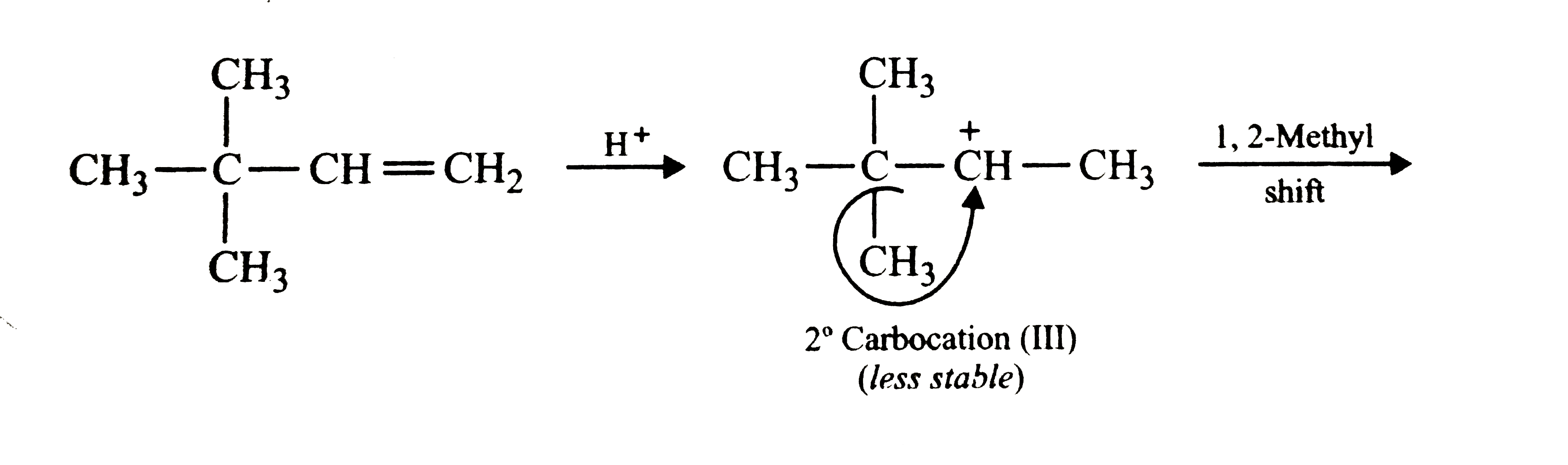 formed `2^@` carbocation (III) being less stable rearranges by 1,2-methyl shift to form the more stable carbocation (IV) which then reacts with `Br^-`to give the rearranged addition product (V). `underset"(more stable)"underset(3^@ "Carbocation (IV)")(CH_3-underset+oversetoverset(CH_3)|C-undersetunderset(CH_3)|CH-CH_3)overset(Br^-)to undersetunderset"(V)""2-Bromo-2,3-dibromobutane"(CH_3-undersetunderset(Br)|oversetoverset(CH_3)|C-undersetunderset(CH_3)|CH-CH_3)` |
|
| 6. |
Explain why the alkali metals cannot be obtained by reducting method. |
| Answer» Solution :ALKALI METALS are strong reducing AGENTS and it is difficult to reduce their oxides by any other reducing AGENT. | |
| 7. |
Explain why the aquatic species are more conmfortable in cold water during winter season rather than warm water during the summer. |
|
Answer» SOLUTION :Total pressure `= 1 atm` `P_(N2)=((80)/(100)) xx` Total pressure `= (80)/(100) xx 1 atm = 0.8 atm` ` P _(O2)= ((20)/(100)) xx 1 = 0.2 atm` According to Henry.s Law `P_("solute" ) = K _(H) X _("solute in solution") ` `THEREFORE P _(N2) = (K _(H))_("Nitrogen") xx` Mole fraction of Nitrogen in solution `(0.8)/(8.5 xx 10 ^(4)) = x _(N_(2))` `x _(N2)=9.4 xx 10 ^(-6)` Similarly `x _(O2)= (0.2)/( 4.6 xx 10 ^(4)) = 4.3 xx 10 ^(-6)` |
|
| 8. |
Explain why temperature of a boiling liquid remains constant ? |
| Answer» SOLUTION :At the boiling POINT, the heat supplied is used up in BREAKING off the intermolecular FORCES of attraction of the liquid to change it into vapour and not for RAISING the temperature of the liquid. | |
| 9. |
Explain why size of cation is smaller than of the parent atom. |
Answer» Solution :CATION is formed by the ion of one of more election from the gaseous atom . Now in CAT ion the NUCLEAR charge remains the same as that in the parent atom but the number of ELECTRONS becomes less . As a result of these , the nucleus hold on the remaining elections INCREASE because of the increase in the effective nuclear change per electron.Thus causes decrease in size , Ex: The relative size of sodium atom and sodium ion is as follows : 
|
|
| 10. |
Explainwhy siliconshowsa higher covalency than carbon. |
|
Answer» Solution :Si because of the PRESENCE ofvacantd-orbitalscan SHOW a cavalency upto SIX while because ofthe absenceof d-orbitals cannot have a covalency of more than FOUR. For example, 
|
|
| 11. |
Explain : Why real gases behave deviation than ideal gas ? |
|
Answer» Solution :We find that two ASSUMPTIONS of the kinetic theory do not hold good. There is no FORCE of attraction between the molecules of a gas : If assumption is correct, the gas will never liquify. However, we know that gases do liquify when cooled and compressed. Also, liquids formed are very difficult to compress. This means that FORCES of repulsdion are powerful enough ad prevent squashing of molecules in tiny volume. `therefore` There must be attraction force present between molecules of gases. Volume of the molecules of a gas is NEGLIGIBLY small in comparison to the space occupied by the gas : If assumption is correct, the presure vs volume graph of experimental data (real gas) and that theoretically calculated from Boyle.s law (ideal gas) should coincide But such THING is not possible so Assumptions are unfair. |
|
| 12. |
Explain why reactivity of benzene ring is increases due to presence of -OH group in phenol. |
|
Answer» SOLUTION :According to above structure of phenol, ortho and para position of -OH possess negative charge MEANS HIGH density of electrons. So electrophilic group react on ortho and para position. (a) On resonance, electron PAIR of -OH group enter into the benzene ring, so electrophilic substitution reaction becomes easy in phenol with respect to benzene. (b) -OH group has -I effect, so it will ATTRACT electrons of ring towards itself.  butstrengthof resonanceeffect` gt`strengthofinductiveeffect, soelectrondensityis moreinphenolis morereactivetowards. thebenzene ringof phenolis morereactivetowardselectrophilicreactionoccursat orthoand parapositionof -OHgroupalso-OHgroupis activatoin nature . |
|
| 13. |
Explain : Why pure liquids and solids can be ignored while writing the value of equilibrium constants. |
|
Answer» Solution :This is BECUASE MOLAR concentration of pure SOLID or liquid is independent of the amount present . Molar concentrtion `=("No. of moles")/("volume") xx ("mass ")/("Volume") xx "Density"` since density of pure liquied or solid is FIXED and molar mass is also fixed , THEREFORE molar concentration are constant. |
|
| 14. |
Explain why quaternary carbon is possible but quaternary hydrogen is not possible ? |
| Answer» SOLUTION :Quaternary carbon is attached with four different carbon and fulfill four VALENCY. So attachement of HYDROGEN is no possible with quanternary carbon. So quanternary hydrogen is not possible. | |
| 15. |
Explain why pure liquids and solids can be ignored while writng the equilibrium canstant expression. |
|
Answer» Solution :[Pure liquid ] or [Pure solid] =` (" No. of MOLES ")/(Volume in L) = ("Mass//MOL.mass")/(Volume) = ("Mass")/("Volume")xx 1/("Mol .mass") = ("Density")/(" Mol . Mass") ` As demsity of a pureliquid or pure solid is CONSTANT at constanttemperature and molecularmass is also constant ,therefore , their molar concentrations are constantand included into the EQUILIBRIUM constant . |
|
| 16. |
Explain why pure liquids and solids can be ignored while writing the equilibrium constant expression ? |
|
Answer» Solution :The molar concentration of a pure solid or liquid is constant (i.e. independent of the amount present). In other words if a substance .X. is involved then [`X_((s))`and `X_((l))` ] are constant whatever the amount of .X. is taken. `therefore` Molarity =`"No. of MOL"/"VOLUME" xx "Density x Volume"/"Mass"` (`because` =`"Volume"/"Mass"`) and `"Density x Volume"/"Mass"` =1 `therefore` Molarity = Density At a given temperature density of pure solid and liquid is constant, So, concentration is constant. Any amount of solid and liquid taken but concentration during reaction is constant. So, pure solid and liquid can IGNORE. e.g.: `CaCO_(3(s)) hArr CaO_((s)) + CO_(2(g))` `K=([CaO_((s))][CO_2])/([CaCO_(3(s))])` So, `K_p=p_(CO_2)` and `K_c=[CO_2]` |
|
| 17. |
Explain why phosphotric acid is preferred to sulphuric acid in preparation of H_(2)O_(2) from hydrated barium perioxide. |
|
Answer» Solution :The reaction with sulphuric acid is given as: `BaO_(2).8H_(2)SO_(4)("DIL") to underset("White ppt.")(BaSO_(4))+H_(2)O_(2)+8H_(2)O` `BaSO_(4)` formed is slightly soluble in water. The `Ba^(2+)` ions present in the solution or promote the decmposition of HYDROGEN peroxde to water and OXYGEN. In CASE phosphoric acid is used, then barium phosphate gets compleltely PRECIPITATED and the solution does not contain any `Ba^(+)`ions present in the solutionaccelerate or promote the decomposition of hydrogen peroxide to water and oxygen. In case phosphoric acid is used, the barium phosphate gets completely precipitated and the solution does not contain any `Ba^(2+)` ions. `3BaO_(2).8H_(2)S+2H_(3)PO_(4) to underset("ppt.")(Ba_(3)PO_(4))+24H_(2)O_(2)+3H_(2)O_(2)` |
|
| 18. |
Explain why PCl_(5) is trigonal bipyramidal whereas IF_(5) is square pyramidal. |
Answer» Solution :`PCl_(5)` : The ground STATE and the excited state electronic configurations of phosphorus (Z = 15) are REPRESENTED below  In `PCl_(5), `P is `sp^(3)`d hybridised, therefore, its SHAPE is trigonal bipyramidal.  `IF_(5)`: The ground state and the excited state outer electronic configuration of IODINE (Z = 53) are represented below.  So in `IF_(5)`, I is `sp^(3) d^(2)` hybridised, as RESULT, shape of `IF_(5) ` is square pyramidal. 
|
|
| 19. |
Explain why pH of 0.1 molar solution of acetic acid will be higher than that of 0.1 molar solution of HCl ? |
| Answer» Solution :Acetic acidis a WEAK electrolyte. It is not completely ionized and hence gives LESS `H^(+)` ion concentration. HCL is a strong acid. It is completely ionized GIVING more `H^(+)` ion concentration . As `pH = - log [H^(+)] ` , less the `[H^(+)]`, greater will be the pH. | |
| 20. |
Explain why PCl_(5) is trigonal bipyramidal whereas IF_(5)is square pyramidal. |
| Answer» SOLUTION :`IF_(5) to` SIMILAR to `BrF_(5)` explanied | |
| 21. |
Explain why oxide ion is called a hard ion ? |
| Answer» Solution :Oxide ION is very small in SIZE and thus cannot be easily POLARIZED and HENCE it is called a hard ion. | |
| 22. |
Explain why o-hydroxybenzaldehyde is liquid at room temperature while p-hydroxybenzaldehyde is a high meltingsolid . or Why o-nirophenol is volatile in steam but p-nitrophenol is not ? |
|
Answer» Solution :In o-hydroxybenzalde , there is intrmolecular hydrogen bonding which further prevents ASSOCIATION of the molecular . In p-hydroxy BENZALDEHYDE, there is intermolecular hydrogen bonding and hence , there is association AMONG the moleculas . 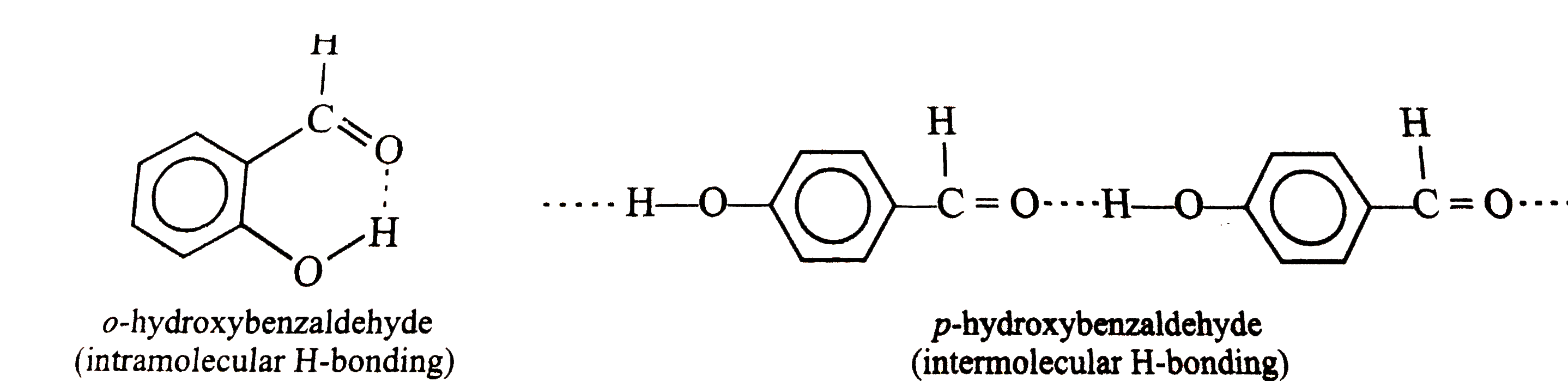 As a result , o-hydroxybenzaldehyde is a LIQUID whereas p-hydroxybenzaldehyde is a solid . Similarly, in CASE of nitrophenol , we have  . .
|
|
| 23. |
Explain why nucleophilic substitution reactions are not very common in phenols. |
| Answer» Solution :In phenol, aromatic ring is highly electron RICH due to `+M` of `-OH` GROUP. So nucleophile does not easily attack on the ring. | |
| 24. |
Explain why NH_(3) is basic while BiH_(4) is only feebly basic. |
| Answer» Solution :Both N in `NH_(3)andBi" in "BiH_(3)` have a lone pair of ELECTRONS on the CENTRAL atom and hence should behave as LEWIS bases. But `NH_(3)` is much more BASIC than `BiH_(3)`. This can be explained on the basis of electron density on the central atom. Since the atomic size of N (70 pm) is much smaller than that of Bi (148 pm), therefore, electron density on the N-atom is much HIGHER than that on Bi-atom. Consequently. the tendency of N in `NH_(3)` to donate its pair of electrons is much higher than that of Bi in `BH_(3)`. Thus, `NH_(3)` is much more basic than `BH_(3)`. | |
| 25. |
Explain why Na is less reactive than K? |
| Answer» SOLUTION :IONISATION enthalpy OFK is less than that of na and hence K is more eletropositivie and REACTIVE. | |
| 26. |
Explain why N_(2) has greater bond dissociation energy than N_(2)^(+)whereas O_(2)^(+)has greater bond dissociation energy than O_(2) . |
|
Answer» SOLUTION :`B.O.of N_(2) (3) GT B.O.of N_(2) ^(+)(2.5) but B.O.of O_(2)^(+) (2.5) gt B.O. of O_(2) ` (2) . Greater the BOND order , greater is the bond dissociation ENERGY . |
|
| 27. |
Explain why more alkylated alkene is formed predominatly if base is CH_3CH_2O^(o-), while less alkylated alkene is obtained majorly when t-Buoverset(o-)O base is used. |
|
Answer» |
|
| 28. |
Explain why lower alkanes are gaseous in state and higher alkane are liquid in state ? |
|
Answer» Solution :* The first FOUR member, `C_(1)` to `C_(4)` are gases, `C_(5)` to `C_(17)` are liquids and those containing 18 carbon atoms or more are solids at 298 K. Because they possess weak van der Waals forces in alkane C-C and C-H bonds are there. DIFFERENCE of electronegativitiy is very less (0.1), therefore, they are charged less. There is weak van der Waals force betwen C and H. Therefore at normal temperature alkanes are gaseous and liquid state. |
|
| 29. |
Explain why is there a phenomenal decreases in ionization enthalpy from carbon to silicon ? |
| Answer» Solution :Due to increase in atomic size and screening effect, the force of ATTRACTION of the NUCLEUS for the valence electron decreases CONSIDERABLY in SI as compared to C. As a result , there ISA phenomenal decreases in ionization enthalpy from carbon to silicon . | |
| 30. |
Explain why is there a phenomenal decrease in ionisation enthalpy from carbon to silicon ? |
| Answer» Solution :Ionisation enthalpy of carbon (the first element of group 14) is very HIGH (1086 kJ/mol). This is expected owing to its SMALL SIZE. HOWEVER, on moving down the group to SILICON, there is a sharp decrease in the enthalpy (786 kJ). This is because of an appreciable increase in the atomic sizes of elements on moving down the group. | |
| 31. |
Explain why is sodium less reactive than potassium ? |
| Answer» Solution :The IONIZATION enthalpy `(Delta_(i) H_(1))` of potassium (419 kJ `mol^(-1)`) is less than that of sodium (496 kJ `mol^(-)`) or more precisely the standard electrode potential `(E^(@))` of potassium `(-2*925 V)` is more negative than that of sodium `(-2*714V)` and HENCE potassium is more reactive than sodium . | |
| 32. |
Explain, why is sodium less reactive than potassium ? |
|
Answer» Solution :The standard electrode potential (`E^@`) of sodium (-2.714 V) is more (less negative) than that of potassium (-2.925 V). Moreover, the ionisation enthalpy of sodium `(496 kJ MOL^(-1)`)is more than that of potassium`(419 kJ mol^(-1))`. Hence, sodium is less reactive than potassium. |
|
| 33. |
Explain why is hydrogen peroxide stored in colured/plastic bottles? |
| Answer» Solution :Hydrogen PEROXIDE readily decomposes because of its unstable nature. The decomposition is furtheracclerated by sun light and ROUGH surface. In order to CHECK it, hydrogen is stored in coloured or plastic bottles. | |
| 34. |
Explain why: (i) the dipole moment of chlorobenzene is lower than that of cyclohexyl chloride? (ii) alkyl halides though polar. are immiscible with water? (iii) Gringard reagents should be prepared under anhydrous conditions? |
|
Answer» Solution :(i) CHLOROBENZENE is stabilised by resonance and there is NEGATIVE charge on .Cl. in 3 out of 5 resonating structures, therefore it has a lower dipolec moment than cyclohexyl chloride in which there is no such negative charge. (ii) ALKYL halides cannot form H-bond with water and cannot break H-bonds between water molecules, therefore they are INSOLUBLE in water. (iii) Grignard reagents react with `H_2O` to form alkanes, therefore they are preparcd under anhydrous conditions. |
|
| 35. |
Explain why hydrogen is not placed with the halogen in the periodic table. |
|
Answer» Solution :(i) Hydrogen resembles alkali metals as well as halogens, (ii) Hydrogen resembles more alkali metals than halogens. (III) Electron affinity of hydrogen is much less than that of halogen ATOM. Hence the tendency to form hydride ion is low compared to that of halogens. (iv) In most of its compounds hydrogen exists in +1 OXIDATION state. Therefore it is reasonable to PLACE the hydrogen in group 1 along with alkali metals as shown in the LATEST period table published by IUPAC. |
|
| 36. |
Explainwhy HF is less viscousthan H_(2) O. |
|
Answer» Solution :There is GREATER intermolecular hydrogen BONDING in`H_(2) O `than that in HF as each ` H_(2) O `molecule forms fourH-bonds with other water molecules whereas HF forms only two H-bonds with other HF molecules . Greater the intermoleuclar H-bonding, greater is the visosity . HENCE , HF is less VISCOUS than `H_(2) O` |
|
| 37. |
Explain why HCl is a gas of liquid. |
| Answer» Solution :Due to greater electronegativity of F over Cl, F forms STRONGER H-bonds as compared to Cl. As a result , more energy is NEEDED to break the H-bonds in HF than in HCl and hence the b.p. of HF is HIGHER than that of HCl. Consequently, H-F is liquid while HCl isa gas at room temperature . | |
| 38. |
Explain why HCl is a gas and HF is a Liquid ? |
| Answer» SOLUTION :Due to greater electronegativity of F over CI, F forms stronger H-bond as compared to CL. As a result, more energy is REQUIRED to break the H-bonds in HF than HCI and hence the boiling point of HF is HIGHER than that of HCI. Consequently, HF is liquid while HCI is a gas at room temperature. | |
| 39. |
Explain why halides of beryllium fume in moist air but those of barium do not. |
|
Answer» Solution :`BeCl_(2)` being a salt of a weak base , `Be(OH)_(2)` and a strong acid , HCl undergoes hydrolysis by water to FORM HCl which fumes in air. `BaCl_(2)` , on the other hand , being a salt of a strong base , `Ba(OH)_(2)` and strong acid , HCl does not undergo hydrolysis by water to form HCl and hence does not fume in air . `BeCl_(2) + 2H_(2)O to Be(OH)_(2) + 2HCl, BaCl_(2) + 2H_(2)O to Ba(OH)_(2) + 2HCl` |
|
| 40. |
Explain why H_(2)O has dipolemoment while CO_(2) does not have. |
| Answer» SOLUTION :`CO_(2)` is a LINEAR MOLECULE | |
| 41. |
Explain why each of the following structure is not a resonance form? (a) :overset(..)(O)= overset(..)(O): and underset(.):overset(..)(O)= underset(.)overset(..)(O): (b) CH_(3) - underset(underset(OH)(|))(C )=CH_(2) and CH_(3) - underset(underset(O)(||))(C )-CH_(3) |
|
Answer» SOLUTION :(a) Contributing structures must have the same number of paired ELECTRONS. SINGLET and triplet states can not be contributing structures. (b) These isomers differ in the PLACEMENT of the H atom, in this special case they are called TAUTOMERS. |
|
| 42. |
Explain why electrolysis of ordinary water occurs faster than heavy water ? |
| Answer» Solution :Due to lower BOND DISSOCIATION ENERGY of protium BONDS in H-O-H than deuterium bonds in D-O-D, electrolysis of `H_(2)O` occursmuch FASTER than that of `D_(2)O`. | |
| 43. |
Explain why does the mercury level in a barometer go down when atmospheric pressure decreases? |
| Answer» Solution :The weight of the COLUMN of mercury in the barometer is exactly BALANCED by the atmospheric pressure. THEREFORE, a DECREASE in the atmospheric pressure decreases the LEVEL of mercury to such an extent that the weight of the column of mercury is again equal to the changed atmospheric pressure. | |
| 44. |
Explain why does conductivity of germanium crystals increase on doping with gallium . |
| Answer» Solution :Germanium (GE) belongs to Group 14 while Gallium (GA) belongs to Group 13. Ge has 4 ELECTRONS in the valence shell whereas Ga has only 3. When Ge is replaced by Ga, an electron vacancy is created Electrons from neighbouring atoms move to FILL this vacancy . As a result, a hole is created in its original position. When an electric FIELD is applied , electrons move towards the position plate and conduct electricity. The holes move towards the negative plate. | |
| 45. |
Explain why dipole moment of hydrogen halides decreases from HF to HI |
|
Answer» Solution :This is because electrongativity of HALOGEN ATOM decreases frem F to I . HENCE , the POLAR character decreases and so is the dipole moment. |
|
| 46. |
Explain why diamond melts at a very high temperatuer even though it is composed of covalently linked carbon atoms. |
| Answer» Solution :In the crystal of diamond, each `sp^(3)`-hybridised C-atom is bonded to four others by SINGLE COVALENT bonds (bond length 1.54Å) and a large NUMBER of tetrahedral units are linked togetehr to form a three-dimensional giant molecule. Strong covalent bonds extent in all DIRECTIONAL. due to this compact structure involving strong bonds, diamond is very hard and has a very high melting point. | |
| 47. |
Explain why cyclooctatetraene is not aromatic? Strategy: Apply Huckel's rule and use the polygon-and-circle method for deriving the relative energies of the piMOs. |
Answer» Solution : Cyclooctatetraence has total of eight `pi` electrons. Eight is not a Huckel number, i.e., not a `4N+2` number it is a `4n` number. Assuming cyclooctatetraene to be planar, we can apply the polygon-and-crcle METHOD. Like benzene, it does not have a closed shell of `pi` electrons. It has an unpaired ELECTRON in each of the TWO nonbonding orbitals.Molecules with unpaired electrons (radicals) are not usually stable, they are typically highly reactive and unstable. A planar form of cyclooctateraene is therefore not at all like benzene and Hence cannot be AROMATIC. |
|
| 48. |
Explain why CO_(3^(2-) ion cannot be represented by a single Lewis structure. How can it be best represented? |
Answer» Solution :A single LEWIS structure of `CO_(3)^(2-)` ion cannot explain all the PROPERTIES of this ion. It can be REPRESENTED as a resonance hybrid of the following structures  If, it were represented only by one structure, there should be two types of bonds, i.e., C = Odouble bond and C - O single bonds but ACTUALLY all bonds are found to be identical with same bond LENGTH and same bond strength. |
|
| 49. |
Explain why CO_(3)^(2-) ion cannot be represented by a single Lewis structure. How canit be best represented ? |
|
Answer» Solution :A single Lewis streucture of `CO_(3)^(2-)` ION connot explain all the properites of this ion. It can be represented as aresonance hybrid of the following structures : 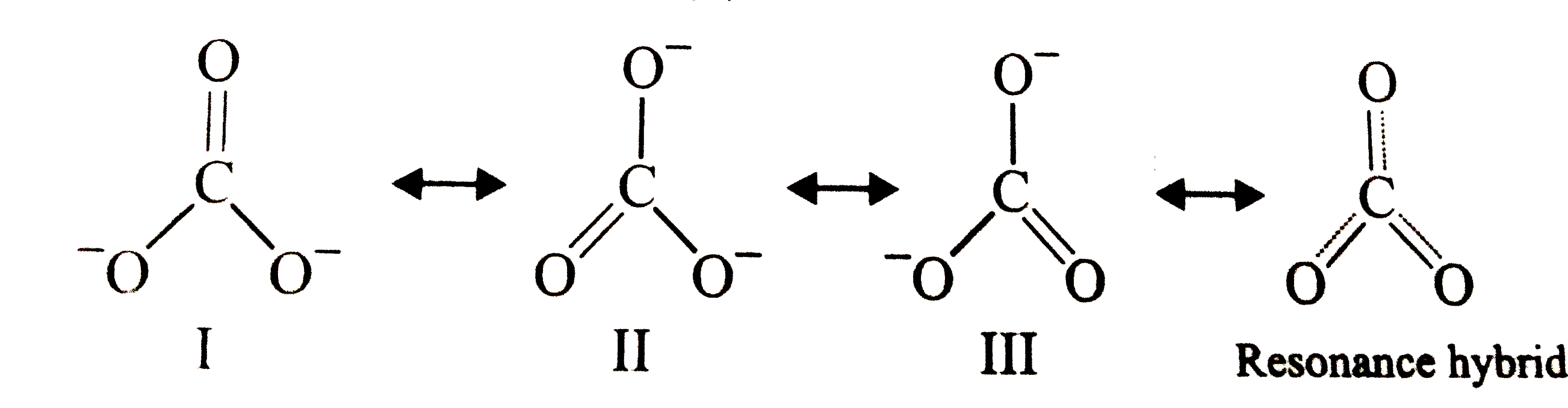 If it were represented only by one structer, there should be two TYPES of bonds, i.e., C= Odouble bond and C-O single bonds but ACTUALLY all bonds are foundto be IDENTICAL with same bond length and same bond strenth. |
|
| 50. |
Explain why (CH_(3))_(3)overset(+)(C) is more stable than CH_(3)overset(+)(C)H_(2) and overset(+)(C)H_(3) is the least stable cation. |
| Answer» Solution :`(CH_(3))_(3)overset(+)(C)` has nine `alpha`-hydrogens and hence has nine hyperconjugation structures while `CH_(3)overset(+)(C)H_(2)` has only THREE `alpha`-hydrogens and hence has only three hyperconjugation structures. As a RESULT, `(CH_(3))_(3)C^(+)` is more stable than `CH_(3)CH_(2)^(+)`. In contrast in `CH_(3)^(+)`, the vacant p-orbital is PERPENDICULAR to the plane in which the three C-H bonds lie and hence cannot overlap with it. THUS, `CH_(3)^(+)` is not stabilized by hyperconjugation and hence is the least stable of the three cations. | |