

Saved Bookmarks
This section includes 7 InterviewSolutions, each offering curated multiple-choice questions to sharpen your Current Affairs knowledge and support exam preparation. Choose a topic below to get started.
| 1. |
How many isomers of C_7H_8 O exists that has phenyl ring ? |
Answer» 
|
|
| 2. |
How many isomers of C_(5)H_(11)OH will be primary alcohols? |
|
Answer» 5 (ii) `CH_(3)-CH_(2)-UNDERSET(CH_(2))underset(|)(CH)-CH_(2)-OH`, (iii) `CH_(3)-underset(CH_(3))underset(|)(CH)-CH_(2)-CH_(2)-OH` (iv) `CH_(3)-underset(CH_(3))underset(|)overset(CH_(3))overset(|)(C)-CH_(2)-OH` |
|
| 3. |
How many isomers are possible of anorganic compound having molecule formula C_(4)H_(8)O ? |
|
Answer» 4 (ii) `CH_(3)CH_(2)CH_(2)CHO` butanl (iii) `CH_(3) UNDERSET(underset(CHO)(|))(C )HCH_(3)` 2-methyl PROPANAL |
|
| 4. |
How many isomers are possible for the formula C_5 H_(11) Br? |
|
Answer» 11 |
|
| 5. |
How many isomers are possible for the formula C_5H_11Br ? |
|
Answer» 11 |
|
| 6. |
How many isomers are possible for the formula C_4H_9Cl ? |
|
Answer» 3 |
|
| 7. |
How many isomers are possible for the formulaC_(3) H_(7) F? Give their structures and names |
|
Answer» Solution :`C_(3) H_(7) F-2` isomers are POSSIBLE (i) `CH_(3) - CH_(2) - CH_(2) F ""` 1-fluoropropane (II) `CH_(3) - underset(F)underset(|)(C)H- CH_(3) ""` 2-fluoropropane |
|
| 8. |
How many isomers are possible for monochloro anthracene? |
|
Answer» 2 |
|
| 9. |
How many isomers are possible for an aromatic compound having formula C_(7)H_(8)O ? |
|
Answer» 3 |
|
| 10. |
How many isomers are possible for a disubstituted benzene ? What is the relationship between them ? |
Answer» SOLUTION :Three ISOMERS are possible. These are : 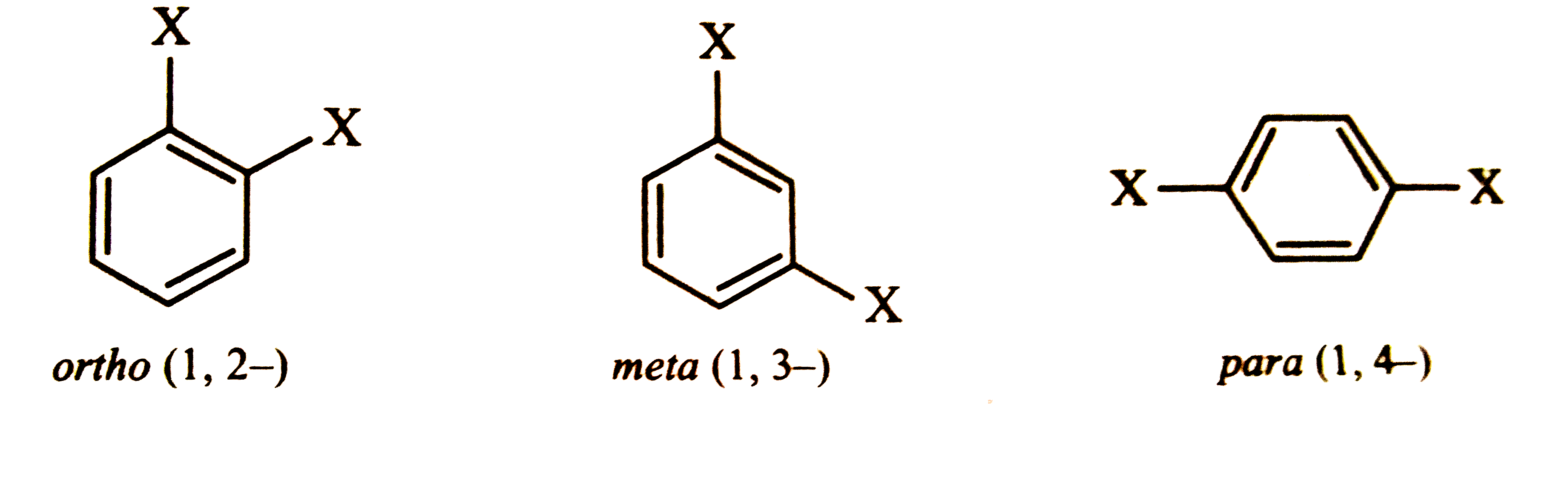 Since these isomers differ in the POSITION of the substituents on the BENZENE ring, THEREFORE, these are called position isomers. |
|
| 11. |
How many isomeric structural alkene on catalytic hydrogeneation gives 3-Methyl hexane |
|
Answer» 3 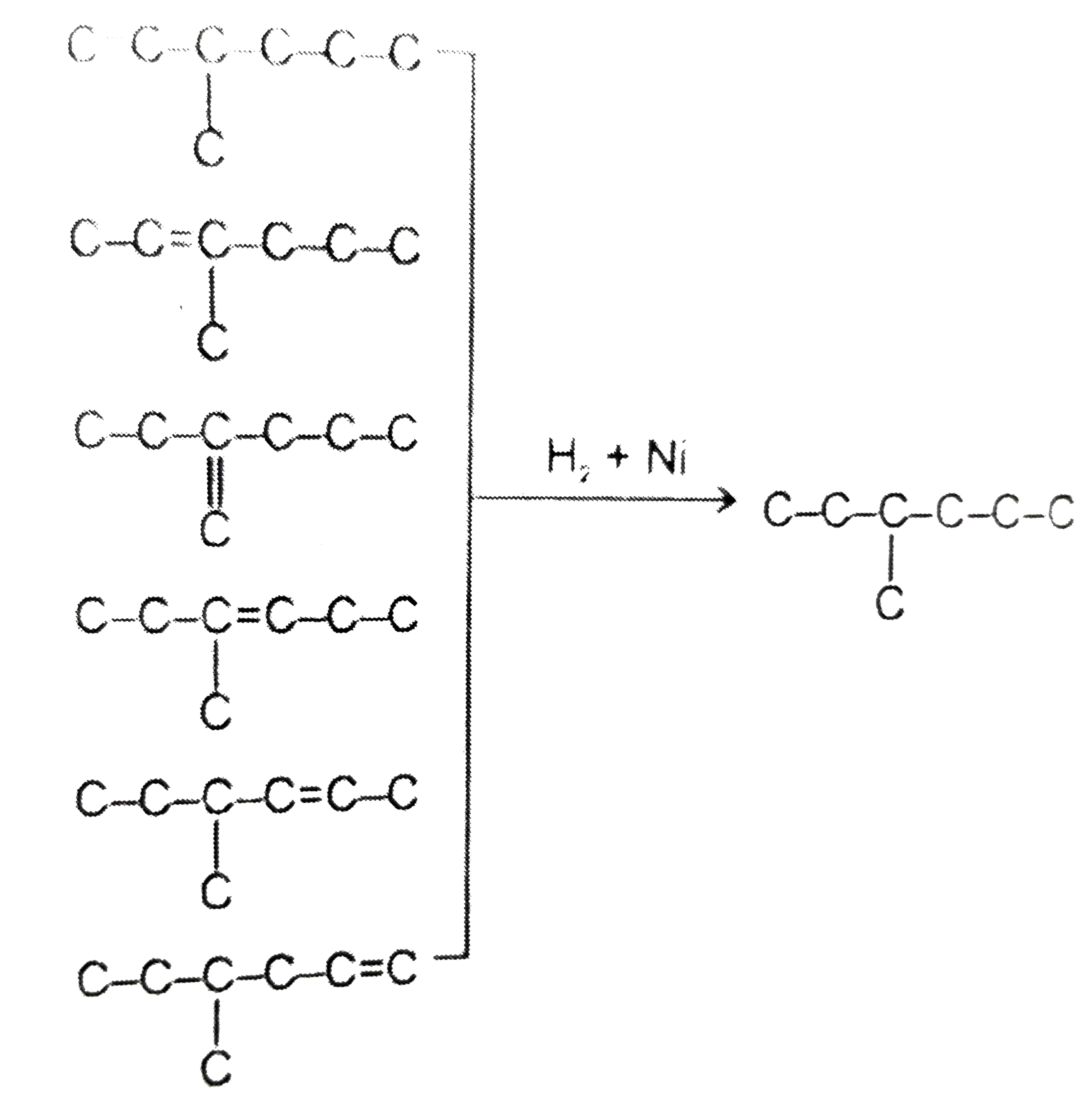
|
|
| 12. |
How many isomeric structures can heptane (C_7H_16) have? |
| Answer» SOLUTION :Nine. | |
| 13. |
How many isomeric primary alcohols are possible for C_(4)H_(9)OH ? |
|
Answer» 1 |
|
| 14. |
How many isomeric carbonyl compounds are possible with the molecular formula, C_(5)H_(10)O? Draw their structures |
|
Answer» |
|
| 15. |
How many isomeric alkynes on catalytic hydrogenation gives 3-Ethyl-4-methylheptane ? |
|
Answer» |
|
| 17. |
How many ionisation energies can carbon have ? Electron configuration of carbon {:("in Ground state", 1s^2 2s^2 2p_x^1 2p_y^1),("in Excited state", 1s^2 2s^1 2p_x^1 2p_y^1 2p_z^1):} |
|
Answer» 1 |
|
| 19. |
How many hydroxyl ions are required for the conversion: CN_((aq))^(-) to CNO_((aq))^(-) |
|
Answer» Solution :`CN^(-)+OH^(-)rarrCNO^(-)` Balancing the HALF reaction `CN^(-)+2OH^(-)rarrCNO^(-)+H_(2)O+2e^(-)` Number of HYDROXYL `OH^(-)` ions `= 2` |
|
| 20. |
How many hydrogen bonded water molecules are associated with FeSO_(4).7H_(2)O ? |
| Answer» Answer :B | |
| 21. |
How many hydrogen bonded water molecule(s) are associatedwith CuSO_(4) .5 H_(2)O ? |
|
Answer» 1 HYDROGEN bonds . |
|
| 22. |
How many hydrogen bonded water molecules are associated in CuSO_4. 5H_2O? |
|
Answer» SOLUTION : Only one WATER molecule, which is outside the COORDINATION sphere, is hydrogen BONDED with sulphate ion. The other four MOLECULES of water are coordinated with copper cation. `CuSO_4.5H_2O-= [ Cu(H_2O)_4]SO_4. H_2O` |
|
| 23. |
How many hydrogen-bonded water molecule(s) are associated in CuSO_4. 5H_2O ? |
| Answer» SOLUTION :Only one water molecule, which is outside the BRACKETS (COORDINATION sphere), is hydrogen bonded. The other four MOLECULES of water are coordinated. | |
| 24. |
How many hydrogen atoms are replaced by D in the following tautomerization? CH_(3)-overset(Ph)overset(|)C=underset(Ph)underset(|)C-overset(O)overset(||)C-CH_(3)underset(D_(2)O)overset(D^(o+))rarr |
|
Answer» `-overset(O)overset(||)C-` are replaced by D. `CH_(3)-overset(CH_(3))overset(|)C=underset(CMe_(3))CH_(3) underset(D_(2)O"Longtime")overset(D^(+))rarrCD_(3)-overset(CMe_(3))overset(|)C=underset(CMe_(3))underset(|)C-CD_(3)` |
|
| 25. |
How many hydrogen atoms in the ground state are exited by means of monochromatic radiation of wavelength 970.6 Ã…. How many different lines are possible in the resulting emission spectrum? Find the longest wavelength among these . |
|
Answer» `(-21.69xx10^(-19))/(n^(2))+(21.69xx10^(-19))/(1)=(6.626xx10^(-34)xx3xx10^(8))/(970.6xx10^(-10))` `n=4` `(1)/(lamda)=RZ^(2)((1)/(n_(1)^(2))-(1)/(n_(2)^(2)))` `(1)/(lamda)=109677.77xx1^(2)((1)/(1^(2))-(1)^(2^(2)))` `lamda=1215.68`Ã… 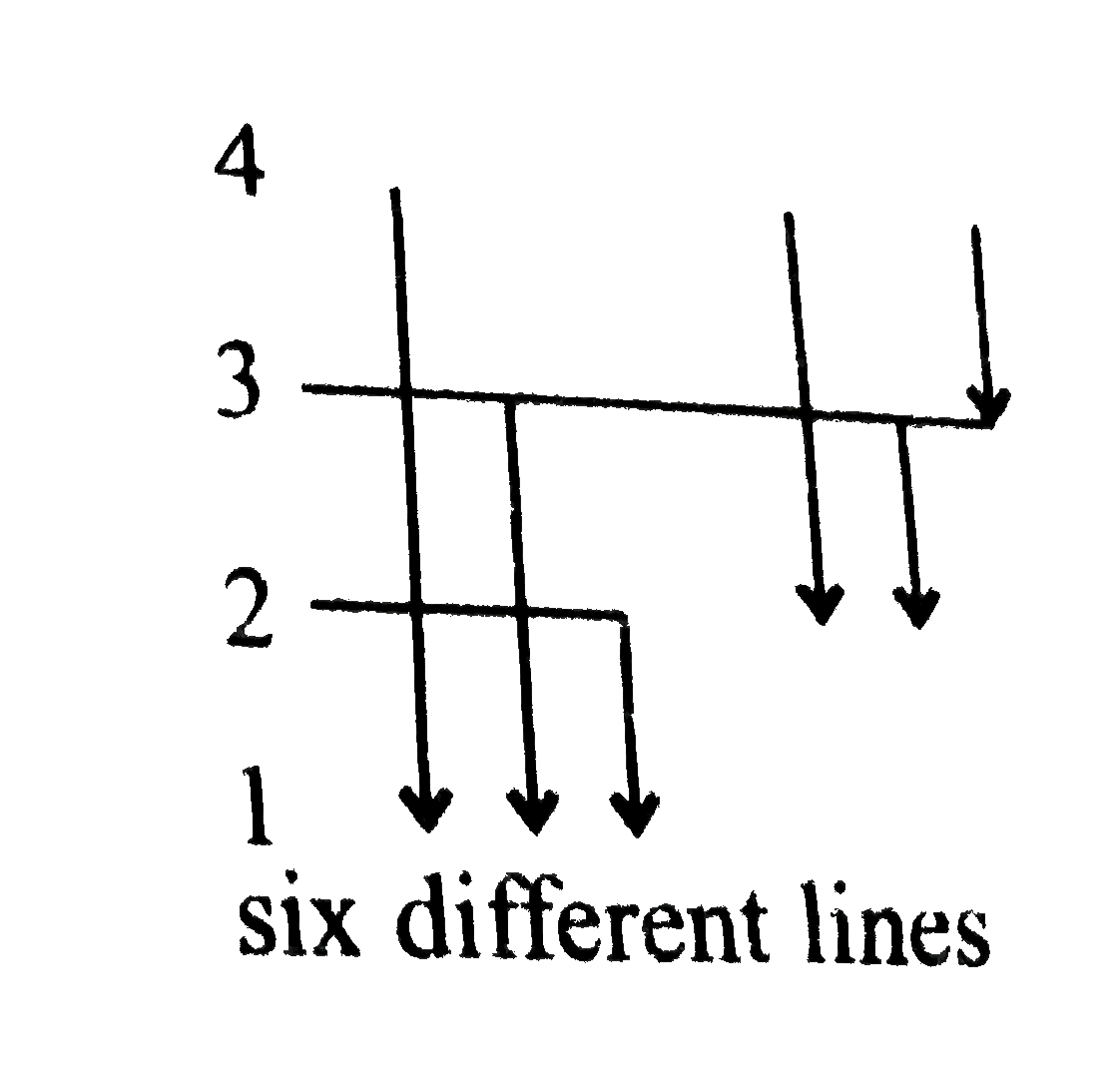 . .
|
|
| 26. |
How many hydrogen-bonded water molecule (s) are associated in CuSO_(4).5 H_(2)O ? |
Answer» Solution :Only one water molecule, which is outside the BRACKETS (coordination sphere), is HYDRODEN bonded to `SO_(4)^(2-)` ion as shown below . The remaining four molecules are linked to `CU^(2+)` ion by COORDINATE bonds. 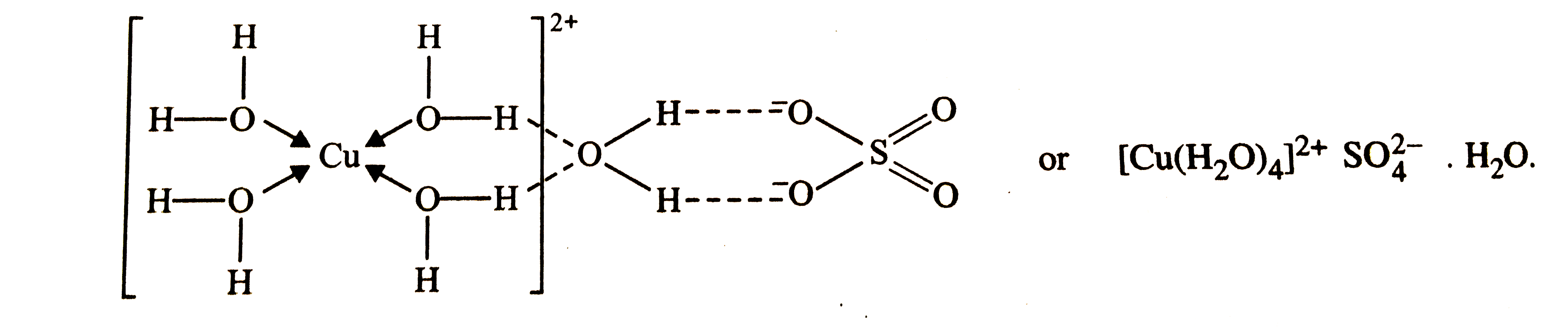
|
|
| 27. |
How many hydrogen atoms are replaced by D in the following tautomerization? |
|
Answer» |
|
| 28. |
How many hydrocarbons having molecular mass 68 can give white precipitate with Tollen's reagentsodium bicarbonate, but B can not . The structure of A & B are respectively. |
|
Answer» 1 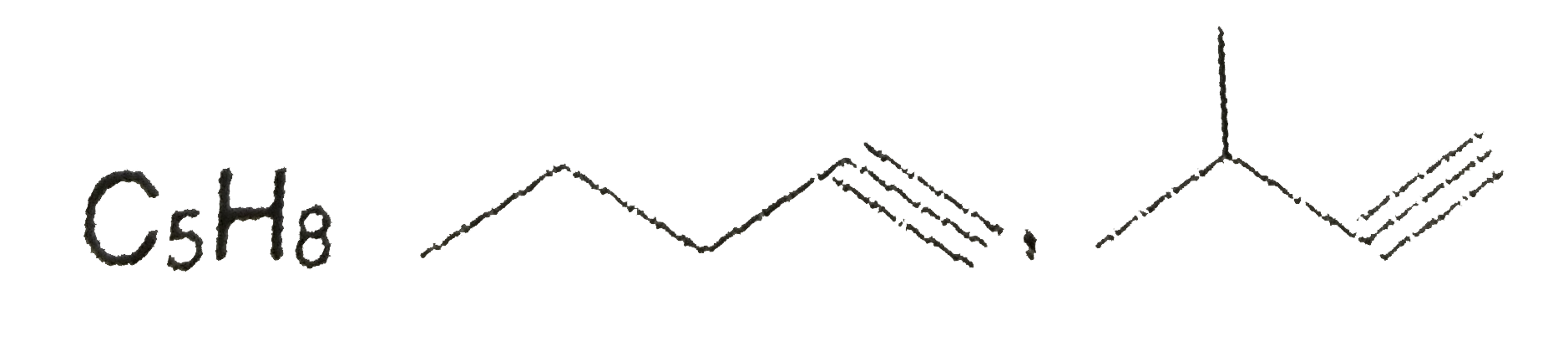
|
|
| 29. |
How many H_(2)O molecules are there in a snowflake weighing 1 mg? |
|
Answer» `3.35xx10^(19)` Molar mass of `H_(2)O`=2+16=18g 1 Mole CONTAINS `6.023 xx 10^(23)` water MOLECULE 18 g contains `6.023 xx 10^(23)` water molecule `:.` 1 mg contains `(6.023xx10^(23))/18xx1g//1000mg=3.35xx10^(19)H_(2)O` molecule. |
|
| 30. |
How many H will be replaced by D in product having 6 carbon on prolonged keeping? |
|
Answer» 4 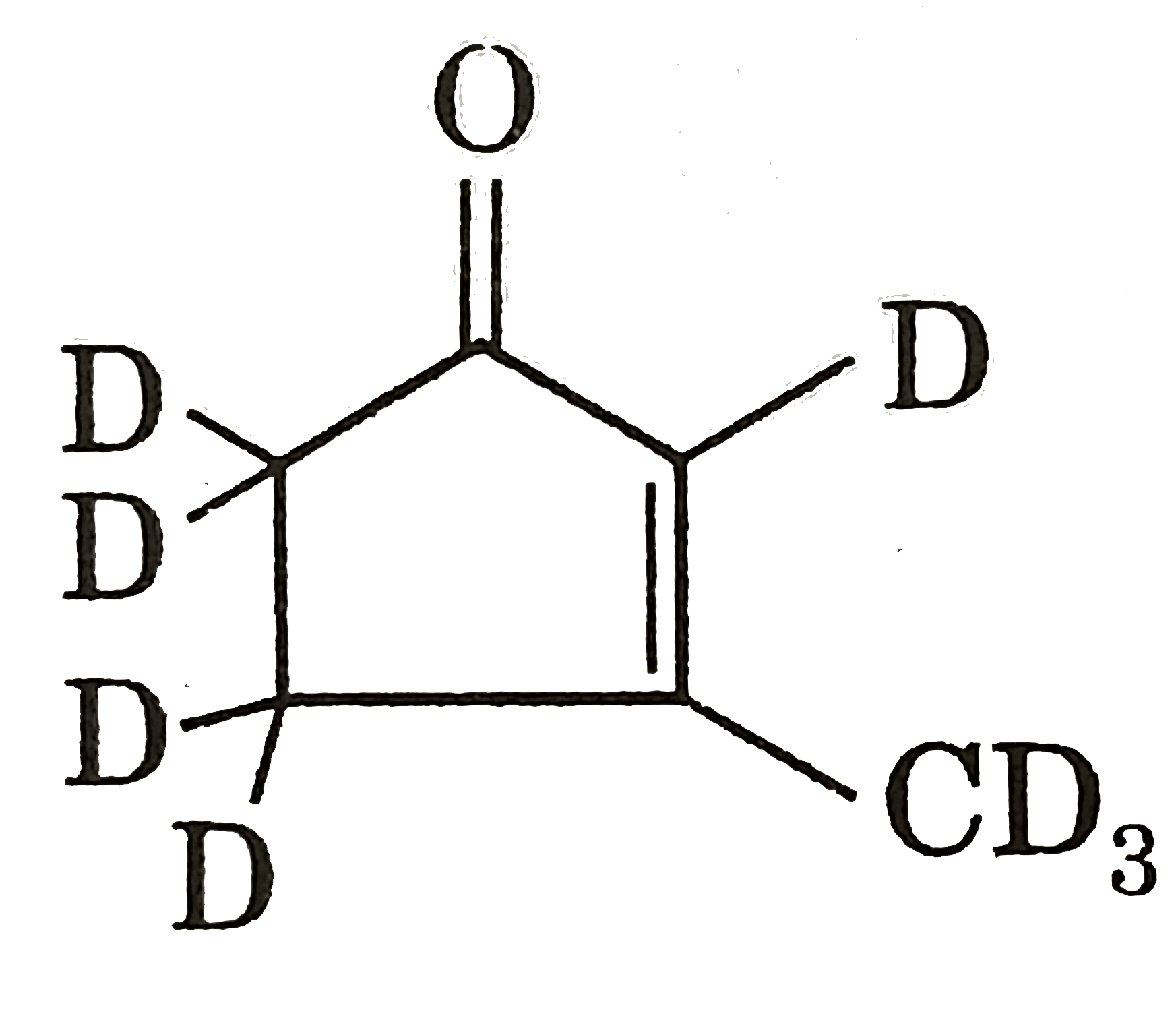 is the PRODUCT. is the PRODUCT.
|
|
| 31. |
How many H-bonds are formed by each H_(2) Omolecule and how many water moleculasare attached to each water molecule and in what diraction ? |
|
Answer» Solution :Each `H_(2) O `molecula FORMS four H-bonds, two O-atom and two with H-atoms. Futher , each ` H_(1)O` molecule in linked to four ` H_(2)O`molecules through H-bonds tetrahedrally |
|
| 32. |
How many H atoms are directly attached with Patom in hypophosphorus acid ? |
|
Answer» 0 |
|
| 33. |
How many H-bonded water moelcule (s) are associated in CuSO_(4)5H_(2)O |
|
Answer» |
|
| 34. |
How many H are replaced by D on prolonged treament in the following? CH_(3)-overset(O)overset(||)C-underset(Ph)underset(|)Ph=overset(Ph)overset(|)C-Me underset(D_(2)O)overset(D^(o+))rarr |
|
Answer» 6 H will be replaced by deuterium. |
|
| 35. |
How many grams of sodium hydroxide must be dissolved in one litre of water to prepare its N/10 solution ? What will be its pH value ? |
|
Answer» `:. ` For 1 L of N/10 NaOH sol. NaOH dissolved `= 40xx(1)/(10) = 4 g` `[OH^(-)]=10^(-1) M :. [H_(3)O^(+)]=10^(-13)M`. `PH = - log 10^(-13)=13` |
|
| 36. |
How many grams of potassium dichromate are required to oxidise 20.0 g of Fe^(2+) in FeSO_4 " to " Fe^(3+) if the reaction is carried out in an acidic solution ? |
|
Answer» SOLUTION :When dissolved in water , `K_2Cr_2O_7` dissociates into `K^+ and Cr_2O_7^(2-)` ions and `FeSO_4` dissociates into `FE^(2+) and SO_4^(2+)` ions. The skeleton EQUATION is : `Fe^(2+) + Cr_2O_7^(2-) rarr Fe^(3+) +2Cr^(3+)` The BALANCED equation is `Cr_2O_7^(2-)+6FE^(2+)+14H^(+)rarr6Fe^(3+)+2Cr^(3+)+7H_2O` Formula weight of `K_2Cr_2O_7=2xx39+2xx52+7xx16=294` Formula weight of `FeSO_4` `=56+32+4xx16=152` `:.` 1 mol `K_2Cr_2O_7=6 mol FeSO_4` `294 ""6xx152` `6xx152` g of `FeSO_4` require `K_2Cr_2O_7 = 294 g` 20 g of `FeSO_4` require `K_2Cr_2O_7` `=(294)xx(6xx152)xx20=6.45g` `K_2Cr_2O_7` required to oxidise 20 g of `FeSO_4` `=6.45 g ` |
|
| 37. |
How many grams of potassium dichromate are required to oxidise 20.0 g of Fe^(2+) "in" FeSO_(4) "to" Fe^(3+) if the reaction is carried out in acidic medium? Molar masses of K_(2)Cr_(2)O_(7)"and"FeSO_(7) are 294 and 152respectively |
|
Answer» 6.45 g |
|
| 38. |
How many grams of potassium dichromate are required to oxidise 20.0 g of Fe^(2+) inFeSO_(4) to Fe^(3+) if the reaction is carried out in an acidic medium ? (Molar mass of K_(2)Cr_(21)O_(7) and FeSO_(4)) are 294 and 152 respectively |
|
Answer» `2FeSO_(4)+H_(2)SO_(4)+OrarrFe_(2)(SO_(4))_(3)+H_(2)Oxx3` balanced REDOX reaction `K_(2)Cr_(2)O_(7)+6FeSO_(4)+7H_(2)SO_(4)rarrK_(2)SO_(4)+Cr_(2)(SO_(4))_(3)+3Fe_(2)(SO_(4))_(3)+7H_(2)O` It is evident from balanced equation that 6 moles of `FeSO_(4)=1` mole of `K_(2)Cr_(2)O_(7)` `therefore` 20 g of `FeSO_(4)` will require `K_(2)Cr_(2)O_(7)` `=(294)/(6xx152)xx20=6.45 g` |
|
| 39. |
How many grams of potassium dichromate are required to oxidise 15.2 g of FeSO_(4) in acidic medium? |
|
Answer» Solution :To write balanced chemical equation of the redox reaction `Cr_(2)O_(7)^(2-)+14 H^(+)+6 e^(-) rarr 2Cr^(3+)+7 H_(2)O` `Fe^(2+) rarr Fe^(3+)+e^(-)]xx6` `Cr_(2)O_(7)^(2-)+6 Fe^(2+)+014 H^(+) rarr 2Cr^(3+)+6Fe^(3+)+7 H_(2)O` step 2 To calculate the amount of`K_(2)Cr_(2)O_(7)` REQUIRED It is EVIDENT from balanced equation that 1 mole of `Cr_(2)O_(7)^(2-)=6 "moles of" Fe^(2+) "or 1 mole" k_(2)Cr_(2)O_(7)=6 "moles" FeSO_(4)` But 1 mole of `K_(2)Cr_(2)O_(7)=2xx39+2xx52+16xx7=294g` and 6 moles of `FeSO_(4)=6xx(56+32+16+45)=6xx152g FeSO_(4)` Now `6xx152 g "if"FeSO_(4)` are oxidised by `K_(2)Cr_(2)O_(7)=(294xx152)/(6xx152)=4.9g` |
|
| 40. |
How many grams of nitric acid can be prepared from 50.0 g of KNO_3 of 80% purity ? |
|
Answer» `underset(2 xx 101.11 g)(2KNO_(3)) + H_(2)SO_(4) to underset(2 xx 63.018 g)(2HNO_(3)) + K_(2)SO_(4)` Since, the given sample of `KNO_(3)` in 50.0 g of it `(50.0 xx 80)/100= 40.0 g` `THEREFORE 2 xx 101.11 g` of `KNO_(3)` GIVE `HNO_(3) = 2 xx 63.018 g` `therefore 40.0 g` of `KNO_(3)` will give `HNO_(3)` `=(2 xx 63.018)/(2 xx 101.11) xx 40.0 = 24.9 g` Hence, the given sample of `KNO_(3)` can give 24.9 g of `HNO_(3)` |
|
| 41. |
How many grams of oxygen are present in a decimol of washing soda. |
|
Answer» |
|
| 42. |
How many grams of NaOH must be dissolved in one litre of the solution to giveit a pH value of 12 ? |
|
Answer» SOLUTION :`pH=-LOG[H_(3)O^(+)] :. Log[H_(3)O^(+)]=-pH=-12` `:. [H_(3)O^(+)]`= ANTILOG (-12) = antilog `(bar(12))=10^(-12)` g ions/litre But we know that `[H_(3)O^(+)][OH^(-)]=K_(w)=10^(-14) :. [OH^(-)]=(K_(w))/([H_(3)O^(+)])=(10^(-14))/(10^(-12))=10^(-2)` g ions/litre Since NaOH is a strong electrolyte, it undergoes COMPLETE ionization as : `NaOH rarr Na^(+)+OH^(-)` `:. [OH^(-)]=[NaOH]=10^(-2)M = 10^(-2) "mol" L^(-1)` Mol. mass of NaOH = 40 `:.` Amountof NaOH dissolved PER litre `=10^(-2) xx 40 = 0.4 g` |
|
| 43. |
How many grams of NaOH will be required to prepare 500 g solution containing 10% w/w prepare solution ? |
| Answer» Answer :B | |
| 44. |
How many grams of NaOH must be dissolved in IL of the solution to give it a pH value of L^(2) ? |
|
Answer» |
|
| 45. |
How many grams of NaOH is to be added to one litre of1 M H_2CO_3 to get a HCO_3^(-) //CO_3^(-2)buffer of maximum capacity ? |
|
Answer» 90 gram ` rArr H_2CO_3` was NEUTRALIZED and `HCO_3^(-) ` was `1//2` neutralized i.e.,NaOH required `= 1xx 1 + 1 xx (1)/(2) = (3)/(2)" moles weight " = 40 xx (3)/(2)= 60 gms ` |
|
| 46. |
How many grams of NaOH is dissolved in 2 L 0.5NaOH aqueous solution ? Molecular weight of NaOH : 40 g /mol. |
|
Answer» 0.4 g |
|
| 47. |
How many grams of NaOH can neutralise 100 ml ofH_2SO_4solution with P^(H)solution with P^(H)value 3.301? |
|
Answer» 2mg ` therefore ` moles of acid ` = 0.1 xx 5 xx 10 ^(-4)= 5 xx 10 ^(-5) ` to NEUTRALIZE , MOLESOF NaOH`= 5 xx 10 ^(-5) ` ` therefore ` weight` = 40 xx 5 xx 10 ^(-5)= 2 xx 10 ^(-3)= 2 mg ` |
|
| 48. |
How many grams ofMgC_2O_4 (formula weight =112 )will dissolve in 1.5 Lof water ?(K_(sp) =8.1 xx 10^(5)) |
|
Answer» `1.0` ` s= 9 xx 10 ^(-3)MOL//"LT" =9 xx 10 ^(-3)xx 112 gm//"lt"` 1 LIT ___________ ` 9 xx 112 xx 10^(-3)gm ` 1.5 lit ____________ ? |
|
| 49. |
How many grams of KMnO_(4) required for the redox reaction of 1 L of 1NMnO_(4)in acidic medium ? |
|
Answer» 31.6 |
|
| 50. |
How many grams of Al_2(SO_4)_3, will be required to prepare 4 litres of 0.025M solution ? |
|
Answer» |
|