

Saved Bookmarks
This section includes 7 InterviewSolutions, each offering curated multiple-choice questions to sharpen your Current Affairs knowledge and support exam preparation. Choose a topic below to get started.
| 1. |
How many grams of H_(2)SO_(4) required to be dissolved in 250g of water to prepare decimolal solution? |
|
Answer» |
|
| 2. |
How many grams of hydrogen are needed to produce 10 moles of phosphoric acid (H_3PO_4)? |
|
Answer» |
|
| 3. |
How many grams of H_(2) S will react with6.32 g of KMnO_(4) to produce K_(2) SO_(4) and MnO_(2) ? |
|
Answer» |
|
| 4. |
How many grams of H_2O_2in 1 litre of 1.5 N H_2O_2. |
|
Answer» 25 gram =(1.5) x (17) = 25.5 gm/lit |
|
| 5. |
How many grams of Glucoose in 10% w/v 400 ml solution ? |
|
Answer» 40 |
|
| 6. |
How many grams of Glucose dissolve in 10% w/v 400 mL as solution of Glucose ? |
|
Answer» 40 `:. 10 = (100 xx w)/(400) "" :.w= 40 g` |
|
| 7. |
How many grams of ethene may be burnt completely by the oxygen gas produced by complete decomposition of 9.6 grams of potassium chlorate? |
|
Answer» |
|
| 8. |
How many grams of dibasic acid (molecular mass 200) should be present in 100 mL of the aqueous solution to give 0.1 N solution ? |
|
Answer» Solution :Molarity of ACID `= 0.1//2 = 0.05 M` Molarity `= (("Mass of acid")/("Molar mass"))/("Volume in litre")` `(0.05 MOLL^(-1))=(W)/(("200 g mol"^(-1))xx("0.1 L"))` `W = (0.05 mol L^(-1))xx("200 g mol"^(-1))xx(0.1 L) =-1g`. |
|
| 9. |
How many grams of concentrated nitric acid solution should be used to prepare 250 mL of 2.0 M HNO_(3) solution ? The concentration of nitric acid is 70 % by mass. |
|
Answer» 54.0 g conc. `HNO_(3)` `("2.0 mol L"^(-1))=(W)/(("63 g mol"^(-1))xx("0.250 L"))` `W=("2.0 mol L"^(-1))xx("63 g mol"^(-1))xx("0.250 L")` `=31.5g` Actual mass of `HNO_(3)=31.5gxx(70)/(100)=45.0g`. |
|
| 10. |
How many grams of Chlorine can exert 1200 torr at room temperature in a vessel of 1.5 L capacity? |
|
Answer» Solution :From the ideal gas EQUATION, the mass of a gas is GIVEN as, `m= (PVM)/(RT)` Substituting the values, `m=( 1200 XX 1.5 xx 71 )/( 760 xx 0.0821 xx 298 )` Mass of chlorine = 6.88grams |
|
| 11. |
How many grams of CH_(3)OH would have to be added to water to prepare 150 mL of a solution that is 2.0 M CH_(3)OH ? |
|
Answer» 9.6 |
|
| 12. |
How many grams of chlorine are required to completely react with 0.650 g of hydrogen to yield hydrogen chloride ? Also calculate the amount of HCI formed. |
| Answer» Solution :`Cl_(2)` required = 22.8 G, HCL FORMED = 23.5 g | |
| 13. |
How many grams of CaWO_4 would contain the same mass of tungsten that is present in 569 g of FeWO_4? (W = 184) |
|
Answer» Solution :LET the mass of `CaWO_(4)` be w g. As given mass of W in w g of `CaWO_(4)`= mass of W in 569 g of `FeWO_(4)` Moles of W in `CaWO_(4) xx` at. Wt. of W = moles of W in `FeWO_(4)xx` wt of W. As both `CaWO_(4)` and `FeWO_(4)` CONTAIN 1 atom of W each. `THEREFORE` moles of `CaWO_(4) xx` at wt. of W = moles of `FeWO_(4) xx` at. wt of W `w/288 xx 184 = 569/304 xx 184` w= 539.05 g |
|
| 14. |
How many grams of alluminium will have the same number of atoms as one gram of magnesium? |
|
Answer» |
|
| 15. |
How many grams of anhydrous sodium carbonate can be decomposed using 50mL of seminormal hydrochloric acid? |
|
Answer» Solution :Number of milli EQUIVALENT of acid `=50xx0.5=25` Number of milli equivalents of `Na_(2)CO_(3)-25` Number of milli equivalents of `Na_(2)CO_(3)=25` 1 equivalent =1000m.eq = 53g of `Na_(2)CO_(3)` 25m.eq=? Weight of `Na_(2)CO_(3)` DECOMPOSED when treated with the given acid solution `=53xx(25)/(1000)=1.325g` |
|
| 16. |
How many grams of 40% pure sodium hydroxide is dissolved in 0.5 M, 250 ml NaOH solution? |
|
Answer» 5 gm Weight = 5 gm 100 gm impure = 40 gm pure `? "le" 5 gm = 12.5 gm` |
|
| 17. |
How many grams are to be weighed inorder to represent 0.1 mole of each (a) sodium carbonate (b) copper sulphate penta hydrate (c ) sodium oxalate and (d) sodium hydroxide? |
|
Answer» |
|
| 19. |
How many grams are contained in 1 gram atom of Na? |
|
Answer» Solution :1 gram atom of Na Na = Atomic MASS = 23 g (or) 23 AMU 1 gram atom of Na = 1 mole = 23 g |
|
| 20. |
How many gram NaOH dissolve to make 1 L NaOH solution containing 10.06 pH ? |
| Answer» SOLUTION :`4.59xx10^(-3)`G | |
| 21. |
How may gram of 83.4% pure sodium sulphate can be produced form 250 g of 95% pure NaCl. |
|
Answer» `288.2g` Amount of PURE `NaCl=250xx(95)/(100)=237.5g` `2xx58.5gNaCl-142gNa_(2)SO_(4)` `237.5gNaCl-288.2gNa_(2)SO_(4)` To get 83.4 pure `Na_(2)SO_(4)` - take 100G impure sample of `Na_(2)SO_(4)` To get 288.2g pure `Na_(2)SO_(4)` - take 345.4g impure `Na_(2)SO_(4)` |
|
| 22. |
How many grams of 80% pure marble stone on calcination can give 14 grams of quick lime? |
|
Answer» Solution :On calculation marble stone decomposes to GIVE QUICK lime (CaO) `CaCO_(3) to CaO+CO_(2)` 1 mole of CaO =1 mole of `CaCO_(3)` 56 grams of CaO =100 grams of `CaCO_(3)` 14 grams of CaO=? The WEIGHT calcium carbonate required `=(14)/(56) xx 100` =25 grams Percentage purity is only 80% 80 grams of calcium carbonate =100 grams of marble stone 25 grams of calcium carbonate=? Weight of marble stone to be calcinated `=(25)/(80) xx 100` =31.25 grams |
|
| 23. |
How many gram equivalents are present in (a) 24.5g of H_(2)SO_(4) used in neutralisation and (b) 16.8 lit of SO_(2) at STP used as reductant. |
|
Answer» |
|
| 24. |
How many gram atoms are present in 4000 amu of calcium ? |
|
Answer» Solution :4000 amu of `Ca =40xx10^(2)xx1.66xx10^(-24)g` One gram atom of Ca=40g NUMBER of gram atoms of Ca in 4000 amu `=(40xx1.66xx10^(2)xx10^(-24))/40=1.66xx10^(-22)` |
|
| 25. |
How many gram atoms and gram molecules are present in 64.0 g of oxygen ? |
| Answer» SOLUTION :Gram atoms =4, gram MOLECULES = 2 | |
| 27. |
How many gm KClO_(3) dissoviate to obtained 2.4 L O_(2) gas at 25^(@)C temperature and 740 mm Hg ? (Molecular mass of KClO_(3)=122.5 g mol^(-1), Molar volume = 22.4L) |
|
Answer» |
|
| 28. |
How many glucose molecules are present in 5.23 gm of glucose |
| Answer» SOLUTION :`1.75 XX 10^(22)` MOLECULES | |
| 29. |
How many gepometrical isomers are possible for the following structure ? |
Answer» 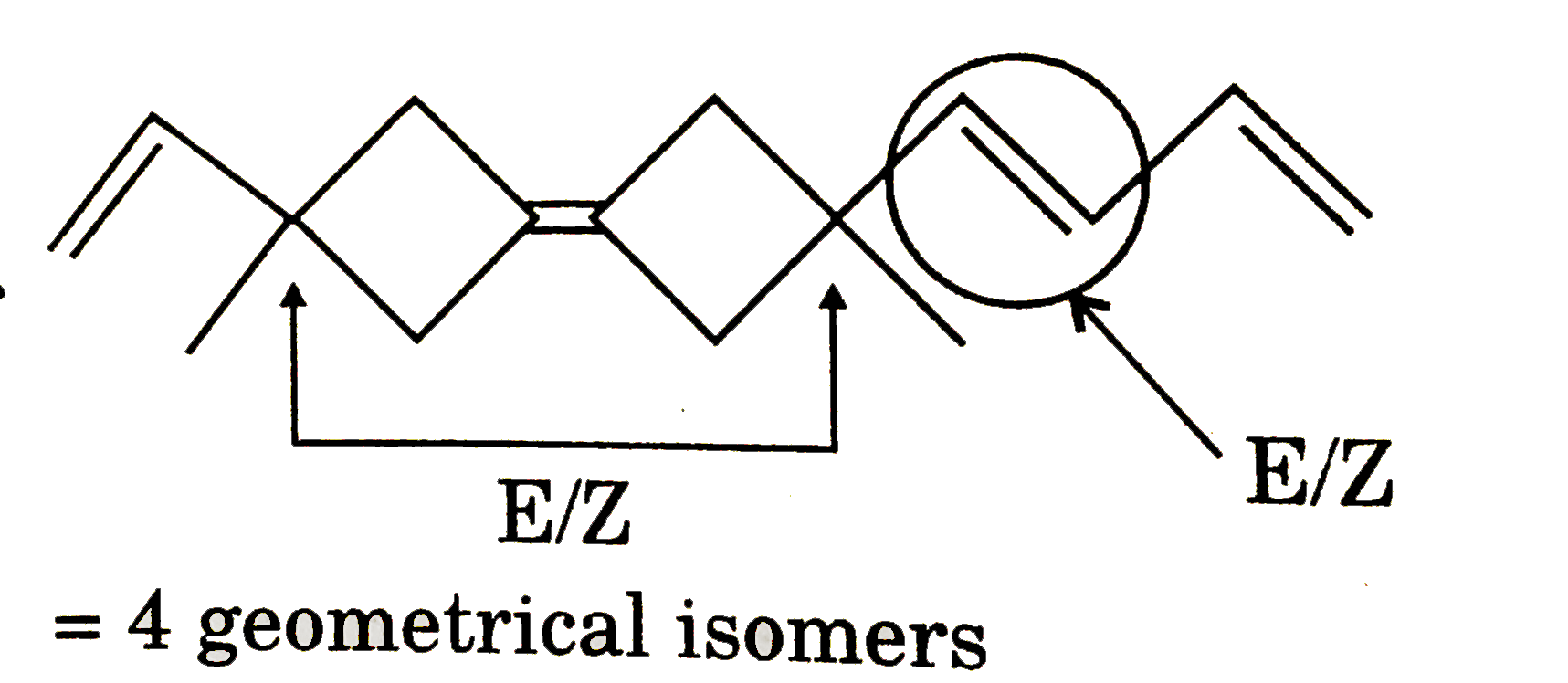 = 4 GEOMETRICAL ISOMERS |
|
| 30. |
How many geometrical isomers are possible for the given compound? CH_(3)-CH=CH-CH=CH-C_(2)H_(5) |
|
Answer» Four |
|
| 31. |
How many geometrical isomers are possible for 2, 4-hexadiene? |
|
Answer» Solution :Three GEOMETRICAL isomers are POSSIBLE for 2, 4-hexadiene. (1) 2-cis-4-cis hexadiene (2) 2-trans-4-trans hexadiene (3) 2-cis-4-trans hexadience `-=` 2-trans -4-cis hexadiene |
|
| 32. |
How many geometrical isomers are possible by H_(3)C-CH=CH-CH=CH-CH=C=C=C-CH_(3) ? |
|
Answer» `H_(3)C-CH=CH-CH=CH-CH=C=C=C-CH_(3)` has three GEOMETRICAL centre and is UNSYMMETRICAL thus, totla G.I. = `2^(3)`=8. |
|
| 33. |
How many fundamental particles are present in the radioactive isotope of hydrogen? |
| Answer» SOLUTION :Radioactive isotope of HYDROGEN is tritium. It has four FUNDAMENTAL particles (one ELECTRON, one proton and two neutrons). | |
| 35. |
How many fractions can be obtained after fractional distillation of all dibromo derivatives of n-butane? |
|
Answer» |
|
| 36. |
How many following pairs of compounds are not position isomers? |
|
Answer» Three 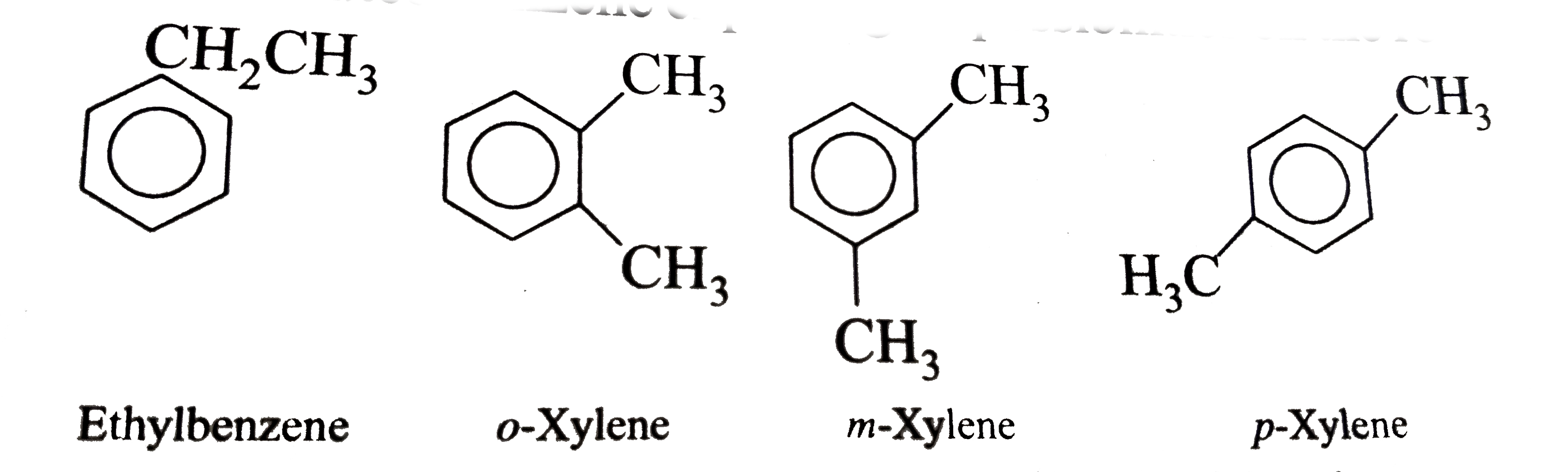 SINCE we have two EXTRA C atoms relative to BENZENE, we start with monosubstituted benzene and end up with diubstituted benzene exploring all POSSIBILITIES on the route: |
|
| 38. |
How many equivalents of Sodium sulphate is formed when Sulphuric acid is completely neutralized with a base NaOH? |
|
Answer» 0.2 |
|
| 39. |
How many enantiomers are possible on monochlorination of isopentane. |
Answer» 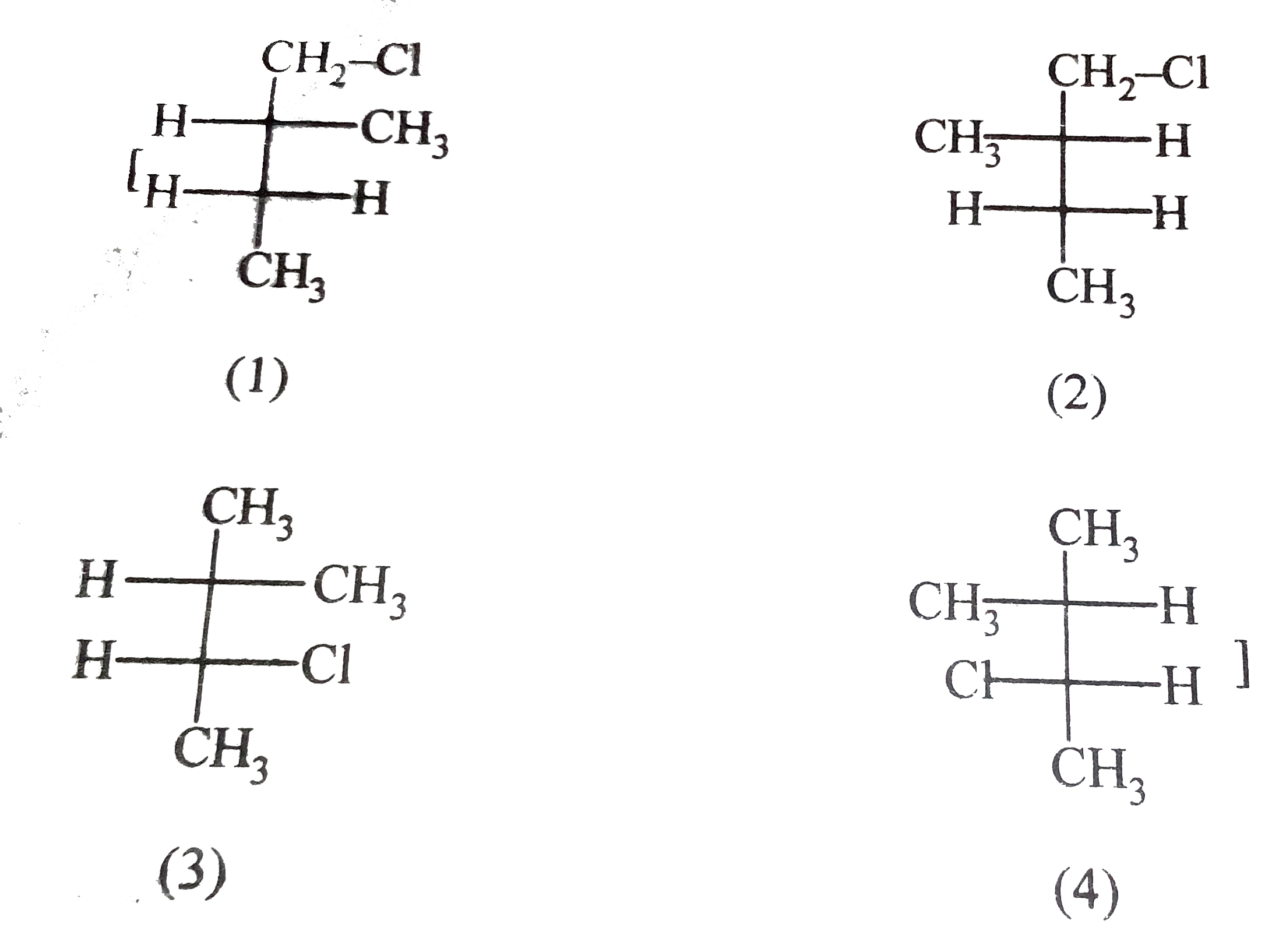
|
|
| 40. |
How many elements in periodic table in gaseous from ? Give its place in periodic table ? |
Answer» SOLUTION :11 ELEMENTS are in GASEOUS from in PERIODIC table.
|
|
| 42. |
How manyelementscan beaccommodated in the presentset upof theformof the periodictable ?Explain. |
|
Answer» Solution :In thepresent SET up tothe longformof theperiodic tablewe havesevenperiods (i.e., principalquantum number n=7) and four blocks (s,p,d- andf- block elements ) . Thereforethe maximumnumberof elements whichcan beaccommodated in thepresentset up of the longformof theperiodictable in theaccordancewithaufbauprinciple is `1 s^(2)2 s^(2)2P^(6)3 s^(2)3p^(6)3 d^(10)4p^(6)5s^(2)4d^(10)5 p^(6)6s^(2) 4 f^(14) 5 d^(10)6 p^(6) 7 s^(2)5 f^(14)6 d^(10)7 p^(6) = 118` |
|
| 43. |
How many elements can be accommodated in the long form of the periodic table ? Explain. |
|
Answer» Solution :In the present set up of the long form of the PERIODIC table ,we have eighteen groups ,seven periodic table , we have eighteen groups ,seven periods (i.e. PRINCIPAL quantum number ,n=7)and four blocks (s,p,d and f -BLOCK elements). Therefore ,the maximum number of elements which can be accommodated in the present set up of the long form of the periodic table in accordance with Aufbau principle is `1s^(2),2s^(2),2p^(6),3s^(2),3p^(6),4s^(2),3d^(10),4P^(6),5s^(2),4d^(10)5p^(6),6s^(2),4f^(14),5D^(10),6p^(6),7s^(2),5f^(14),6d^(10),7p^(6)=118`. |
|
| 44. |
How many elements are there having electrons in d-orbital among the elements with atomic number 1 to 100 ? |
|
Answer» 30 |
|
| 45. |
How many elements are there in 6^(th) period? Prove it. |
| Answer» Solution :In sixth period, 32 elements are present. This period starts with the filling of `6^(th)` ENERGY shell, n=6. There are sixteen ORBITALS (one 6s, seven 4F, five 4d and three 6p) to be FILLED. These sixteen orbitals can accommodate 32 `(16xx2=32)` electrons. Hence, 32 elements are present in sixth period. | |
| 46. |
How many elements are there in 4^(th) period? Prove it. |
| Answer» Solution :In fourth period, 18 ELEMENTS are present. In this period electrons are entering into fourth energy level, ie, n=4. It starts with the filling of 4s-orbitals. However, after the 4s, but before the 4p orbitals, there are five 3D-orbitals also to be filled. Thus, nine orbitals (ONE 4s, five 3d and three 4p) have to be filled. These nine orbitals can ACCOMMODATE `(9xxx2=18)` 18 electrons. Hence, `4^(th)` period contain 18 elements in it. | |
| 47. |
How many elements are present in s-block ? |
|
Answer» Solution :Alkali metal : Li, Na, K, Rb, Cs, Fr Alkaline EARTH metal : Be, Mg, Ca, Sr and RA |
|
| 48. |
How many elements are present in 1 to 7 periods? |
Answer» SOLUTION :
|
|
| 49. |
How many elements are possible in first period ? |
|
Answer» Solution :In first period have DOUBLE number than orbitals elements present. First Period n = 1 and Sub shell 1 = (n-1) = 0, So only ls orbital is present. Element are 2 in 1s orbital. NOTE: Calculate elements in period 2, 3, 4, 5, 6 |
|