

Saved Bookmarks
This section includes 7 InterviewSolutions, each offering curated multiple-choice questions to sharpen your Current Affairs knowledge and support exam preparation. Choose a topic below to get started.
| 1. |
How the excessive amount of nitrogen oxide is harmful ? |
| Answer» Solution :Higher concentration of `NO_2` damage the leaves of PLANTS and retard the rate of photosynthesis. Nitrogen oxide is a lung irritant that can LEAD to an acute RESPIRATORY disease in children. It is toxic to living tissues `NO_2` is harmful to various TEXTILE fibres and metals. | |
| 2. |
How theenergy of an electron changein orbit ? |
|
Answer» SOLUTION :As theatomicnumberis moreenergyis morenegativeand asnumberof orbitincreasethe energyis lessnegative . `E_(n) = -2.18 xx 10^(18)(Z^(2))/(n^(2))` J |
|
| 3. |
How the electron movement is represent? |
Answer» Solution :The movement of electron is shown by curved- arrow  . It is starts from the POINT from where an electron PAIR is shifted and it ENDS at a LOCATION to which the pair of electron may move. . It is starts from the POINT from where an electron PAIR is shifted and it ENDS at a LOCATION to which the pair of electron may move.
|
|
| 4. |
Howtheelectronis observed ? |
| Answer» SOLUTION :To observeelectronit isilluminated by lightorelectromagnaticradition .Thelightusedmustof ANELECTRON. | |
| 5. |
How the crystal form of ice will be examine ? |
| Answer» SOLUTION :The EXAMINATION of ICE CRYSTALS is DONE with X-rays. | |
| 6. |
How the detection of carbon and hydrogen compound? Explain with reaction |
|
Answer» Solution :In organic compound the carbon and hydrogen are detected by heating the compound with copper (II) oxide. (i) Presence of carbon:Carbon present in the compound is oxidised to carbon dioxide (tested with lime -water, which develops turbidity). Reaction: `C + 2CuO RARR 2Cu + CO_(2(g))` `underset("Carbon dioxide")(CO_(2(g))) + underset("lime water")(CA(OH)_(2)) rarr underset("WHITE solid")(CaCO_(3(s))) + H_(2)O` (ii) Presence of hydrogen: The organic compound is heated with CuO and convert into hydrogen to water and tested with anhydrous copper sulphate, which turns blue. So this is a detection test of presence of hydrogen. `2H + CuO overset(Delta)rarr Cu + H_(2)O` `5H_(2)O + underset(underset("Copper sulphate")("White anhydrous"))(CuSO_(4)) rarr underset(underset("Copper sulphare")("Blue hydrated"))(CuSO_(4).5H_(2)O)` |
|
| 7. |
How the covalent bond is form according to lewis & langmuir ? |
| Answer» SOLUTION :When two ATOMS share are ELECTRON pair theyfrom covalent bond By sharing `bar(E)` they get electron CONFIGURATION like inner gas. | |
| 8. |
How the colour and magnetic property of solutions of alkali metals in liquid NH_(2) changes with .concentration ? |
| Answer» Solution :SOLUTIONS of ALKALI metals in liquid `NH_(3)` are blue in colour and PARAMAGNETIC in NATURE due to ammoniated electron. In concentrated solution, the blue colour changes to bronze colour and becomes diamagnetic. | |
| 9. |
How the chemistry is associated with nature ? |
|
Answer»
|
|
| 10. |
Howthe atomicorbitalsare distingulshed fromeachother ? |
| Answer» SOLUTION :Atomicorgitalsaresymbolisedby princciplequantumnumber(N )Angularquantumnumber(L ) andMagneticquantumnumber `(M_(1))` | |
| 11. |
How theatomwordis derived ? |
| Answer» SOLUTION :The WORD ATOMHAS beenderivedfrom theGreekworda - ATOMIO whichmeansuncutableor non-divisible . | |
| 12. |
How sulphur is estimated by Carius method and give calculation. |
|
Answer» Solution :A known mass of an ORGANIC compound is heateed in a carius TUBE with sodium peroxide of FUMING `HNO_(3)`. Sulphur present in the compound is Oxidized to sulphuric acid. It is precipitated as Barium sulphate by adding barium chloride solution. The precipitate is filtered dried and weighted the mass of `BaSO_(4)` is NOTED. Mass of Organic compound taken `=mg` mass of `BaSO_(4)` 1 mol of `BaSO_(4)=233g` 233g of `BaSO_(4)` contain 32 G of sulphur `M_(1)g` of `BaSO_(4)` contain `(32xxM)/233` of sulphur. % age of sulphur `=(32xxM_(1)xx100)/(233xxM)` |
|
| 13. |
How Sodium metalreacts with (i) ethanol and (ii) acetylene. |
|
Answer» Solution :Sodium METAL reacts with ethanol to FORM sodium ETHOXIDE and liberates `H_(2)`gas. `2Na + C_(2)H_(5)OH to 2C_(2)H_(5)ONA + underset(Na)(H_(2))uarr` `HC=CH + Na to H-C=C-Na to Nunderset("Sodium ACETYLIDE")(a-C=C-Na)` |
|
| 14. |
Howpropene is prepared form1,2 dichloropropane |
| Answer» Solution :`CH_(3)- underset(CI)underset(|)(CH) - CH_(3)- CIunderset(Delta ) overset(ZnCH_(4)OH) (to)CH_(4)- CH = CH_(2) + ZnCI_(2)` | |
| 15. |
How particulates help in the cloud formation ? |
| Answer» SOLUTION :They ACT as NUCLEI for CLOUD FORMATION | |
| 16. |
How ozone reacts with 2 methyl properie |
Answer» SOLUTION :
|
|
| 17. |
How p-niro toluene can be converted to benzene? |
Answer» SOLUTION :The sequence of REACTION involved in the CONVERSION of p-nitro toluene to benzene as follows REMOVAL of `CH_3` GROUP : 
|
|
| 18. |
How ozone reacts with 2-methyl propene ? |
Answer» SOLUTION :
|
|
| 19. |
How ozone is formed from the oxygen present in atmosphere? |
|
Answer» Solution :The upper stratosphere consists of considerable amount of OZONE `(O_3)`, which PROTECTS us from the harmful ultraviolet (UV) radiations coming from the sun. These radiations cause skin cancer in humans. Therefore, it is important to maintain the ozone shield In the stratosphere when UV radiations acting on dioxygen `(O_2)` molecules, the UV radiations split APART molecular oxygen into free oxygen (O) atoms. These oxygen atoms combine with the molecular oxygen to form ozone. `O_(2(g)) overset(UV)to O_((g)) + O_((g))` `O_((g)) + O_(2(g)) overset(UV)to O_(3(g))` Ozone is thermodynamically unstable and decomposes to molecular oxygen. Thus, a dynamic equilibrium exists between the production and decomposition of ozone molecules. The DEPLETION of this protective ozone layer because of the presence of certain chemicals in the stratosphere. |
|
| 20. |
How oxides of nitrogen are harmful? |
|
Answer» SOLUTION :(i) Oxides of nitrogen are produced during high temperature combustion processes, by oxidation of nitrogen in air and it is formed the combustion of fuels such as coal, diesel and petrol (II) `N_(2) + O_(2) overset(gt 1210^@C) rarr 2NO` `2NO+O_(3) overset(1100^@C) 2NO_(2)` `NO + O_(3) rarr NO_(2) + O_(2)` (iii) The oxides of nitrogen are CONVERTED intp nitric acid which comes down in the form of acid rain. They also form REDDISH brown haze in heavy traffic. (iv) Nitrogen dioxide potentially damage plant leaves and retard photosynthesis. (v) `NO_(2)` is a respiratory irritant and it can CAUSE asthma and lung injury. |
|
| 21. |
How of the following are positively charged sols ? Cu sol, Ag sol, CdS, As_(2)S_(3), Fe(OH)_(3), Al(OH)_(3) methylene blue. |
|
Answer» |
|
| 23. |
How much zinc should be treated with excess of dilute hydrochloric acid to obtain 2.24 litres of hydrogen at S.T.P. |
|
Answer» Solution :The balanced chemical equation representing the combination of zinc with hydrochloric acid is: `underset(1 "mole 1 gram atom 65.38 g")(ZN) + 2HCL (aq) to ZnCl_(2)(aq) + underset("1 mole 22.4 L at S.T.P")(H_(2)(g))` This equation signifies that 1 mole (1 gram atom), i.e., 65.38 g of zinc react with hydrochloric acid to produce 1 mole, i.e., 22.4 L of hydrogen at S.T.P `therefore 22.4 L` of hydrogen at S.T.R are GIVEN by zinc = 65.38 g `therefore 2.24` L of hydrogen at S.T.P will be given by zinc `=(65.38)/22.4 xx 2.24 = 6.54 g` Hence, 2.24 L hydrogen at ST. R will be PRODUCED by the action of 6.54 g of zinc with excess of HCl. |
|
| 25. |
How much water should be added to 200 mL of semi normal solution of NaOH to make it exactyly decinormal? |
|
Answer» 200 mL `V_(2) = 1/2 xx 200 xx 10 = 1000ML` `THEREFORE` VOLUME of water added = 100-200 = 800 mL |
|
| 26. |
How much water should be added to 500 mL of N/2NaOH solution to obtain a decinormal solution? |
|
Answer» SOLUTION : Suppose, X mL of WATER are required to be added for dilution. According to the law of equivalence, `underset("Conc. Sol")(N_(1)V_(1)) = underset("Dil. Sol")(N_(2)V_(2))` For concentrated (given) solution, `N_(1) = 1/2, V_(1) = 500 mL` For diluted solution, `N_(2) = 1/10` (DECINORMAL), `V_(2) = 500 +x` Therefore, according to the above equation `1/2 xx 500 = 1/10 xx (500 +x)` or x = 2000 mL Hence, 2000 mL of water should be added to obtain a decinormal solution. |
|
| 27. |
How much water required to convert 10 mL 10 N HNO_(3)in 0.1 NHNO_(3) |
| Answer» Answer :B | |
| 28. |
How much water required to convert 1 N 100 mL Glucose to 0.1 N ? |
|
Answer» 1000 `1 XX 100= 0.1 xx V_(2) "" :.V_(2)=1000`ML `V=V_(2)-V_(1) = 1000-100=900ml` |
|
| 29. |
How much water must be added to 100ml of 0.5M NaOH to get 0.2M NaOH solution. |
|
Answer» |
|
| 30. |
If x' litres of O_(2) is released at STP from one litre of H_(2)O_(2) solution due to decomposition of H_(2)O_(2) then we lable such solution as 'x volume H_(2)O_(2) 2H_(2)O_(2) to 2H_(2)O+O_(2) 30% (w/v) H_(2)O_(2) is called perhydrol. How much volume of O_(2) is released from 100 ml of Phydrol" due to decomposition ofH_(2)O_(2) at STP? |
|
Answer» 18 lit 1 ML perhydrol gives 100 ml `O_2` 100 ml perhydrol gives 10 lt `O_2` But 90% DECOMPOSED` :. `9ltis RELEASED |
|
| 31. |
How much volume of oxygen will be required to burn completely 24mL of methane? How much volume of carbon dioxide is formed under similar conditions? |
|
Answer» |
|
| 32. |
How much volume of chlorine is required to prepare 89.6 L of HCI gas at STP? |
|
Answer» Solution :`UNDERSET(1xx22.4L)(H_(2(g))) + underset(1xx22.4L)(Cl_(2(g))) rarr underset(2xx22.4L)(2HCl_(g))` 2 `XX` 22.4 L of HCI is produced by 22.4 L of `Cl_(2)` `:.`89.6 L of HCI will be produced by `22.4/(2xx22.4) xx 89.6L` = `44.8` L of chlorine. |
|
| 33. |
How much volume of chlorine is required to form 11.2 L of HC1 at 273 K and 1 atm pressure? |
|
Answer» Solution :The balanced equation for the formation of HCl is, `H_(2)` (g) +` Cl_(2)(g) rarr 2 HCl(g) ` As per the STOICHIOMETRIC equation, under given CONDITIONS, To PRODUCE 2 moles of HCl, 1 mole of chlorine gas is REQUIRED. To produce 44.8 litres of HCl, 22.4 litres of chlorine gas are required. `:.` To produce 11.2 litres of HCl, `(22.4 L Cl_(2))/(cancel(44.8L of HCl)4) xx 11.2 L` of `HCl` 5.6 litres of chlorine are required |
|
| 34. |
How much volume of 6 M solution of NaOH is required to prepare 500 ml of 0.250 M Naon solution? |
| Answer» Solution :6% - `(v)/(v)`aqueous solution CONTAINS 6g of methanol in 100 ml solution.`therefore`To prepare 500 ml of 6% v/v solution of methanol 30g methanol is taken in a 500 ml STANDARD flask and REQUIRED quantity of water is added to make up the solution to 500 ml. | |
| 35. |
How much volume of carbon dioxide is produced when 50 g of calcium carbonate is heated completely under standard condition ? |
|
Answer» Solution :The balanced chemical equation is. `CaCO_(3) (s) rarr`CaO(s) + `CO_(2)` (g) As per the STOICHIOMETRIC equation. 1 MOLE (100G) `CaCO_(3)` on heating produces I mole `CO_(2)` 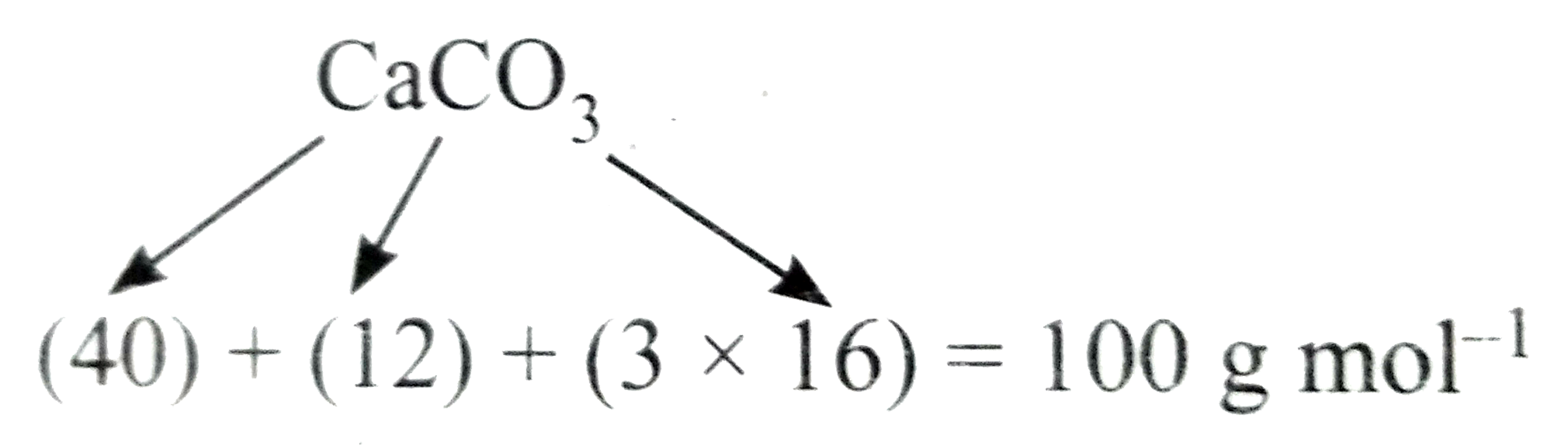 At STP. 1 mole of `CO_(2)` OCCUPIES a volume of 22.7 litres `:.` At STP, 50 g of `CaCO_(3)` on heating produces, `("22.7 litersof" CO_(2))/(cancel(100g CaCO_(3))_2) xx 50g CaCO_(3)` = 11.35 liters of `CO_(2)` |
|
| 36. |
How much volume of Carbon dioxide is produced when 25 g of calcium carbonate is heated completely under standard conditions? |
|
Answer» Solution :`CaCO_(3)(G) rarr CaO + CO 3_(s) + CO_(g)` 22.4 L 100 g of `CaCO_(3)` PRODUCES 22.4 L of `CO_(2)` `:.` 25 g of `CaCO_(3)` will produce = `22.4/100 XX 25 ` = 5.6 L of `CO_(2)`. |
|
| 37. |
How much volume of 11.2 volumes H_2O_2 is required to completely oxidise one mole of lead sulphide into lead sulphite? |
|
Answer» 2Its 1 mole Z4 mole `22.4 vol H_2O_2 = 2M H_2O_2` 11.2 vol `H_2O_2 = 1M H_2O_2 = 1 " mole" //"lt"` |
|
| 38. |
How much volume of 6 M solution of NaOH is required to prepare 500 mL of 0.250 M NaOH solution. |
|
Answer» SOLUTION :`6% (V)/(v)` aqueous solution contains 6G of methanol in 100 ml solution. `therefore` To prepare 500 ml of `6%` v/v solution of methanol 30 g methanol is take in a 500 ml standard flask and required quantity of wter is added to MAKE up the solution to 500 ml. |
|
| 39. |
How much volume of 0.40 M Na_(2)S_(2)O_(3) would be required to react with the I_(2) liberated by adding excess of KI of 50 mLof 0.20 M M CuSO_(4) |
|
Answer» 12.5 mL `0.4xxVxx1=50xx0.2xx1 " V=25ml"` |
|
| 40. |
How much volume of 0.1 M Hac should be added to 50 mL of 0.2 M NaAc solution if we want to prepare a buffer solutionof pH 4.91. Given pK_(a) for acetic acid is 4.76. |
|
Answer» or `log. (["Salt"])/(["Acid"])=0.15 or (["Salt"])/(["Acid"])=ANTILOG 0.15 = 1.41` `("MOLES of Salt")/("Moles of Acid")=1.41," i.e.," ((0.2)/(1000)xx50)/((0.1)/(1000)xxV)=1.41 or (0.01)/(1000V)=1.41 or V= 100//1.41 = 70.92 ML` |
|
| 41. |
How much volume of 10M HCl should be diluted with water to prepare 2.00L of 5M HCl. |
|
Answer» Solution :`N_1V_1 = N_2V_2` `10N HCl = 5N HCl ` `10 XX V_1 = 5 xx 2.00` `:. V_1 = (5 xx 2.00)/(10)` `=1.00 L ` |
|
| 42. |
How much time would it take to distribute one Avogadro number of wheat grains, if 10^(10) grains are distributed each second ? |
|
Answer» SOLUTION :1 Avogadro no. are wheat grains `= 6.022xx10^(23)`now, `10^(10)` grains are distributed time in = 1 sec. `therefore 6.022xx10^(23)` grains would be distributed time in `= (6.022xx10^(23)xx1s)/(1xx10^(10))=6.022xx10^(13)` sec. `= (6.022xx10^(13)s)/(60xx60xx24xx365 "s YEAR"^(-1))` `= (6.022xx10^(13))/(0.6xx0.6xx2.4xx3.65xx10^(7))` year `= 1.90957xx10^(6)` year `~~` 1909570 year 19 Lakh 9 Thousand five hundred SEVENTY years. (THINK about it : How big value Avogadro number is !). |
|
| 43. |
How much time would it take to distribute one Avogadro number of wheat grains, if 10^(10)grains are distributed each second ? |
|
Answer» SOLUTION :Avogadro.s number = `6.022 xx 10^(23) and 10^(10)` GRAINS are distributed each second. `:. """ TIME taken in the distribution of " 6.022 xx 10^(23)` grains `= (6.022 xx 10^(23))/(10^(10))` =`(6.022xx10^(23))/(10^(10))xx 1/(3.156xx10^7)` years `( :. 1 " year " =3.156 xx 10^7 s)` `=1.908xx10^6` years |
|
| 44. |
How much time it would take to distribute one Avogadro's number of wheat grains if 10^(10) grains are distributed each second ? |
|
Answer» Solution :SIMILAR to Q.21, page 1/55 (UNIT 1). Time REQUIRED`=(6.02xx10^(23))/(10^(10))s=6.02xx10^(13)s` `=(6.02xx10^(13))/(60xx6xx24xx365)` YEARS `=1.9089xx10^(6)` years approx. |
|
| 45. |
How much sulphur is to be burnt to produce 0.224 lit of SO_(2) at NTP? |
|
Answer» 0.03 g |
|
| 46. |
How much sodium acetate should be added to 0.1m solution of CH_(3)C O O H to give a solution of pH 5.5 (pK_(a) "of" CH_(3)C O O H=4.5). |
|
Answer» 0.1 m `5.5=4.5+log .([CH_(3)CO ONa])/(0.1)` `=4.5 + log [CH_(3)CO ONa]+1` or` log [CH_(3)CO ONa]=0` `:. [CH_(3)CO ONa]=1M` |
|
| 47. |
How much should the pressure be increased in order to decrease the volume of a gas by 5% at constant temperature |
| Answer» ANSWER :D | |
| 48. |
How much quantityof zinc will have to be reacted with excess of dilute HCl solution ti produce sufficient hydrogen gas for completely reacting with the oxygen obtained by decomposing 5.104g of potassium chlorate? |
|
Answer» `(5.104)/(122.5)` mole `KClO_(3)=(3xx5.104)/(122.5)` MOL of `Zn = (3xx5.104xx65)/(122.5)=8.124 ""G"" Zn` |
|
| 49. |
How muchradiusare therein stationary orbitals ? |
|
Answer» Solution :`r_(N) = (n^(2)a_(0))/(Z ) = ((52.9)n^(2))/(z) PM ` wheren = qunatumnumber orbitalof electron= energylevel =1.2.3 `a_(0) =52 .9 pm=-0.0529 nm= 5.29 xx 10^(11)m` |
|