

Saved Bookmarks
This section includes 7 InterviewSolutions, each offering curated multiple-choice questions to sharpen your Current Affairs knowledge and support exam preparation. Choose a topic below to get started.
| 1. |
Air contains N_(2) and O_(2) in the ratio of 4:1 by volume. The average conditions of temperature and pressure ? |
|
Answer» `12.0` `:.` AVERAGE VAPOUR density of air `=(28.8)/(2)=14.4` |
|
| 2. |
Air contains nitrogen and oxygen in the volume ratio of 4:1. The average molecular weight of air is |
|
Answer» 30 |
|
| 3. |
Air contains 79% N_(2), 20% O_(2) and 1% CO_(2) by volume. If the total pressure of air is 1 bar, find the partial pressure of N_(2), O_(2), CO_(2). |
|
Answer» |
|
| 4. |
Air contains 21% oxygen by weight. What weight of air is required t burn 200 g of coal which contains only 80% combustible material |
|
Answer» `2031.79` wt. if combustible meterial `(80)/(100)xx200=160g` `12g C_________32g` OXYGEN `160g C________426.6g` oxygen To get 21g oxygen - take 100g air To get 426.6g oxygen - take 2031.7g air |
|
| 5. |
Air contains 21% of oxygen by volume. The number of moles of O_(2) present in 5L of air at STP conditions |
|
Answer» `2.23xx10^(-1)` |
|
| 6. |
Air contains 20% by volume of oxygen. The volume of air required for the compoete combustion of 1L of methane under the same conditions is |
|
Answer» 2L |
|
| 7. |
Air contain 99%N_(2) and O_(2) gases. Then why don't they combine to form NO under the standard conditions? Given that the standard free energy of formation ofNO(g) is 86.7 kJ mol^(-1) . |
| Answer» Solution :STANDARD free energy of FORMATION `( Delta_(f)G^(@))` for the REACTION `(1)/(2)N_(2)(g)+(1)/(2)O_(2)(g) rarr NO(g0` is POSITIVE ( equal to `+86.7 kJ mol^(-1))`. Hence, the reaction isnon-spontaneous under the standard CONDITIONS. | |
| 8. |
AI(OH)_(2)darr ("white")+ OH^(-) rarr [AI(OH)_(4)]^(-) (soluble complex) White precipitate of AI(OH)_(3) reappears when: |
|
Answer» a solution of AMMONIUM chloride is added 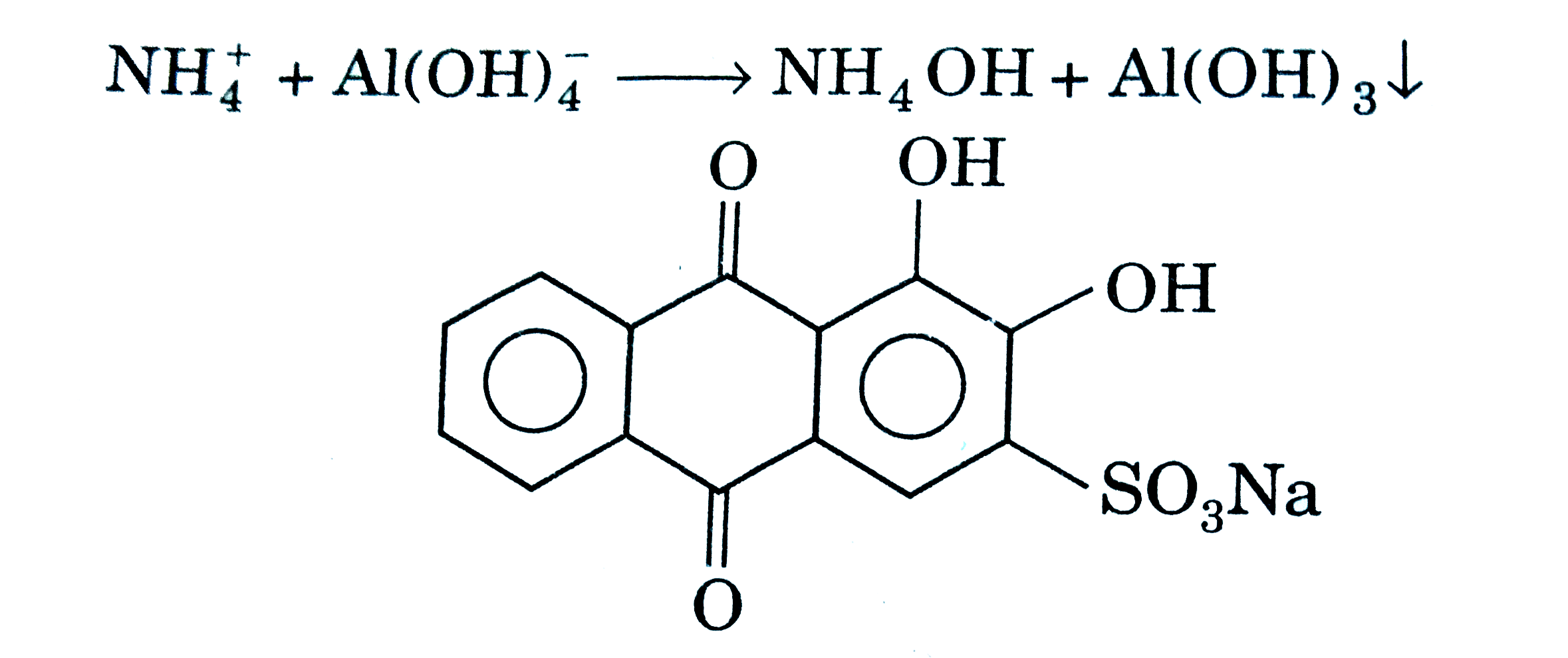 (Alizarin red S) `rarr` Red ppt. or LAKE in ammonical solution. |
|
| 9. |
AI(OH)_(2)darr ("white")+ OH^(-) rarr [AI(OH)_(4)]^(-) (soluble complex) Identify the correctstatement with respect to the gelantinous white precipitate of aluminium hydroxide. |
|
Answer» Fresh precipitate dissolves by the addition of strong acid and base (Alizarin red S) `rarr` Red PPT. or lake in AMMONICAL solution. |
|
| 10. |
AI(OH)_(2)darr ("white")+ OH^(-) rarr [AI(OH)_(4)]^(-) (soluble complex) Fe(OH)_(3) precipitate and AI(OH)_(3) precipitate can be separated by: |
|
Answer» increasing the `OH^(-)` concentration by SODIUM hydroxide 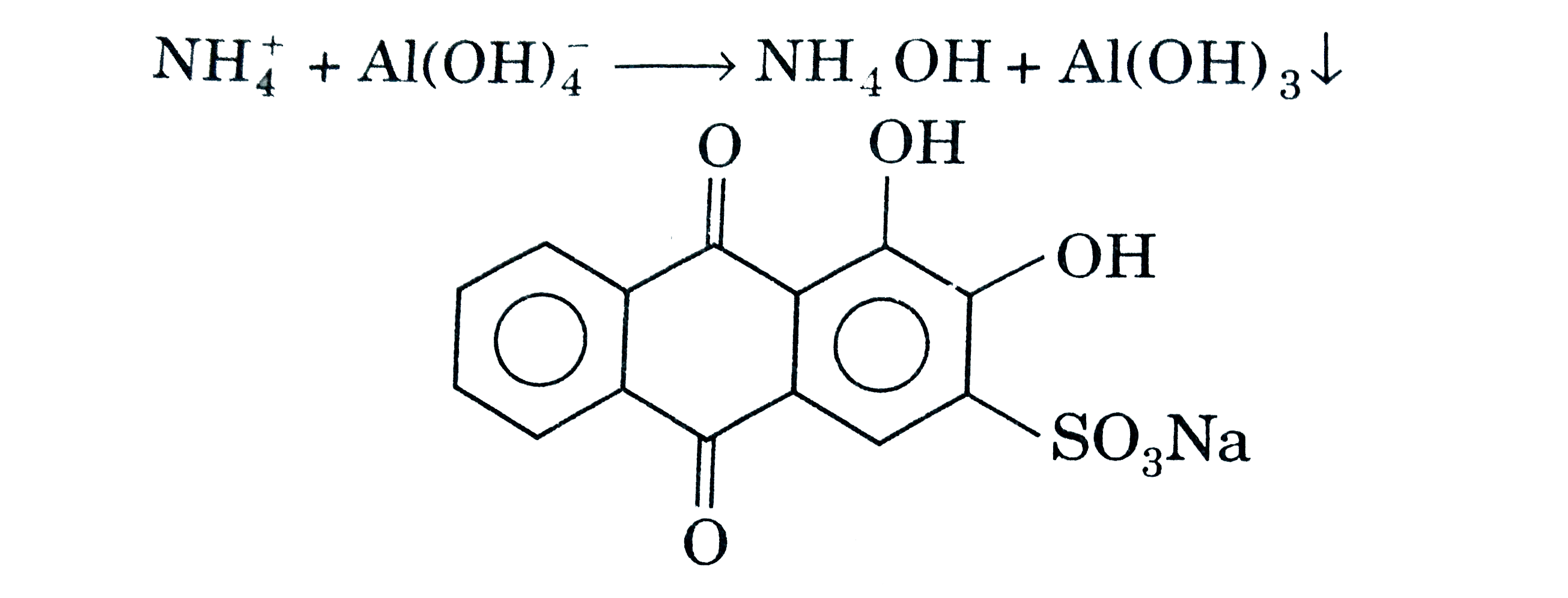 (Alizarin red S) `rarr` Red ppt. or lake in ammonical solution. |
|
| 11. |
AlCl_(3) exist as dimer because |
|
Answer» AL has greater I.P |
|
| 12. |
AICI_(3) overset(+NaOH)rarr X darr overset("excess" NaOH)rarr Y(Clear solution). |
|
Answer» |
|
| 13. |
AICI_3 exists as a dimer through halgen bridged bonds. (R): AICI_3 gets stability by accepting electrons from the bridged halogen. |
|
Answer» Both A and R are true, R explains A |
|
| 14. |
AICI_3 fumes in moist air due to its hydrolysis b) Al metal is stable in dry air because of protective oxide layer. c) p pi -p pi back bonding does not occur in halides of aluminium because of larger size. d) Anhydrous AICI_3 cannot be prepared by heating AlCl_3 . 6H_2 O. Correct statements are |
|
Answer» a , B only |
|
| 15. |
aH_(2)S+bHNO_(3)rarrcS +dNO+ eH_(2)O. The value of([(cxxd)-e])/((a-b))=______ |
|
Answer» `((3xx2)-4)/((3-2))=2` |
|
| 16. |
DeltaH^(0) for a reaction F_(2) + 2HCl rarr 2HF + Cl_(2) is given as -352.8 kJ. Delta H_(f)^(0) for HF is -268.3 KJ mol^(-1), then Delta H_(f)^(0) of HCl would be |
|
Answer» SOLUTION :`Delta H = H _(P) - H _(R) = 2 H _(HF) - 2H _(HCl)` `=- 352.8 kJ = 2 (0268.3) - 2 (H _(HCl))` `2 (H _(HCl))=-536.6 + 352.8 =-183.8kJ.` (or) `H _(HCl) =-91.9 kJ mol ^(-1).` |
|
| 17. |
Agl crystallises in cubic close packed ZnS structure. What fraction of tetrahedral sites is occupied byAg^(+)ions? |
| Answer» Solution :In the face- centred unit CELL of AgI,there are `4 Ag^(+)`ions and ` 4I ^(-)` ions in the PACKING , therefore, there are eight tetrahderal voids. Of these , half are occupied by SLIVER cations. | |
| 18. |
AgI crystallises in cubic close packed ZnS structure. What fraction of tetrahedral sites is occupied of Ag^+ ions ? |
| Answer» Solution :In the face-centred unit cell of AGI, there are `4 Ag^+` ions and `4 I^-` ions. As there are `4 I^-` ions in the PACKING. Therefore, there are eight tetrahedral VOIDS. Of these , half are occupied by silver cations. | |
| 19. |
AgI crystallises in cubic close packed ZnS structure.Guess how it mighthave happened ? |
| Answer» SOLUTION :NACL MUST have beensubjected to HIGH PRESSURE. | |
| 20. |
AgF_(2) is unstable but sometimes it behaves like strong oxidising agent ? |
|
Answer» Solution :`AgF_(2)` contain `Ag^(+2)`. So it is unstable. Therefore it can EASILY accept `e^(-)` and BECOMES STABLE STATE `Ag^(+)`. `Ag^(+2)toAg^(+)` So `Ag_(2)F_(2)` strong oxidising agent. |
|
| 21. |
AgCl is sparingly soluble salt ? If NaCl or KCI is added into it ? What happen ? |
Answer» SOLUTION : So `Cl^-` increases. So REVERSE reaction take place and CONCENTRATION of solid AgCl increase. So solubilities of AgCl DECREASE. |
|
| 22. |
AgCl is a sparingly soluble salt and …….. |
|
Answer» It is COMPLETELY INSOLUBLE in water |
|
| 23. |
AgBr_((s)) + 2S_(2)O_(3(aq))^(2-) hArr [Ag(S_(2)O_(3))_(2)]_((aq))^(3-) + Br_((aq))^(-) [Ksp(AgBr)= 5 xx 10^(-13), K_(f) [Ag(S_(2)O_(3))_(2)]^(3-) = 5 xx 10^(13)] What is the molar solubility of AgBr in 0.1 M Na_(2)S_(2)O_(3)? |
|
Answer» `0.5 M` `AgBr_((s)) hArr Ag_((aq))^(+) + Br_(aq)^(-)` `ArBr_((s)) + UNDERSET((0.1-2x))(2S_(2)O_(3(aq))^(2-))hArr[Ag(S_(2)O_(3))_(2)]_((aq))^(3-)+Br_((aq))^(-)` `Ksp xx K_(f) = 25` As value of `K_(f)` is very higher so we can assume almost `Ag^(+)` inverts into complex `25 = (x^(2))/((0.1 - 2x)^(2)), 5 = (x)/(0.1-2x), x = 0.045 M` |
|
| 24. |
[Ag^+]in solution is 1 xx 10^(-6) M then what is the concentration of Br^- ? K_(sp) of AgBr= 4.0xx10^(-13) . |
| Answer» SOLUTION :`4.0xx10^(-7)` M | |
| 25. |
Ag Br_(s) + 2S_2O_(3(aq) ) ^(2-) hArr Ag (S_2O_3)_(2(aq) ) ^(3-)+Br_(aq) ^(-)[Using :K_(sp)(AgBr)= 5xx 10 ^(-13)K_(f) (Ag(S_2O_3) _2^(3-) ) =5xx 10^(13) ] What is the molar solubility of AgBr in 0.1 M Na_2S_2O_3 |
|
Answer» ` 0.5 M` ` {:(AgBr +2S_2 O_3^(-2) HARR, [Ag(S_2O_3)_2]^(3-) ,+Br) ,(0.1M,0,0),((0.1-2x),x,x):}` ` 25= (x^(2))/((0.1-2x) ^(2) ), (x)/(0.1 - 2x) =5rArr x =0.045 M` |
|
| 26. |
A(G)+B(g)hArrC(g)+D(g) Above equilibrium is established by taking A& B in a closed container. Initial concentration of A is twice of the initial concentration of B. At equilibrium concentraons of B and C are equal. Then find the equilibrium constant for the reaction, C(g)+D(g)hArrA(g)+B(g). |
|
Answer» |
|
| 27. |
After the execution of the alpha-ray scattering experiment what were the observatoins made by Rutherford? What did he conclude from his observation? |
Answer» SOLUTION :
|
|
| 28. |
After rounding 1.235 and 1.225 to three significant figures, we will have their answers respectively as |
|
Answer» 1.23, 1.22 |
|
| 29. |
Atomic number of the element which has diffe rentiating electron enters into a d-subshell for the first time |
|
Answer» 4s |
|
| 30. |
After 3d-su level is completely filled the differentiating electron enters into ….. sub level. |
|
Answer» 4s |
|
| 31. |
The Lanthanide contraction relates to (AFMC) |
| Answer» Answer :A | |
| 32. |
Aerosol cans carry clear warning of heating of the can. Why? |
| Answer» Solution :Most aersol cans contian SEVERAL ounces of a propellant carbon dioxided, propane or butane. When exposed to flame, aerosol containers experince than they were designed to resist, causing them to RUPTURE violently into large fire balls. This occurs when the gas and LIQUID inside expands when heated, increasing the pressure inside the CONTAINER. | |
| 33. |
Advantage of soap over detergent : Soap are biodegradable whereas detergents are non-biodegradable. Difference in chemical behaviour of compound of hydrogen with elements of atomic number 17 and 20. |
|
Answer» Solution :a. ATOMIC number 17 = CHLORINE, and atomic number 20 = calcium. b. `H_(2)+CI_(2)to2HCI` `CI_(2)` is OXIDIZING AGENT, `H_(2)` is reducing agent. `Ca+H_(2)toCaH_(2)` |
|
| 34. |
Adsorption of gases on solid surface is generally exothermic because |
|
Answer» enthalpy is positive |
|
| 35. |
Adsorption is generally an |
|
Answer» EXOTHERMIC process `+DeltaS=Delta H=TDeltaS` (-ve)= `DeltaH-(+ve)(-ve)` or `Delta H=-ve` `therefore` For adsorption, `DeltaH` is generally -ve i.e., process is generally exothermic. |
|
| 36. |
Adsorption is multilayer in the case of |
|
Answer» PHYSICAL ADSORPTION |
|
| 37. |
Adsorption is an exothermic process. The amount of substance adsorbed should |
|
Answer» INCREASE with DECREASE in temperature |
|
| 38. |
Adsorption is accompanied by |
|
Answer» DECREASE in enthalpy and increase in entropy |
|
| 39. |
Adsorption is |
|
Answer» Colligative |
|
| 40. |
Adsorption due to strong chemical forces is called |
|
Answer» Chemisorption |
|
| 41. |
Adsorbed acetic acid on acitvated charcoal is |
|
Answer» Adsorber |
|
| 42. |
Adenosine triphosphate (ATP) is the energy. Currency for celuclar processes. ATP provides the energy for both energy consuming endergonic reaction and energy releasing exerogonic reactions, which require a small input of activation energy. When the chemical bonds within ATP are broken, energy is relased and can be harnessed for celluar work. The more bonds in a molecule, the more potential energy it containsl. Because the bond in ATP is si easily broken and reformed, ATP is like a rechargeable battery that power callular processes ranging rfeom DNA replicatin to protein synthesis. Adenosine triphosphate (ATP) is comprising of the molecule adenosinek, bound to three phosphate groups. together, these chemical groups constitute energy powerhouse. Together the two bonds between the phosphates are equal high-energy bonds (phosphonhydride bonds) that, when broken release sufficient energy to power a variet of cellular reaction and processes. the bond between the beta and gamma phosphate is considered "hi-energy" because wnen the bond breaks, the products [adenosine diphosphate (ADP) and one inorgnic phosphate group (P_(1))is called hydrolysis because it concumes a water molecule (hydro, meaning "water" ,and lysis, meaning separation). ATP is hydrolyzed into ADP in the followinf reaction : ATP(aq)+H_(2)O(l)rarrADP(aq)+P_(i)(aq)+H_(3)O^(+)(aq)Delta_(r)=-30kJ//mol Like most chemical reactions, the hydrolysis of ATP to ADP is reversible. The reverse reaction combines ADP +P_(1) to regenerate ATP (adenosine diphosphate). Since ATP hydrolysis releases energy, ATP syntesis must require an input of free energy. The syntheses of ATP molecule involvesoxidationofglucosebyNDA^(+) (Nicotinamidedinucleotide)to pyruvateions (CH_(3)COCOO^(-)) by reaction. C_(6)H_(12)O_(6)(aq)+2NAD^(+)(aq)rarr2CH_(3)COCO_(2)^(-)(aq)+2NDHA(aq)+4H_(3)O^(+)(aq),Delta_(r)G^(@)=-147kJ//mol Overall reaction : C_(6)H_(12)O_(6)(aq)+2NDA^(+)(aq)+2ADP(aq)+2P_(i)(aq)+2H_(3)O^(+)(aq)rarr2CH_(3)COCO_(2)^(-)(aq)+2NADH(aq)+2ATP(aq)+2H_(2)O(l) Hydrolysis of adenosine triphosphate (ATP) is used to drive biological reaction. Which of following processes can be driven by hydrolysis of one mole of ATP molecules ? |
|
Answer» Biosynthesis of tripeptide (3-peptide links) with each link involving `Delta_(r)G^(@)=17 kJ//mol` |
|
| 43. |
Adiabatic demagnetisationis a technique used for |
|
Answer» ADIABATIC expansion of a gas |
|
| 44. |
Adenosine triphosphate (ATP) is the energy. Currency for celuclar processes. ATP provides the energy for both energy consuming endergonic reaction and energy releasing exerogonic reactions, which require a small input of activation energy. When the chemical bonds within ATP are broken, energy is relased and can be harnessed for celluar work. The more bonds in a molecule, the more potential energy it containsl. Because the bond in ATP is si easily broken and reformed, ATP is like a rechargeable battery that power callular processes ranging rfeom DNA replicatin to protein synthesis. Adenosine triphosphate (ATP) is comprising of the molecule adenosinek, bound to three phosphate groups. together, these chemical groups constitute energy powerhouse. Together the two bonds between the phosphates are equal high-energy bonds (phosphonhydride bonds) that, when broken release sufficient energy to power a variet of cellular reaction and processes. the bond between the beta and gamma phosphate is considered "hi-energy" because wnen the bond breaks, the products [adenosine diphosphate (ADP) and one inorgnic phosphate group (P_(1))is called hydrolysis because it concumes a water molecule (hydro, meaning "water" ,and lysis, meaning separation). ATP is hydrolyzed into ADP in the followinf reaction : ATP(aq)+H_(2)O(l)rarrADP(aq)+P_(i)(aq)+H_(3)O^(+)(aq)Delta_(r)=-30kJ//mol Like most chemical reactions, the hydrolysis of ATP to ADP is reversible. The reverse reaction combines ADP +P_(1) to regenerate ATP (adenosine diphosphate). Since ATP hydrolysis releases energy, ATP syntesis must require an input of free energy. The syntheses of ATP molecule involvesoxidationofglucosebyNDA^(+) (Nicotinamidedinucleotide)to pyruvateions (CH_(3)COCOO^(-)) by reaction. C_(6)H_(12)O_(6)(aq)+2NAD^(+)(aq)rarr2CH_(3)COCO_(2)^(-)(aq)+2NDHA(aq)+4H_(3)O^(+)(aq),Delta_(r)G^(@)=-147kJ//mol Overall reaction : C_(6)H_(12)O_(6)(aq)+2NDA^(+)(aq)+2ADP(aq)+2P_(i)(aq)+2H_(3)O^(+)(aq)rarr2CH_(3)COCO_(2)^(-)(aq)+2NADH(aq)+2ATP(aq)+2H_(2)O(l) How many moles of ATP can by synthesised along with generation of maximum muscular and nervous work of 174 kJ by oxidation of glucose ? |
| Answer» Answer :B | |
| 45. |
Addtion of hydrohalides to alkene is an examplefor …………….. |
| Answer» SOLUTION :Electrophilicaddition | |
| 46. |
Addition reaction takes place in |
|
Answer» Alkane |
|
| 47. |
Addition of zinc power to CuSO_4solution precipitate copper due to |
|
Answer» reduction of `Cu^(2+)` Reduction of `Cu^(2+)` |
|
| 48. |
Addition of water to which of thefollowing equilibria causes it to shift in the backward direction ? |
|
Answer» `CH_(3)NH_(2)(aq) + H_(2)O(l)hArrCH_(3)NH_(3)(aq) + OH^(-) (aq)` |
|
| 49. |
Addition of water to the following compound gives H_2O_2 |
|
Answer» `CaOCl_2` |
|
| 50. |
Addition of water to phenyl acetylene in presence of dil. H_2SO_4 and HgSO_4 give ______ |
|
Answer» |
|