

Saved Bookmarks
This section includes 7 InterviewSolutions, each offering curated multiple-choice questions to sharpen your Current Affairs knowledge and support exam preparation. Choose a topic below to get started.
| 1. |
An industrial method of preparation of methanol is : |
|
Answer» Catalytic reduction of CARBON MONOXIDE in the PRESENCE of `ZnO-Cr_(2)O_(3)` |
|
| 2. |
An industrial fuel, 'water gas', which consists of a mixture of H_(2) "and" CO can be made by passing steam over red-hot carbon. The reaction is C(s)+H_(2)O(g)hArrCO(g)+H_(2)(g),DeltaH=+131KJ The yield of CO "and" H_(2) at equilibrium would be shifted to the product side by, |
|
Answer» raising the RELATIVE PRESSURE of the steam |
|
| 3. |
An industrial fuel 'water gas', which consists of a mixture of H_2 and CO can be made by passing steam over red-hot carbon. The reaction is : C(s) + H_2O(g) hArr CO(g)+H_2(g), DeltaH=+131kJ The yield of CO and H_2 at a equilibrium would be shifted to the prodcuts side by : |
|
Answer» raising the relative pressure of the STEAM |
|
| 4. |
An indicator is a weak acid and pH range of its colour is 3.1 to 4.5. If the neutral point of the indicator lies in the centre of the hydrogen ion concentrations correspondin to the given pH range, calculate the ionisation constain of the indicator. |
|
Answer» `4.13 xx 10^(-8)` `[H^(+)]_(1) = 7.94 xx 10^(-4) , [H^(+)]_(2) = 3.16xx 10^(-5)` At naturalpoint `[H^(+)] = ([H^(+)]_(1) + [H^(+)]_(2))/(2)` `:. HIN + H_(2)O hArr H_(3)O^(+) + In^(-)` `K_("In") = ([H_(3)O^(+)]["In"^(-)])/(["HIn"])` At netural point `["In"^(-)] = [HIn]` |
|
| 5. |
An idealgas has C_(p) =( 5)/(2) R. The gas is kept is a closed container of volume 0.0083m^(3) at a temperature of 300 K and a pressureof 1.6 xx 10^(6) Nm^(-2). An amount of energy equal to 2.49 xx10^(4) J is supplied to the gas. Calculated the final temperature of the gas. |
|
Answer» SOLUTION :No. of moles of the gas `(n) = (PV)/(RT) = ( 1.6 XX 10^(6) xx 0.0083)/( 8.3 xx300) =5.33` Given `C_(p) = ( 5)/(2) R` `:. C_(v) = C_(p) -R = ( 5)/(2) R-R= (3)/(2) R=(3)/(2) xx 8.3 = 12.45 JK ^(-1) mol^(-1)` Heat suppliedat CONSTANT volume `= n xx C_(v) = DeltaT` `:.2.49 xx 10^(4) = 5.33 xx 12.45 xx Delta T ` or `DeltaT = 375K` `:. `Final temperature `= 300 + 375 K = 675K` |
|
| 6. |
An ideal gasa undergoes through folowing cyclic procees.1-2 : Reversible adialbatic comparession from P_(1)V_(1)T_(1)"to"P_(2)V_(2)T_(2)2-3 : Reversible isochoric heating fromP_(2)V_(2)T_(2)" to "P_(3)V_(3)T_(3) 3-4Reversible adialbaticexpansion from P_(3)V_(3)T_(3)" to "P_(4)V_(4)T_(4)4-1Reversible isochoriccooling fromP_(4)V_(4)T_(4)" to "P_(1)V_(1)T_(1)Eefficiencyof the cycle is : |
|
Answer» `((T_(4)-T_(1))/(T_(3)-T_(2)))` |
|
| 7. |
An ideal gas occuping a volume of 2 dm^(3) and a pressure of 5 bar undergoes isothermal and irreversible expansion against external pressure of 1 bar. The final volume of the system and work involved in the process is |
|
Answer» `10 dm^3, 1000 J` |
|
| 8. |
An ideal gas undergoes isothermal expansion at constant pressure . During the process |
|
Answer» ENTHALPY increases but ENTROPY decreases . |
|
| 9. |
An ideal gas obeying kinetic theory of gases "____________". |
|
Answer» <P>can be liquefied if its temperature is more than CRITICAL temperature `T_(c ) `. |
|
| 10. |
An ideal gas, obeying kinetic theory of cannot be liquefied, because |
|
Answer» its critical TEMPERATURE is above `0^(@)C`. |
|
| 11. |
An ideal gas isexpanded from ( p_(1) ,V_(1),T_(1)) to (p_(2),V_(2), T_(2)) under different conditions. The correct statements (s) among the following is ( are ) : |
|
Answer» The work done by the gas is less when it is expanded reversiblyfrom `V_(1)` to `V_(2)`under adiabatic conditions as compared to that when expanded reversibley from `V_(1)`to `V_(2)` under isothermal conditions. 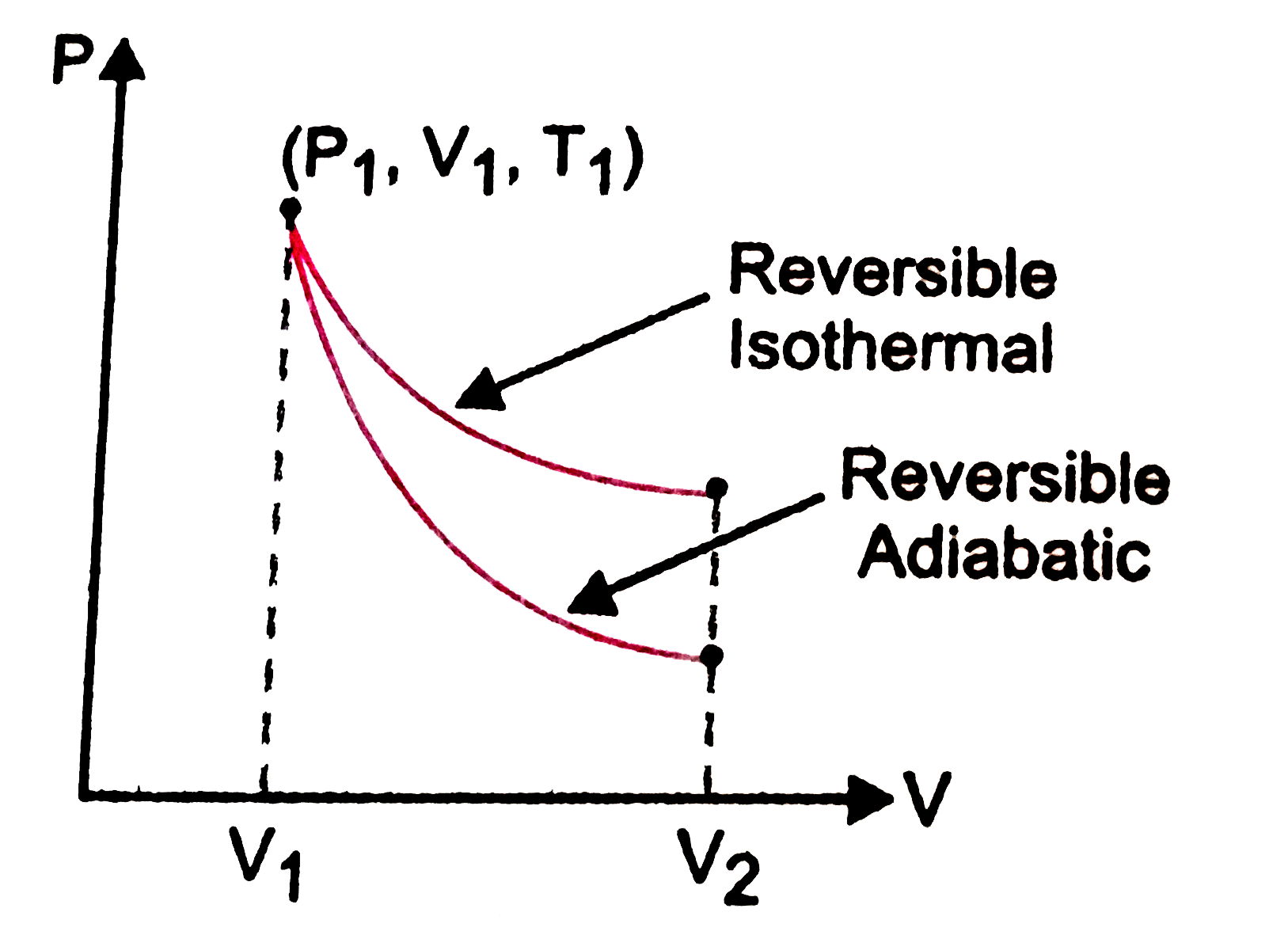 Area under the curve of reversible isothermal expansion is more thanthat under the adiabatic curve. Hence, work done in reversible isothermal expansion is more. (B) For reversible expansion with `T_(1) = T_(2)` means isothermal expansion.For reversible isothermal expansion of a gas, `DeltaU = 0 (:' DeltaU = n C_(v) DeltaT)` In reversible adiabatic expansion, `T_(2) LT T_91)` i.e., `DeltaT = -ve,:. DeltaU = n C_(v) DeltaT = -ve ` ( and not `+ve)` (c ) In free expansion , `P_(ext) = 0:. W=0` If process is carried out isothermally , `DeltaU =0`. Hence, by 1st law , `DeltaU= q + w` or `q= DeltaU -w=0-0=0` ( i.e. adiabatic). If process is carried out adiabatically , `q=0`. As `w=0`, therefore,by 1st law, `DeltaU = q+w =0` ( isothermal). (d) 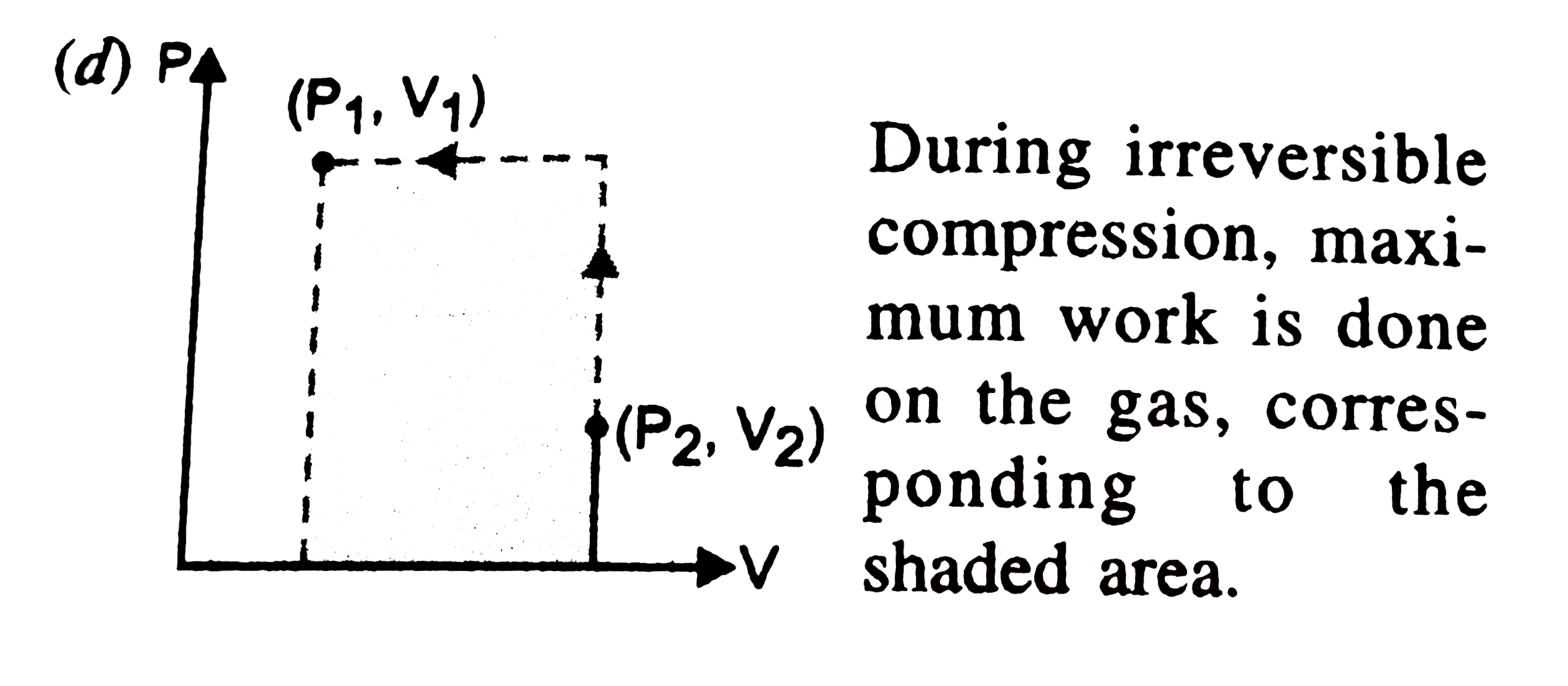 During irrevesible compression,maximum work is done on the gas, corresponding to the shaded area. During irrevesible compression,maximum work is done on the gas, corresponding to the shaded area.
|
|
| 12. |
An ideal gas is taken through the cycle A rarr B rarr C rarr A, as shown in the figure. If the net heat supplied to the gas in the cycle is 5 J, what is the work done by the gas in the process C rarr A |
| Answer» ANSWER :A | |
| 13. |
An ideal gas is taken from the state A (pressure P, volume V) to the state B (pressure P/2, volume 2V) along a straight line path in the P-V diagram. Select the wrong statement from the following: |
|
Answer» The work done by the GAS in the process A to B exceeds the work that WOULD be done by if the system were taken from A to B along the isotherm. |
|
| 14. |
An ideal gas is expanded so that the amount of heat transferredto thegas is equalto thedouble thedecrease in enthalpy . Indentifythe options whicharecorrect.[Symbols haveusual meaning ] |
|
Answer» `PV^((3gamma)/(2gamma+1))`= CONSTANT |
|
| 15. |
An ideal gas is expandendisothermallyfrom(P_(1) V_(1)) andto (P_(2)V_(2)) against a constantexternalpressure. Whichof the following is/arecorrect regardingabove process ? |
|
Answer» <P>If `P_(ext)=P_(2)`piston will not stop automatically ATTHE final state |
|
| 16. |
An ideal gas is allowed to expand both reversibly and irreversibly in anisolatedsystem. IfT_(i) is theinitial temperature andT_(f) is the final temperature,which of the following statements is correct? |
|
Answer» `(T_(f))_(REV)= (T_(f))_(irrev)` |
|
| 17. |
An ideal gas is allowed to expand against a constant pressure of 2 bar from 10L too 50L in one step. Calculate the amount of work done by the gas. If the same expansion were carried out reversibly, will the work done be higher or lower than the earlier case? (Given that 1 L bar = 100 J) |
|
Answer» <P> Solution :`w = -p_(ext)(V_(f) -V_(i))`` = -2(50-10)` `= -80L bar` ` = -80 xx 100 J or = - 8 kJ` The negative sign shows that work is done by the stystem on the surroundings.Work done will be more in the reversible expansion because INTERNAL pressure and external pressure are almost same at EVERY step. |
|
| 18. |
An ideal gas is allowed to expand against a constant pressure of 2 bar from 10L to 50 L in one step. Calculate the amount of work done by the gas. If the same expansion were carried out reversibly, will the work done be higher or lower than the earlier case ? (Give that, 1 L bar = 100 J) |
|
Answer» Solution :In the first case, as the EXPANSION is against constant external pressure `W = p_("ext") (V_(2) - V_(1)) = - 2 "bar" xx (50 - 10) L` `= - 80 L "bar" ""(1 L "bar" = 100 J)` `= - 80 xx 100 J` `= - 8 kJ` If the GIVEN expansion was carried out reversibly, the internal pressure of the gas should be GREATER than the external pressure at every stage. Hence, the work done will be more |
|
| 19. |
An ideal gas is allowed to expand both reversibly and irreversibly in an isolated system. If T_(1) is initial temperature and T_(f) is the final temperature, which of the following statement is correct |
|
Answer» `(T_(f))_("irr") gt (T_(f))_("rev")` `RARR` work done at the cost of INTERNAL energy `rArr Delta E lt 0` More energy loss in reversible as more work done in reversible `rArr T_("rev") lt T_("irr")` |
|
| 20. |
An ideal gas is allowed to expand against a constant pressure of 2 bar from 10 L to 50 L in one stop. Calculate the amount of work done by the gas. If the sameexpansion were carried out reversibly,will the workdone be higher or lower than the earlier case ? |
|
Answer» <P> Solution :In the firstcase, as the expansion is against constant external pressure, ,brgt `w= - P_(ext) (V_(2)-V_(1)0 = - 2 "bar" xx ( 50-10) L= -80 L "bar" = - 80 xx 100 J = - 8 kJ ( 1L `bar` = 100 J) `If the above expansion were carried out reverisbly, the INTERNAL pressure of the gas should be infinitesimally greater than the external pressure at everystage. Hence, the work DONE will be more. |
|
| 21. |
An ideal gas is allowed to expand against a constant pressure of 2 bar from 10 L to 50 L in one step. Calculate the amount of work done by the gas. If the same expansion were carried out reversibly, will the work done be higher or lower than the earlier case ?(Given that 1 L bar = 100 J) |
|
Answer» <P> Solution :In the first case, as the expansion is against constant external pressure`W= - p_("ext") (V_(2) - V_(1) ) = - 2 "bar" xx (50 - 10) "L"` `W= - p_("ext") (V_(2) - V_(1) ) = - 2 "bar" xx (50 - 10 )` L `= - 80` L bar(1 L bar = 100 J) `= - 80 xx 100 "J"` `= - 8 "kJ"` If the given expansion was carried out reversibly, the internal pressure of the gas should be GREATER than the external pressure at EVERY stage. Hence, the work done will be more. |
|
| 22. |
An ideal gas expands in volume from 10^(-3) m^(3) to 10^(-2)m^(3) at 300 K against a constant pressure of 10^(5) Nm^(-2). The work done is |
|
Answer» `-900 J` |
|
| 23. |
An ideal gas expands from the volume of 1xx10^(-3)m^3 to 1xx10^(-2) m^3 at300K against a constant pressure at 1xx10^5Nm^(-2). The work done is ___ |
|
Answer» `-900` J `w=-(1xx105 NM^(-2))(1xx10^(-2) m^3 -1 xx10^(-3) m^3)` `w=-10^5 (10^(-2) -10^(-3))`Nm `w=-10^5 (10-1)10^(-3)` J `w=-10^5 (9xx10^(-3))`J `w=-9xx10^2` J w=-900 J |
|
| 24. |
An ideal gas expands from the volume of 1xx10^(-3)m^(3) to 1xx10^(-2) m^(3) at 300K against a consta pressure at 1xx10^(5) Nm^(-2). The work done is ............ |
|
Answer» `-900 J` `w=-(1xx105 Nm^(-2))(1XX10^(-2)m^(3)-1xx10^(-3)m^(3))` `w=-10^(5)(10^(-2)-10^(-3)) Nm` `w=-10^(5)(10-1)10^(-3)J` `w=-10^(5)(9xx10^(-3))J` `w=-10^(5)(9xx10^(-3))J` `w=-9xx10^(2)J` w=-900 J |
|
| 25. |
An ideal gas equation is obeyed fairly well by all gases at "________________". |
|
Answer» HIGH pressure and high TEMPERATURE. |
|
| 26. |
An ideal gas expands from the volume of 1xx10^(-3) m^(3) " to "1xx10^(-2)m^(3) " at " 300Kagainst a constant pressure at 1xx10^(5) Nm^(-2) . The work done is |
|
Answer» `-900J` |
|
| 27. |
An ideal gas expands from 500 cm^3 to 700 cm^3 against 1 atm pressure, by absorbing 2J of energy. Calculate change in internal energy of the ideal gas. |
|
Answer» |
|
| 28. |
An ideal gas cannot be liquified because |
|
Answer» collisions are elastic |
|
| 29. |
An hourly requirement of an astronaut can be satisfied by the energy released when 34 grams of sucrose (C_(12)H_(22)O_(11)) are burnt in his body. How many grams of oxygen would be require to carry in space capsule to meet his requirement for one day (24 hours) ? |
|
Answer» Mass of sucrose needed for 1 hour = 34 g Mass of sucrose needed for 24 hours `= 34 xx 24 = 816 g` Step II. Mass of oxygen required `UNDERSET(underset(=342g)(12xx12+22xx1+16xx11))(C_(12)H_(22)O_(11))+underset(underset(=384g)(12xx32))(12O_(2))rarr12CO_(2)+11H_(2)O` 342 g of sucrose require oxygen = 384 g 816 g of sucrose require oxygen `= (384)/(342)xx816=916.2g`. |
|
| 30. |
An ice cube at 0^(@)C is placed in some liquid water at 0^(@)C, the ice cube sinks - Why? |
|
Answer» Solution :(i) In an ice CUBE, each atom is SURROUNDED tetrahedrally by four water molecules through hydrogen bond and its density is low. (ii) Liquid water at `0^(@)C` has the density as 999.82 `kg//cm^(3)`. Maximum desnity is attained by water only at `4^(@)C` as 1000 `kg//cm^(3)`. (iii) When the temperature changed from `4^(@)C " to " 0^(@)C`, the density of water decreases rather than increases. This is CALLED anomalous expansion of water. (IV) The reason for this phenomenon lies in the structure of ice lattice and hydrogen bonding in water. (v) At `0^(@)C`, ice cube sinks in liquid water at `0^(@)C` because of the lesser desnity and greater volume of water. |
|
| 31. |
An hourly energy requirement of an astronaut can be satisfied by the energy released when 34 grams of sucrose (C_(12)H_(22)O_(11))are burnt in his body. How many grams of oxygen would he need to be carried in space capsule to meet his requirement for one day ? |
|
Answer» SOLUTION :The astronaut consumes 34 g of sucrose in one hour. `therefore` Themassof sucroseneededinoneday `= 34 XX 24 = 816 g` The burning of sucrose in presence of oxygen is in accordance to the following equation. `UNDERSET(342.3 g)(C_(12)H_(22)O_(11)) + underset(384.0 g)(12 O_(2)) to 12 CO_(2) + 11H_(2)O` `therefore 342.3 g` of sucrose require for combustion, oxygen = 384.0 g `therefore 816 g` of sucrose will require for combustion, `=(384.0)/(342.3) xx 816 = 915.4 g` Hence, the astronaut should carry 915.4 g of oxygen in space capsule to meet his requirement for one DAY. |
|
| 32. |
An exothermic reaction is spontaneous reaction ............ is correct from the following. |
|
Answer» `Delta G GT 0` |
|
| 33. |
An exothermic reaction A rarr B is spontaneous in the backward direction. What will be the sign of DeltaS for the forward reaction ? |
| Answer» Solution :Backward REACTION will be endothermic . THUS, energy factor opposesthe backward reaction. As backward reaction is SPONTANEOUS , randomness factor MUST favour, i.e.,`DeltaS` will be`+ve` for the backward reaction oritwill be `-ve`for FORWARD reaction. | |
| 34. |
An excited hydrogen atom emits a photon of wavelength t while returning to the ground state. If R is the Rydberg.s constant, then the quantum number n of the excited state is |
|
Answer» `sqrt(LAMBDA R)` ` implieslambda= (n^2)/(R(n^2-1)),n = sqrt((lambdaR)/(lambda R-1))` |
|
| 35. |
An excess of potassium ions makes KCl crystals appear violet or lilac in colour since |
|
Answer» Some of the anionic sites are occupied by an UNPAIRED electron. |
|
| 36. |
An excess KI solution is mixed in a solution of K_(2)Cr_(2)O_(7) and liberated iodine required 72 mL of 0.05 N Na_(2)S_(2)O_(3) for complete reaction. How many grams of K_(2)Cr_(2)O_(7) were present in the solution of K_(2)Cr_(2)O_(7) ? The reaction occurs as : Cr_(2)O_(7)^(2-)+6I^(-)+14H^(+) to 2Cr^(3+)+3I_(2)+7H_(2)O |
|
Answer» SOLUTION :The REACTION involved may be given as : `Cr_(2)O_(7)^(2-)+6I^(-)+14H^(+) to 2Cr^(3+)+3I_(2)+7H_(2)O` `3[I_(2)+2Na_(2)S_(2)O_(3)]to 3[2NaI+Na_(2)S_(3)O_(6)]` 1 mole `K_(2)Cr_(2)O_(7)-=6 " moles of" Na_(2)S_(2)O_(3)` No. of moles of hypo`=("Mass")/(M.w. (158))=(ExxNxxV)/(1000xx158)` `N_(Na_(2)S_(2)O_(3))=(158xx0.05xx72)/(1000xx158)=3.6xx10^(-3)` No. of moles of `K_(2)Cr_(2)O_(7)=(1)/(6)` [No. of moles of `Na_(2)S_(2)O_(3)`] `=(1)/(6)[3.6xx10^(-3)]=6xx10^(-4)` mole Mass of `K_(2)Cr_(2)O_(7)` in the given solution =No. of moles `xx` Molecular WEIGHT `=6xx10^(-4)xx294=0.1764` |
|
| 37. |
An examplle of a face centred cubic lattice is |
|
Answer» ZINE |
|
| 38. |
An example of water in oil type emulsion is |
|
Answer» MILK |
|
| 39. |
An example of Perkin's reaction is |
|
Answer» `C_(6)H_(5) CHO + CH_(3)NO_(2) OVERSET(KOH)rarr C_(6)H_(5)CH = CHNO_(2)` 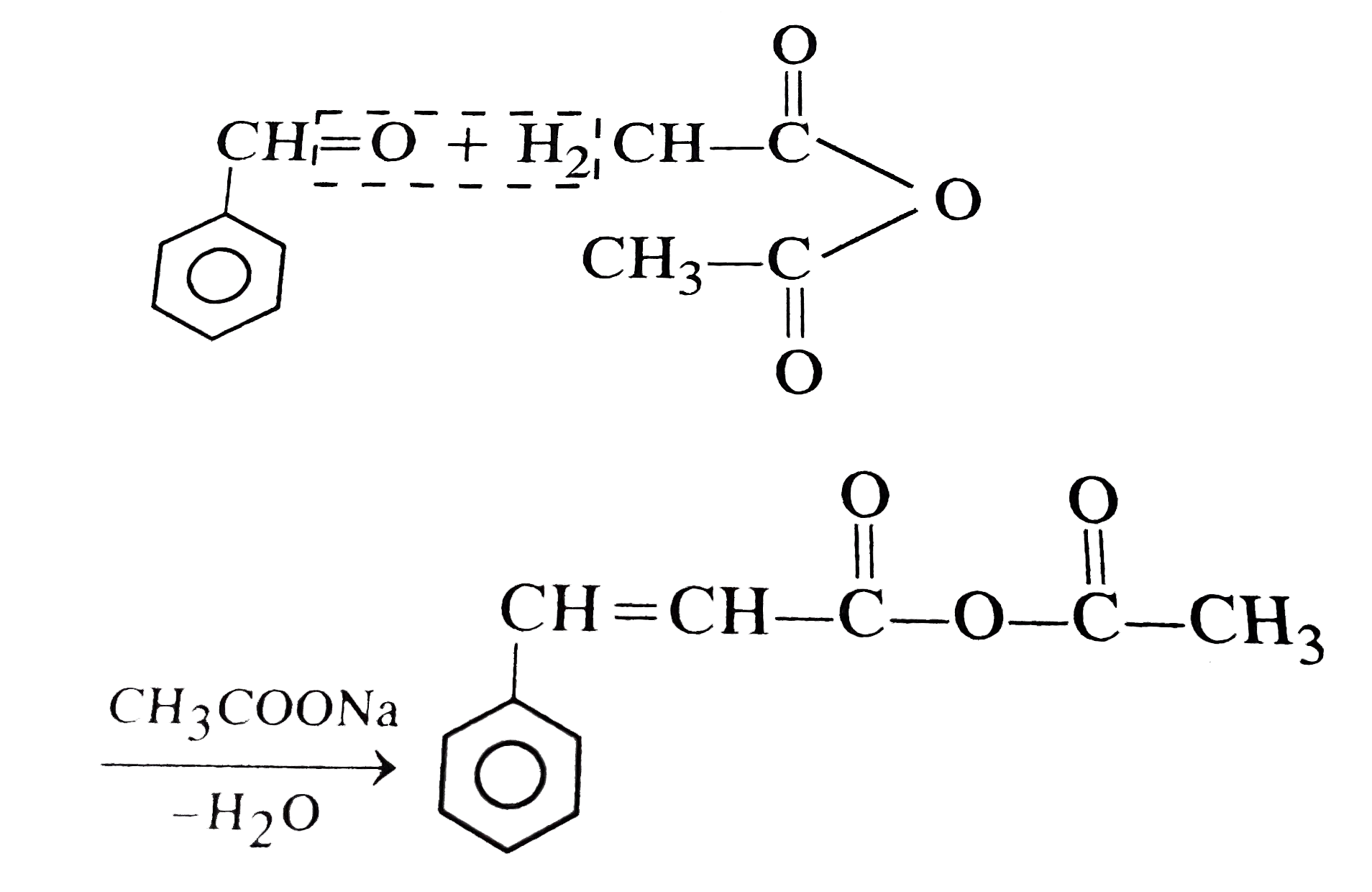 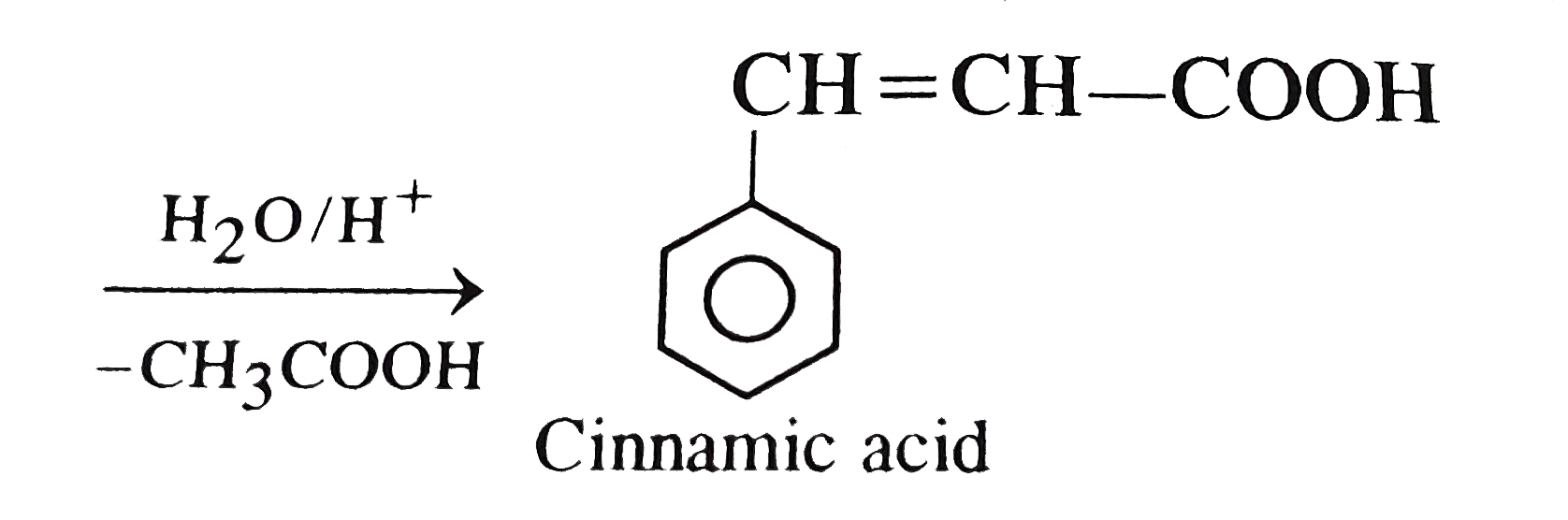
|
|
| 43. |
An example of gel is |
|
Answer» MILK |
|
| 45. |
An example of colloidal sol in which the affinity of the sol particles for the medium is due to hydrogen bonding is |
|
Answer» Sulphur in WATER |
|
| 46. |
An example of chemical toxics is |
|
Answer» removing water from industrial REACTIONS |
|
| 47. |
An example of autocatalysis is |
|
Answer» oxidation of NO to `NO_(2)` |
|
| 48. |
Which of the following is an irreversible reaction |
|
Answer» `CH_3COOC_2H_5+H_2OrarrCH_3COOH+C_2H_5OH` |
|
| 49. |
An example of an associated colloid is:- |
|
Answer» Milk |
|